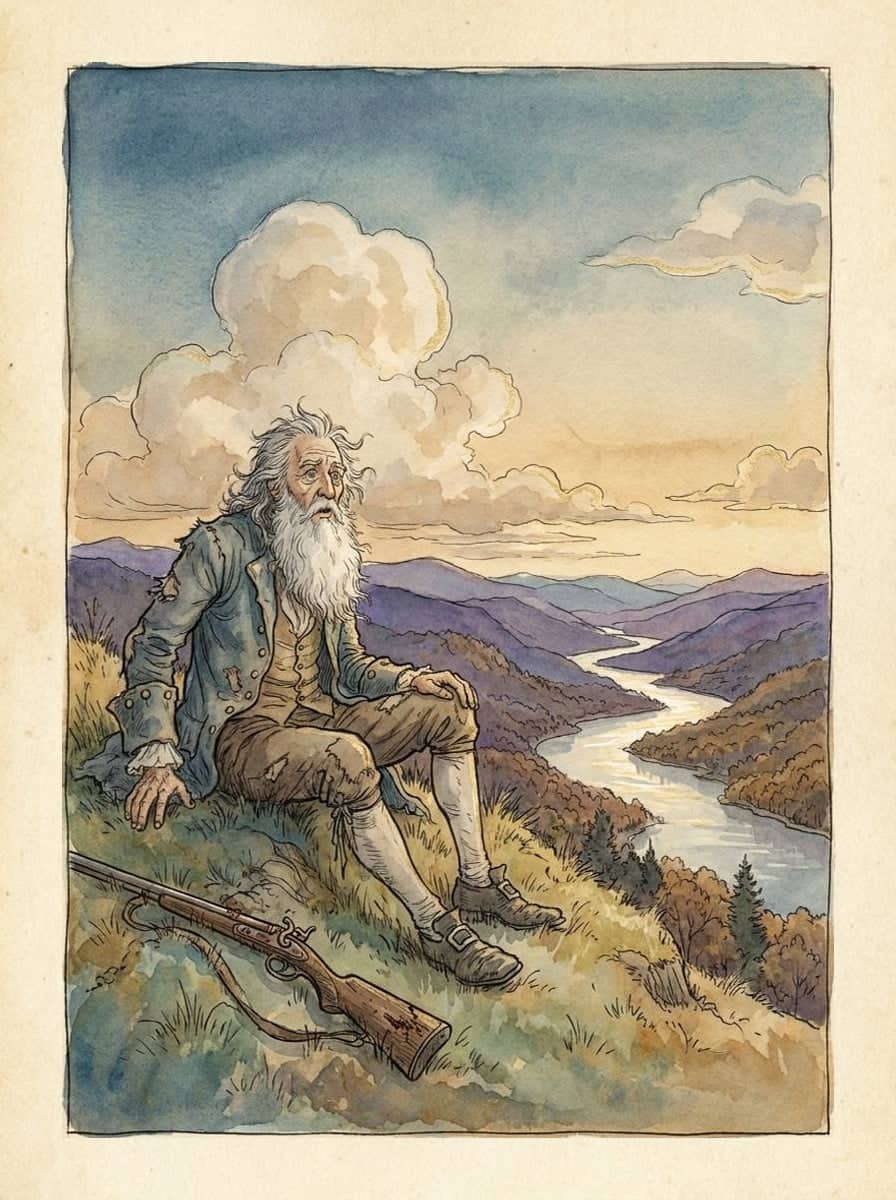
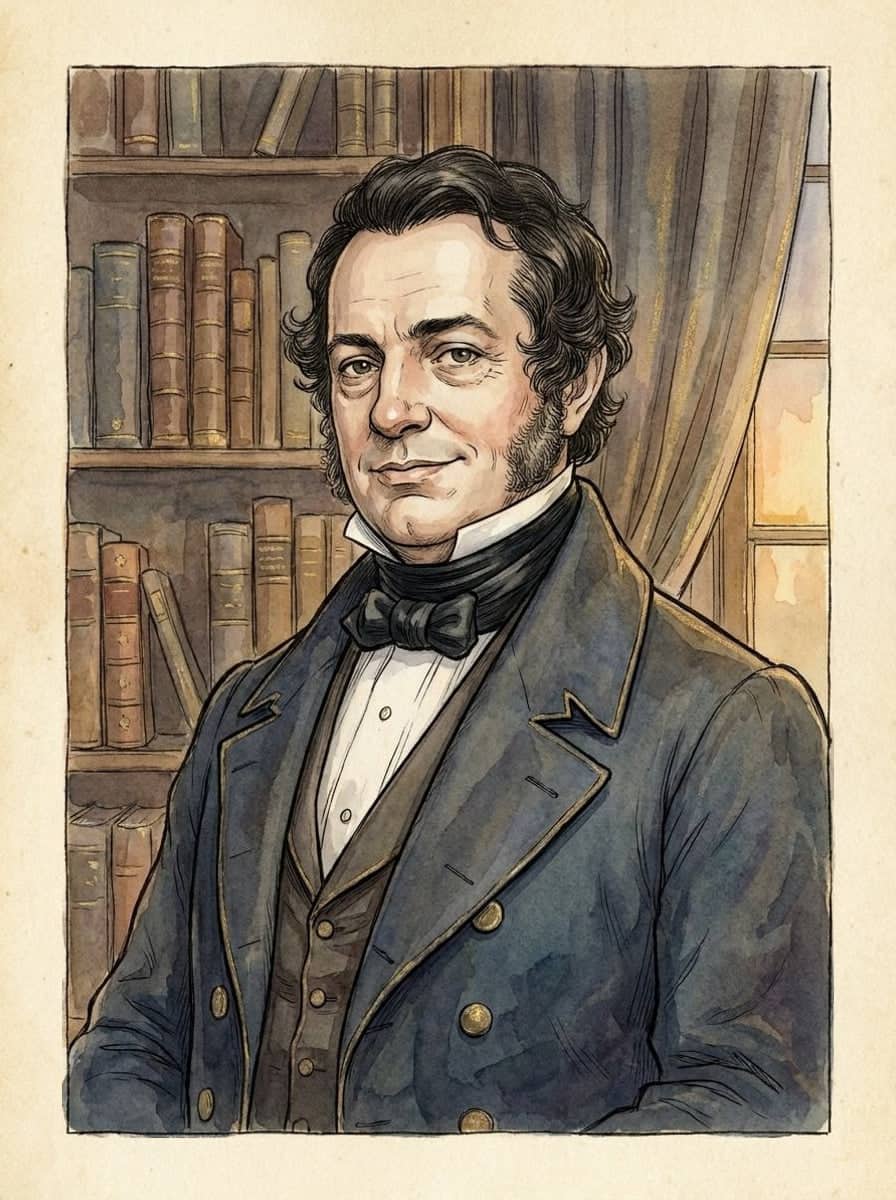
Rip Van Winkle, an idle Catskill villager, escapes his nagging wife and falls into a magical sleep after drinking with silent, ghostly strangers in the mountains. He wakes twenty years later, his wife dead, and settles into old age on the inn bench, telling how Hendrick Hudson’s crew plays ninepins in the thunder.
Anyone who has sailed up the Hudson River remembers the Catskill Mountains, blue and purple against the evening sky. At their foot lies a little village of shingled roofs and yellow brick, founded long ago by Dutch settlers.
In one of its houses, in the days when the country still belonged to Great Britain, there lived a good-natured man named Rip Van Winkle. His wife scolded him from morning until night, and perhaps that was what made him so gentle everywhere else. The children shouted for joy when he came near, for he told them stories of ghosts and witches, and not a dog would bark at him.
Rip had one great fault: he could not bear any work that might bring in money. He would fish all day on a wet rock without complaining, though nothing so much as nibbled, and never refused to help a neighbor with even the roughest work. Rip was ready to attend to anybody’s business but his own.
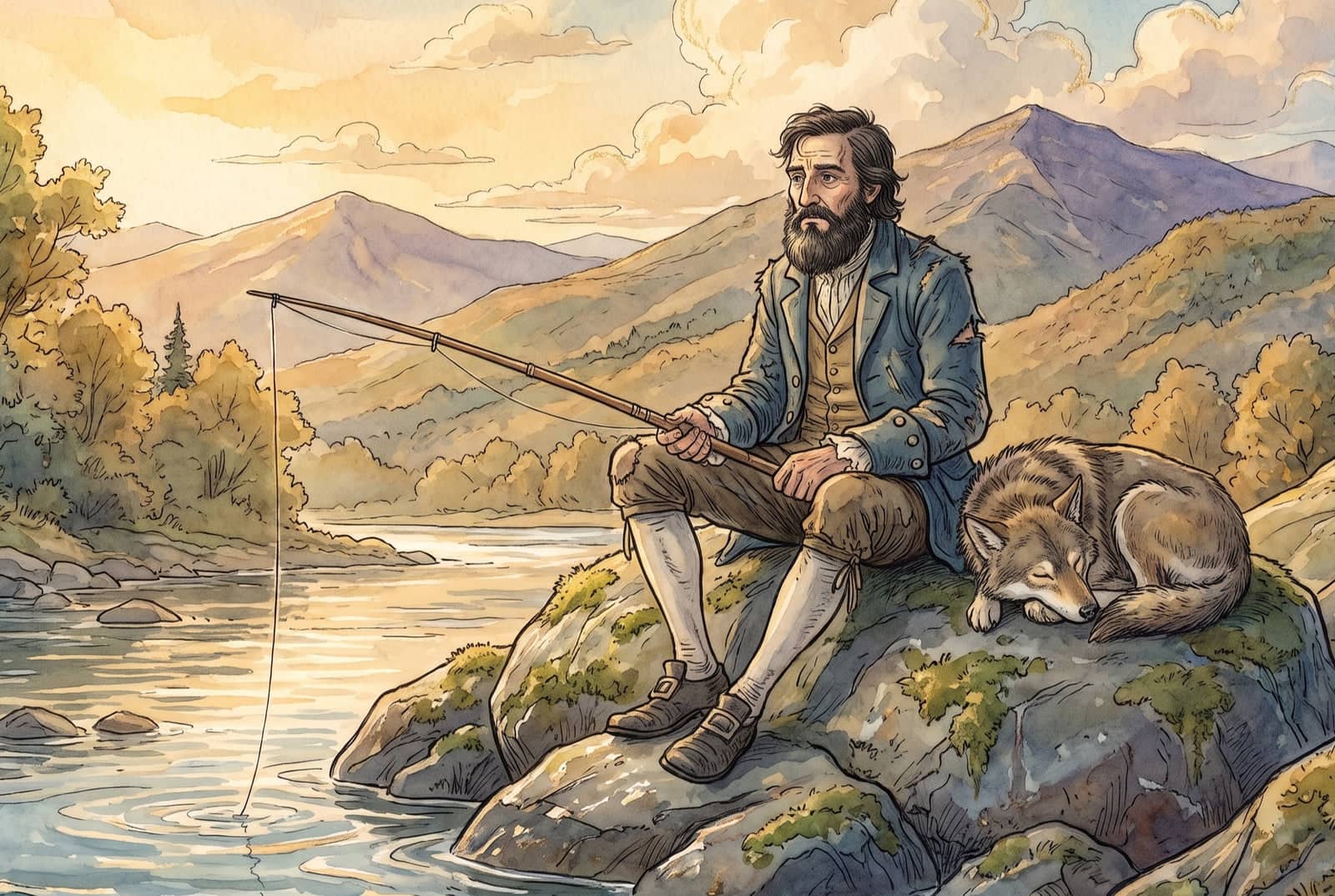
His own farm was the worst kept in the country. His fences fell to pieces, and the rain set in the moment he had work to do out of doors. His son, young Rip, promised to inherit his habits along with his old clothes.
Left to himself Rip would have whistled his life away in contentment, but his wife reminded him daily of his idleness. He had one answer, and long use had made it a habit: he shrugged, shook his head, looked up at the sky and said nothing. That only brought another storm, so he would retreat to the outside of the house. His one friend indoors was his dog Wolf, scolded as much as his master.
When he was driven out, Rip found comfort in a club of village elders that met on a bench before the small inn, under a rosy portrait of King George the Third. They sat there through the long summer days telling sleepy stories about nothing at all, and Derrick Van Bummel, the schoolmaster, read out whatever old newspaper a traveler had left behind. Their opinions were settled by Nicholas Vedder, the landlord, who sat by his door from morning to night, smoked, and hardly ever spoke.
Even from there Rip was routed at last, for his wife would burst in and call the whole company good for nothing. Then he would take his gun into the woods and sit at the foot of a tree, sharing what was in his bag with Wolf.
“Poor Wolf,” he said one day, “she leads you a hard life of it. But never mind, my lad. As long as I live you shall never want a friend to stand by you.”
Wolf wagged his tail, looked up into his master’s face, and pitied him with all his heart.
On one such ramble, on a fine autumn day, Rip climbed without noticing it to one of the highest parts of the Catskills. Late in the day he threw himself down on a green knoll at the top of a cliff. Below him lay a deep, lonely glen, and beyond it the Hudson moving on its silent course. Evening came on, and it would be dark long before he reached home. He sighed at the thought of facing his wife.
He was about to start down when a voice called to him out of the distance.
“Rip Van Winkle! Rip Van Winkle!”
He looked all around and saw nothing but a crow flying across the mountain, and then the same cry rang through the still evening air.
“Rip Van Winkle! Rip Van Winkle!”
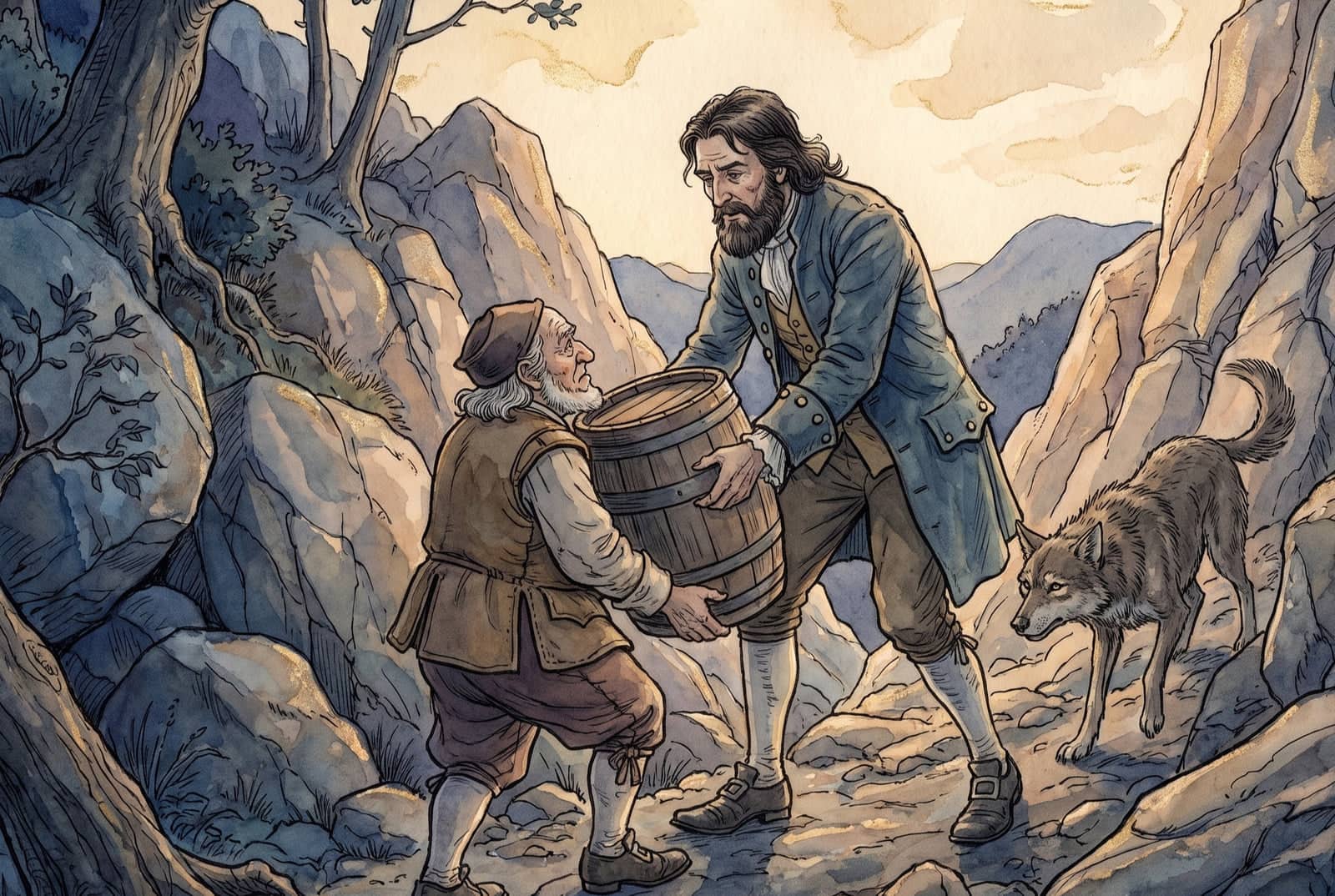
Wolf bristled, growled low and crept to his master’s side. Rip made out a figure toiling up the rocks, bent under something heavy. He supposed it was a neighbor who needed help, and hurried down to give it.
The stranger was a short, square-built old fellow with bushy hair and a grizzled beard, dressed in the Dutch fashion of long ago, in a cloth jerkin and wide breeches. He carried a stout keg on his shoulders, and made signs for Rip to take a turn with it.
Rip helped as he always did, and the two climbed a narrow gully, the dry bed of a mountain torrent. As they went up, long rolling peals like thunder came out of a cleft in the rocks ahead, and Rip took them for a passing shower. Beyond the cleft lay a hollow like a small amphitheater, walled round with sheer rock. They climbed in silence, for something about the old man checked every question.
In the middle of the hollow a company of strange figures was playing at ninepins, in outlandish clothes, with long knives in their belts and enormous breeches like their guide’s. One seemed made almost entirely of nose, under a tall white hat with a red feather; another was plainly the captain, in a laced doublet and high-heeled shoes with roses on them. They might have stepped out of an old Flemish painting.
Strangest of all, though they were plainly amusing themselves, they kept the gravest faces and the deepest silence. Nothing broke the stillness but the balls, which rumbled along the mountains like thunder whenever they were rolled.
As Rip and his guide came near, the players stopped and stared at him with such fixed, statue-like eyes that his heart turned over. His companion emptied the keg into large flagons and made signs that Rip should serve them. He obeyed, trembling. They drank in silence and went back to their game.
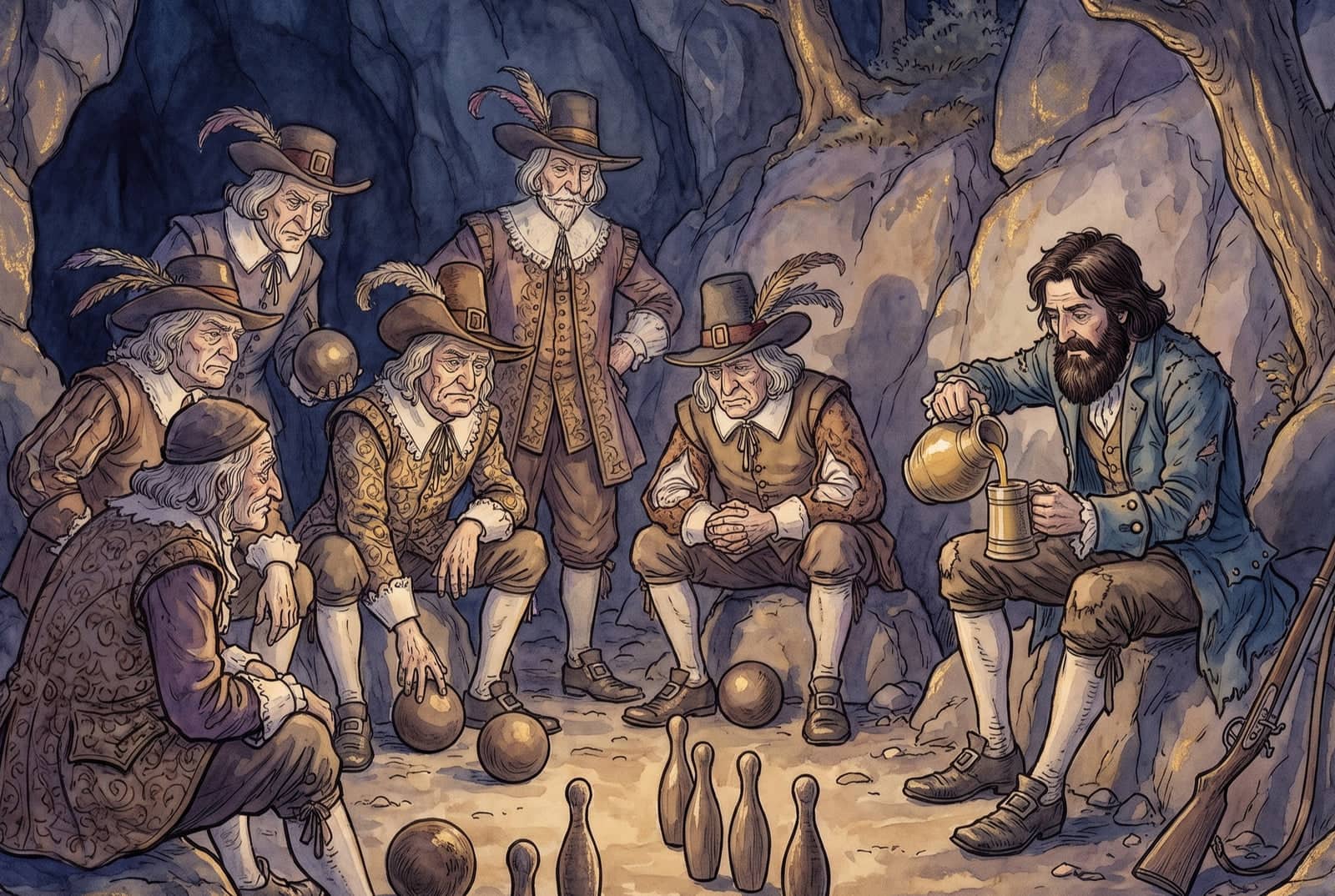
Little by little Rip’s fear wore off, and when nobody was looking he ventured a taste of the drink, which had the flavor of good Dutch gin. One taste led to another, until at last his eyes swam, his head sank, and he fell into a deep sleep.
He woke on the green knoll where he had first seen the old man of the glen. It was a bright sunny morning, and an eagle wheeled high in the mountain air.
“Surely,” thought Rip, “I have not slept here all night.”
He remembered it all: the man with the keg, the ravine, the hollow among the rocks, the silent players, the flagon.
“Oh, that flagon,” he groaned. “That wicked flagon. Whatever shall I say to my wife?”
He looked around for his gun, and in place of his clean fowling piece he found an old firelock, the barrel crusted with rust and the stock eaten by worms. The company of the mountain, he thought, had tricked him. Wolf was gone too, and came for neither whistle nor shout. Getting to his feet, Rip found himself stiff in every joint.
He got down into the glen and found the gully of the evening before, and to his astonishment a stream was now foaming down it. He scrambled up beside it to the place where the ravine had opened into the amphitheater. There was no opening: the rocks stood in one unbroken wall, and over it the water fell into a deep black pool.
Poor Rip could go no further. He called and whistled for his dog again, and was answered only by a flock of crows. He dreaded meeting his wife, but he could not starve among the rocks, so he shouldered the rusty firelock and turned for home.
As he came near the village he met people he did not know, though he had thought he knew everybody in the country round. They stared at him, and every one of them stroked his own chin. Rip did the same without thinking, and found that his beard had grown a foot long.
Strange children ran hooting at his heels, and strange dogs barked at him. The village was bigger and busier, with rows of houses he had never seen and strange names over the doors. Yet there stood the Catskills, and there ran the silver Hudson, where they had always been.
“That flagon last night,” he thought, “has muddled my poor head badly.”
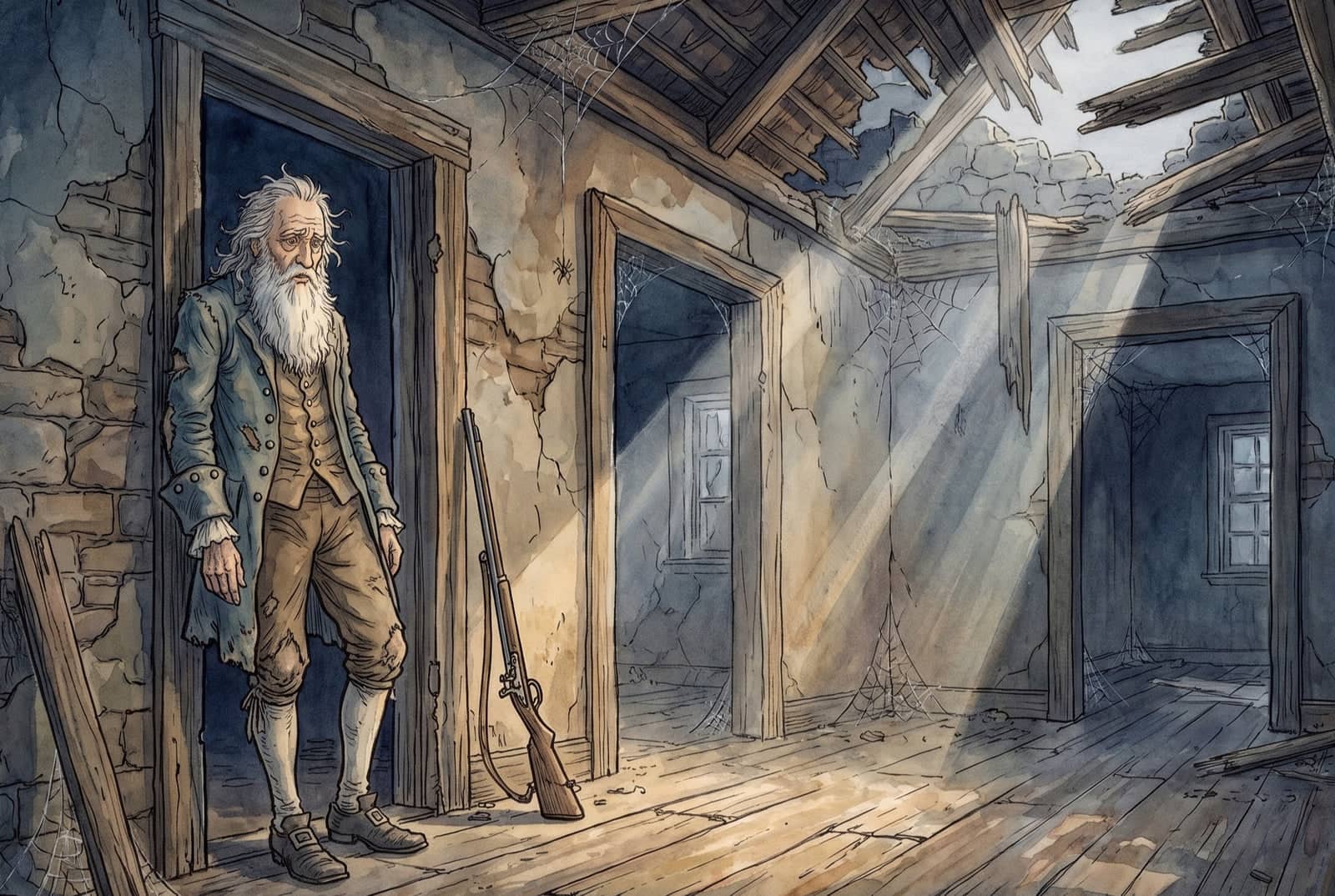
He found his own house with difficulty and came up to it quietly, expecting his wife’s sharp voice at any moment. The roof had fallen in, the windows were broken and the doors hung off their hinges. A half-starved dog that looked like Wolf snarled at him and went by.
“My own dog,” sighed poor Rip, “has forgotten me.”
He went inside. The rooms his wife had always kept so neat were empty and deserted. The loneliness swept away every fear he had of her, and he called out for his wife and his children. The bare rooms rang for a moment, and then all was silent.
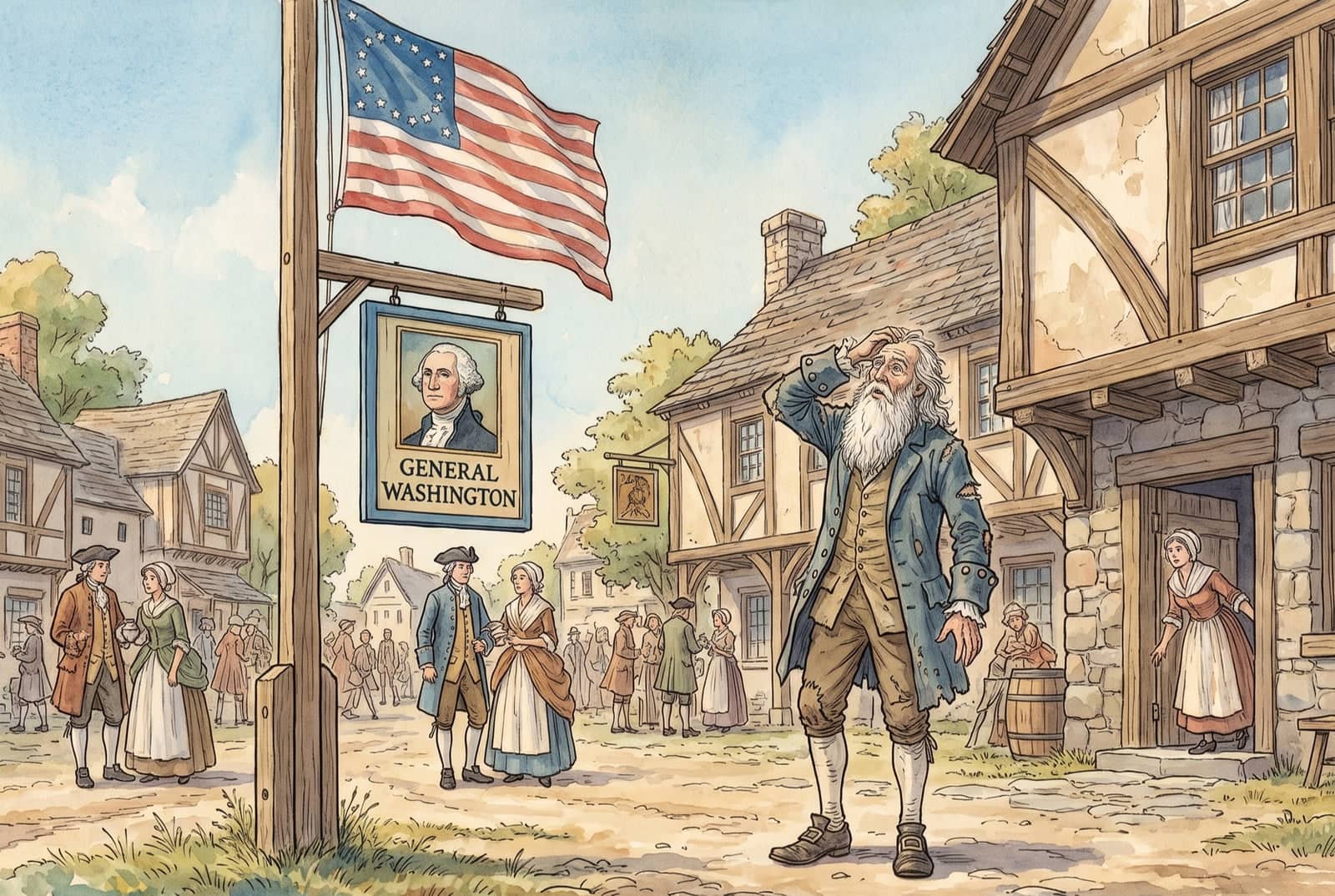
He hurried out to the inn, but that was gone as well. In its place stood a large rickety building, and over the door was painted, “The Union Hotel, by Jonathan Doolittle.” Where the great tree had shaded the quiet Dutch inn there was now a tall bare pole flying a flag of stars and stripes. He knew the old sign, with the ruby face of King George, but the red coat was blue and buff now, the hand held a sword instead of a scepter, and underneath was painted, “GENERAL WASHINGTON.”
There was the usual crowd about the door, and not a face among them that Rip remembered. The people seemed busy and quarrelsome instead of drowsy and calm. In place of wise Nicholas Vedder and his long pipe, a thin, sour-looking fellow with his pockets full of handbills was making a loud speech about citizens and elections and Congress and liberty, and a great many words that meant nothing to bewildered Rip.
His long gray beard, his rusty gun and the crowd of children at his heels soon drew attention. The speaker drew him aside and asked which side he voted on, and Rip only stared. A busy little man rose on tiptoe and asked in his ear whether he was Federal or Democrat. Then a self-important old gentleman in a sharp cocked hat demanded sternly what he meant by coming to an election with a gun on his shoulder.
“Gentlemen,” cried Rip, quite dismayed, “I am a poor, quiet man. I was born here, and I am a loyal subject of the King, God bless him.”
“A tory! A spy! Away with him!” shouted the bystanders all together.
The man in the cocked hat restored order with difficulty and demanded whom the stranger was looking for. Rip humbly said he wanted only some of his old neighbors.
“Well, who are they? Name them.”
“Where is Nicholas Vedder?” asked Rip.
There was a silence, and then an old man answered in a thin, piping voice.
“Nicholas Vedder? Why, he has been dead these eighteen years, and even the wooden headstone in the churchyard has rotted away.”
“Where is Brom Dutcher?”
“He went off to the army at the beginning of the war. Some say he fell at the storming of Stony Point, others that he was drowned in a squall. He never came back.”
“And Van Bummel, the schoolmaster?”
“He went to the wars too. He became a great general of the militia, and now he is in Congress.”
Rip’s heart died away at these changes among his friends, and every answer spoke of stretches of time he could not understand. He cried out in despair.
“Does nobody here know Rip Van Winkle?”
“Oh, Rip Van Winkle!” said two or three at once. “To be sure. That is Rip Van Winkle over there, leaning against the tree.”
Rip looked, and saw the exact likeness of himself as he had been when he went up the mountain. Now he doubted whether he was himself or another man, and the man in the cocked hat asked him what his name might be.
“Heaven knows,” he cried, at his wits’ end. “I am not myself. I am somebody else. That is me over there. No, that is somebody else who has got into my shoes. I was myself last night, but I fell asleep on the mountain, and they have changed my gun, and everything is changed, and I cannot tell what my name is or who I am.”
The bystanders looked at one another and tapped their fingers against their foreheads. Just then a young woman with a fresh, kind face pushed through the crowd, a plump child in her arms, and the child began to cry.
“Hush, Rip,” she said, “hush, you little goose. The old man will not hurt you.”
The name of the child, and the sound of the mother’s voice, woke a train of memories in him.
“What is your name, my good woman?” he asked.
“Judith Gardenier.”
“And your father’s name?”
“Ah, poor man, his name was Rip Van Winkle. It is twenty years since he went away from home with his gun, and he has never been heard of since. His dog came back without him, and nobody could tell what became of him. I was only a little girl then.”
Rip had one more question, and he asked it with a faltering voice.
“And where is your mother?”
“She died a little while ago,” said the young woman. “She fell into a rage at a peddler from New England, and a blood vessel burst.”
The honest man could contain himself no longer, and caught his daughter and her child up in his arms.
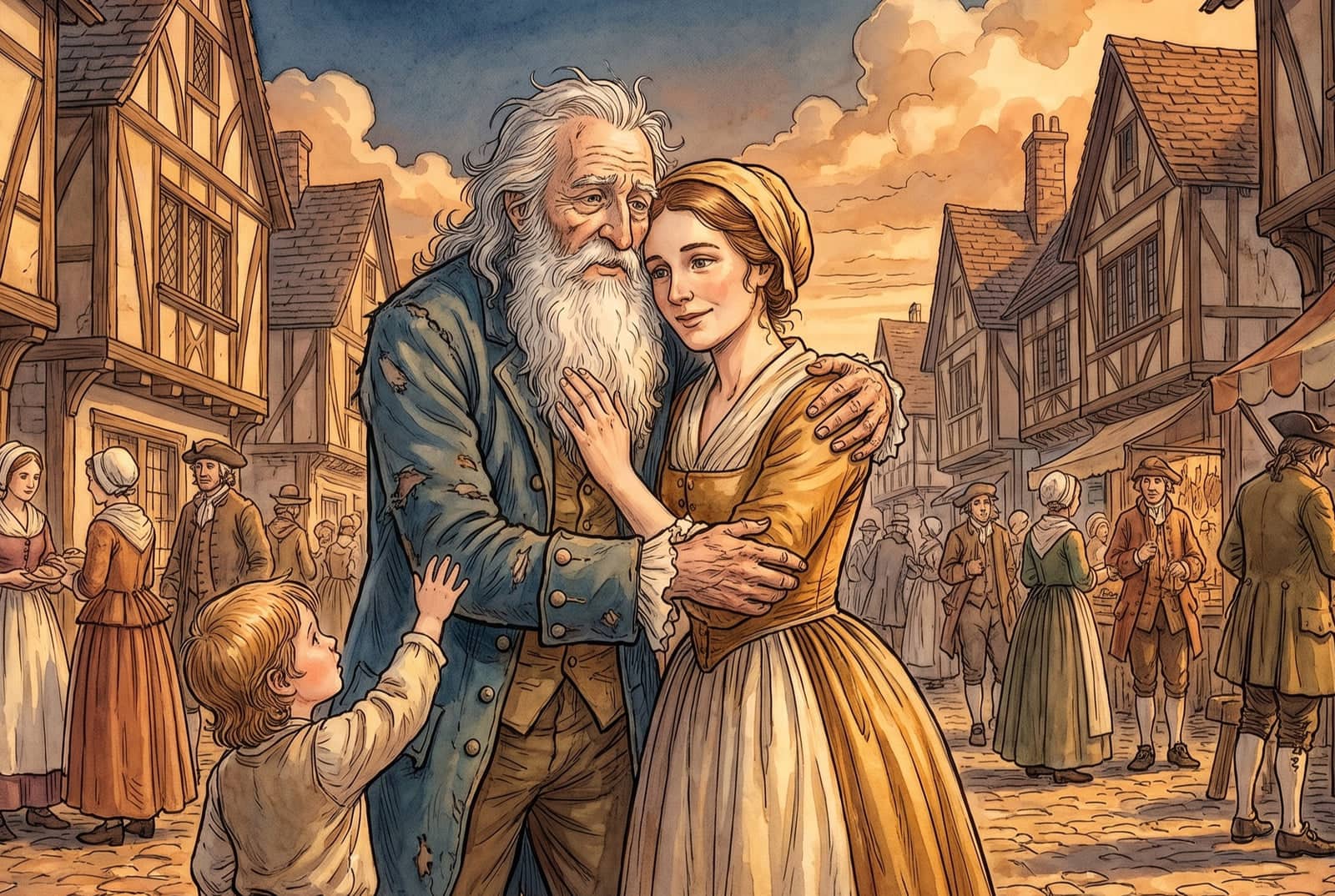
“I am your father,” he cried. “Young Rip Van Winkle once, old Rip Van Winkle now. Does nobody know poor Rip Van Winkle?”
They all stood amazed, until an old woman came tottering out of the crowd and peered up into his face.
“Sure enough, it is Rip Van Winkle. It is himself. Welcome home again, old neighbor. Why, where have you been these twenty long years?”
Rip’s story was soon told, for the whole twenty years had been no more to him than a single night. Some of the neighbors winked at each other as they listened, and the man in the cocked hat shook his head.
Then old Peter Vanderdonk, the oldest man in the village, came up the road, knew Rip at once, and confirmed his story. It was a fact handed down in his family, he said, that the Catskills had always been haunted by strange beings, and that Hendrick Hudson, who first discovered the river, kept a watch up there once every twenty years with the crew of the Half Moon. Peter’s own father had seen them playing at ninepins in the hollow of the mountain, and Peter himself had once heard the sound of their balls, like far-off thunder.
After that the company went back to the election. Rip’s daughter took him home to live with her. She had a snug house and a cheerful farmer for a husband, whom Rip remembered as one of the boys who used to climb on his back. His son, the very image of him, was set to work on the farm, and showed the family gift for attending to anything except his own business.
Rip took up his old walks and habits again. He found many of his old companions much the worse for time, and came to prefer making friends among the young. Having reached the happy age when a man may be idle and nobody minds, he took his place once more on the bench by the inn door.
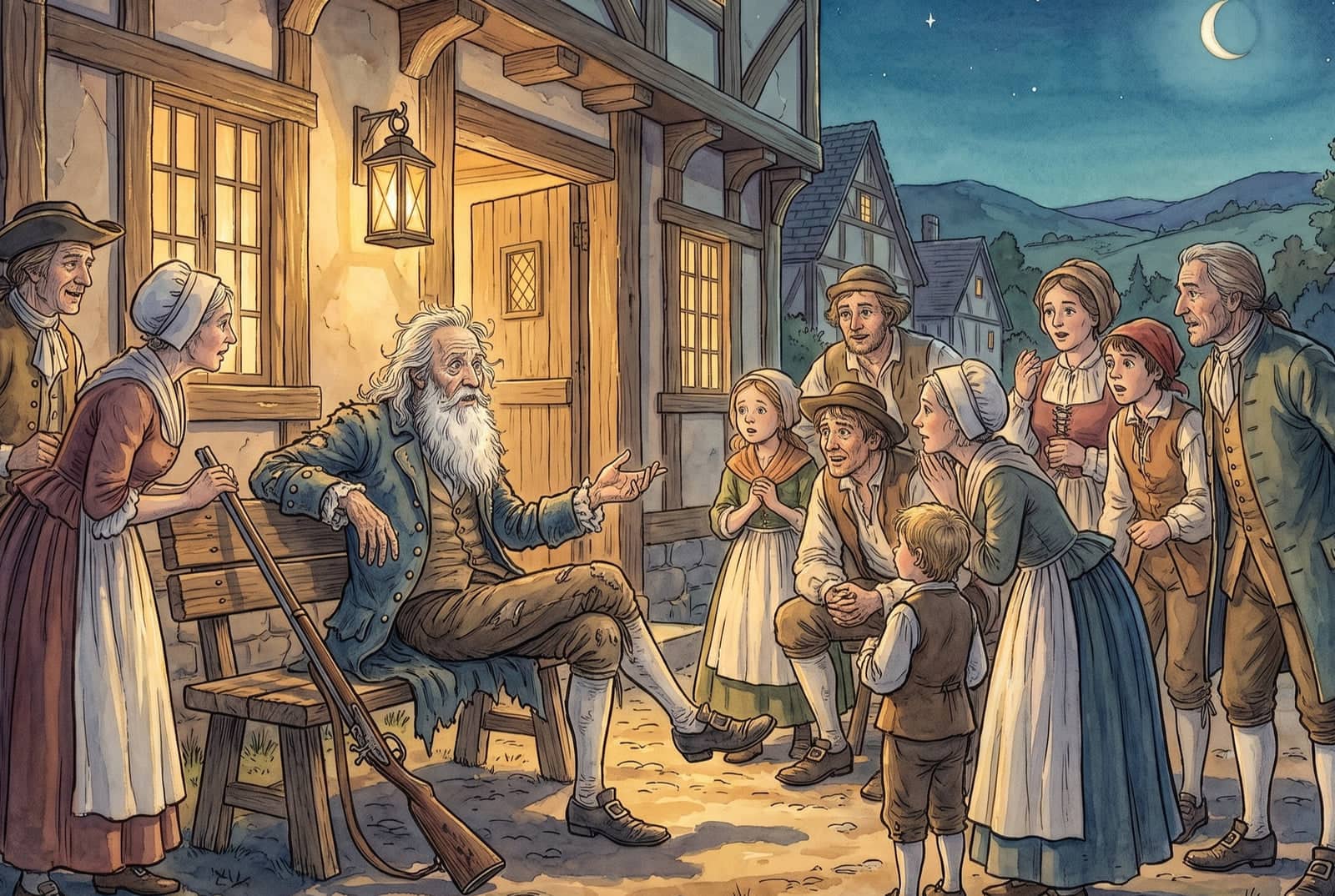
It was long before he could take in what had happened while he slept: that there had been a war, that the country had thrown off the rule of old England, and that he was now a free citizen of the United States. When his wife’s name was spoken he would shake his head, shrug and look up at the sky, and nobody could say whether he meant sorrow or peace.
He told his story to every stranger who came to Mr. Doolittle’s hotel, and it settled at last into the tale you have just heard. The old Dutch families believed every word, and to this day, whenever they hear thunder over the Catskills on a summer afternoon, they say that Hendrick Hudson and his crew are at their game of ninepins.
Retold by Talerie from Rip Van Winkle (opens in a new window)License: Public domainCopy this text, adapt it, use it however you like. A link back to Talerie is appreciated but never required.CC0 1.0 (opens in a new window)