When a miller’s youngest son inherits only a crafty cat, the cat wins him a king’s favor, a noble title and a monstrous ogre’s castle through one clever scheme after another. The young man marries the princess that very day, and the cat, now a great lord, chases mice only now and then, for his own amusement.
Once upon a time a miller died and left his three sons nothing but his mill, his donkey and his cat. The eldest took the mill, the second the donkey, and the youngest the cat.
“My brothers can make a living if they put their shares together,” the youngest said sadly, “but when I have eaten my cat and made mittens of his fur, I shall starve.”
The Cat heard this, though he pretended to take no notice.
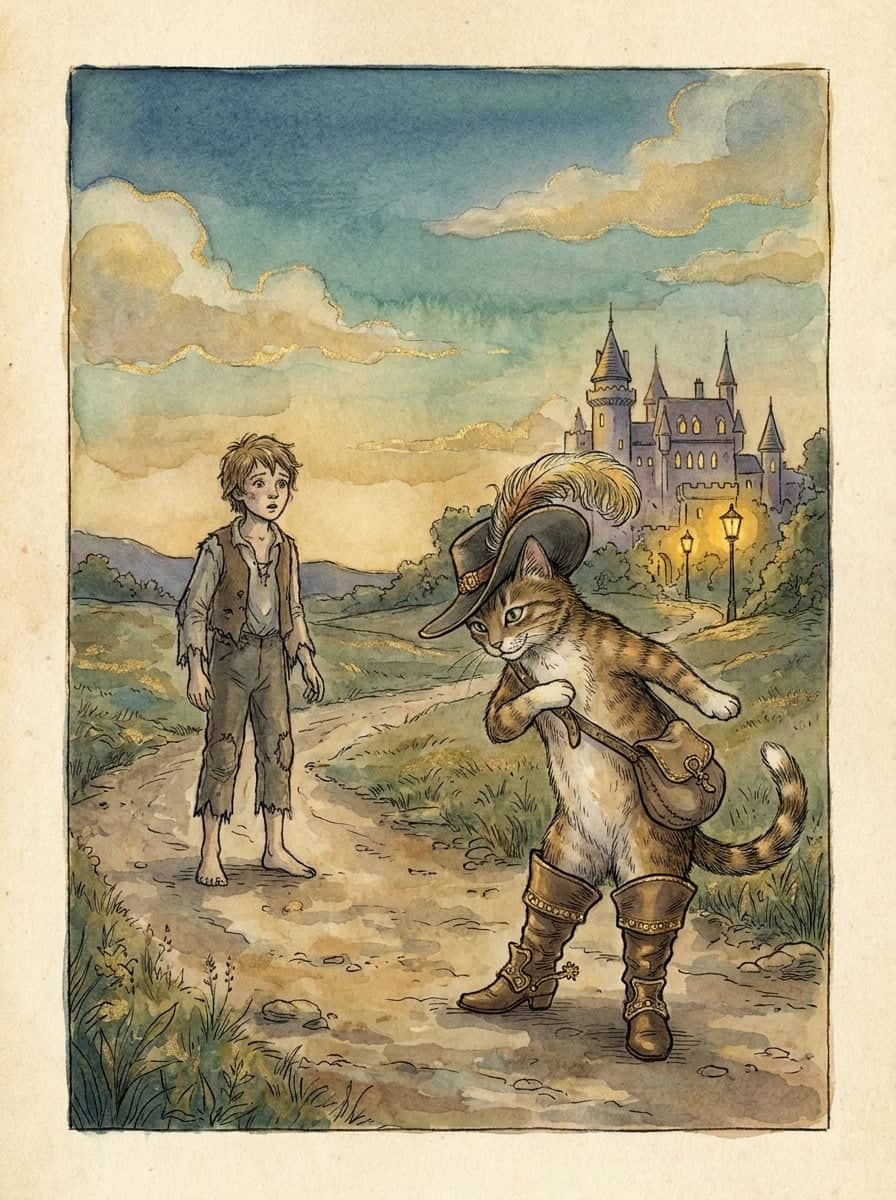
“Do not be so unhappy, master,” he said. “Give me a bag, and a pair of boots to walk through the brambles in, and you will see that your share is not so poor.”
His master had little faith in that, but he had seen the Cat play clever tricks to catch rats and mice, hanging upside down by his feet or lying in the flour as if dead, so he found a bag and ordered the boots.
The Cat pulled them on, took his bag and set off for a warren full of rabbits. He shook a little bran into the bag, lay down beside it as still as a stone, and before long a rash young rabbit came bounding in after the bran. Puss drew the strings tight and killed it, then carried his prize straight to the palace, where he was shown up to the King and made a low bow.
“Sire, I bring you a rabbit from my noble lord, the Marquis of Carabas, who sends it with his respects.”
The Marquis of Carabas was a title the Cat had invented that very minute.
“Tell your master,” said the King, “that I thank him, and that his gift pleases me well.”
Another day the Cat caught two partridges in his bag and carried them to the palace in the same way, and so it went on for two or three months, always game from my lord the Marquis of Carabas.
Then the Cat learned that the King would drive along the river with his daughter, the most beautiful princess in the world.
“Do as I tell you,” he said to his master, “and your fortune is made. Go and bathe at the spot I show you, and leave the rest to me.”
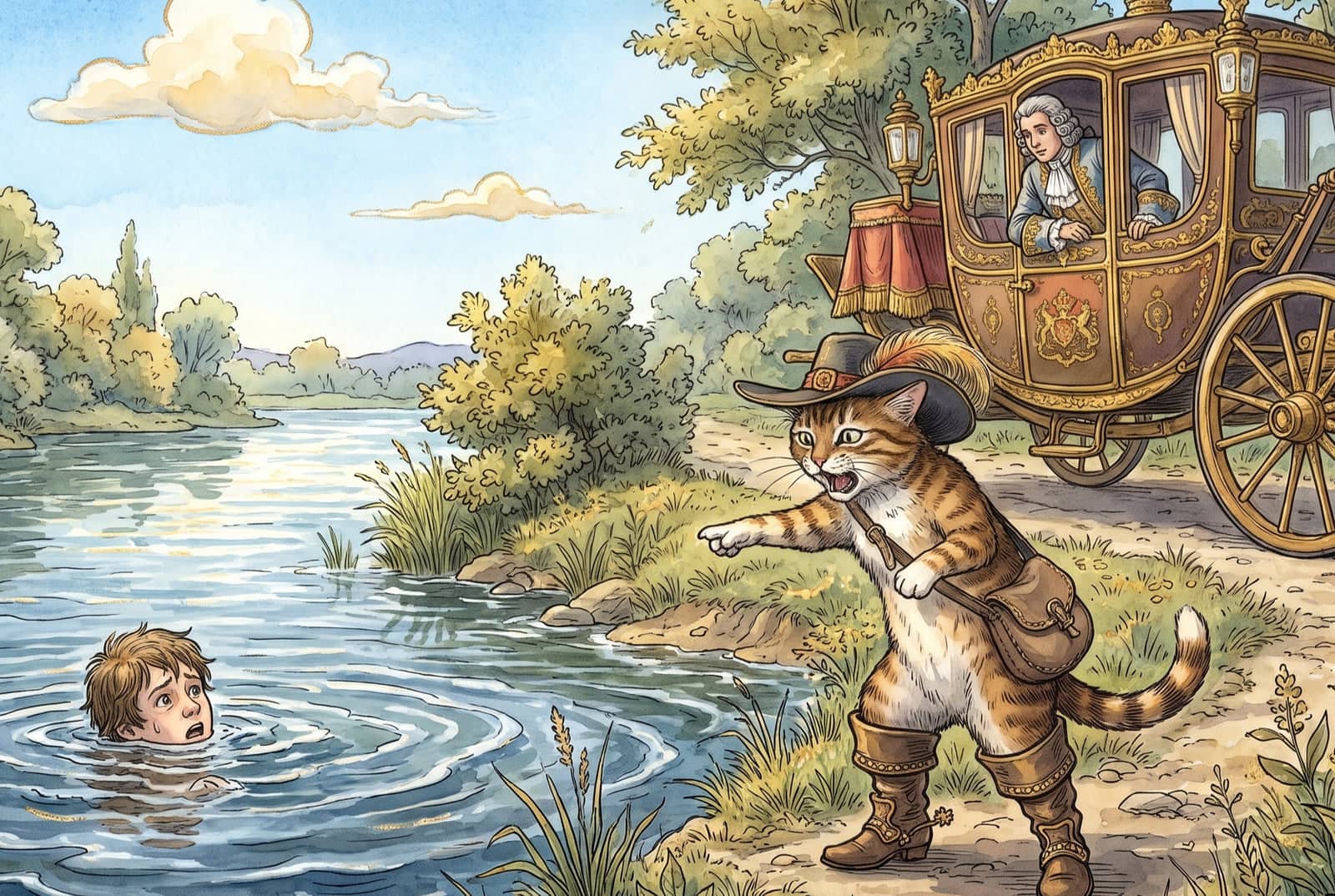
The miller’s son could not see the good of it, but he did as he was told. As the royal coach came along the road, Puss cried out with all his might.
“Help! Help! My lord the Marquis of Carabas is drowning!”
The King put his head out of the window, saw the Cat who had brought him so much game, and sent his guards running to the rescue. Puss told him that thieves had made off with his master’s clothes, which the Cat had himself hidden under a stone, and the King sent for one of his own finest suits.
The fine clothes suited the young man well, and the princess found him much to her liking. Two or three tender looks, and she was quite in love with him. The King invited him into the coach.
Puss ran on ahead and came to some countrymen mowing a meadow.
“Good people,” he said, “if you do not tell the King that this meadow belongs to my lord the Marquis of Carabas, you will be chopped as small as herbs for the pot.”
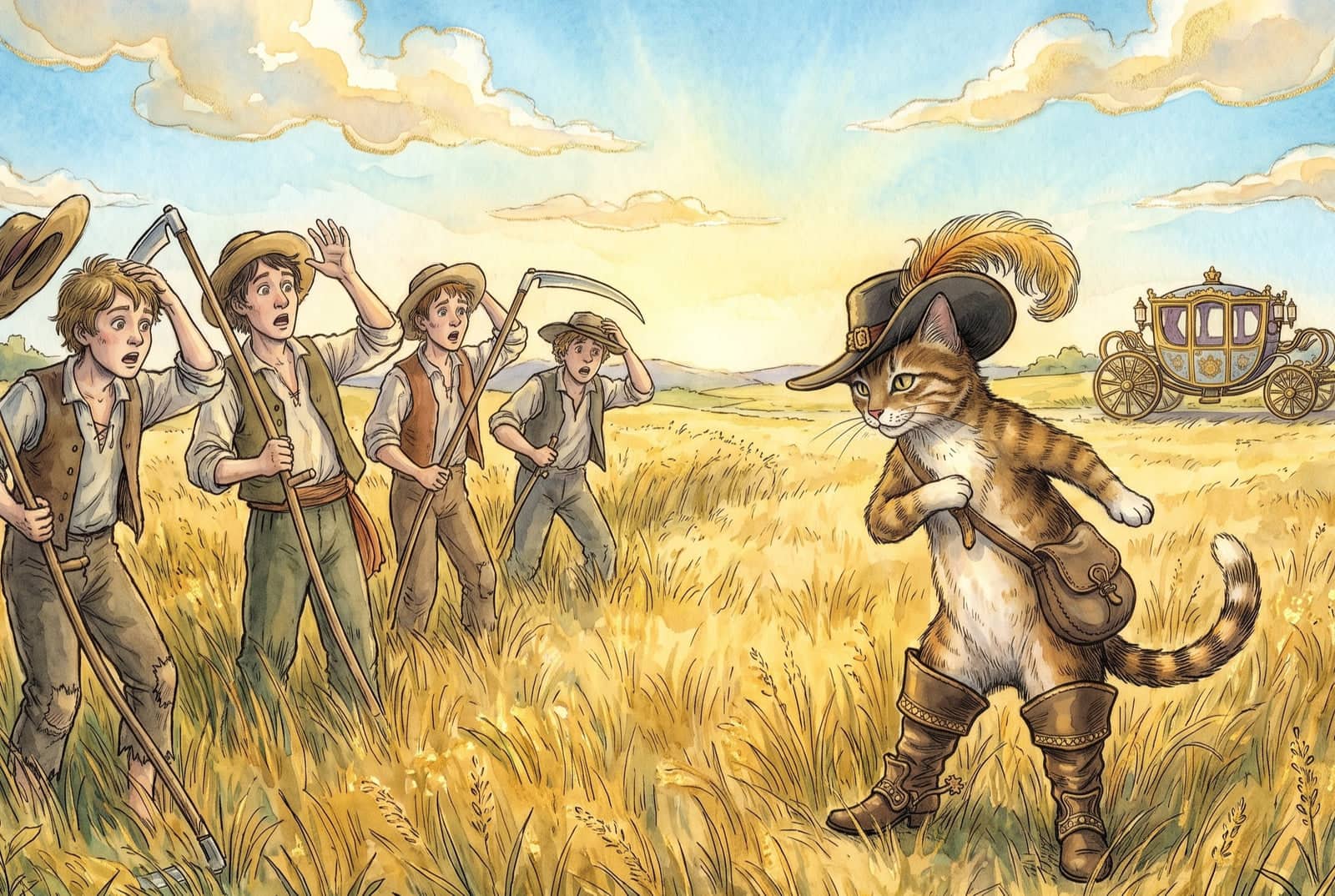
Sure enough, the King asked whose meadow it was.
“It belongs to my lord the Marquis of Carabas,” the mowers answered together, for the Cat’s threat had frightened them.
The Cat ran on ahead again and came to some reapers.
“Good people,” he said, “if you do not tell the King that all this wheat belongs to my lord the Marquis of Carabas, you will be chopped as small as herbs for the pot.”
The King passed a moment later and asked whose wheat it was.
“It belongs to my lord the Marquis of Carabas,” the reapers replied. Puss said the same to everyone he met, until the King was astonished at the vast estates of the Marquis.
At last the Cat came to a stately castle belonging to an Ogre, the richest that ever was, for all the land the King had driven through that day was truly his. Puss asked to speak with him, and the Ogre received him as politely as an Ogre can.
“They tell me,” said the Cat, “that you can change yourself into any creature you please: a lion, an elephant.”
“That is quite true,” said the Ogre roughly. “Watch me turn into a lion.”
A lion stood in the room, so close that Puss scrambled up among the high rafters in fright, which was no easy thing in boots. When the Ogre had his own shape again, the Cat came down and admitted he had been afraid.
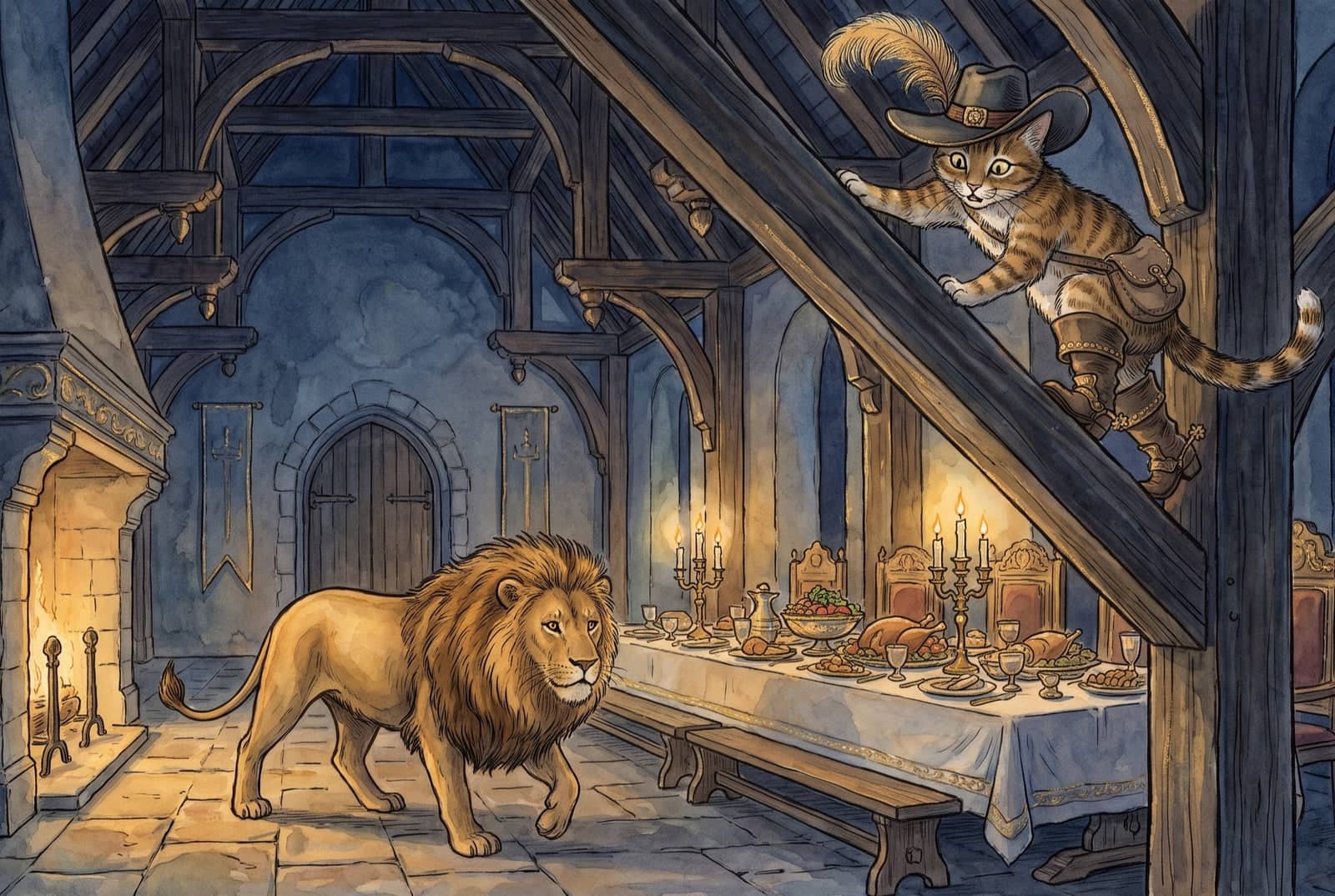
“They tell me something else,” he said, “though I cannot believe it: that you can take the shape of the smallest animals too, even a mouse. That must surely be impossible.”
“Impossible!” roared the Ogre. “You shall see.”
In a moment a little gray mouse ran across the floor. Puss pounced on it and ate it in one gulp, and that was the end of the Ogre and of his power over those lands.
Just then the King’s coach came over the drawbridge, and Puss ran out to meet it.
“Your Majesty is welcome to the castle of my lord the Marquis of Carabas,” he said.
“Does this castle belong to you as well, my lord Marquis?” cried the King. “Let us see the rooms, if you please.”
The Marquis gave his hand to the princess and followed the King inside. In the great hall stood a splendid feast the Ogre had made ready for friends who, seeing the royal coach, did not dare come in.
The King was charmed by the Marquis’s manners, his daughter was more in love than ever, and there were all those lands besides.
“My lord Marquis,” he said, “you have only to say the word, and you shall be my son-in-law.”
The Marquis bowed low and accepted the honor, and that very same day he married the princess.
As for Puss, he became a great lord, and he never chased a mouse again except now and then, for his own amusement.
Retold by Talerie from The Tales of Mother Goose (opens in a new window)Public domainCopy this text, adapt it, use it however you like. A link back to Talerie is appreciated but never required.CC0 1.0 (opens in a new window)