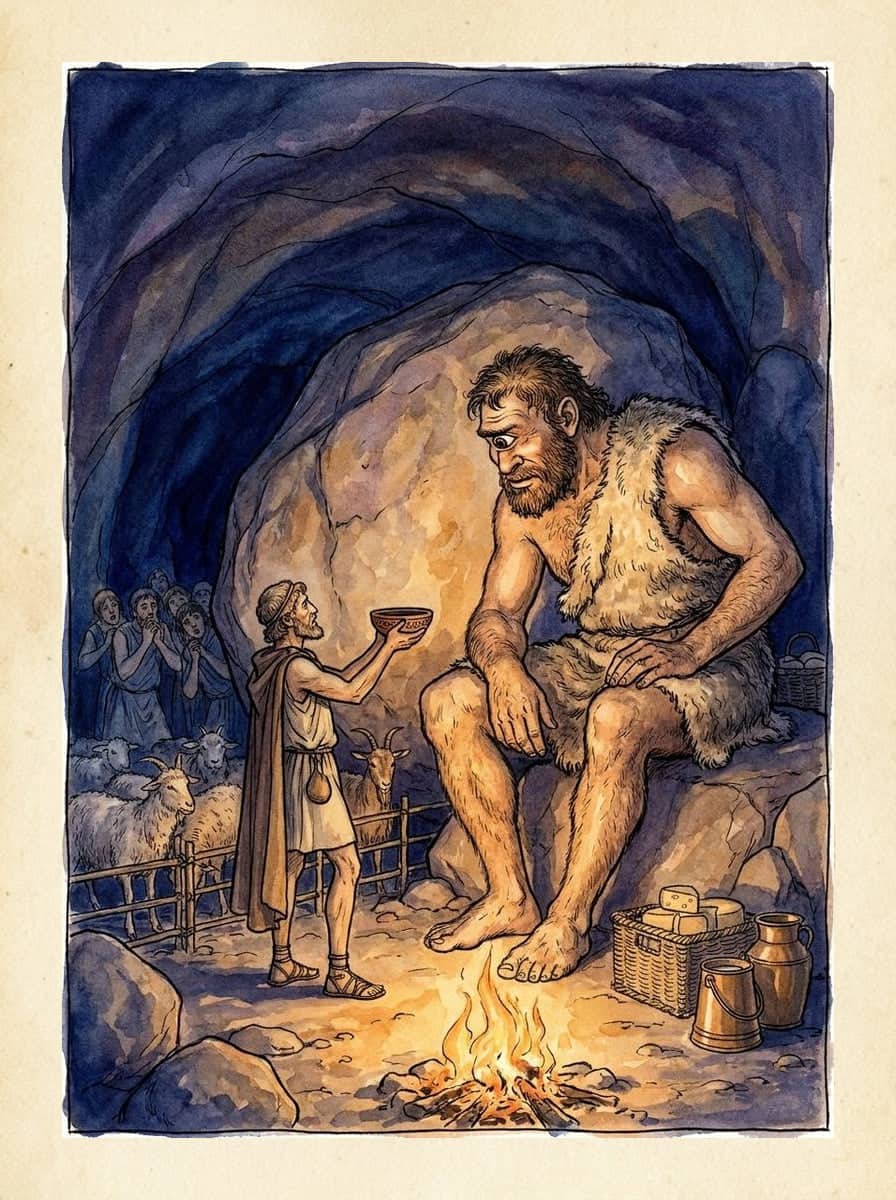
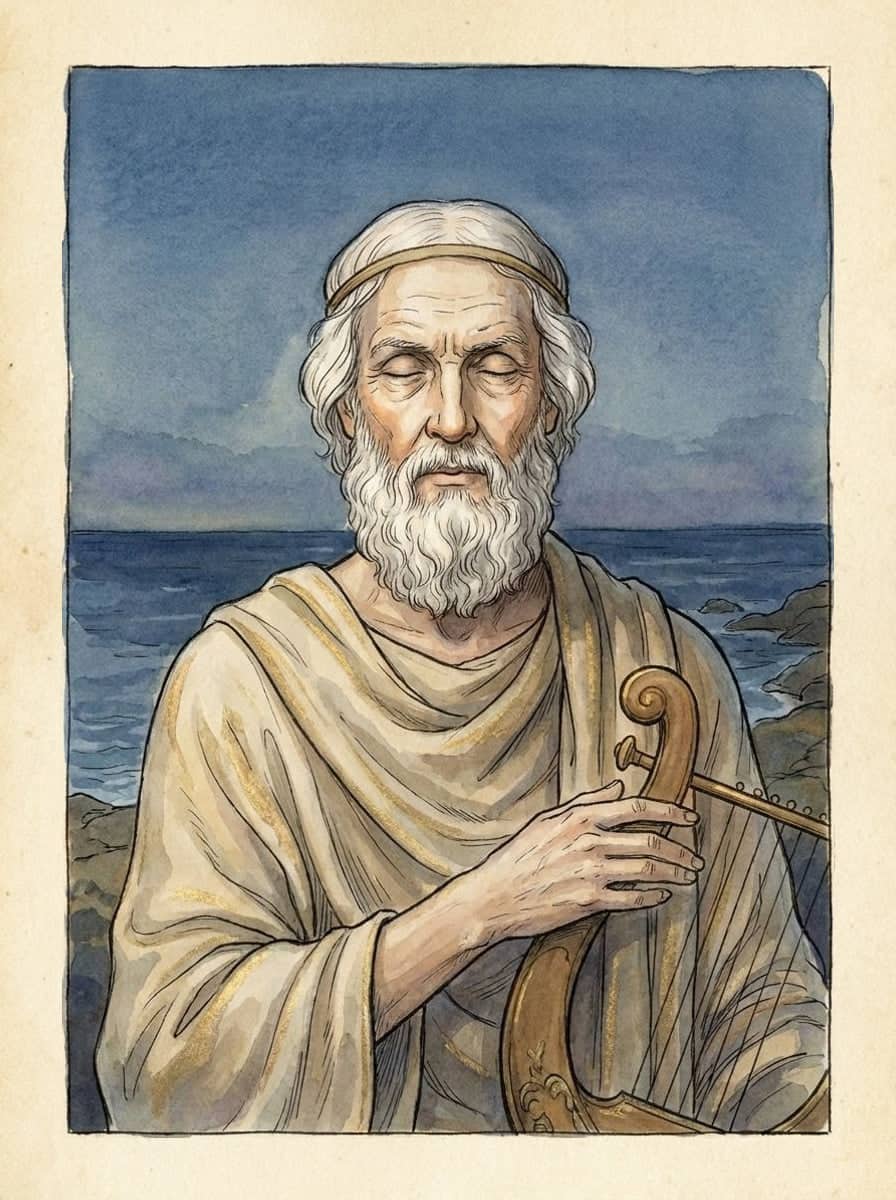
Trapped in the cave of the one-eyed giant Polyphemus, Odysseus gets him drunk, says his name is Nobody, and with four men drives a hot olive stake into the giant’s eye. Clinging under the great ram, Odysseus escapes to his ship and sails on, grieving for his lost friends, while Poseidon hears the Cyclops’s prayer.
Long ago, when the war at Troy was over, the hero Odysseus set sail for his home on the island of Ithaca with twelve ships and their crews. After many troubles at sea they came to a strange coast.
It was the land of the Cyclopes, giants with a single round eye in the middle of the forehead. They never ploughed or planted, and they had no laws. Each one lived in a cave in the mountains and cared nothing for his neighbours.
Just off their shore lay a small wooded island full of wild goats. Nobody ever went there, because the Cyclopes had no ships. One dark, misty night Odysseus and his fleet drifted into its harbour, seeing nothing until their keels touched the sand, as if some god had guided them.
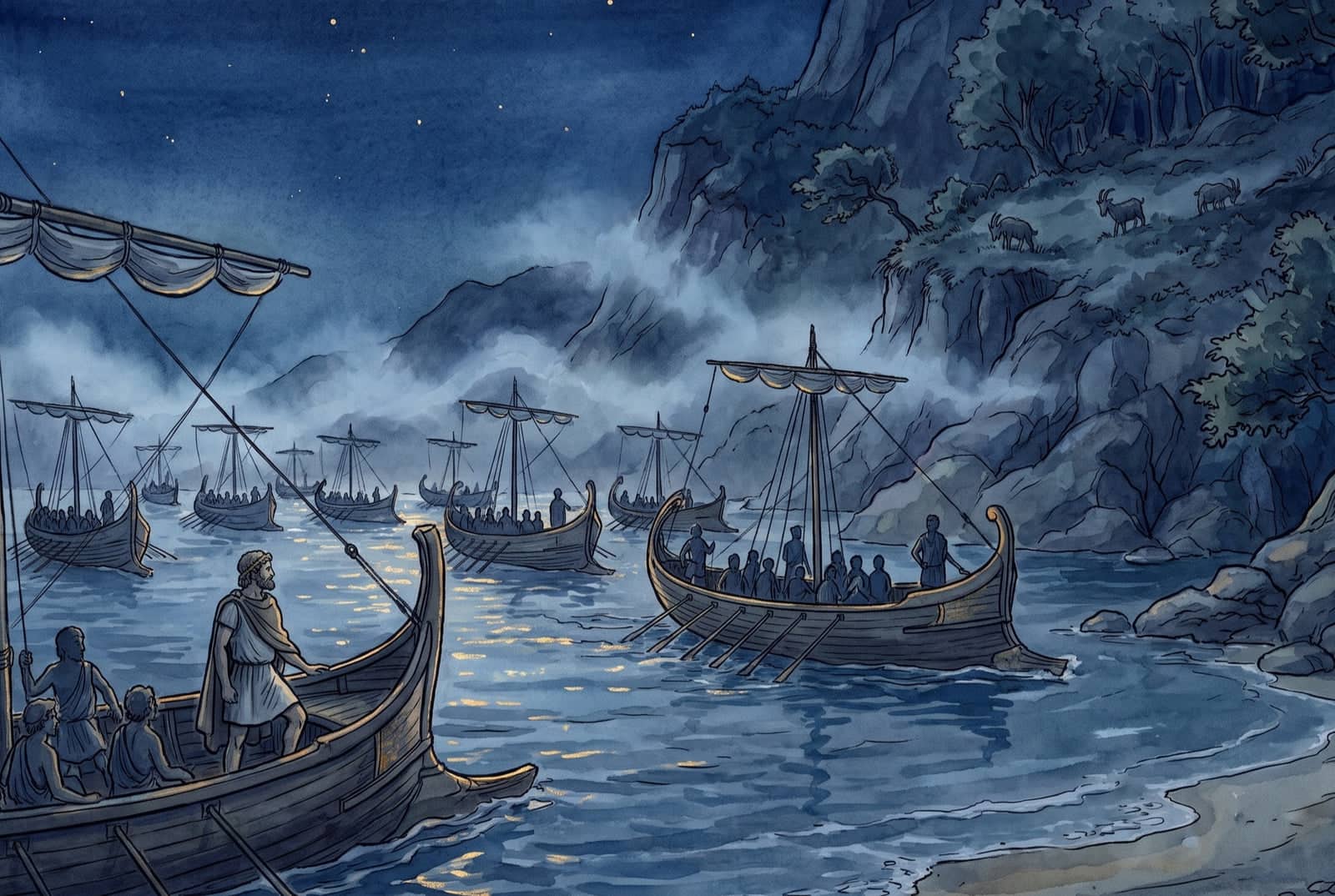
In the morning they hunted the goats, and there was plenty for everyone. All day they feasted, watching the smoke of fires rise over the land of the Cyclopes.
The next morning Odysseus called his men together.
“Stay here, all of you,” he said, “while I take my own ship across and find out who lives over there. I want to know whether they are wild and lawless, or kind to strangers and fearful of the gods.”
High in a cliff near the sea, he and his crew found a great cave with laurel bushes hanging over its mouth and a walled yard for sheep and goats. The one who lived there was out with his flocks. He was a huge creature who kept away from everyone, and looked less like a man than like a lonely crag on a mountaintop.
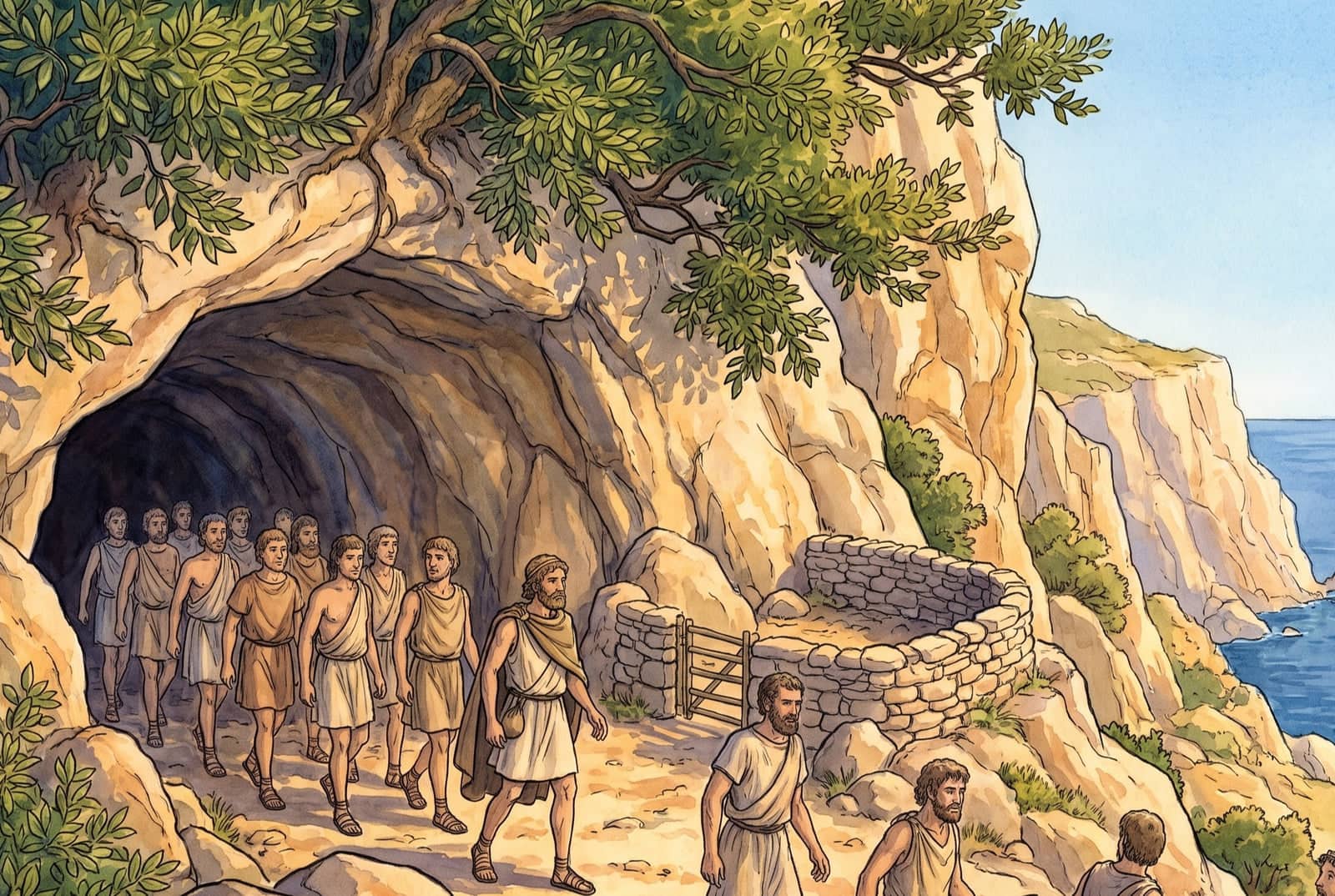
Odysseus left most of the crew by the ship and took twelve of his best men with him. He also took a goatskin full of a very special wine, dark and sweet, a gift from Maron, a priest of Apollo, whose life Odysseus had once spared.
That wine was so strong that Maron poured twenty cups of water into every cup of it. Odysseus brought it because he had an uneasy feeling. Whoever lived in that cave, he thought, might be enormously strong and might care nothing for right or wrong.
The owner was still away, so they went inside and looked around. There were racks loaded with cheeses and pens crowded with lambs and young goats. Every bowl and pail stood full to the brim with milk.
“Let’s take some cheeses and go,” the men begged. “Then we can come back for the lambs and kids, drive them down to the ship and sail away.”
It would have been far better to listen to them. But Odysseus wanted to see the owner of the cave, hoping he might be given a guest’s gift. So they lit a fire, ate a little of the cheese, and sat down to wait.
Towards evening the Cyclops came home. He threw down a huge load of firewood with such a crash that the men fled in terror to the back of the cave.
He drove in the ewes and nanny goats he meant to milk and left the rams outside in the yard. Then he lifted an enormous stone and set it in the doorway. It was so heavy that twenty-two strong wagons could not have dragged it away.
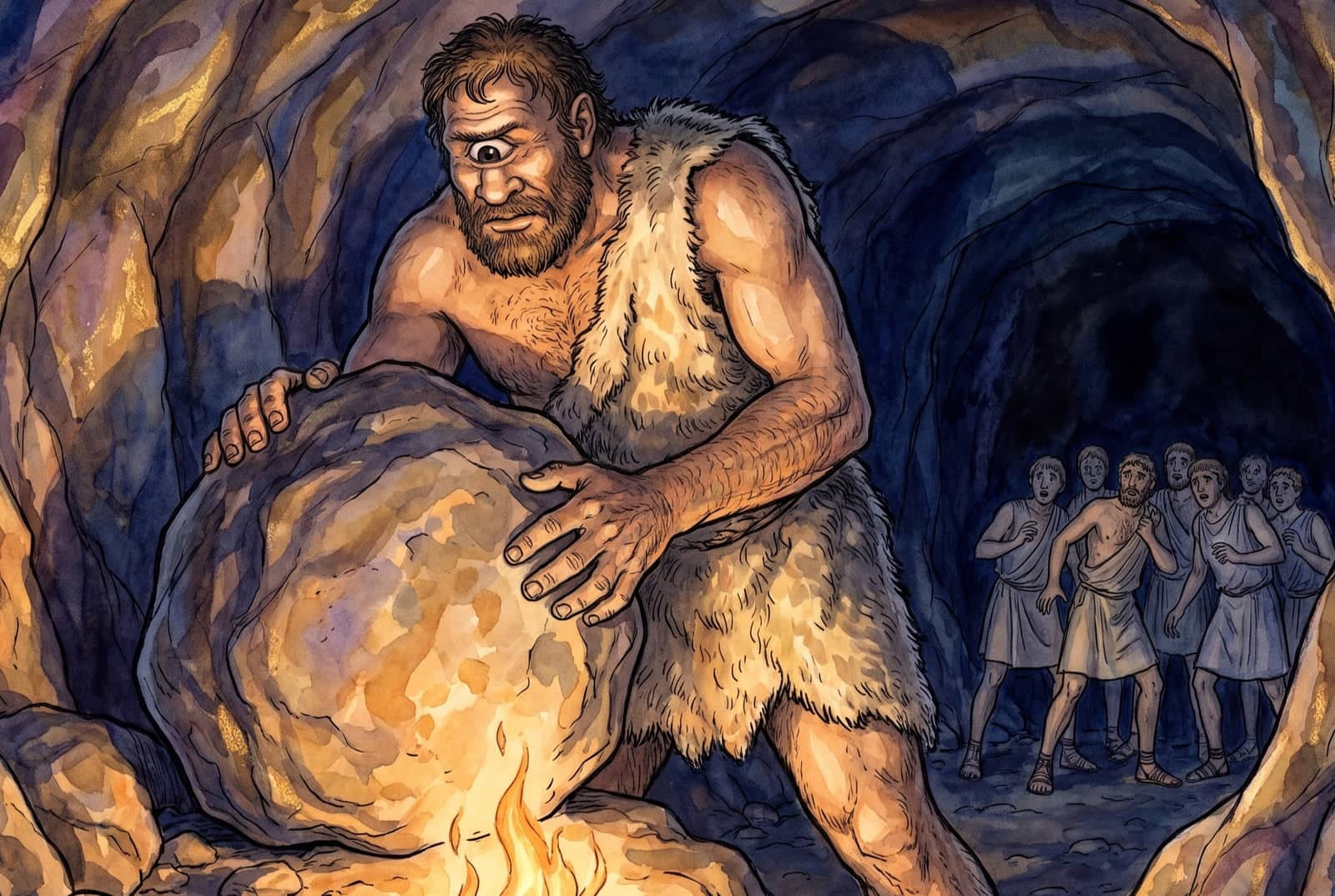
He milked his animals and put each lamb and kid to its mother. Then he lit his fire, and in its light he saw the men.
“Strangers, who are you?” he boomed. “Where have you sailed from? Are you traders, or pirates roaming the sea?”
The men’s hearts nearly stopped, but Odysseus found the courage to answer.
“We are Greeks, on our way home from Troy, and storms have blown us off our course. We come to you as guests, and we ask you to treat us kindly. Respect the gods, great one. Zeus himself watches over strangers, and he punishes anyone who harms them.”
The Cyclops gave him a pitiless reply.
“You must be a fool, stranger, to tell me to fear the gods. We Cyclopes care nothing for Zeus or for any of your gods, because we are far stronger than they are. I will spare you only if I feel like it. Now tell me, where did you leave your ship?”
He was trying to trick him, but Odysseus was too clever for that, and he answered with a lie.
“My ship is gone. Poseidon, lord of the sea, drove it onto the rocks and smashed it to pieces. Only these men and I escaped.”
The Cyclops did not answer. Instead he reached out, seized two of the men, and ate them for his supper. The others wept and lifted their hands to the sky, helpless. When the giant had eaten, he stretched out among his sheep and fell asleep.
Odysseus’s first thought was to draw his sword and strike the monster as he slept. But then he stopped himself. If the Cyclops died, who would move the stone from the doorway? So they sat in the dark, grieving, until morning.
At dawn the Cyclops lit his fire again, milked his flock, and took two more of the men for his breakfast. Then he moved the great stone aside, drove his flock out, and set the stone back as easily as putting a lid on a box. They heard him whistling to his sheep as he drove them up the mountain.
All day Odysseus thought about how to pay the monster back, and at last he had a plan.
Beside one of the pens lay the Cyclops’s club, a trunk of green olive wood as long and thick as the mast of a big ship. Odysseus cut off a piece about as long as a man is tall. He sharpened one end to a point and hardened it in the fire. Then he hid it under the dung that covered the floor of the cave.
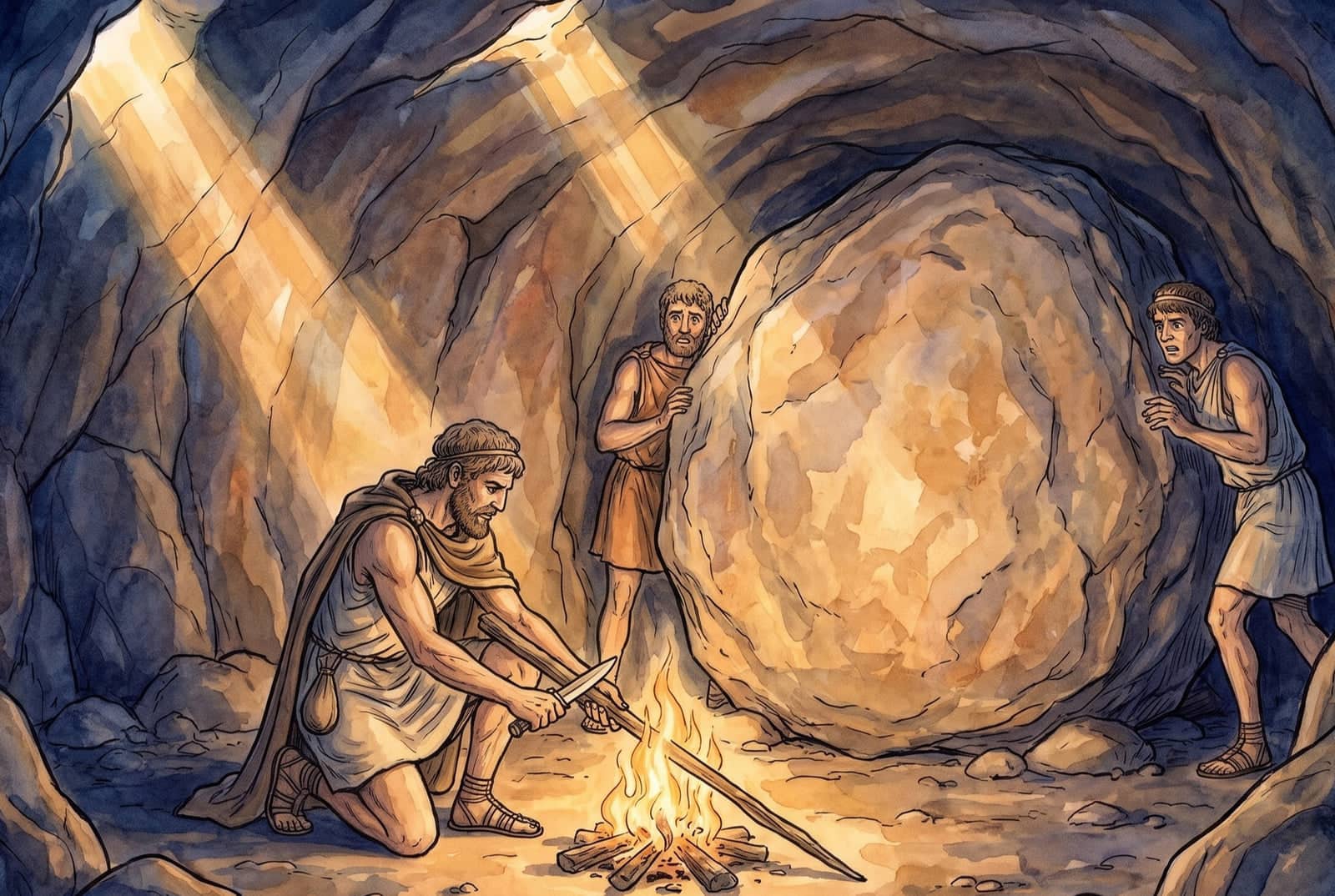
Next the men drew lots to decide who would help him drive the stake into the giant’s eye while he slept. The lot fell on the very four Odysseus would have chosen himself, and with him that made five.
That evening the Cyclops came home and drove every animal into the cave, rams and all. Perhaps a god had put the idea into his head. He set the stone in the doorway, milked his flock, and once again took two of the men and ate them.
Now Odysseus stepped forward, holding a wooden bowl full of the dark wine.
“Here, Cyclops,” he said. “You have eaten your fill of men, so try this wine. I brought it as a gift for you, hoping you would help us on our way home. But you have done nothing but rage at us. Who will ever visit you again, if this is how you treat your guests?”
The Cyclops drank it down and held out the bowl for more.
“Give me another,” he said, “and tell me your name, right now. I want to give you a gift you’ll be glad of. This tastes like the drink of the gods.”
Three times Odysseus filled the bowl, and three times the Cyclops drained it. When Odysseus saw that the wine had gone to his head, he spoke to him in his friendliest voice.
“You ask my name, Cyclops, so I will tell you, and then you must give me the gift you promised. My name is Nobody. That is what my mother and father and all my friends call me.”
The giant answered cruelly. “Then Nobody will be the last one I eat. All his friends will go first, and I’ll keep Nobody till the end. That is my gift to you.”
As he said it, he toppled over onto his back and fell into a heavy sleep. He had drunk so much that he was sick in his sleep.
Odysseus pushed the olive stake deep into the embers until it was about to burst into flame, and he spoke to his men to keep their courage up. Then he pulled it out, glowing hot, and the four gathered round him.
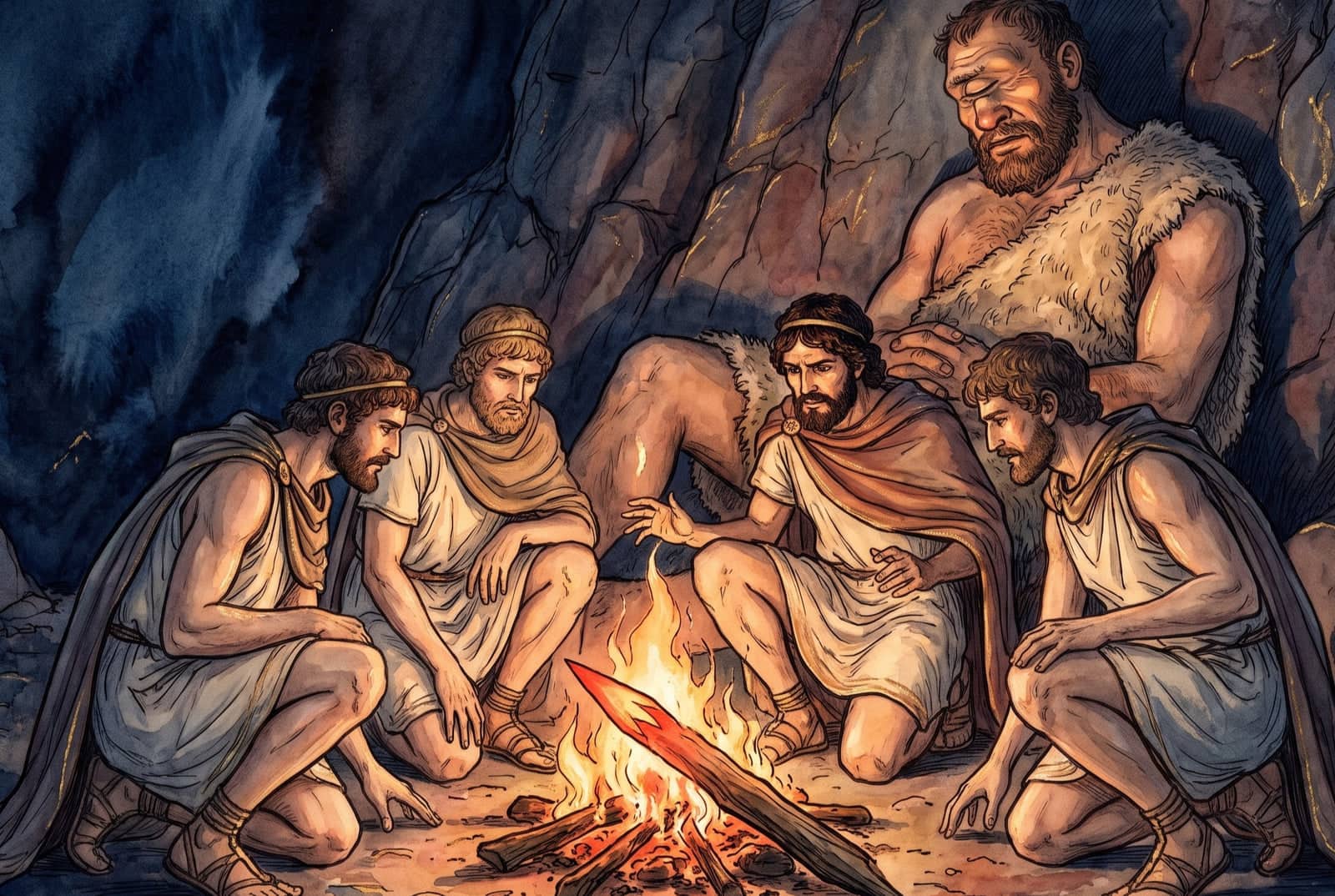
Together they lifted the stake and drove it into the Cyclops’s eye. Odysseus leaned on it with all his weight and twisted it, the way a shipbuilder turns a drill through a plank. The eye hissed around the hot wood like red-hot iron plunged into a blacksmith’s tub of water.
The Cyclops gave a terrible scream, and the men ran back in terror. He tore the stake away and bellowed for the other Cyclopes who lived in the caves nearby. They came from every side and gathered outside his door.
“What’s wrong, Polyphemus?” they called. “Why are you shouting in the middle of the night? Is someone stealing your sheep? Is someone trying to kill you, by trickery or by force?”
From inside the cave Polyphemus roared back, “Nobody is killing me! Nobody has tricked me!”
“Well, if nobody is hurting you,” they said, “then you must be ill, and an illness sent by Zeus can’t be helped. You had better pray to your father, Poseidon.”
And off they went. Odysseus laughed to himself at how well his false name had worked.
Moaning with pain, the Cyclops felt his way to the doorway and pulled the stone aside. Then he sat down in the opening with his arms stretched out, ready to catch anyone who tried to slip out among the sheep.
Odysseus thought and thought. The rams in the cave were big and strong, with thick, dark fleece. Without a sound, he tied them together in threes. Under each middle ram went one of his men, and the two rams on either side kept him hidden.
For himself he chose the biggest and finest ram of all. He swung himself underneath it and clung face up to the thick wool of its belly.
So they waited, afraid, until morning. At dawn the rams hurried out to pasture. In spite of his pain, the Cyclops ran his hands over the back of every ram as it passed, but it never occurred to him to feel underneath.
The great ram came last of all, slowed down by the weight of Odysseus clinging beneath it. Polyphemus stopped it and stroked it.
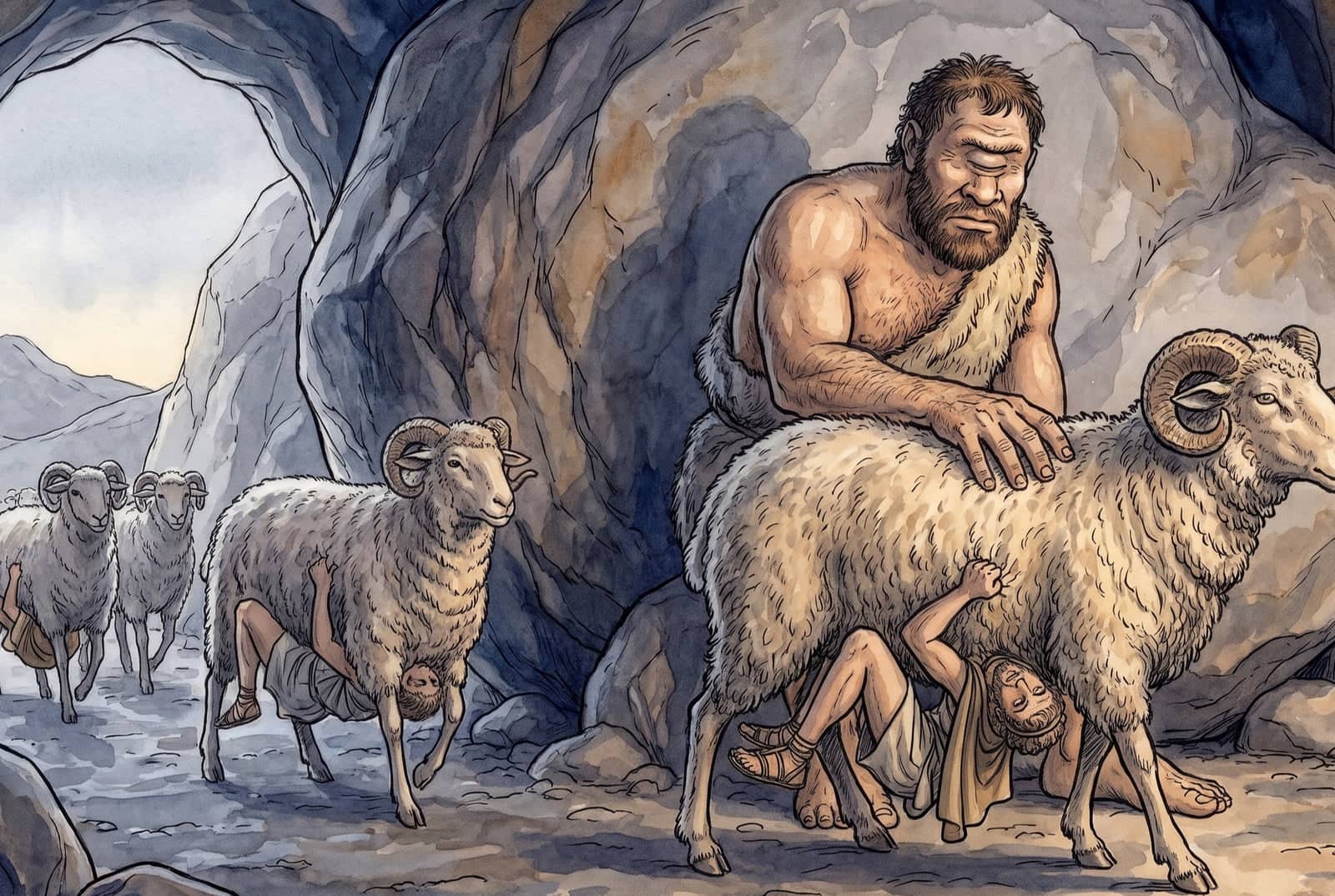
“My dear old ram,” he said, “why are you the last to leave the cave today? You are always the first to run out to the fresh grass, and the first to come home at night. Are you sad for your master’s eye, which that wicked Nobody took from me? If only you could speak and tell me where he is hiding, I would dash him against the ground and pay him back for all the harm he has done me.”
Then he let the ram go.
A little way from the cave, Odysseus let go of the ram and untied his men. Together they drove the fat sheep down to the shore. The crew waiting there were overjoyed to see them alive, and then they began to weep for the six who would never come back.
Odysseus frowned to stop their crying and told them to get the sheep on board and put out to sea at once. When they were as far out as a shout would carry, he called back to the shore.
“Cyclops! You picked the wrong man when you ate his friends. How could you eat the guests in your own home? Now Zeus and the other gods have punished you for it.”
This made the Cyclops angrier than ever. He tore the top off a mountain and hurled it at them. It crashed into the sea just in front of the ship, and the great wave it raised swept them back towards the land.
Odysseus grabbed a long pole and pushed them off, nodding fiercely at his men to row for their lives. When they were twice as far out, he wanted to shout again. His men begged him not to.
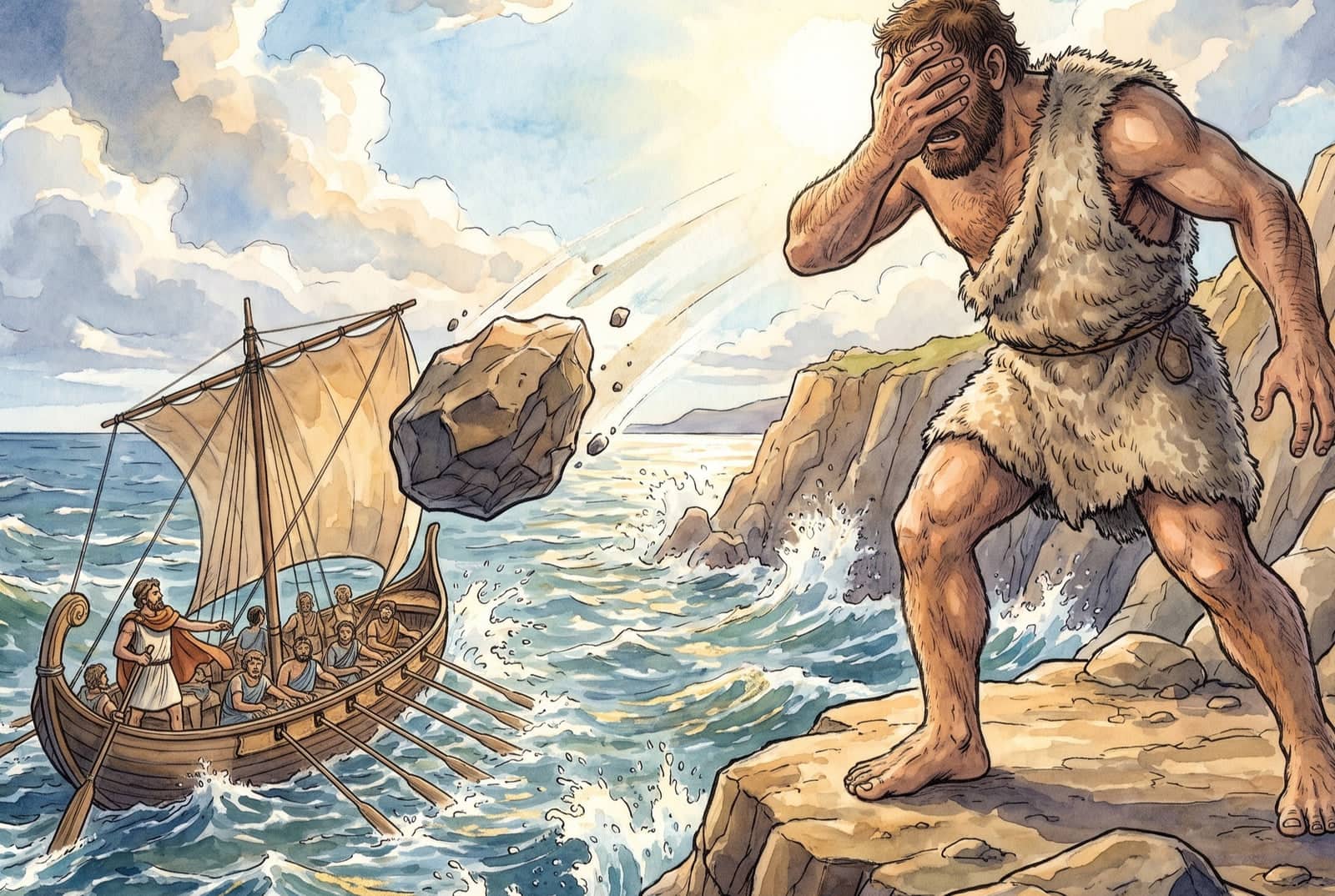
“Please, don’t make him any angrier!” they said. “That rock nearly finished us. If he hears us again, he’ll smash us and our ship to pieces.”
But Odysseus would not listen. In his anger he shouted, “Cyclops, if anyone ever asks who took your eye, tell them it was Odysseus, son of Laertes, who lives on Ithaca!”
The Cyclops groaned. “So the old prophecy has come true. Long ago a seer called Telemus told me that one day I would lose my sight at the hands of Odysseus. I always expected someone huge and strong. Instead it was a puny little man who blinded me after getting me drunk.
“Come back, Odysseus, and I will ask Poseidon to speed you home, for Poseidon is my father. He can heal my eye if he wishes, and no one else can.”
“I wish I could be as sure of finishing you off,” Odysseus shouted back, “as I am that not even Poseidon will ever heal that eye!”
Then the Cyclops raised his hands to the sky and prayed.
“Hear me, Poseidon, lord of the sea. If I am truly your son, let Odysseus never reach his home. But if he is meant to see his home and his friends again, let him come late and in misery, with all his men lost, on a stranger’s ship, and let him find trouble waiting in his house.”
And Poseidon heard his prayer.
Then the Cyclops threw a rock even bigger than the first. It fell just behind the ship, and this time the wave carried them forward, towards the island.
At last they reached the island where the other ships were waiting. Their friends had been watching anxiously for their return. They brought the Cyclops’s sheep ashore and shared them out fairly.
Everyone agreed that Odysseus should have the great ram as an extra gift. There on the beach he offered it to Zeus, the ruler of all. But Zeus would not accept the offering. He was already planning how to destroy those ships and all the friends who sailed in them.
All that day they feasted, and when darkness came they slept on the beach. At dawn they took their places at the oars and sailed on with heavy hearts, glad to be alive, but grieving for the friends they had lost.
Retold by Talerie, Source: The Odyssey (opens in a new window)
License: Public domainCopy this text, adapt it, use it however you like. A link back to Talerie is appreciated but never required.CC0 1.0 (opens in a new window)