 Original
Odysseus and the Cyclops
25 min readages 9 and uptalerie.com/en/tales/odysseus-and-the-cyclops-original
Trapped in the cave of the giant Polyphemus, who eats two men at once, Odysseus gets him drunk, says his name is Nobody and drives an olive stake into the giant’s eye. Odysseus and his men escape under the rams and reach the island where their friends wait, and he sacrifices the great ram to Zeus before they sail on.
I am Odysseus, and this is what happened to us on the way home from Troy. We sailed on, sick at heart for the comrades we had already lost, until we came to the land of the Cyclopes, a lawless and savage people. The Cyclopes neither plant nor plough. They leave everything to the gods and live on the wheat and barley that grow wild without any tending, and on wild grapes, which give them wine whenever the sun and the rain allow. They have no laws and no councils. They live in caves on the tops of high mountains, each one master of his own wife and children, and none of them cares in the least about his neighbours.
Off their harbour, not close to their shore and yet not far from it, lies a wooded island, rich and green. It is overrun with wild goats, which breed there in great numbers because no one ever disturbs them. Hunters, who will put up with any hardship in forests and on mountain cliffs, never go there, and the land is never ploughed or grazed. Year after year it lies wild, unsown and untilled, with nothing living on it but goats. The Cyclopes have no ships and no shipbuilders to make them, so they cannot sail from city to city or cross the sea to visit other lands, as people with ships can. If they had ships, they would have settled that island long ago, for it is a fine one and would bear every crop in its season. In places its meadows run right down to the water, well watered and thick with soft grass. Vines would thrive there. There is flat land for ploughing, and the soil is so deep that every harvest would be heavy. There is a good harbour too, where a ship needs no cables and no anchor and does not have to be tied up at all: you simply run her onto the beach and wait until the wind is right for sailing again. At the head of the harbour a spring of clear water flows out of a cave, and poplars grow all around it.
That is where we came in, and the night was so dark that some god must have guided us, for we could see nothing at all. A thick fog lay around our ships, and the moon was hidden behind heavy clouds, so that no one could have made out the island even if he had been looking for it. We heard no waves breaking to warn us that land was near, and the first we knew of it was when our ships ran up onto the sand. Once they were beached, we took down the sails, went ashore and slept on the beach until morning.
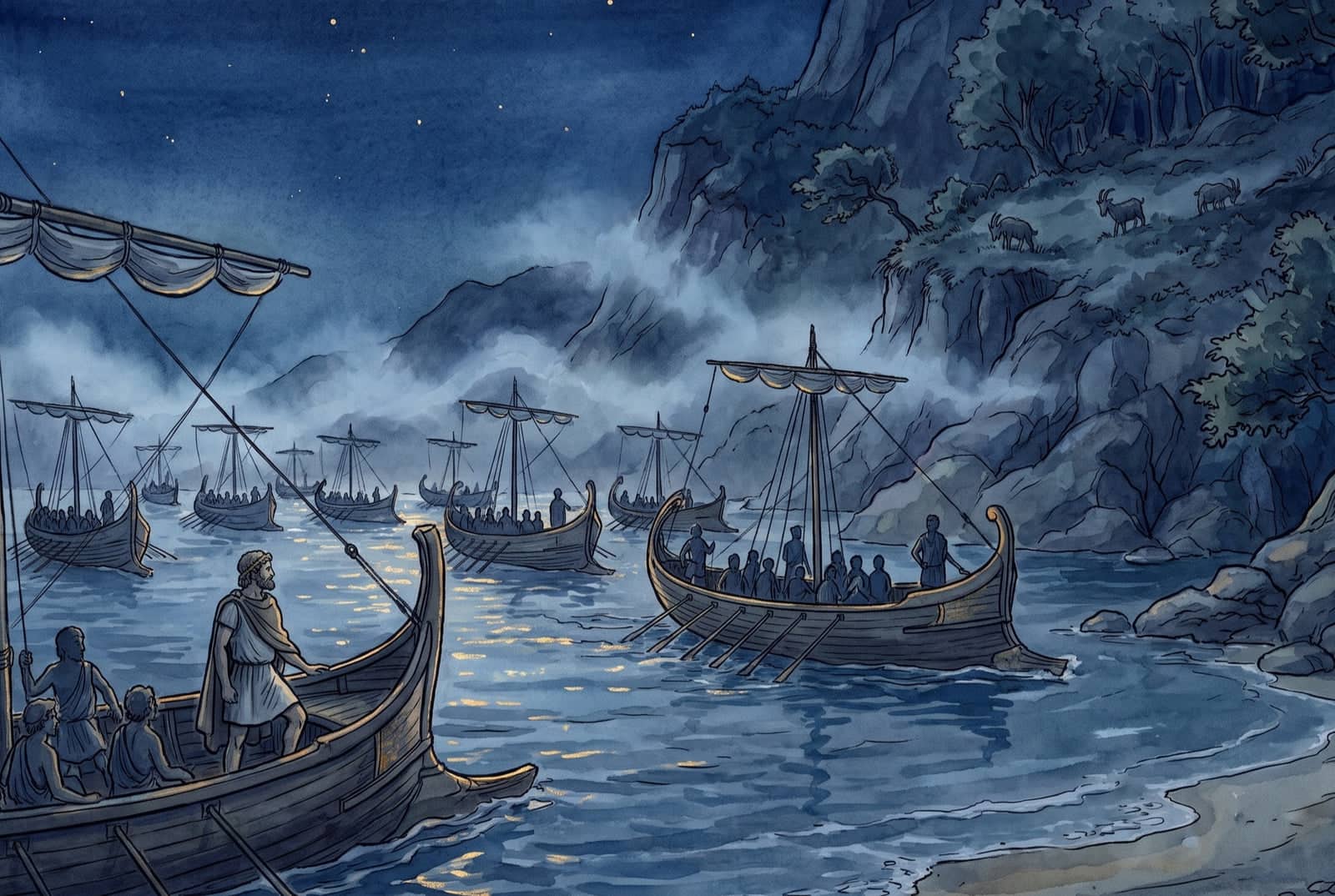
When rosy-fingered Dawn, the child of morning, appeared, we wandered all over the island, marvelling at it, and the nymphs, the daughters of Zeus, stirred up the wild goats so that we could have meat for our meal. We fetched our spears and our bows and arrows from the ships, split into three parties and began to shoot. The gods gave us fine hunting. I had twelve ships with me, and each ship got nine goats, while mine got ten. So all day long, until the sun went down, we sat eating and drinking our fill, and we still had plenty of wine, because every man had filled many jars when we sacked a city on our way, and they were not empty yet. As we feasted we kept looking across at the land of the Cyclopes, which was very near, and we could see the smoke of their fires. We almost thought we could hear their voices and the bleating of their sheep and goats. When the sun set and darkness fell, we lay down to sleep on the beach, and the next morning I called my men together.
“Stay here, my good friends, all of you,” I said, “while I take my own ship and find out about these people for myself. I want to know whether they are savages who respect no law, or a kind people who welcome strangers.”
I went aboard and told my crew to follow me and cast off the ropes. They took their places at the benches and struck the grey sea with their oars. The land was not far, and when we reached it we saw, in the face of a cliff close to the sea, a great cave with laurels hanging over its mouth. Many sheep and goats were kept there at night, and in front of it was a large yard with a high wall of stones set deep in the ground and tall trunks of pine and oak. This was the home of a monstrous giant, who was away just then, out with his flocks. He had nothing to do with anyone else, but lived alone, outside every law. He was a fearful thing to see, not like a man at all, but more like a jagged peak standing alone against the sky, high up among the mountains.
I told my crew to pull the ship up on the shore and wait beside it, all but the twelve best men, who were to come with me. I also took a goatskin full of dark, sweet wine. It had been given to me by Maron, son of Euanthes, the priest of Apollo at Ismarus, who lived in the god’s wooded grove there. When we attacked his city we had spared him, his wife and his child out of respect, and so he gave me splendid gifts: seven talents of fine gold, a silver mixing bowl, and twelve jars of sweet wine, unmixed and wonderful to taste. No one in his house knew about that wine, not a single servant, only he himself, his wife and one housekeeper. When he drank it, he poured in twenty measures of water to one of wine, and even then a scent rose from the bowl so sweet that no one could keep from drinking. I filled a big skin with this wine and took a bag of food as well, for something told me that we might meet some savage of enormous strength, who cared nothing for right or for law.
We soon reached the cave, but he was out with his flocks, so we went in and looked around. His racks were loaded with cheeses, and his pens were crowded with more lambs and kids than they could hold. Each age was kept apart: the oldest young ones in one pen, the middle ones in another, and the newborns in a third. All the pails and bowls he milked into were brimming with whey. When my men saw all this, they begged me to let them take some of the cheeses and hurry back to the ship, then come back, drive the lambs and kids down to the shore, put them aboard and sail away. It would have been far better if I had listened. But I would not, because I wanted to see the owner himself and hoped he would give me a guest-gift. As it turned out, when he did come, my poor men found him anything but kind.
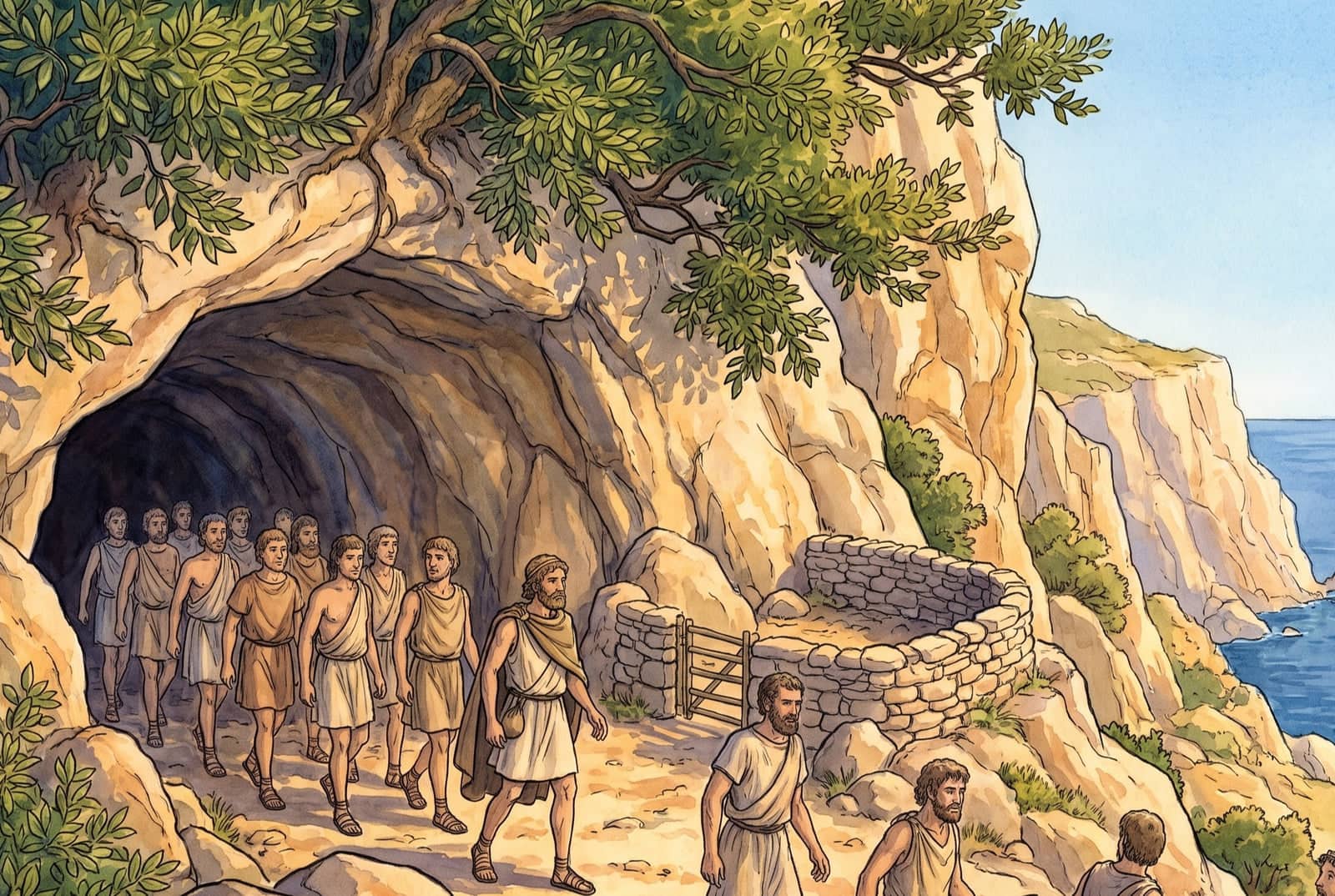
We lit a fire, offered some of the cheese to the gods, ate some ourselves, and sat waiting for him to come home with his flocks. At last he came, carrying a huge load of dry wood to cook his supper, and he threw it down on the floor of the cave with such a crash that we fled in terror to the far end. Then he drove in the ewes and the nanny goats he meant to milk, and left the rams and the billy goats outside in the yard. After that he lifted a huge stone and set it in the doorway. It was so heavy that twenty-two strong four-wheeled wagons could not have dragged it from its place. Then he sat down and milked his ewes and goats, each in turn, and put every mother’s young one under her. Half the milk he curdled and set aside in wicker baskets for cheese, and the other half he poured into bowls to drink with his supper. When all his work was done, he lit the fire, and then he caught sight of us.
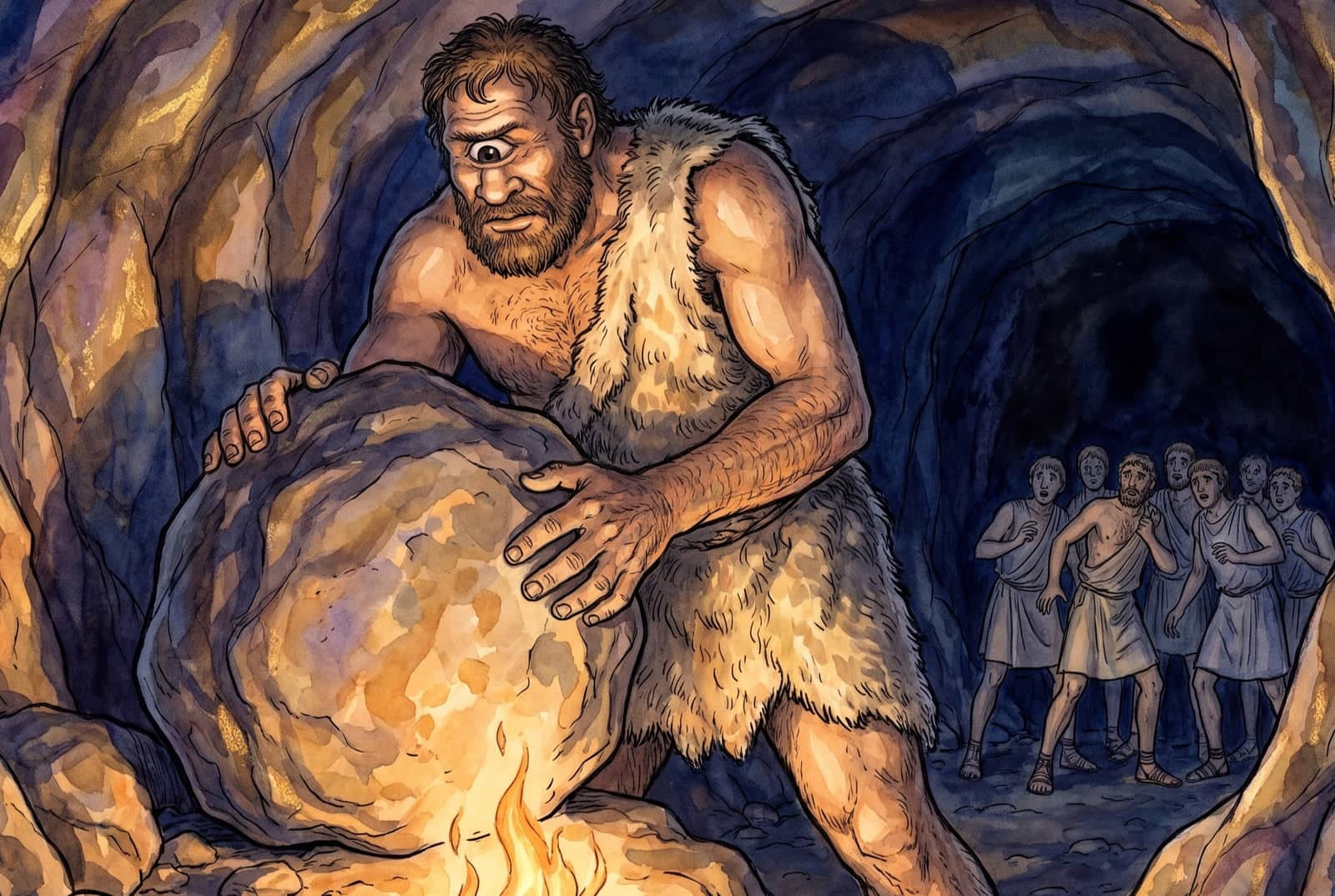
“Strangers, who are you?” he said. “Where have you sailed from? Are you traders, or do you roam the sea like pirates, risking your lives and bringing trouble to everyone you meet?”
Our hearts sank at his booming voice and his monstrous size, but still I managed to answer him.
“We are Greeks,” I said, “sailing home from Troy. By the will of Zeus and the force of the storms we have been driven far off our course. We are the men of Agamemnon, son of Atreus, whose fame has spread through the whole world, because he sacked a great city and destroyed a great people. Now we come to you as suppliants, and we ask you to treat us as guests and give us the gifts that visitors may fairly expect. Good sir, fear the anger of the gods. We are asking for your mercy, and Zeus protects every honest traveller, for he punishes anyone who wrongs a stranger or a suppliant in need.”
He answered me without a trace of pity. “Stranger, either you are a fool, or you know nothing about this country, to tell me to fear the gods and keep clear of their anger! We Cyclopes care nothing for Zeus or for any of your blessed gods, because we are far stronger than they are. I will not spare you or your friends to keep Zeus happy, unless I happen to feel like it. But tell me, where did you leave your ship when you came ashore? Around the point, or close in to the land?”
He said this to trap me, but I was too clever to be caught so easily, and I answered him with a lie. “Poseidon wrecked my ship,” I said. “He drove her onto the rocks at the far end of your country and broke her to pieces there. The wind blew us in from the open sea, and only I and these men escaped with our lives.”
The cruel monster did not say a word in answer. He reached out, seized two of my men at once and dashed them against the ground as if they were puppies. Their brains spilled out on the floor, and the earth grew wet with their blood. Then he tore them limb from limb and made his supper of them. He ate like a lion in the wild, leaving nothing behind: flesh, bones, marrow and insides. We wept and lifted our hands to heaven at the sight of such horror, for there was nothing else we could do. When the Cyclops had filled his enormous belly with human flesh and washed it down with plain milk, he stretched out full length on the floor among his sheep and fell asleep. My first thought was to draw my sword and drive it into his heart. But a second thought held me back: if I did that, we would all die there too, because we could never have moved the great stone he had set against the door. So we stayed where we were, weeping and groaning, until morning came.
When rosy-fingered Dawn, the child of morning, appeared, he lit his fire again and milked his ewes and goats, each in turn, and put every mother’s young one under her. As soon as his work was done, he seized two more of my men and ate them for his breakfast. Then, with no effort at all, he moved the great stone from the doorway and drove his flocks out, and set it back again as easily as a man puts the lid on a quiver of arrows. He shouted after his sheep and drove them up onto the mountain, and I was left behind, plotting how I might pay him back and win glory for myself.
In the end this seemed to me the best plan. Beside one of the pens lay the Cyclops’s great club, cut from green olive wood, which he meant to carry as a staff once it had dried. To us it looked as big as the mast of a broad merchant ship with twenty oars, built to cross the open sea. I went up to it and cut off a length of about six feet. I gave it to my men and told them to smooth it down, which they did, and then I sharpened one end to a point myself and turned it in the blazing fire to harden it. I hid it carefully under the dung, which lay in heaps all over the cave. After that I told the men to draw lots to decide who would dare to help me lift the stake and drive it into the monster’s eye while he slept. The lot fell on the very four I would have picked myself, and I made the fifth.
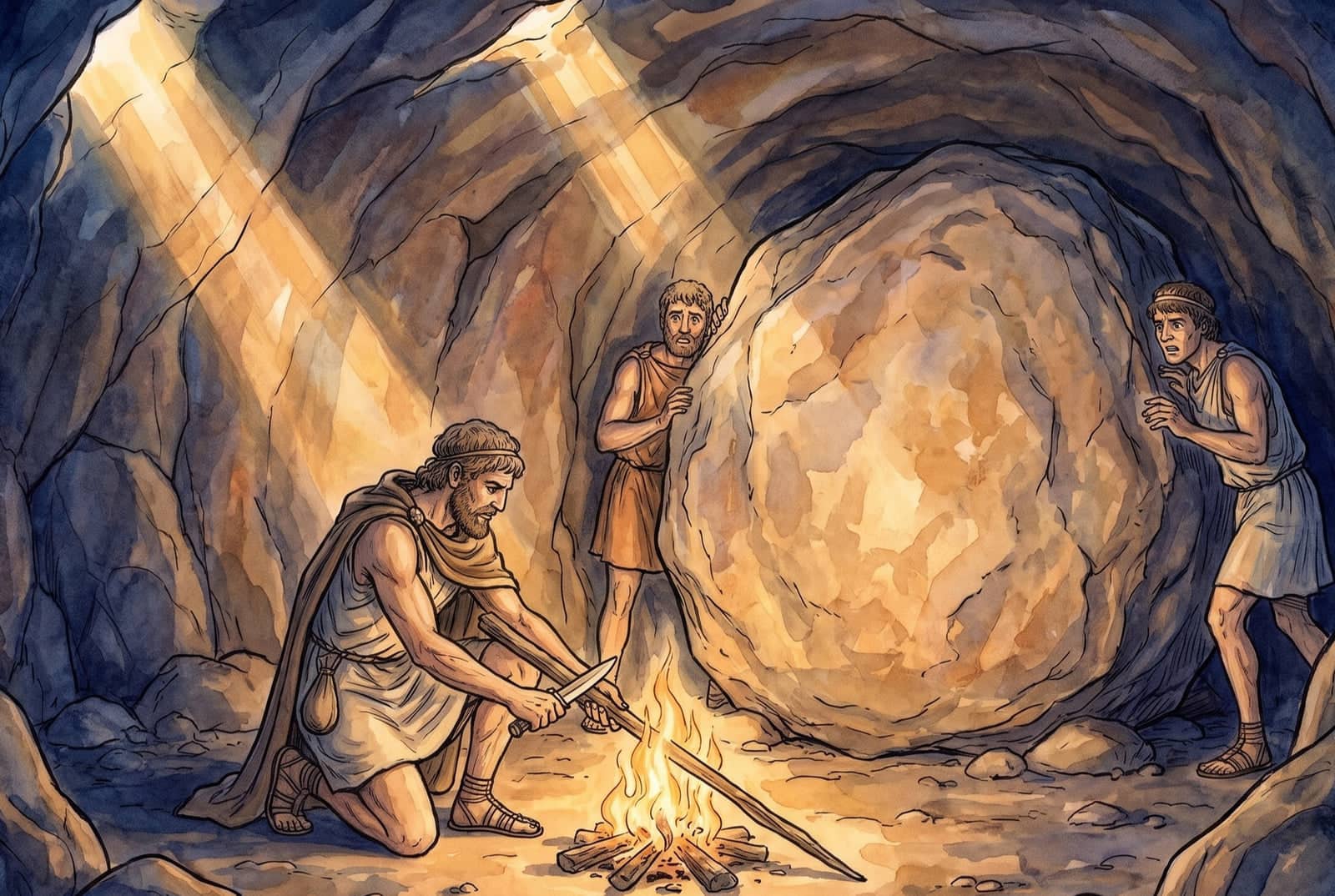
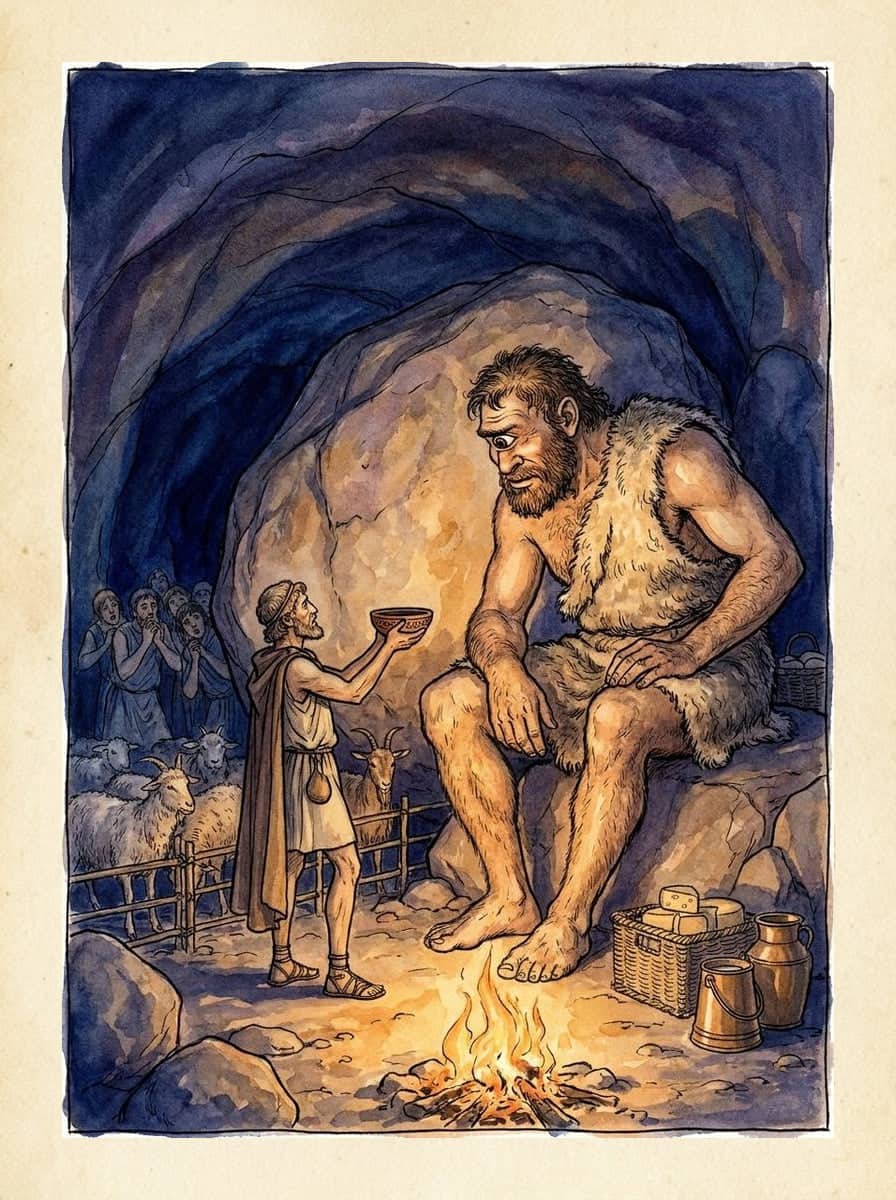
In the evening he came back from the pastures, and this time he drove all his flocks inside and left none of them out in the yard. Perhaps some notion had taken hold of him, or perhaps a god had put it into his head. He set the great stone back in the doorway, sat down and milked his ewes and goats, each in turn, and put every mother’s young one under her. When all his work was done, he seized two more of my men and ate them for his supper. Then I went up to him, holding an ivy-wood bowl full of dark wine.
“Here, Cyclops,” I said. “You have eaten plenty of human flesh. Now have some wine, and see what kind of drink we carried on our ship. I was bringing it to you as an offering, hoping you would take pity on me and help me on my way home. But there is no end to your raging. You ought to be ashamed of yourself. How can you expect anyone to come and visit you again, when you treat your guests like this?”
He took the bowl and drank, and he liked the taste so much that he begged me for more.
“Be kind and give me another bowl,” he said, “and tell me your name, right now. I want to give you a gift that will make you glad. We have wine in this country too, for our soil grows grapes and the sun ripens them, but this is something else. This is nectar and ambrosia rolled into one.”
So I poured him more. Three times I filled the bowl for him, and three times he drained it without a second thought. When I saw that the wine had gone to his head, I spoke to him as smoothly as I could.
“Cyclops, you ask me my name, and I will tell you. Now give me the gift you promised. My name is Nobody. Nobody is what my mother and father have always called me, and all my friends as well.”
But the cruel monster answered, “Then I will eat all Nobody’s friends first and keep Nobody for last. That is the gift I will give him.”
As he spoke he toppled over and lay flat on his back, his great neck bent to one side, and a deep sleep came over him. Then, because he was so drunk, he was sick, and wine and lumps of human flesh came pouring out of his mouth. At once I pushed the stake deep into the embers to heat it, and I kept encouraging my men, so that none of them would lose his nerve. When the olive wood, green as it was, was just about to catch fire, I pulled it out of the flames, glowing hot, and my men gathered around me, for a god had filled their hearts with courage. We drove the sharp end into the monster’s eye, and I leaned on it from above with all my weight and twisted it round and round, the way a shipwright bores a hole in a plank with a drill, while two men below keep it spinning with a strap for as long as they like. In the same way we twisted the red-hot stake in his eye, and the blood boiled up around it as we turned it. The steam from the burning eyeball scorched his eyelids and eyebrows, and the roots of the eye crackled in the fire. When a blacksmith plunges an axe or a hatchet into cold water to temper it, which is what gives iron its strength, the metal gives a great hiss. Just so did the Cyclops’s eye hiss around the olive stake. He let out a terrible howl that rang through the cave, and we ran back in fright. He tore the stake out of his eye, dripping with blood, and flung it away from him, mad with rage and pain. Then he roared out to the other Cyclopes who lived in caves on the windy heights nearby. They heard him and came from every direction, and gathered around the cave asking what was wrong.
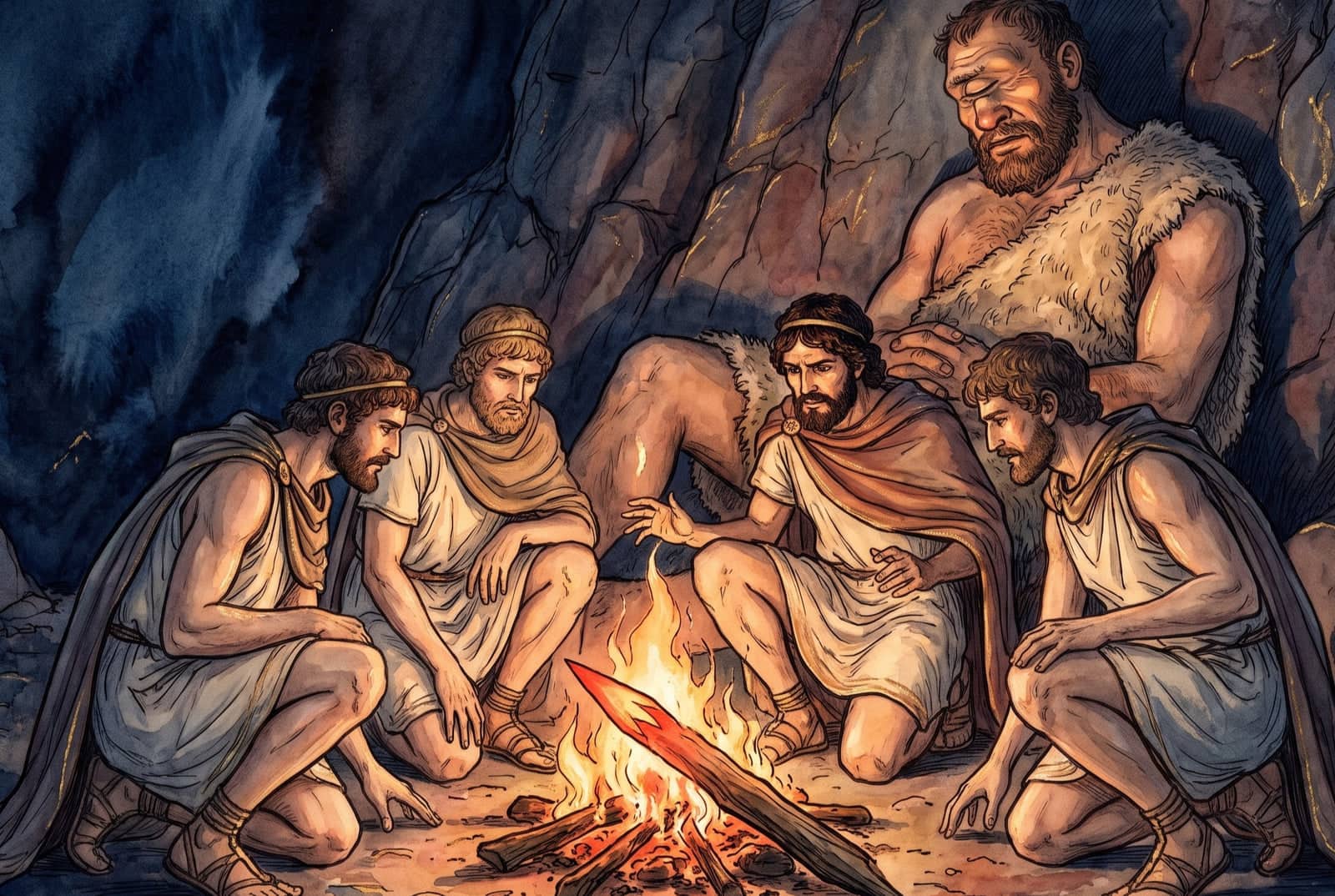
“What is the matter, Polyphemus,” they said, “that you shout like this in the middle of the night and keep us all awake? Surely nobody is driving off your sheep? Surely nobody is trying to kill you, by trickery or by force?”
From inside the cave Polyphemus shouted back, “Nobody is killing me! Nobody is killing me by trickery, not by force!”
“Well then,” they answered, “if nobody is attacking you, you must be ill. When Zeus sends a sickness, there is nothing anyone can do. You had better pray to your father, Poseidon.”
With that they went away, and I laughed to myself at how well my clever trick had worked. But the Cyclops, groaning in agony, groped around with his hands until he found the stone, and he took it away from the doorway. Then he sat down in the entrance with his arms stretched out, to catch anyone who tried to slip out among the sheep, for he thought I might be foolish enough to try it.
I racked my brains for a way to save my own life and the lives of my friends. I turned over one plan after another, like a man who knows his life depends on it, for the danger was very great. In the end this seemed the best. The rams were big and well fed, with thick dark fleeces. Without a sound I tied them together in threes, using the twisted twigs the wicked monster slept on. The middle ram of each three was to carry a man underneath it, and the two on either side would shield him, so that every man had three sheep to hide him. For myself, there was one ram finer than all the others. I took hold of his back, tucked myself into the thick wool under his belly, and hung there face upward, gripping his fleece with both hands and holding on patiently the whole time.
So we waited in great fear until morning. When rosy-fingered Dawn, the child of morning, appeared, the rams hurried out to pasture, while the ewes bleated around the pens waiting to be milked, their udders fit to burst. Their master, though he was in terrible pain, ran his hands along the backs of all the sheep as they stood before him, but he was not clever enough to guess that my men were tied beneath their woolly bellies. Last of all came the great ram, weighed down by his thick fleece and by me with all my cunning. Polyphemus laid his hands on him and spoke to him.
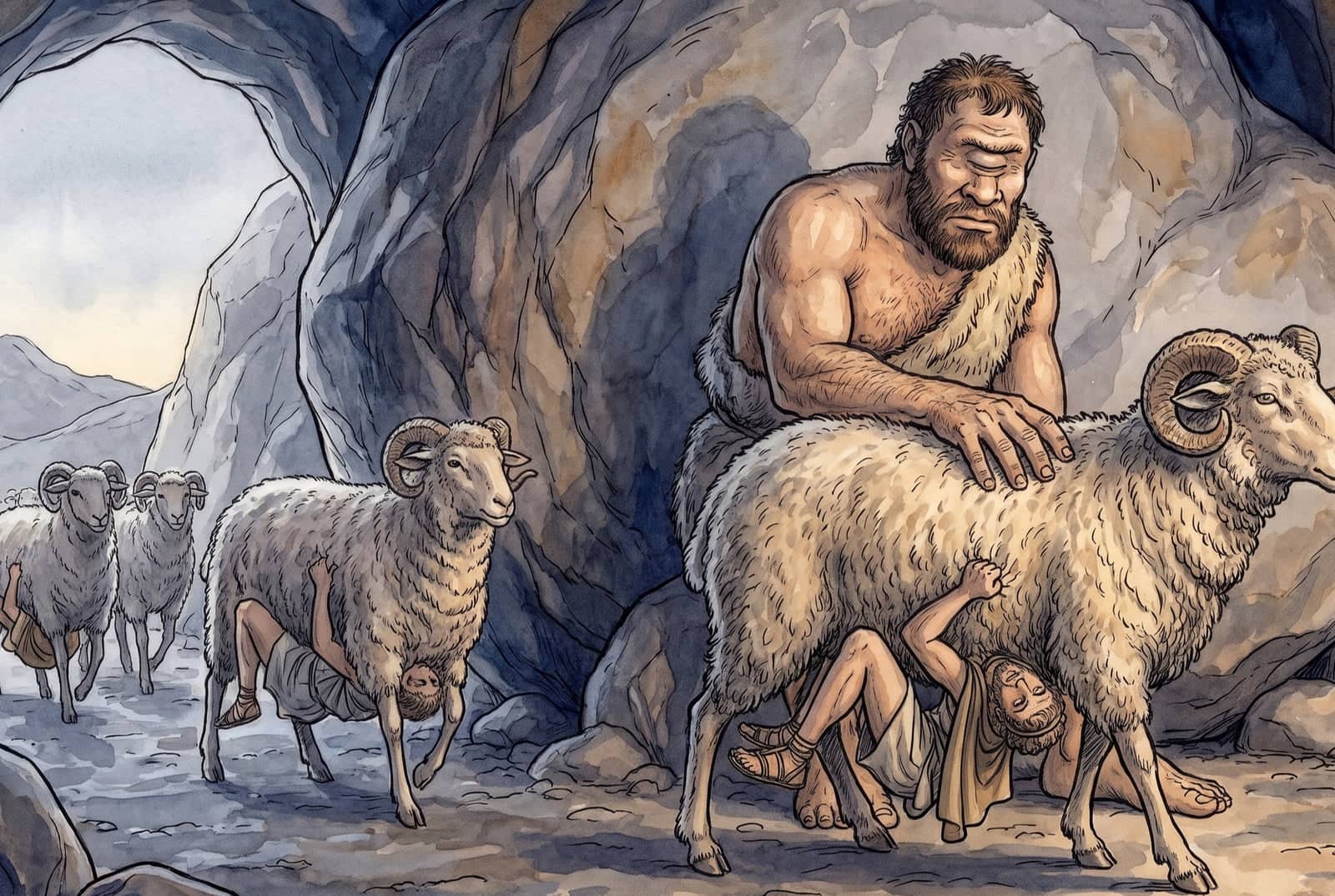
“My good ram, why are you the last to leave the cave this morning? You never used to let the ewes go ahead of you. You always led the flock, running out first to the flowery meadows and the bubbling springs, and you were always the first to come home in the evening. And now you are the very last of all. Is it because you know your master has lost his eye? That wicked Nobody and his miserable crew got me drunk and blinded me. But I will have his life yet. If only you could understand and speak, and tell me where the wretch is hiding! I would dash his brains against the ground until they splattered all over the cave. Then I would have some comfort for all the harm this good-for-nothing Nobody has done me.”
Then he let the ram go out through the door. When we had gone a little way from the cave and the yard, I let go of the ram first and then untied my friends. The sheep were very fat, and by keeping them always turned the right way we managed to drive them all down to the ship. Our shipmates were overjoyed to see those of us who had escaped death, but they wept for the others the Cyclops had killed. I would not let them cry. With nods and frowns I signalled to them to be quiet, and told them to get all the sheep aboard at once and put out to sea. They climbed in, took their places at the benches and struck the grey sea with their oars. When we were as far out as a shout can carry, I began to mock the Cyclops.
“Cyclops,” I called, “you should have taken a better look at the man whose friends you ate in your cave! You brute, eating your guests in your own home! Your wickedness was bound to catch up with you, and now Zeus and the other gods have punished you for it.”
That made him angrier than ever. He broke off the top of a high mountain and hurled it at us, and it fell just in front of our ship, very nearly striking the end of the rudder. The sea heaved as the rock plunged in, and the wave it raised swept us back toward the land and drove us toward the shore. But I seized a long pole and pushed us off, and with nods I urged my men to row for their lives, and they bent to their oars with all their strength. When we were twice as far out as before, I was ready to shout at the Cyclops again, but my men begged me to hold my tongue.
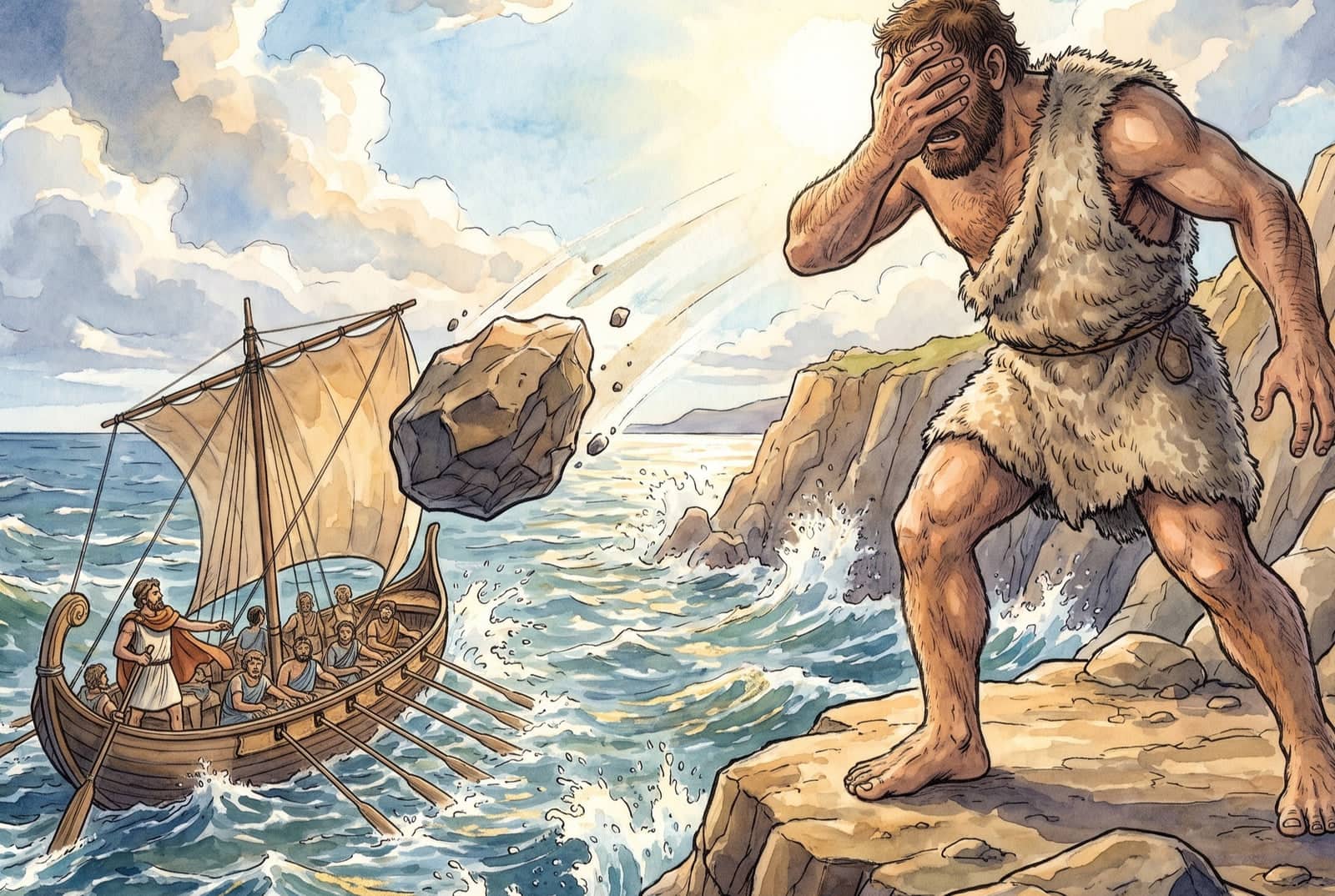
“Don’t be so reckless,” they said. “Why make that savage any angrier? He has already thrown one rock at us that drove us back toward the land, and we were sure it was the end of us. If he had heard one more sound from us, he would have smashed our heads and our ship’s timbers to pulp with the jagged rocks he would have flung at us. He can throw a very long way.”
But I would not listen, and in my anger I shouted back at him, “Cyclops, if anyone ever asks you who put out your eye and spoiled your looks, tell him it was the brave warrior Odysseus, son of Laertes, whose home is in Ithaca.”
At this he groaned and cried out, “Oh no, then the old prophecy has come true! There was once a seer here, a brave man and a tall one, Telemus, son of Eurymus. He was a fine prophet, and he did all the prophesying for the Cyclopes until he grew old. He told me that all this would happen to me one day, and that I would lose my sight at the hands of Odysseus. I was always expecting some tall, splendid man of tremendous strength. And now a puny little weakling has blinded me, after getting the better of me with wine. Come back, Odysseus, so that I can give you gifts as a good host should, and ask Poseidon to speed you on your way, for Poseidon and I are father and son. He will heal me if he chooses, and no one else can, neither god nor man.”
Then I answered him, “I only wish I could be as sure of killing you and sending you down to the House of Hades as I am that it will take more than Poseidon to heal that eye of yours.”
At that he lifted his hands toward the sky and prayed. “Hear me, great Poseidon. If I truly am your son, grant that Odysseus never reaches his home alive. Or if he must get back to his friends in the end, let him come late and in misery, after losing all his men, on a ship that belongs to someone else, and let him find trouble waiting in his house.”
So he prayed, and Poseidon heard him. Then the Cyclops picked up another rock, far bigger than the first, swung it high and hurled it with tremendous force. It fell just short of the ship, very nearly striking the end of the rudder. The sea heaved as the rock plunged in, and this time the wave carried us forward toward the shore of the island.
At last we reached the island where we had left the rest of our ships, and there we found our friends mourning for us and anxiously waiting for our return. We ran our ship up on the sand and climbed out onto the shore. We also brought the Cyclops’s sheep ashore and shared them out fairly, so that no one would have reason to complain. As for the great ram, my friends agreed that I should have him as an extra share. So I sacrificed him there on the shore and burned his thighbones for Zeus, who is lord of all. But Zeus paid no attention to my sacrifice. He was thinking only of how to destroy my ships and my friends.
So all day long, until the sun went down, we sat feasting on meat and wine. When the sun set and darkness fell, we lay down to sleep on the beach. When rosy-fingered Dawn, the child of morning, appeared, I told my men to go aboard and cast off the ropes. They took their places and struck the grey sea with their oars. And so we sailed on, sad at heart for the friends we had lost, yet glad that we ourselves had escaped death.
Retold by Talerie, Source: The Odyssey (opens in a new window)
License: Public domainCopy this text, adapt it, use it however you like. A link back to Talerie is appreciated but never required.CC0 1.0 (opens in a new window)