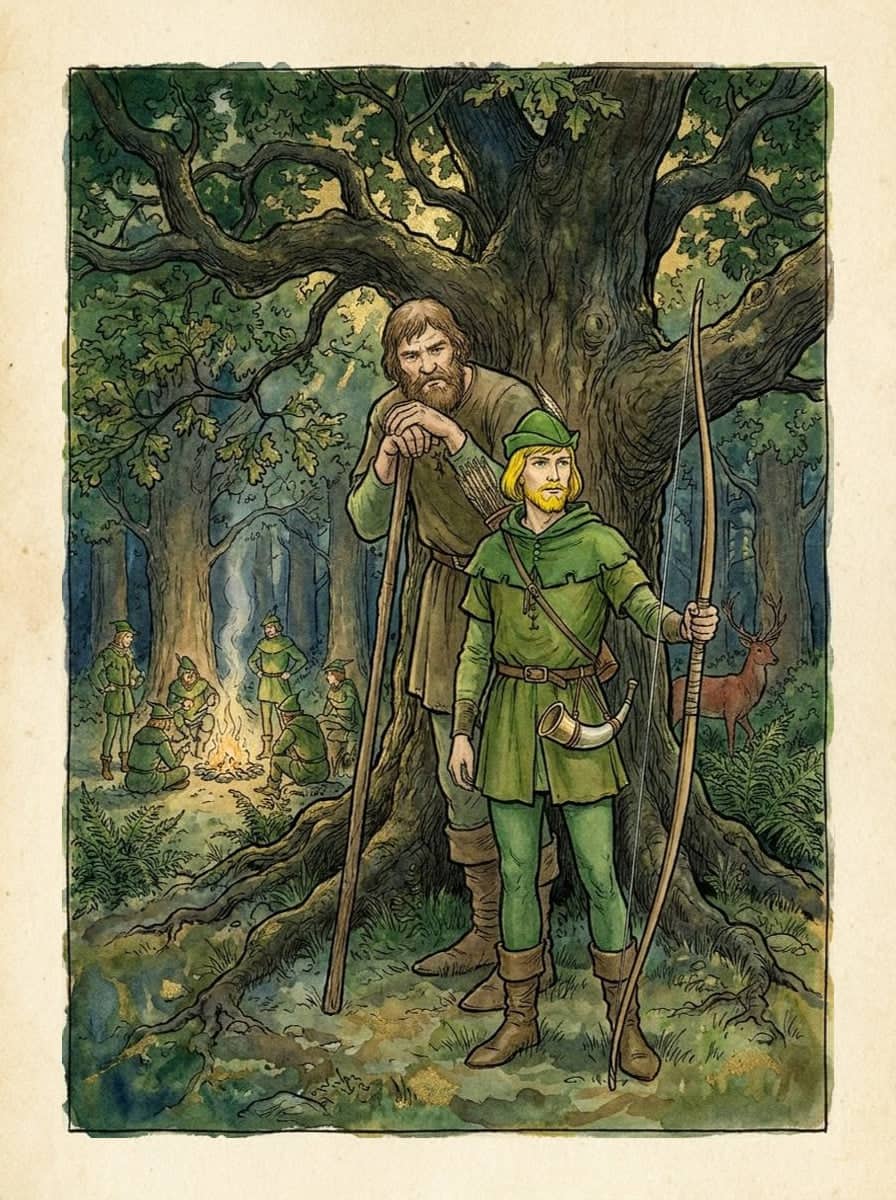
Robin Hood and his band live in Sherwood Forest and take from the greedy rich to give to the poor, while Robin outwits the sheriff and wins Little John and Friar Tuck as friends. Grown old and ill, Robin is betrayed by his cousin the prioress of Kirklees and, dying, makes Little John promise not to harm her.
“And what of Peter the Plowman? He was a good friend of mine.”
“Peter has been hanged, and his wife and children turned out of their home to beg.”
Young Robin Hood was standing beside his father, who had met a traveler from his old village. These were hard times in England. The Norman lords ruled the land and treated the Saxon common people cruelly.
“But why?” cried Robin. “Peter was one of the best men I ever knew!”
“He shot a deer in the king’s forest,” said the traveler. “The tax collector had taken everything he had, and his children were crying with hunger, so he shot the deer to feed them. The sheriff hanged him for it. And the abbot wanted his bit of land to make his garden bigger, so out went the widow and her children.”
“Laws like that are wicked,” said Robin, his eyes flashing. “When I’m a man, I will make the rich give part of their wealth to the poor.”
And when Robin grew up, that is just what he did. He gathered a band of men in Sherwood Forest who took back from the rich what they had squeezed out of the poor. The Normans called them robbers. The common people called them the merry men of the greenwood, and loved them.
Robin stayed loyal to the king, even while he defied the cruel men who ruled in the king’s name. And it was his pride that none of his men had ever harmed a woman, robbed a farmer or hurt a parish priest.
Robin was the best archer in the land, and the sheriff of Nottingham hated him more than anyone, because Robin always outwitted him. At last the sheriff had an idea.
“I’ll hold an archery contest,” he said, “with an arrow of beaten gold as the prize. That will bring Robin Hood here for certain, and then I’ll hang him.”
“Don’t go, master,” Robin’s men begged. “It’s a trap. They’ll know you by your yellow hair and your face.”
Robin only laughed. “I’ll stain my hair dark with walnut juice and put a patch over one eye. An adventure is all the better for a little danger.”
So his men came to Nottingham dressed as friars, tinkers and farmhands, and Robin came as the raggedest beggar the town had ever seen, all in tattered scarlet. The sheriff sat in velvet and gold chains, glaring about for Robin Hood, and never noticed the beggar standing ten feet away.
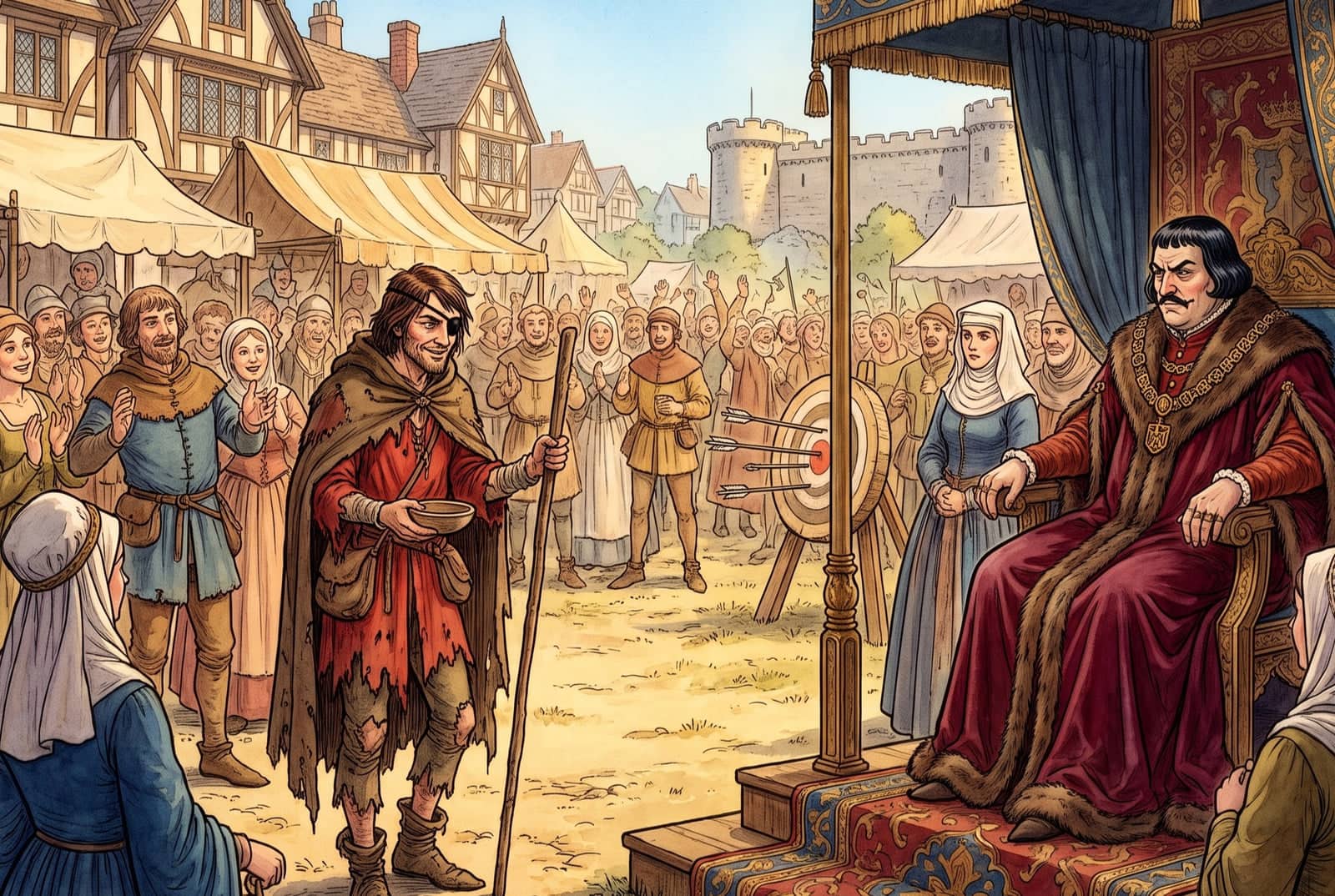
When the best ten archers were left, the sheriff scowled. “Couldn’t one of these be Robin Hood in disguise?” he asked the man-at-arms beside him.
“No, my lord,” said the man-at-arms. “Six of them I know well. Of the other four, one is too tall, one too short and one too narrow in the shoulders. That leaves this beggar, and his hair is far too dark, and he’s blind in one eye besides.”
The man-at-arms was secretly glad, for like most common folk he loved Robin Hood. Yet even he did not know Robin that day.
In the last round, Gill o’ the Red Cap shot a finger’s width from the center. Then the beggar’s arrow struck the very center, and old Adam o’ the Dell unstrung his bow. “I can never better that,” he said.
The sheriff handed over the golden arrow with a sour face. “You’re a better archer than that coward Robin Hood,” he said, “who didn’t dare show his face here today.”
All the way home, those words stung. “I can’t bear even my enemy thinking I’m a coward,” Robin told his men. “I wish the sheriff knew who won his arrow.”
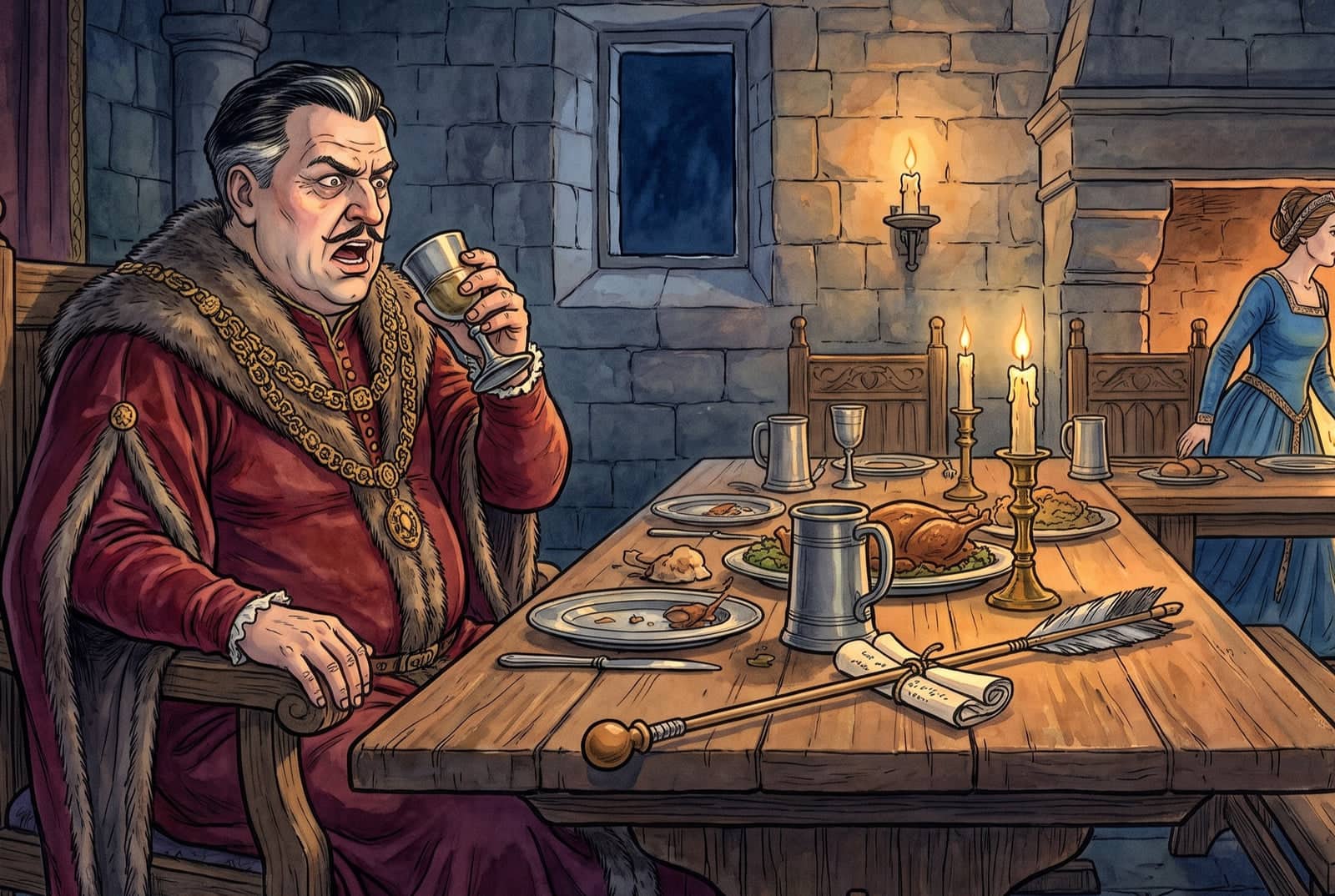
That evening the sheriff sat gloomily at supper. Suddenly an arrow flew in at the window and fell rattling among the dishes. Tied to it was a note saying that Robin Hood had won the golden arrow. When the sheriff read it, even his wife thought it best to slip quietly away.
This is how Robin met his dearest friend. One day he came to a bridge over a stream, so narrow that only one man could cross at a time. Just as he stepped on at one end, a tall young stranger stepped on at the other.
“Go back and let the better man cross,” Robin called.
“Go back yourself,” said the stranger. “I’m the better man.”
“Then let’s fight for it,” said Robin, and he cut himself an oak staff. “Whoever knocks the other into the water wins.”
They fought for an hour, then another, and took plenty of bruises, but neither could knock the other down. At last the stranger swung his staff so hard that Robin tumbled into the stream.
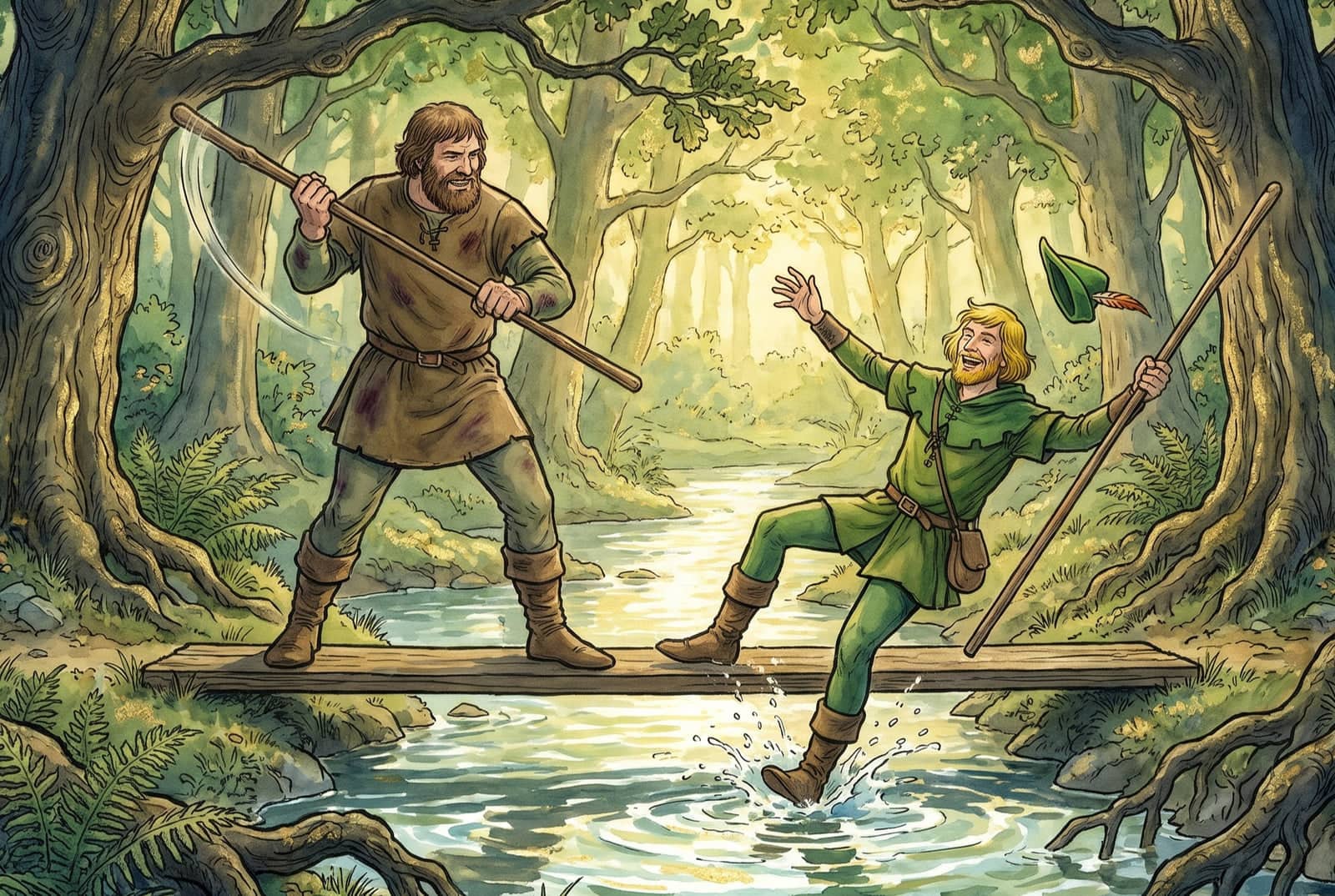
Robin lay there laughing, for he never held a grudge. He splashed ashore and blew his horn, and his men came running through the trees in Lincoln green.
“That stranger knocked you into the water?” cried Will Stutely. “Then he’ll get a dunking himself!”
“No,” said Robin. “It was a fair fight, and he won.” He turned to the stranger. “I’m Robin Hood. Will you join my band?”
“If any of you can shoot better than I can, I will,” said the stranger.
A strip of white bark was set up on an oak eighty yards away. The stranger hit the very center. Then Robin shot, and his arrow struck the stranger’s arrow and split it in two.
“With all my heart I’ll join you,” said the stranger.
“What’s your name?” asked Will Stutely.
“John Little.”
“He’s far too small to be called John Little,” laughed Will. “Let’s call him Little John!”
And from that day Little John was Robin’s right-hand man.
Another day the outlaws found a young man with a harp, lying face down in the forest and sobbing. His name was Allen-a-Dale.
“My sweetheart, Ellen, is to marry a rich old knight in two days,” he told Robin. “Her father wants it, and she will obey him, but it will break her heart.”
“Then we’ll go to the church and see that she marries you instead,” said Robin. “But we’ll need a priest.”
“I know just the man,” said Will Scarlet. “Friar Tuck of Fountain Dale.”
So Robin set out, and near the river he heard two voices talking below. He peeked over the bank. A stout friar sat alone against a willow with a meat pie in his lap, pretending to be two people. He offered pie to his right hand, then to his left, and at last he coaxed himself into a song, singing the maid’s part high and squeaky and the youth’s part deep and gruff. It was so funny that Robin joined in.
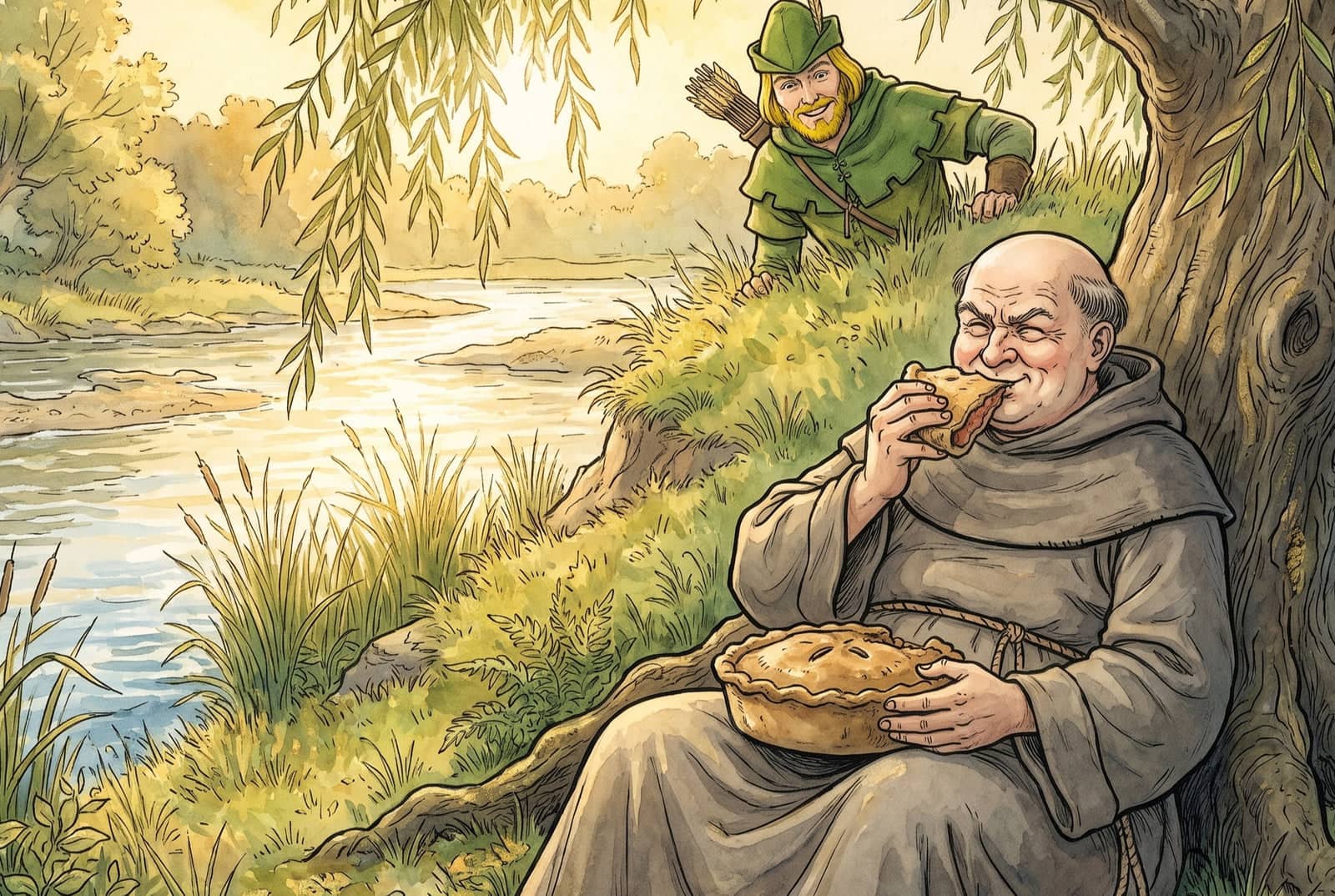
Up leaped the friar, drawing a heavy sword. “What spy have we here?”
“Folks who have sung together shouldn’t fight,” said Robin. “Is the friar of Fountain Dale on this side of the river or the other?”
“That,” said the friar, “is something you’ll have to find out for yourself.”
“Then carry me across,” said Robin, “or my fine clothes will be spoiled.”
The friar laughed. “Saint Christopher carried travelers, so why shouldn’t I? Give me your sword so it won’t get wet.”
He carried Robin over, set him down gently and pointed the sword at him. “Now I’m wet,” he said, “so you carry me back.”
Robin had no choice. But in the water he loosened the friar’s sword belt, and on the bank he snatched it away. Now Robin had both swords. “Carry me over again,” he said.
The friar did, but halfway across he dropped Robin into the river “to cool him off.” Then they fought for hours, and neither could win. So they became friends, and Friar Tuck agreed to marry Allen-a-Dale and Ellen.
On the wedding day, Robin hid his men near the church of Emmet and went in dressed as a harper. The prior of Emmet had come to perform the ceremony, and the old bridegroom, Sir Stephen, was glad to have music.
Then Ellen’s father led her in. She was very beautiful, but pale and drooping like a broken lily.
“Maiden,” Robin asked her, “are you marrying this knight of your own free will?”
“No,” sobbed Ellen. “I want no one but my own true love, Allen-a-Dale.”
“Then Allen-a-Dale you shall marry!” cried Robin, and he blew his horn. His men poured into the church with Friar Tuck among them.
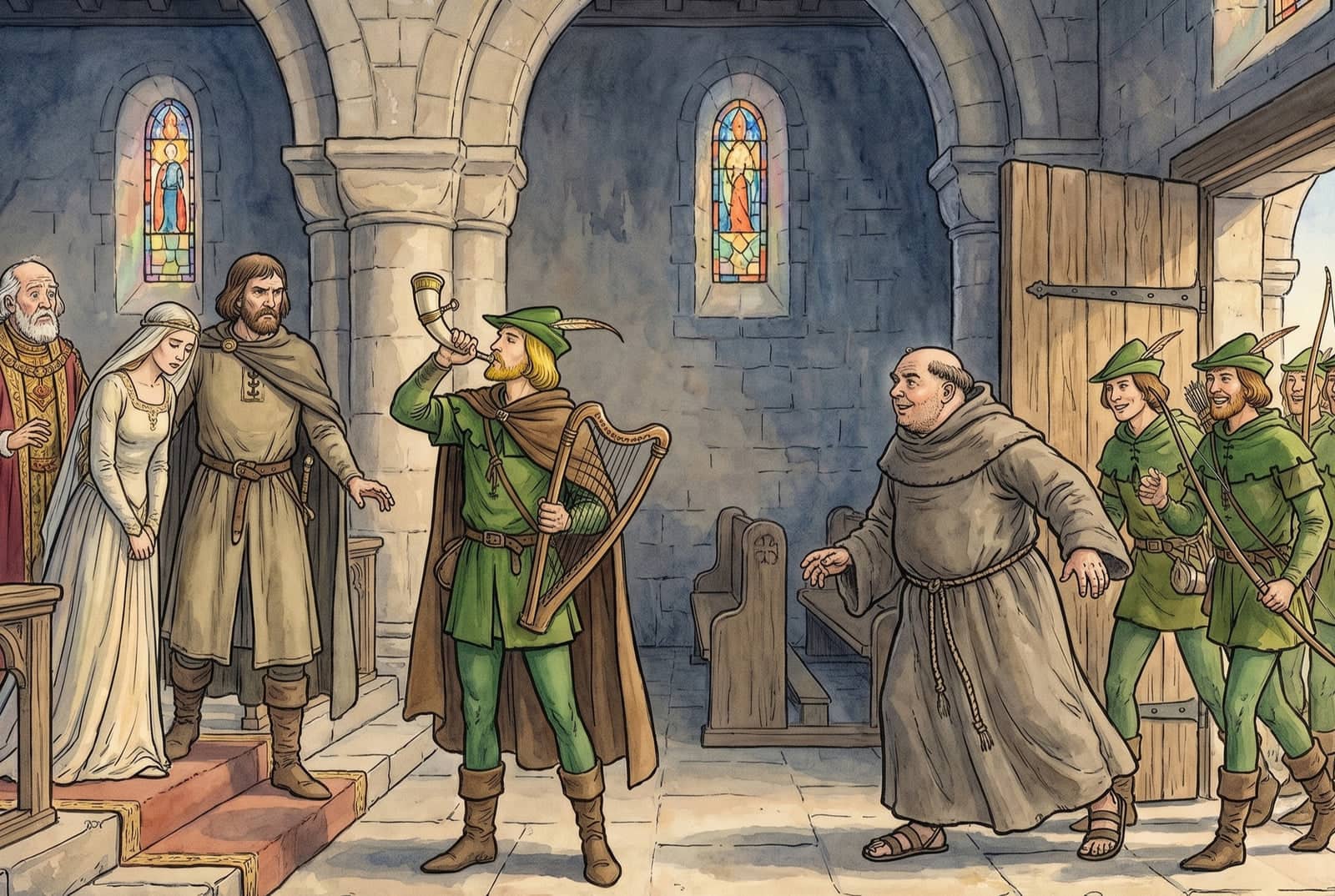
Sir Stephen stormed out, saying he would not marry the girl now for all of England, and the prior of Emmet swept out after him.
“You can’t hold a wedding,” the prior called from the door. “You have no priest.”
“Am I not a priest?” bellowed Friar Tuck, and the prior hurried away.
“But the banns haven’t been read,” said Ellen’s father, for a wedding had to be announced in church three times first.
“Then I’ll read them,” roared Friar Tuck. He called out the banns three times, and then, in case that wasn’t enough, six times more.
“But I can’t marry without my father’s blessing,” sobbed Ellen.
Robin strode up to her father with a bag of gold in each hand. “Here are two hundred gold angels for her dowry if you give your blessing,” he said. “If you don’t, she’ll be married just the same, and you’ll get nothing.”
So Ellen’s father gave his blessing, and the wedding went ahead. Allen-a-Dale and Ellen lived happily ever after, and Friar Tuck never went back to Fountain Dale. He became one of the merry men.
Robin had a rule for rich travelers. He brought them into the forest, gave them a feast and then made them pay for it. Everything they carried was split into three piles: one went back to the guest, one stayed with the band and one went to the poor.
One day Little John brought back the rich Bishop of Hereford with five mules loaded with goods. Robin, meanwhile, had met no one but a knight who rode along sighing.
“What troubles you?” asked Robin.
“To save my son’s life I borrowed four hundred pounds from the prior of Emmet,” said the knight, “and pledged my lands. Now he won’t give me a single day more. He means to take everything and turn me out a beggar.”
“Men in trouble always have friends in Sherwood,” said Robin. “Come with me.”
The bishop’s packs held rich goods and fifteen hundred pounds in gold. The men split it all into three, and Robin gave the share for the poor to the knight. “The churchmen robbed you,” he said, “so the churchmen shall help you.”
“I’ll take it only as a loan,” said the knight. “I’ll pay it back to the bishop, or to you.”
“Pay it to me,” said Robin, “and I’ll use it for the poor. The bishop would only lock it away.” So the knight saved his lands, and the greedy prior had to give them up.
King Richard had heard so much about Robin Hood that he longed to see him. So he dressed as a fat abbot, with seven of his men as friars, and rode into Sherwood.
Robin’s men stopped them, took the king’s gold and gave half of it back, for they never left any man in need. Then they gave their guests a feast.
“Will you take off your hood, holy father?” asked Robin.
“My brothers and I have vowed not to show our faces,” said the abbot. Robin never dreamed it was the king.
After the feast they shot at a garland of flowers hung on a stake far away. “Whoever misses the garland,” said Robin, “gets a box on the ear, as hard as it can be given.”
Robin’s men shot well. Wat the Tinker missed by a little and got a blow that sent him tumbling head over heels.
Last of all Robin shot. His first two arrows flew true, but the third swerved and landed an inch outside the garland. The men roared with laughter.
“I’ll take my blow from our guest,” said Robin. He thought a churchman’s hand would be soft.
But the abbot rolled up his sleeve, showed an arm thick with muscle and struck a blow that knocked Robin flat.
“Who are you?” gasped Robin, sitting up. “No churchman hits like that.”
The guest threw back his hood, and Robin knew his king. He knelt and his men knelt with him. “Your Majesty, you have no subjects more loyal than we are,” said Robin. “We have harmed no one but the greedy rich who oppressed your people. Pardon us, and we will serve you always.”
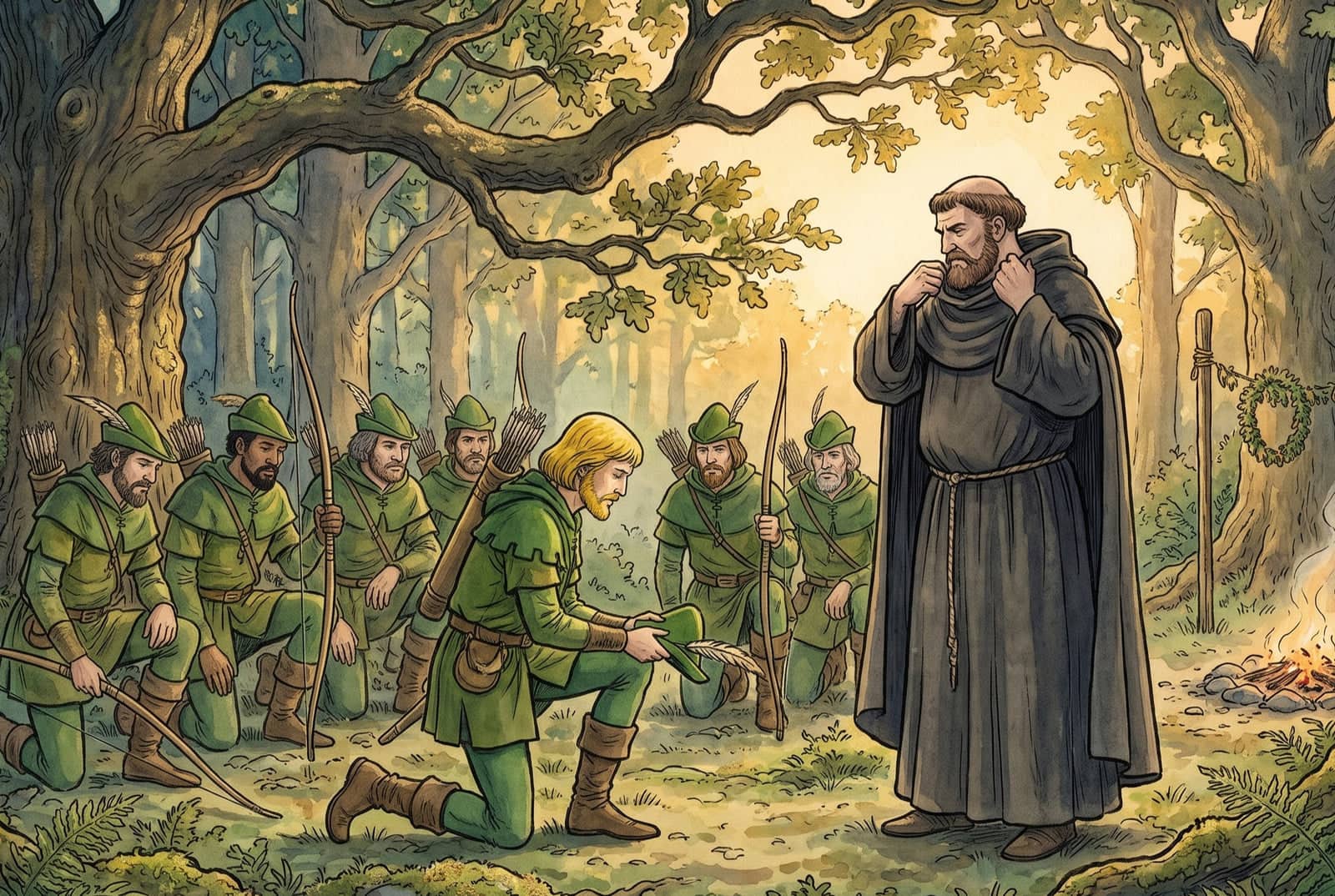
“I forgive you,” said King Richard, “if you’ll come and serve me at court.”
So Robin served King Richard well. But after Richard died, his brother John became king, one of the worst kings England ever had. Then Robin went back to Sherwood, his merry men gathered around him again, and once more they were outlaws.
At last Robin grew old and fell ill with a fever. “I’ll go to my cousin, the prioress of Kirklees,” he said. “She’ll bleed me, and I’ll get well.” In those days people believed that letting out a little blood could cure a fever.
Robin had helped his cousin become prioress, but she loved one of his enemies, and she betrayed him. She opened a vein in his arm and never closed it, then locked him in a high room at the top of the priory. All day his strength slipped away.
At evening Robin lifted his horn and blew. The sound was weak, but Little John heard it, for the prioress had shut him out and he had waited outside all day.
Little John seized a huge stone mortar, smashed in the locked door and ran up the stairs. He saw at once that his master was dying. “I’ll burn this priory to the ground!” he cried.
“No,” said Robin, with a weak but wonderfully sweet smile. “I have never hurt a woman in my life, nor let my men do it. I won’t allow it now.”
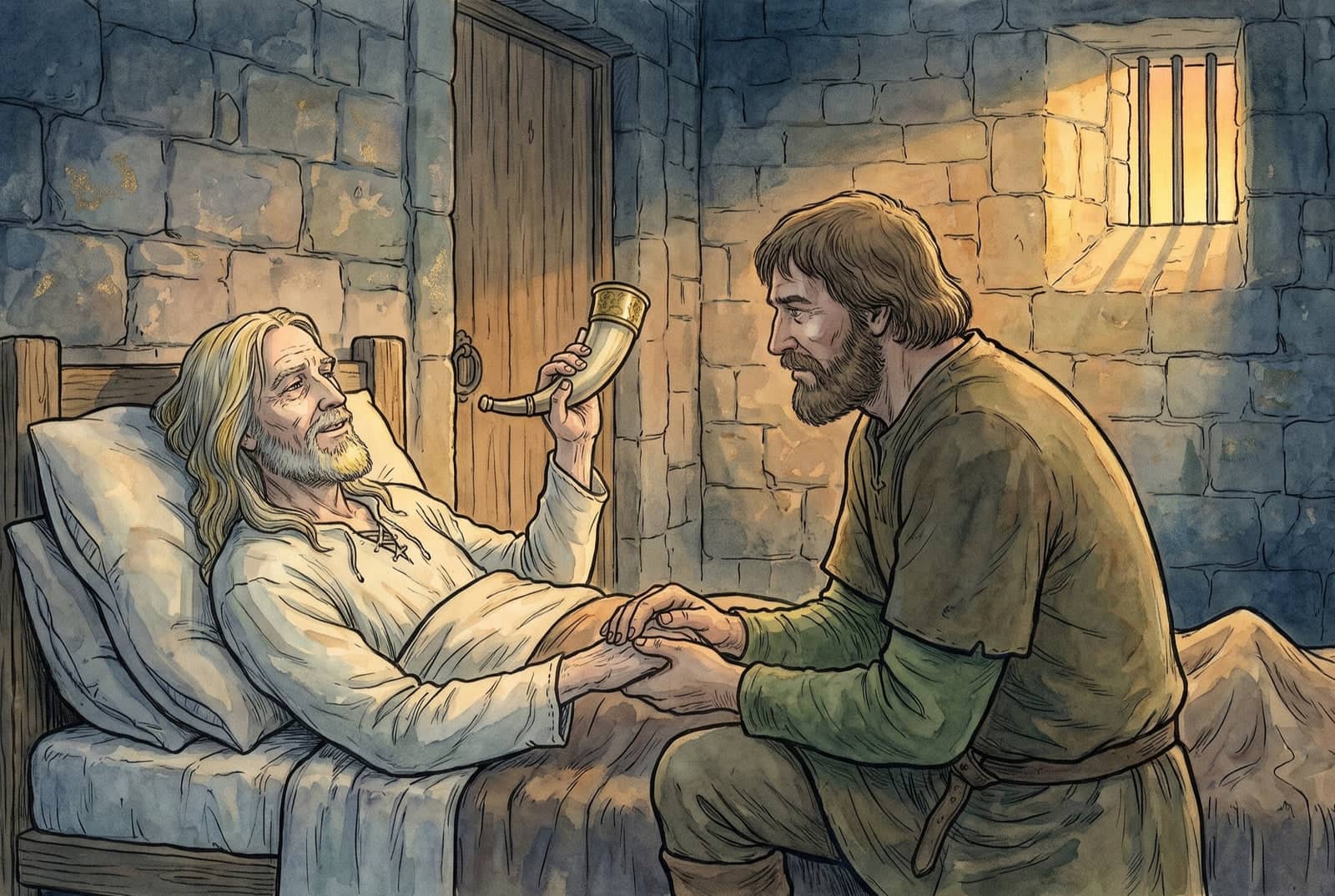
And with almost his last breath, Robin made Little John promise not to harm the prioress.
Retold by Talerie from Stories of Robin Hood (opens in a new window)License: Public domainCopy this text, adapt it, use it however you like. A link back to Talerie is appreciated but never required.CC0 1.0 (opens in a new window)