Beauty and the Beast
 Jeanne-Marie Leprince de Beaumont
15 min readages 6 and uptalerie.com/en/tales/beauty-and-the-beast
A merchant’s youngest daughter offers to live with a fearsome enchanted Beast to save her father’s life, and grows fond of her strange, gentle host. When she agrees to marry him, the Beast becomes a handsome prince, and the next day their wedding is celebrated with great splendour as her brothers and sisters dance.
Once upon a time, in a country far from here, there lived a merchant so fortunate in everything he undertook that he grew enormously rich, and his six sons and six daughters were used to having whatever they fancied.
Then misfortune came all at once. His house burned to the ground, his ships were lost at sea, and the clerks he trusted in distant countries cheated him. Nothing was left but a cottage in a dark forest, a hundred leagues from the town. The friends who had crowded round the family while they were rich now offered nothing.
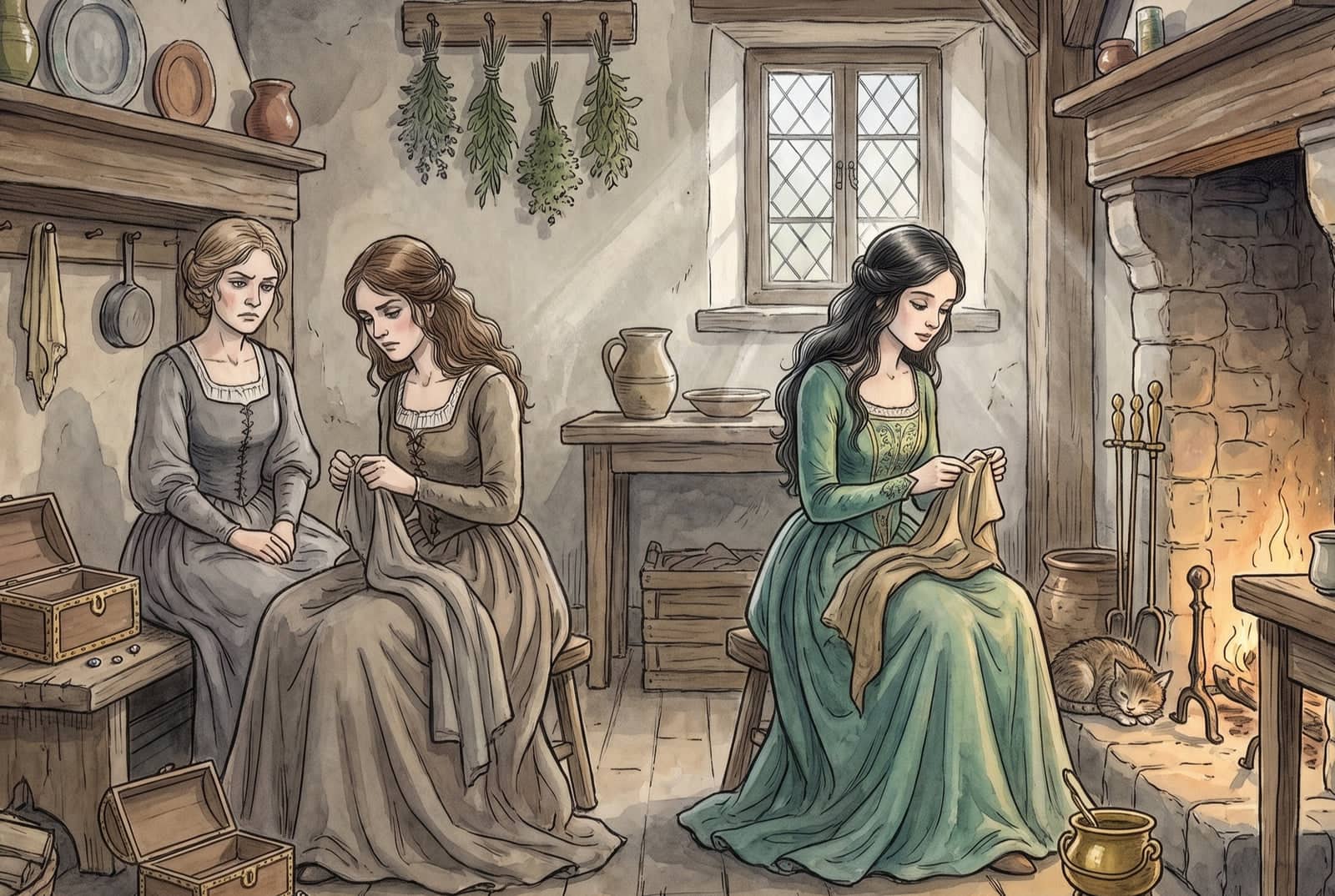
The sons worked in the fields and the girls with their hands. The elder sisters mourned their lost gowns from morning until night, and told the youngest, who alone tried to be cheerful, that this wretched life must be all she was fit for. Yet she was kinder and cleverer than any of them, and so lovely that everyone called her Beauty.
Two years later, word came that one of the merchant’s ships, long given up for lost, had reached port with a rich cargo. He set out for the town to learn the truth, and his children loaded him with orders for jewels and gowns. Only Beauty asked for nothing.
“And what shall I bring for you, Beauty?” he said.
“The only thing I want is to see you come home safely,” she answered.
That vexed her sisters, and her father insisted that she choose something.
“Then bring me a rose, dear father,” she said. “I have not seen one since we came here, and I love them so much.”
In the town he found that his old companions, believing him dead, had shared out the cargo among themselves, and he came away as poor as he went. Night caught him in the forest, the snow too deep for his horse to go on, and he crouched in the hollow of a great tree until daybreak while the wolves howled.
The snow had covered every path, but at length he made out a track that led him into an avenue of orange trees in flower and fruit, where not a flake had fallen, and at the end of it stood a splendid castle. He passed through room after room, all warm, all beautifully furnished, all silent, and finding nobody to ask for food, he fell asleep beside a clear fire.
Hunger woke him hours later. He was still alone, but a table had been drawn up with a good dinner on it; and though he searched the palace afterwards, he found not so much as a servant.
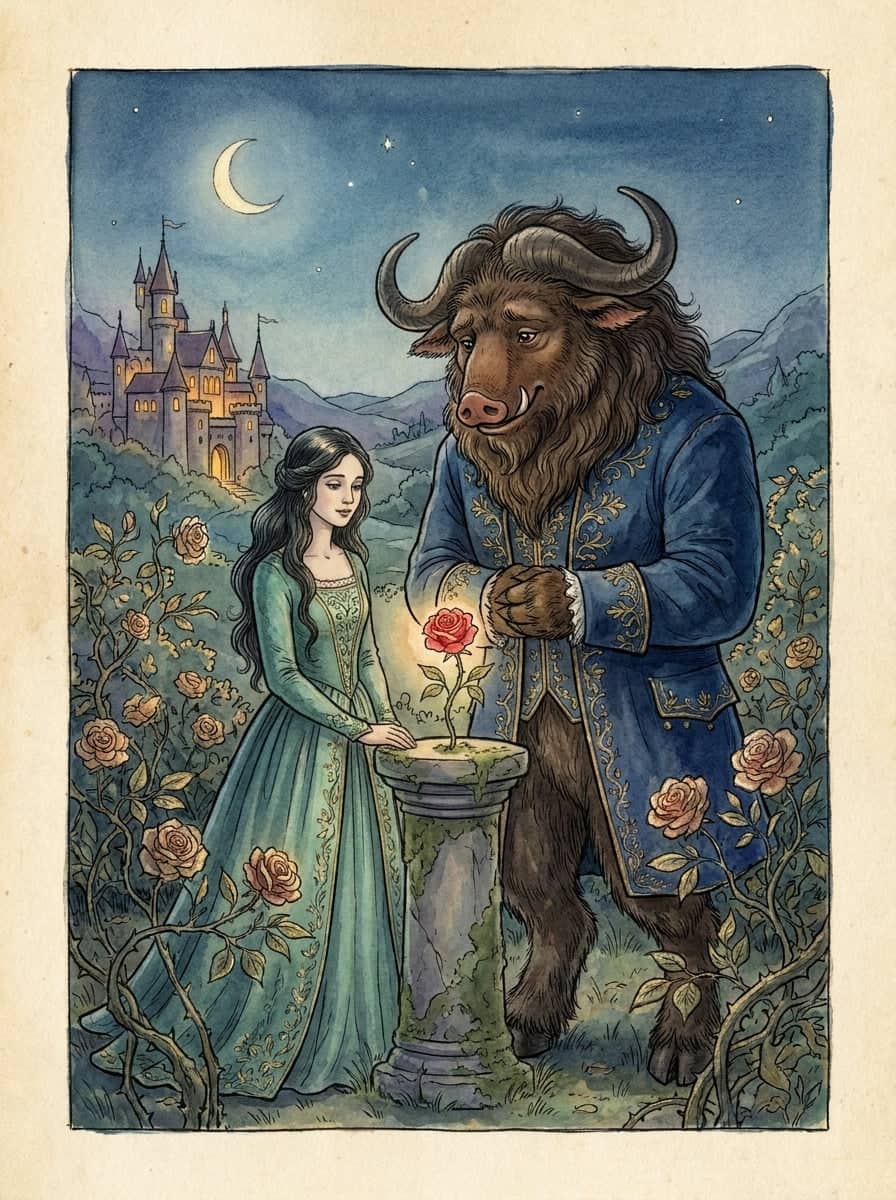
In the garden it was summer, though winter lay over all the rest of the world, and he thought that everything here must be meant for him. He turned down the path to the stable, meaning to ride home and fetch his children. A hedge of roses grew on either side, and the flowers reminded him of his promise. He had just picked one when a terrible noise made him turn. Behind him stood a Beast, and his voice shook the air.
“Who told you that you might pick my roses? Was it not enough that I sheltered you and treated you kindly? Is this how you thank me? Your insolence will not go unpunished.”
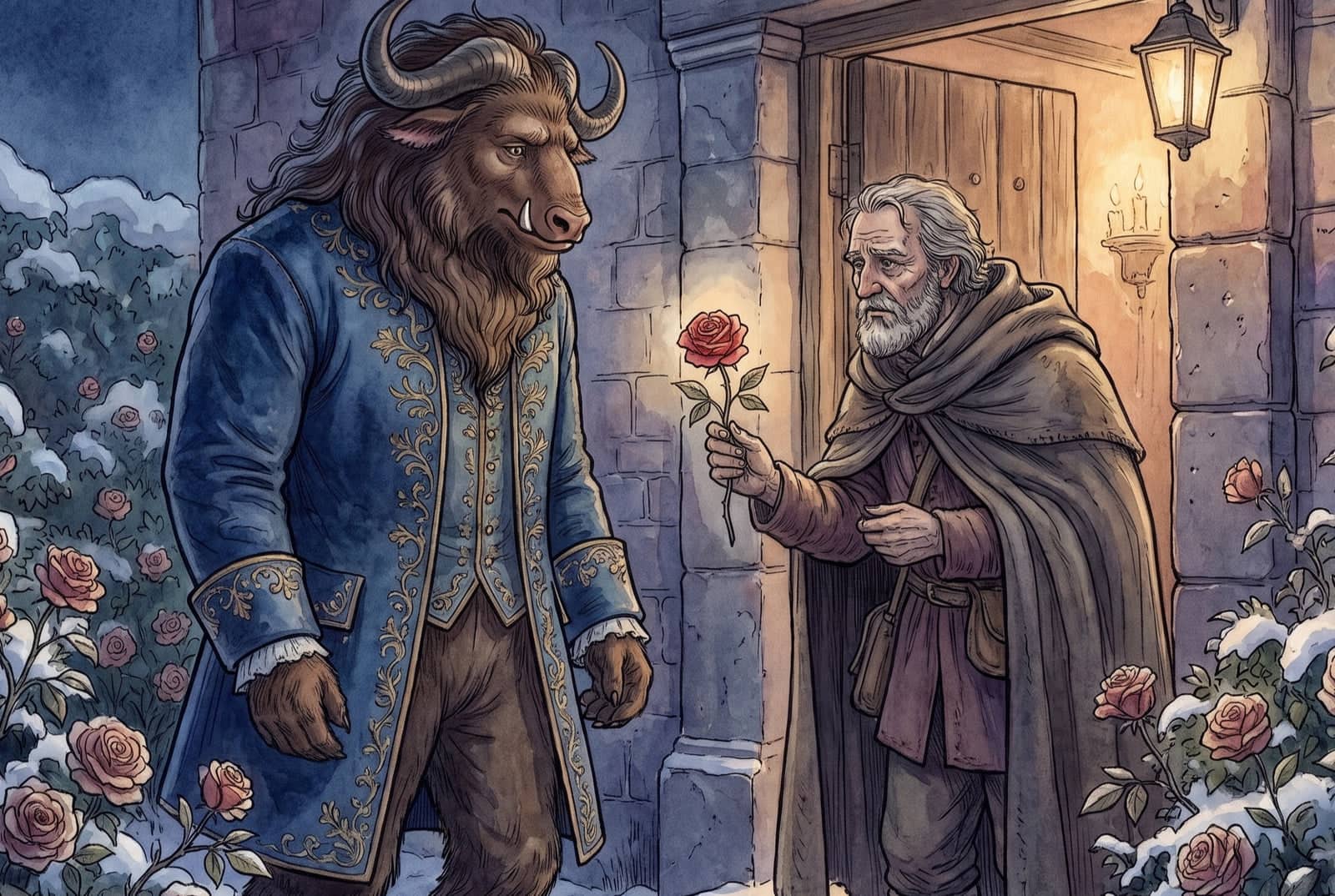
The merchant dropped the rose and fell on his knees. “Forgive me, noble sir. Your hospitality was so magnificent that I never imagined one flower could offend you.”
“You are quick with excuses,” said the Beast, “but they will not save you.”
Then, in despair, the merchant told him everything: his ruin, his journey, the daughters who had asked for jewels, and the youngest who had asked only for a rose.
The Beast was quiet a moment, and when he spoke again his voice was less terrible. “I will forgive you on one condition: you must give me one of your daughters.”
“How could I buy my own life with my child’s?” said the merchant.
“If she comes at all, she must come willingly,” the Beast answered. “See whether one of them loves you enough to save your life. I give you a month. If none of them will come, you must return alone and belong to me. And do not imagine you can hide, for if you break your word I will come and fetch you.”
The merchant agreed, though he did not believe any daughter of his could be persuaded, and that evening he could hardly eat the supper laid for him.
“Do not get up tomorrow,” said the Beast, when he came, “until you see the sun and hear a golden bell ring. The horse in the courtyard will carry you home, and bring you back when you come with your daughter a month from now. Take a rose to Beauty, and remember your promise.”
In the morning he picked the rose and rode home, and his children ran out to meet him, sure from the splendid horse that the news was good. He only said, giving Beauty her flower, “Here is what you asked me for. You little know what it has cost.”
Then he told them the whole story. The girls wept and the sons began to plan how they might kill the Beast, and the elder sisters said that if Beauty had asked for something sensible this would never have happened.
“I did cause it,” Beauty said, “but I did it innocently. Who could have guessed that a rose would bring so much sorrow? The harm is mine, so the suffering should be mine too. I shall go back with my father and keep his promise.”
Nobody would hear of it, but Beauty would not be moved. She divided her small possessions among her sisters and rode away behind her father. Night fell, and coloured lights began to shine among the trees, and fireworks blazed above them, and beyond the avenue of orange trees the palace was lit from roof to ground.
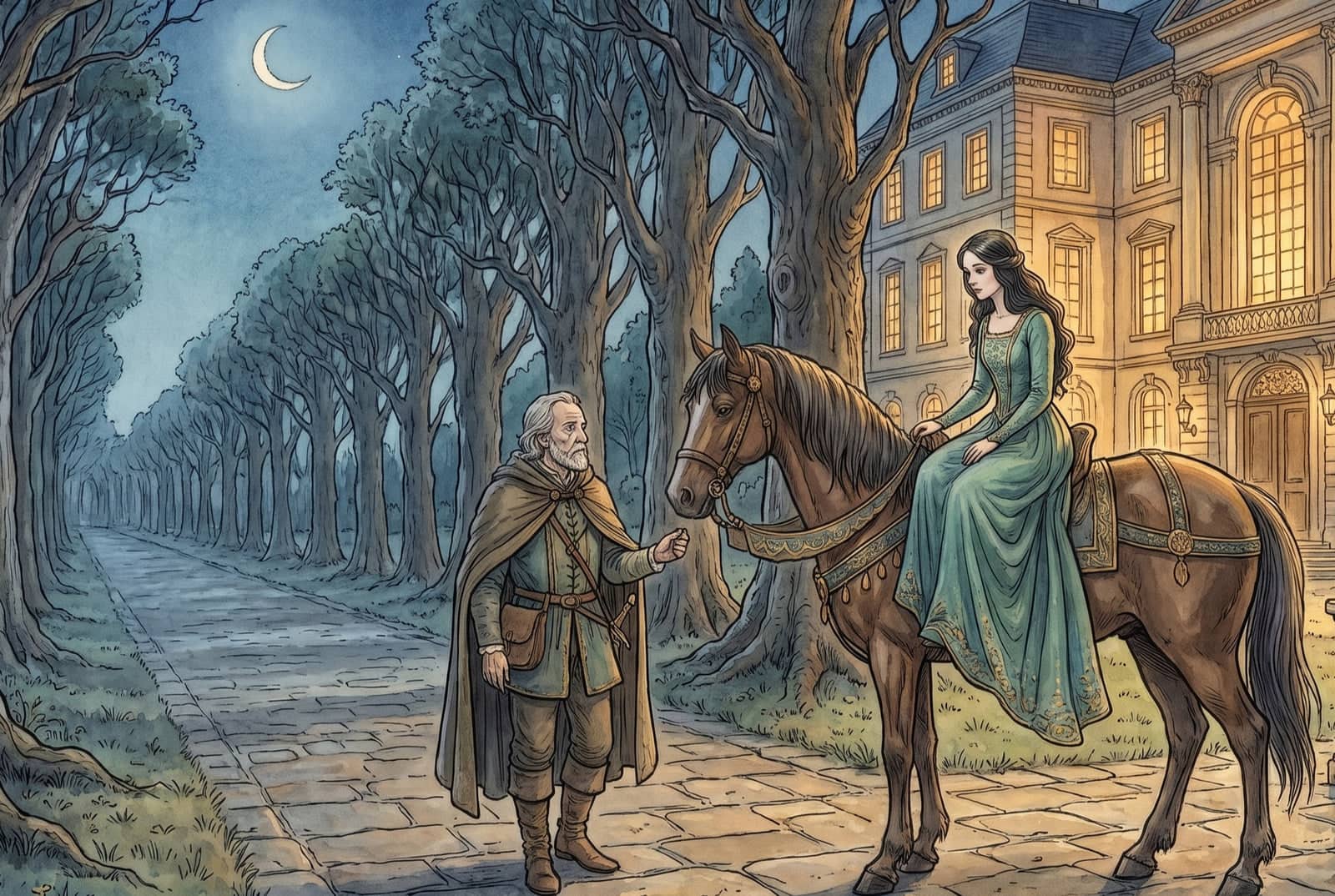
“The Beast must be very hungry,” said Beauty, trying to laugh, “if he makes such a celebration over the arrival of his dinner.”
Supper was laid for them in a little room, and they had hardly finished when they heard the Beast’s footsteps. Beauty clung to her father, more frightened still to see how frightened he was; but when the Beast came in she greeted him respectfully.
“Good evening, old man. Good evening, Beauty,” said the Beast.
Her father was too terrified to answer, but Beauty said sweetly, “Good evening, Beast.”
“Have you come willingly? Will you be content to stay here when your father goes away?”
She answered bravely that she was quite prepared to stay.
“I am pleased with you,” said the Beast. “You came of your own accord, so you may stay. As for you, old man, you leave at sunrise and must never expect to see my palace again. Before you go, fill the two travelling trunks in the next room for your children.”
They filled them with gowns and jewels and gold, and the more they put in, the more room there seemed to be, until the trunks were so heavy that an elephant could not have carried them. Her father was sure the Beast had only been mocking him, but Beauty could not believe that he meant to deceive them.
In the morning her father rode away with the trunks, and the goodbye was a hurried one. Beauty cried a while, and then, feeling strangely sleepy, lay down and dreamed. She was walking beside a brook among myrtle trees when a young prince came to her, handsomer than anyone she had ever seen.
“Ah, Beauty,” he said, “you are not so unlucky as you think. Only try to find me out, however I may be disguised, for I love you dearly. Do not trust your eyes too much, and do not desert me until you have saved me.”
Then she thought she stood in a room with a tall and beautiful lady. “Dear Beauty, do not grieve for what you have left behind,” the lady said. “A better fate is waiting for you. Only do not let appearances deceive you.”
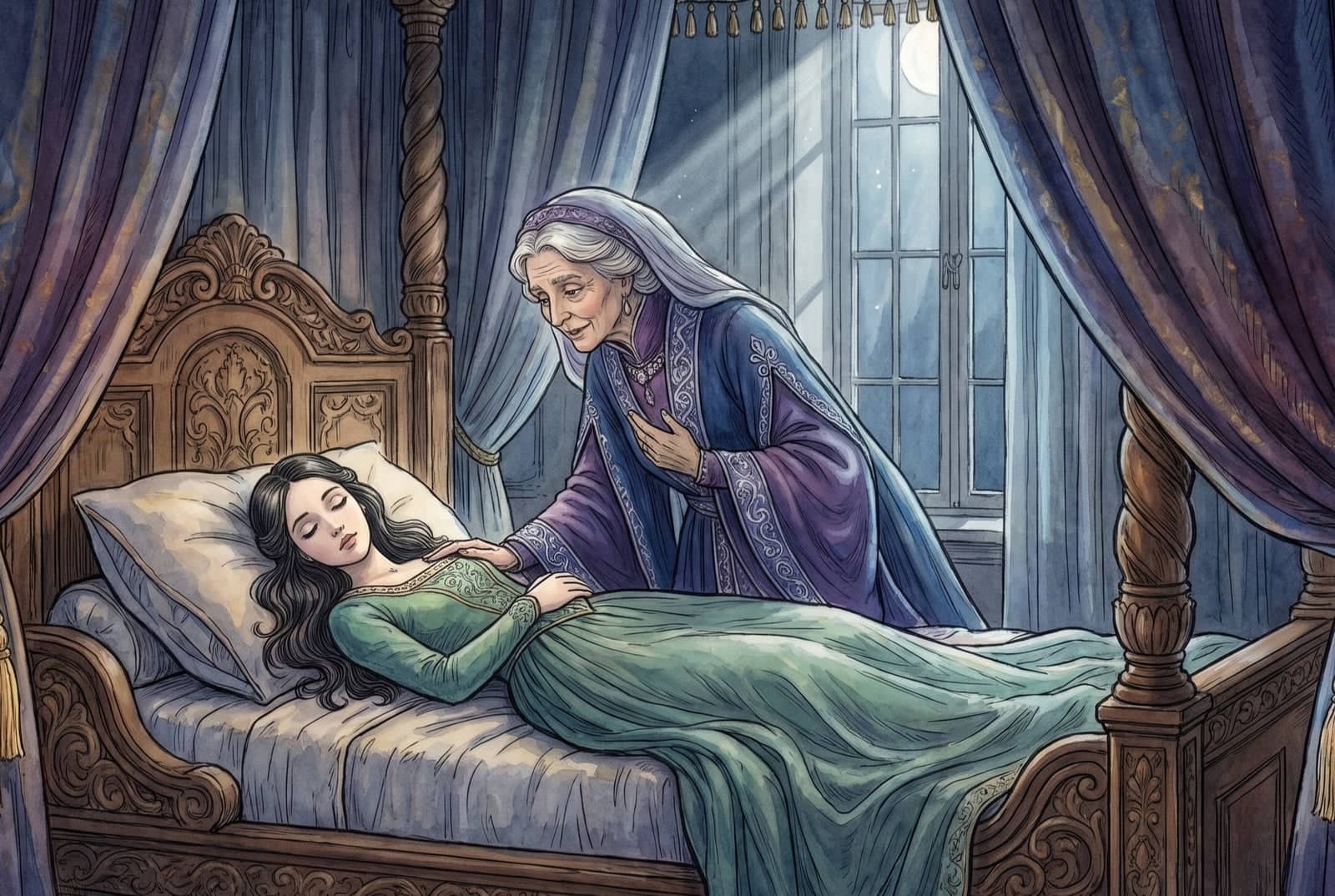
A clock woke her by calling her name twelve times, and she spent the day exploring. In a hall of mirrors she found a bracelet hanging from a chandelier, with a portrait of the very prince of her dream in it; and as dusk came, candles in candlesticks of diamond and ruby lit themselves in every room.
She was beginning to find the silence dull when she heard the Beast coming, and wondered, trembling, whether he meant to eat her.
“Good evening, Beauty,” he said gruffly, and he did not look at all fierce.
She answered cheerfully, hiding her fear; and by the end of an hour’s talk she thought him far less terrible than she had supposed. Then he rose to go.
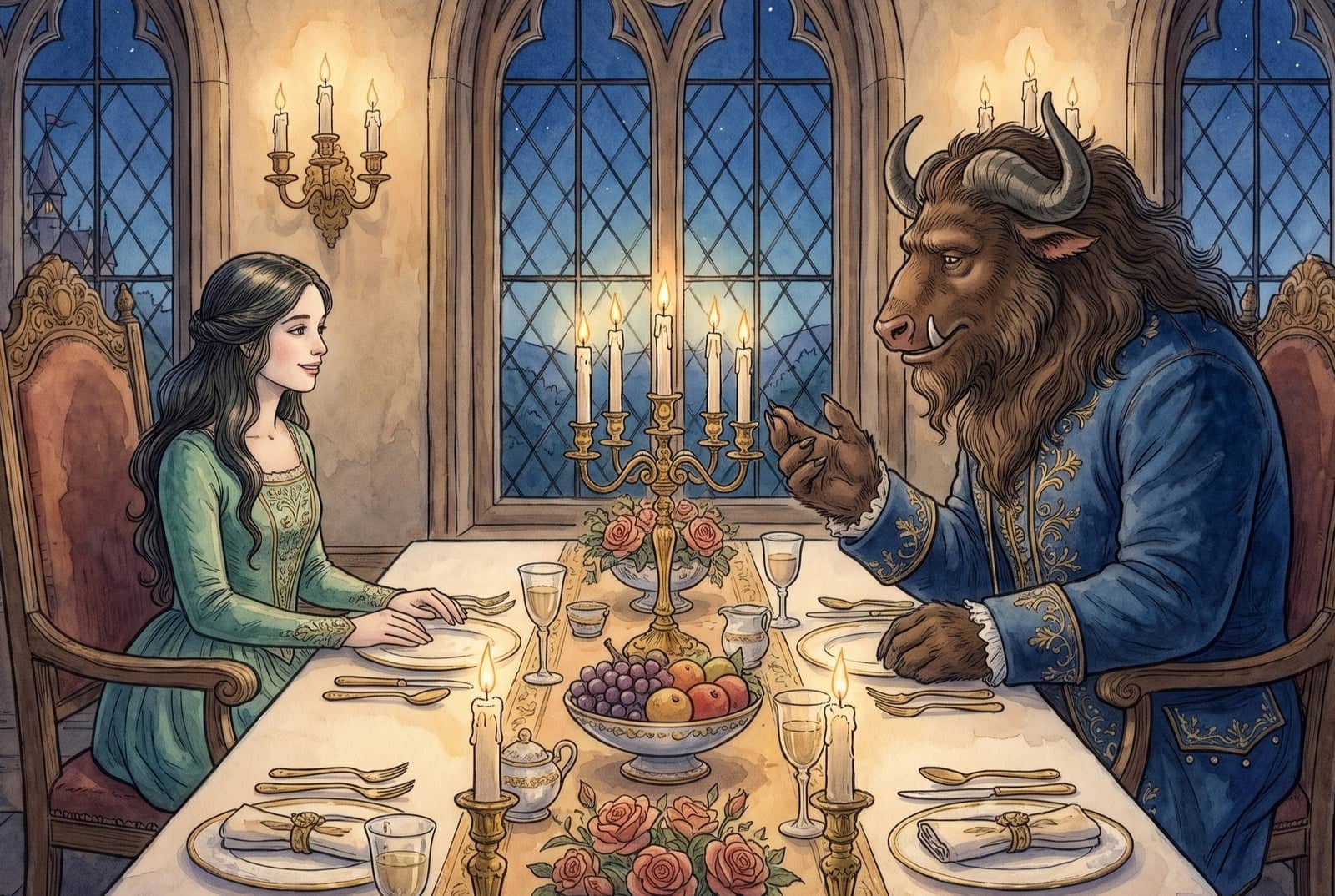
“Beauty, will you marry me?”
“Oh, what shall I say?” she cried, afraid of making him angry.
“Say yes or no without fear.”
“Oh, no, Beast.”
“Then goodnight, Beauty.”
“Goodnight, Beast,” she answered, glad that her refusal had not angered him; and she slept, and dreamed of her prince, who asked her sorrowfully why she was so unkind to him.
In the morning she walked in the garden and knew it at once, for there was the brook among the myrtle trees where the prince had spoken to her in her dream. Indoors, tame birds flew to her shoulders and parrots greeted her by name, and she was never lonely.
Every evening the Beast came to see her, and every evening, before he said goodnight, he asked in his terrible voice, “Beauty, will you marry me?” And now that she understood him better, it seemed to her that when she said, “No, Beast,” he went away very sad. But her dreams of the prince made her forget the Beast, and the only thing that troubled her was being told, over and over, to distrust appearances and let her heart guide her instead of her eyes.
So the time went on, until, happy as she was, Beauty began to long for her family; and one night, seeing her look sad, the Beast asked what was the matter. She had long since stopped fearing him, and she told him she wished to see her home once more.
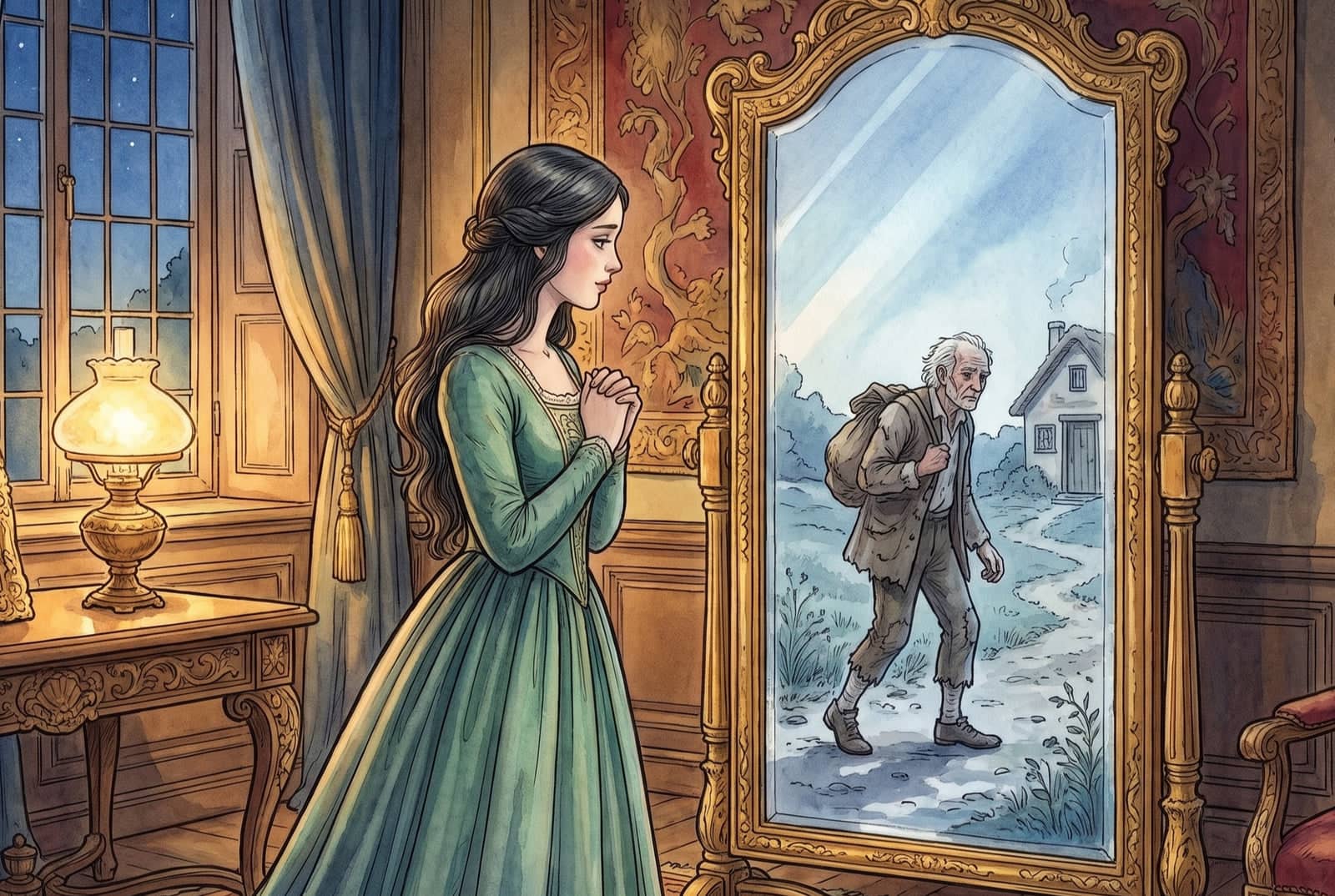
“Ah, Beauty,” he cried miserably, “have you the heart to leave an unhappy Beast? Is it because you hate me that you want to escape?”
“No, dear Beast,” she said softly. “I do not hate you, and I should be sorry never to see you again. But I long for my father. Let me go for two months, and I promise to come back and stay for the rest of my life.”
The Beast sighed. “I cannot refuse you anything, even if it costs me my life. Fill the four boxes in the room next to yours with whatever you wish to take. But remember your promise, for if you do not come back in time you will find your faithful Beast dead. Take this ring, and when you are in bed turn it upon your finger and say firmly: I wish to go back to my palace and see my Beast again.”
Beauty filled the boxes and could hardly sleep for joy; and when at last she dreamed of her prince, he was lying on a grassy bank, weary and unlike himself.
“How can you look at me so, cruel one?” he said. “Are you not leaving me to die?”
“I am only going to tell my father that I am safe and happy,” she said. “I have promised the Beast that I will come back, and he would die of grief if I broke my word.”
A voice woke her, and she opened her eyes in a plain room she had never seen, with her boxes beside her. Then she heard her father, and ran out and threw her arms around him. When her family learned that she must go back to the palace for ever, they wept aloud.
When she asked her father what her strange dreams could mean, he thought a while. “You tell me yourself that the Beast, frightful as he is, loves you dearly and deserves your gratitude,” he said. “I believe the prince means you to reward him by doing as he asks, in spite of his ugliness.”
Beauty could see that this was very likely; and still, when she thought of her handsome prince, she felt no wish to marry the Beast. Her family were rich again, yet nothing amused her for long, and at home she never dreamed of her prince at all. Her father and brothers begged her to stay and looked so grieved that she had not the courage to say goodbye, until the two months were gone and a dreadful dream decided her. She was walking in the palace gardens when she heard groaning from bushes that hid a cave, and there lay the Beast on his side, hardly able to speak. The tall lady appeared beside him.
“Ah, Beauty, you are only just in time to save his life,” she said gravely. “See what comes of breaking a promise. One day more and you would have found him dead.”
Next morning she announced that she was going back at once. That night she said goodbye to her family, and as soon as she was in bed she turned the ring upon her finger and said firmly, “I wish to go back to my palace and see my Beast again.”
She fell asleep instantly, and woke to hear the clock calling “Beauty, Beauty” twelve times, which told her she was home again. The day seemed the longest she had ever known, and when suppertime came, no Beast appeared. She ran into the garden and called and called, until she found herself opposite the bushes of her dream. There was the cave, and there lay the Beast; and when she stroked his head he neither moved nor opened his eyes.
“Oh, he is dead, and it is all my fault,” she said, weeping bitterly.
But looking again she thought he was still breathing. She fetched water from the nearest fountain and sprinkled it over his face, and to her great joy he began to stir.
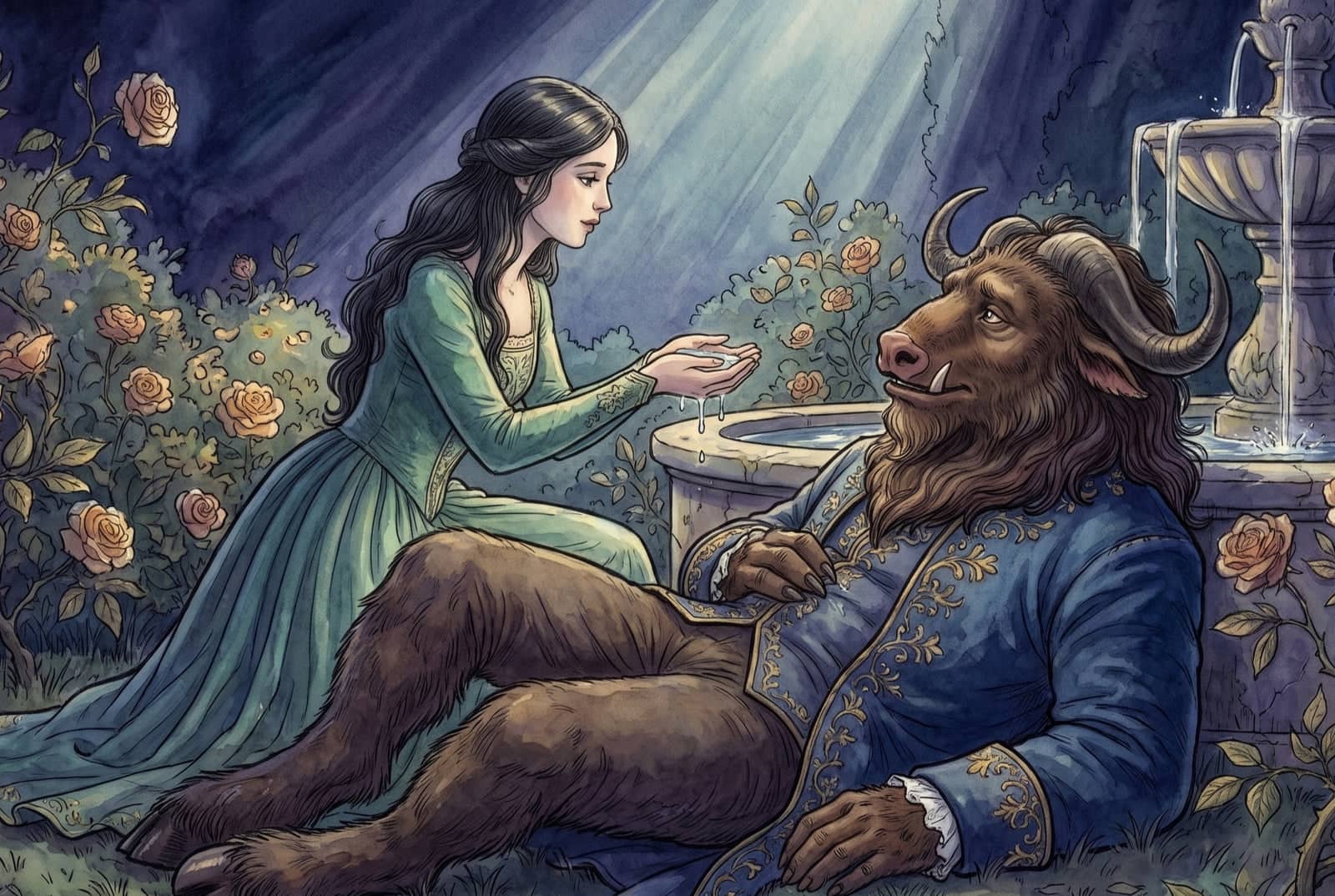
“Oh, Beast, how you frightened me,” she cried. “I never knew how much I loved you until this moment, when I thought I had come too late.”
“Can you really love such an ugly creature?” he said faintly. “Ah, Beauty, you came only just in time. I was dying because I thought you had forgotten your promise. Go and rest now.”
Supper was waiting when she returned, and afterwards the Beast came in as usual. And when the time came for him to go, he asked, as he had asked so many times before, “Beauty, will you marry me?”
“Yes, dear Beast,” she answered softly.
As she spoke, a blaze of light sprang up before every window of the palace, and across the avenue of orange trees, in letters made of fireflies, were written the words: Long live the Prince and his Bride. Beauty turned to ask the Beast what it meant and found him gone, and in his place stood the prince she had loved so long.
Carriage wheels sounded on the terrace, and two ladies came in: the tall lady of her dreams, and another so queenly that Beauty hardly knew which to greet first.
“Well, Queen,” said the lady she knew, “this is Beauty, who has had the courage to rescue your son from a terrible enchantment. They love one another, and only your consent is wanting to make them perfectly happy.”
“I consent with all my heart,” cried the Queen, “and how can I ever thank you for giving me back my son in his own form?”
The tall lady, who was a fairy, sent for all Beauty’s brothers and sisters to dance at the wedding, which was celebrated the very next day with the greatest splendour; and Beauty and her prince lived happily ever after.
Retold by Talerie, Source: The Blue Fairy Book (opens in a new window)
License: Public domainCopy this text, adapt it, use it however you like. A link back to Talerie is appreciated but never required.CC0 1.0 (opens in a new window)