A king who would rather keep his throne promises it to whichever son brings him the most beautiful little dog. The youngest, lost in the forest on a stormy night, rings the bell at a gate of gold. Inside, hands that belong to no one dress him in fine clothes and lead him to a table laid for two.
Once upon a time there was a king who had three brave and handsome sons. He was growing old, but his mind was as sharp as ever, and he had no wish to give up a throne he still filled so well. So he decided to keep his sons busy with promises he could always find a way around.
“My dear children,” he told them, “I am too old to rule as I once did, and I mean to give my crown to one of you. When I retire to the country, a pretty little dog would be good company. Whichever of you brings me the most beautiful little dog, one year from today, will be my heir.”
The two younger princes saw their chance, and the eldest was too timid to stand up for his rights. The brothers promised one another lifelong friendship, agreed to meet at a castle near the city on their return, and set off by different roads.
This is the story of the youngest. He bought dogs nearly every day, letting the old one go each time he found a finer one. One night, deep in a forest, he was caught in thunder and pouring rain and lost the path.
At last he saw a light and followed it to a gate of gold. A deer’s foot hung beside it on a chain of diamonds. He pulled it, a bell rang, and the gate opened, but all he could see was a dozen hands in the air, each holding a torch. Other hands pushed him from behind, and not gently. He walked on with his hand on his sword, until two lovely voices began to sing.
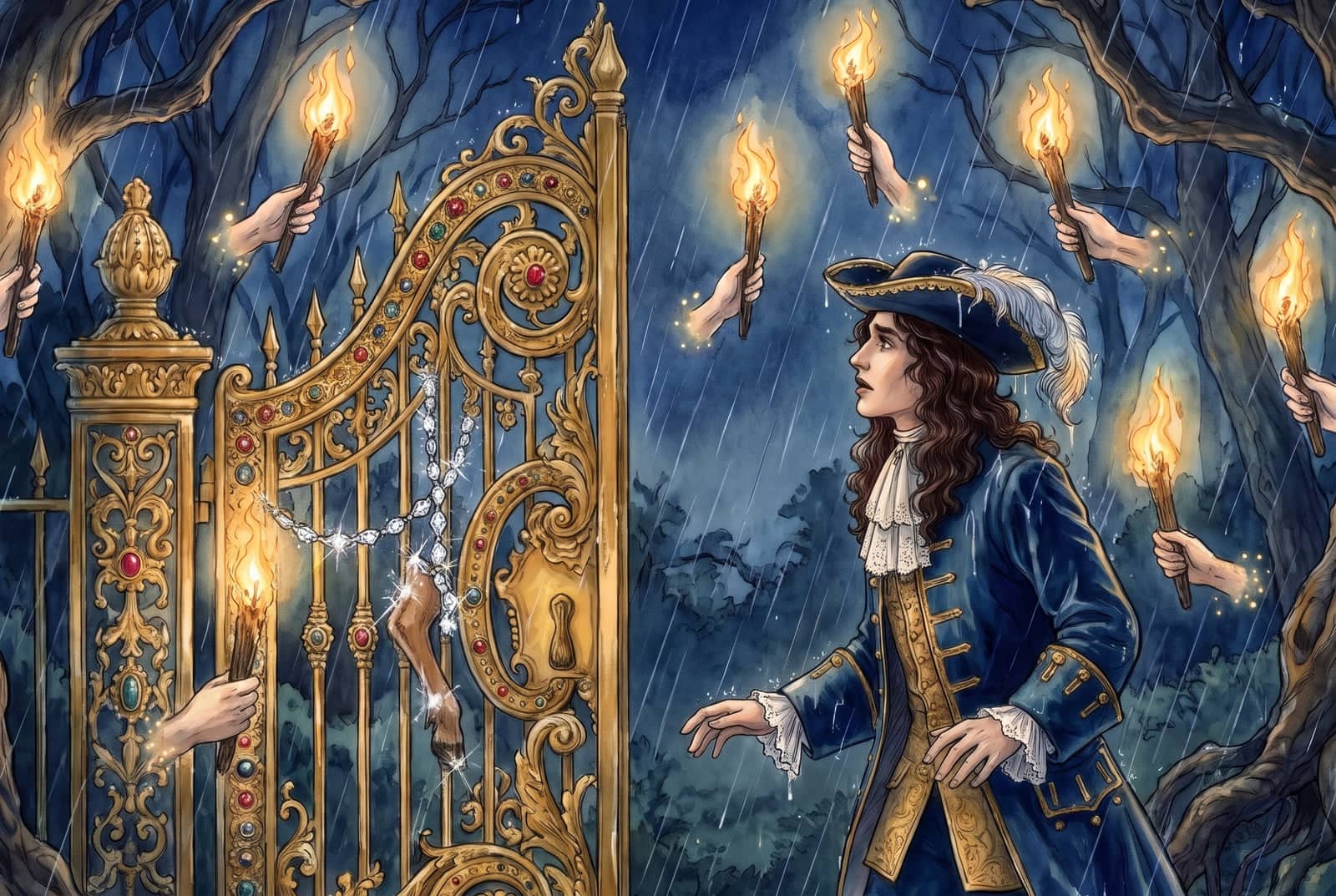
Do not fear the hands you see, for nothing here will do you harm, unless your heart would like to be safe from a lovely face’s charm.
The hands led him through sixty splendid rooms to a fire, where they took off his wet clothes, combed his hair, and dressed him in finer ones. They were small, white, pretty hands, and they belonged to no one he could see.
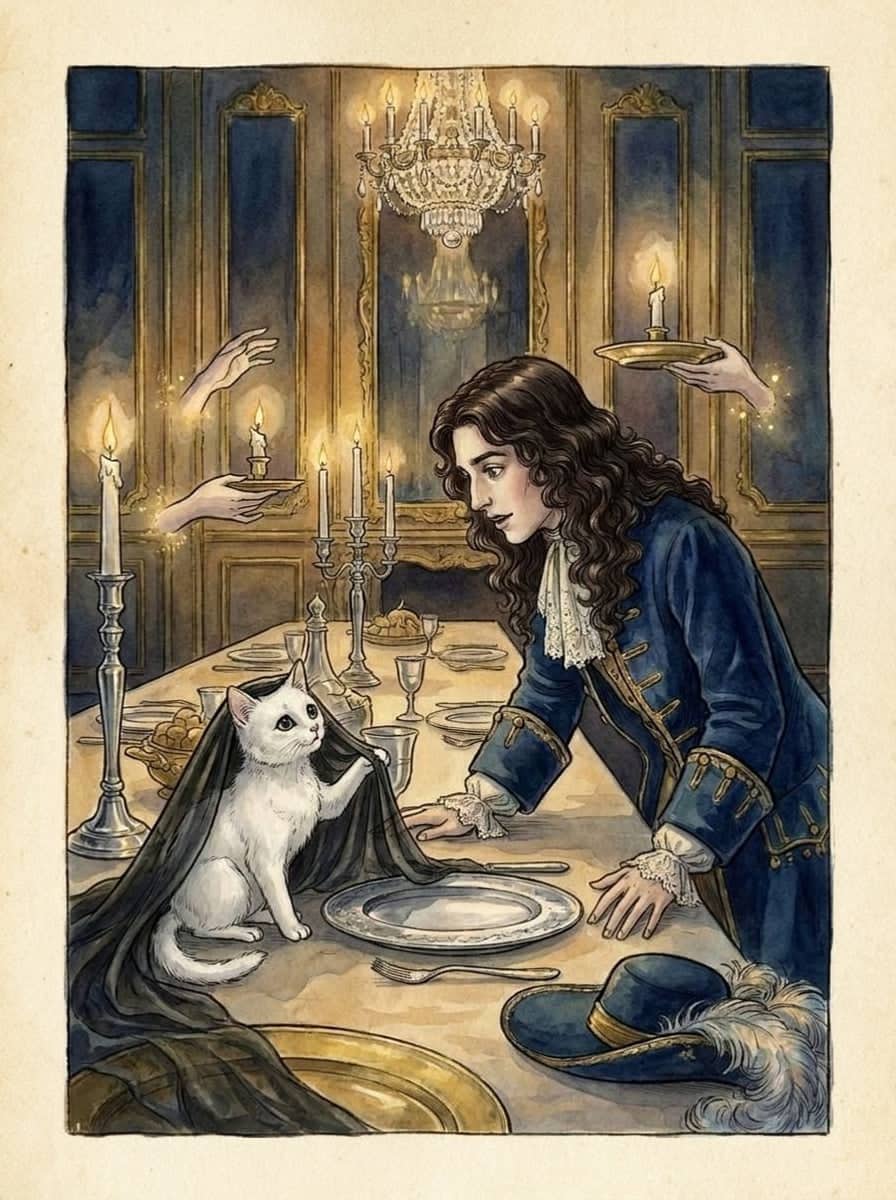
In the dining hall the table was laid for two. A band of cats sat in a little gallery with tiny guitars, and all at once they began to meow in every key and scratch the strings with their claws. It was the strangest music ever heard, and the prince covered his ears and laughed.
Then a tiny figure under a long black veil came in, led by two cats in mourning cloaks. She lifted her veil, and the prince saw the loveliest little white cat that ever was or ever will be. She looked very young and very sad.
“King’s son,” she said in a soft, sweet mew, “you are welcome here.”
“Lady Cat,” said the prince, “you are very kind. But you are no ordinary cat.”
“King’s son,” said the White Cat, “please stop paying me compliments. I am plain in my ways, but I have a good heart.”
The hands brought two soups, one of pigeons and one of fat mice. The prince lost his appetite, until the White Cat guessed what he was thinking and told him that his own dishes came from a separate kitchen. On her paw he noticed a small portrait. He asked to see it and was astonished: it showed a handsome young man who looked exactly like himself. The White Cat sighed, grew sadder still, and said nothing at all. The prince did not dare to ask more.
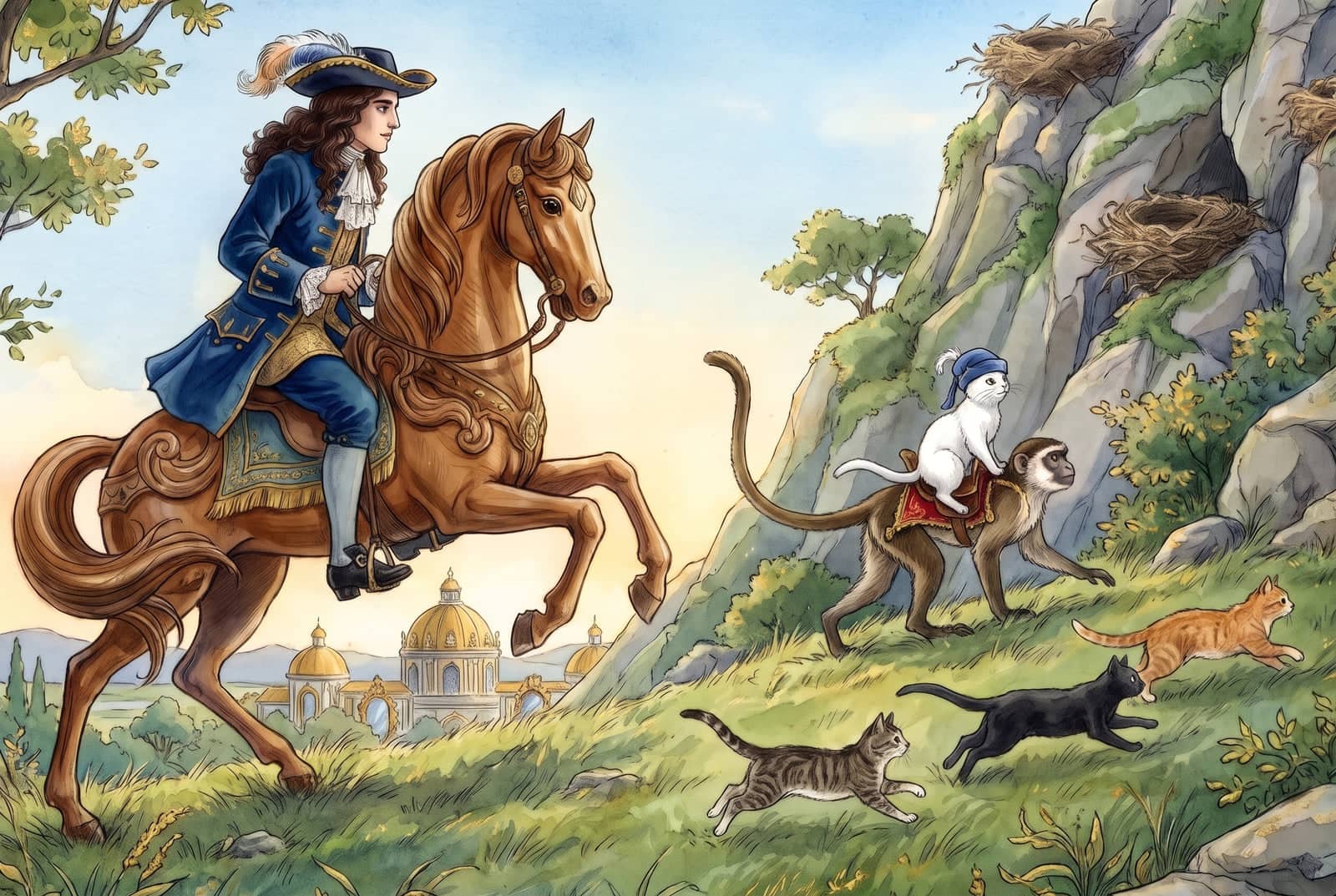
After supper twelve cats and twelve monkeys danced a ballet. In the morning they went hunting. The White Cat rode a monkey that carried her up into the eagles’ nests, and the prince rode a wooden horse that galloped like a live one.
At supper he drank the liqueurs brought to the table, and at once they made him forget the little dog he was supposed to bring the king. From then on he thought of nothing but keeping the White Cat company. The days went by in hunts and feasts, and soon he no longer gave a thought even to his own country.
A year flies by when there is nothing to worry about, and it was the White Cat who remembered. “Do you know,” she said, “that you have only three days left to find the little dog your father wants?”
The prince came to his senses. “What spell made me forget?” he cried. “Where will I find such a dog, and a horse fast enough to carry me home?”
“King’s son,” she said gently, “don’t worry. I am your friend. Your country is five hundred leagues from here, but the wooden horse will take you there in less than twelve hours. And here,” she said, handing him an acorn, “is a little dog more beautiful than the Dog Star.”
“Oh, Lady Cat, Your Majesty is making fun of me!”
“Hold it to your ear.”
He did, and heard a tiny dog yapping inside. She told him not to open it until he stood before the king. He begged her to come with him, but she answered only with a deep sigh.
At the meeting place, the prince hid his adventures from his brothers and showed them a shabby turnspit dog, the kind that turns the roasting spit in a kitchen. Friends though they were, the two older princes felt a secret glee, and at dinner they nudged each other under the table, as if to say they had nothing to fear from him.
At court the older brothers’ dogs were so nearly equal in beauty that the king could not choose between them. Then the youngest opened his acorn. Inside, on a bed of cotton, lay a little dog of a thousand colors, with ears that trailed on the ground. It jumped through a ring without touching it and danced a sarabande with castanets, as lightly as the finest Spanish dancer.
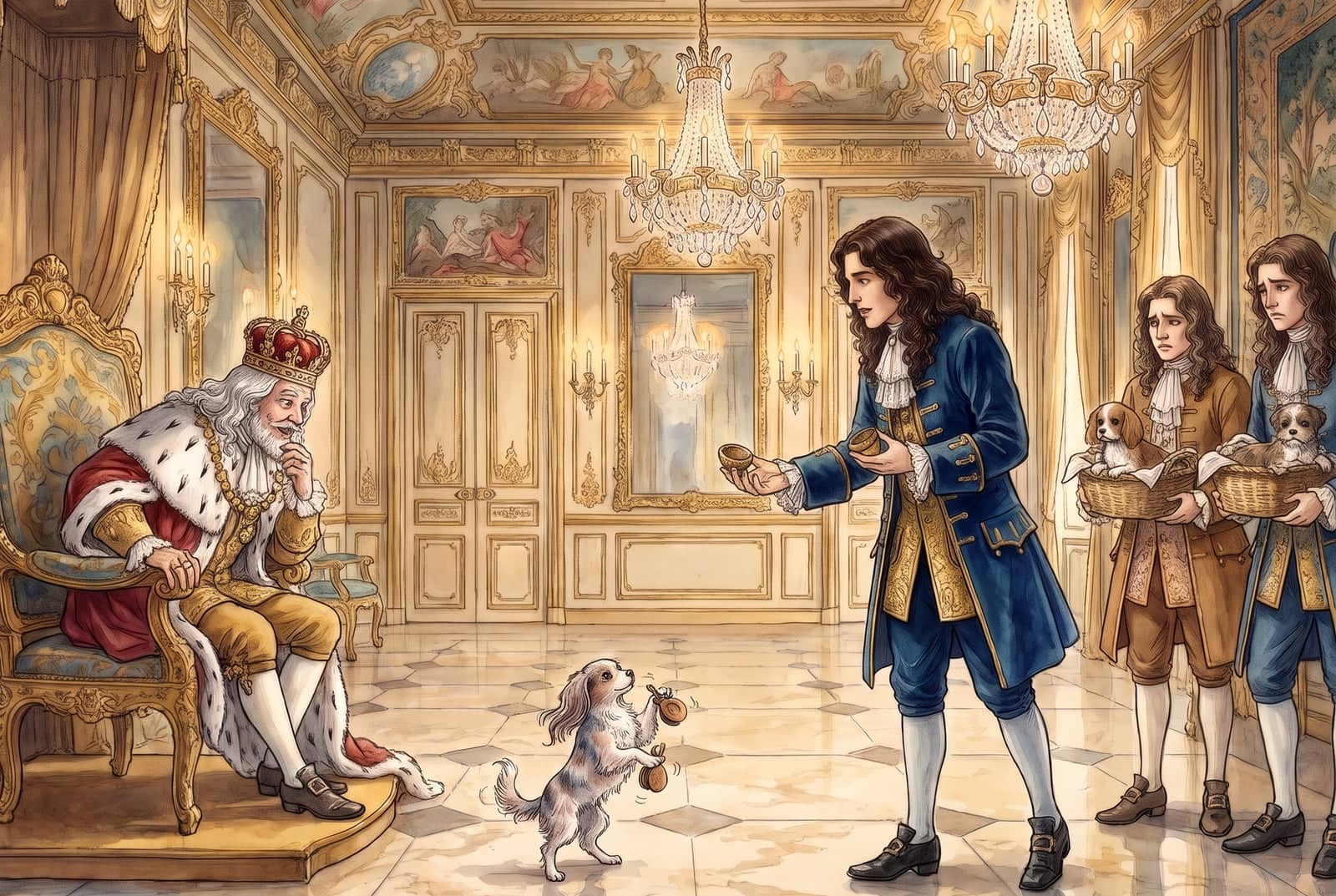
The king could find no fault with the little dog, but the smallest jewel in his crown was dearer to him than all the dogs in the world. Before keeping his word, he said, he would test them once more: in another year they must bring him a piece of cloth so fine that it would pass through the eye of a needle made for Venetian lace.
The prince rode his wooden horse straight back to the White Cat. She leaped and frisked with joy at the sight of him, and when he told her the king’s new demand, she said that luckily she had cats in her castle who were excellent spinners, and that he could rest easy.
One night four cats who had been found guilty of treason were to be burned in a fireworks show, but the prince begged for their pardon and won it. The second year passed like the first, and often he asked the White Cat how she could think and speak like a person.
“If you love me, sweet Minette,” he said, “tell me what wonder lets you speak so wisely.”
“Stop asking, King’s son,” she answered. “I am not permitted to answer. It is enough that I always keep my claws sheathed for you.”
When the time came, she sent him home in a golden carriage drawn by twelve snow-white horses. “Here is a walnut,” she said. “Don’t crack it until you stand before your father, and you will find the cloth inside.”
“Dear Blanchette,” said the prince, “if you would allow it, I would rather spend my life with you than have all the glory that waits for me anywhere else.”
“King’s son,” she said, “your heart is good, and that is rare among princes. I am grateful for your affection for a little white cat who is good for nothing but catching mice.”
The prince kissed her paw and set off.
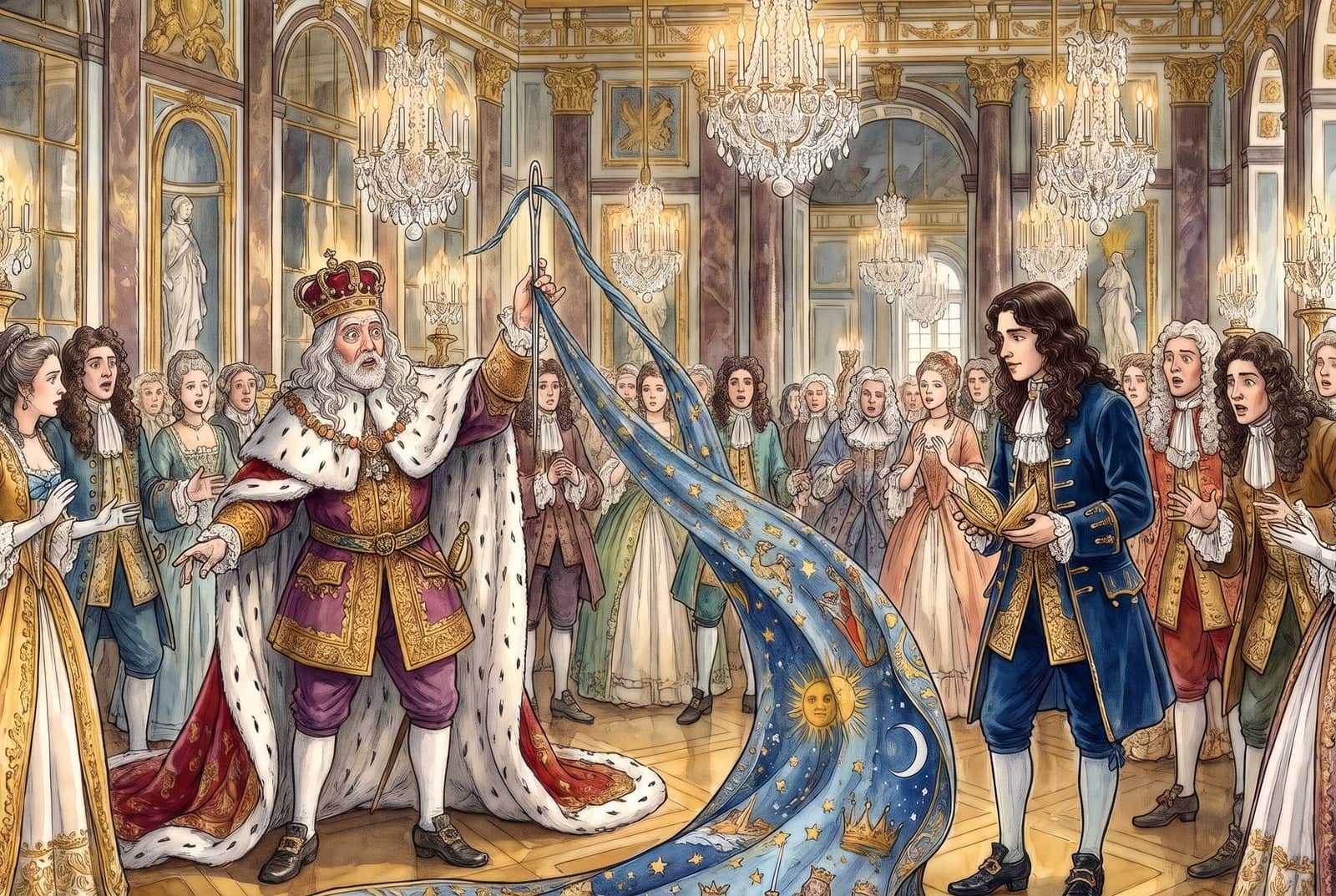
At court his brothers had already unrolled their cloths. These passed through the eye of a large needle but not a small one, and the king gladly took that as his excuse: the needle he had named was a small one. Just then trumpets sounded, and the youngest prince arrived in all his splendor.
He cracked the walnut and found a hazelnut. He cracked that and found a cherry stone, and the king laughed softly at his son for believing that cloth could fit inside a nut. In the cherry stone was a kernel, and the room filled with jeering: “The young prince has been fooled!” In the kernel was a grain of wheat, and in the wheat a grain of millet.
“White Cat, White Cat,” the prince muttered, “you have made a fool of me.” At that moment an unseen cat’s claw scratched his hand so hard that it bled. He opened the millet seed anyway, and out came a piece of cloth four hundred ells long. Painted on it was the whole world: every creature, the sun, the moon, and the stars, and every king on earth with every last one of his subjects. The king turned pale. The cloth passed through the eye of the needle six times.
Still the king would not give up. “Travel for one more year,” he told his sons. “Whoever brings home the most beautiful bride shall marry her and be crowned on his wedding day. I swear that this time I will keep my word.”
It was unfair to the youngest, but he was too well-mannered to argue, and he returned to the White Cat. Every cat in the castle climbed onto the gutters to welcome him with a tremendous yowling.
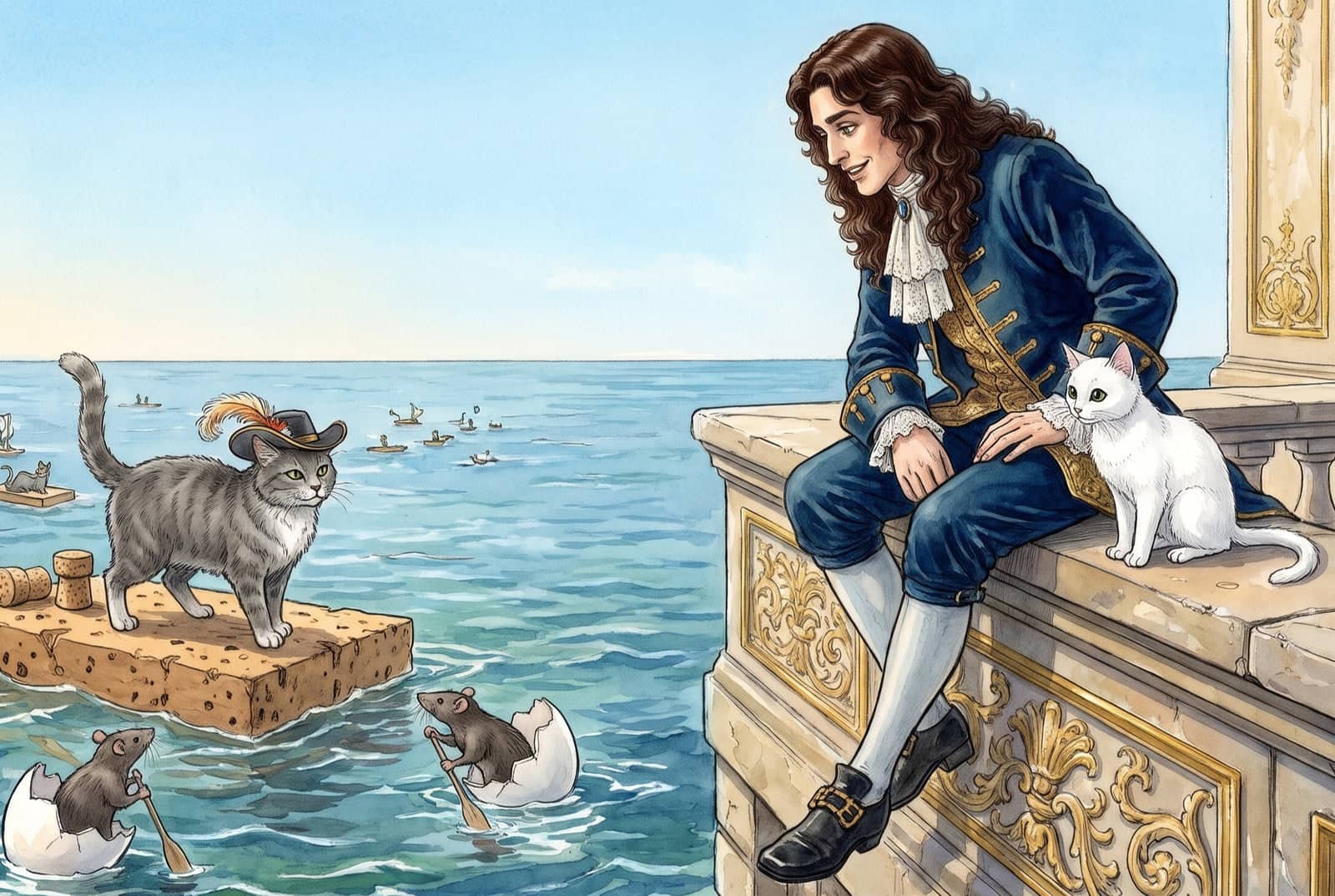
“Well, King’s son,” she said, “so you are back again without a crown? Never mind. I will find you a bride who will win the prize. Meanwhile, I have arranged a sea battle between my cats and the rats of this country.”
From a terrace above the sea, the prince watched the cats sail on great pieces of cork and the rats in eggshells. The rats were better swimmers, and twenty times the battle swung one way and then the other, until Minagrobis, the old tomcat who was admiral of the cats’ fleet, ate the rats’ admiral.
The third year slipped by in hunting and games of chess, and the prince kept asking whether she was a fairy or someone under a spell, but her answers told him nothing.
Once again it was she who remembered. On the eve of his departure she told him he could take home one of the most beautiful princesses in the world, for the hour had come to undo the fairies’ cruel work. He must cut off her head and her tail and throw them quickly into the fire.
“Blanchette, my darling,” he cried, “could I be so cruel as to kill you?”
“King’s son,” she said, “neither you nor I decide our fate in this. Do what I ask, and we will both begin to be happy.”
He wept and begged her to spare him, but she insisted that she wanted to die by his hand, and that it was the only way to keep his brothers from the crown. At last he drew his sword and, with a trembling hand, cut off the White Cat’s head and her tail.
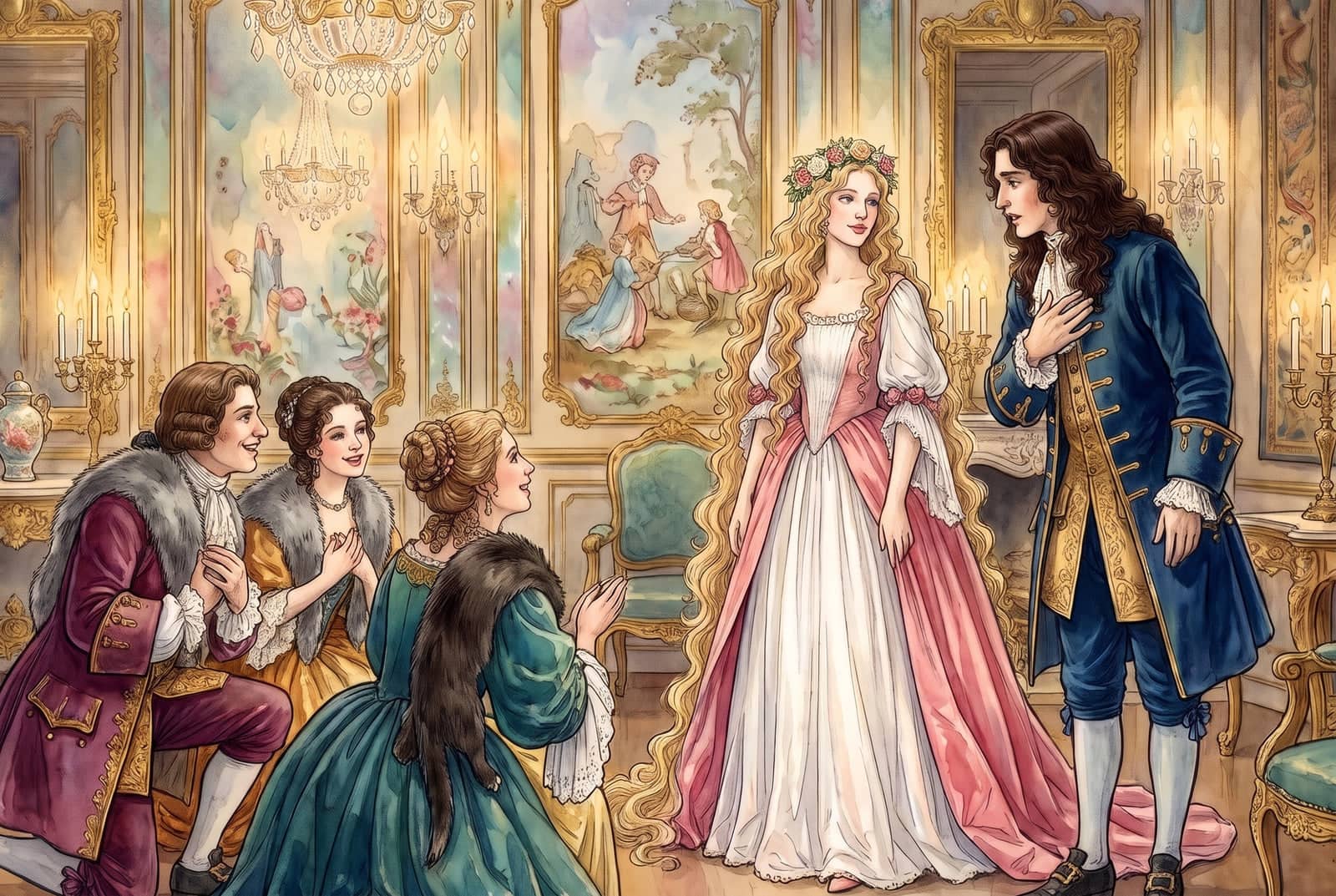
At once her body grew tall and became a young woman lovelier than words can say. The prince stood speechless. Then a great crowd of lords and ladies came in, each with a cat skin thrown over one shoulder, and knelt before their queen, rejoicing to see her in her true shape again. When they had gone, she told the prince her story.
“My lord, my father was king of six kingdoms. When my mother was expecting me, she longed so badly for the fruit in a fairies’ walled garden that she fell dangerously ill. One night an ugly little old fairy appeared by her bed. ‘Your Majesty may have all the fruit you can carry,’ she said, ‘if you give us the daughter you are expecting. We will raise her and make her happy.’ Rather than die, my mother promised.
“When my father learned of it, he was furious. He shut my mother up alone in a tower and kept me, once I was born, in his own palace. The fairies demanded me, and when he refused, they sent a dragon that ravaged his six kingdoms, eating men and children, until he saw no other way to save his people and gave me up. The fairies carried me off on the dragon and raised me in a tower with no door, where they called me their daughter. My only companions were Parrot and my little dog, Toutou, and both of them could talk.
“One day a young king rode by below my window. He came back each morning and spoke to me through a speaking-trumpet, and Parrot carried messages between us. I fell in love with him. Then the fairies chose a husband for me, King Migonnet, a dwarf with eagle’s feet and birds nesting in his beard. I would rather have died.
“I told the fairy Violente, who made me call her Mama, that I wanted cord to make nets for the birds, and in secret I plaited a rope ladder. One evening the young king climbed it into my room, and with Parrot and Toutou as our witnesses, we were married. When Migonnet came to see me, I ran from him and shut myself in my room.
“The next night, while my husband was with me, the fairies broke in through the windows on their dragon, with Migonnet behind them. My husband drew his sword to defend me, but they drove the dragon at him, and before my eyes it devoured him. I threw myself into its jaws, but the fairies would not let me die. They turned me into a white cat and my lords and ladies into cats, leaving some only their hands, and brought us to this palace. I could be freed, they said, only by a prince who looked exactly like my husband.
“You are that prince, my lord. I knew it the moment I saw you. Now we must go to your father and see what he thinks of me.”
Near the city the queen hid inside a little crystal rock studded with gold and rubies. The prince found his brothers with two princesses of wonderful beauty, and when the brothers asked whether he had brought a bride, he said that all he had was a little white cat. They laughed at him.
Before the court the king admired both princesses and could not choose between them. “Your Majesty,” said the youngest, “in this rock there is a little white cat who will surely please you.”
The king went to open the rock himself, but as he came near, it fell open, and the queen stepped out like the sun from behind a cloud. Her blond curls fell to her feet, she was crowned with flowers, and she wore a gown of white gauze lined with rose-pink taffeta. “Here is the one who deserves my crown!” cried the king.
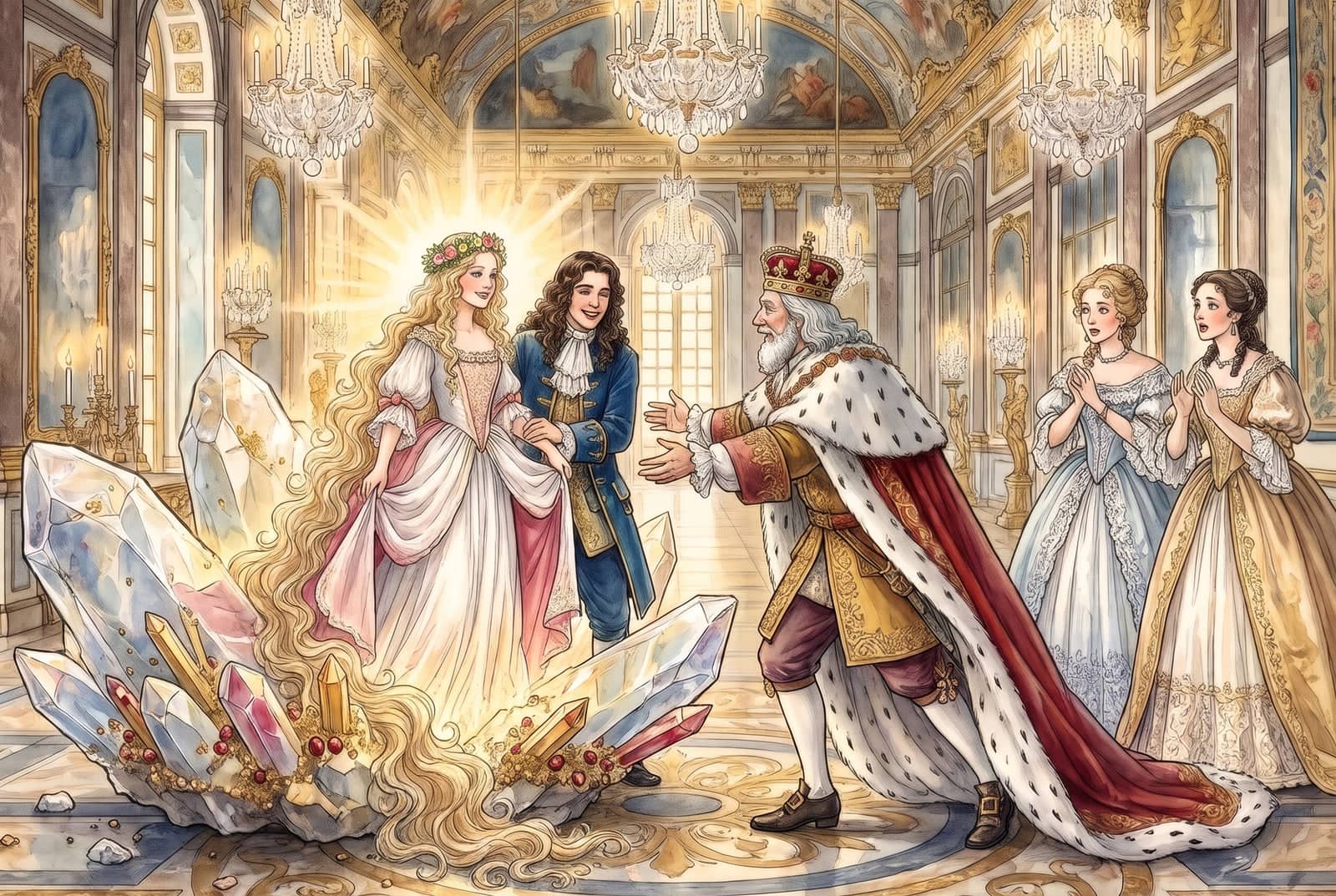
“Sire,” she said, “I have not come to take your throne. I was born with six kingdoms. Allow me to give one of them to you and one to each of your elder sons. All I ask is your friendship, and this young prince for my husband. Three kingdoms will be enough for us.”
The three weddings were held at once, and after months of celebration each couple went off to rule their own kingdom. The White Cat was remembered ever after as much for her kindness and generosity as for her beauty.
Retold by Talerie from Contes des fées (opens in a new window) Public domain Copy this text, adapt it, use it however you like. A link back to Talerie is appreciated but never required. CC0 1.0 (opens in a new window)