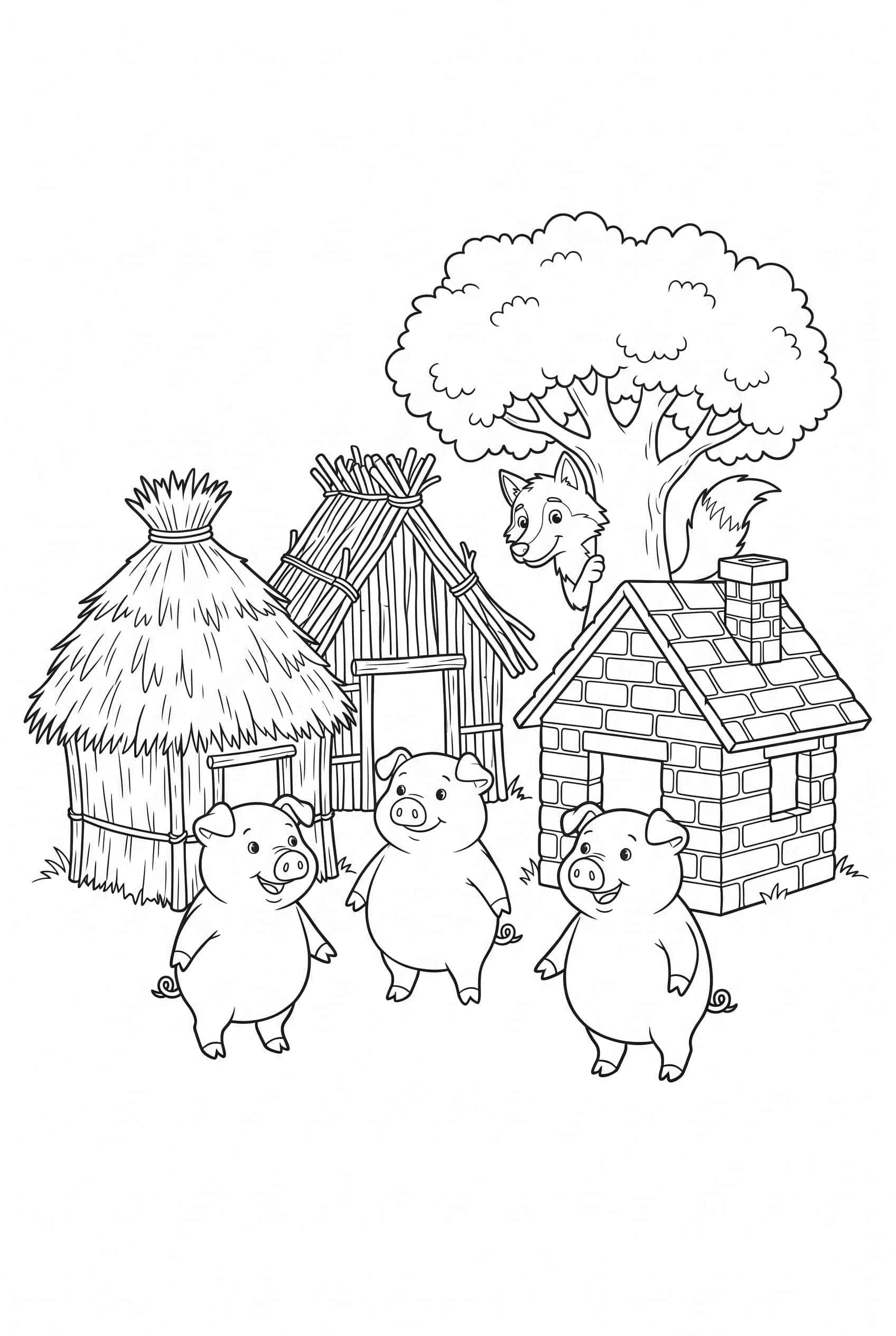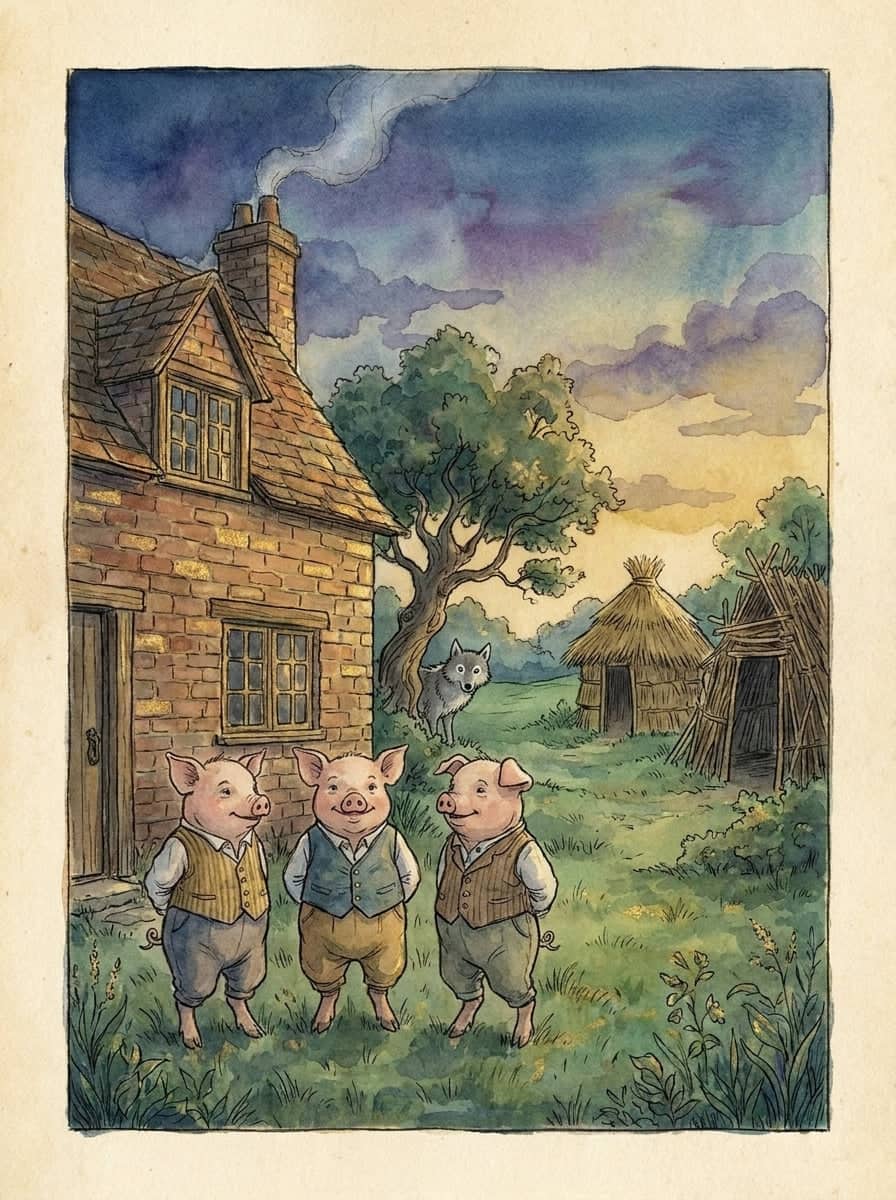
Three little pigs leave home to build with straw, sticks and bricks, and a wolf blows the first two houses in. Only the brick house stands, and the third pig outwits the wolf over turnips, apples and a butter churn before the wolf comes down the chimney into a pot of water on the fire.
Once upon a time, when pigs spoke rhyme,and monkeys played the banjo,when hens drank tea and sang off key,and ducks went quack, quack, quack, O!
There was an old mother pig who had three little pigs and not enough to feed them. So one morning she kissed them all goodbye and sent them out into the world to make their own way.
The first little pig had not gone far when he met a man carrying a bundle of straw.
“Please, sir, will you give me that straw to build myself a house?” he asked.
The man gave it to him gladly, and the little pig had his house finished before the sun went down. It was quick work, and he was very pleased with himself. But that evening a wolf came padding along the lane, and knocked at the door, and called:
“Little pig, little pig, let me come in.”
“No, no, by the hair of my chinny chin chin,” said the little pig.
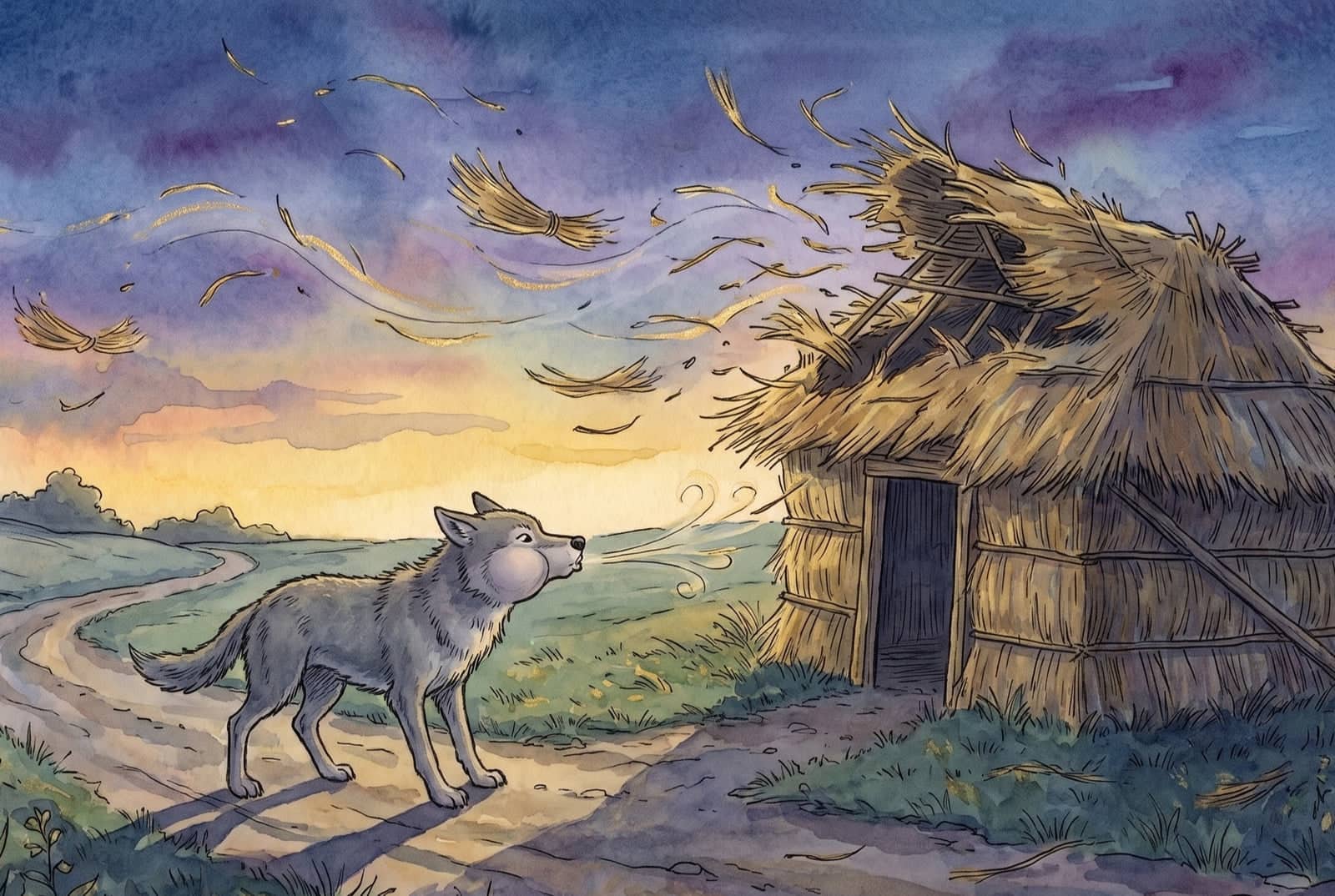
“Then I’ll huff, and I’ll puff, and I’ll blow your house in,” said the wolf.
And he did. He huffed, and he puffed, and the straw went up into the air like dry grass in a storm, and the wolf ate up the first little pig.
The second little pig met a man carrying a bundle of sticks.
“Please, sir, will you give me those sticks to build myself a house?” he asked.
The man gave them to him, and the little pig built his house of sticks, which took him a little longer, though not much longer. And soon enough the wolf came knocking at that door too.
“Little pig, little pig, let me come in.”
“No, no, by the hair of my chinny chin chin.”
“Then I’ll huff, and I’ll puff, and I’ll blow your house in.”
He huffed, and he puffed, and he puffed, and he huffed, and at last the walls came apart, and the wolf ate up the second little pig too.
Now the third little pig met a man with a cartload of bricks.
“Please, sir, will you give me those bricks to build myself a house?” he asked.
The man gave him the bricks, and the third little pig set to work. He laid them one on top of another, straight and true, and it took him days; but when he had finished he had solid walls, a good stout door, and a chimney standing up on the roof. And in time the wolf came to that house as well.
“Little pig, little pig, let me come in.”
“No, no, by the hair of my chinny chin chin.”
“Then I’ll huff, and I’ll puff, and I’ll blow your house in.”
So he huffed, and he puffed. He huffed and he puffed and he puffed and he huffed, until there was no breath left in him at all. And the house stood exactly where it was.
When the wolf saw that no amount of huffing would bring those bricks down, he sat back and put on his politest voice.
“Little pig,” he said through the door, “I know where there is a fine field of turnips.”
“Where?” said the little pig.
“In Mr. Smith’s field, the one behind his house. Be ready in the morning and I will call for you, and we shall go together and fetch some for dinner.”
“Very well,” said the little pig. “I will be ready. What time do you mean to go?”
“Six o’clock,” said the wolf.
But the little pig was up at five. He trotted out to the field, filled his basket, and was home again with the door shut before the wolf knocked at six.
“Little pig, are you ready?”
“Ready?” said the little pig. “I have been and come back, and there is a potful of turnips on the fire for my dinner.”
The wolf was angry at that, but he swallowed it down and thought of something else.
“Little pig,” he said, “I know where there is a fine apple tree.”
“Where?” said the little pig.
“Down at Merry Garden. If you will not trick me again, I will come for you at five tomorrow and we shall pick some apples.”
The next morning the little pig was up at four, because the orchard lay further off and there was climbing to be done. He was high in the branches with his basket half full when he looked down and saw the wolf coming along the path, and his heart went hammering.
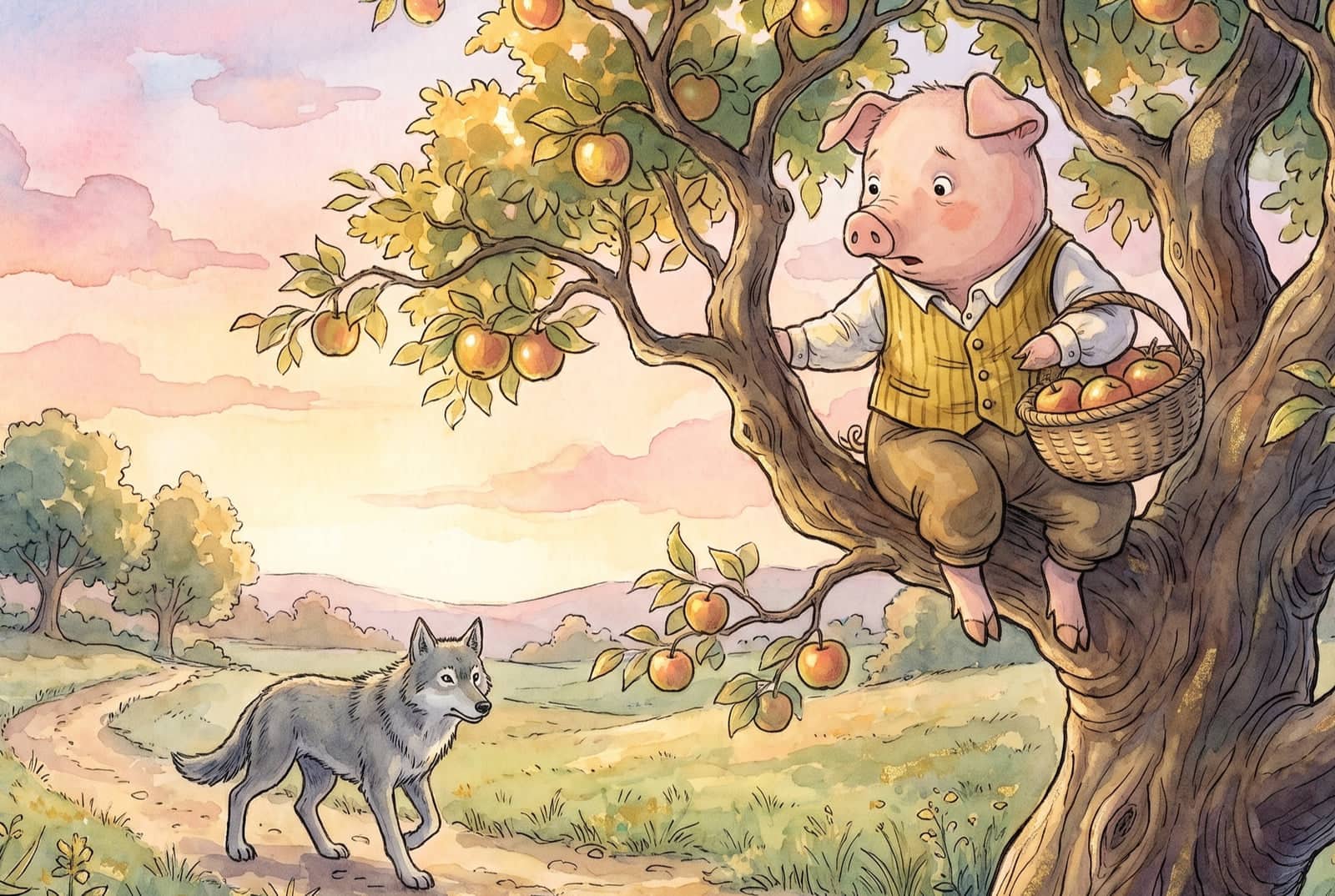
“Little pig!” called the wolf. “What, here before me again? Are they good apples?”
“Very good,” said the little pig. “I will throw you one down.”
And he threw it as far as ever he could. While the wolf went running after it, the little pig scrambled out of the tree and ran all the way home.
The next day the wolf came again.
“Little pig, there is a fair at Shanklin this afternoon. Will you come?”
“Oh yes,” said the little pig. “What time will you be ready?”
“Three o’clock,” said the wolf.
The little pig went early, the way he always did. He walked around the fair and bought himself a butter churn, and he was rolling it home down the hill when he saw the wolf coming along the road toward him. There was nowhere at all to hide, so he climbed inside the churn. Over it tipped, and down the hill it went with the little pig inside, bumping and booming, and the wolf took one look at the great round thing thundering past him and ran home without ever seeing the fair.
Later he came to the little pig’s house and told him, in a small voice, about the terrible thing that had come down the hill.
“That was me,” said the little pig. “I had been to the fair and bought a butter churn, and when I saw you I got inside it and rolled down the hill.”
Then the wolf was angrier than he had ever been in his life. “I will have you for my supper,” he shouted, “if I have to come down the chimney to get you!”
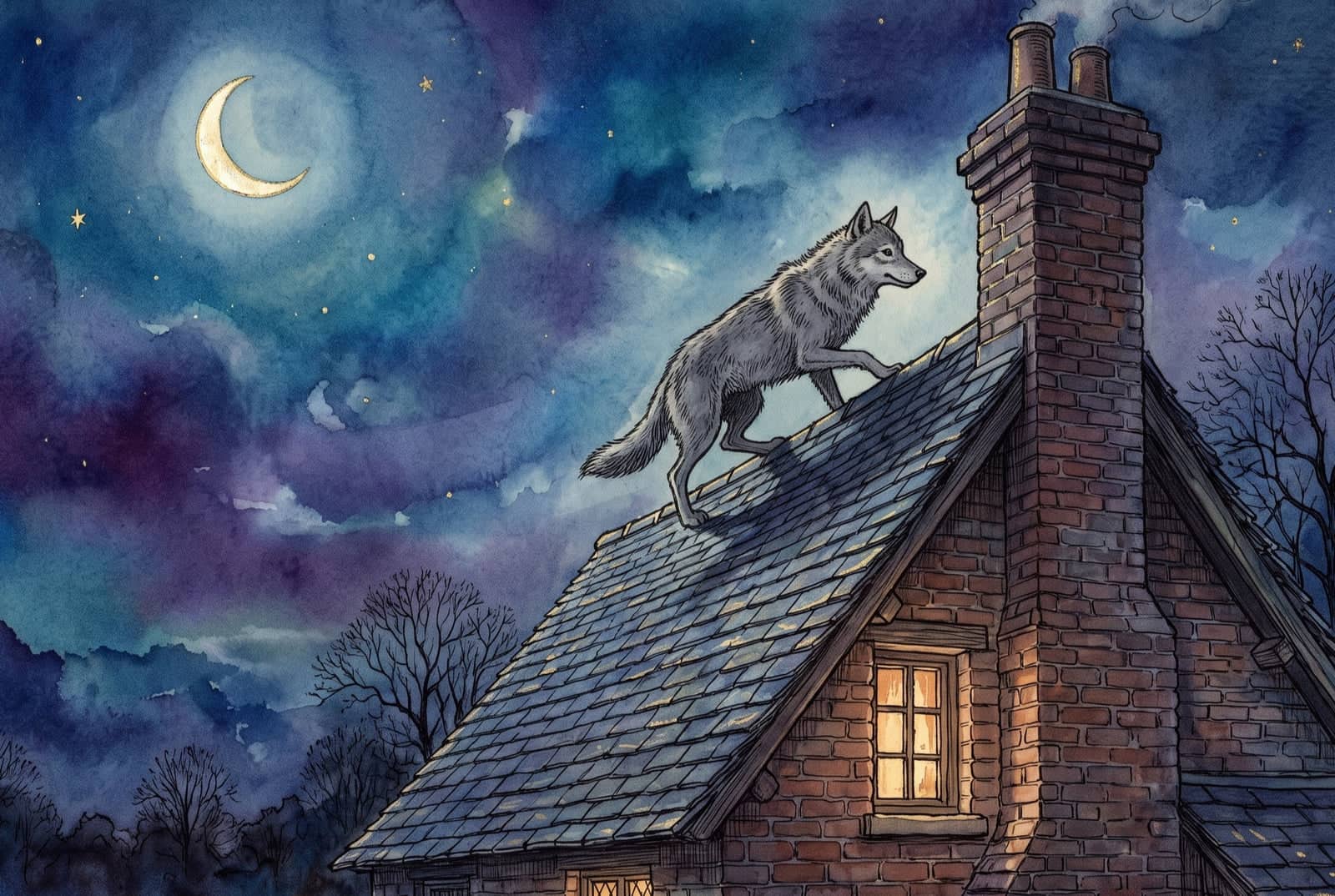
The little pig heard him climbing onto the roof. He hung his big pot of water over the fire, and built the fire up until it blazed, and lifted the lid off, and stood well back. Down came the wolf, straight into the pot, and the little pig clapped the lid on in an instant. Then he boiled him up and ate him for supper, and that was the end of the wolf.
So the third little pig kept his house, and his turnips, and his apples, and his butter churn, and nobody ever knocked at that good stout door to frighten him again. And he lived happily ever after.
Retold by Talerie from English Fairy Tales (opens in a new window)License: Public domainCopy this text, adapt it, use it however you like. A link back to Talerie is appreciated but never required.CC0 1.0 (opens in a new window)