The Velveteen Rabbit
13 min read ages 4 and up talerie.com/en/tales/the-velveteen-rabbit
The Skin Horse is the oldest toy in the nursery, and the only one who is kind to the new velveteen rabbit. A toy becomes Real, the Skin Horse tells him, when a child loves it for a long, long time. Then one night Nana can’t find the china dog, and she gives the Boy the Rabbit to sleep with instead.
There was once a velveteen rabbit, and in the beginning he was truly splendid. He was fat and bunchy, as a rabbit should be, with a coat spotted brown and white, real thread whiskers, and ears lined with pink sateen. On Christmas morning he sat in the top of the Boy’s stocking with a sprig of holly between his paws.
For at least two hours the Boy loved him. Then the aunts and uncles came to dinner, and in the excitement over the new presents the Velveteen Rabbit was forgotten.
For a long time he lived in the toy cupboard, and because he was only velveteen, the more expensive toys snubbed him. The mechanical toys looked down on everyone and pretended they were real. The model boat never missed a chance to mention his rigging, and even Timothy, the jointed wooden lion, put on airs.
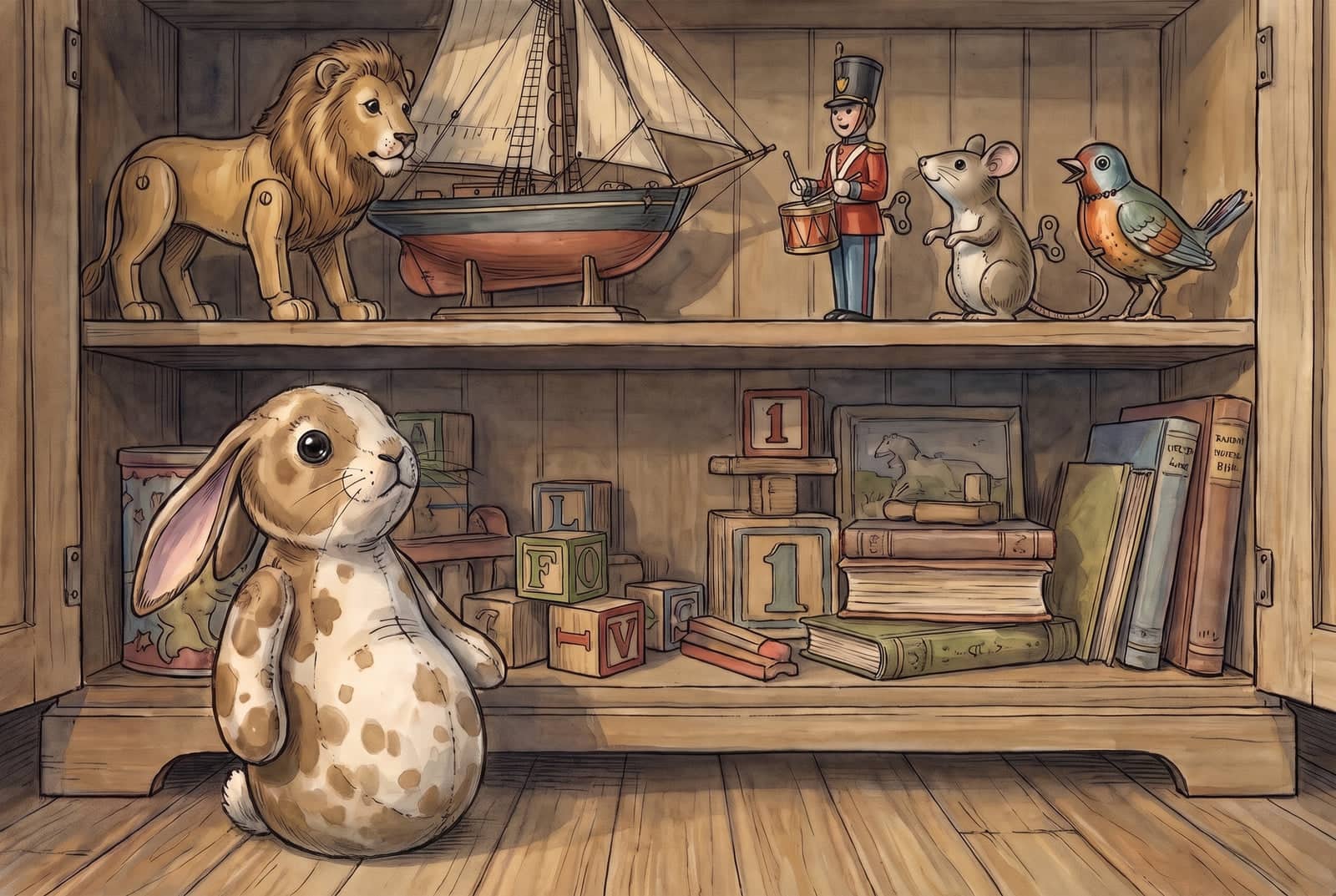
The Rabbit didn’t know that real rabbits existed. He thought they were all stuffed with sawdust like himself. Among those grand toys he felt very small, and the only one who was kind to him was the Skin Horse.
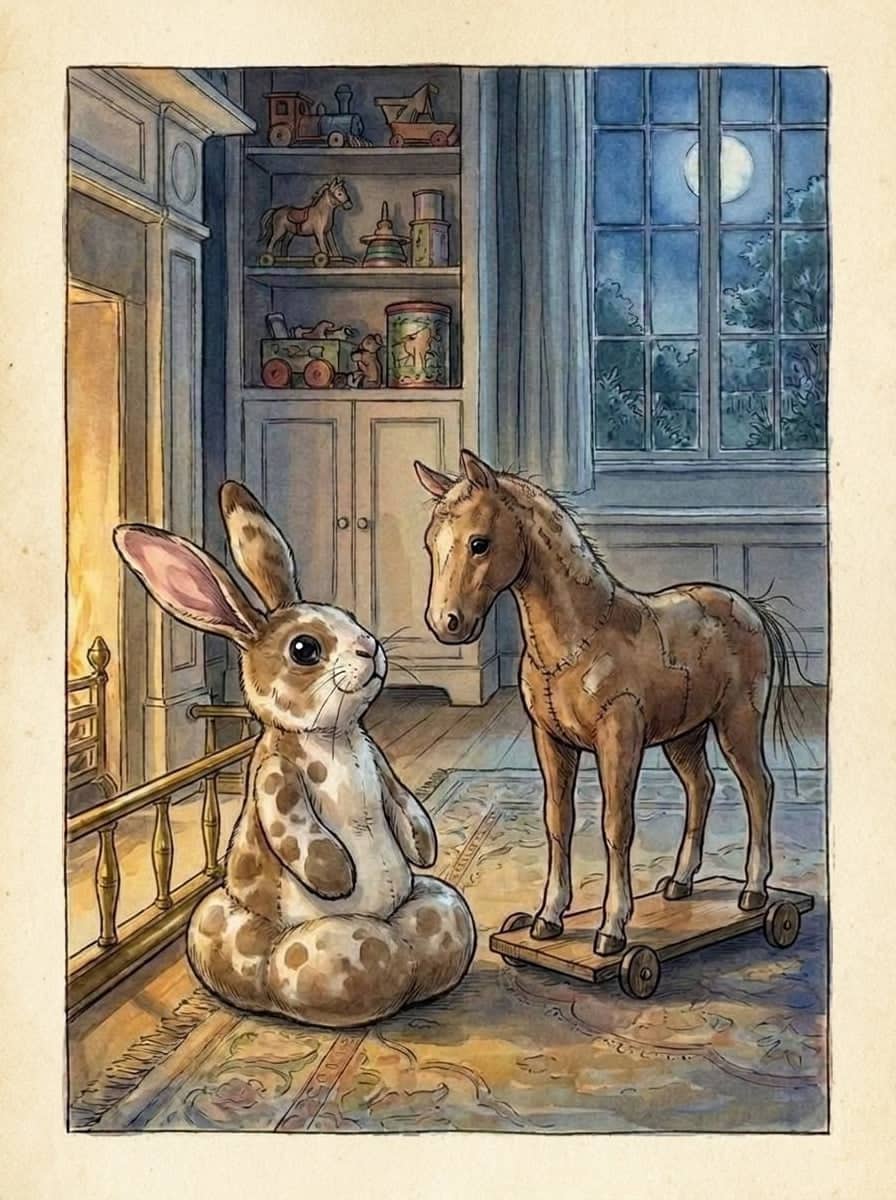
The Skin Horse was the oldest toy in the nursery. His brown coat was bald in patches, and he was wise. He had watched many mechanical toys arrive to boast and swagger, then break their mainsprings and be thrown away.
“What is REAL?” the Rabbit asked one day, as they lay side by side on the nursery floor. “Does it mean having things that buzz inside you and a handle sticking out?”
“Real isn’t how you are made,” said the Skin Horse. “It’s a thing that happens to you. When a child loves you for a long, long time, not just to play with, but REALLY loves you, then you become Real.”
“Does it hurt?” asked the Rabbit.
“Sometimes,” said the Skin Horse, for he always told the truth. “When you are Real you don’t mind being hurt.”
“Does it happen all at once, like being wound up,” the Rabbit asked, “or bit by bit?”
“It takes a long time,” said the Skin Horse. “By the time you are Real, most of your hair has been loved off, and your eyes drop out, and you get loose in the joints and very shabby. But these things don’t matter at all, because once you are Real you can’t be ugly, except to people who don’t understand. And once you are Real, you can’t become unreal again. It lasts for always.”
The Rabbit sighed. He longed to become Real, but he wished it could happen without growing shabby and losing his eyes and whiskers.
The nursery was ruled by Nana, who now and then swooped around like a great wind and bundled the playthings into cupboards.
One evening the Boy couldn’t find the china dog that always slept with him. Nana was in a hurry and didn’t want to hunt for china dogs at bedtime, so she made a swoop at the open toy cupboard.
“Here,” she said, “take your old Bunny! He’ll do to sleep with you!” She pulled the Rabbit out by one ear and put him into the Boy’s arms.
From that night on, the Velveteen Rabbit slept in the Boy’s bed. At first it was uncomfortable, for the Boy hugged him very tight. But soon he came to like it. The Boy talked to him and made tunnels for him under the bedclothes, and when the Boy fell asleep, the Rabbit snuggled close under his warm little chin and dreamed.
Time went on, and the little Rabbit was so happy that he never noticed how his velveteen fur was getting shabbier and shabbier, how his tail was coming unsewn, and how all the pink had been rubbed off his nose where the Boy had kissed him.
Spring came, and wherever the Boy went, the Rabbit went too. There were rides in the wheelbarrow and fairy huts under the raspberry canes. Once the Rabbit was left on the lawn until long after dark. The Boy couldn’t go to sleep without him, so Nana had to take a candle and go out to look for his Bunny.
He was soaked with dew and covered in earth, and Nana grumbled as she wiped him clean with a corner of her apron.
“You must have your old Bunny!” she said. “All that fuss over a toy!”
The Boy sat up in bed and stretched out his hands.
“Give me my Bunny!” he said. “You mustn’t say that. He isn’t a toy. He’s REAL!”
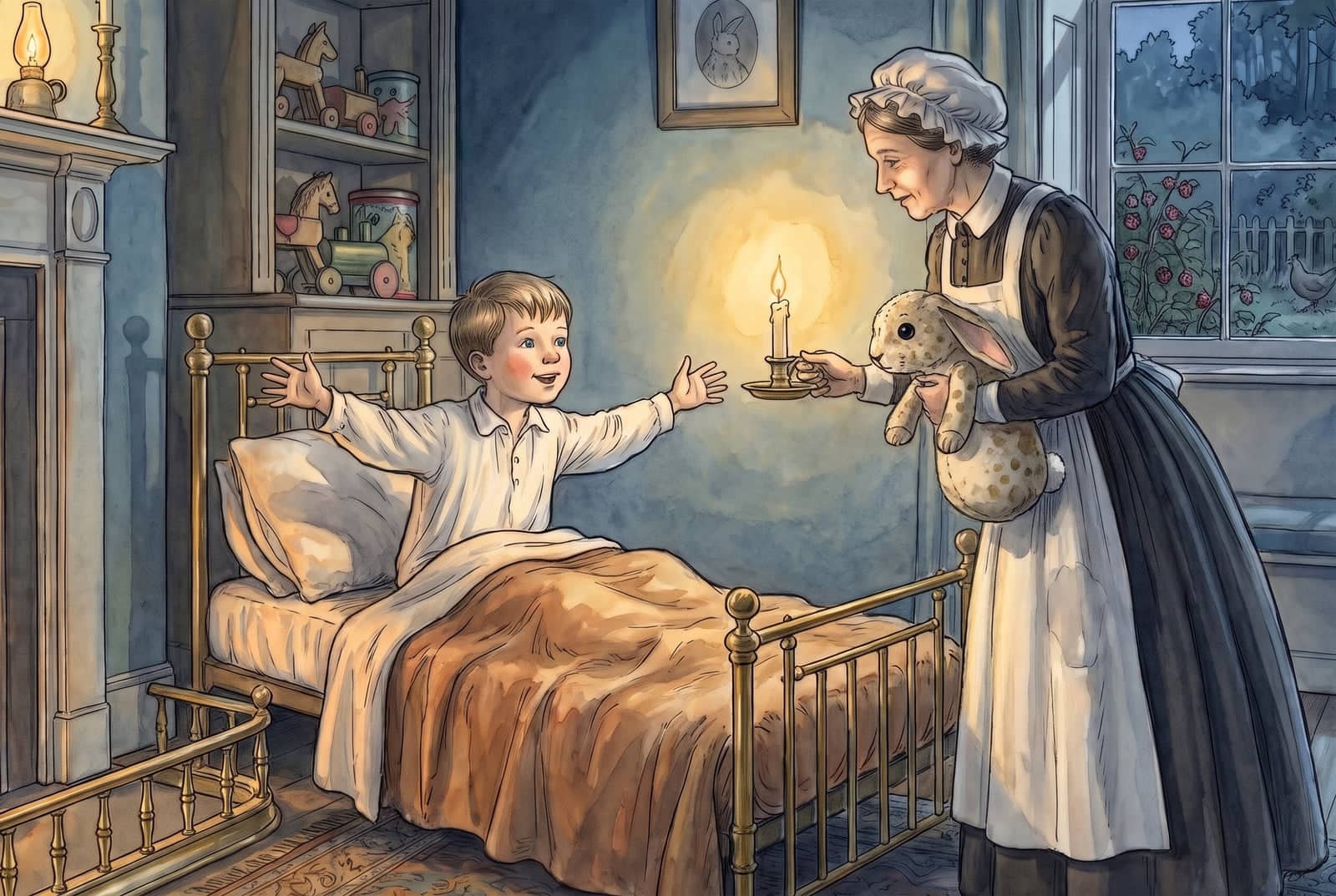
When the little Rabbit heard that, he was very happy, for the nursery magic had happened to him at last. He was Real. The Boy himself had said so.
That night so much love stirred in his little sawdust heart that it nearly burst. A look of wisdom and beauty came into his worn boot-button eyes, and even Nana noticed it the next morning.
“Well, I declare,” she said, “that old Bunny has quite a knowing look!”
That was a wonderful summer! On long June evenings the Boy liked to play in the woods near the house. He always took the Rabbit along and made him a little nest in the ferns before he ran off to play among the trees.
One evening, while the Rabbit lay there alone, he saw two strange creatures creep out of the tall ferns. They were rabbits like himself, but furry and brand-new. The Rabbit stared hard to see where their clockwork stuck out, but he couldn’t find it.
“Why don’t you get up and play with us?” one of them asked.
“I don’t feel like it,” said the Rabbit, for he didn’t want to explain that he had no clockwork.
“Ho! It’s as easy as anything,” said the furry rabbit, and he gave a big hop sideways and stood on his hind legs. “Can you hop on your hind legs?”
That was a dreadful question, because the Velveteen Rabbit had no hind legs at all! The back of him was made all in one piece, like a pincushion. He sat still in the ferns and hoped the wild rabbits wouldn’t notice.
“I don’t want to!” he said.
But wild rabbits have very sharp eyes, and this one stretched out his neck and looked.
“He hasn’t got any hind legs!” he called out. “Imagine a rabbit without any hind legs!” And he began to laugh.
“I do!” cried the little Rabbit. “I do have hind legs! I’m sitting on them!”
“Then stretch them out and show me, like this!” said the wild rabbit, and he began to spin around and dance until the little Rabbit felt quite dizzy.
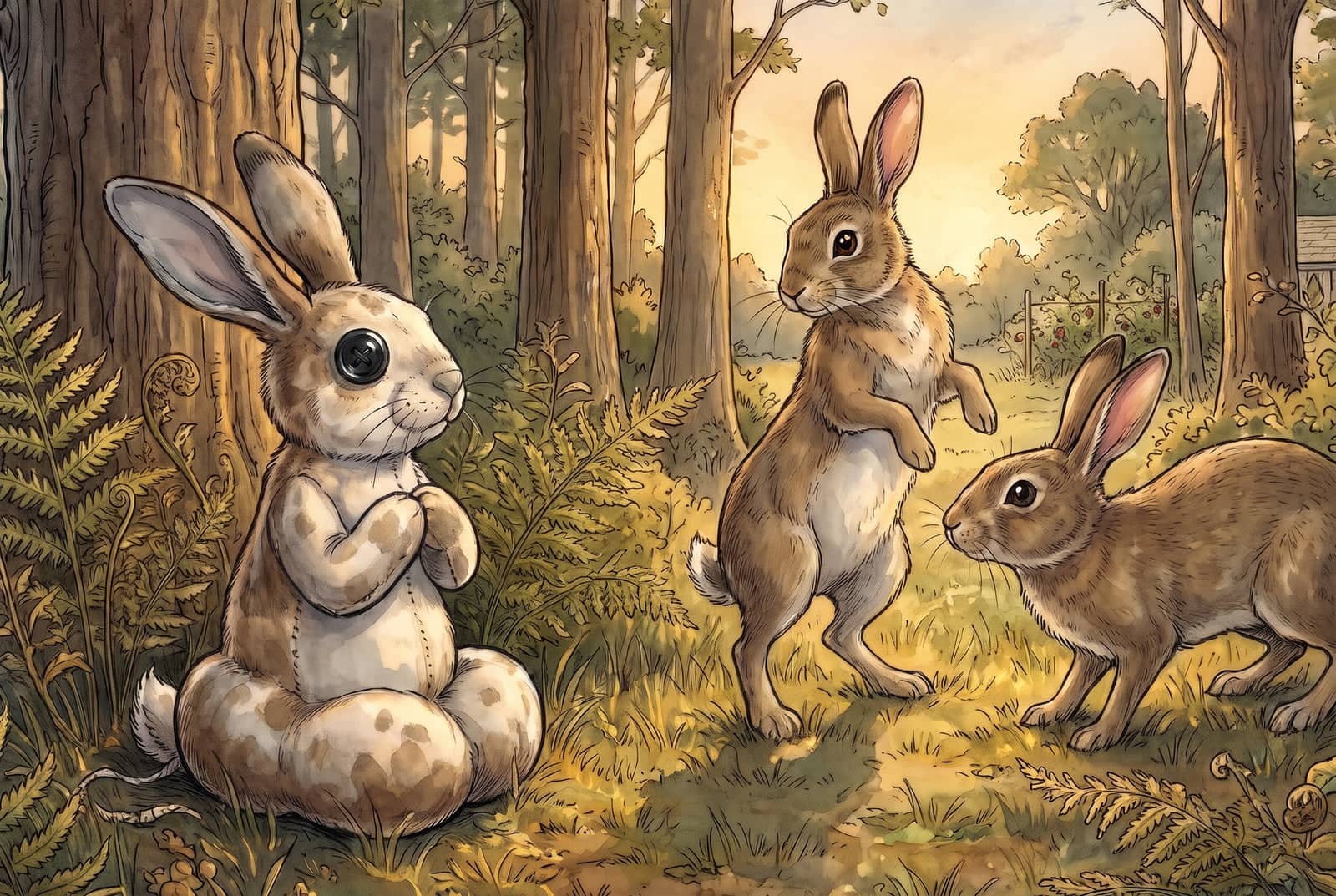
The Rabbit said he would rather sit still, but all the while he was longing to dance. He would have given anything in the world to jump around the way those rabbits did.
The strange rabbit stopped dancing, came up close, and sniffed at the Velveteen Rabbit. Then he wrinkled his nose, flattened his ears, and jumped backward.
“He doesn’t smell right!” he cried. “He isn’t a rabbit at all! He isn’t real!”
“I am Real!” said the little Rabbit. “I am Real! The Boy said so!” And he nearly began to cry.
Just then the Boy ran past, and with a thump of feet and a flash of white tails the two strange rabbits were gone.
“Come back and play with me!” called the little Rabbit. “Oh, do come back! I know I am Real!”
But there was no answer. They never came back, and at sunset the Boy carried him home.
Weeks passed, and the little Rabbit grew very old and shabby, but the Boy loved him just as much. He loved him so hard that he loved all his whiskers off. The pink lining of the Rabbit’s ears turned gray, and his brown spots faded. He hardly looked like a rabbit anymore, except to the Boy, and that was all the little Rabbit cared about.
And then, one day, the Boy fell ill.
His little body was so hot that it burned the Rabbit when the Boy held him close. Through it all the Rabbit lay hidden under the bedclothes and never stirred, for he was afraid that someone might take him away, and he knew the Boy needed him.
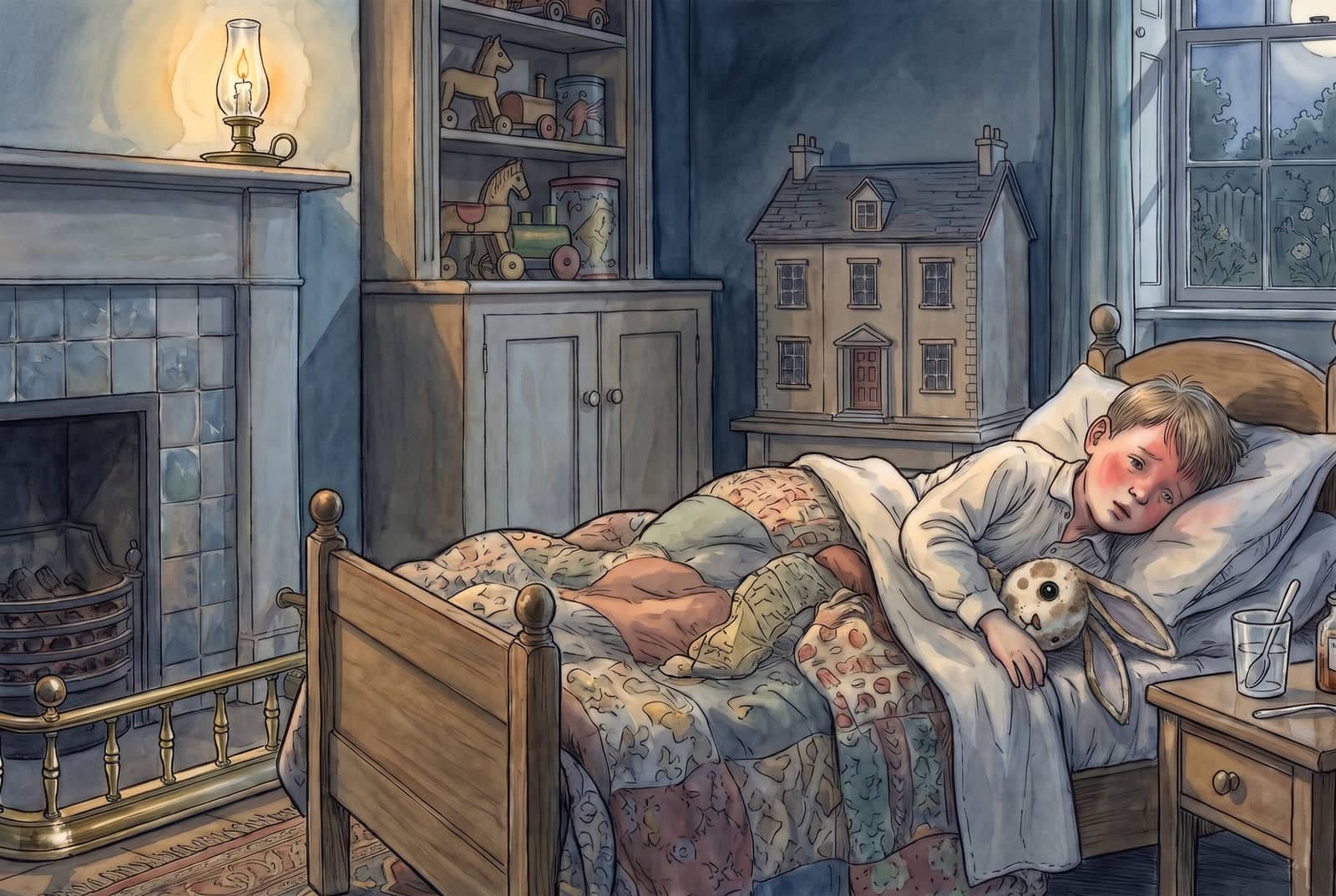
It was a long, weary time. The Rabbit whispered to the Boy about the games they would play in the garden once he was well. At last the fever broke, and the Boy got better.
One bright morning they carried the Boy out onto the balcony, wrapped in a shawl, while the Rabbit lay tangled in the bedclothes, listening. The doctor had settled everything: the Boy was to go to the seaside the next day, and all the books and toys he had played with in bed were to be burned.
“Hooray!” thought the little Rabbit. “Tomorrow we’ll go to the seaside!”
Just then Nana caught sight of him.
“What about his old Bunny?” she asked.
“That?” said the doctor. “Why, it’s a mass of scarlet fever germs! Burn it at once. What? Nonsense! Get him a new one. He mustn’t have that anymore!”
So the little Rabbit was put into a sack with the old picture books and a lot of trash and carried out behind the henhouse at the end of the garden. The gardener promised to burn it all first thing in the morning.
That night the Boy slept in a different room with a new white plush bunny, but he hardly looked at it. He could think of nothing but the seaside.
Behind the henhouse, the little Rabbit wriggled his head out of the untied sack. He felt very lonely, and he was shivering, for his coat had been hugged so thin that it no longer kept him warm.
He could see the raspberry canes where he had played with the Boy, and a great sadness came over him. He remembered the wonderful day he first knew he was Real. He thought of the Skin Horse, so wise and gentle. What use was it to be loved, and lose your beauty, and become Real, if it all ended like this?
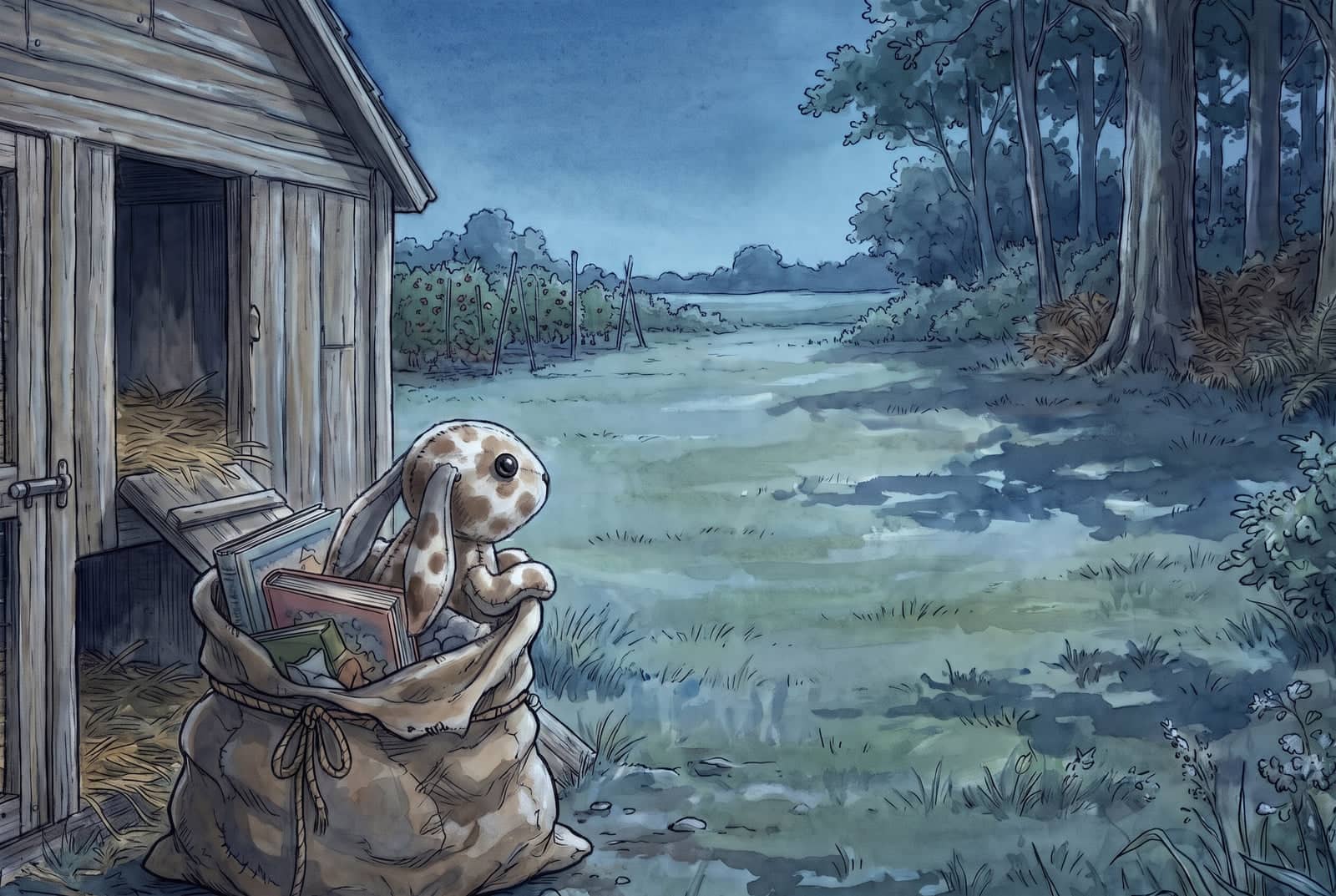
And a tear, a real tear, trickled down his shabby little velvet nose and fell to the ground.
Then a strange thing happened. Where the tear had fallen, a flower grew out of the ground, a mysterious flower. In the middle of its emerald leaves was a blossom like a golden cup. The blossom opened, and out of it stepped a fairy.
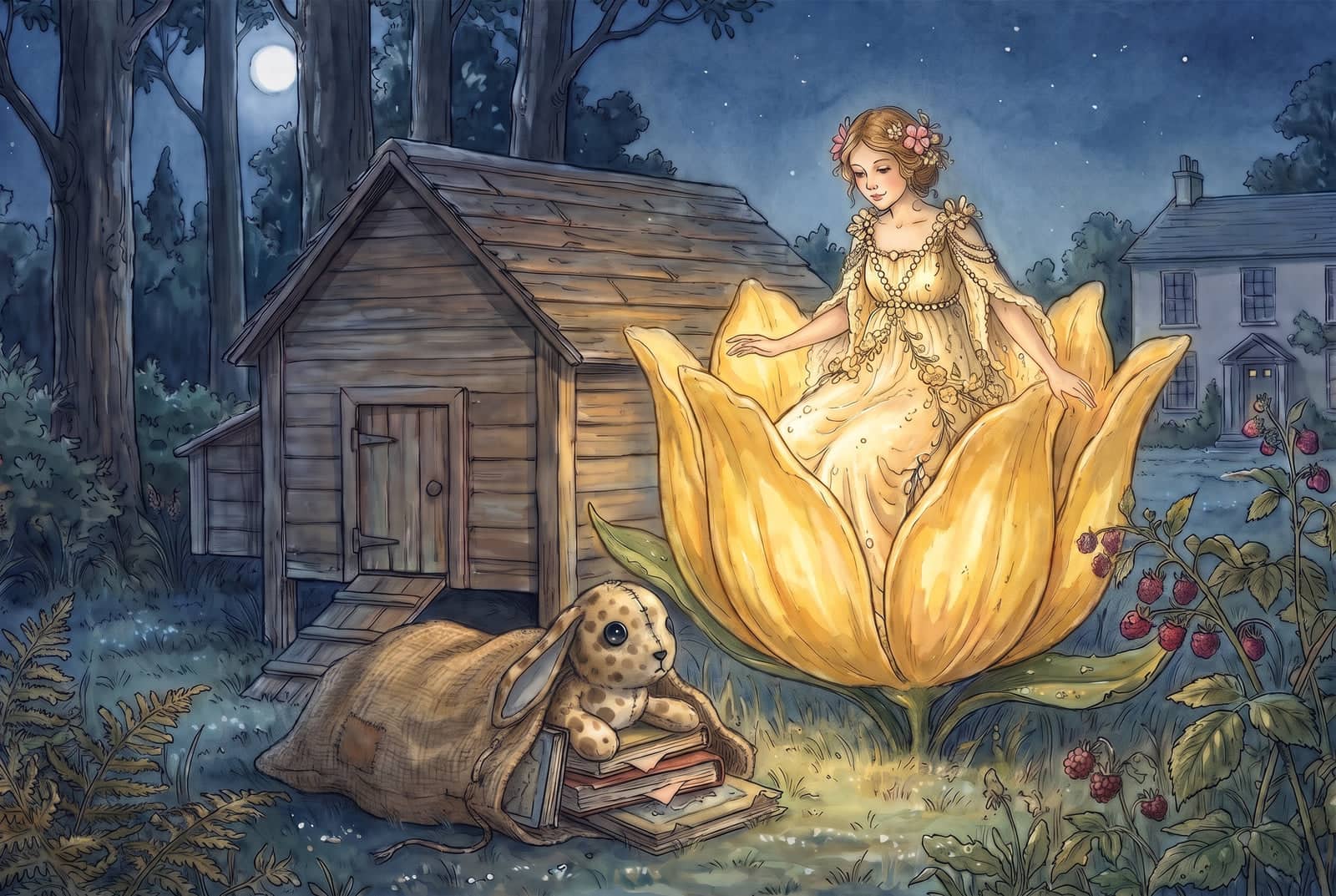
She gathered the little Rabbit up in her arms and kissed him on his velveteen nose, which was still damp from crying.
“Little Rabbit,” she said, “don’t you know who I am?”
The Rabbit looked up at her. It seemed to him that he had seen her face before, but he couldn’t think where.
“I am the nursery magic Fairy,” she said. “I take care of all the playthings that children have loved. When they are old and worn out and the children don’t need them anymore, I come and take them away with me and turn them into Real.”
“Wasn’t I Real before?” asked the little Rabbit.
“You were Real to the Boy,” the Fairy said, “because he loved you. Now you shall be Real to everyone.”
She held him close and flew with him into the woods. In a moonlit glade the wild rabbits were dancing with their shadows on the grass, but when they saw the Fairy, they all stopped and stood around in a ring to stare.
“I’ve brought you a new playmate,” the Fairy said. “Be very kind to him and teach him everything he needs to know, for he is going to live with you forever and ever!”
She kissed the little Rabbit again and set him down on the grass.
“Run and play, little Rabbit!” she said.
But the little Rabbit sat still. With all the wild rabbits dancing around him, he suddenly remembered that he had no hind legs, and he didn’t want anyone to see that he was made all in one piece. He did not know that with her last kiss the Fairy had changed him completely. He might have sat there a long time if something hadn’t tickled his nose. Without thinking, he lifted his hind toe to scratch it.
And he found that he really had hind legs! Instead of dingy velveteen he had brown fur, soft and shiny, his ears twitched all by themselves, and his whiskers brushed the grass. He leaped, jumping sideways and spinning around as the others did. When at last he stopped to look for the Fairy, she was gone.
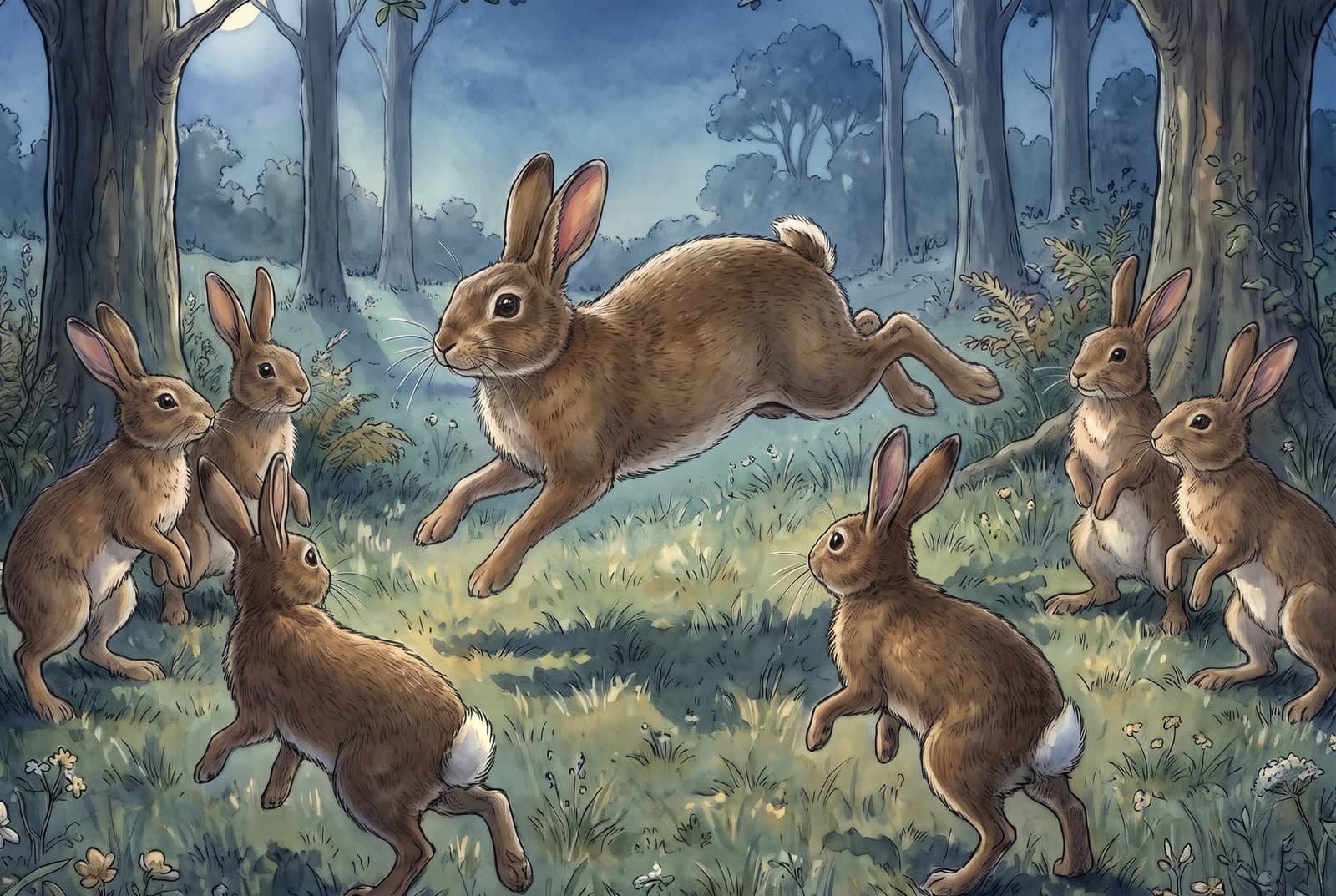
He was a Real Rabbit at last, at home with the other rabbits.
Autumn passed, and winter, and in the spring the Boy went out to play in the woods behind the house. Two rabbits crept out of the ferns and peeped at him. One was brown all over, but the other had faint markings under his fur, as though long ago he had been spotted and the spots still showed through. There was something so familiar about his soft little nose and round black eyes that the Boy thought, “Why, he looks just like my old Bunny that was lost when I had scarlet fever!”
But he never knew that it really was his own Bunny, come back to look at the child who had first helped him to be Real.
Retold by Talerie from The Velveteen Rabbit (opens in a new window) Public domain Copy this text, adapt it, use it however you like. A link back to Talerie is appreciated but never required. CC0 1.0 (opens in a new window)