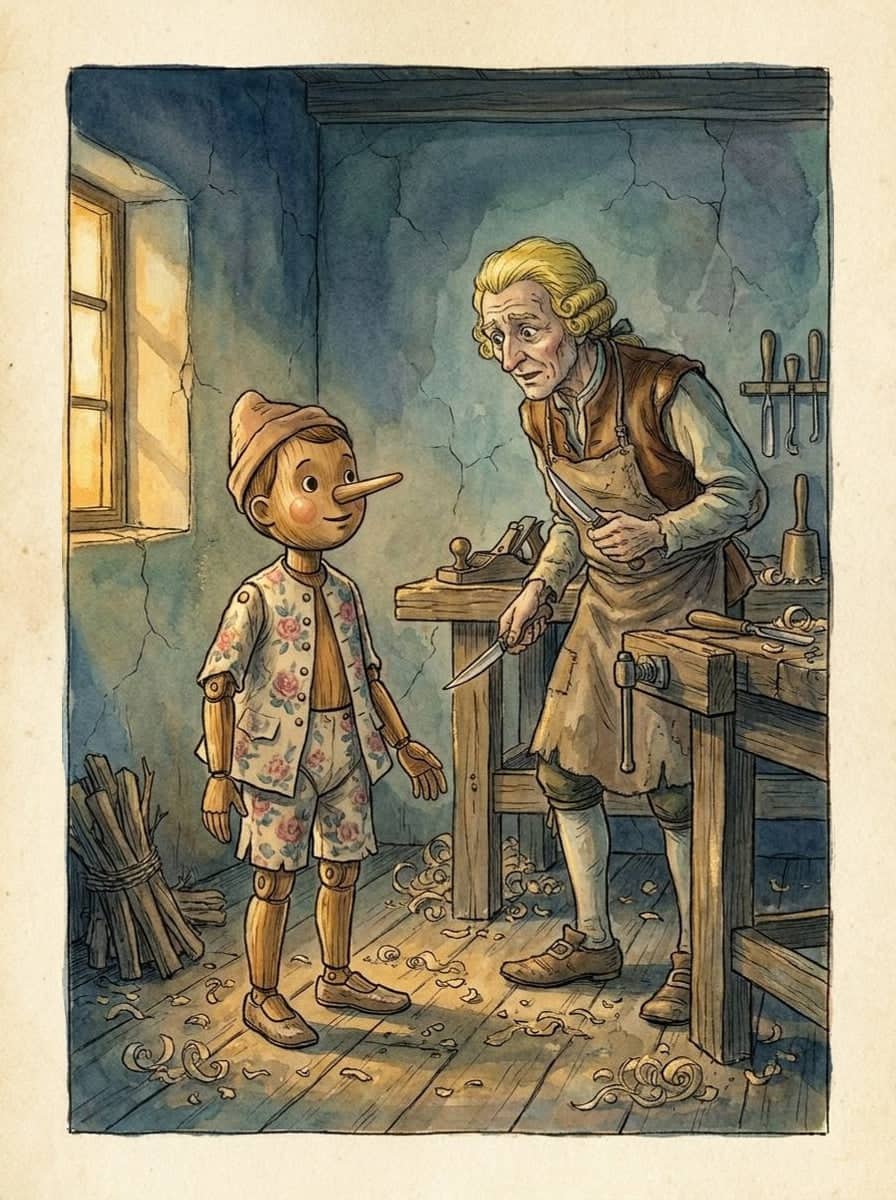
A poor carver cuts a puppet from a log, and the puppet sells his spelling book, buries his gold where a Fox tells him to, and grows a longer nose with every lie. Pinocchio gives his forty pennies to the sick Fairy and wakes a real boy, with Geppetto carving at his bench and the wooden puppet propped against a chair.
Once upon a time there was a piece of wood, a plain log from the woodpile, the kind that goes into the stove on a cold morning.
It came to a poor old carver called Geppetto, who lived in one room with a broken chair, a narrow bed and a fire painted on the wall, because he could not afford a real one.
“I shall carve a puppet that can dance and turn somersaults,” he said, “and travel the world with him and earn my bread. I shall call him Pinocchio.”
He cut the eyes, and the eyes looked back at him. He cut the nose, and it grew longer the more he trimmed it. He made the hands, and they whipped the corn-yellow wig off his head. He made the feet, and they kicked him on the nose.
“I brought this on myself,” sighed Geppetto, and he showed the puppet how to walk.
Pinocchio walked. Then he ran. Then he saw the door standing open, and out he went into the street like a hare.
A soldier caught him and handed him back, but when Geppetto took him by the collar the puppet threw himself down and howled, and the neighbours came crowding round.
“Poor little thing,” they said. “That old man will break him to pieces.”
They made such a noise that the soldier let Pinocchio go and marched Geppetto off to prison instead.
Pinocchio ran home, bolted the door and stretched out on the floor, very pleased with himself.
“Cri-cri-cri,” said a small voice on the wall. “I am the Talking Cricket. I have lived in this room a hundred years, and boys who run away from their fathers never come to any good.”
“Tomorrow I am off,” said Pinocchio. “If I stay they will send me to school, and I mean to do nothing but eat and play and sleep.”
“Then I am sorry for you. Boys who live that way end up in prison or in a hospital, and every one of them turns into a donkey sooner or later.”
That was more than Pinocchio could bear. He snatched up a hammer and threw it, and the small voice said nothing more.
In the morning his father was at the door, home from a prison he had done nothing to deserve, with three pears in his pocket for his own breakfast. He gave away all three, and made the boy a paper suit, shoes made of bark and a breadcrumb cap.
“Now I shall go to school,” said Pinocchio, “only I have no spelling book.”
Geppetto put on his old patched coat, went out into the snow, and came back with a spelling book. The coat was gone.
“Father, where is your coat?”
“I sold it. It made me too warm.”
Pinocchio understood him perfectly, and threw his arms round the old man’s neck.
He set off for school next morning with the book under his arm, and had not gone far when he heard a fife and a drum. There was a puppet theatre in the square, four pennies to go in.
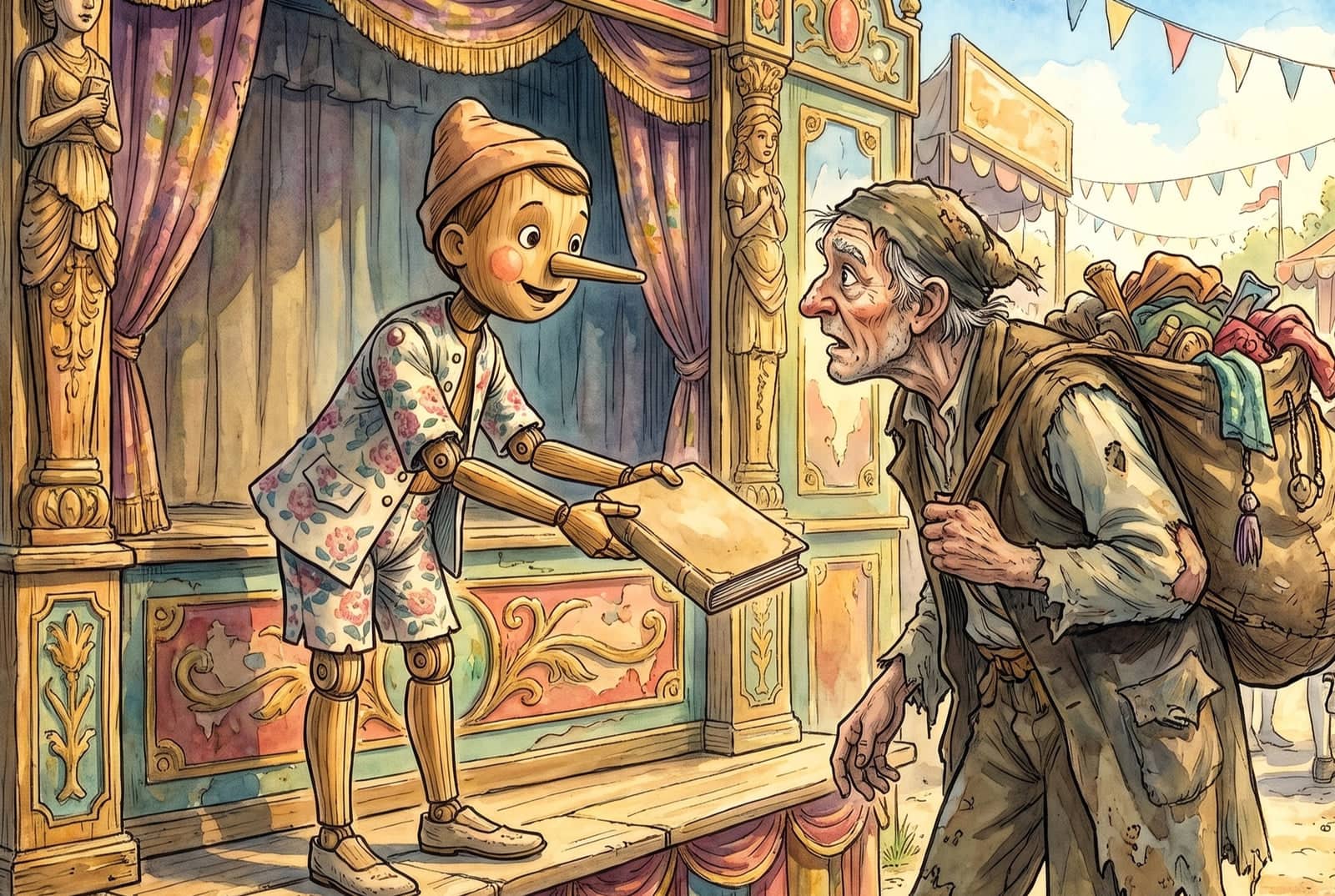
Pinocchio had no pennies. What he had was a spelling book bought with an old man’s coat, and a rag seller at his elbow offering four pennies for it. Inside a minute the book was sold and Pinocchio was in the theatre, up on the stage among the puppets, who stopped the play to embrace their wooden brother.
The master of the theatre was a huge man called Fire Eater, with a beard down to his boots, who had a leg of mutton roasting and no wood left to finish it.
“He is good dry wood,” said Fire Eater. “Throw him on the fire.”
Pinocchio cried out for his father, and Fire Eater, who sneezed whenever he was sorry for anybody, sneezed twice and let him go. “Then burn Harlequin instead,” he said.
Pinocchio threw himself down at the big man’s feet.
“No. Harlequin is my friend and he has done nothing. Burn me.”
Fire Eater sneezed four or five times over, and spared them both. The puppets danced till daybreak, and in the morning the big man put five gold coins into Pinocchio’s hand for his father.
On the road home he met a Fox lame in one paw and a Cat blind in both eyes, who were very sorry for themselves until they heard the coins chink.
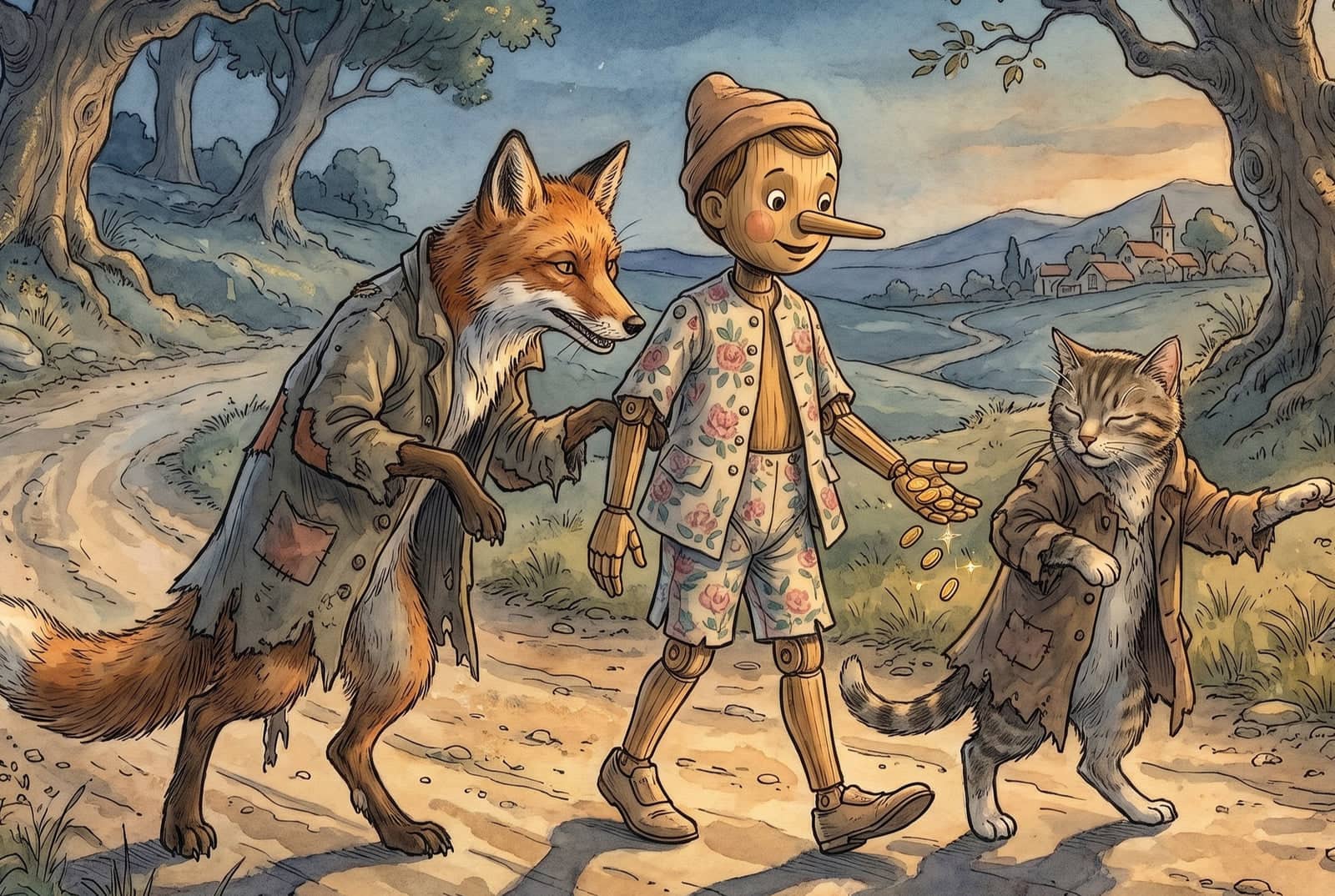
“Why be content with five,” said the Fox, “when by tomorrow you could have two thousand? Beyond the town lies the Field of Miracles. You dig a hole, drop your gold in, water it and go to bed, and in the morning you come back to a tree hung all over with coins.”
Pinocchio, who had been going straight home, went with them instead. They stopped for supper at an inn, and at midnight the two of them went on ahead and left him the bill, so it was four coins, not five, that he carried into the dark.
He walked all night, and at daybreak came to a little white house shining in the wood, knocked, and fell across the step.
The house belonged to a girl with hair as blue as a cornflower, who was no girl at all but a Fairy, a thousand years old. She carried him in, put him to bed and kept him as her own son.
“And the gold,” she said, when he had told her his story. “Where is it now?”
“I lost it,” said Pinocchio. The coins were in his pocket.
His nose grew two fingers longer.
“Where did you lose it?”
“In the wood,” said Pinocchio, and his nose grew longer still, until he could not turn round without knocking it against the bed or the window.
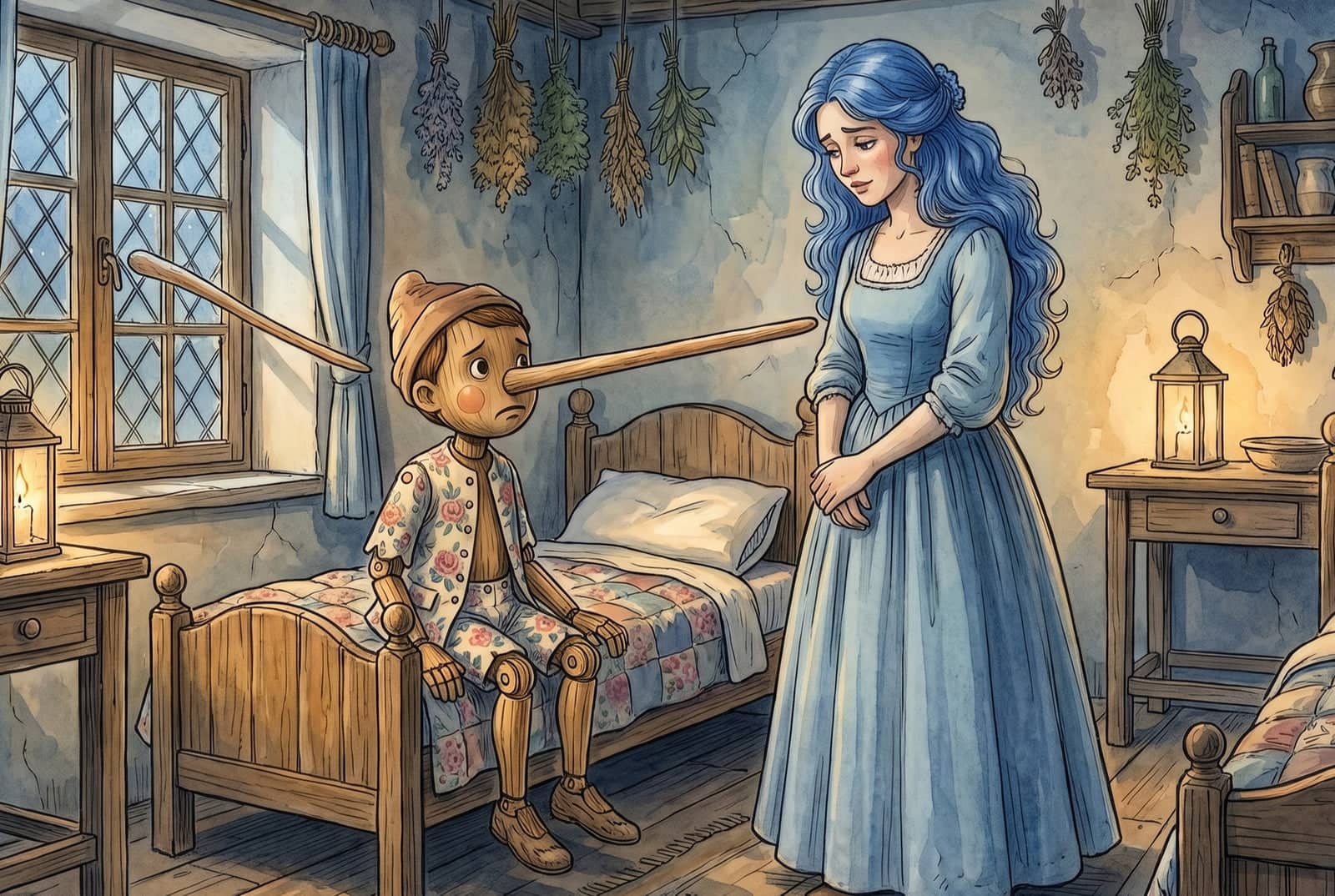
“There are two kinds of lies, my boy,” said the Fairy. “The ones with short legs and the ones with long noses. Yours are the second kind.”
Pinocchio cried with shame, and when at last he told her the truth, his nose came quietly back to its own size.
“You need not be a puppet all your life,” said the Fairy. “You can become a real boy of flesh and blood, if you deserve it: doing as you are told, willing to study and to work, and telling the truth when a lie would be easier.”
“I promise,” said Pinocchio, and he meant it, the way he always meant it.
He meant it for one day. Then the Fox and the Cat found him again and told him the Field of Miracles was to be sold tomorrow, and nobody allowed to sow money in it after that.
So he dug his hole outside the town, put the four gold pieces in and carried water from the well in his shoe to sprinkle them. Then he went away to wait, counting the minutes.
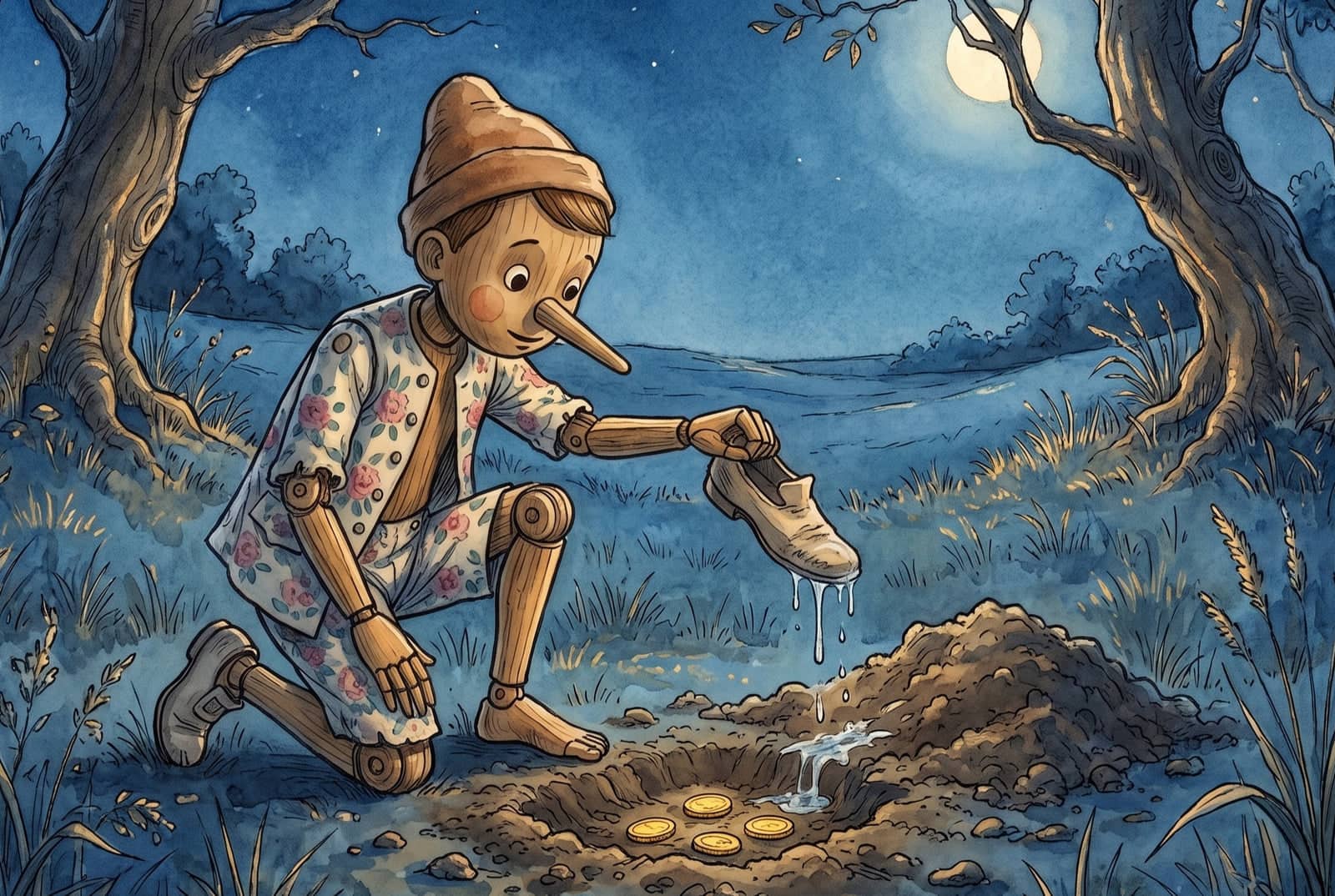
When he came back he dug a hole you could have buried a haystack in and found nothing. His two friends had come an hour after he left and gone off with the money like the wind, and the judge he complained to had him locked up for four months. So the Cricket had been right about the prison.
When he was let out he went back to the white house, and the Fairy forgave him, once and not twice.
“Your father sold what he had left and built a little boat,” she said. “He has gone to sea to look for you, and nobody has seen him since.”
Pinocchio cried the whole of that night. In the morning he went to school.
And he kept his word for a whole year. He was first into the schoolroom and last out of it, and at the end of the year he took the first prize at the examinations.
“Tomorrow,” said the Fairy, kissing him, “you will stop being a puppet and become a real boy.”
That evening he went out to tell his friends the news, and found the last of them under a shed at the edge of the town. This was Romeo, called Lamp Wick because he was as long and thin as a new wick, and the friend Pinocchio loved best.
“I am going away tonight,” said Lamp Wick, “to the Country of Playthings. No schools there, no teachers, no books. Six Saturdays in every week and one Sunday, and the holidays begin on the first of January and end on the last of December. Come with us and always be happy.”
“No, no,” said Pinocchio. “I have promised.”
He said it a dozen times, and each time he stayed a little longer. At midnight a coach came down the road without a sound, drawn by little donkeys in white boots, with a fat little man on the box, his face as smooth as butter and his voice like a cat asking for milk.
“Come with us and always be happy,” called the boys inside, and Pinocchio sighed once, and twice, and a third time, and climbed up.
There was nobody in that country but boys, and nothing to do but play, from sunrise until long after dark. They played there five months.
Then one morning Pinocchio woke and scratched his head and felt something that had not been there the night before. Two long ears, furred like a donkey’s, had pushed out under the brim of his breadcrumb cap.
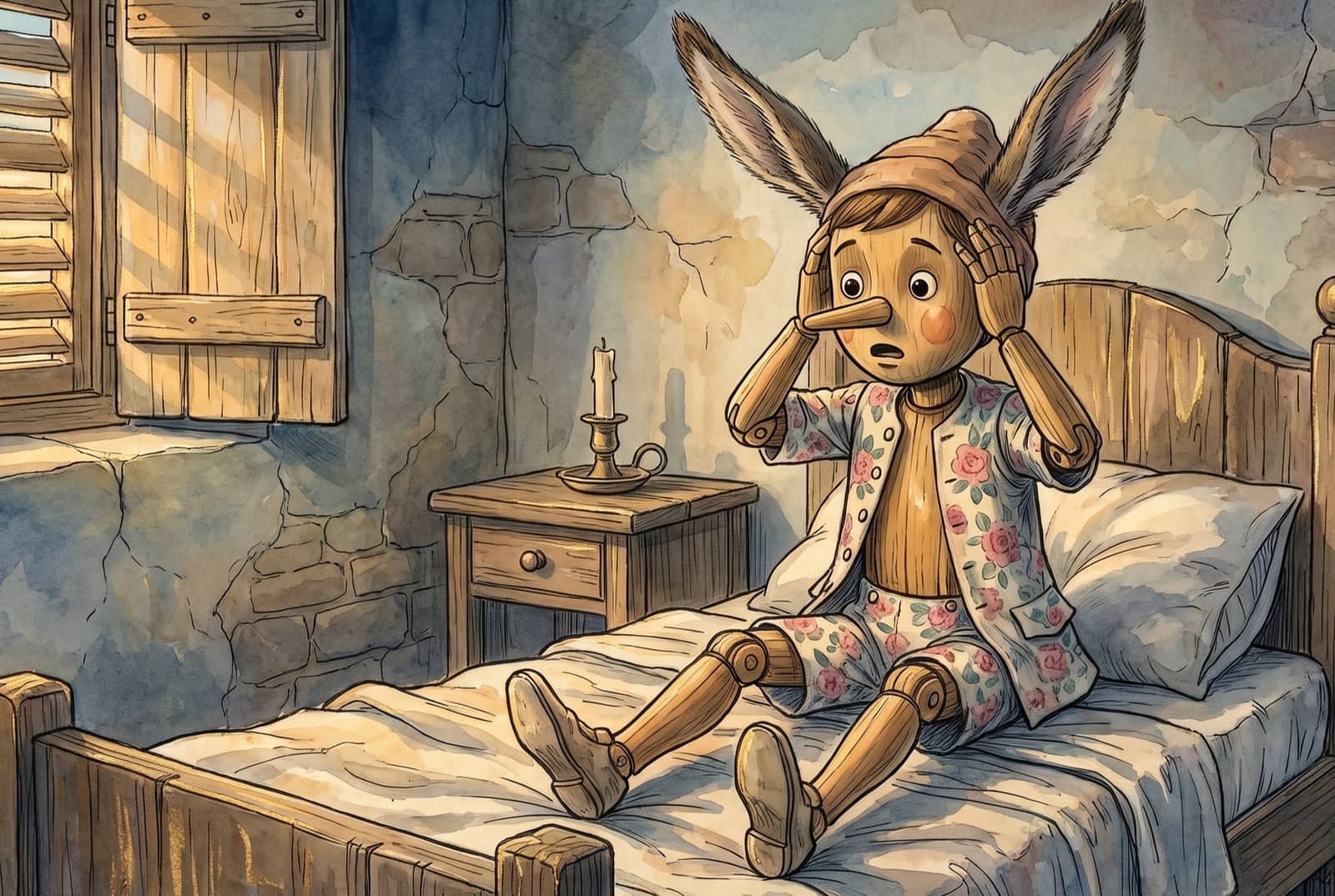
It was the donkey fever, said the dormouse downstairs, and there was no cure for it.
Pinocchio pulled the cap down over his ears and went to find Lamp Wick, who was wearing a cap of his own. They took the caps off together, on the count of three, and laughed at each other with four long ears between them, until the laughing turned into something else and they were down on all fours with tails behind them.
Then the fat little man came with straps and bridles, led them to the market and sold them both. That was his trade, and it had made him rich: he gathered up the boys who hated school, let them play until they were donkeys, and sold them.
Lamp Wick went to a farmer. Pinocchio went to the master of a circus, who taught him with a whip to waltz and jump through hoops. The theatre was full on the night he appeared, and he was lame before the dance was over, for his hind legs went from under him.
A lame donkey is no use to a circus. They took him to the market, and a man bought him for pennies, twenty-five of them, and not for work.
“I want the hide,” he said. “It will make me a fine drumhead.”
He led him to the top of a cliff above the sea, tied a stone about his neck, let him down into the water on a rope, and waited. When he hauled it up an hour later there was no donkey on the end of it, only a wooden puppet wriggling like an eel.
“My Fairy sent a shoal of little fishes,” said Pinocchio, “and they ate the donkey off me. When they came to the wood they turned up their noses and swam away.”
He slipped off the rock before the man could shut his mouth.
He was a long way out when the water lifted behind him and an enormous shark, the one the fishermen called the Dogfish, opened a mouth like a barn door and swallowed him whole.
Inside it was as black as ink, but far off down that great dark belly a small light was burning, and Pinocchio walked towards it. It was a candle stuck in the neck of a green glass bottle, and behind it, at a little table, sat his father.
“Father!” said Pinocchio.
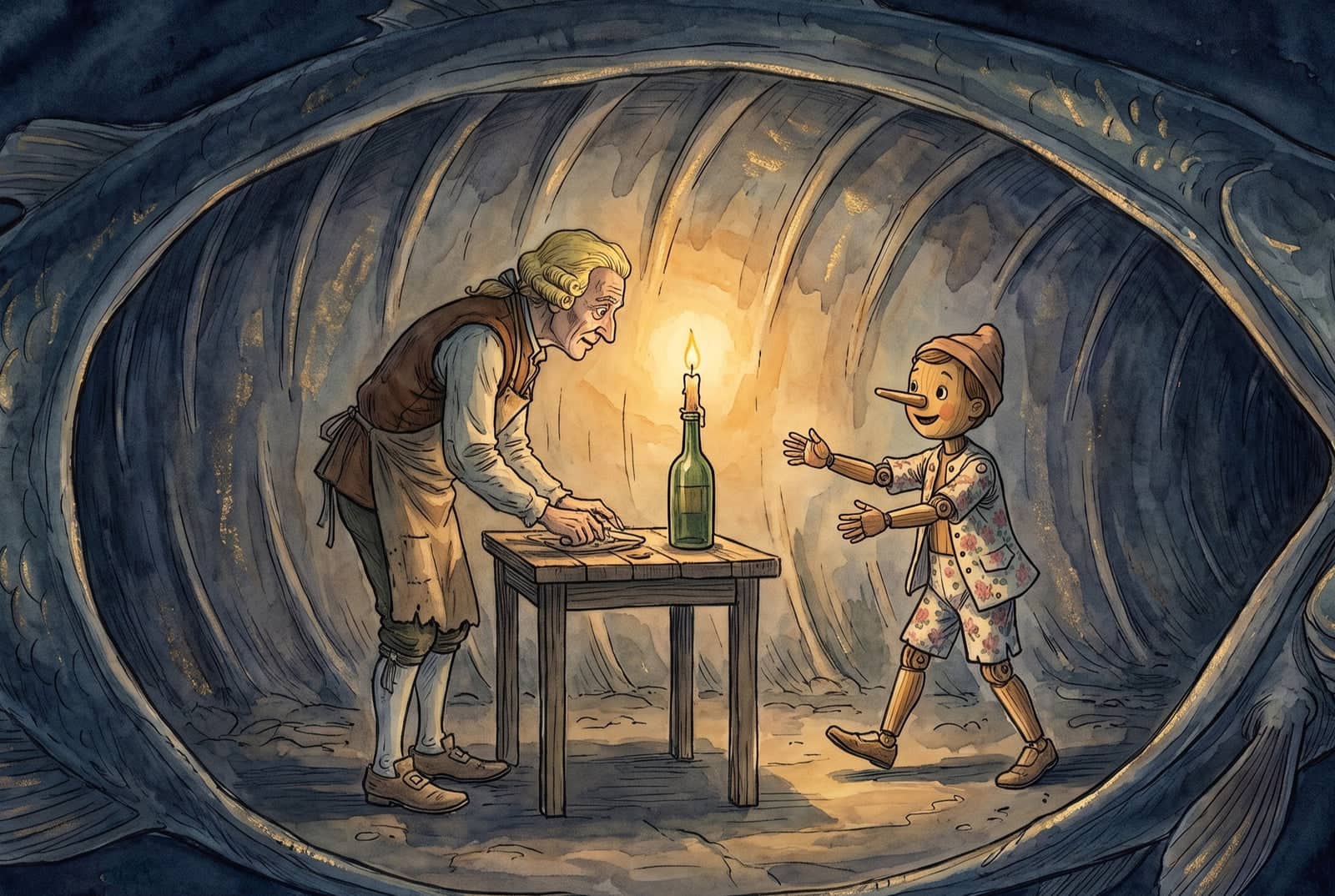
Geppetto had been in the shark two years. The shark had swallowed him in a storm, boat and all, and he had lived on the boat’s stores ever since. The candle was his last one.
“Then there is no time to lose,” said Pinocchio. “We shall walk out of the shark’s mouth and swim for it.”
“I cannot swim,” said Geppetto.
“You can ride on my back.”
The shark was old and short of breath and slept with his mouth open. Pinocchio led his father up over the tongue and out between the three rows of teeth, and Geppetto put his arms round the boy’s neck and Pinocchio struck out for the shore.
It was further than he had any strength for. He swam until he could not feel his arms, and then further still, because the old man on his back could not swim. Then Pinocchio’s feet touched sand.
They found a hut with a straw roof up the beach. Pinocchio made his father a bed of straw and went to look for milk, and the farmer three fields off said that milk cost a penny a glass.
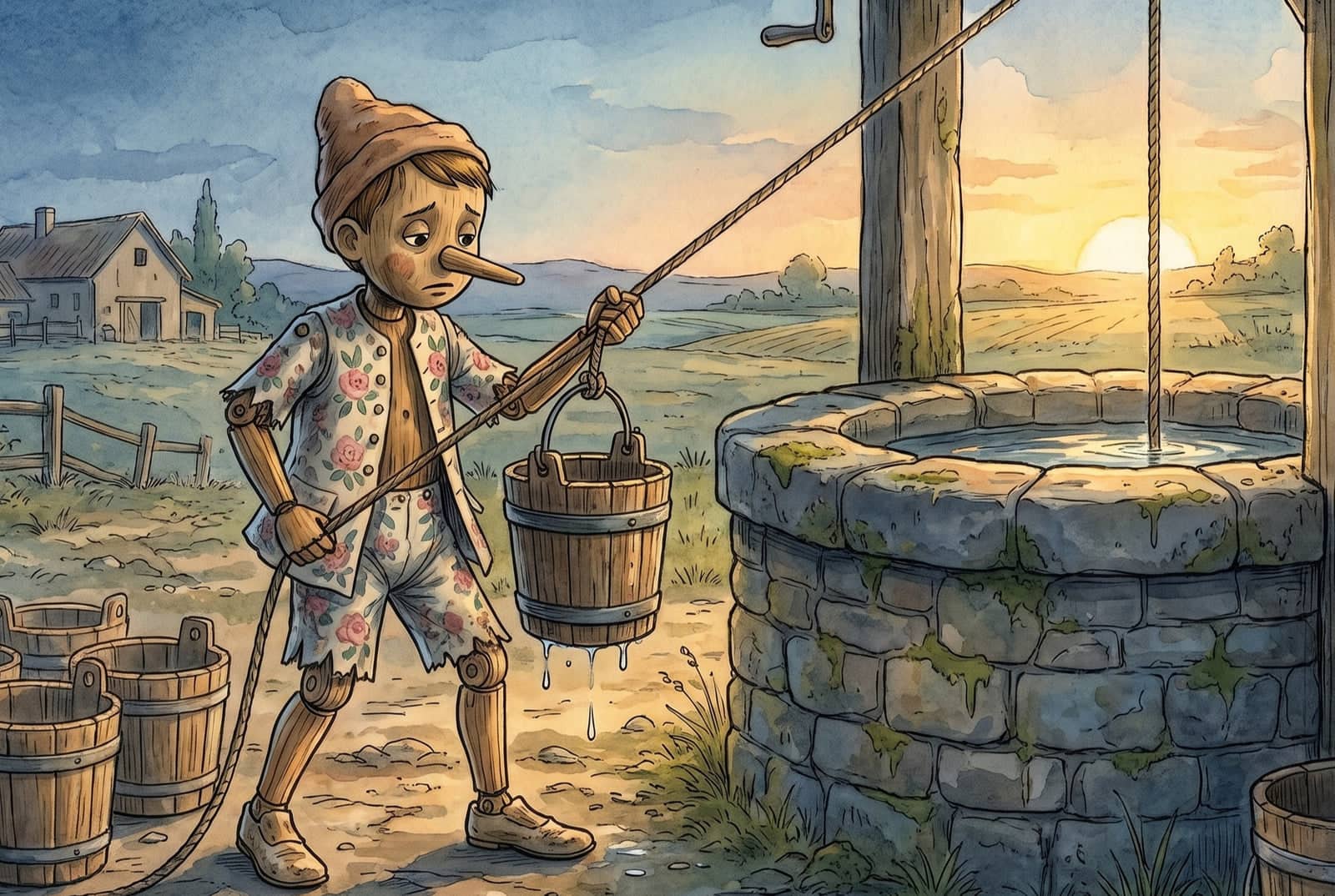
“I have no penny,” said Pinocchio, “but I can draw water.”
“Bring me up a hundred bucketfuls out of that well and the milk is yours.”
He drew the hundred bucketfuls, and when he had finished he was wet through and shaking, and had never been so tired in his life. He came back at daybreak next morning and did it again, and every morning for five months.
In the afternoons he plaited straw into mats and sold them, and built a little cart to take his father out into the sun. At night, when the old man slept, he practised his reading and his writing.
The farmer kept a donkey to turn the wheel of the well, and one morning the beast lay in its stall and would not get up. Pinocchio knelt down in the straw beside the donkey.
“Who are you?” he asked, in the donkey language he had not forgotten.
The donkey opened his eyes. “Lamp Wick,” he said, and closed them again.
He was worn out and dying, and he was never going to be a boy again. Pinocchio sat with him a long while, and told nobody at that farm that the donkey had once been at school with him.
By the end of the five months he had forty pennies saved, and one morning he set out to buy himself a jacket and a pair of shoes.
On the road the Fairy’s own snail called him by name, coming up as slowly as snails do.
“The Fairy is ill,” it said. “She is in a hospital, and so poor that she has not a mouthful of bread.”
“Then take her the forty pennies,” said Pinocchio, and set them down in front of the snail. “All of them. Tell her I shall have more in two days.”
He went home in his rags, and that night, instead of sleeping, he worked until midnight. Then he lay down and dreamed of the Fairy, who kissed him and said, “Good Pinocchio. For your kind heart I forgive you everything.”
When he woke he was not made of wood any more.
He was a boy, a real boy, with chestnut hair and bright eyes. The bare room had curtains and chairs in it now, and new clothes lay at the foot of the bed. In the pocket of the jacket was a little purse of mother-of-pearl, and inside it, instead of forty pennies, forty gold coins.
Geppetto was in the next room, straight-backed and well, carving at his bench as he used to when he was young.
“Father, what has happened to us?”
“When bad boys turn good,” said Geppetto, “everything in the house turns with them.”
“And where is the old Pinocchio, the wooden one?”
“There,” said Geppetto, and pointed.
A puppet was propped against a chair, its head hanging over, its arms down, its legs crossed, and it was a wonder it stood. Pinocchio looked at it for a long moment.
“How funny I was,” he said, “when I was a puppet. And how glad I am to be a real boy at last.”
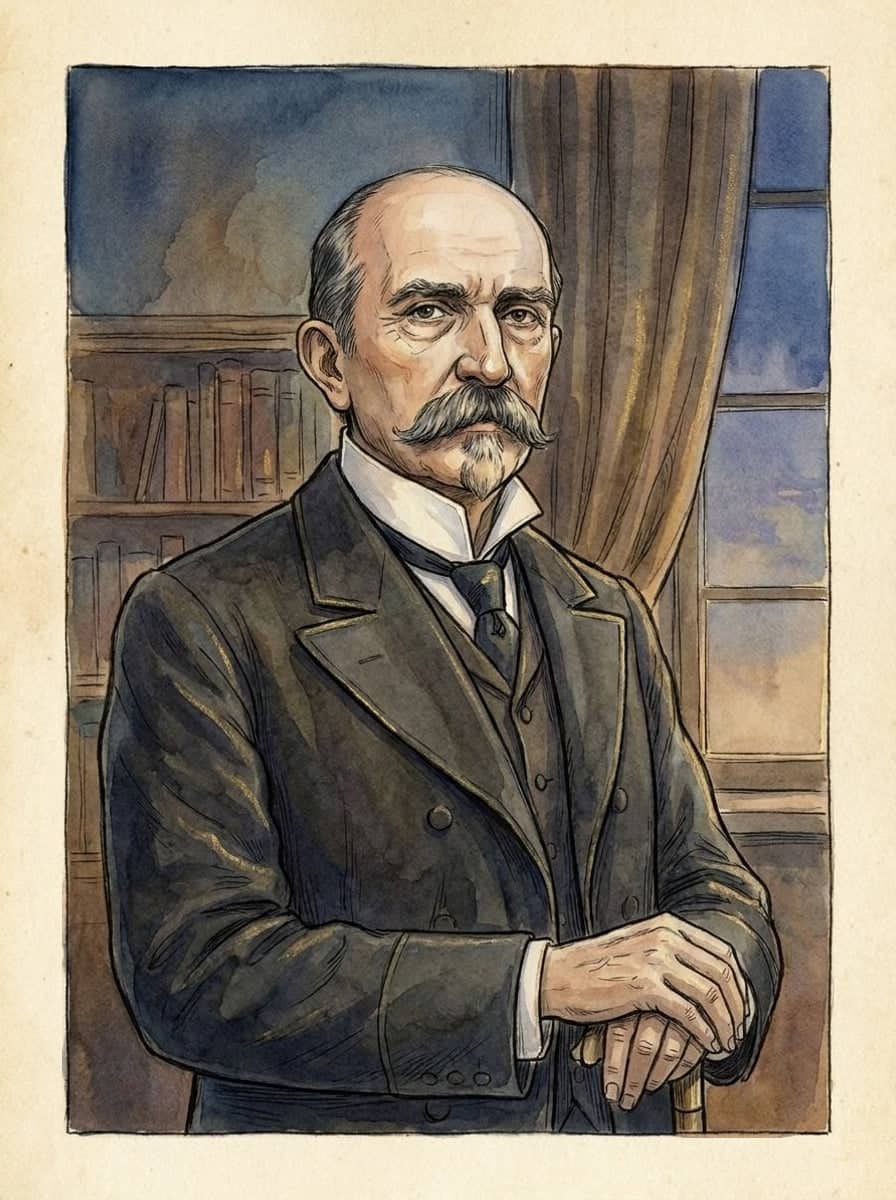
Retold by Talerie, Source: The Adventures of Pinocchio (opens in a new window)
License: Public domainCopy this text, adapt it, use it however you like. A link back to Talerie is appreciated but never required.CC0 1.0 (opens in a new window)