Skip to content
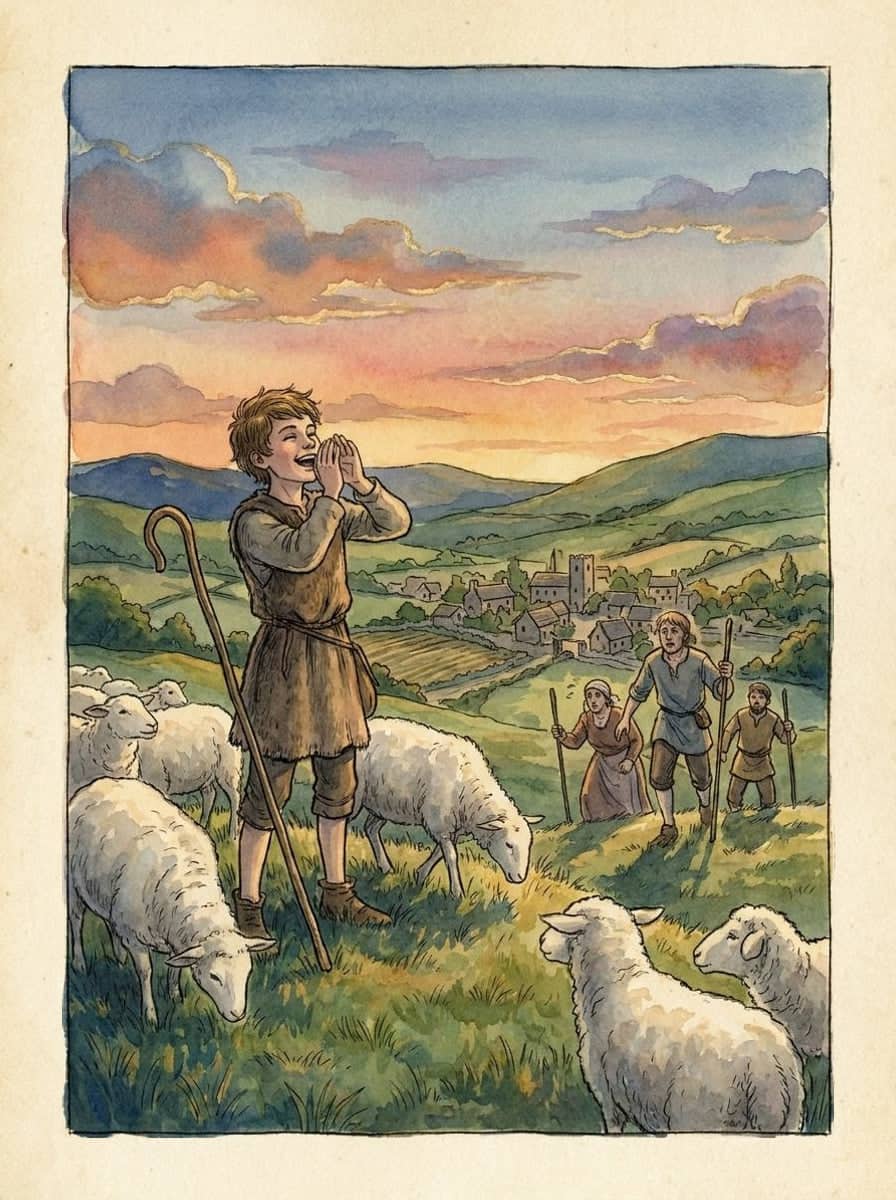
A laughing boy on a sunlit hillside cups both hands to his mouth and shouts, his crook standing in the grass, his sheep grazing, three villagers climbing up.

The Boy Who Cried Wolf

Aesop

2 min read ages 4 and up

A bored shepherd’s boy thinks of a joke and shouts down to the village that a wolf is coming. The villagers run up with sticks and find only grazing sheep and a laughing boy. A few days later, he tries it again.


There was once a shepherd’s boy who watched his flock on a hillside above a village. The sheep grazed, the sun crossed the sky, and nothing at all happened.

One long afternoon, for want of anything better to do, the boy thought of a joke. He stood up, filled his lungs, and shouted down the hill.

“Wolf! Wolf!”

The villagers dropped what they were holding and came running up with sticks, ready to drive the wolf off. They found the boy sitting in the grass, and the sheep chewing quietly, and no wolf anywhere. The boy laughed until his sides hurt.

Down the hill the villagers went again, out of breath and not at all pleased.

A few days later he tried it once more.

“Wolf! Wolf!”

Up they came, and again there was nothing to find but a laughing boy and a peaceful flock. Nobody laughed with him, and they went back down the hill without a word.

Then one evening, as the light was going, a wolf really did slip out of the trees. The sheep broke and scattered across the slope. The boy jumped to his feet and shouted with every scrap of breath he had.

“Wolf! Wolf!”
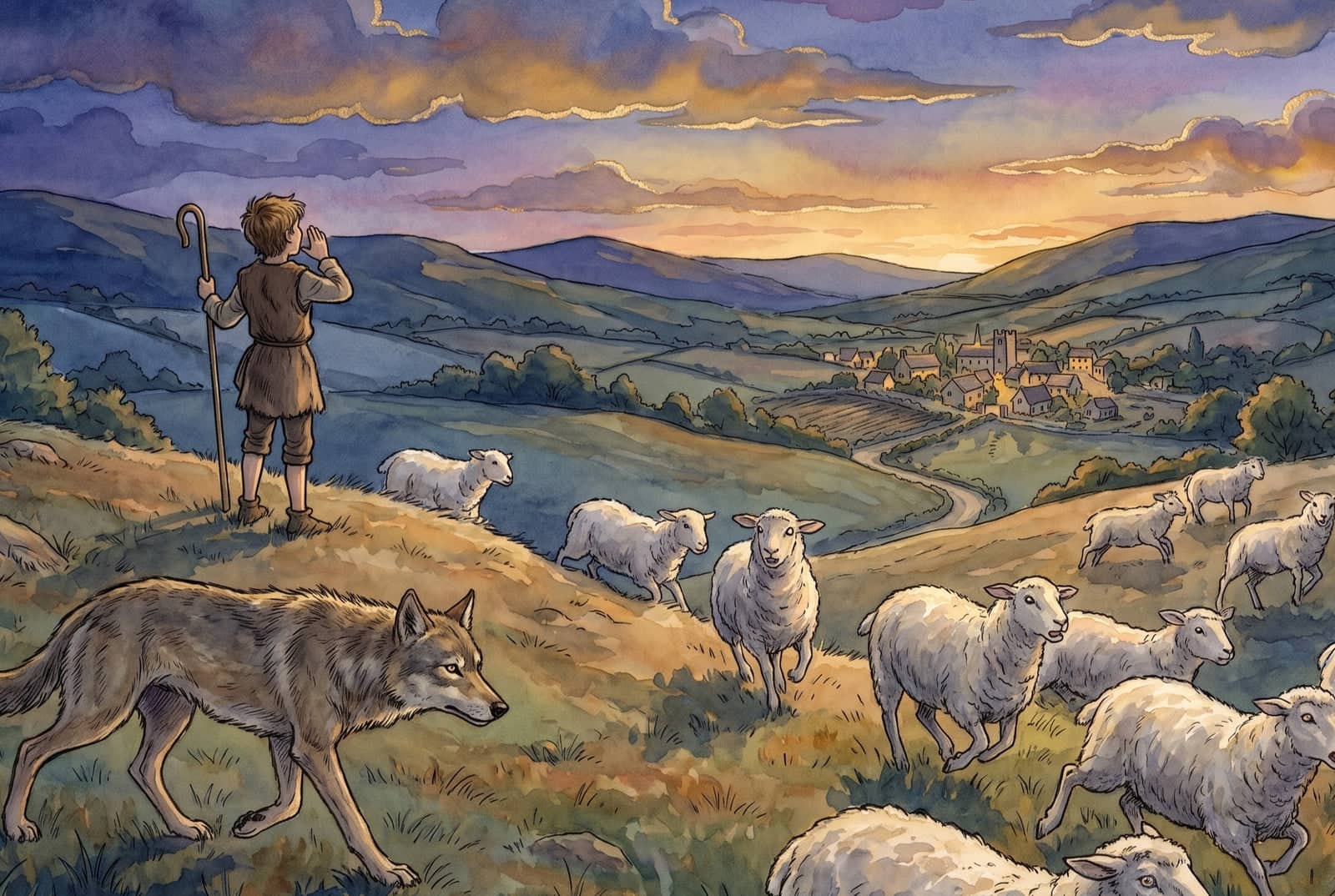
Seen from behind, a boy with a crook calls down to the lit village below while a gray wolf pads across the foreground and the flock scatters downhill.

In the houses below, people heard him plainly. They looked at one another, shook their heads, and went back to their suppers. Not one of them came.

So the wolf had the hillside all to himself, and took sheep after sheep, unhurried, while the boy stood in the dusk and called and called.

How did you like this fable?

Retold by Talerie from Aesop’s Fables: a new translation (opens in a new window) Public domain

Similar fables

About this fable

The Boy Who Cried Wolf belongs to the fables credited to Aesop. The Greek prose text, number 318 in Chambry’s collection, makes the liar a shepherd, not a boy. He keeps calling the villagers to save his sheep from wolves that are not there; when wolves really come, the village takes it for his usual joke and he loses his sheep.

Our English version retells V. S. Vernon Jones, whose title is “The Shepherd’s Boy and the Wolf” and whose text is one paragraph long. There the shepherd is a boy who laughs at the villagers, and a single wolf comes. Ours runs to twelve short paragraphs, with two false alarms before the real one and a moral of our own.

The Greek fable and the English text we retell

Greek prose (Chambry)Vernon Jones (1912)
Who cries wolfa shepherd, no age givena shepherd’s boy
Whya joke he plays again and againto hoax the villagers for fun
The cryreported, not quoted“Wolf! wolf!”
False alarmstwo or threemore than once
Laughing at themnot in Chambry’s Frenchlaughs at them for their pains
The wolfwolves, pluralone wolf
The endthe shepherd loses his sheepthe wolf kills off sheep after sheep
Show more
Wolf! Wolf!
V. S. Vernon Jones, 1912: Wolf! wolf!

What happens in our text

Our boy watches his flock on a hillside above a village. One long afternoon, for want of anything better to do, he shouts “Wolf! Wolf!” down the hill. The villagers come running up with sticks, find the sheep chewing quietly and no wolf anywhere, and the boy laughs until his sides hurt. A few days later he does it again, and nobody laughs with him. Then one evening a wolf really does slip out of the trees. The people below hear the boy plainly, and not one of them comes.

The boy himself comes to no harm. While he stands in the dusk calling, the wolf takes sheep after sheep. Our text says no more than that; in Vernon Jones the wolf kills them off. Vernon Jones ends with the moral “You cannot believe a liar even when he tells the truth”; ours speaks of people who stop coming up the hill.

Other English texts and a different wolf fable

In Joseph Jacobs’s retelling the boy tends his sheep at the foot of a mountain near a dark forest and plays his trick out of loneliness, to get a little company and some excitement. The villagers are fooled twice, and at the end the wise man of the village says, “A liar will not be believed, even when he speaks the truth.” Jacobs added a note saying the fable was known from its place in the spelling-books, “whence our expression ‘To cry wolf.’” George Fyler Townsend’s boy brings the villagers out three or four times, and his wolf “lacerated or destroyed the whole flock.” None of these texts gives the boy a name.

Our page The Wolf in Sheep’s Clothing tells a different fable, about a wolf disguised as a sheep.

Sources

Period texts

Commentary

Catalog

Claims checked against these sources on October 30, 2026.

Coloring pages to print

Where else to find this fable