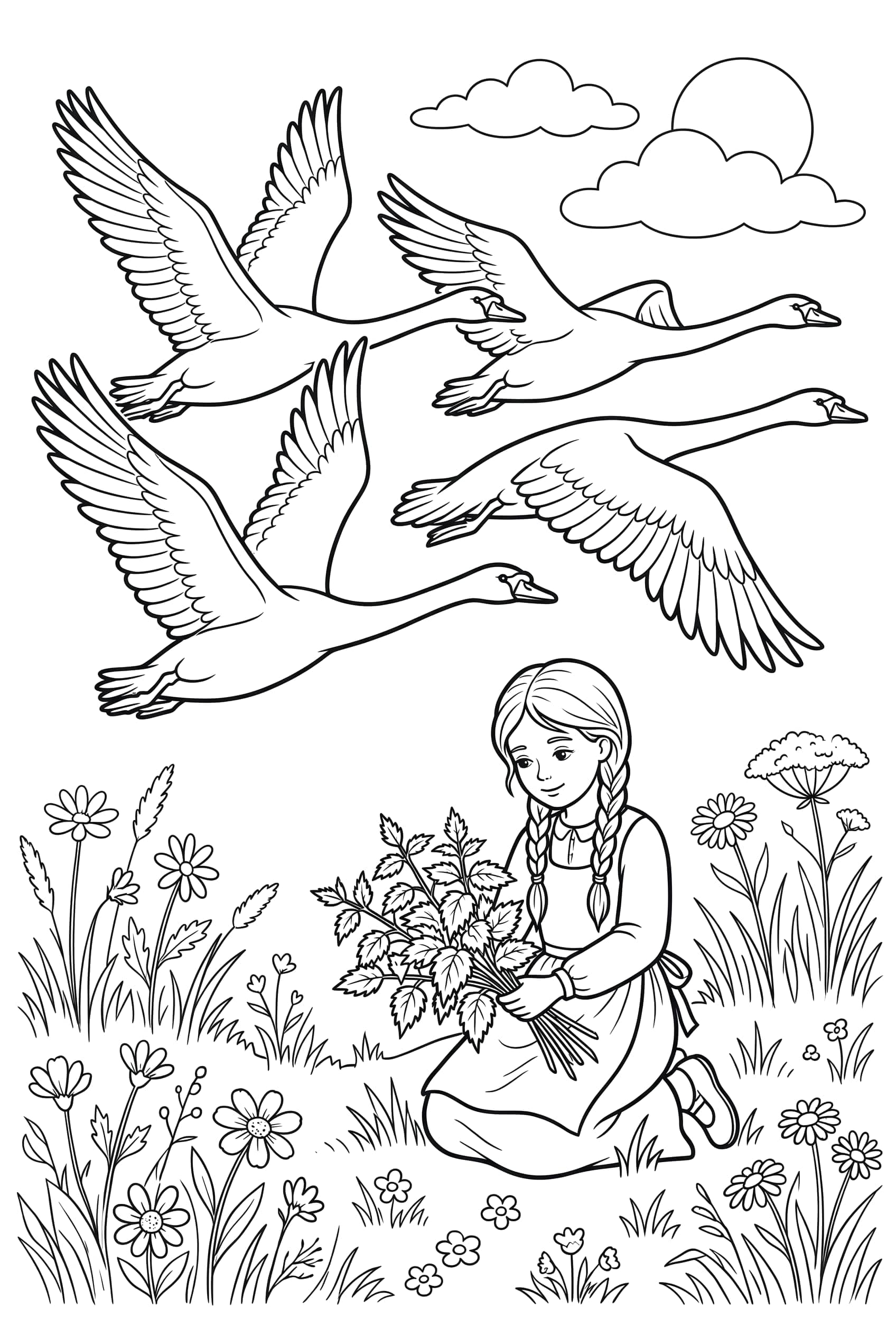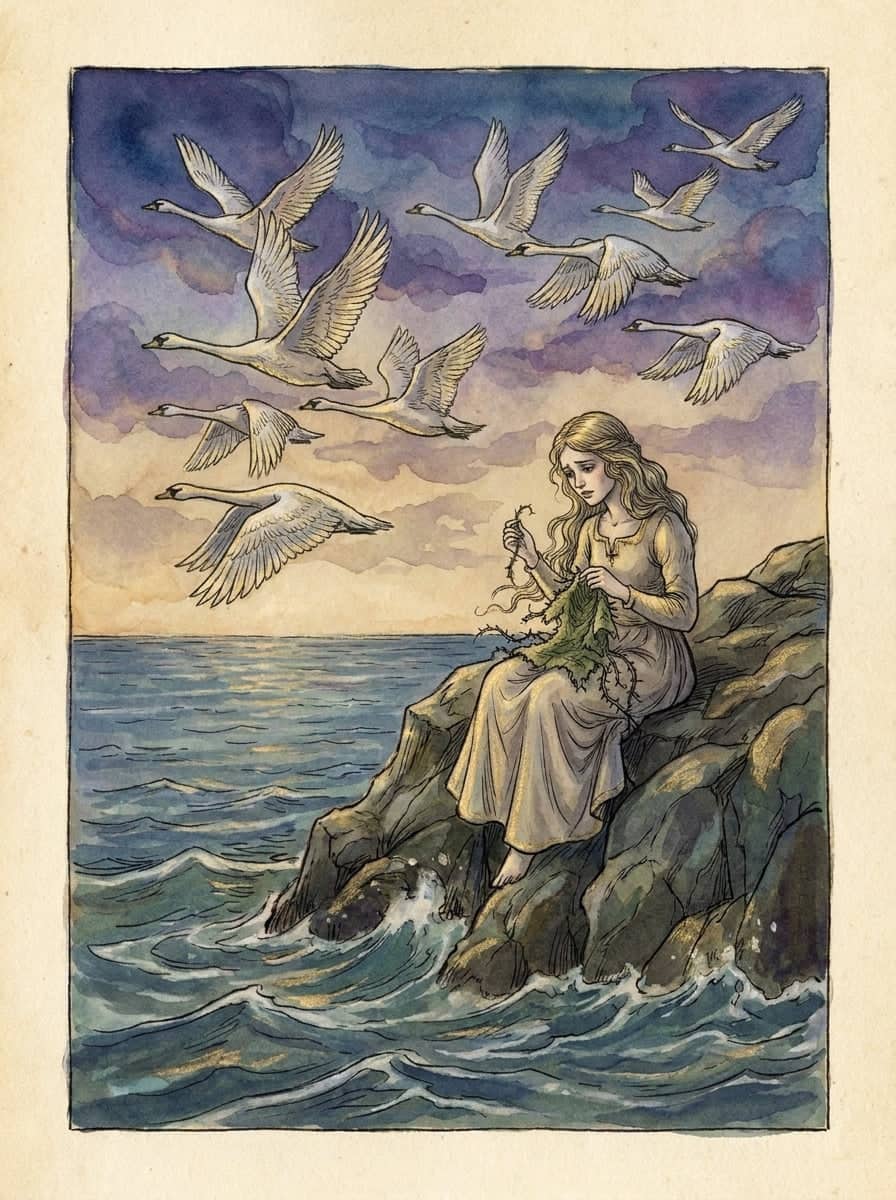
A new queen turns eleven princes into wild swans, and their sister Elisa can free them only by weaving eleven nettle shirts in silence. Condemned as a witch, she throws the shirts over the swans before the crowd, and her brothers stand there as princes, the youngest with a swan’s wing for one arm.
Far away, in the land the swallows fly to in winter, there lived a king with eleven sons and one daughter, Elisa.
The eleven princes went to school with a star on the breast and a sword at the side. Elisa had a picture book that had cost half a kingdom.
Oh, those children were happy. But it was not to last.
Their father married a new queen who had no love for them. At the wedding feast she gave them a teacup of sand and told them to pretend it was cake.
The week after, she sent Elisa to a farmer in the country, and told the king such untrue things about the princes that he troubled himself no more about them.
“Go out into the world and earn your own bread,” said the queen. “Fly away like great birds with no voice.”
But she could not make them as ugly as she wished. The princes turned into eleven splendid wild swans and flew from the palace windows with a strange cry.
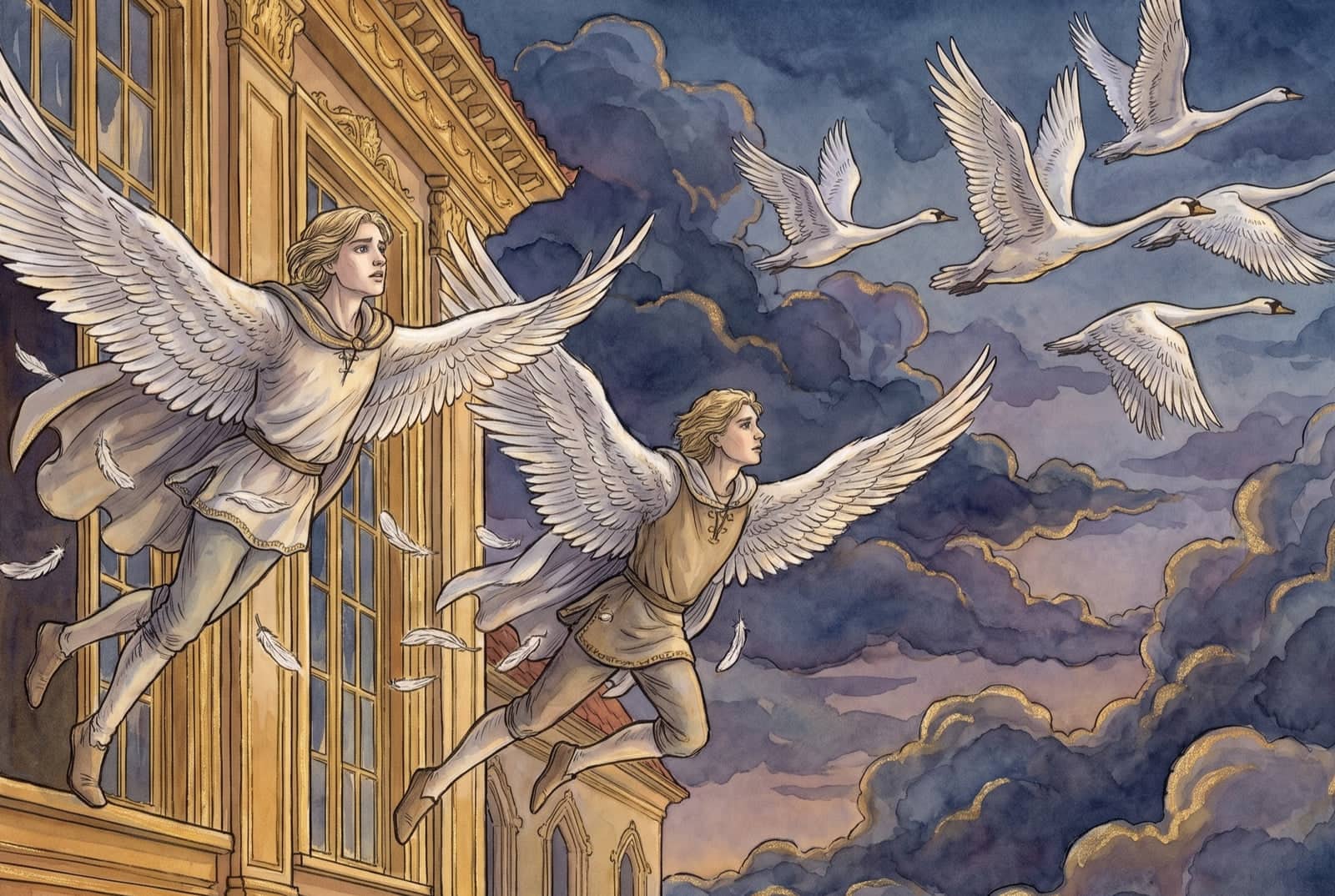
At dawn they passed the farmhouse where their sister slept. They beat their wings above the roof, but nobody heard them, and they flew on to a dark wood beside the sea.
At fifteen Elisa was sent for. The queen hated her at first sight, but did not dare touch her, for the king wished to see his daughter.
Early one morning the queen went into the marble bath house with three toads, and kissed them.
“Sit on Elisa’s head,” she told the first, “so that she grows as dull as you are.”
“Sit on her forehead,” she said to the second, “so that she grows as ugly as you, and her father will not know her.”
“Rest on her heart,” she whispered to the third, “and let her turn wicked, so that it torments her.”
She put the toads into the water, which turned green at once, and called Elisa down into the bath.
One settled in her hair, one on her forehead and one over her heart. Elisa did not seem to feel them, and when she rose again, three red poppies floated on the water.
She was too good and too innocent for any spell to have power over her.
So the queen rubbed her with walnut juice until her skin was dark brown, smeared her face with a foul ointment and tangled her hair.
Her father said this was not his daughter. Nobody knew her but the watchdog and the swallows, and they were poor creatures with nothing to say.
Then Elisa wept for her brothers, driven into the world as she was now. She stole out of the palace and walked all day into the great forest.
Night came down and she lost the path, so she lay on the moss and dreamed all night of her brothers.
In the morning she found a clear pool. The face that looked up at her was so brown and strange that it frightened her, but she washed, and the white skin came shining through. She braided her long hair and went on.
A few steps on she met an old woman with a basket of berries, and asked whether she had seen eleven princes riding through the wood.
“No,” said the old woman, “but yesterday I saw eleven swans with golden crowns on their heads, swimming down the river close by.”
She showed her the river, and Elisa followed it to the open shore.
The sea lay before her, and not one sail on it. But the pebbles at her feet had been rubbed round by water softer than her own hand, and that water never tired, and neither would she.
As the sun went down, eleven wild swans with golden crowns came flying in toward the land, one behind the other, like a long white ribbon. She hid behind a bush.
The moment the sun was under the water, the feathers fell away and eleven handsome princes stood there. She knew them at once, and sprang into their arms and called them each by name.
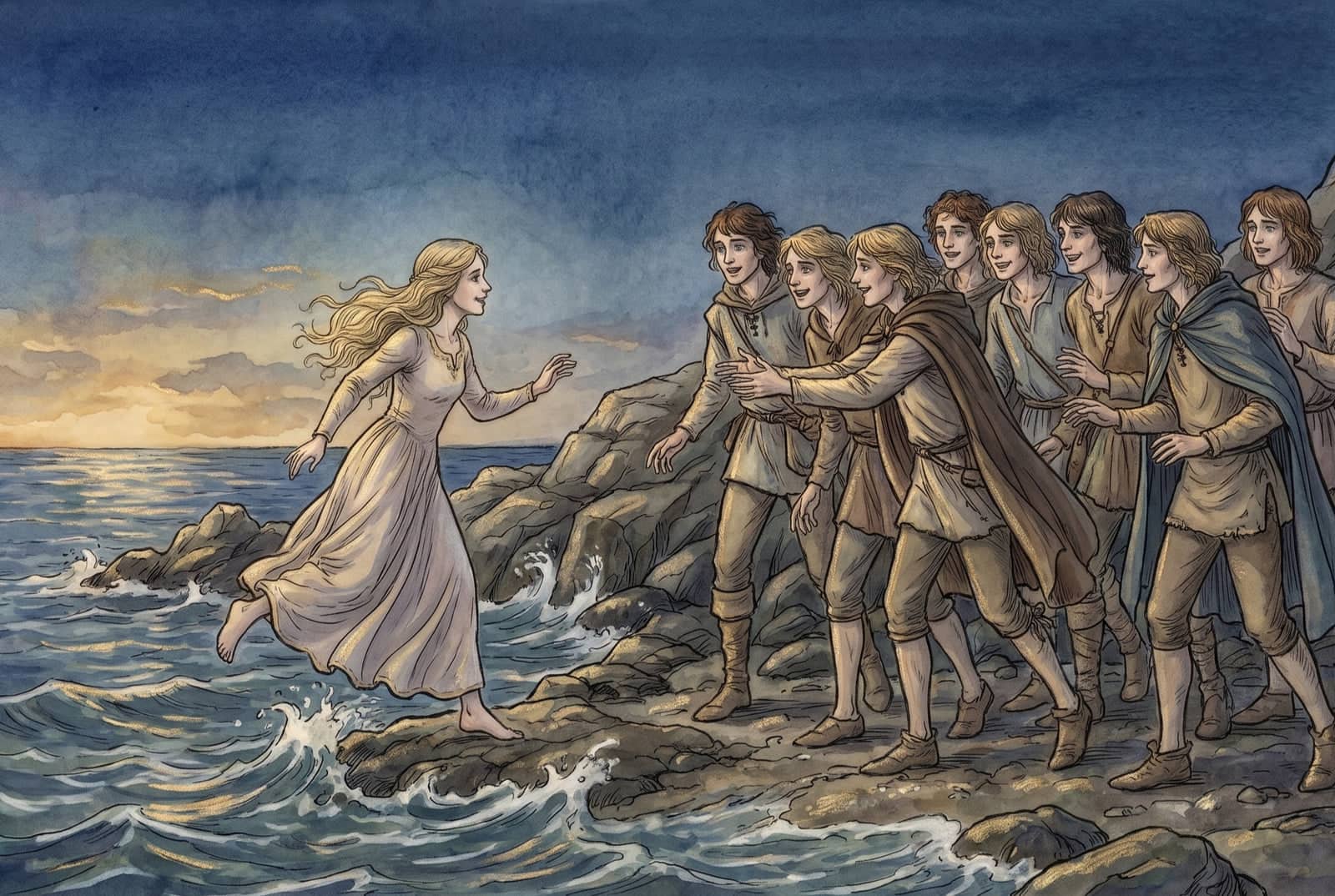
“We fly as wild swans while the sun is up,” said the eldest, “and the moment it goes down we are men again. So we must have somewhere to set our feet by sunset, or we fall into the sea.”
“We live beyond the ocean now, two of the longest days of the year away. There is no island on the way, only a rock just big enough for us crowded close together.”
“Once a year we may come home for eleven days. Two are left to us, and then we must go back. How can we take you? We have no ship and no boat.”
“How can I set you free?” asked Elisa.
They talked of it nearly all night. Next day the youngest swan stayed, his head in her lap, and at sunset the brothers stood there in their own shape again.
“Tomorrow we fly away, and we cannot come back for a whole year,” said one. “But we cannot leave you here. Have you the courage to come with us?”
“Yes, take me with you,” said Elisa.
All night they wove a net of willow bark and rushes. Elisa lay down on it, and at sunrise the swans took it in their beaks and flew up toward the clouds with her.
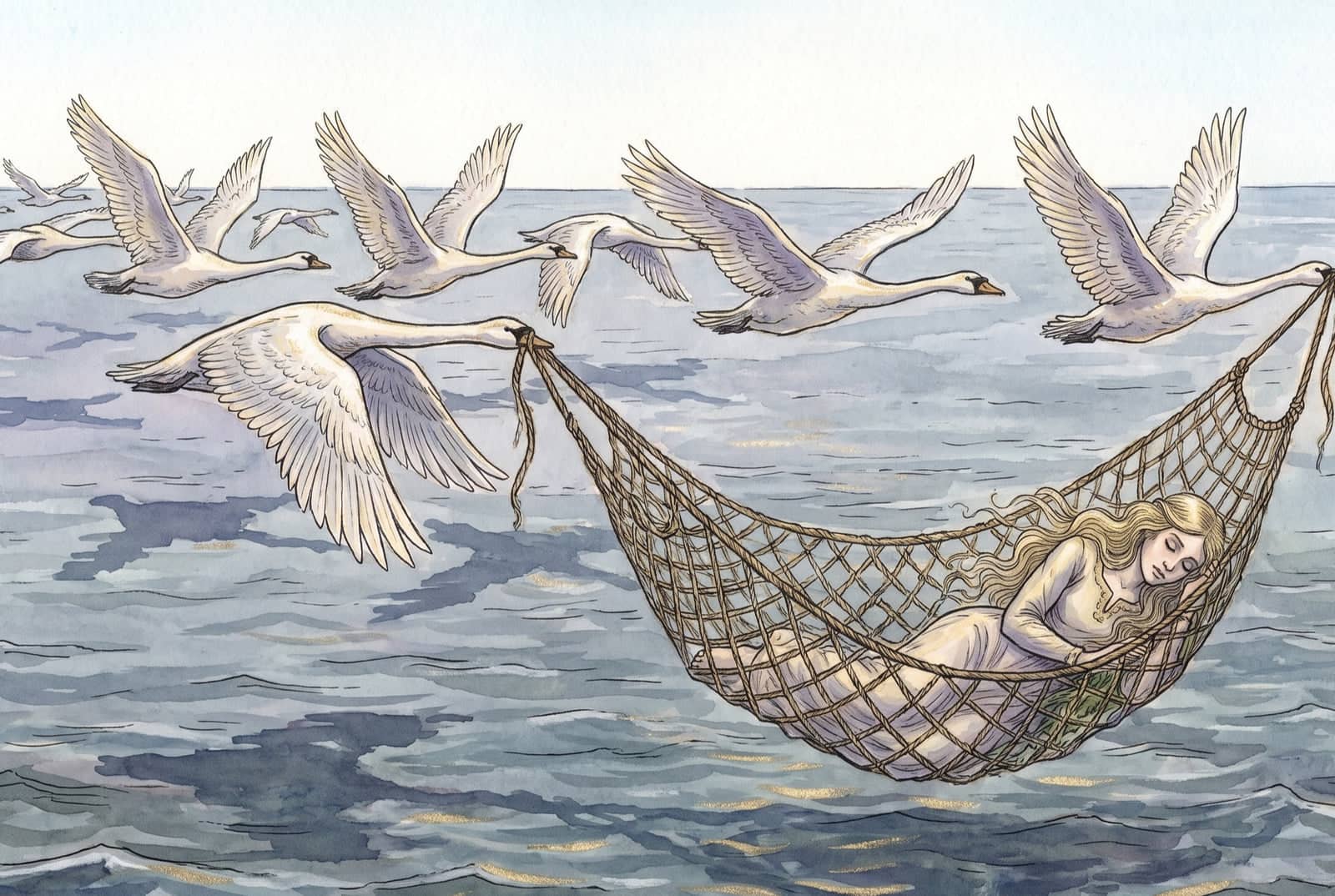
The youngest flew above her head to shade her, and when she woke, he had laid berries and sweet roots beside her.
All day they flew on, more slowly than usual, for now they had their sister to carry, and bad weather was coming up.
Elisa watched the sinking sun in fear, for the rock was nowhere to be seen. When the sun went down her brothers would become men, and fall, and drown.
The black clouds stood up like one great wave, and the lightning came flash upon flash. The swans dropped so fast that she thought she was falling, and then they were gliding again.
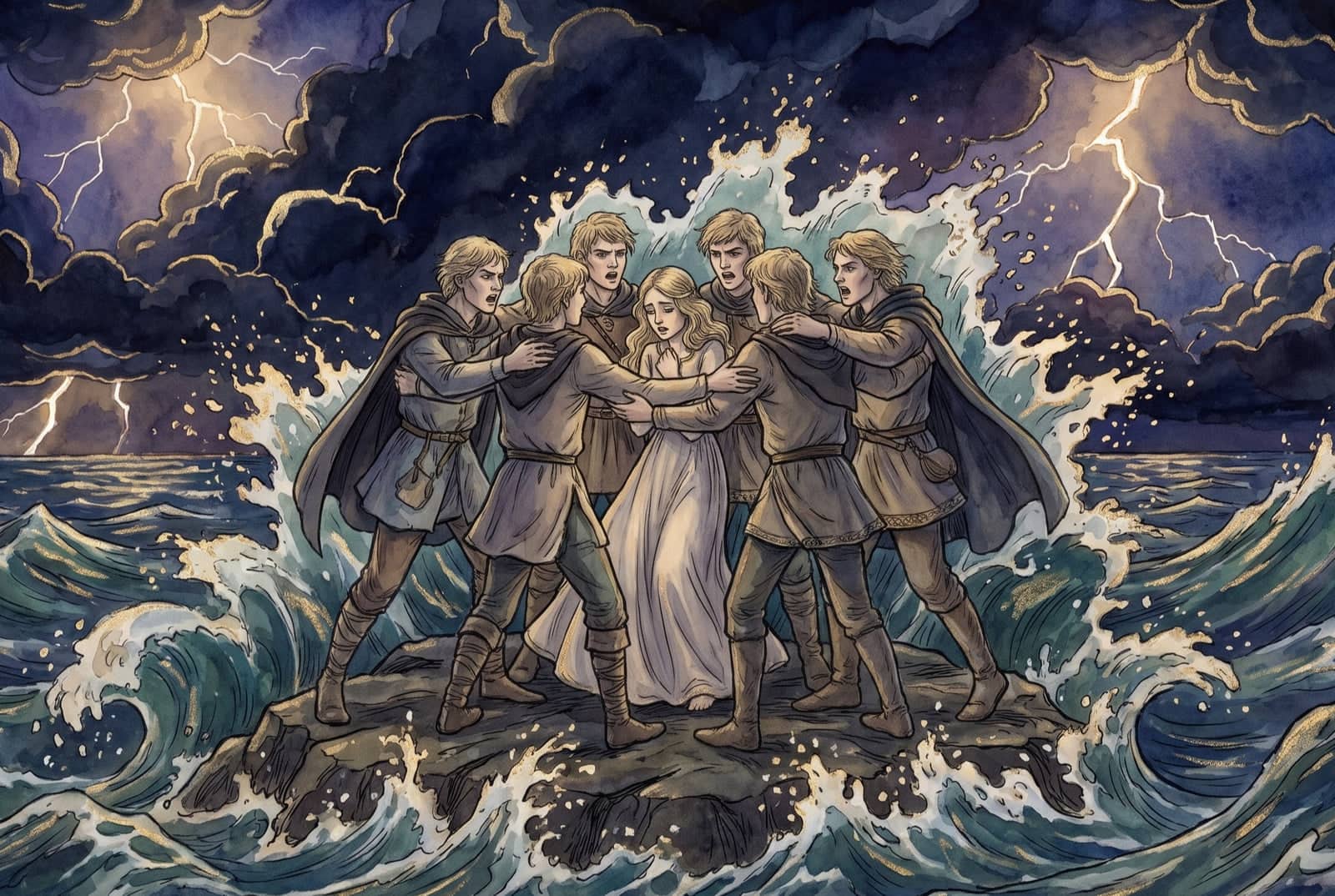
Half the sun was under the water when she saw the rock below them, no bigger than a seal putting up its head. The light shrank to a star, and then her foot touched firm ground.
Arm in arm her brothers stood round her, with just room for them and no more. The sea went over them like driving rain and the thunder rolled, but they held each other’s hands and sang, and the singing gave them courage.
At daybreak the swans flew on, and later Elisa saw ahead of her, half floating in the air, a country of icy mountains with a castle a mile long, and palm woods swaying below it.
She asked whether this was the land they were going to, but the swans shook their heads. It was the cloud castle of the Fata Morgana, forever changing, into which no living person may be carried.
At last she saw the real land, with its blue mountains and cedar forests, and before sunset she sat in front of a great cave hung with green creepers.
“Now let us see what you dream here tonight,” said the youngest brother, showing her where she was to sleep.
“Heaven grant that I dream how to set you free,” she said.
That night she dreamed that she flew up to the cloud castle, and a fairy came to meet her, shining and beautiful, yet exactly like the old woman with the berries.
“Your brothers can be set free,” she said, “but have you courage and patience? Water is softer than your hands, and yet it shapes the stones. It does not feel what your fingers will feel.”
She held up a stinging nettle.
“Nettles like this grow round your cave, and others on the graves in the churchyard. Nothing else is any use to you, and you must pick them, though they burn blisters on your hands.”
“Break them with your bare feet and you will have flax. Out of it you must weave eleven shirts with long sleeves. Throw them over the swans and the spell is broken.”
“But from the hour you begin until the work is done, though it take years of your life, you must not speak. The first word you say will cost your brothers their lives.”
She touched Elisa’s hand with the nettle. It burned like fire, and Elisa woke.
It was broad day, and close by lay a nettle like the one in her dream. She went out to begin.
The nettles burned great blisters on her hands, but she bore it gladly to free her brothers. She broke the nettles with her bare feet and twisted the green flax.
When the sun went down her brothers came, and were frightened to find her silent. But when they saw her hands they understood, and the youngest wept, and wherever his tears fell the blisters went away.
She worked all night, and all next day while the swans were gone. One shirt was finished and the second begun, when a hunting horn sounded among the hills.
Dogs barked, coming nearer. She fled into the cave, tied her nettles into a bundle and sat down on it.
In a few minutes the huntsmen stood before the cave. The handsomest was the king of that country, who had never seen so beautiful a girl.
“How did you come here, you lovely child?” he asked.
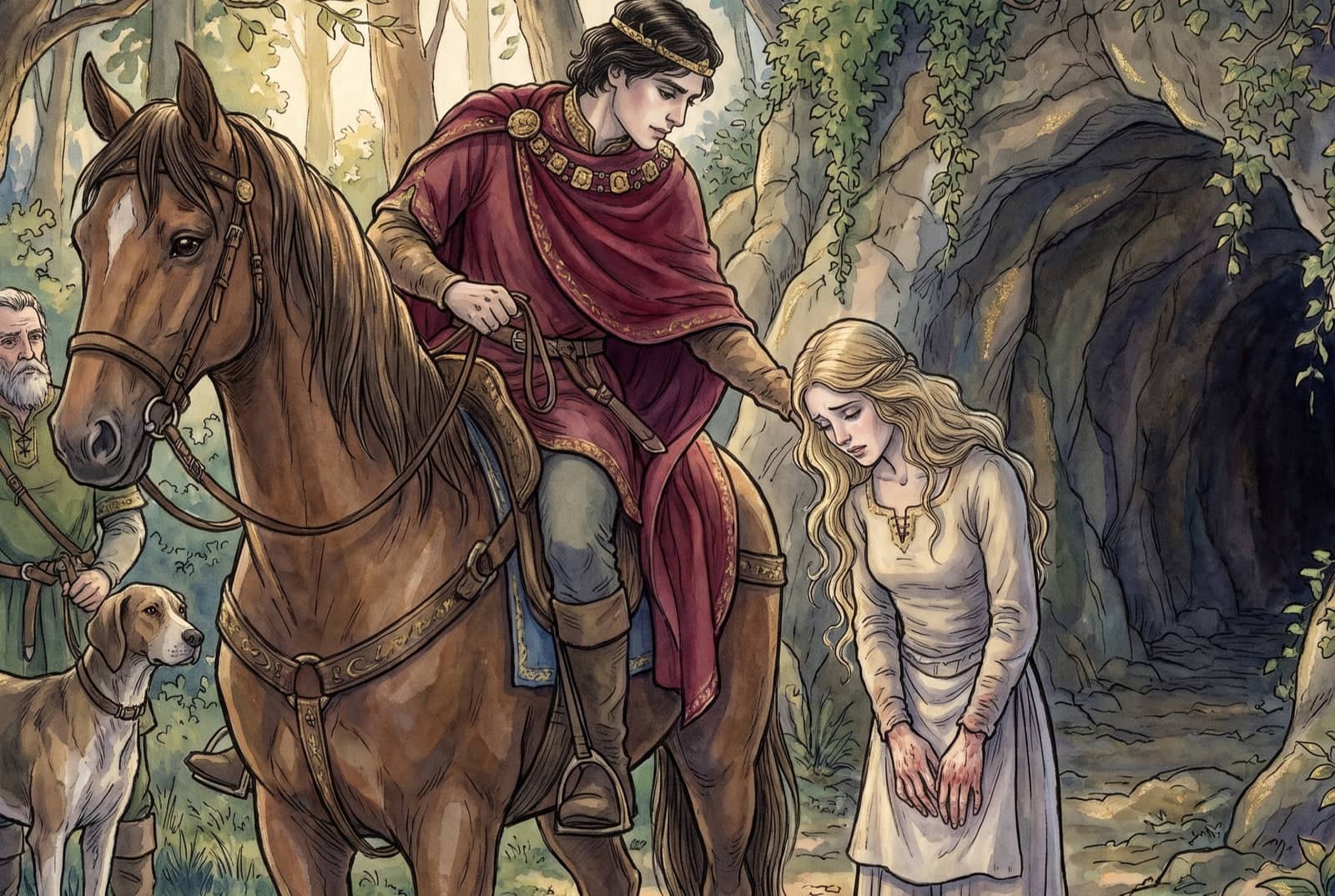
Elisa shook her head. She dared not speak, and she hid her hands under her apron so that he should not see what she suffered.
“Come with me,” he said. “If you are as good as you are beautiful, I will put a golden crown on your head, and you shall live in my richest castle.”
Then he lifted her onto his horse. She wept and wrung her hands, but he said, “I want only your happiness. One day you will thank me for it.”
At sunset he led her into a castle of marble halls and fountains, but she had no eyes for it. The women drew soft gloves over her burned fingers.
The king chose her for his bride, though the archbishop shook his head and whispered that the girl from the wood was a witch who had blinded the king’s eyes.
The king would not listen. No smile came to her lips, and she stood there like a picture of sorrow.
Then he opened a little room where she was to sleep, hung with green tapestry and just like her cave. On the floor lay her flax, and the finished shirt hung above.
“Here you can dream yourself back into your old home,” said the king. “Here is the work my huntsmen brought me.”
At the sight of it a smile played about her mouth, and she kissed the king’s hand. He had the bells ring out the wedding, and the silent girl from the wood was made queen.
The archbishop whispered evil words in the king’s ear, but they did not reach his heart. The archbishop set the crown on her head, and out of spite pressed the narrow band down so hard that it hurt.
But a heavier band lay round her heart, and she did not feel the pain. Yet her eyes spoke her love for the good king, and she loved him more with every day that passed.
Silent she had to be, and silent she had to finish. At night she slipped from his side into the little room and wove one shirt after another.
When she began the seventh, she had no flax left, and the nettles she needed grew in the churchyard, where she had to pick them herself.
“What is the pain in my fingers against the pain in my heart?” she thought. “I must risk it.”
With as much dread as if she were doing something wicked, she crept through the moonlit garden and the empty streets to the churchyard.
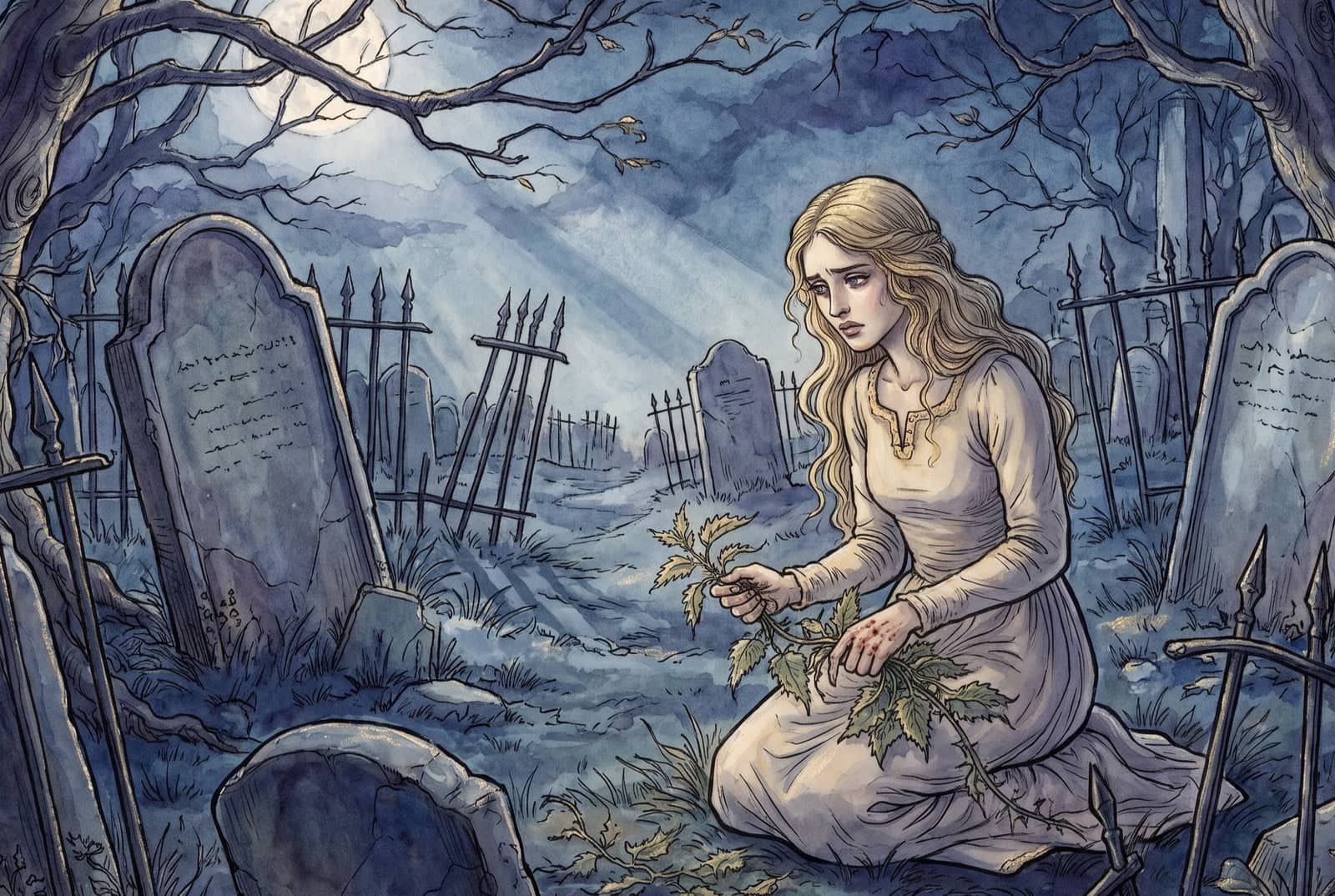
On one of the broadest gravestones sat a circle of hags, clawing open the fresh graves with long thin fingers. They fixed their wicked eyes on her, but she prayed silently, gathered the nettles and carried them home.
One person had seen her: the archbishop, awake while the rest slept. She was a witch, he thought, and so she had charmed the king and his people.
In the church he told the king what he had seen, and while he spoke the carved saints shook their heads, as if to say, “It is not so. Elisa is innocent.”
But the archbishop believed they were bearing witness against her.
Two heavy tears rolled down the king’s cheeks. That night he only pretended to sleep, and saw Elisa get up and go to her little room, and he saw it every night after.
Day by day his face grew darker, and Elisa saw it and did not understand.
Only one shirt was missing now, and not a nettle was left. Once more she had to go to the churchyard.
Elisa went, and the king and the archbishop followed. They saw her pass through the gate, and the hags sat on the gravestone as before.
The king turned his face away, for he believed she was among them, she whose head had rested against him that evening.
“The people must judge her,” he said. And the people judged her. She was to be burned.
She was led into a dark, damp cell. They gave her the nettles for a pillow and the rough shirts for a covering, and nothing could have pleased her more.
Toward evening there was a whirr of swan wings at the bars. It was the youngest brother, and she sobbed aloud for joy.
Then the archbishop came to be with her in her last hour, but her eyes begged him to go. This night she had to finish, or all her pain would have been for nothing.
An hour before sunrise the eleven brothers stood at the castle gate and demanded to see the king. They pleaded, they threatened, and at last he came out and asked what this meant.
At that moment the sun rose. The brothers were gone, and eleven wild swans flew away over the castle.
Out of the city gate poured the people, to see the witch burned. An old horse drew the cart where she sat in a gown of coarse sackcloth.
Her lips moved while her fingers worked at the green flax. Even now she did not stop. The ten shirts lay at her feet, and she was working at the eleventh.
“Look at the witch, how she mutters,” the crowd jeered. “No hymn book in her hand, only her ugly conjuring. Tear it into a thousand pieces.”
They pressed in to tear the shirts apart. Then eleven wild swans came flying and settled round her on the cart, beating their great wings. The crowd fell back in fright.
“A sign from heaven,” many whispered. “She is innocent.” None dared say it aloud.
Now the executioner took her by the hand. Quickly she threw the eleven shirts over the swans, and at once eleven handsome princes stood there.
But the youngest had a swan’s wing instead of one arm, for a sleeve was missing from his shirt. She had not been able to finish it.
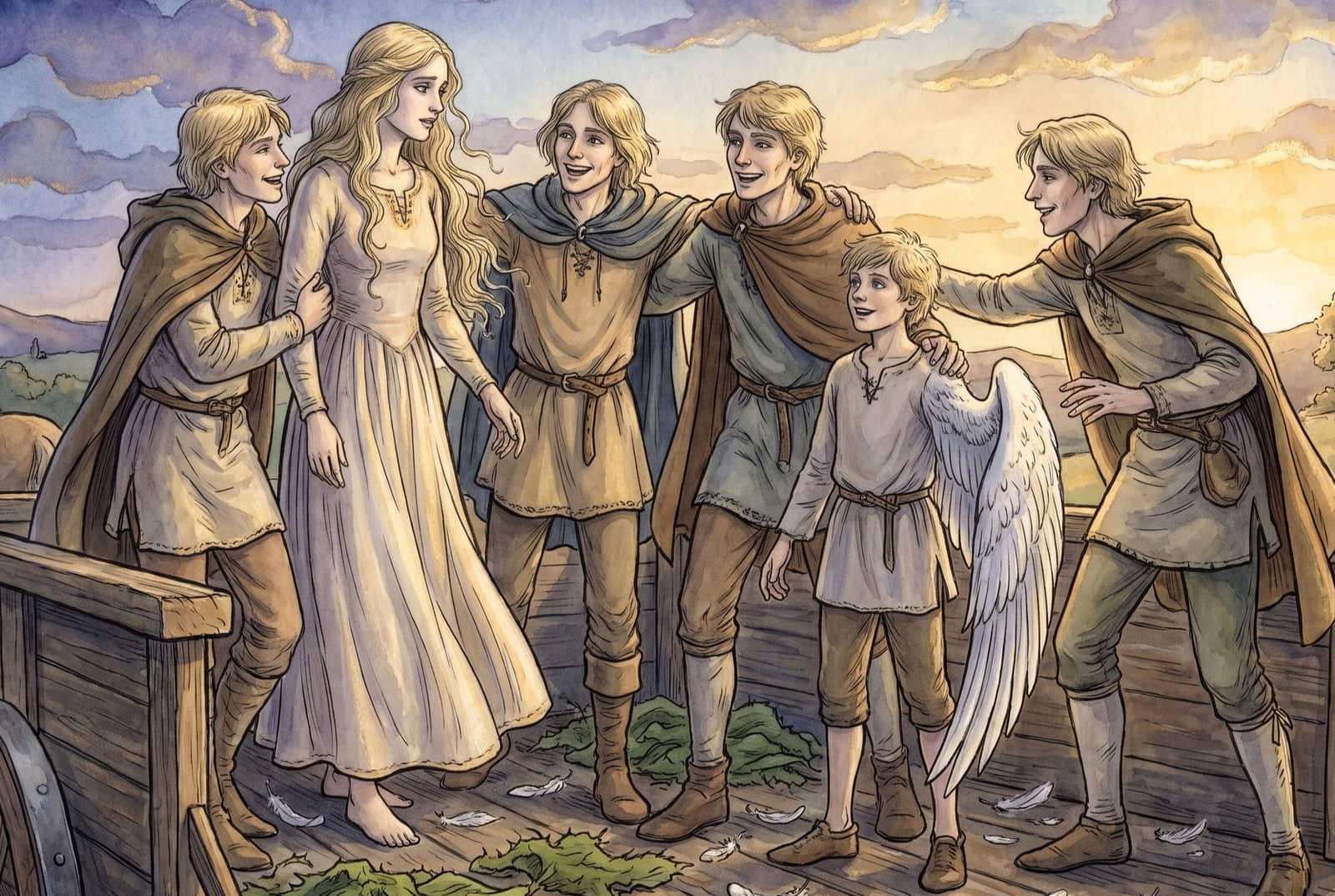
“Now I may speak,” she said. “I am innocent.”
The people bowed before her as before a saint. But she sank down in her brothers’ arms without a sound, so worn out was she with fear and pain.
“Yes, she is innocent,” said the eldest brother, and he told them everything that had happened.
And while he spoke, every stick of wood in the pile took root and put out branches, and a scent spread as if from a million roses.
There stood a tall hedge of red roses, and at the top one flower, white and shining like a star. The king picked it and laid it on Elisa’s breast, and she woke with peace in her heart.
And all the church bells rang of themselves, and the birds came in great flocks. And there was such a wedding procession back to the castle as no king had ever seen.
Retold by Talerie from Fairy Tales of Hans Christian Andersen (opens in a new window)License: Public domainCopy this text, adapt it, use it however you like. A link back to Talerie is appreciated but never required.CC0 1.0 (opens in a new window)