 Original
The Wild Swans
36 min readages 9 and uptalerie.com/en/tales/the-wild-swans-original
A wicked queen turns eleven princes into wild swans, and their sister Elisa gathers nettles and knots eleven coats of mail in silence to break the spell. Sentenced to burn as a witch, she throws the coats over the swans, and her brothers stand there as princes, the youngest with a swan’s wing.
Far away, in the country to which the swallows fly when winter comes to us, there lived a king who had eleven sons and one daughter, whose name was Elisa.
The eleven brothers were princes. They went to school with a star on the breast and a sword at the side, and they wrote with diamond pencils on slates of gold. They learned their lessons by heart as easily as they read them, and anyone who listened for a moment could hear that they were princes. Their sister Elisa sat on a little stool of mirror glass, and she had a picture book that had cost half a kingdom.
Oh, those children had everything that children could wish for. But it was not to stay that way.
Their father, who was king over the whole land, married a wicked queen who had no love at all for the poor children. They noticed it on the very first day. There were great festivities in the palace, and the children were playing at having visitors. Usually they were given all the cakes and all the baked apples that could be found; this time the queen gave them sand in a teacup and told them they could pretend it was something nice.
The week after, she sent little Elisa away into the country, to a farmer and his wife, and before long she had told the king so many lies about the poor princes that he stopped troubling himself about them at all.
“Fly out into the world and feed yourselves,” said the queen. “Fly like the great birds that have no voice.”
But she could not make it turn out as badly as she would have liked. The princes became eleven splendid wild swans. With a strange cry they flew out of the palace windows, out over the park and away into the forest.
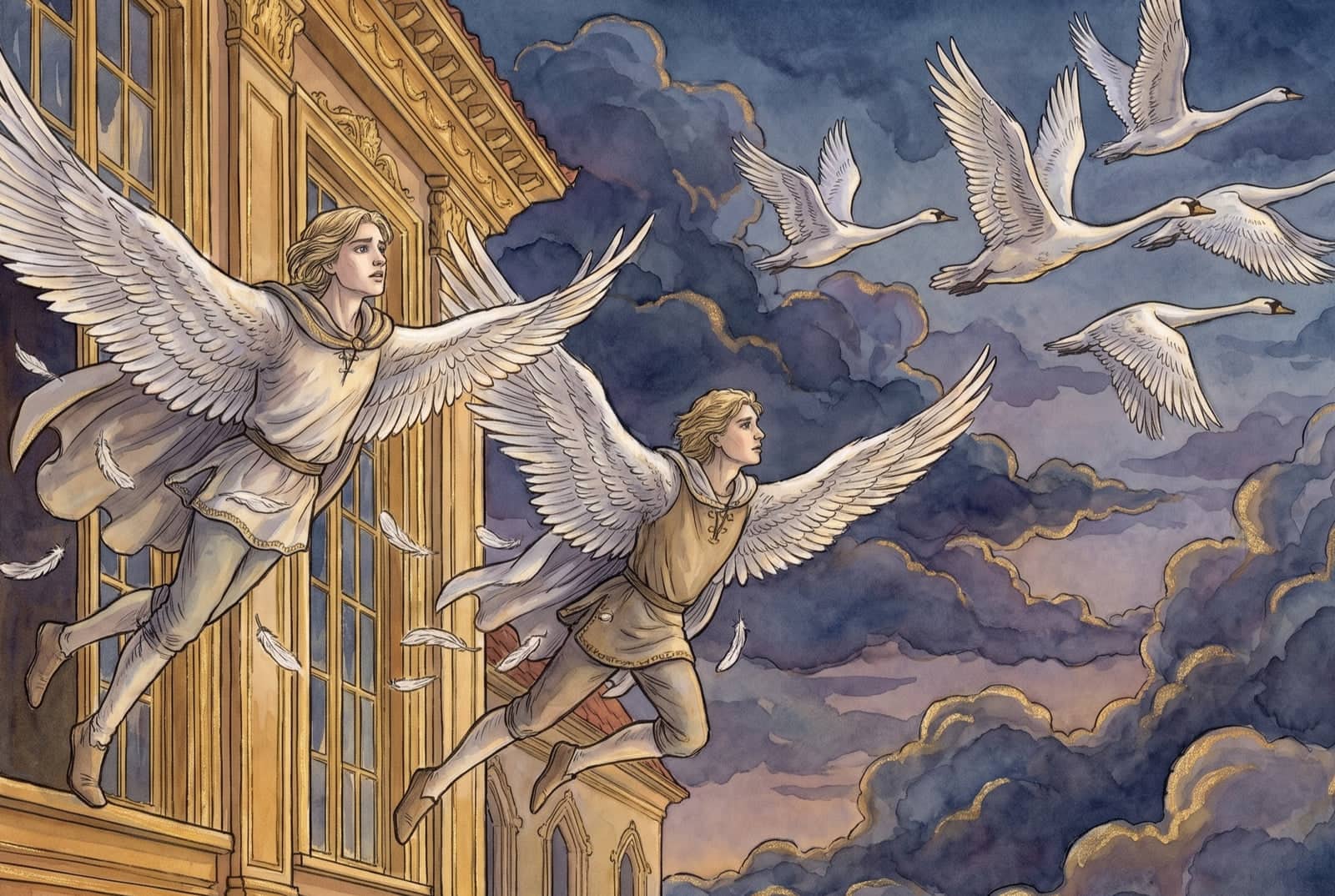
It was still early in the morning when they passed the place where their sister Elisa lay asleep in the farmer’s cottage. They hovered above the roof, turned their long necks and beat their wings, but nobody heard them and nobody saw. They had to fly on, high up toward the clouds and out into the wide world, until they came to a great dark wood that stretched all the way down to the shore.
Poor little Elisa stood in the farmer’s room and played with a green leaf, for she had no other toy. She pricked a hole in the leaf and looked through it up at the sun, and it was as though she were looking into her brothers’ clear eyes. Every time the warm sunbeams fell on her cheeks, she thought of all their kisses.
One day passed exactly like another. When the wind went through the big rose hedges outside the house, it whispered to the roses, “Who can be lovelier than you?” But the roses shook their heads and said, “Elisa is.” And when the farmer’s wife sat in the doorway on a Sunday and read her hymn book, the wind turned the pages and said to the book, “Who can be better than you?” And the hymn book answered, “Elisa is.” What the roses and the hymn book said was the plain truth.
When Elisa was fifteen she was sent for, to come home. And when the queen saw how beautiful she was, she hated her for it. She would gladly have turned her into a wild swan like the brothers, but she did not dare do it at once, because the king wished to see his daughter.
Early one morning the queen went into the bath chamber, which was built of marble and furnished with soft cushions and the finest coverings. She had brought three toads with her. She kissed them, and said to the first, “Sit on Elisa’s head when she comes into the bath, so that she may grow as stupid as you are.” To the second she said, “Sit on her forehead, so that she may grow as ugly as you are, and her own father will not know her.” And to the third she whispered, “Rest on her heart. Give her an evil mind, so that she may suffer for it.”
Then she put the toads into the clear water, which turned green at once, and she called Elisa, helped her undress and let her step down into the bath. As Elisa dipped her head under, one toad settled in her hair, the second on her forehead and the third on her breast. She did not seem to feel them, and when she stood up again there were three red poppies floating on the water. If the creatures had not been poisonous, and had not been kissed by the witch, they would have turned into red roses. Flowers they became all the same, because they had rested on her head, on her forehead and on her heart. She was too good and too innocent for witchcraft to have any power over her.
When the wicked queen saw that, she rubbed Elisa with walnut juice until her skin was dark brown, smeared her lovely face with a foul-smelling ointment and tangled her beautiful hair. It was impossible now to recognize Elisa.
When her father saw her he was badly shaken, and he said that this was not his daughter. Nobody would claim her but the chained watchdog and the swallows, and they were only poor creatures with nothing to say.
Then poor Elisa cried, and thought of her eleven brothers, who were all gone. Full of grief, she slipped out of the palace and walked the whole day across fields and moorland until she came to the great forest. She had no idea where she was going, only that she was unhappy beyond measure and that she longed for her brothers. They had surely been driven out into the world just as she had. She would look for them, and she would find them.
She had not been in the wood long when night came down. She lost every path and track, so she lay down on the soft moss, said her evening prayer and leaned her head against the stump of a tree. It was deeply quiet, the air was mild, and all around her in the grass and the moss hundreds of glow-worms shone like green fire. When she touched a twig lightly with her hand, the shining insects came tumbling down to her like falling stars.
All night she dreamed of her brothers. They were children again, playing together, writing with their diamond pencils on the slates of gold and looking at the wonderful picture book that had cost half a kingdom. But on the slates they were not writing rows of zeros and strokes as they used to do. They were writing down the brave things they had done, everything they had lived through and seen. And in the picture book everything was alive. The birds sang, and the people stepped out of the pages and talked to Elisa and her brothers. When anyone turned a page, they jumped straight back in again, so that nothing should fall out of order.
When she woke, the sun was already high. She could not see it, of course, for the tall trees spread their branches thick and close above her, but up there the beams played like woven gold. There was a scent of green growing things, and the birds came so near that they almost settled on her shoulders. She heard water splashing. It came from a number of large springs that all flowed into one lake with the finest sandy bottom. Thick bushes grew round the water, but in one place the deer had trampled a wide opening, and Elisa went down there. The lake was so clear that, if the wind had not stirred the branches and the bushes, she would have thought they were painted on the bottom, so plainly was every leaf mirrored there, the leaves in the shade as well as those in the sunlight.
As soon as Elisa caught sight of her own face she was frightened: it was so brown and so ugly. But when she wetted her small hand and rubbed her eyes and her forehead, the white skin shone through again. So she took off her clothes and went into the fresh water, and a lovelier king’s daughter than she was could not have been found in all the world.
When she had dressed again and braided her long hair, she went to the bubbling spring, drank out of the hollow of her hand and wandered deep into the wood, without knowing where she was going. She thought of her brothers, and she thought of God, who would surely not forsake her. It is God who lets the wild apples grow in the wood to satisfy the hungry, and he showed her such a tree now, with its branches bending under the weight of the fruit. There she took her midday meal, and she set props under the branches before she went on into the darkest part of the forest.
It was so still there that she could hear her own footsteps, and the rustle of every withered leaf that bent under her foot. Not a bird was to be seen, not a single sunbeam could push its way through the great dark boughs. The tall trunks stood so close together that, when she looked ahead of her, it seemed as if one lattice of beams after another was shutting her in. Oh, here was a loneliness she had never known before.
The night grew very dark. Not one small glow-worm shone in the moss now. Sorrowfully she lay down to sleep, and then it seemed to her that the branches above her moved apart and that God looked down at her with gentle eyes, and that little angels were peeping out above his head and under his arms.
When she woke in the morning she did not know whether she had dreamed it or whether it had really been so.
She had gone only a few steps forward when she met an old woman with berries in her basket, and the old woman gave her some of them. Elisa asked whether she had seen eleven princes riding through the forest.
“No,” said the old woman, “but yesterday I saw eleven swans with gold crowns on their heads, swimming down the river close by here.”
And she led Elisa a little way on, to a slope. At the foot of it a small river wound along. The trees on its banks stretched their long leafy branches out toward one another, and where they could not reach across by their natural growth, they had torn their roots loose from the earth and leaned out over the water with their branches tangled together.
Elisa said goodbye to the old woman and walked along beside the river until it flowed out onto the wide open shore.
The whole glorious sea lay before the young girl, but there was not a sail on it, not a boat to be seen anywhere. How was she to get any further now? She looked at the countless little stones on the beach. The water had rubbed them all round. Glass, iron, pebbles, everything that had been washed up together there, had been given its shape by the water, which was so much softer than her own delicate hand.
“It rolls on and never tires, and so the hard things are made smooth,” she said. “I will be just as untiring. Thank you for the lesson, you clear rolling waves. One day, my heart tells me, you will carry me to my brothers.”
On the seaweed that had washed ashore lay eleven white swan feathers, and she gathered them into a bunch. There were drops of water on them, and nobody could have said whether they were dew or tears. It was lonely there on the shore, but she did not feel it, for the sea offered endless change, more of it in a few hours than the fresh inland lakes can show in a whole year. When a big black cloud came up, it was as though the sea meant to say, “I can look dark too.” Then the wind blew and the waves turned their white side outward. But when the clouds glowed red and the winds slept, the sea was like a rose petal, now green, now white. And however quietly it lay, there was always a small movement at the water’s edge, a faint lifting and falling, like the breast of a sleeping child.
As the sun was going down, Elisa saw eleven wild swans with gold crowns on their heads flying toward the land, one behind the other, like a long white ribbon. Elisa climbed the slope and hid behind a bush. The swans came down close to her and beat their great white wings.
The moment the sun was under the water, the swan feathers fell away, and eleven handsome princes, Elisa’s brothers, were standing there. She gave a loud cry, for although they had changed a great deal, she knew that it was them; she felt that it had to be. She sprang into their arms and called them each by name, and the princes were overjoyed when they saw their little sister, whom they knew again, though she was grown now and beautiful. They laughed and they cried, and very soon they understood one another, and knew how wickedly their stepmother had acted toward them all.
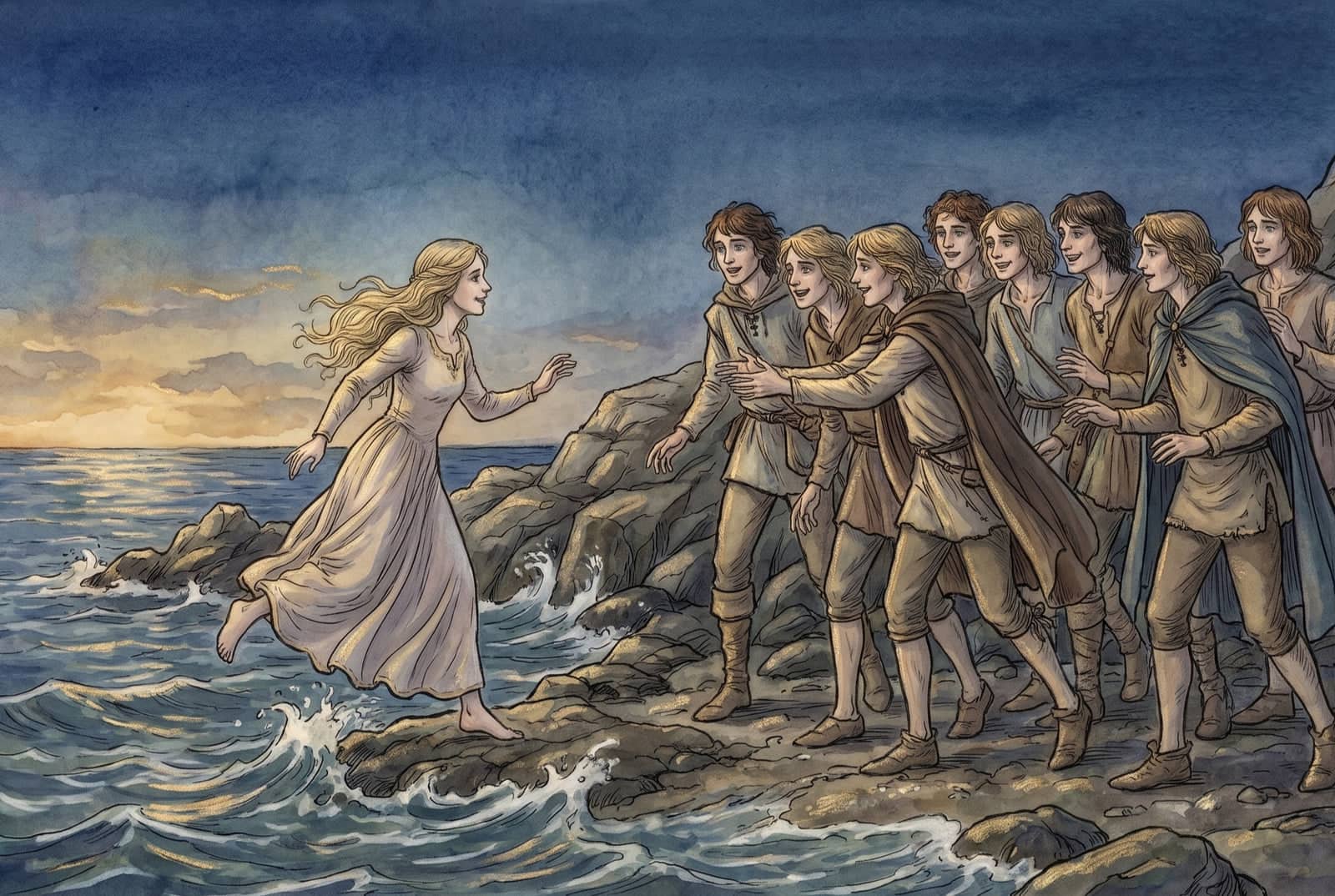
“We brothers,” said the eldest, “fly as wild swans for as long as the sun stands in the sky. As soon as it has gone down, we get our human shape back. That is why we must always take care to have a resting place for our feet at sunset. If we are flying up among the clouds at that hour, we fall as men into the deep. We do not live here. There is a land as lovely as this one on the other side of the sea, but the way to it is long. We have to cross the great ocean, and there is no island along our way where we could spend the night. Only one small rock rises out of the middle of it, just big enough for us to rest on if we stand pressed close together. When the sea runs high, the water splashes right over us, and yet we thank God for that rock. We spend the night there in our human shape, and without it we could never visit our own dear country, for the flight takes us two of the longest days of the year. Once a year we are allowed to come home. We may stay eleven days, and fly over the great forest, and from up there we can see the palace where we were born and where our father lives, and the high church tower where our mother is buried. Here it seems to us that the trees and the bushes are our own family. Here the wild horses run across the plains as we saw them run in our childhood, and the charcoal burner sings the old songs we danced to when we were children. This is our own country, this is what draws us back, and here we have found you, dear little sister. We can stay two days longer, and then we must go away over the sea to a beautiful land, but not to our own. How are we to take you with us? We have neither ship nor boat.”
“How can I set you free?” asked their sister.
And they talked about it almost the whole night through, and slept only a few hours.
Elisa was woken by the beating of swans’ wings rushing above her. Her brothers had been changed again and were flying in wide circles, and at last far away; but one of them, the youngest, stayed behind. The swan laid his head in her lap and she stroked his wings, and they were together the whole day. Toward evening the others came back, and when the sun had gone down they stood there in their own shape.
“Tomorrow we fly away from here, and we cannot come back for a whole year,” said one of them. “But we cannot leave you like this. Have you the courage to come with us? My arm is strong enough to carry you through the wood, so surely all our wings together are strong enough to fly with you over the sea.”
“Yes, take me with you,” said Elisa.
They spent the whole night weaving a net out of supple willow bark and tough rushes, and it grew big and strong. Elisa lay down on the net, and when the sun came up and the brothers were changed into wild swans, they took the net in their beaks and flew high toward the clouds with their dear sister, who was still sleeping. The sunbeams fell straight onto her face, so one of the swans flew above her head to shade her with his broad wings.
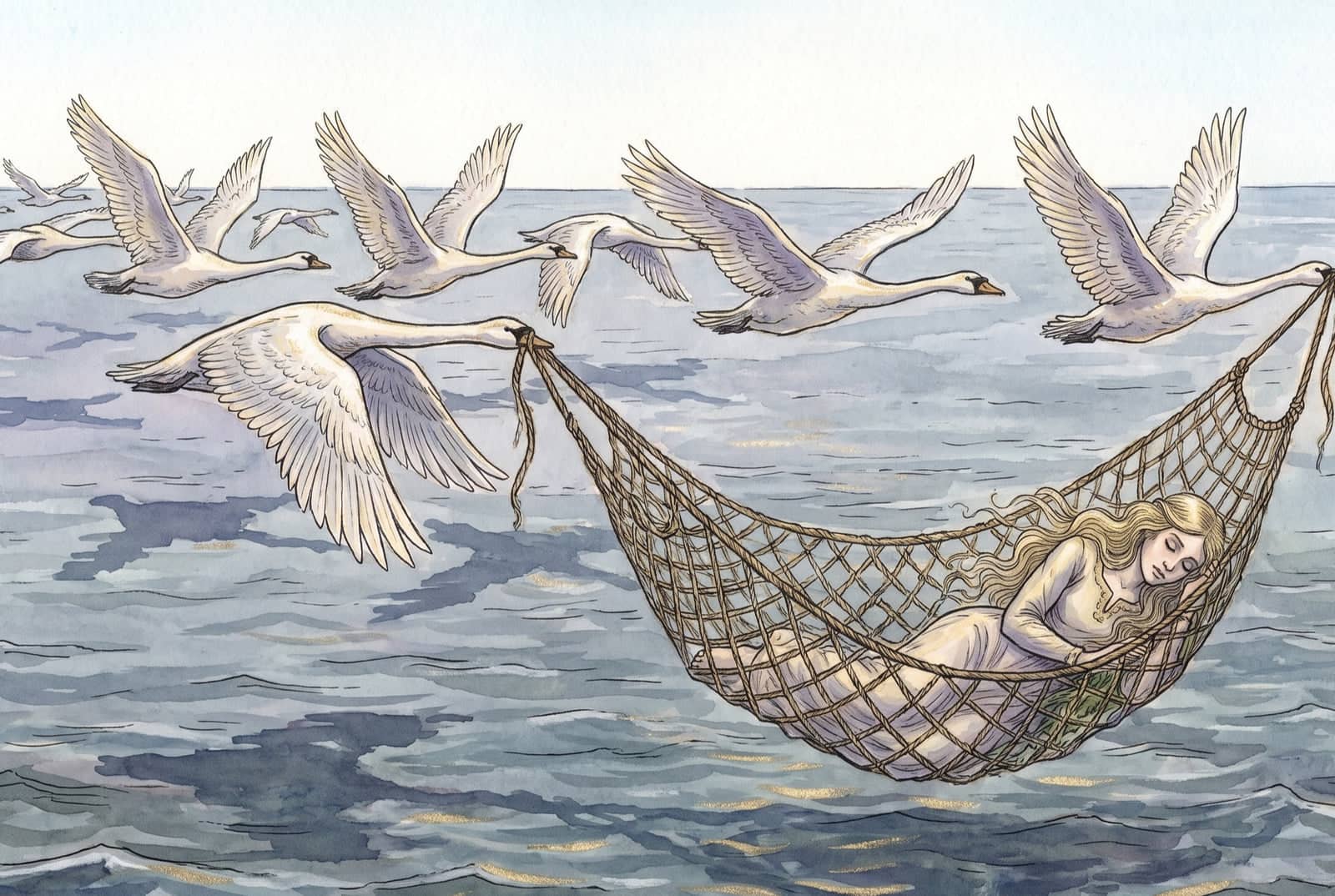
They were far from land when Elisa woke. She thought she must still be dreaming, so strange was it to be carried high through the air and out over the sea. Beside her lay a branch with beautiful ripe berries and a bundle of sweet roots. The youngest of the brothers had gathered them and laid them there for her. She smiled at him in thanks, for she knew him. He was the one flying above her and shading her with his wings.
They were so high that the largest ship they could see below them looked like a white gull lying on the water. A great cloud stood behind them like a mountain, and on it Elisa saw her own shadow and the shadows of the eleven swans, flying there enormous. It made a picture more splendid than any she had ever seen. But as the sun climbed higher and the cloud fell behind, the floating shadow picture faded away.
All day they flew on like an arrow whirring through the air, and yet more slowly than usual, for now they had their sister to carry. Bad weather was gathering. Evening came on, and Elisa watched the sinking sun in fear, for the lonely rock in the sea was still nowhere to be seen. It seemed to her that the swans were beating their wings harder. Oh, it was her fault that they were not getting on quickly enough. When the sun went down they would become men, and fall into the sea, and drown. She prayed to God from the very bottom of her heart, and still she could see no rock. The black cloud came nearer. The clouds stood up in one great threatening wave that came rushing forward like lead, and flash followed flash of lightning.
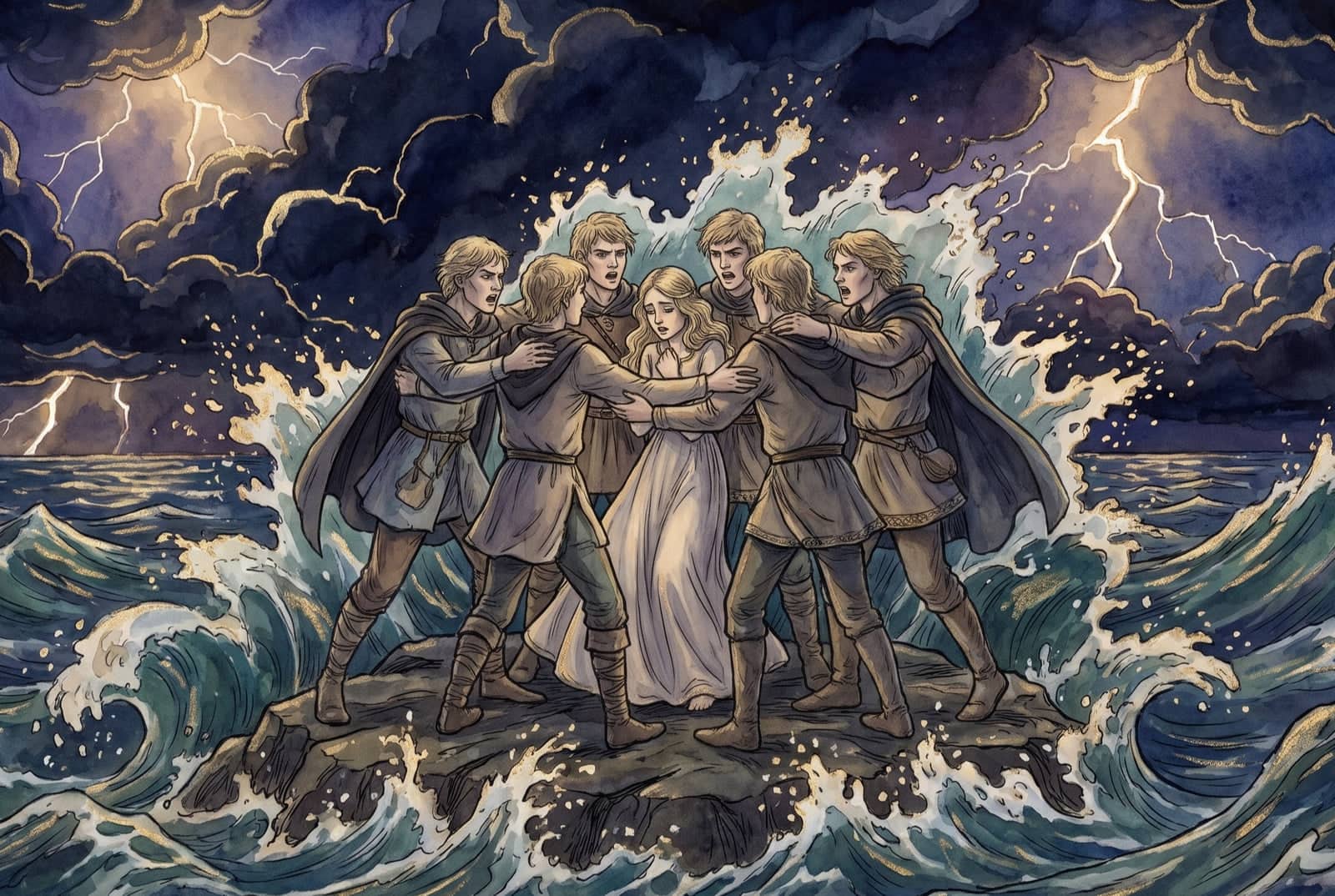
Now the sun was right at the edge of the sea. Elisa’s heart shook. Then the swans shot downward so fast that she thought she was falling, but they were gliding again in a moment. The sun was half under the water when she saw the little rock at last, just below them. It looked no bigger than a seal putting its head up out of the sea. The sun sank very quickly. Now it was only a star, and then her foot touched firm ground. The sun went out like the last spark in a piece of burning paper, and she saw her brothers standing around her arm in arm, with no more room than there was for them and for her, and not an inch to spare. The sea beat against the rock and went over them like a driving shower of rain. The sky burned with one flash after another, and the thunder rolled peal upon peal. But the sister and the brothers held one another’s hands and sang hymns, and from them they drew comfort and courage.
At dawn the air was clear and still, and as soon as the sun came up the swans flew away from the rock with Elisa. The sea was still running high, and from up in the air the white foam on the dark green water looked like millions of swans swimming there.
When the sun had climbed higher, Elisa saw ahead of her, half floating in the air, a mountain country with shining masses of ice on the cliffs, and in the middle of it rose a castle a good mile long, with one bold row of columns above another. Below it palm woods swayed, and flowers as big as mill wheels bloomed. She asked whether this was the land they were making for, but the swans shook their heads, for what she saw was the Fata Morgana’s beautiful, forever changing castle of cloud, and no human being may be carried into it. Elisa stared at it, and then mountains, forests and castle came down together, and twenty proud churches stood there instead, all alike, with high towers and pointed windows. She thought she could hear the organ, but it was the sea she was hearing. Now she was quite close to the churches, and they turned into a whole fleet sailing along beneath her; and when she looked down, it was only sea mist gliding over the water. So there was one change after another before her eyes, until at last she saw the real land they were bound for, with its glorious blue mountains, its cedar forests, its cities and its palaces.
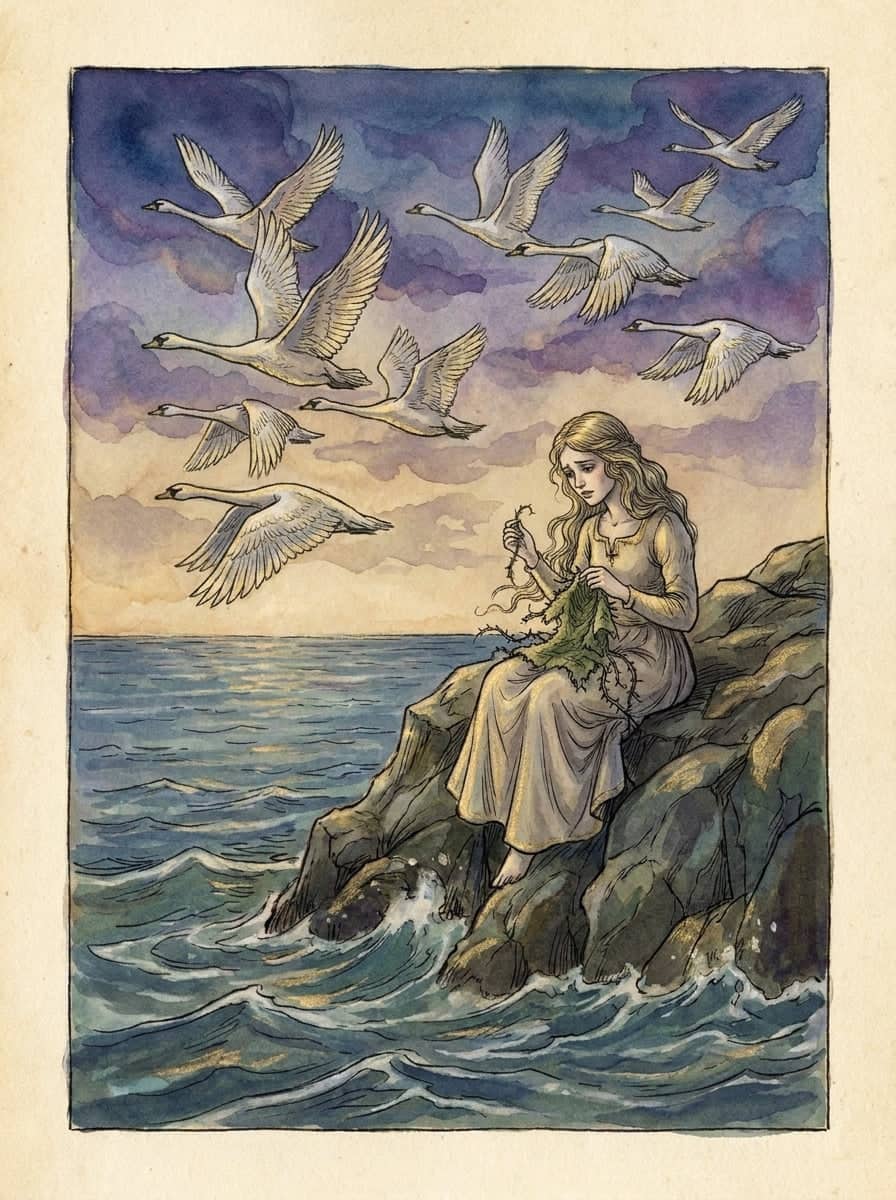
Long before the sun went down she was sitting on a rock in front of a large cave, grown over with fine green creepers that looked like embroidered carpets.
“Now we shall see what you dream here tonight,” said the youngest brother, and showed her where she was to sleep.
“Heaven grant that I dream how to set you free,” she said.
That thought filled her completely. She prayed hard to God for his help, and she went on praying even in her sleep. Then it seemed to her that she was flying high into the air, to the Fata Morgana’s castle of cloud, and that the fairy came out to meet her, beautiful and shining, and yet exactly like the old woman who had given her berries in the wood and had told her about the swans with gold crowns on their heads.
“Your brothers can be set free,” she said. “But have you the courage, and can you hold out? Water is softer than your fine hands, and yet it shapes the stones. But it does not feel the pain your fingers will feel; it has no heart, and does not suffer the fear and the torment you will have to bear. Do you see this stinging nettle I am holding? Nettles of the same kind grow all around the cave where you sleep. Only those, and the ones that grow on the graves in the churchyard, are of any use. Remember that. You must pick them, though they will burn blisters on your hands. Break the nettles with your feet and you will have flax. Out of that you must plait and knot eleven coats of mail with long sleeves. Throw them over the eleven swans, and the spell is broken. But keep this well in mind: from the moment you begin the work until it is finished, even if years go by over it, you must not speak. The first word you say will go into your brothers’ hearts like a deadly dagger. Their lives hang on your tongue. Remember all of it.”
And as she spoke she touched Elisa’s hand with the nettle. It was like a burning fire, and Elisa woke.
It was broad daylight, and close beside the place where she had slept lay a nettle, the same as the one she had seen in her dream. She fell on her knees, thanked God, and went out of the cave to begin her work.
With her fine hands she reached down into the ugly nettles. They were like fire; they burned great blisters on her hands and arms. But she would suffer it gladly if only she could free her dear brothers. She broke every nettle with her bare feet and plaited the green flax.
When the sun had set the brothers came, and they were frightened to find her mute. They believed it was some new spell of their wicked stepmother’s. But when they saw her hands they understood what she was doing for their sake. The youngest brother cried, and wherever his tears fell she felt no more pain, and the burning blisters disappeared.
She spent the night at her work, for she could have no rest until she had set her dear brothers free. All the next day, while the swans were away, she sat there alone, and never had the time run away from her so quickly. One coat of mail was finished already, and she started on the second.
Then a hunting horn sounded among the mountains, and fear took hold of her. The sound came nearer and nearer. She heard dogs barking, and in terror she fled into the cave, tied the nettles she had gathered and dressed into a bundle, and sat down on it.
At once a great dog came bounding out of the ravine, and then another, and another. They barked loudly, ran back, and came again. It was only a few minutes before all the huntsmen were standing in front of the cave, and the handsomest of them was the king of that country. He came up to Elisa. He had never seen a more beautiful girl.
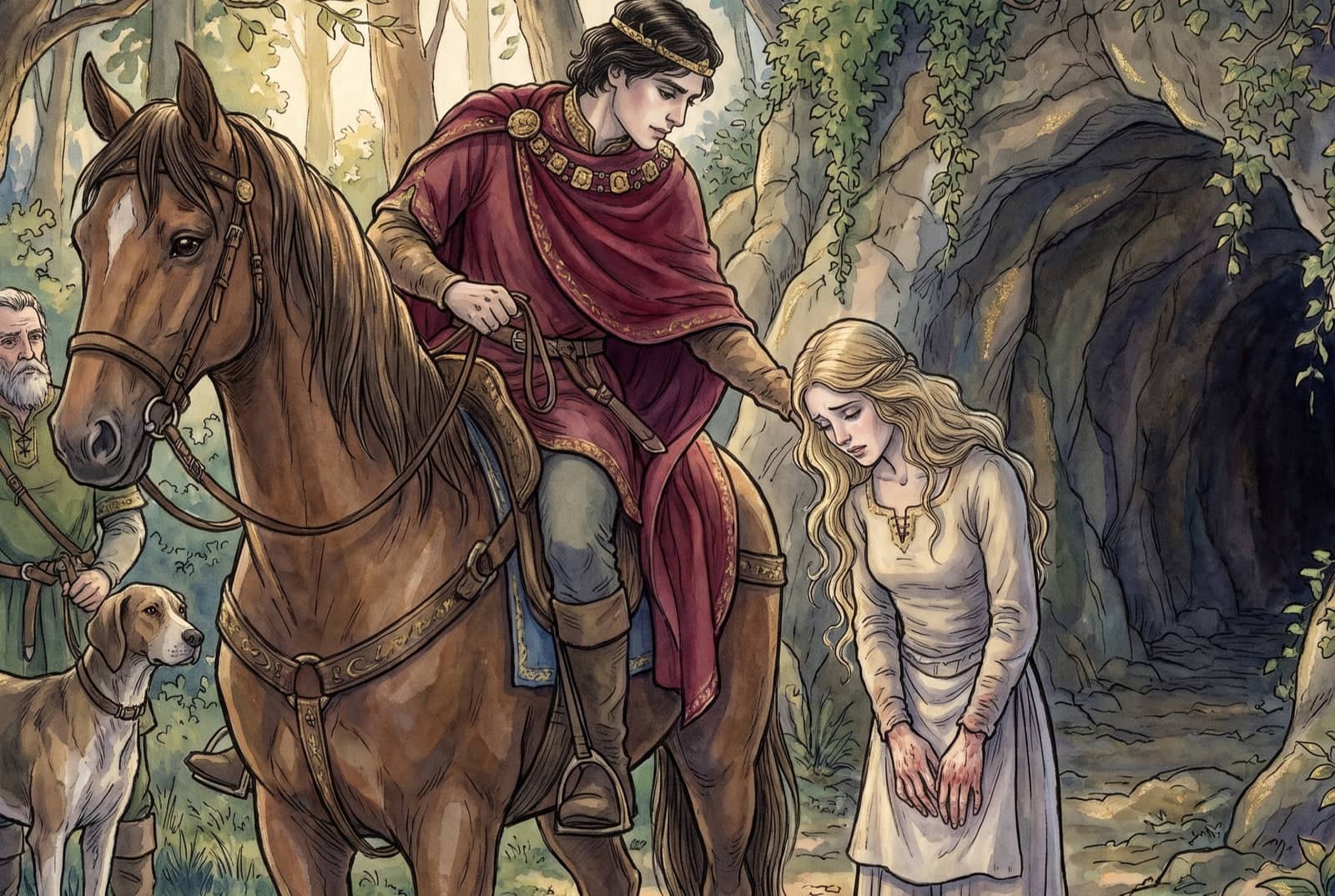
“How did you come here, you lovely child?” he asked.
Elisa shook her head. She dared not speak; her brothers’ freedom and their lives depended on it. And she hid her hands under her apron, so that the king should not see what she had to suffer.
“Come with me,” he said. “You cannot stay here. If you are as good as you are beautiful, I will dress you in silk and velvet, I will set the gold crown on your head, and you shall live and reign in my richest castle.”
Then he lifted her onto his horse. She wept and wrung her hands, but the king said, “I want nothing but your happiness. One day you will thank me for this.” And with that he rode away through the mountains, holding her before him on the horse, and the huntsmen came galloping after.
As the sun went down, the beautiful royal city lay before them with its churches and its domes, and the king led her into the castle, where great fountains splashed in the marble halls and the walls and ceilings were bright with paintings. But she had no eyes for any of it. She wept and mourned. She let the women dress her in royal clothes without a word, let them weave pearls into her hair and draw fine gloves over her burned fingers.
Standing there in all that splendor she was dazzling to look at, and the whole court bowed low. And the king chose her for his bride, although the archbishop shook his head and whispered that the lovely girl from the wood was certainly a witch, that she had blinded the king’s eyes and bewitched his heart.
The king would not listen. He had the music sound, the finest dishes brought in and the loveliest girls dance around her. She was led through scented gardens and into splendid halls, but not one smile came to her lips or into her eyes. She stood there, a picture of grief. Then the king opened a little room close by, where she was to sleep. It was hung with beautiful green tapestries and looked like the cave she had lived in. On the floor lay the bundle of flax she had spun out of the nettles, and from the ceiling hung the coat of mail she had finished. One of the huntsmen had brought all of it away with him as a curiosity.
“Here you can dream yourself back into your old home,” said the king. “Here is the work that kept you busy there. Now, in the middle of all this splendor, it will amuse you to think back to that time.”
When Elisa saw the things that lay so near her heart, a smile played about her mouth and the blood came back into her cheeks. She thought of her brothers and their rescue, and she kissed the king’s hand, and he pressed her to his heart and had all the church bells ring out the wedding feast. The beautiful silent girl from the wood became queen of the land.
Then the archbishop whispered wicked words into the king’s ear, but they did not reach as far as his heart. The wedding was to go ahead, and the archbishop himself had to set the crown on her head. Out of spite he pressed the narrow circle down hard on her forehead, so that it hurt. But a heavier band lay around her heart, her sorrow for her brothers, and she did not feel any pain of the body. Her mouth was silent; a single word would cost her brothers their lives. But her eyes spoke of a deep love for the good and handsome king who did everything to make her glad. She loved him more from one day to the next with her whole heart. Oh, if she could only have trusted him with it and told him what she was suffering. But silent she had to be, and silent she had to finish her work. So at night she slipped away from his side and went into the little room that was decked out like the cave, and she knotted one coat of mail after another. But when she began the seventh, she had no flax left.
She knew that the nettles she needed grew in the churchyard, and that she had to pick them herself. How was she to get out there?
“Oh, what is the pain in my fingers next to the torment my heart is bearing?” she thought. “I have to risk it. The Lord will not take his hand from me.”
With a fear in her heart as though she were setting out to do something wicked, she crept down into the garden in the bright moonlight and went along the avenues and through the empty streets out to the churchyard. There, on one of the broadest gravestones, she saw a circle of ghouls sitting. The hideous creatures pulled off their rags as if they were going to bathe, and then they dug open the fresh graves with their long thin fingers and hauled the dead out with a horrible greed and ate the flesh. Elisa had to pass close by them, and they fixed their evil eyes on her; but she prayed silently, gathered the burning nettles and carried them home to the castle.
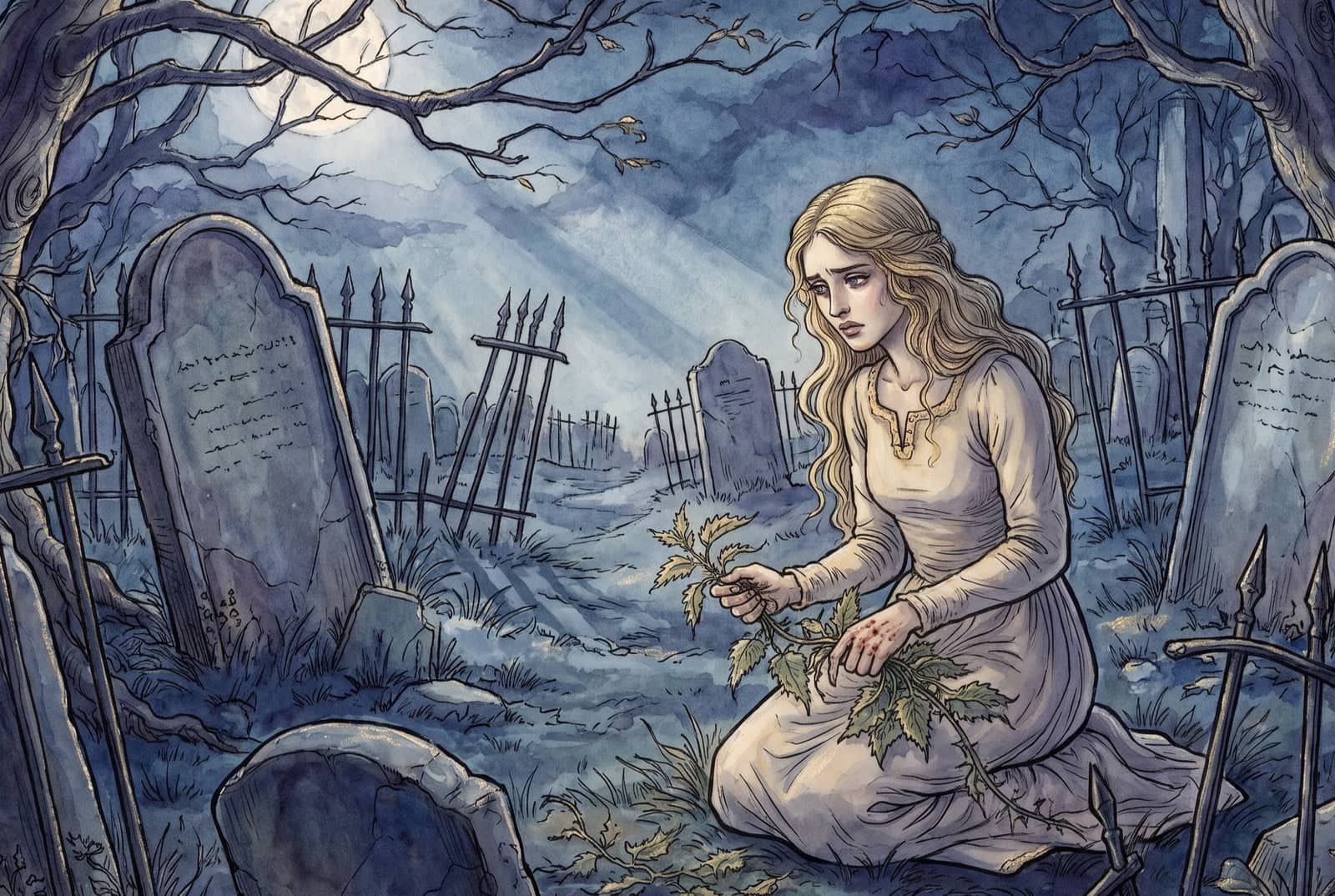
Only one person had seen her, and that was the archbishop. He was up and about while the others slept. So he had been right after all: things were not as they should be with the queen; she was a witch, and that was how she had bewitched the king and all the people.
In the confessional he told the king what he had seen and what he feared. And as the hard words left his lips, the carved images of the saints shook their heads, as if they meant to say, “It is not so. Elisa is innocent.” But the archbishop read it another way. He believed they were bearing witness against her, that they were shaking their heads at her sin.
Two heavy tears rolled down the king’s cheeks. He went home with doubt in his heart, and at night he lay as though he were asleep. But no quiet sleep came to his eyes. He noticed Elisa get up. She did it every night, and every night he followed her softly and saw her disappear into her little room.
His face grew darker from one day to the next. Elisa saw it and did not understand why, and it frightened her, and what she suffered in her heart for her brothers no one could measure. Her hot tears ran down over the royal velvet and purple and lay there like glittering diamonds, and everyone who saw all that splendor wished to be queen.
By now she was nearly done. Only one coat of mail was still missing, but she had no flax left, and not a single nettle. Once more, this one last time, she had to go to the churchyard and pick a few handfuls. She thought with dread of that lonely walk and of the horrible ghouls, but her will stood firm, and so did her trust in the Lord.
Elisa went, and the king and the archbishop followed her. They saw her disappear through the wicket gate into the churchyard, and when they came closer, there sat the ghouls on the gravestone, just as Elisa had seen them; and the king turned his head away, because he counted her among them, the woman whose head had rested on his breast that same evening.
“The people must judge her,” he said.
And the people judged her: she was to die by fire.
Out of the splendid royal halls she was led into a dark, damp hole where the wind whistled in through the grating. Instead of velvet and silk they gave her the bundle of nettles she had gathered, to lay her head on, and the hard, burning coats of mail she had knotted were to be her blankets. But nothing dearer could have been given her. She took up her work again and prayed to God. Outside, the street boys sang mocking songs about her, and not one soul comforted her with a kind word.
Then, toward evening, swans’ wings whirred close to the grating. It was the youngest of the brothers. He had found his sister, and she sobbed aloud for joy, although she knew that the coming night would most likely be the last she had to live. But the work was almost finished now, and her brothers were here.
The archbishop came, to be with her in her last hour, as he had promised the king. But she shook her head and begged him with her eyes and her face to go. This was the night in which she had to finish her work, or all of it would be for nothing, all of it: the pain, the tears and the sleepless nights. The archbishop went away with bitter words against her, but poor Elisa knew that she was innocent, and she went on working.
The little mice ran about the floor and dragged nettles to her feet, to help at least a little; and the thrush settled on the grating of the window and sang the whole night through, as brightly as it could, so that Elisa should not lose heart.
It was still barely light, an hour yet before sunrise, when the eleven brothers stood at the castle gate and demanded to be taken to the king. That could not be done, they were told; it was still night, the king was asleep and must not be woken. They pleaded, they threatened. The guard came out, and at last the king himself stepped out and asked what it all meant. At that moment the sun rose, and now there were no brothers to be seen; but eleven wild swans flew away over the castle.
Out of the city gate the whole crowd came streaming. They wanted to see the witch burn. An old horse drew the cart she sat on. They had put a smock of coarse sackcloth on her; her lovely hair hung loose about her beautiful head; her cheeks were deathly pale, and her lips moved faintly while her fingers worked the green flax. Even on the road to her death she did not break off what she had begun. The ten coats of mail lay at her feet; she was working at the eleventh. The mob jeered at her.
“Look at the witch, how she mumbles! No hymn book in her hand, oh no. There she sits with her ugly sorcery. Tear it into a thousand pieces!”
And they all pressed in on her and wanted to rip the coats of mail apart. Then eleven wild swans came flying down, settled all around her on the cart and beat their great wings, and the crowd fell back in fright.
“It is a sign from heaven. She is surely innocent,” many of them whispered. But they did not dare say it aloud.
Now the executioner took her by the hand. She threw the eleven coats of mail over the swans as fast as she could, and at once eleven handsome princes were standing there. But the youngest had a swan’s wing instead of one arm, for one sleeve was missing from his coat; she had not been able to finish it.
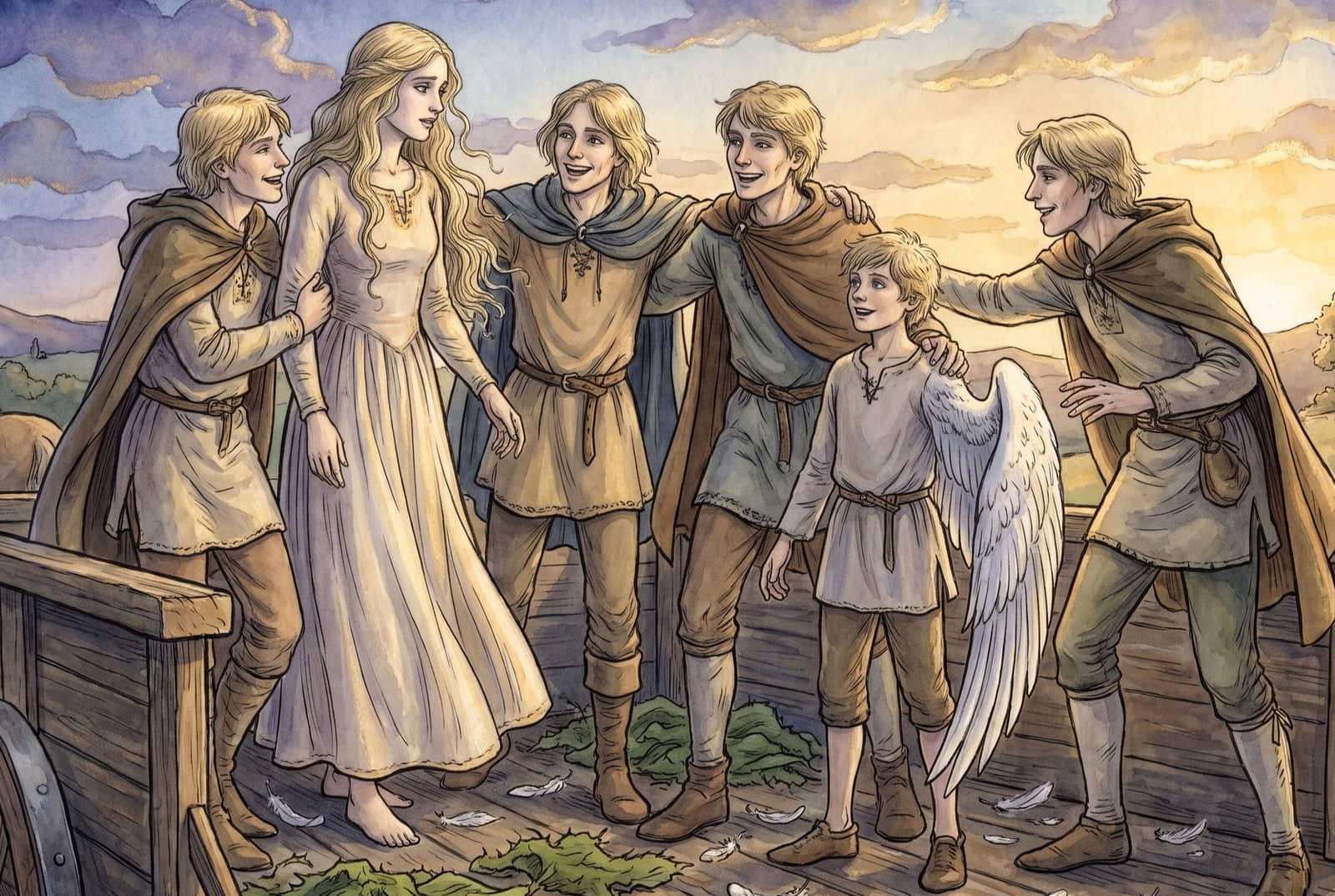
“Now I may speak,” she said. “I am innocent.”
And the people, who had seen what happened, bowed before her as before a saint. But she sank lifeless into her brothers’ arms; the strain, the fear and the pain had done that to her.
“Yes, she is innocent,” said the eldest brother, and then he told them everything that had happened.
And while he spoke, a scent spread over them all as of millions of roses, for every stick of firewood in the pyre had taken root and was putting out branches. A sweet-smelling hedge stood there, high and wide, covered with red roses, and at the very top sat one flower, white and shining, that glowed like a star. The king picked it and laid it on Elisa’s breast, and she woke with peace and happiness in her heart.
And all the church bells rang of themselves, and the birds came in great flocks, and back to the castle went such a wedding procession as no king had ever seen.
Retold by Talerie from Fairy Tales of Hans Christian Andersen (opens in a new window)License: Public domainCopy this text, adapt it, use it however you like. A link back to Talerie is appreciated but never required.CC0 1.0 (opens in a new window)