A splinter of a goblin’s mirror turns Kay cold, and the Snow Queen carries him off to her palace of ice. Gerda follows him to the end of the world, and the two walk home hand in hand to their grandmother’s room, where the roses bloom and it is summer again.
There was once a wicked goblin who made a mirror. Everything good and beautiful reflected in it shrank almost to nothing, while everything mean and ugly grew larger and worse. One day his goblin pupils flew up toward heaven with it and let it slip, and it broke into a hundred million pieces. A splinter smaller than a grain of sand would lodge in a person’s eye, and from that hour he saw only what was wrong with everything. A few got a splinter into the heart, and that was worse still, for the heart turned cold as ice.
Two children lived in a big town, not brother and sister, but loving each other as if they were. Their attic windows faced one another across a gutter, and in the boxes laid between them, rose bushes grew into a leafy arch. There Kay and Gerda sat all summer, and in winter they melted a peephole in the frozen pane with a warm penny.
“Look, the white bees are swarming,” said Kay’s grandmother one snowy day. “The largest of them is their queen. On winter nights she looks in at the windows, and the ice freezes into flowers and castles.”
“Can the Snow Queen come in here?” asked Gerda.
“Just let her try,” said Kay. “I will put her on the warm stove, and she will melt.”
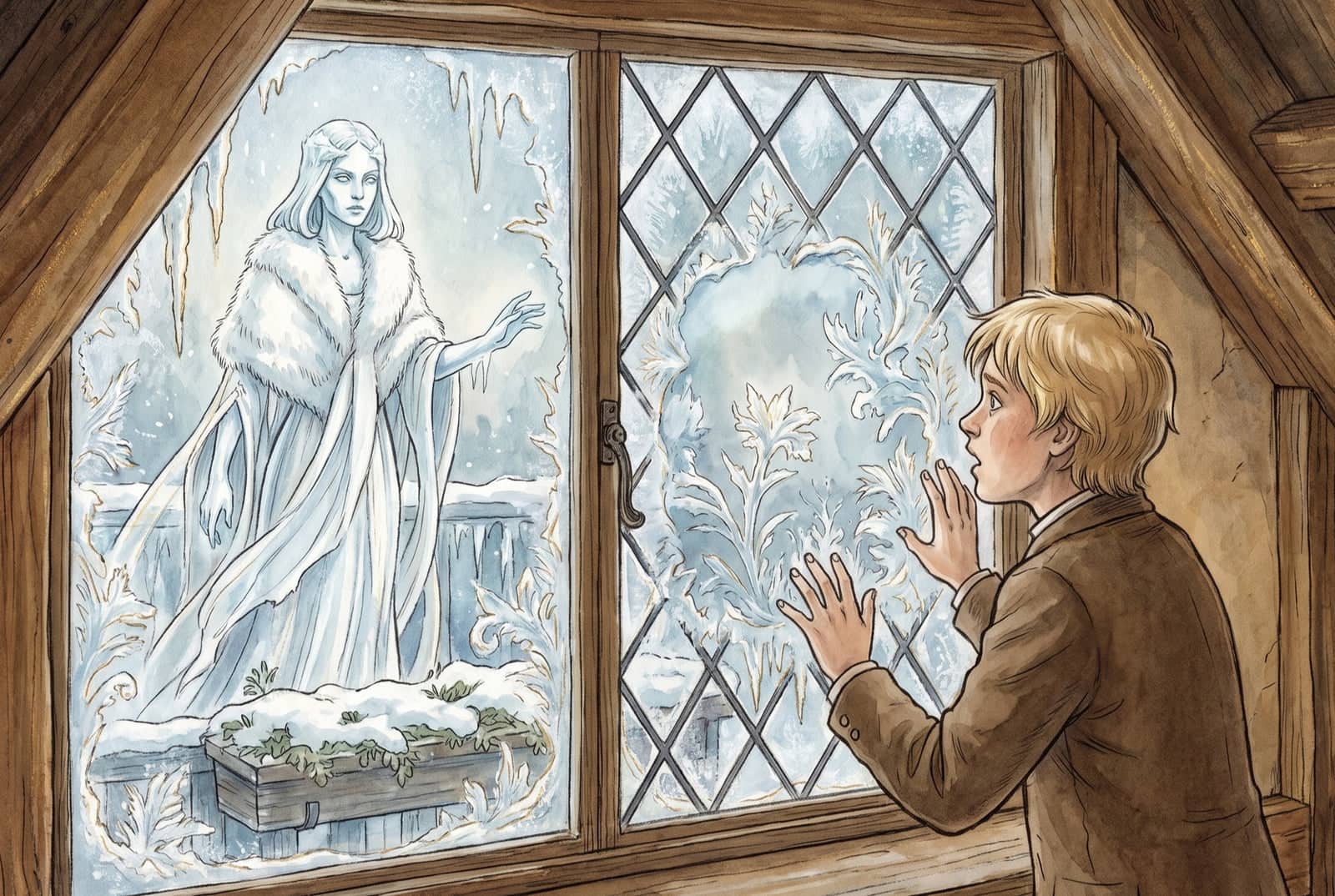
One evening he climbed on a chair and peeped through the hole in the frosted pane. A snowflake larger than the rest settled on the flower box and grew into a woman in white gauze. She was ice, and there was no rest in her eyes. She nodded and beckoned, and Kay jumped down in fright.
Then came summer, and the roses bloomed. Gerda had learned a hymn with roses in it, and she sang it to Kay, and he sang it with her.
Roses bloom and fade away,we shall see the Christ-child one day.
But one day, as the clock struck five, Kay cried out that something had stabbed his heart and something was in his eye. Gerda could see nothing. It was a grain of that mirror, and a splinter of it had lodged in his heart.
“Why are you crying?” he said. “It makes you look ugly. That rose is worm-eaten, and this one is crooked.” He tore the roses from their stems, and when he saw how frightened Gerda was he pulled off another and jumped in at his window.

After that nothing pleased him. He mimicked his grandmother until people laughed and called him clever, and he teased Gerda, who loved him with her whole heart. It was the glass in his eye and the ice in his heart, and nothing else.
Soon after, he took his sled to the great square, where the boys hitched theirs to passing carts. A big white sleigh came by with someone in white fur in it, and Kay hooked his sled on behind, and away they went out through the town gate. Every time he tried to loosen his rope the driver turned and nodded pleasantly, so Kay sat still. He was very frightened and wanted to say the Lord’s Prayer, but all he could remember was his multiplication tables. The snow fell so thickly that he could see nothing but flakes like great white hens.
At last the sleigh stopped and the driver stood up. The fur and the cap were nothing but snow, and they fell away, and there stood a tall white lady: the Snow Queen.
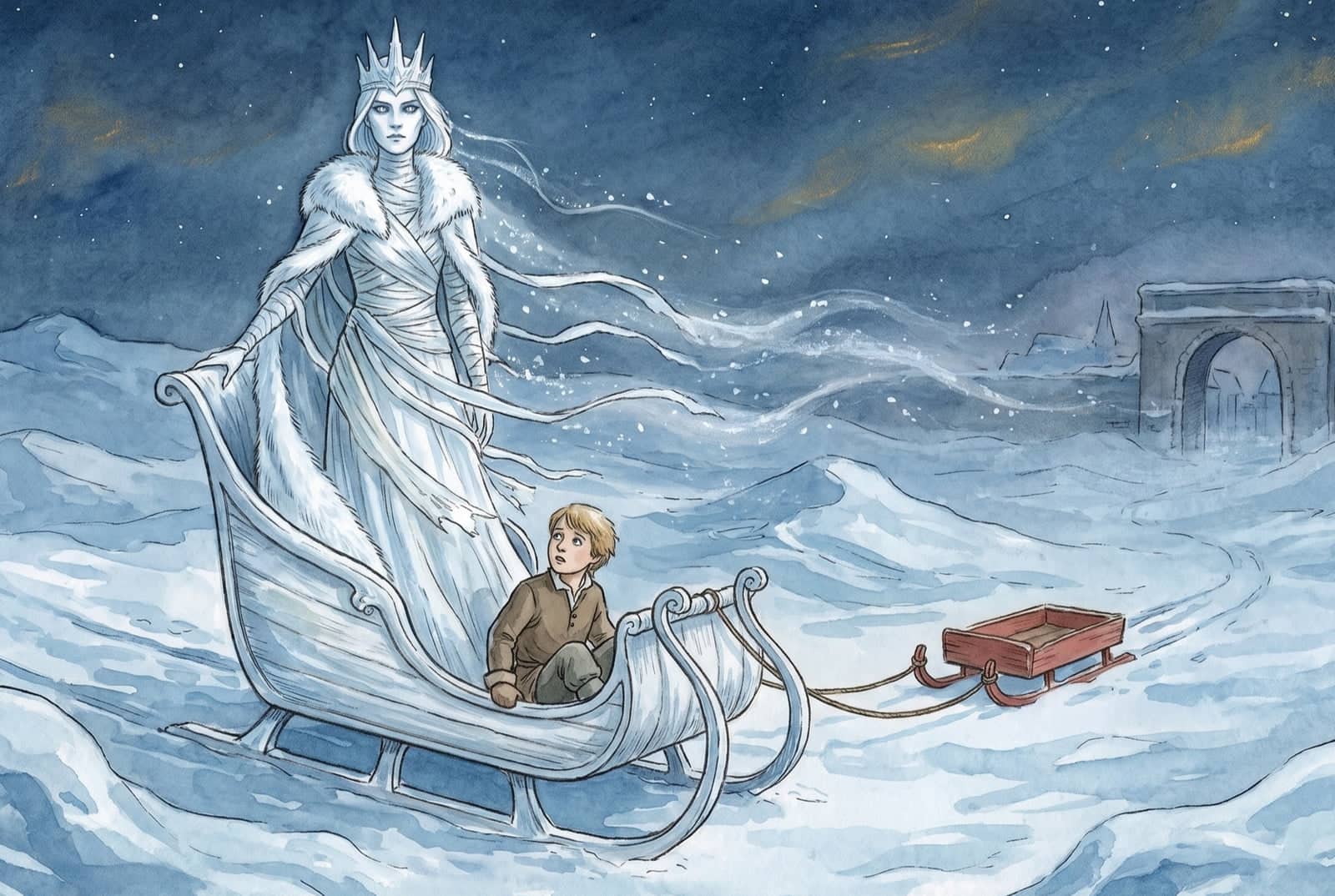
“We have driven well,” she said. “But why are you shivering? Creep into my fur.” Then she kissed his forehead, and the kiss went through to his heart, which was already half ice. He thought he would die, and then he felt nothing at all. She kissed him a second time, and with that kiss he forgot Gerda and his grandmother and everyone at home.
“Now you must have no more kisses,” she said, “or I should kiss you to death.”
Then they flew up on a black cloud, over sea and land, and by day Kay slept at the Snow Queen’s feet.
Nobody at home knew what had become of him. People said he had drowned in the river near the school, and Gerda cried longest and hardest. At last spring came.
“Kay is dead and gone,” Gerda said to the sunshine.
“I don’t believe it,” said the sunshine.
“Kay is dead and gone,” she said to the swallows.
“We don’t believe it,” they answered.
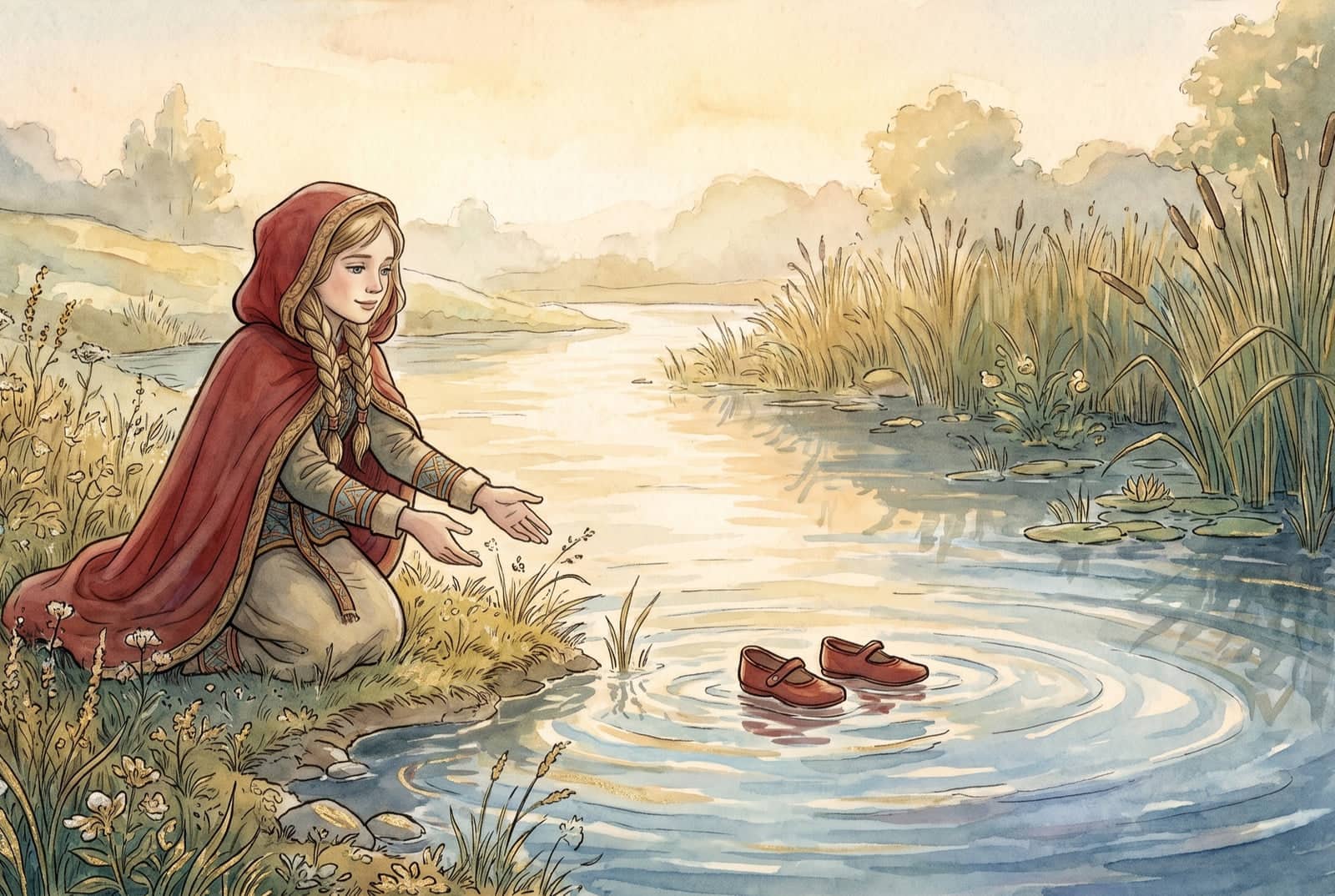
So she put on her new red shoes and went down to the river. “I will give you my red shoes if you give me back my playmate,” she said, and she threw in the shoes she loved best. But the ripples carried them back, so she climbed into a boat among the reeds to throw them from the far end, and the boat was not tied. It drifted away with her, and nobody heard her crying but the sparrows, who flew along the shore and sang, “Here we are! Here we are!”
After many hours the boat came to a cherry orchard, where a very old woman in a sun hat painted all over with flowers came out of a thatched house. She drew the boat to land and heard Gerda’s story. Kay had not come by, she said, but the child must eat cherries and see the flowers. She could conjure a little, and she wanted to keep the child, so while she combed Gerda’s hair with a golden comb she made every rose tree in the garden sink into the earth, lest roses should remind Gerda of Kay.
Gerda played among the other flowers for days, always feeling that one was missing. Then one afternoon she saw a rose painted on the old woman’s hat, forgotten there. She searched every bed and found none, and sat down and wept, and her tears fell where a rose tree had sunk. The warm earth opened, and up the tree came, blooming as before.
“Is Kay dead?” she asked the roses.
“He is not dead,” the roses answered. “We have been down in the earth where the dead are, and Kay is not there.”
No other flower knew anything of him. So Gerda pushed at the rusty latch of the gate until it gave way and ran out into the world on her bare feet. When she stopped to rest she saw that summer was gone and autumn far along.
A crow came hopping over the snow toward her. “Caw, caw. Good day, good day,” he said, as plainly as he could, and asked where she was going. Gerda told him her story and asked whether he had seen Kay.
“Perhaps I have,” said the crow, “but if so, he has forgotten you by now for the princess.” In that kingdom, he said, lived a princess who meant to marry a man who knew what to say when he was spoken to, but for two days every suitor lost his tongue inside the palace gates. “On the third day there came a little fellow with no horse and no carriage, his eyes shining like yours and his boots creaking terribly loudly, and he told the princess he had not come to court her but to hear her wisdom.”
“That was Kay!” cried Gerda. “Will you take me to the palace?”
The crow’s tame sweetheart knew a back staircase and where the key hung, so that night the birds led Gerda up with a lamp, while the dreams of the sleeping court rushed past on the walls.
At last they came to a bedroom where two beds hung from a golden stem like lilies, one white and one red. Gerda pushed the red petals aside, saw a brown neck on the pillow and called Kay’s name. He woke and turned, and it was not Kay but the young prince. The princess woke too, and Gerda wept and told them everything. They pitied her, rewarded the crows, and in the morning gave her boots, a muff and a coach of pure gold. The forest crow rode beside her a few miles and then said goodbye, and that was the saddest parting of all.
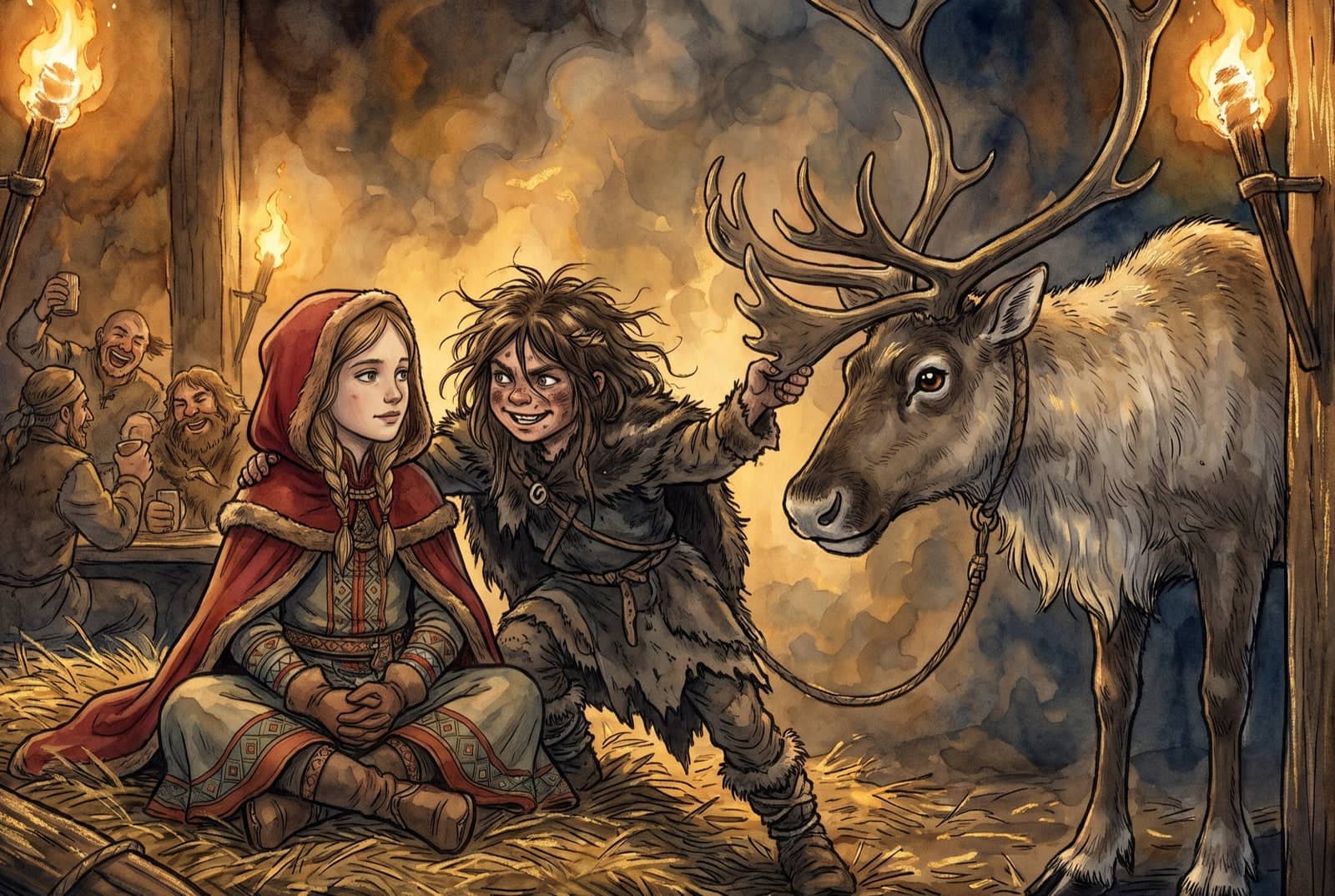
The road went through a dark wood, and the coach shone in it like a torch. Robbers rushed out and seized the horses, and the men who rode with Gerda never came home again. “She is as plump as a little lamb,” said the old robber woman, and drew a knife that glittered horribly. At that moment she screamed, for her own daughter had bitten her ear, and there was no more talk of the knife.
“She shall play with me,” said the little robber girl. “She shall give me her muff and her pretty dress and sleep in my bed.” She had her way, and as they drove into the forest she promised that nobody should hurt Gerda. Gerda told her how dearly she loved Kay, and the robber girl nodded and dried Gerda’s eyes.
That night they lay on straw in a smoky hall. “These are my wood pigeons,” said the robber girl, “and here is my old sweetheart Ba.” She pulled out a reindeer by the horn. Then she fell asleep with one arm across Gerda, who could not close her eyes all night.
Then the wood pigeons said, “Coo, coo. We have seen little Kay. A white hen carried his sled, and he sat beside the Snow Queen as they drove over the wood toward Lapland. Coo, coo.”
“I was born there,” said the reindeer, “and I can carry her.”
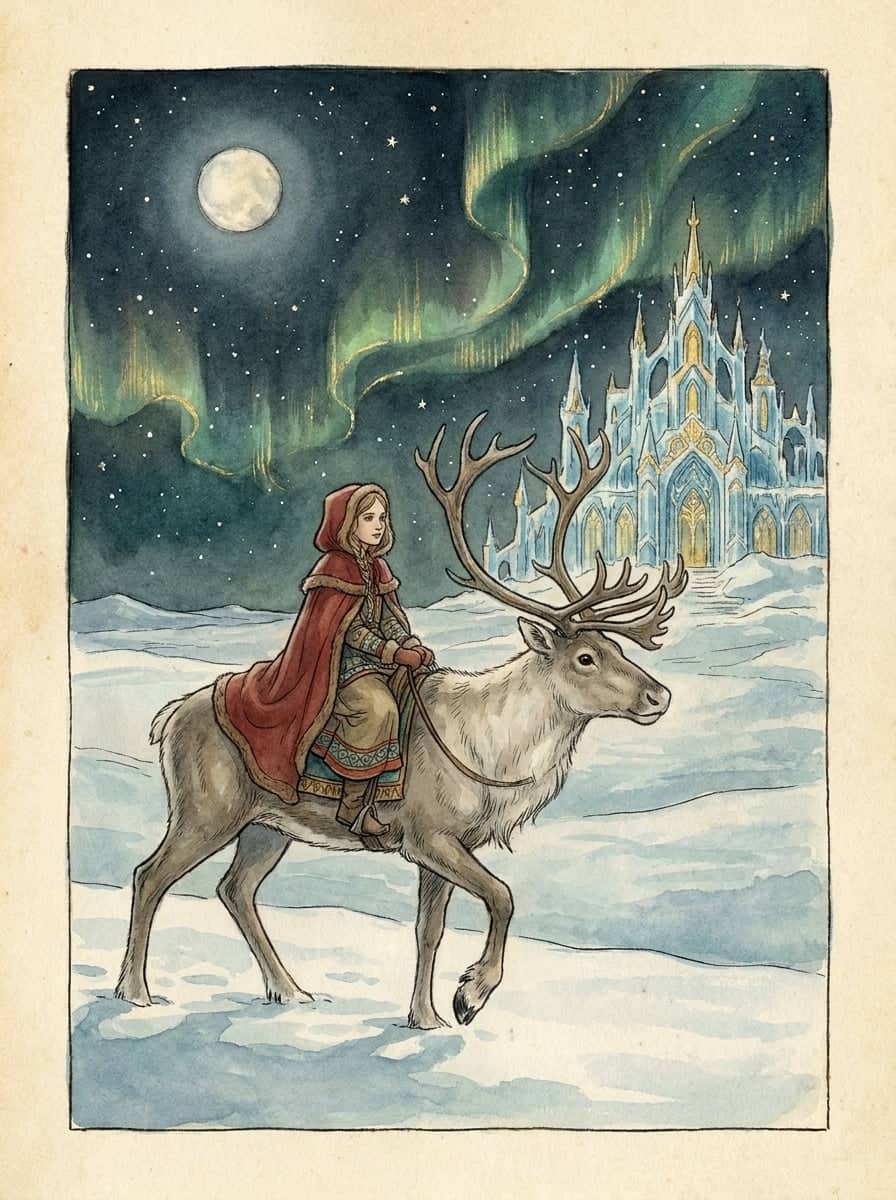
In the morning the robber girl grew serious, and at noon, when her mother had fallen asleep, she untied the reindeer. “Carry her to the Snow Queen’s castle, where her playmate is,” she said, and lifted Gerda onto his back. “Here are your fur boots, but the muff I will keep, for it is far too pretty. Here are my mother’s mittens, and two loaves and a ham, so you will not starve.” Then she turned to the reindeer. “Now run, and take good care of her.”
Away flew the reindeer through the forest, while the wolves howled and the northern lights flashed red in the sky. They stopped in Lapland, where an old woman wrote a few words on a dried codfish and sent them on a hundred miles further, to the Finland woman.
Her hut had no door at all, so they knocked at the chimney and crept in. It was so hot inside that she pulled off Gerda’s boots and mittens. She read the fish three times and then dropped it into the soup pot, for she never wasted anything. Then the reindeer begged her to give the girl the strength of twelve men, to overcome the Snow Queen.
“That would not help much,” said the Finland woman. “Kay has a splinter of glass in his heart and a grain of it in his eye, and they must come out, or he will never be himself again. But I can give Gerda no greater power than she has already. Do you not see how great it is? People and animals serve her, and she has come this far on her own bare feet, and her power is nothing but this, that she is a good and loving child. Set her down by the bush with the red berries, where the Snow Queen’s garden begins.”
The reindeer set her down there and kissed her, and great bright tears ran down his cheeks as he turned for home. She stood barefoot and bare-handed in that bitter country. She ran forward, and a regiment of snowflakes came at her along the ground, growing larger the nearer they came, for they were alive: they were the Snow Queen’s guard, in the strangest shapes.
Then Gerda said her prayer. The cold was so great that she could see her own breath, and as she prayed it took shape and became little angels with spears and shields. More came, until a legion stood round her and struck at the snowflakes, so that they flew into pieces, and Gerda walked on bravely.
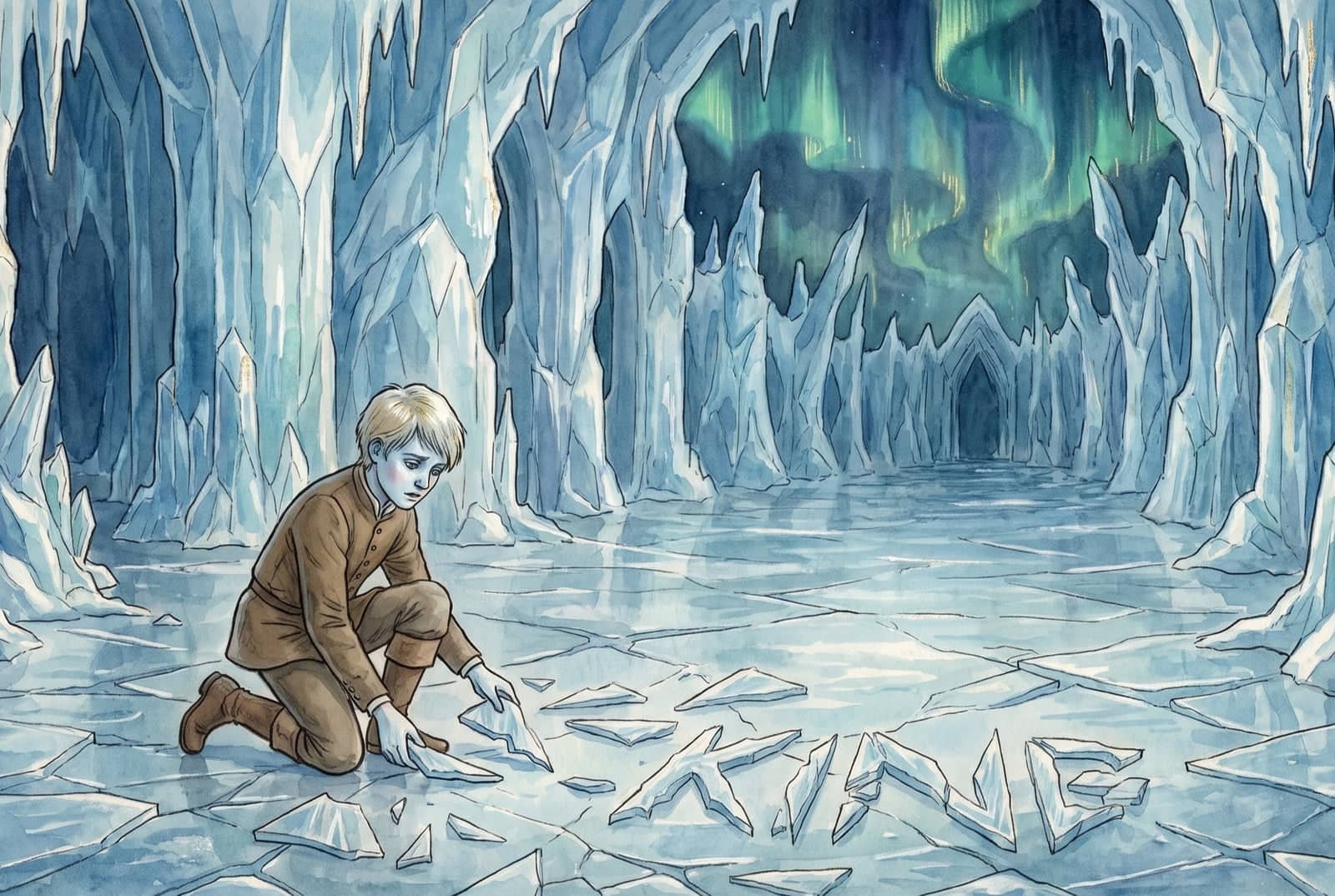
The walls of that palace were drifted snow and its doors the cutting winds, and its halls vast and empty and glittering under the northern lights. In the middle lay a frozen lake, cracked into a thousand pieces, each exactly like the rest. The Snow Queen called it the Mirror of Reason, and said it was the best in the world.
Kay was blue with cold, but he did not feel it, for his heart was a lump of ice. He laid sharp flat pieces of ice into figures, and in his eyes they were the most important things in the world. He laid whole words, but there was one he could never manage, and it was the one he wanted most: Eternity. If he could lay that word, the Snow Queen had told him, he should be his own master and have a new pair of skates.
“Now I must be off to the warm countries,” she said one day, “to look into the black pots, the fire-spitting mountains Etna and Vesuvius, and whiten them a little.” And away she flew, and Kay sat alone in the hall that was miles long, so still he might have been frozen.
Just then Gerda came in through the great gate. Cutting winds raged around her, but they sank as she passed, and she walked into the huge empty hall, and there she saw Kay. She knew him at once and threw her arms round his neck. “Kay! Dear little Kay! I have found you at last!”
But he sat quite still, stiff and cold.
Then Gerda wept hot tears, and they fell on his chest and went down into his heart and thawed the ice and washed the splinter of glass away. He looked at her, and she sang:
Roses bloom and fade away,we shall see the Christ-child one day.
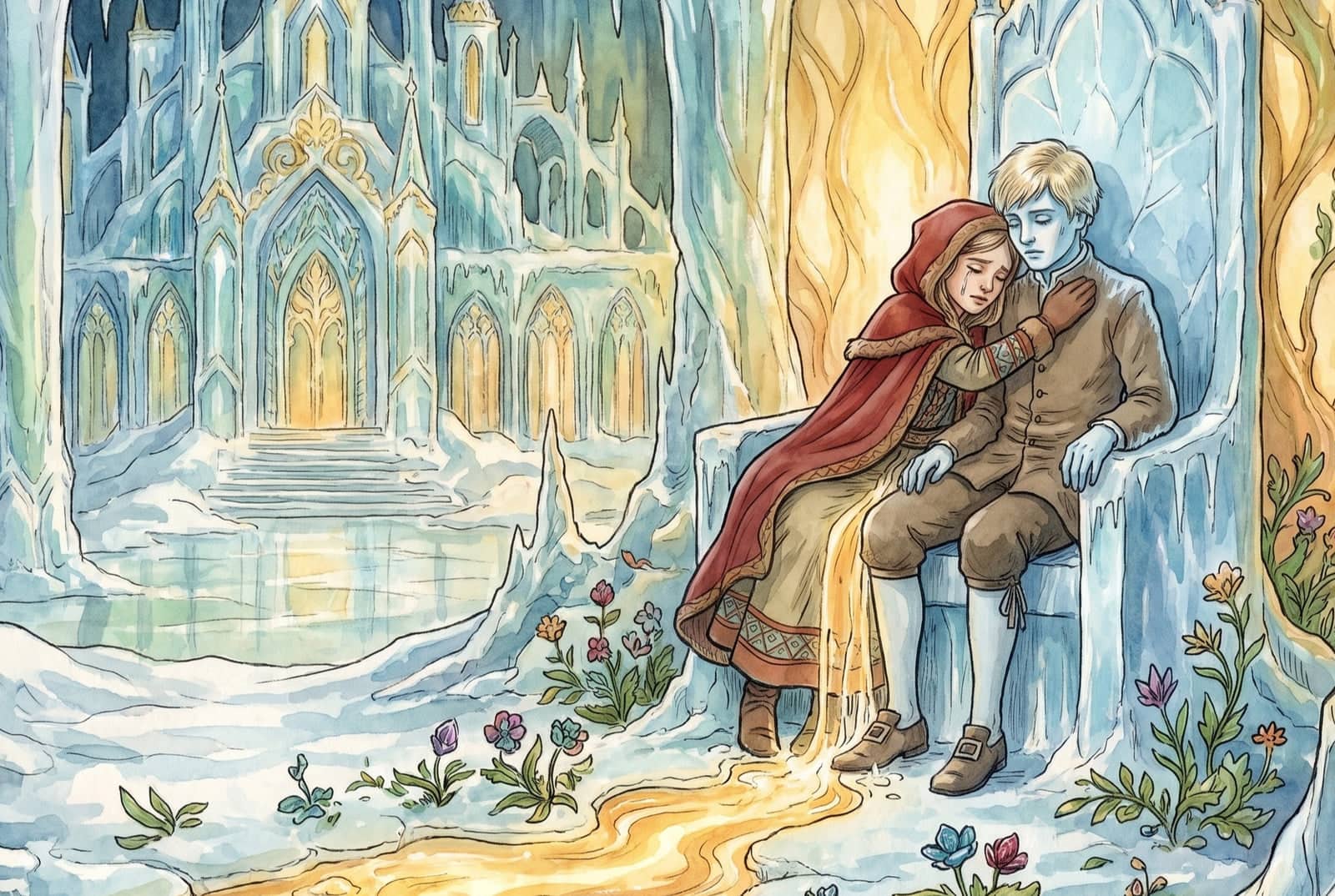
Then Kay burst into tears, and he cried so hard that the grain of glass swam out of his eye. He knew her then and shouted for joy, “Gerda! Dear little Gerda! Where have you been, and where have I been?” She laughed and cried at once, and the pieces of ice danced about, and when they were tired they lay down in the very letters of the word he had been told to find. So Kay was his own master. Gerda kissed his cheeks and his eyes, and he was well and strong again.
They took each other by the hand and walked out of the palace, and wherever they went the winds lay still and the sun shone. At the bush with the red berries the reindeer was waiting, and he carried them back to the Finland woman and to the Lapland woman, who had sewn them new clothes. Then he ran beside them to the border, where green leaves showed.
Out of the budding forest came the little robber girl on a horse Gerda knew, for it had drawn the golden coach; she wore a bright red cap and pistols in her belt.
“You are a fine one for wandering off,” she said to Kay. “I should like to know whether you deserve to have somebody run to the end of the world for you.”
But Gerda asked after the prince and princess, who had gone traveling, and after the crow, who had died. Then she and Kay told the robber girl their whole story.
“Snip, snap, snurre, basselurre!” said the robber girl. She took them both by the hand, promised to visit if she ever passed their town, and rode away.
Kay and Gerda walked home hand in hand. The church bells rang, and they knew the tall towers of their town. They went up the stairs to their grandmother’s room, where the clock still said tick, tock. But as they came through the doorway they saw that they had grown up. The roses were blooming in at the open window, and they sat down on the little chairs of their childhood and held each other by the hand. The grandmother read aloud from her Bible, “Unless you become like little children, you will never enter the kingdom of God.”
And Kay and Gerda looked into each other’s eyes, and all at once they understood the old song:
Roses bloom and fade away,we shall see the Christ-child one day.
And there they sat, grown up and yet children at heart. And it was summer, warm and blessed summer.
Retold by Talerie from Fairy Tales of Hans Christian Andersen (opens in a new window)License: Public domainCopy this text, adapt it, use it however you like. A link back to Talerie is appreciated but never required.CC0 1.0 (opens in a new window)