The Nutcracker and the Mouse King
16 min read ages 7 and up talerie.com/en/tales/the-nutcracker-and-the-mouse-king
On Christmas Eve Maria finds a little nutcracker by the tree, with a head far too big for his thin legs. Fritz cracks three of his teeth out, and she binds his jaw with a ribbon from her dress. At midnight a mouse with seven heads bursts up through the floor at her feet.
All day on the twenty-fourth of December the Stahlbaum children were kept out of the sitting room, and Fritz and Maria waited in the dark.
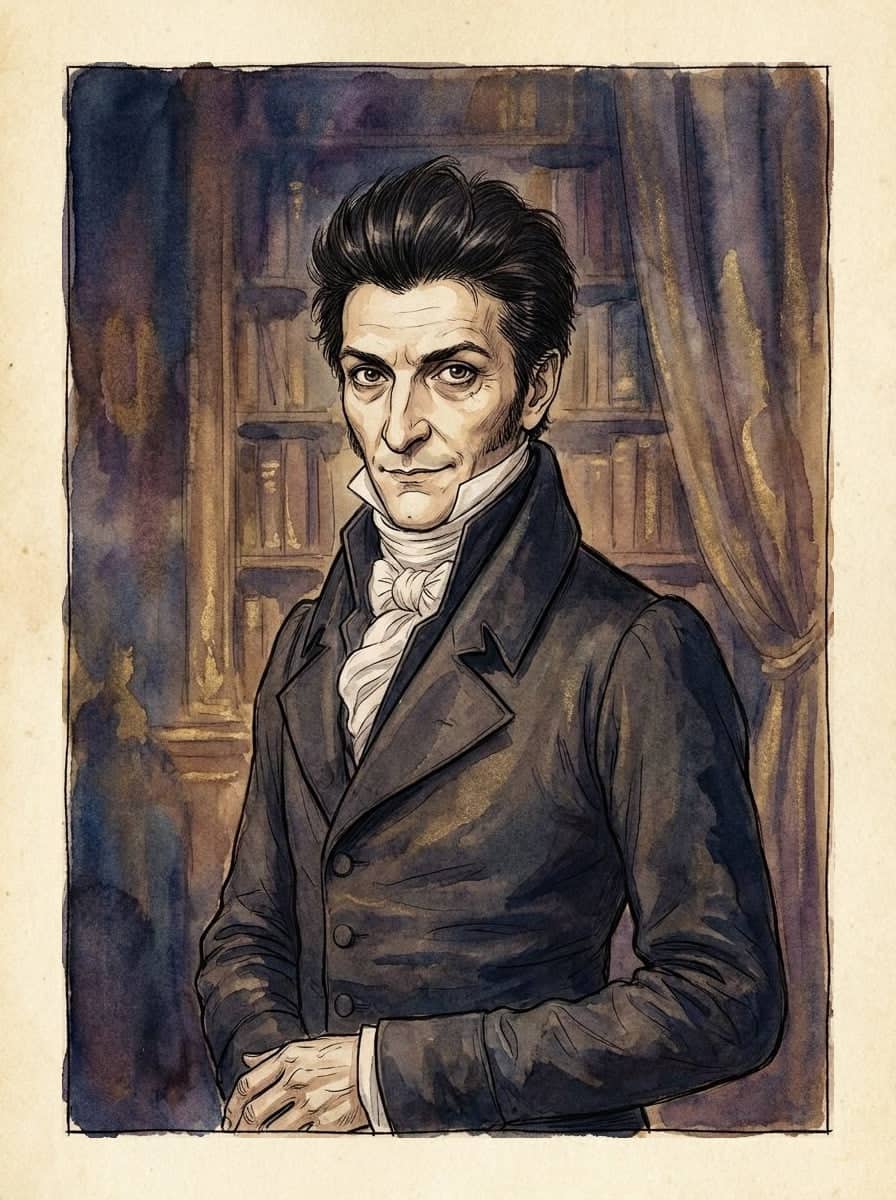
Godfather Drosselmeier was small and wrinkled, with a black patch over one eye and a wig of spun glass. He understood clocks better than anybody in the town, and every Christmas he built the children something wonderful.
Then a bell rang, kling ling, kling ling, the doors flew open, and there stood the tree, hung with gold and silver apples, its candles burning like friendly eyes, and the gifts spread beneath it.
Behind a curtain stood the godfather’s own work, a castle with golden towers where tiny lords and ladies always walked the same way, so Fritz soon went back to his soldiers.
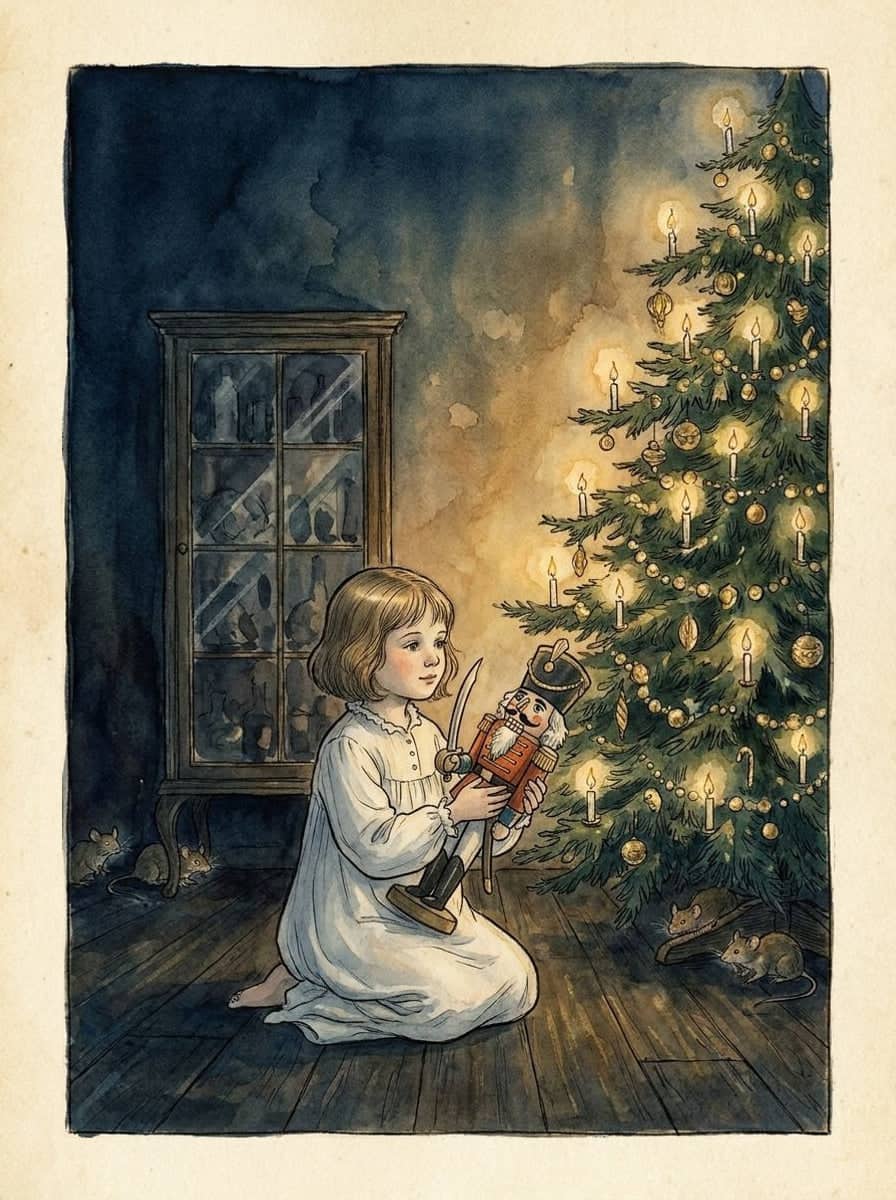
Maria stayed, because she had found a little man nobody else had noticed, standing quiet and patient, as if he were waiting his turn.
His body was too stout for his thin legs and his head far too big for either, but his face was full of kindness.
“Father, whose is that dear little man by the tree?” she asked.
“He cracks the hardest nuts with his teeth,” said her father, “and he belongs to Fritz as much as to you.”
Her father lifted the wooden cloak on the little man’s back. Maria put in a nut, and crack, the sweet kernel dropped into her hand. He belonged to the old family of the Nutcrackers.
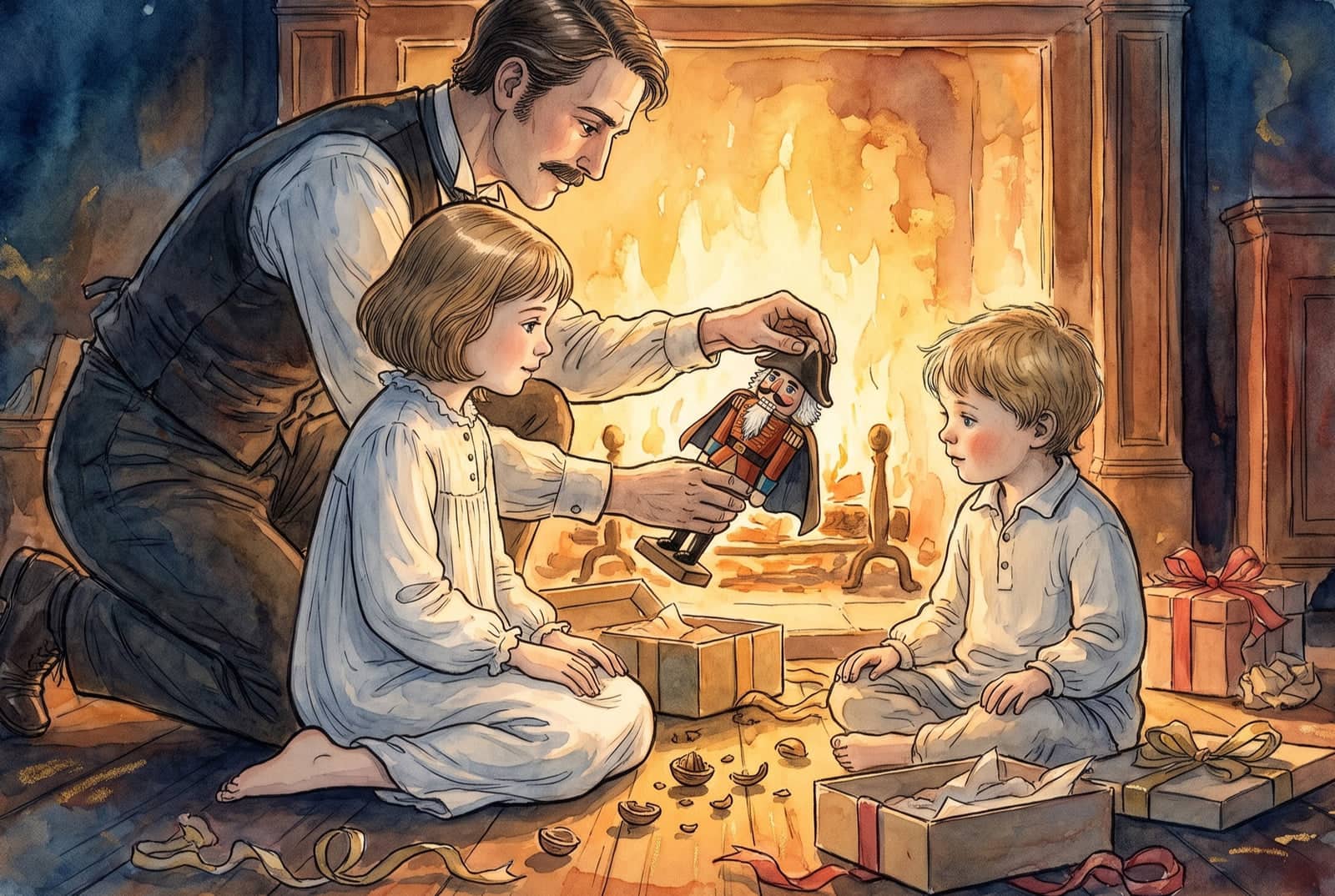
Maria picked out the smallest nuts for him. Fritz picked out the biggest, and crack, crack, three teeth fell out and the poor jaw hung loose.
“Give him to me,” said Fritz. “A nutcracker with bad teeth does not understand his trade.”
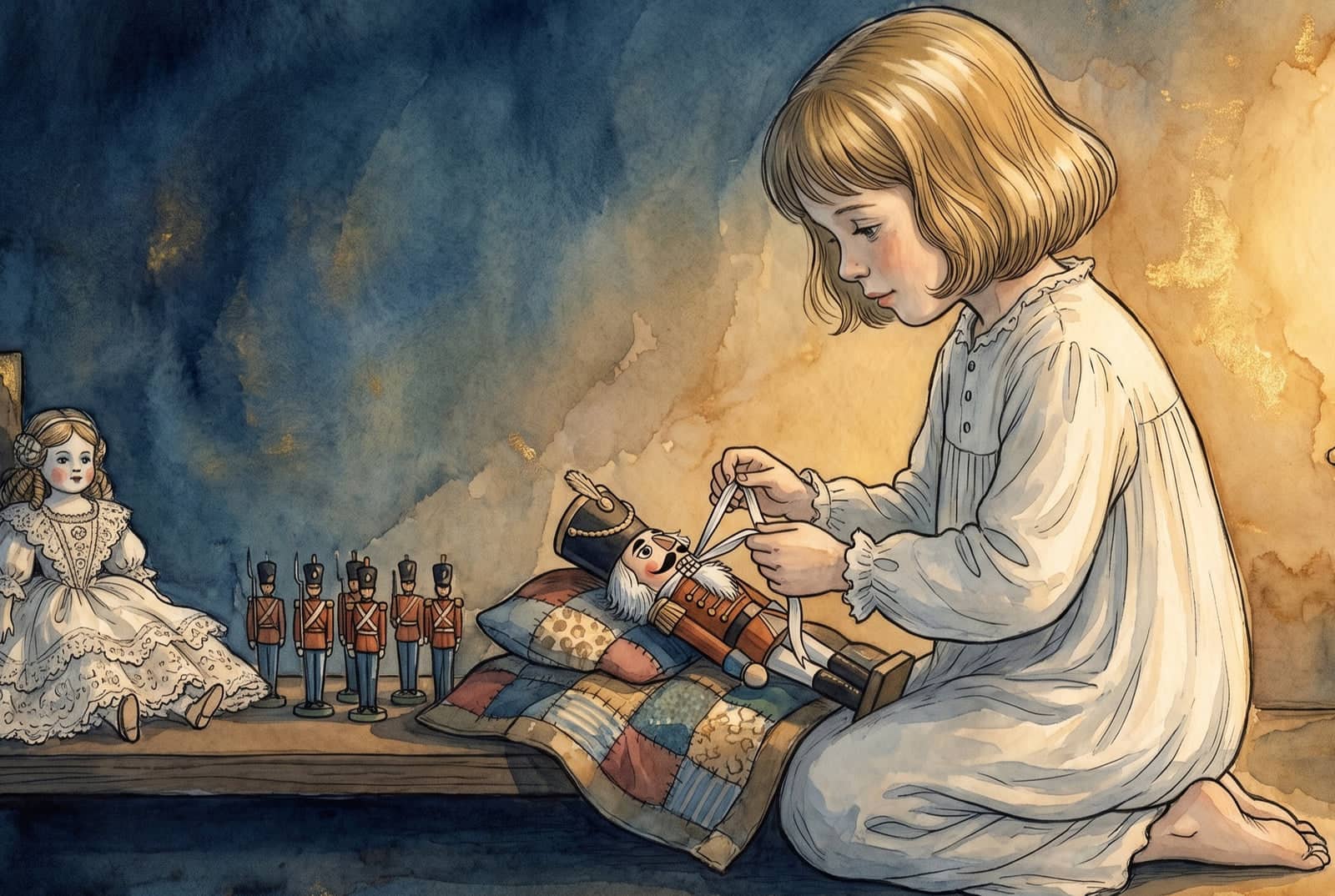
“You shall not have him,” Maria wept, and she bound his wounded chin with a white ribbon from her dress. “A good soldier,” said her father, “does not ask service of the wounded.” And he gave Nutcracker into her care.
That night Maria begged to stay up a little longer, and her mother went to bed, leaving her alone with the lamp and the tall glass case where the children kept their treasures.
“I will nurse you until you are well,” she told Nutcracker, “and Godfather Drosselmeier shall set your teeth, for he understands such things.”
Clara, the proud new doll, had to give up her little bed. Maria tucked him in up to his nose and set him on the shelf beside Fritz’s hussars.
She locked the case, and something began to rustle behind the stove. The great clock whirred but could not strike, for the gilded owl on top had dropped its wings across the clock’s face, and it whirred out words:
Dickory, dickory, dock, whirr softly, softly, clock. The Mouse King has a fine sharp ear; sing him the song he likes to hear. Strike, old clock, strike soft and light, or he may run away in fright.
It struck twelve with a smothered sound, and Maria saw Godfather Drosselmeier sitting where the owl had been, the skirts of his coat hanging like wings.
Squeaking broke out on every side. Mice came up through the cracks and drew up in ranks, and then the floor burst open at her feet and out rose a mouse with seven heads and seven bright crowns.
The army came straight at her. She stumbled back against the case, a pane broke, she felt a sharp pain in her left arm, and the squeaking stopped at once.
Behind her, Nutcracker threw off the bedclothes, leaped out with both feet at once, and cried aloud:
Crack, crack, stupid pack! Drive the mice back! Crick, crack, mouse back, crack, crack, stupid pack!
Clara caught him as he sprang from the shelf, but he would not take her spangled sash.
He wore Maria’s plain ribbon instead. The lids of Fritz’s boxes burst open, the soldiers marched down, and the cannon fired sugarplums into the thick of the mice.
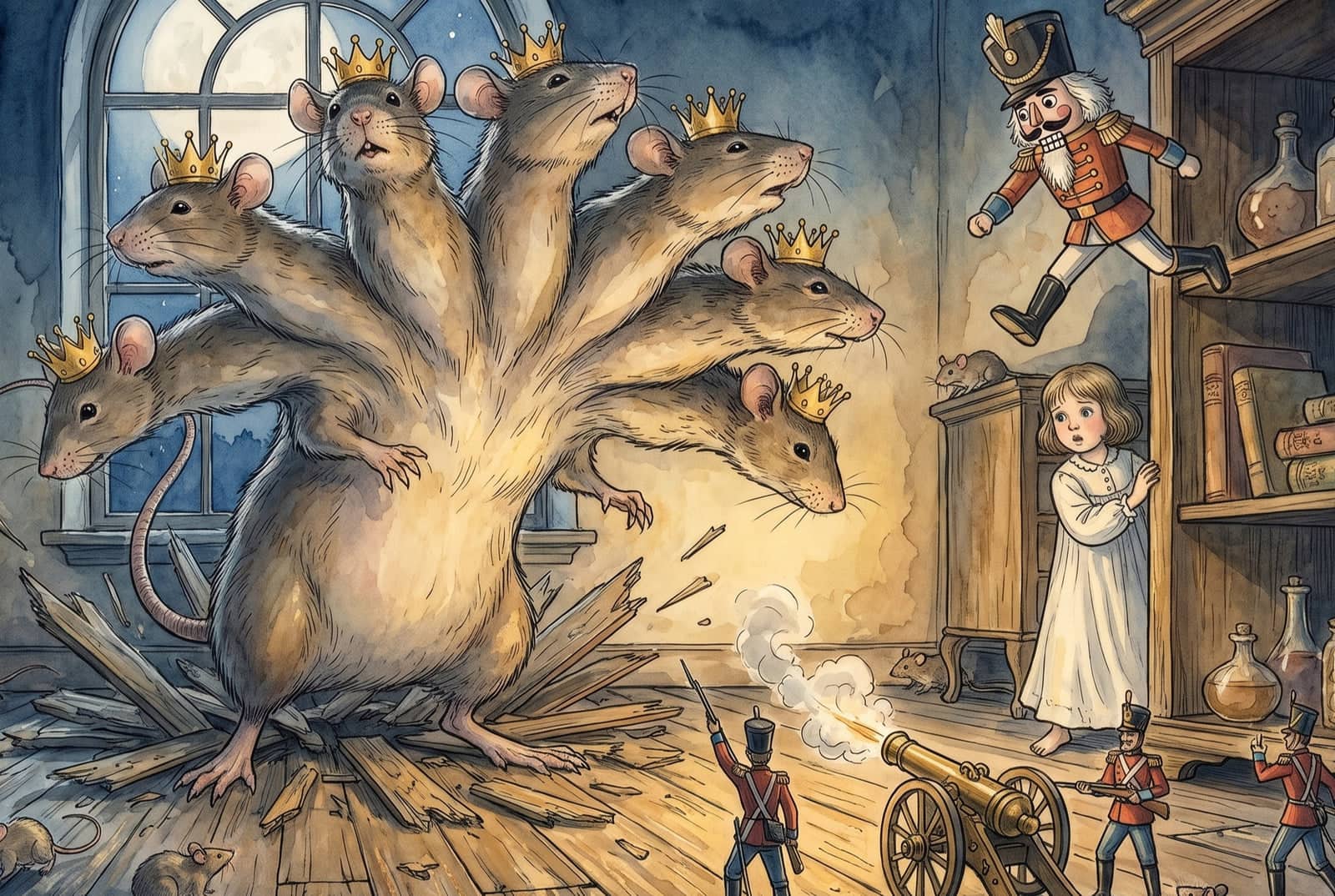
Still they came on, until the guns were taken and the hussars galloped home. Step by step the army fell back, until Nutcracker stood alone and the Mouse King came leaping at him.
“Oh, my poor Nutcracker!” cried Maria. Hardly knowing what she did, she pulled off her left shoe and threw it with all her strength straight at the Mouse King.
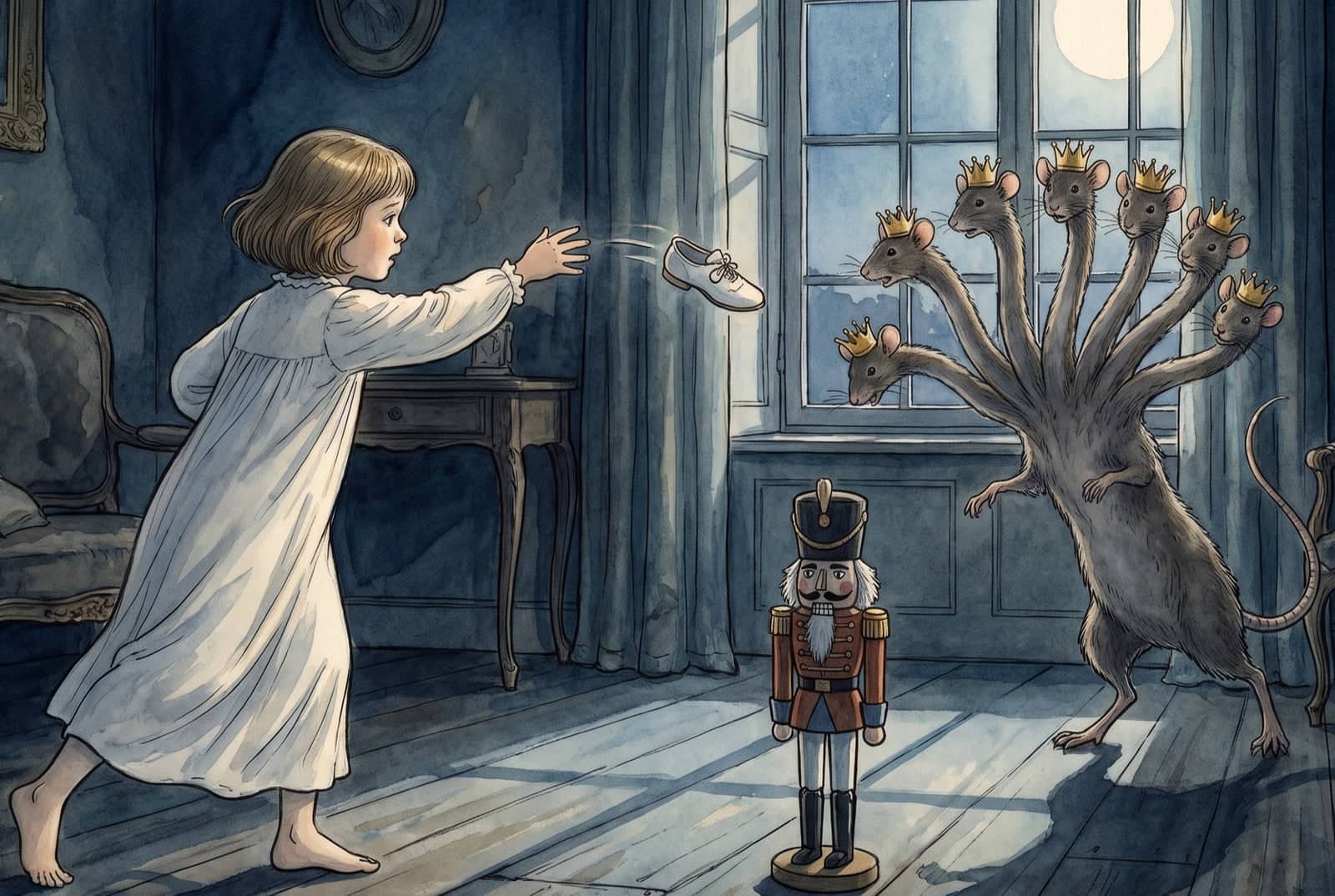
Everything scattered. The pain in her arm grew sharper, and Maria sank down on the floor in a faint.
She woke in her own bed. Her mother said that a stray mouse must have startled her, that she had cut her arm on the broken pane, and that Nutcracker stood safe.
One evening Godfather Drosselmeier came in, and Maria burst out, “I saw you sitting on the clock, covering it with your wings. Why did you not help us?”
Drosselmeier, the Counsellor, made a strange face and sang in a flat, grating voice:
Dickory, dickory, dock, hum and whirr, old clock. Pendulums must sway and swing, tired of ticking all the day. Bing and bang and ding and ring, and scare the Mouse King away.
“It is only my watchmaker’s song,” he said, laughing, and drew out of his pocket Nutcracker himself, with his teeth fastened in and his chin sound.
“You must admit, though, that he is not handsome. Shall I tell you how that ugliness came into his family? It is the story of the Hard Nut.”
Once there was a king whose daughter, Princess Pirlipat, was the loveliest child ever born. Yet six maids watched her cradle every night, each with a cat on her lap that had to be kept purring.
The reason was this. That winter the queen was chopping the fat for a great feast of sausages, and as it began to fry, a small voice spoke out of the hearth.
“Give me a little of the fat, sister. I am a queen too.”
It was Dame Mouserinks, who kept her court under the hearth and called herself queen of the mice. The queen made her welcome, but Dame Mouserinks’s seven sons came out after her and ate nearly all the fat.
At the feast the king wept into his plate and sobbed out three words: “Too little fat!” He swore revenge, and the court watchmaker, Christian Elias Drosselmeier, built traps that cost Dame Mouserinks her seven sons.
She left the palace, but first she rose out of the hearth beside the queen. “Take care,” she said, “that the queen of the mice does not bite your little princess in two.”
So the cats purred and the maids watched, until one night they fell asleep. When they started up, a great mouse stood at the cradle, and disappeared through a hole in the floor.
Pirlipat was alive, but she was not the same. A heavy head sat on a thin little body, her eyes were green and staring, and her mouth stretched from ear to ear.
The king gave the watchmaker four weeks to make her beautiful again. Drosselmeier learned only one thing: the changed child was content all day, so long as she had nuts to crack.
So he and the court astronomer read her stars at midnight, until at last it came clear. Pirlipat would be herself again if she ate the kernel of the nut Crackatook.
But its shell was so hard that even a cannon, wheeled over it, left it unbroken, and it had to be cracked before the princess by a young man who had never shaved and never worn boots, who must then walk seven steps backwards with his eyes shut.
They searched the world for fifteen years and found nothing, until Drosselmeier grew homesick, and the astronomer said they might as well look in Nuremberg as anywhere.
There lived Drosselmeier’s brother, who threw his hat in the air at the news. Years before he had bought a gilded nut, and under the gold the word Crackatook stood on the shell.
The brother had a son who had never shaved and never worn boots, and who cracked nuts so neatly that everybody called him the handsome Nutcracker. They fastened a stout wooden pigtail to his jaw and took him to the palace. The king had promised that whoever cracked the nut should marry the princess and be king after him.
Young Drosselmeier put the nut between his teeth, pulled at his pigtail, and crack, the shell broke in pieces. He handed the kernel to the princess and shut his eyes, and she swallowed it and stood there lovely again.
The court danced for joy, and in all the noise the young man counted his steps backwards. At the seventh step Dame Mouserinks came squeaking out of the floor, and he stumbled over her.
When he stood up he was changed. His head had grown huge and his body small, his mouth stretched from ear to ear, and a narrow wooden cloak hung down his back to work his jaw.
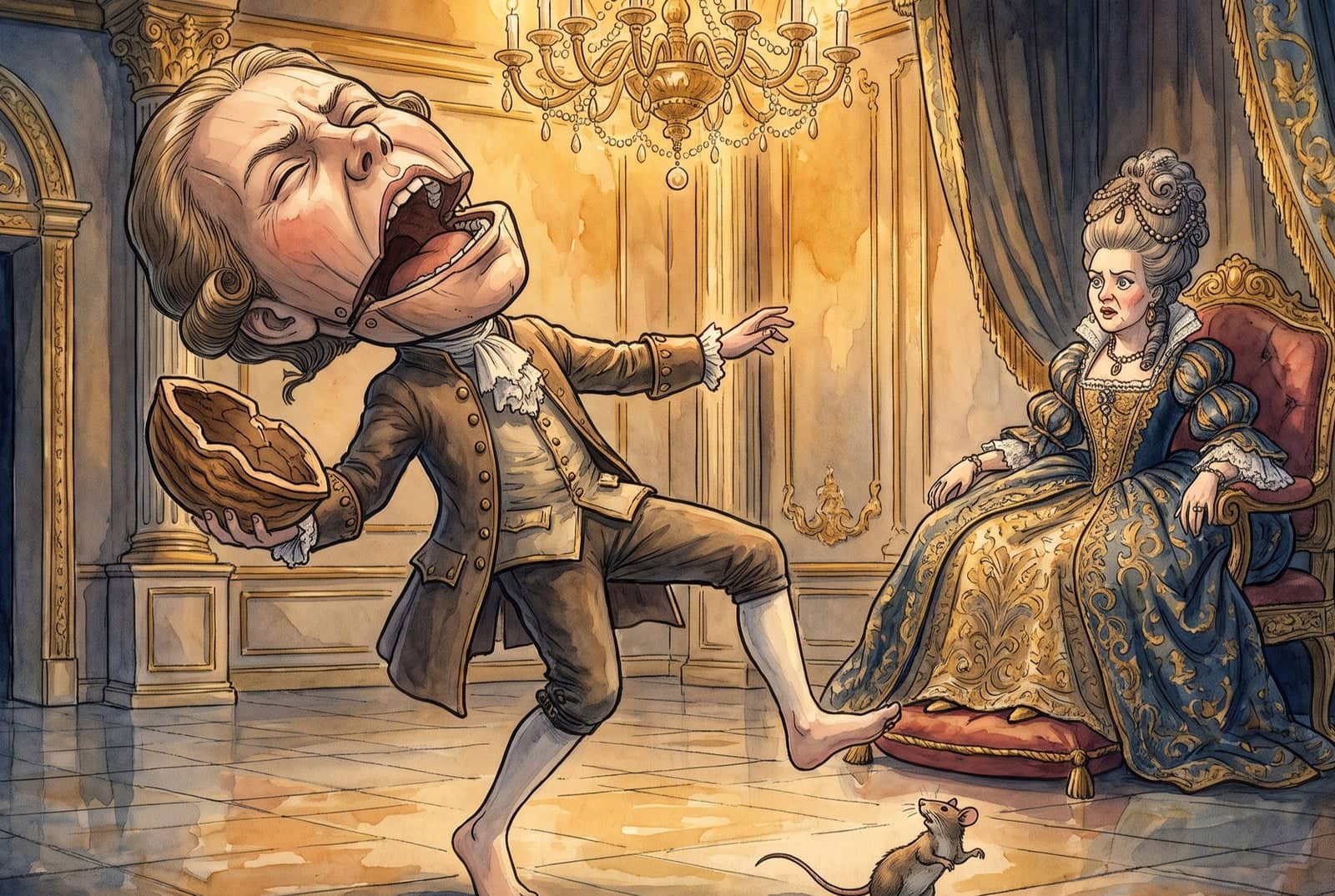
Dame Mouserinks lay where she had fallen. She whispered, in a small, spiteful voice:
Crackatook, hard nut, hard nut, by you I come to die. My son who wears the seven crowns will bite him by and by.
The princess would not even look at the young man who had saved her. “Take the ugly Nutcracker away,” she cried, and he was put out of the door. The watchmaker and the astronomer were banished forever.
But the astronomer read the stars once more. The young man would be a king in spite of his shape, and his own face would come back to him when Dame Mouserinks’s last-born son, the one with seven heads, fell by his hand, and a girl loved him although he was ugly.
“And that,” said Godfather Drosselmeier, “is the story of the Hard Nut, and that is why nutcrackers are ugly.”
When Maria was well again she stood before the glass case, and she knew. Her Nutcracker was young Drosselmeier, and the watchmaker in the story was her godfather.
“You cannot speak to me,” she said, “but I know that you understand me, and you may depend upon my help.”
Nutcracker did not stir. Yet a small sigh went through the case, and a voice rang out like a little bell:
Maria mine, I will be yours, and you be mine, Maria mine.
When she asked her godfather why he would not help his nephew, her mother and Fritz laughed. But the Counsellor said softly, “I cannot save him, dear Maria. You alone can. Be brave and be true.”
Not long after, she woke at midnight. The Mouse King came out of a hole in the wall and sprang on the little table by her bed.
Sugarplums, gingerbread, give them to me, little thing, little thing, or you will see: I will bite your Nutcracker, bite him in two!
She told nobody, for nobody would have believed her. That evening she laid her sugarplums and gingerbread before the glass case, and by morning they were crumbs.
The next night he came again.
Sugar dolls, chocolate men, give them to me, little thing, little thing, or you will see: I will bite your Nutcracker, bite him in two!
Maria had sugar shepherds and milk-white lambs, and a little red-cheeked baby she loved best of all. She kissed them one by one and set them down, and by morning they were bitten to pieces.
On the third night he squeaked close against her ear.
Picture books, Christmas frock, give them to me, little thing, little thing, or you will see: I will bite your Nutcracker, bite him in two!
In the morning Maria wept before the case. “Dear Master Drosselmeier, when I have given him everything, he will ask for me instead of you.”
Then she saw the dark mark the battle had left on Nutcracker’s neck. She rubbed it with her handkerchief, and he grew warm in her hand and began to move.
“Dearest Miss Stahlbaum,” he whispered, with great effort, “no picture books, no Christmas frock. Get me a sword. A sword.” And then he was still again.
Maria asked Fritz. He had lately pensioned off a colonel of cuirassiers, and he buckled the colonel’s silver sabre round Nutcracker.
Toward midnight there was a clashing in the sitting room, one shrill squeak, and then quiet. Then somebody knocked at Maria’s door, and there knelt Nutcracker, his sword in his hand.
“You alone gave this arm its courage,” he said. “The Mouse King is beaten. Take the tokens of his defeat from a knight who is yours until death.” And he gave her the seven crowns.
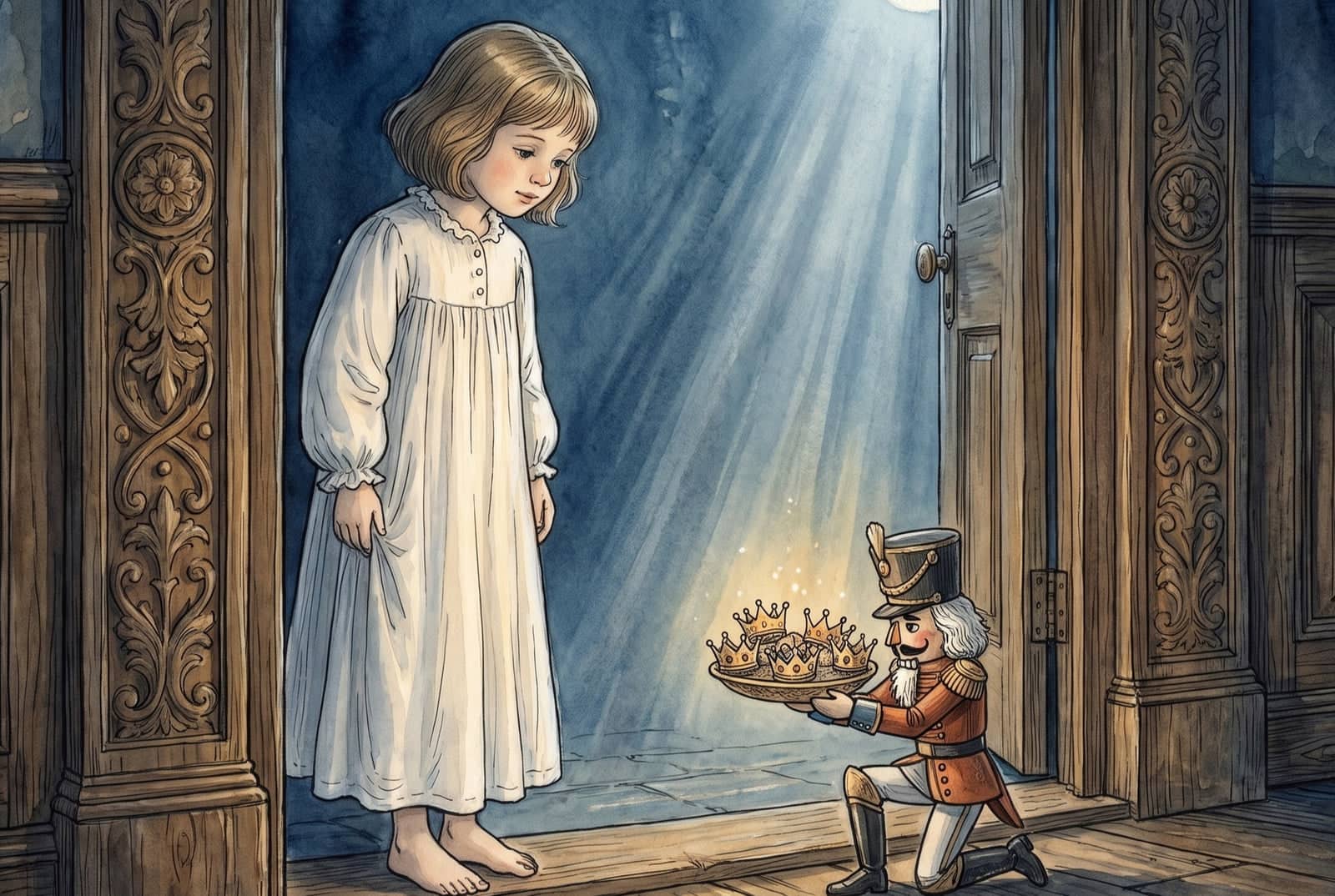
“Now, if you would follow me a few steps, I could show you the most beautiful things in the world.”
He led her to the old wardrobe and pulled the tassel of her father’s traveling coat, and a stair of cedar wood came sliding out of the sleeve.
She climbed through the sleeve and out on a sweet-smelling meadow, where the air turned rose-colored. Silver swans sang on Rose Lake, and two dolphins drew Maria and Nutcracker across it to the capital, Confectionville, where the roofs were crowns and the gate was built of macaroons. Beyond the city stood Marchpane Castle.
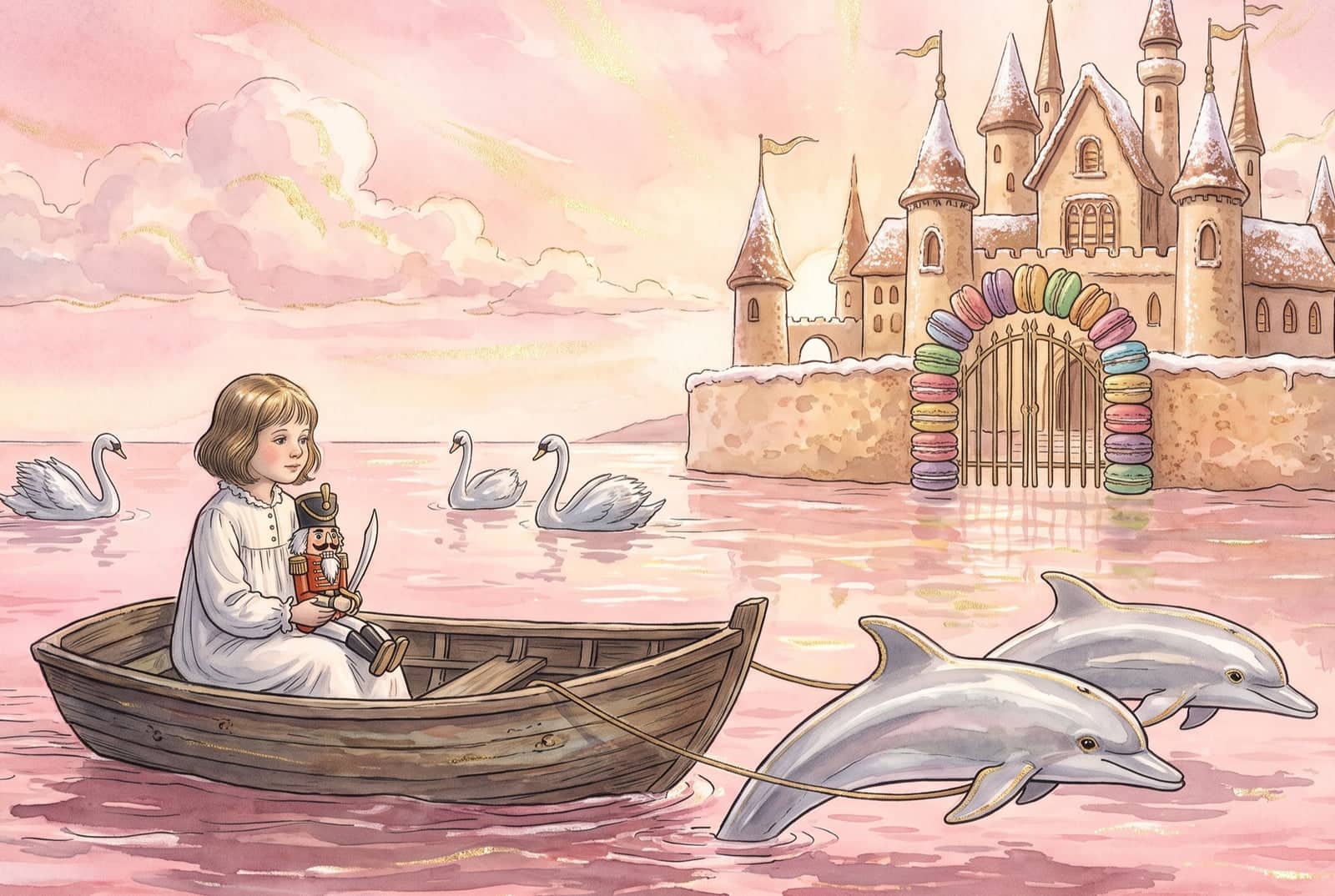
Nutcracker’s four sisters ran out and threw their arms round his neck, and he told them that Maria had saved his life.
Little by little his voice grew fainter, and a silver mist came up, and Maria felt herself rising, higher and higher.
Then, prr, puff, she fell from an immense height and opened her eyes in her own bed. “You have had a beautiful dream,” said her mother, when Maria had told her everything.
So Maria fetched the seven crowns out of her box. They were worked so finely that no human hand could have made them, and still her father would not believe her.
Then Godfather Drosselmeier came in, and as soon as he saw the crowns he laughed. “Stupid pack! Stupid pack!” he cried. “Those are the crowns I wore on my watch chain years ago.”
But when she begged him to tell them that her Nutcracker was his nephew, his face went dark and grave, and he only muttered, “Stupid pack! Stupid pack!”
“Once and for all, put this nonsense out of your head,” said her father. “If I hear it again, I shall throw the ugly Nutcracker out of the window.”
So Maria said no more, though she thought of the kingdom all the more. One day, while the Counsellor was mending a clock, she sat looking at Nutcracker, and the words slipped out before she knew it.
“Dear Master Drosselmeier, if you were really alive, I would not be like Princess Pirlipat. I would never turn away from you because you had lost your good looks for my sake.”
“Stupid pack! Stupid pack!” cried the Counsellor. There was a clap and a knock so loud that Maria slipped off her chair in a faint.
When she opened her eyes her mother was bending over her. “Here is Godfather Drosselmeier’s nephew, come all the way from Nuremberg.”
There stood a well-made young man in a red coat trimmed with gold, with a sword that flashed like jewels, and he had brought Maria the very sugar figures the Mouse King had bitten.
At table he cracked the hardest nuts for the whole company, and afterwards, beside the glass case, he knelt before Maria.
“Dearest Miss Stahlbaum, you see at your feet the Drosselmeier whose life you saved on this spot. You said you would not turn away from me for being ugly, and in that moment I became myself again.”
“Share my crown and my kingdom, and rule with me in Marchpane Castle, for there I am king still.”
Maria raised him up. “You are a kind, good young man,” she said, “and since you rule over such a lovely country, I will be your bride.”
A year and a day later he came for her in a golden coach drawn by silver horses, and two-and-twenty thousand shining figures danced at the wedding.
And Maria is queen to this day of a country where you may see sparkling Christmas woods and clear marchpane castles and all the most wonderful things there are, if only you have the eyes for them.
Retold by Talerie from Nutcracker and Mouse-King (opens in a new window) Public domain Copy this text, adapt it, use it however you like. A link back to Talerie is appreciated but never required. CC0 1.0 (opens in a new window)