 Original
The Snow Queen
68 min readages 8 and uptalerie.com/en/tales/the-snow-queen-original
A splinter of a goblin’s mirror lodges in Kay’s eye and heart, and the Snow Queen carries him off in her white sleigh. Gerda follows him to the frozen halls of the ice palace, where her warm tears melt the ice from his heart, and the two children walk home hand in hand into the spring.
The First Story: The Mirror and the Splinters
Now then, let us begin. When we come to the end of this story we shall know more than we know now, for there was once a wicked goblin, one of the very worst of them, for he was the devil himself. One day he was in a splendid mood, because he had made a mirror with a strange power in it. Everything good and beautiful that was reflected in that mirror shrank away almost to nothing, while everything worthless and ugly stood out and grew worse than it had been. The loveliest landscapes looked like boiled spinach in it, and the best of people turned hideous, or stood on their heads with no bodies at all. Their faces were twisted so that nobody could recognize them, and if a person had a single freckle you could be sure it would spread over the nose and mouth together.
That was tremendously amusing, said the devil. And when a good and holy thought passed through anyone’s mind, a grin appeared in the mirror, and the devil had to laugh out loud at his clever invention.
Everyone who went to the goblin school, for he kept a school for goblins, told the whole world that a wonder had happened. Now at last, they said, people could see what the world and the human race really looked like. They ran about everywhere with the mirror, until there was not a country left and not a person left who had not been seen crooked in it. Then they wanted to fly up to heaven itself, to make fun of the angels and of God. The higher they flew with the mirror, the harder it grinned, and they could scarcely hold on to it. Higher and higher they flew, nearer to God and the angels, and then the mirror shook so terribly in its grinning that it slipped out of their hands and fell to the earth, where it broke into hundreds of millions and billions of pieces, and more pieces still.
And now it did far more harm than before. Some of the splinters were hardly as big as a grain of sand, and these flew out into the wide world, and wherever one of them got into a person’s eye it stayed there. From that hour the person saw everything crookedly, or had eyes only for what was wrong with a thing, for every little splinter kept the same power the whole mirror had held. A few people even got a splinter into the heart, and that was truly dreadful, for the heart turned into a lump of ice.
Some of the pieces were so big that they were used for windowpanes, but it was no good looking at your friends through those. Other pieces were made into spectacles, and it went badly when people put such glasses on in order to see clearly and to judge fairly. The evil one laughed until his belly shook, it tickled him so pleasantly. But out in the air little splinters of glass were still flying about. Now we shall hear what happened.
The Second Story: A Little Boy and a Little Girl
In the great town, where there are so many people and so many houses that there is not room enough for everybody to have a little garden, and where most people have to be content with flowers in flowerpots, there lived two poor children who had a garden a little larger than a flowerpot. They were not brother and sister, but they were as fond of each other as if they had been.
Their parents lived directly opposite one another, in two attic rooms. Where the roof of one house met the roof of the next, and the gutter ran along between them, there was a little window in each house, and you had only to step across the gutter to get from one window to the other.
Outside each window the parents kept a big wooden box, and in the boxes grew the kitchen herbs they needed, and a little rose tree; there was one in each box, and they grew beautifully. Then it came into the parents’ heads to set the boxes across the gutter, so that they reached almost from one window to the other and looked very much like two banks of flowers. Sweet peas hung down over the edges, and the rose trees put out long branches that twined about the windows and bent toward each other, until it was almost a triumphal arch of leaves and blossoms. The boxes were very high, and the children knew they must not climb up on them, but they were often allowed to step out and sit on their little stools under the roses, and there they played wonderfully well.
In winter that pleasure came to an end. The windows were often frozen right over, but then the children warmed copper pennies on the stove and held a warm penny against the frosted pane, and that made a lovely peephole, so round, so round, and behind it shone a gentle, friendly eye, one at each window. They were the little boy and the little girl. His name was Kay and hers was Gerda. In summer they could reach each other in a single step; in winter they had to go all the way down one staircase and all the way up the other, while the snow blew outside.
“Those are the white bees swarming,” said the old grandmother one snowy day.
“Do they have a queen bee too?” asked the little boy, for he knew that the real bees have one.
“They do,” said the grandmother. “She flies where the swarm is thickest. She is the biggest of them all, and she never stays still on the ground; she flies up again into the black cloud. Many a midnight she flies through the streets of the town and looks in at the windows, and then they freeze in such a strange way, as if flowers were growing on them.”
“Yes, we have seen that,” said both children, and now they knew it was true.
“Can the Snow Queen come in here?” asked the little girl.
“Just let her come,” said the boy. “I will put her on the warm stove, and she will melt.”
But the grandmother smoothed his hair and told other stories.
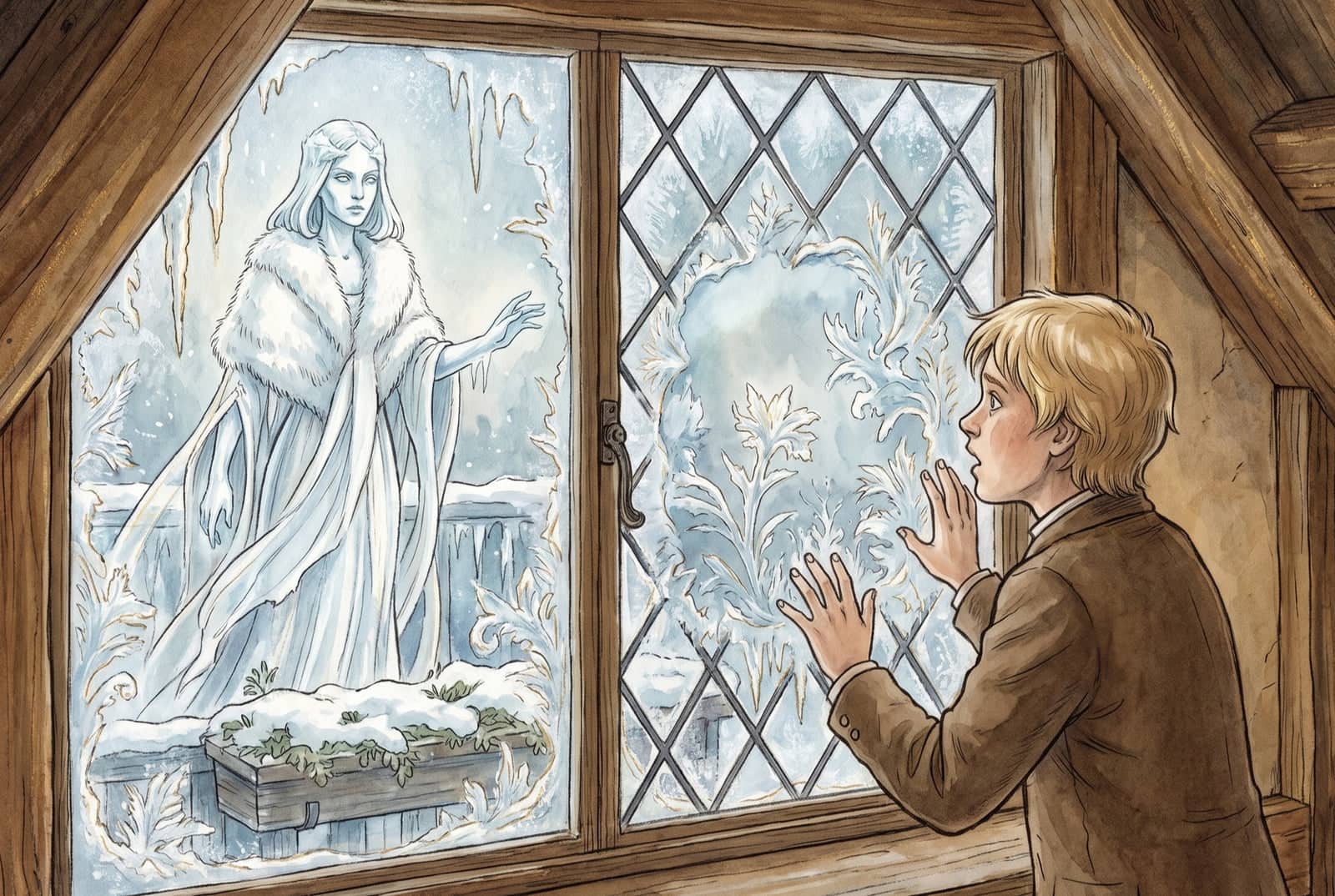
One evening, when little Kay was at home and half undressed, he climbed on the chair by the window and looked out through the little hole. A few snowflakes were falling, and one of them, the largest, settled on the edge of one of the flower boxes. That snowflake grew and grew, until at last it became a woman, dressed in the finest white gauze, which seemed to be made of millions of starry flakes. She was beautiful and delicate, but she was of ice, of dazzling, glittering ice, and yet she was alive. Her eyes shone like two clear stars, but there was no peace and no rest in them. She nodded toward the window and beckoned with her hand. The little boy was frightened and jumped down from the chair, and just then it seemed as though a great bird flew past the window outside.
The next day brought a clear frost, and then the spring came. The sun shone, the green buds came out, the swallows built their nests, the windows were opened, and the two children sat once more in their little garden high up in the gutter, above all the other floors.
How gloriously the roses bloomed that summer. The little girl had learned a hymn, and there were roses in it, and when she thought of roses she thought of their own. She sang it to the little boy, and he sang it with her.
Roses bloom and fade away,we shall see the Christ-child one day.
And the little ones held each other by the hand, and kissed the roses, and looked into God’s bright sunshine and spoke to it as if the Christ-child were there. What glorious summer days those were, and how good it was out among the fresh rose trees, which seemed as though they would never leave off blooming.
Kay and Gerda sat looking at a picture book of animals and birds, and it was just then, as the clock in the great church tower struck five, that Kay cried, “Oh! Something stabbed me in the heart, and now something has flown into my eye.”
The little girl put her arm round his neck. He blinked; no, there was nothing to be seen.
“I think it is gone,” he said. But it was not gone. It was one of those grains of glass that had sprung from the mirror, the magic mirror we remember so well, the ugly glass that made everything great and good shrink small and ugly, while everything mean and bad stood out and every flaw in a thing was noticed at once. Poor Kay had a splinter of it right in his heart as well, and very soon that would be like a lump of ice. It did not hurt any more, but it was there.
“Why are you crying?” he asked. “It makes you look ugly. There is nothing the matter with me. Ugh!” he cried suddenly. “That rose there is worm-eaten, and look, this one is quite crooked. They are ugly roses when you come down to it. They are just like the box they stand in.” And he kicked the box with his foot and tore off the two roses.

“Kay, what are you doing?” cried the little girl, and when he saw how frightened she was, he tore off another rose and jumped in at his own window, away from dear little Gerda.
Afterwards, when she came with the picture book, he said it was for babies in swaddling clothes, and when the grandmother told stories he always came in with a “but.” If he could manage it, he would walk along behind her, put on a pair of spectacles and talk exactly as she did. He did it so well that people laughed. Soon he could imitate the speech and the walk of everybody in the street. Everything about them that was odd or unlovely, Kay knew how to copy, and people said, “That boy has a remarkable head on him.” But it was the glass that had gone into his eye and the glass that sat in his heart, and that was why he teased even little Gerda, who loved him with her whole heart.
His games were quite different now; they were very clever games. On a winter’s day when the snow was falling, he came out with a big magnifying glass, held out the blue tail of his coat and let the snowflakes fall on it.
“Look through the glass, Gerda,” he said, and every flake grew much bigger and looked like a splendid flower or a ten-pointed star. It was beautiful to see. “Look how cleverly it is made,” said Kay. “That is far more interesting than real flowers. There is not a single fault in them; they are perfectly regular. If only they did not melt.”
Soon afterwards Kay came in with big gloves and his sled on his back. He shouted into Gerda’s ear, “I have permission to go sledding in the great square, where the other boys play,” and off he went.
Over in the square the boldest boys often tied their sleds to a farmer’s cart and rode along with it a good stretch of the way. It was fine sport. While they were in the middle of their play, a big sleigh came by, painted all white, and in it sat somebody wrapped in a rough white fur with a rough white cap on his head. The sleigh drove twice round the square, and Kay quickly tied his own little sled to it, and away he went. It went faster and faster, straight into the next street. The driver turned round and nodded to Kay in a friendly way, as though they knew each other, and every time Kay wanted to untie his little sled the driver nodded again, and so Kay stayed where he was. They drove straight out through the town gate.
Then the snow began to fall so thickly that the little boy could not see his own hand in front of him, and still they drove on. He let go of the cord in a hurry, to get free of the big sleigh, but it was no use; his little sled hung fast and went on like the wind. He called out as loudly as he could, but nobody heard him, and the snow whirled about him, and the sleigh flew on. Now and then it gave a jump, as if it were going over ditches and hedges. He was very frightened. He wanted to say the Lord’s Prayer, but all he could remember was his multiplication tables.
The snowflakes grew bigger and bigger, until at last they looked like great white hens. All at once they sprang aside, the big sleigh stopped, and the person who was driving it stood up. The fur and the cap were made of nothing but snow. It was a lady, tall and slender and shining white. It was the Snow Queen.
“We have driven well,” she said, “but why are you shivering? Creep into my fur.” And she set him beside her in the sleigh and wrapped the fur about him. It was as if he were sinking into a snowdrift.
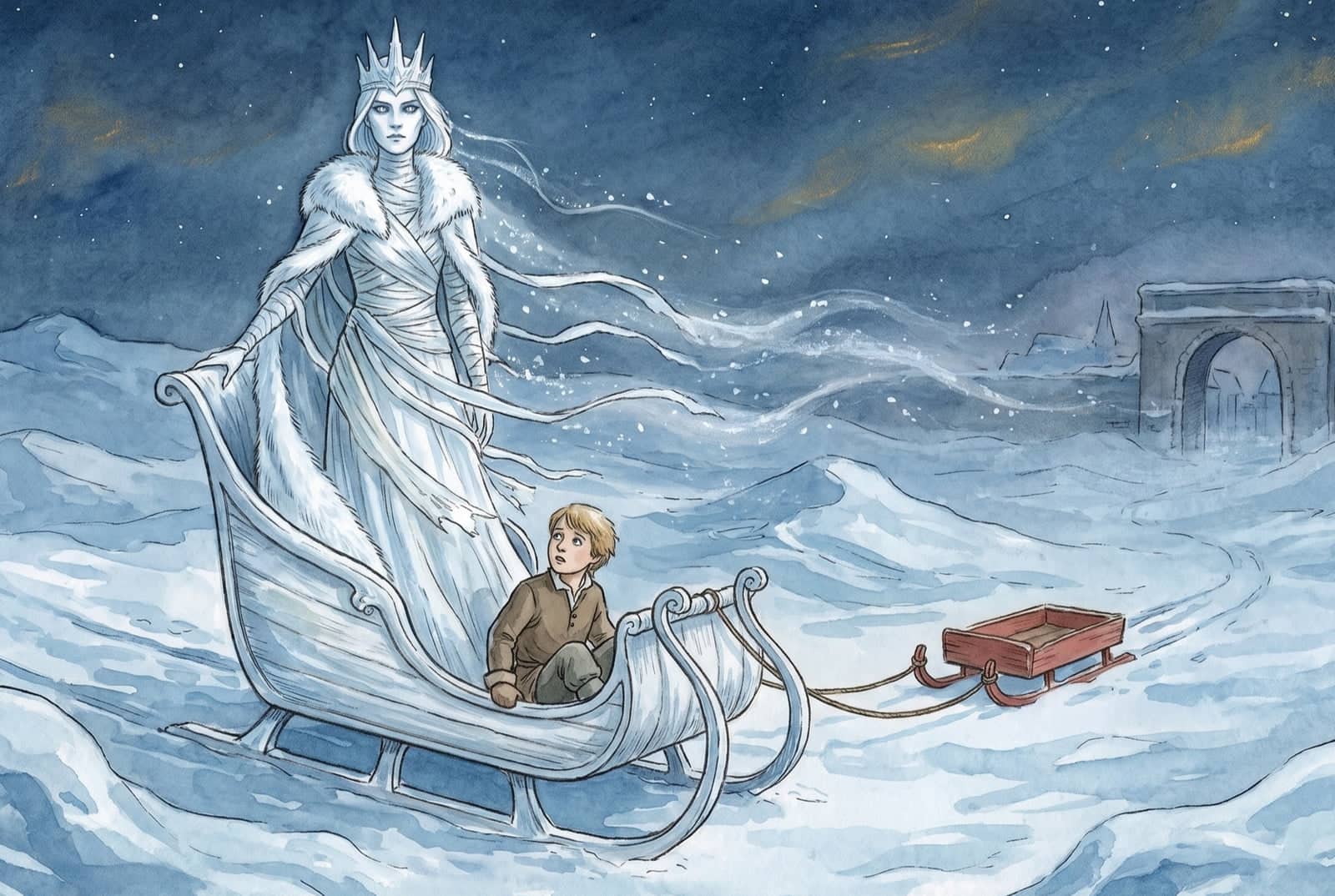
“Are you still cold?” she asked, and kissed him on the forehead. Oh, that was colder than ice. It went straight into his heart, which was already half a lump of ice, and he felt as though he were going to die, but only for a moment; then it did him good, and he no longer noticed the cold around him.
“My sled! Don’t forget my sled!” That was the first thing he thought of, and the sled was tied fast to one of the white hens, which flew along behind with the sled on its back. The Snow Queen kissed Kay once more, and by then he had forgotten little Gerda and the grandmother and everyone at home.
“Now you shall have no more kisses,” she said, “or I should kiss you to death.”
Kay looked at her. She was so beautiful; he could not imagine a wiser or a lovelier face. She did not seem to be made of ice now, as she had that evening outside the window when she beckoned to him. In his eyes she was perfect, and he felt no fear at all. He told her that he could do arithmetic in his head, and with fractions too, and that he knew how many square miles the country had and how many people lived in it. She only smiled, and then it seemed to him that what he knew was not so very much after all. He looked up into the wide sky, and she flew with him high onto the black cloud, and the storm whistled and roared as though it were singing old songs. They flew over forests and lakes, over sea and land; beneath them the cold wind whistled, the wolves howled, the snow crackled; above them flew the black screaming crows. But high overhead the moon shone great and clear, and Kay looked at it through the long, long winter night. By day he slept at the Snow Queen’s feet.
The Third Story: The Flower Garden of the Woman Who Could Do Magic
But how did little Gerda fare when Kay did not come back? Where had he gone? Nobody knew, nobody could say. The boys could only tell that they had seen him tie his sled to a great big sleigh that drove down the street and out through the town gate. Nobody knew where he had gone. Many tears were shed, and little Gerda cried long and bitterly. Then people said he was dead, that he had drowned in the river which ran close by the school. Oh, those were long, dark winter days.
Then the spring came with warmer sunshine.
“Kay is dead and gone,” said little Gerda.
“I don’t believe it,” said the sunshine.
“He is dead and gone,” she said to the swallows.
“We don’t believe it,” they answered, and in the end little Gerda did not believe it either.
“I will put on my new red shoes,” she said one morning, “the ones Kay has never seen, and then I will go down to the river and ask it about him.”
It was still very early. She kissed her old grandmother, who was asleep, put on the red shoes and went out all alone through the town gate to the river.
“Is it true that you have taken my little playmate away from me? I will give you my red shoes if you will give him back to me.”
And it seemed to her that the waves nodded in a strange way. So she took her red shoes, the dearest things she had, and threw them both into the river; but they fell close to the bank, and the little waves carried them back to her, as if the river would not take the dearest thing she had, because it did not have little Kay. Still, she thought she had not thrown the shoes far enough out, so she climbed into a boat that lay among the reeds, went right out to the far end of it and threw the shoes into the water from there. But the boat was not tied up, and the movement she made set it sliding away from the shore. She saw it and hurried to get out, but before she could reach the end, the boat was more than a yard from the land and drifting away faster and faster.
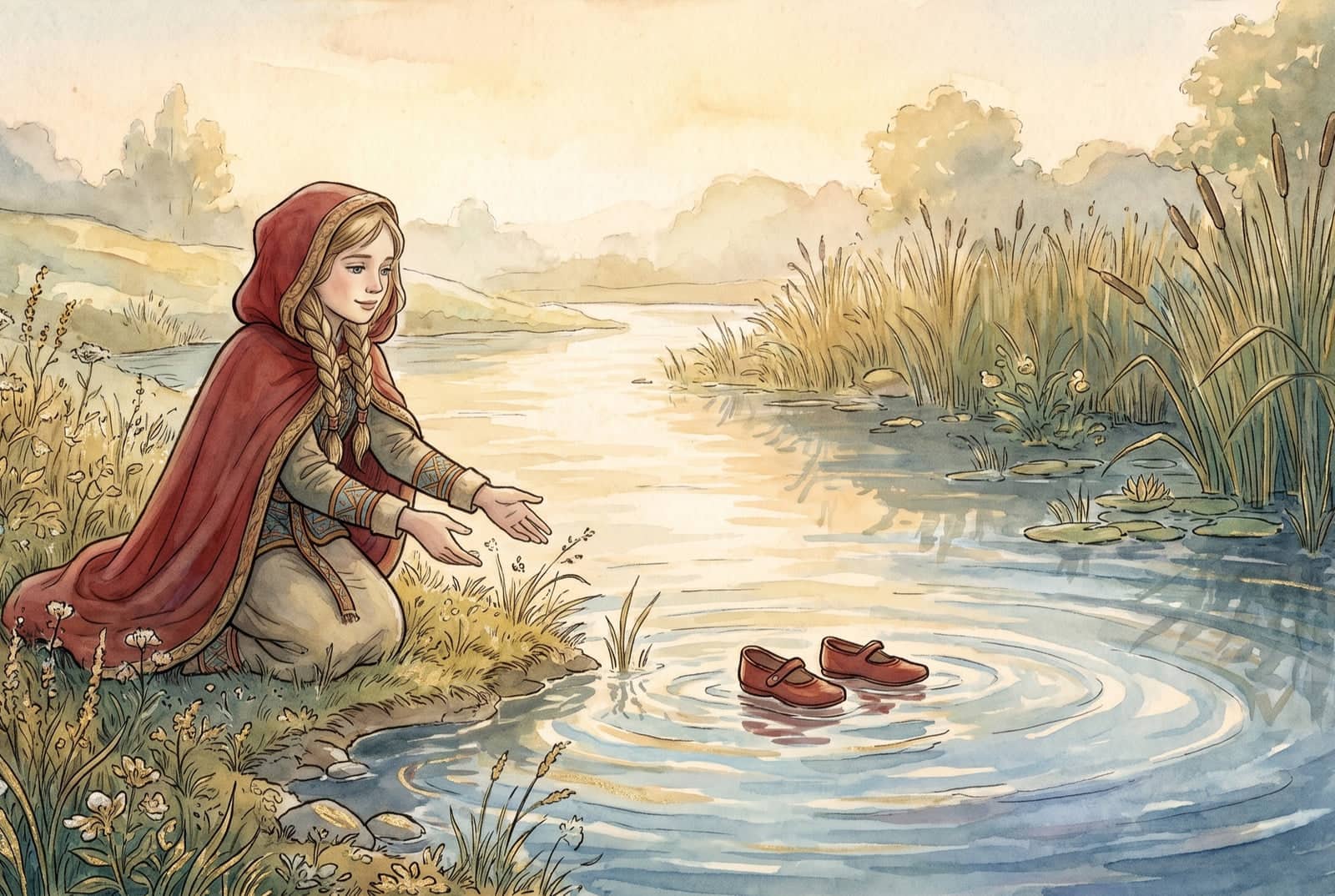
Then little Gerda was very frightened and began to cry, but nobody heard her except the sparrows, and they could not carry her ashore. They flew along the bank and sang, as if to comfort her, “Here we are! Here we are!” The boat drifted with the current, and little Gerda sat quite still in her stocking feet. Her little red shoes floated along behind, but they could not catch up with the boat, which went faster than they did.
It was pretty on both banks: lovely flowers, old trees, and slopes with sheep and cows. But not a single person was to be seen.
Perhaps the river is carrying me to little Kay, thought Gerda, and that cheered her. She sat up and looked for hours at the beautiful green banks. Then she came to a great cherry orchard, and in it stood a little house with strange red and blue windows. It had a thatched roof, and outside stood two wooden soldiers, who shouldered arms to everyone who sailed past.
Gerda called to them, for she thought they were alive, but of course they did not answer. She came quite close to them, for the river was driving the boat straight in toward the land.
Gerda called louder still, and then an old, old woman came out of the house, leaning on a crooked stick. She wore a big sun hat, and it was painted over with the loveliest flowers.
“You poor little child,” said the old woman. “However did you get out on the great rushing river and drift so far into the wide world?” And the old woman waded into the water, caught the boat with her stick, pulled it in to land and lifted little Gerda out.
Gerda was glad to be on dry ground again, though she was a little afraid of the strange old woman.
“Come and tell me who you are, and how you came here,” she said.
And Gerda told her everything, and the old woman shook her head and said, “Hm, hm.” And when Gerda had told it all and asked whether she had seen little Kay, the woman said that he had not come by, but that he would very likely come yet; Gerda was not to be sad, but to taste the cherries and look at the flowers, which were finer than any picture book, for every one of them could tell a story. Then she took Gerda by the hand, led her into the little house and shut the door.
The windows were set very high, and the panes were red, blue and yellow, so the daylight came in strangely, in all the colors at once. On the table stood the finest cherries, and Gerda ate as many of them as she liked, for that was allowed. While she ate, the old woman combed her hair with a golden comb, and the hair curled and shone a lovely yellow all round the little friendly face, which was so round and looked like a rose.
“I have longed for a dear little girl like you for a long time,” said the old woman. “Now you shall see how well we two will get on together.” And as she combed little Gerda’s hair, Gerda forgot little Kay more and more, for the old woman knew how to conjure. She was not a wicked witch, though; she conjured only a little, for her own pleasure, and she wanted very much to keep little Gerda.
So she went out into the garden and held her crooked stick out toward all the rose bushes, and however beautifully they were blooming, they all sank down into the black earth, and nobody could see where they had stood. The old woman was afraid that if Gerda saw roses she would think of her own, and then remember little Kay, and run away.
Now she led Gerda out into the flower garden. What a fragrance was there, and what a splendor. Every flower that anyone could think of, and for every season of the year, stood there in fullest bloom. No picture book could be brighter or lovelier. Gerda jumped for joy and played until the sun went down behind the tall cherry trees, and then she was given a beautiful bed with red silk pillows stuffed with violets, and there she slept and dreamed as sweetly as a queen on her wedding day.
The next day she could play with the flowers again in the warm sunshine, and so many days went by. Gerda knew every flower, and yet, many as they were, it seemed to her that one was missing, though which one she could not tell. Then one day she sat looking at the old woman’s sun hat with the painted flowers on it, and the loveliest of them all was a rose. The old woman had forgotten to wipe it off the hat when she conjured the real roses down into the earth. But that is how it goes when a person does not keep her thoughts together.
“What? Are there no roses here?” said Gerda, and she ran in among the beds and searched and searched. But there was not one to be found. Then she sat down and cried, and her tears fell just where a rose bush had sunk down, and when the warm tears wetted the earth, the bush shot up all at once, in bloom just as it had been when it sank. Gerda threw her arms round it and kissed the roses and thought of the glorious roses at home, and with them of little Kay.
“Oh, how long I have been kept here!” said the little girl. “I meant to look for little Kay. Don’t you know where he is?” she asked the roses. “Do you think he is dead?”
“He is not dead,” answered the roses. “We have been down in the earth. All the dead are there, and Kay was not among them.”
“Thank you,” said little Gerda, and she went to the other flowers and looked into their cups and asked, “Don’t you know where little Kay is?”
But every flower stood in the sun dreaming its own story or its own little fairy tale, and Gerda heard so many, many of them, and not one knew anything about Kay.
And what did the tiger lily say?
“Do you hear the drum? Boom, boom. There are only two notes, always boom, boom. Listen to the women singing their song of mourning; listen to the call of the priests. In her long red robe the Hindu wife stands on the pile of wood; the flames leap up around her and around her dead husband. But the Hindu wife is thinking of the living man there in the circle, of him whose eyes burn hotter than the flames, of him whose burning eyes touch her heart more than the fire that will soon burn her body to ashes. Can the flame of the heart die out in the flame of the pyre?”
“I don’t understand that at all,” said little Gerda.
“That is my story,” said the tiger lily.
And what does the morning glory say?
“Above the narrow footpath hangs an old knight’s castle. Thick ivy climbs up the crumbling red walls, leaf upon leaf, all round the balcony, and there stands a beautiful girl. She leans out over the railing and looks along the road. No rose hangs fresher on the branch than she; no apple blossom, when the wind carries it off the tree, floats more lightly than she does. How the splendid silk gown rustles as she bends and says, ‘Is he not coming yet?’”
“Is it Kay you mean?” asked little Gerda.
“I am only speaking of my story, my dream,” answered the morning glory.
And what does the little snowdrop say?
“Between two trees a long board hangs on ropes. It is a swing. Two pretty little girls sit on it, with dresses white as snow and long green silk ribbons fluttering from their hats, and they swing. Their brother, who is bigger than they are, stands up in the swing with one arm round the rope to hold himself steady, for in one hand he has a little bowl and in the other a clay pipe, and he is blowing soap bubbles. The swing goes up, and the bubbles rise with it in beautiful changing colors; the last one still hangs from the stem of the pipe and sways in the wind. The swing goes up. The little black dog, light as the bubbles, rises on his hind legs and wants to come into the swing too; up it goes, the dog falls, and he barks and is angry. They tease him, and the bubbles burst. A swinging board, a bursting picture of foam: that is my song.”
“It may well be pretty, what you are telling me, but you say it so sadly, and you do not mention little Kay at all.”
And what do the hyacinths say?
“There were three beautiful sisters, fine and delicate. The dress of the first was red, the dress of the second was blue, the dress of the third was white. Hand in hand they danced beside the still lake in the clear moonlight. They were not elves; they were human children. The air smelled so sweet there, and the girls disappeared into the wood; the fragrance grew stronger. Three coffins, with the beautiful girls lying in them, glided out of the thicket of the wood and across the lake. The fireflies flew shining round about them, like little floating lights. Are the dancing girls asleep, or are they dead? The scent of the flowers says they are dead. The evening bell tolls for them.”
“You make me quite sad,” said little Gerda. “Your scent is so strong that it makes me think of the dead girls. Oh, is little Kay really dead? The roses have been down in the earth, and they say no.”
“Ding, dong,” rang the hyacinth bells. “We are not ringing for little Kay; we do not know him. We only sing our own song, the only one we know.”
And Gerda went to the buttercup, shining out from among the bright green leaves.
“You are a little bright sun,” said Gerda. “Tell me, do you know where I can find my playmate?”
And the buttercup shone so prettily and looked back at Gerda. What song could the buttercup sing? It was not about Kay either.
“In a little courtyard the dear sun shone warm on the first day of spring. Its rays slid down the white wall of the house next door, and close by grew the first yellow flower of the year, shining like gold in the warm sunbeams. The old grandmother sat outside in her chair, and her granddaughter, a poor and pretty servant girl, came home from a short visit and kissed her. There was gold, heart’s gold, in that blessed kiss. Gold on the lips, gold in the ground, gold in the morning hour. There, that is my little story,” said the buttercup.
“My poor old grandmother,” sighed Gerda. “She is surely longing for me and grieving for me, just as she grieved for little Kay. But I shall soon be home again, and I shall bring Kay with me. It is no use asking the flowers; they know only their own song and can tell me nothing.”
And then she tucked up her little dress so that she could run faster; but the narcissus struck against her leg as she jumped over it, and she stopped and looked at the tall yellow flower and said, “Perhaps you know something?” And she bent right down to the narcissus. And what did it say?
“I can see myself! I can see myself!” said the narcissus. “Oh, how sweet I smell. Up in a little attic room a young dancer stands, half dressed. She stands now on one leg, now on both; she treads the whole world under her feet; she is nothing but an illusion. She pours water out of the teapot onto a piece of cloth she is holding; it is her bodice. Cleanliness is a fine thing. The white dress hangs on the hook; that has been washed in the teapot too, and dried on the roof. She puts it on and ties the saffron-yellow scarf round her neck, and now the dress looks whiter still. Point the toe! See how she stands on her one stem. I can see myself! I can see myself!”
“I don’t care about that at all,” said Gerda. “You needn’t tell me such things.” And she ran to the far end of the garden.
The door was locked, but she pushed at the rusty latch until it gave way. The door flew open, and little Gerda ran out into the wide world with bare feet. She looked back three times, but nobody was following her. At last she could run no further and sat down on a big stone, and when she looked about her, the summer was over. It was late autumn. You could not tell that at all in the beautiful garden, where there was always sunshine and always flowers of every season.
“Goodness, how late I am,” said little Gerda. “Autumn has come. Now I must not rest.” And she got up to go on.
Oh, how sore and tired her little feet were. All around her it looked cold and raw. The long willow leaves were quite yellow, and the dew dripped down like water; one leaf fell after another. Only the blackthorn still bore fruit, and the sloes were so sour that they set her teeth on edge. Oh, how gray and heavy it was out in the wide world.
The Fourth Story: The Prince and the Princess
Gerda had to rest again, and there on the snow, right opposite the place where she sat, a big crow came hopping. It had sat a long while looking at her and wagging its head, and now it said, “Caw, caw. Good day, good day.” It could not say it any better than that, but it meant well by the little girl, and it asked where she was going all alone in the wide world. The word alone Gerda understood very well, and she felt how much lay in it, so she told the crow her whole life and everything that had happened to her, and asked whether it had seen little Kay.
And the crow nodded very thoughtfully and said, “That might be. That might be.”
“What? Do you think so?” cried the little girl, and she kissed the crow and nearly hugged it to death.
“Gently, gently,” said the crow. “I think I know. I believe it may be little Kay, but he has certainly forgotten you by now for the princess.”
“Does he live with a princess?” asked Gerda.
“Yes, listen,” said the crow. “But it is so hard for me to speak your language. If you understood crow talk, I could tell it better.”
“No, I have never learned it,” said Gerda, “but my grandmother understood it, and she could speak it too. If only I had learned it.”
“No matter,” said the crow. “I will tell it as well as I can, though it will come out badly.” And then it told what it knew.
“In the kingdom where we are sitting there lives a princess who is quite uncommonly clever. She has read all the newspapers in the world and forgotten them again, she is so clever. The other day she was sitting on her throne, and that is not so pleasant a thing as people say, and she began to sing a song, and the song went, ‘Why should I not be married?’ Well, there is something in that, she thought, and so she meant to marry; but she wanted a husband who knew how to answer when he was spoken to, not one who only stood there and looked grand, for that is so dull. So she had all the ladies of the court called together at the beat of a drum, and when they heard what she wanted they were delighted. ‘We like that,’ they said. ‘We were thinking about it ourselves only the other day.’ You may believe every word I tell you,” added the crow, “for I have a tame sweetheart who goes about freely in the palace, and she told me all of it.”
The crow’s sweetheart was a crow too, of course, for one crow always seeks another.
“The newspapers came out at once with a border of hearts round them and the princess’s initials among the hearts, and you could read in them that any young man who was good-looking was free to come up to the palace and speak with the princess, and that the one who spoke as if he were at home there, and who spoke best of all, that one the princess would take for a husband. Yes, yes,” said the crow, “you may believe me; it is as true as I sit here. People came streaming in. There was a crowding and a running, but nobody had any luck, either on the first day or the second. They could all talk well enough while they were out in the street, but when they came in at the palace gate and saw the guards in silver and the footmen in gold all the way up the stairs and the great lighted halls, they were bewildered. And when they stood before the throne where the princess sat, they could think of nothing to say but the last word she had spoken herself, and she had no wish at all to hear that over again. It was as if the people in there had swallowed something that put them to sleep, until they came out into the street again, and then they could talk. There was a line of them all the way from the town gate to the palace. I was in there myself to see it,” said the crow. “They grew hungry and thirsty, but in the palace they did not get so much as a glass of water. A few of the wisest had brought bread and butter with them, but they did not share with their neighbors. They thought: let him look hungry, and then the princess will not take him.”
“But Kay, little Kay!” asked Gerda. “When did he come? Was he among the crowd?”
“Wait, wait! Now we are coming to him. It was on the third day, and a little fellow came marching cheerfully up to the palace, with no horse and no carriage. His eyes shone like yours; he had beautiful long hair, but his clothes were poor.”
“That was Kay!” Gerda shouted for joy. “Oh, then I have found him!” And she clapped her hands.
“He had a little knapsack on his back,” said the crow.
“No, that was surely his sled,” said Gerda, “for he went away with his sled.”
“That may well be,” said the crow. “I did not look at it very closely. But I know from my tame sweetheart that when he came in at the palace gate and saw the guards in silver and the footmen in gold up the stairs, he was not the least bit put out. He nodded to them and said, ‘It must be dull work standing on the stairs. I would rather go inside.’ The halls blazed with lights. Privy councillors and excellencies walked about barefoot carrying golden dishes; it was enough to make anyone solemn. His boots creaked terribly loudly, and still he was not afraid.”
“That is certainly Kay,” said Gerda. “I know he had new boots. I have heard them creak in grandmother’s room.”
“Creak they did,” said the crow. “And in he went, bold as you please, straight to the princess, who was sitting on a pearl as big as a spinning wheel. All the ladies of the court with their maids and their maids’ maids, and all the gentlemen with their servants and their servants’ servants, who each had a boy of his own, stood ranged all round; and the nearer they stood to the door, the prouder they looked. The servant’s boy, who always goes about in slippers, you hardly dare look at, he stands so proudly in the doorway.”
“That must be dreadful,” said little Gerda. “And did Kay win the princess?”
“If I had not been a crow, I would have taken her myself, engaged though I am. They say he spoke as well as I do when I speak crow talk; that is what my tame sweetheart told me. He was cheerful and charming; he had not come to court the princess at all, but only to hear her wisdom, and he thought well of that, and she thought well of him.”
“Yes, certainly, that was Kay,” said Gerda. “He was so clever; he could do arithmetic in his head with fractions. Oh, won’t you take me into the palace?”
“That is easily said,” answered the crow, “but how shall we do it? I will talk it over with my tame sweetheart; she will be able to advise us. For I must tell you that a little girl like you never gets permission to go in.”
“Yes, I shall get it,” said Gerda. “When Kay hears that I am here, he will come straight out and fetch me.”
“Wait for me over there by the railing,” said the crow, and it wagged its head and flew away.
It was late in the evening before the crow came back. “Caw, caw,” it said. “She sends you her best greetings, and here is a little loaf of bread for you. She took it from the kitchen; there is bread enough there, and you must be hungry. It is not possible for you to come into the palace by the front way, for you are barefoot, and the guards in silver and the footmen in gold would never allow it. But don’t cry; you shall get up there all the same. My sweetheart knows a little back stair that leads to the bedchamber, and she knows where to find the key.”
And they went into the garden, into the great avenue where one leaf was falling after another, and when the lights in the palace went out, one after the other, the crow led little Gerda to a back door that stood ajar.
Oh, how Gerda’s heart beat with fear and longing. It was just as if she were about to do something wrong, and all she wanted was to know whether it was little Kay. Yes, it must be he. She could see his clever eyes and his long hair so vividly; she could see how he used to smile at her when they sat under the roses at home. He would surely be glad to see her, and glad to hear what a long way she had come for his sake, and to know how sad they had all been at home when he did not come back. Oh, it was a fear and a joy together.
Now they were on the stairs. A little lamp was burning on a cupboard, and in the middle of the floor stood the tame crow, turning her head this way and that, looking at Gerda, who curtsied as her grandmother had taught her.
“My betrothed has spoken so well of you, my little lady,” said the tame crow. “Your life story is very touching. Will you take the lamp? Then I shall go in front. We shall go straight along this way, for here we shall meet nobody.”
“It seems to me as if somebody were coming along behind us,” said Gerda, and something rushed past her, like shadows on the wall: horses with flying manes and thin legs, huntsmen, ladies and gentlemen on horseback.
“Those are only dreams,” said the tame crow. “They come to fetch the thoughts of the great folk out hunting. It is just as well, for then you can look at them all the better in their beds. But I hope that when you rise to honor and dignity you will show a grateful heart.”
“That goes without saying,” said the crow from the forest.
Now they came into the first hall. The walls were of rose-red satin with artificial flowers climbing up them, and here the dreams were already rushing past, but they went so fast that Gerda never saw the great folk. Each hall was finer than the last; it was enough to bewilder anyone. And now they were in the bedchamber. The ceiling here was like a great palm tree with leaves of costly glass, and in the middle of the floor two beds hung from a thick golden stem, and each bed looked like a lily. One was white, and in it lay the princess; the other was red, and it was in that one that Gerda had to look for little Kay. She bent one of the red petals aside and saw a brown neck. Oh, that was Kay. She called his name out loud and held the lamp toward him. The dreams came rushing back into the room on horseback. He woke, and turned his head, and it was not little Kay.
The prince was like him only in the neck, but he was young and handsome. And the princess blinked out from the white lily bed and asked what was the matter. Then little Gerda cried and told her whole story and everything the crows had done for her.
“You poor child,” said the prince and the princess, and they praised the crows and said they were not angry with them, but that they must not do it again. Even so, they should have a reward.
“Would you like to fly free?” asked the princess. “Or would you rather have a fixed appointment as court crows, with everything that falls in the kitchen?”
And both crows bowed and begged for the fixed appointment, for they thought of their old age and said it would be good to have something for their old days, as they called it.
And the prince got out of his bed and let Gerda sleep in it; more than that he could not do. She folded her little hands and thought, “How good they all are, people and animals too.” Then she closed her eyes and slept sweetly. All the dreams came flying in again, and this time they looked like angels of God, and they were pulling a little sled with Kay sitting on it, and he nodded to her. But it was all only a dream, and so it was gone again the moment she woke.
The next day she was dressed from head to foot in silk and velvet, and she was offered a place at the palace and a good easy life there. But she asked only for a little carriage with a horse, and a pair of boots, and then she would drive out into the wide world again and look for Kay.
And she was given the boots, and a muff as well, and she was dressed beautifully. When she was ready to go, a new coach of pure gold stood before the door. The coat of arms of the prince and the princess shone on it like a star, and the coachman, the servants and the outriders, for there were outriders too, sat on horseback with golden crowns on their heads. The prince and the princess helped her into the coach themselves and wished her every happiness. The forest crow, who was married now, went with her for the first three miles, and sat at her side, for it could not bear to ride with its back to the horses. The other crow stood in the doorway and beat her wings. She did not come with them, for she had suffered from headaches ever since she got a fixed appointment and too much to eat. Inside, the coach was lined with sugar cakes, and under the seat there were fruit and gingerbread cookies.
“Farewell! Farewell!” called the prince and the princess, and little Gerda wept, and the crow wept. So it went for the first three miles, and then the crow said farewell too, and that was the hardest parting of all. It flew up into a tree and beat its black wings for as long as it could still see the coach, which shone like the brightest sunshine.
The Fifth Story: The Little Robber Girl
They drove on through the dark forest, but the coach shone like a torch, and it dazzled the eyes of the robbers, who could not bear to let it go by.
“That is gold! That is gold!” they cried, and they rushed out, seized the horses, struck the little postilions and the coachman and the servants dead, and dragged little Gerda out of the carriage.
“She is fat, she is pretty, she has been fattened on nut kernels,” said the old robber woman, who had a long bristly beard and eyebrows that hung down over her eyes. “She is as good as a fat little lamb. How she will taste!” And she drew out her bright knife, and it glittered horribly.
“Ow!” said the old woman in the same breath, for her own daughter, who was hanging on her back and was so wild and unruly that it was a wonder to see, had bitten her in the ear. “You ugly brat,” said the mother, and she had no time to butcher Gerda.
“She shall play with me,” said the little robber girl. “She shall give me her muff and her pretty dress and sleep with me in my bed.” And she bit again, so that the robber woman jumped in the air and spun round, and all the robbers laughed and said, “Look how she dances with her cub.”
“I want to get into the carriage,” said the little robber girl, and she would have her own way, for she was thoroughly spoiled and very stubborn. She and Gerda sat inside, and they drove over stumps and stones deeper into the forest. The little robber girl was as big as Gerda, but stronger and broader in the shoulders, and her skin was dark. Her eyes were quite black and looked almost sad. She took little Gerda round the waist and said, “They shall not kill you as long as I am not angry with you. I suppose you are a princess?”
“No,” said Gerda, and she told her everything that had happened to her, and how dearly she loved little Kay.
The robber girl looked at her quite seriously, nodded her head a little and said, “They shall not kill you, even if I do get angry with you. Then I shall do it myself.” And she dried Gerda’s eyes and put both her own hands into the beautiful muff, which was so soft and warm.
Now the carriage stopped. They were in the middle of the courtyard of a robbers’ castle, and it was cracked from top to bottom. Ravens and crows flew out of the open holes, and the great bulldogs, any one of which looked as if it could swallow a man, leaped high in the air; but they did not bark, for that was forbidden.
In the great old smoky hall a big fire burned in the middle of the stone floor. The smoke drifted along under the ceiling and had to find its own way out. A great cauldron of soup was boiling, and hares and rabbits were turning on the spit.
“Tonight you shall sleep with me and all my little animals,” said the robber girl. They were given something to eat and drink, and then they went over to a corner where straw and rugs were spread. Above them, on laths and perches, sat more than a hundred pigeons, all of them seeming to be asleep, though they turned a little when the two little girls came near.
“They are all mine,” said the little robber girl, and she quickly caught the nearest one, held it by the feet and shook it so that it beat its wings. “Kiss it,” she cried, and slapped it into Gerda’s face. “And there sit the wood rascals,” she went on, pointing behind a row of bars nailed across a hole high up in the wall. “Those two are wood pigeons. They would fly away at once if they were not properly shut in. And here stands my old sweetheart, Ba.” And she pulled a reindeer out by the horn. It wore a bright copper ring round its neck and was tied fast. “We have to keep him in a tight place too, or he would run away from us. Every evening I tickle his neck with my sharp knife, and he is very much afraid of it.” And the little girl drew a long knife out of a crack in the wall and let it slide along the reindeer’s neck. The poor animal kicked out with its legs, and the little robber girl laughed and pulled Gerda into bed with her.
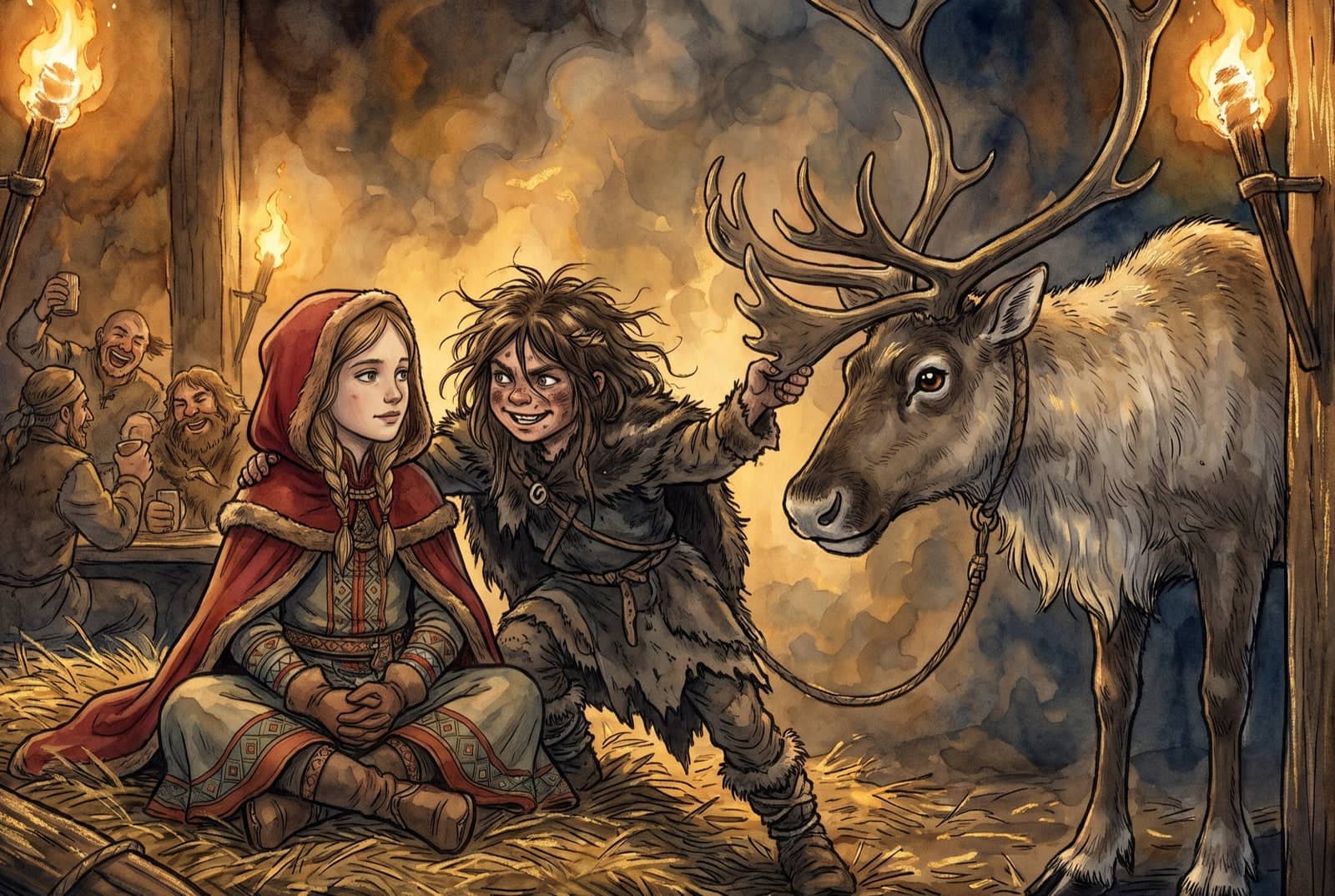
“Are you going to keep the knife while you sleep?” asked Gerda, looking at it rather fearfully.
“I always sleep with my knife,” said the little robber girl. “You never know what may happen. But now tell me again what you told me before about little Kay, and why you went out into the wide world.”
And Gerda told it again from the beginning, and the wood pigeons cooed up in their cage, and the other pigeons slept. The little robber girl put one arm round Gerda’s neck, kept the knife in her other hand and slept so that you could hear it; but Gerda could not close her eyes at all. She did not know whether she was to live or die. The robbers sat round the fire, singing and drinking, and the robber woman turned somersaults. Oh, it was a horrible thing for the little girl to watch.
Then the wood pigeons said, “Coo, coo. We have seen little Kay. A white hen was carrying his sled, and he sat beside the Snow Queen, who came low over the forest while we lay in our nest. She breathed on us young ones, and all of them died except us two. Coo, coo.”
“What are you saying up there?” cried Gerda. “Where was the Snow Queen traveling? Do you know anything about it?”
“She was most likely traveling to Lapland, for there is always snow and ice there. Ask the reindeer that stands tied up over there.”
“There is ice and snow there, and it is glorious and good,” said the reindeer. “There you can leap about freely in the great shining valleys. There the Snow Queen has her summer tent, but her strongest castle is up toward the North Pole, on the island they call Spitsbergen.”
“Oh, Kay, little Kay,” sighed Gerda.
“You must lie still,” said the robber girl, “or I shall put my knife into you.”
In the morning Gerda told her everything the wood pigeons had said, and the little robber girl looked serious, nodded her head and said, “Never mind that, never mind that. Do you know where Lapland is?” she asked the reindeer.
“Who should know it better than I?” said the animal, and its eyes sparkled in its head. “I was born and raised there; I used to leap about on the snowfields there.”
“Listen,” said the robber girl to Gerda. “You see that all our men are away. Only mother is here, and here she stays; but toward midday she drinks out of the big bottle and takes a little nap afterwards, and then I will do something for you.” And she jumped out of bed, threw her arms round her mother’s neck, pulled her by the beard and said, “My own dear billy goat, good morning.” And her mother flicked her on the nose till it was red and blue, and all of it was done out of pure love.
When the mother had drunk from her bottle and fallen asleep, the robber girl went over to the reindeer and said, “I could have a great deal of fun tickling you many times more with my sharp knife, for you look so funny then; but never mind. I am going to untie your rope and help you out, so that you can run to Lapland. But you must use your legs properly and carry this little girl to the Snow Queen’s castle, where her playmate is. You heard what she told me, for she spoke loudly enough, and you were listening.”
The reindeer leaped for joy. The robber girl lifted little Gerda up and had the forethought to tie her on fast, and even to give her a little cushion of her own to sit on. “Here are your fur boots too,” she said, “for it will be cold; but I am keeping the muff, it is far too pretty. Still, you shan’t freeze. Here are my mother’s big mittens; they will reach right up to your elbows. Push your hands in. There, now your hands look just like my ugly mother’s.”
And Gerda cried for joy.
“I can’t bear you to snivel,” said the little robber girl. “You ought to look glad now. And here are two loaves and a ham, so you won’t go hungry.” Both were tied on behind the reindeer. The little robber girl opened the door, coaxed all the big dogs inside, then cut the rope with her sharp knife and said to the reindeer, “Run now! But take good care of the little girl.”
And Gerda stretched out her hands in the big mittens toward the robber girl and said, “Farewell.” And then the reindeer was off over stumps and stones, through the great forest, over marshes and open plains, as fast as it could go. The wolves howled and the ravens screamed. Whoosh, whoosh, went the sky. It was as if the sky were spitting fire.
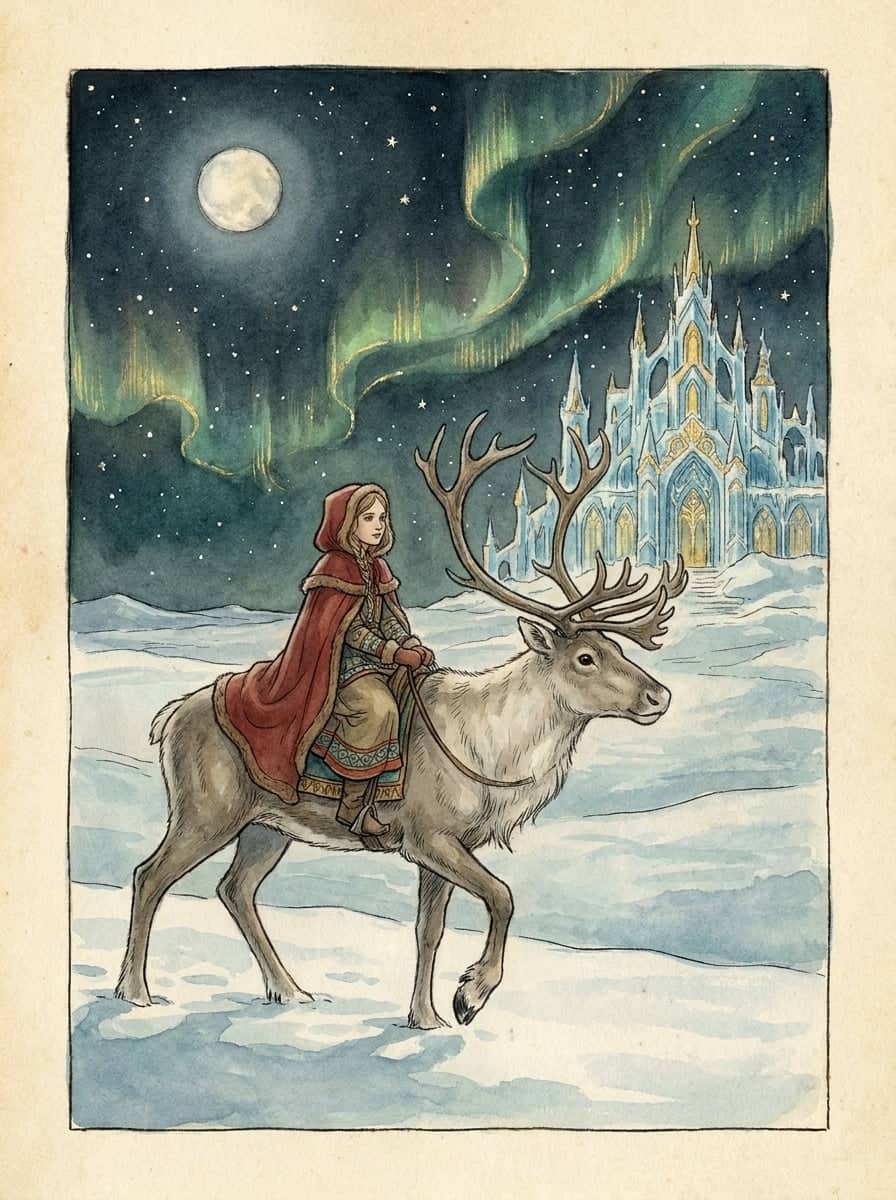
“Those are my old northern lights,” said the reindeer. “Look how they shine.” And on it ran, faster still, day and night. The loaves were eaten, and the ham too, and then they were in Lapland.
The Sixth Story: The Lapland Woman and the Finland Woman
They stopped at a little house, a very poor one. The roof came down almost to the ground, and the door was so low that the family had to creep in and out on their hands and knees. There was nobody at home but an old Lapland woman, who was cooking fish by the light of a lamp that burned fish oil. The reindeer told her Gerda’s whole story, but its own story first, for that seemed to it far more important, and Gerda was so overcome by the cold that she could not speak.
“Oh, you poor things,” said the Lapland woman. “You still have a long way to run. You must go more than a hundred miles into Finland, for the Snow Queen is staying in the country there and burns her colored lights every evening. I will write a few words on a dried codfish, for I have no paper, and you shall carry it to the Finland woman up there. She can tell you better than I can.”
And when Gerda had been warmed and had had something to eat and drink, the Lapland woman wrote a few words on a dried codfish, told Gerda to take good care of it, tied her fast on the reindeer again, and off it sprang. Whoosh, whoosh, went the air above them, and all night long the loveliest blue northern lights were burning. And then they came to Finland and knocked at the Finland woman’s chimney, for she had no door at all.
It was so hot inside that the woman went about with hardly any clothes on. She was small and grubby. She loosened little Gerda’s dress at once and pulled off her mittens and her boots, for otherwise Gerda would have been much too hot, and she laid a piece of ice on the reindeer’s head. Then she read what was written on the codfish. She read it three times, and by then she knew it by heart, so she put the fish into the soup pot, for it could still be eaten and she never wasted anything.
Now the reindeer told its own story first, and then little Gerda’s, and the Finland woman blinked with her clever eyes and said nothing.
“You are so clever,” said the reindeer. “I know you can tie all the winds of the world together with a piece of thread. When the sailor unties one knot he gets a good wind; when he unties the second it blows hard; and when he unties the third and the fourth, there is such a storm that whole forests fall down. Won’t you give the little girl a drink that will give her the strength of twelve men, so that she can overcome the Snow Queen?”
“The strength of twelve men,” said the Finland woman. “That would be of very little use.” But she went over to a shelf, took down a big rolled-up skin and unrolled it. Wonderful letters were written on it, and the Finland woman read until the sweat ran down her forehead.
But the reindeer begged so hard for little Gerda, and Gerda looked at the Finland woman with such pleading eyes full of tears, that she began to blink with her own again. She drew the reindeer into a corner and whispered to it while she laid fresh ice on its head.
“Little Kay is indeed with the Snow Queen, and he finds everything there just to his taste and his liking, and thinks it is the best place in the world. But that is because he has a splinter of glass in his heart and a little grain of glass in his eye. They must come out first, or he will never be a human being again, and the Snow Queen will keep her power over him.”
“But can’t you give little Gerda something that will give her power over the whole of it?”
“I can give her no greater power than she has already. Don’t you see how great it is? Don’t you see how people and animals have to serve her, and how far she has come in the world on her own bare feet? She cannot get her power from us; it sits in her own heart, and it is this, that she is a dear, innocent child. If she cannot get in to the Snow Queen herself and get the glass out of little Kay, then we can do nothing to help. Two miles from here the Snow Queen’s garden begins. You can carry the little girl that far. Set her down by the big bush with the red berries that stands there in the snow. Don’t stand about gossiping; hurry back here.” And then the Finland woman lifted little Gerda onto the reindeer, and it ran for all it was worth.
“Oh, I have not got my boots! I have not got my mittens!” cried little Gerda. She felt it in the cutting cold; but the reindeer did not dare to stop. It ran until it came to the bush with the red berries, and there it set Gerda down and kissed her on the mouth, and great bright tears ran down the animal’s cheeks. Then it ran back again as fast as it could.
The Seventh Story: The Snow Queen’s Palace, and What Happened There
There stood poor Gerda, without boots and without mittens, in the middle of that terrible, ice-cold country.
She ran forward as fast as she could. A whole regiment of snowflakes came at her, but they did not fall from the sky; the sky was clear and shining with northern lights. The snowflakes ran along the ground, and the nearer they came the bigger they grew. Gerda still remembered how large and how finely made the flakes had looked when she saw them through the magnifying glass. But here they were far bigger and far more frightful. They were alive; they were the Snow Queen’s outposts, and they had the strangest shapes. Some looked like great ugly porcupines, some like knots of snakes stretching out their heads, and some like little fat bears with bristling hair. All of them were shining white, and all of them were living snowflakes.
Then little Gerda said the Lord’s Prayer. The cold was so great that she could see her own breath; it came out of her mouth like smoke. The breath grew thicker and thicker and took the shape of little angels, who grew bigger the moment they touched the ground. They all had helmets on their heads and spears and shields in their hands. There were more and more of them, and by the time Gerda had finished her prayer a whole legion stood round her. They thrust their spears at the horrible snowflakes, so that the flakes burst into a hundred pieces, and little Gerda walked on, safe and glad at heart. The angels stroked her hands and her feet, and then she felt the cold less, and she hurried on toward the Snow Queen’s castle.
But first we must see what Kay is doing. He was certainly not thinking of little Gerda, and least of all that she was standing outside the castle.
The walls of the castle were made of driven snow, and the windows and the doors of the cutting winds. There were more than a hundred halls in it, all of them shaped as the snow had blown them together, and the biggest stretched for many miles. The strong northern lights lit them all, and how huge and empty they were, how icy cold and glittering. There was never any merrymaking here, not even a little bears’ ball with the storm for music and the polar bears walking on their hind legs to show their fine manners; never a little game of snap-at-the-mouth and slap-with-the-paw; never a little coffee party for the young white foxes. Empty, huge and cold were the halls of the Snow Queen. The northern lights flamed so exactly that you could count when they stood highest and when they stood lowest.
In the middle of that empty, endless hall of snow lay a frozen lake, broken into a thousand pieces; but each piece was so exactly like the others that it was a perfect work of art. In the middle of the lake sat the Snow Queen when she was at home, and then she said she was sitting in the Mirror of Reason, and that it was the only one in the world and the best.
Little Kay was blue with cold, almost black; but he did not notice it, for she had kissed the shivering out of him, and his heart was like a lump of ice. He dragged some sharp, flat pieces of ice this way and that and laid them together in every possible way, for he wanted to make something out of them. It was like the game we play with little wooden tablets, laying them into shapes, which people call the Chinese puzzle. Kay laid shapes too, and the most cunning ones. It was the ice game of reason. In his eyes the shapes were remarkable and of the greatest importance, and that came from the grain of glass sitting in his eye. He laid whole shapes that made a written word, but there was one word he could never manage to lay, the word Eternity. The Snow Queen had said to him, “If you can find out that figure, you shall be your own master, and I will give you the whole world and a new pair of skates.” But he could not do it.
“Now I must be off to the warm countries,” said the Snow Queen. “I shall go and look down into the black pots.” Those were the fire-spitting mountains, Etna and Vesuvius, as people call them. “I shall whiten them a little. That is only proper; it does the lemons and the grapes good.” And away flew the Snow Queen, and Kay sat quite alone in the empty hall of ice that was many miles long, and looked at his pieces of ice and thought so hard that something cracked inside him. He sat there stiff and still, and anyone would have thought he had frozen to death.
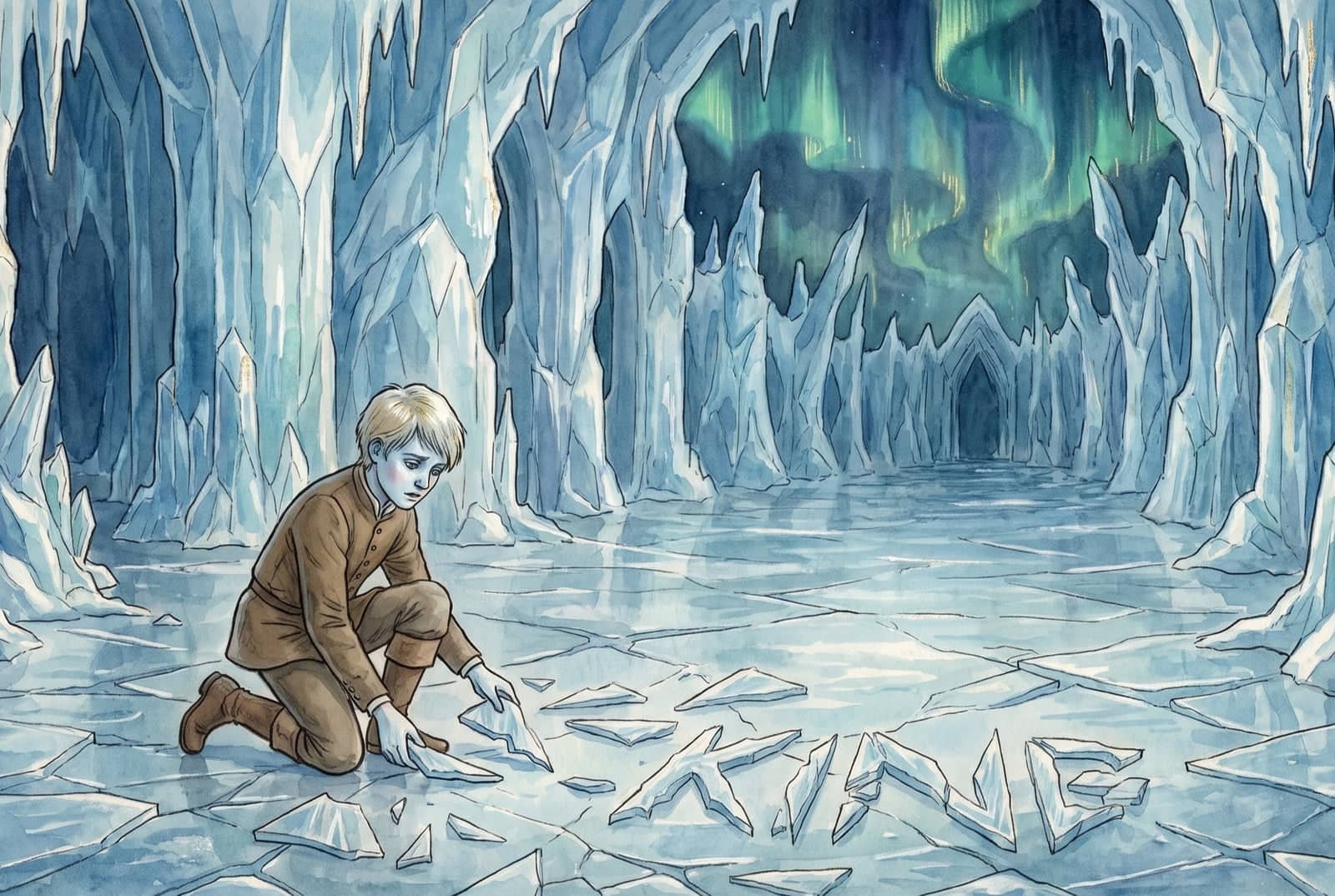
It was just then that little Gerda came in through the great gate of the castle. Cutting winds were raging there, but she said her evening prayer, and the winds lay down as if they wanted to sleep. She went on into the great, empty, cold halls, and there she saw Kay. She knew him at once, and she flew to him and threw her arms round his neck and held him fast and cried, “Kay! Dear little Kay! I have found you at last.”
But he sat quite still, stiff and cold.
Then little Gerda wept hot tears, and they fell on his breast and went right into his heart. They thawed the lump of ice and burned away the little piece of mirror inside it. He looked at her, and she sang:
Roses bloom and fade away,we shall see the Christ-child one day.
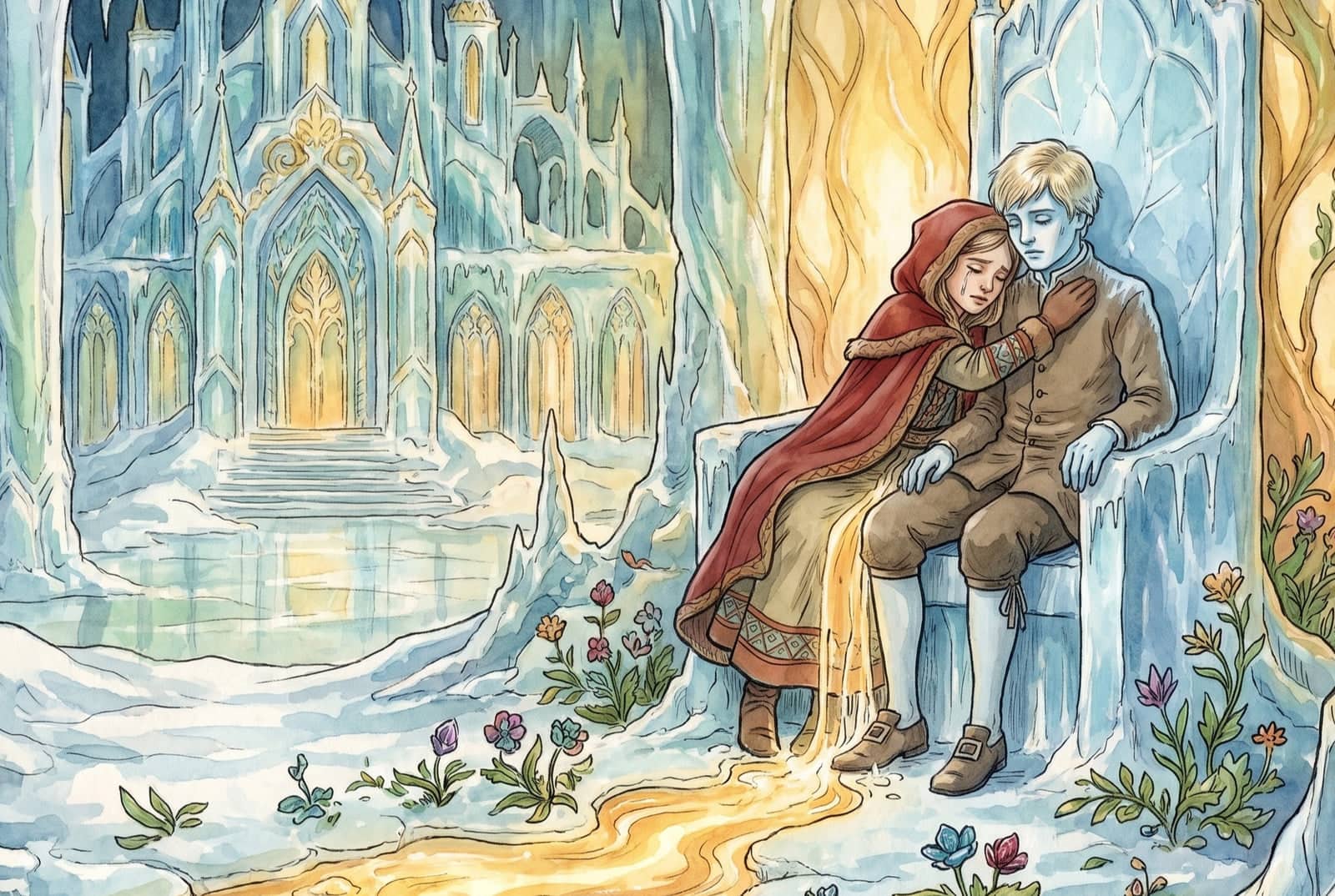
Then Kay burst into tears. He cried so hard that the grain of glass swam out of his eye. Now he knew her, and he shouted for joy, “Gerda! Dear little Gerda! Where have you been all this long time? And where have I been?” And he looked round about him. “How cold it is here. How wide and empty it is here.” And he clung to Gerda, and she laughed and cried for joy. It was so wonderful that even the pieces of ice danced about for joy, and when they were tired and lay down, they lay in exactly those letters the Snow Queen had told him to find out, and then he would be his own master and she would give him the whole world and a new pair of skates.
And Gerda kissed his cheeks, and they bloomed; she kissed his eyes, and they shone like her own; she kissed his hands and his feet, and he was well and merry again. The Snow Queen might come home whenever she pleased; his letter of freedom stood there, written in shining pieces of ice.
They took each other by the hand and walked out of the great castle. They talked of the grandmother and of the roses up on the roof, and wherever they went the winds lay still and the sun broke through. When they reached the bush with the red berries, the reindeer stood there waiting, and it had brought another young reindeer with it, whose udder was full, and she gave the children her warm milk and kissed them on the mouth. Then the two of them carried Kay and Gerda first to the Finland woman, where they warmed themselves through in the hot room and were told the way home, and then to the Lapland woman, who had sewn new clothes for them and put their sled in order.
The reindeer and the young one ran along at their side and followed them as far as the border of the country, where the first green was showing. There they took leave of the two reindeer and of the Lapland woman. “Farewell,” said everyone. And the first little birds began to twitter, and the forest was full of green buds, and out of it came riding a young girl on a splendid horse that Gerda knew, for it had been harnessed to the golden coach. She had a bright red cap on her head and pistols in her belt. It was the little robber girl, who had grown tired of being at home and wanted to go north first, and afterwards, if that did not suit her, to some other part of the world. She knew Gerda at once, and Gerda knew her, and it was a joyful meeting.
“You are a fine fellow for gadding about,” she said to little Kay. “I should like to know whether you deserve to have anyone run to the end of the world for your sake.”
But Gerda patted her cheeks and asked after the prince and the princess.
“They have gone traveling in foreign countries,” said the robber girl.
“And the crow?” asked Gerda.
“Well, the crow is dead,” she answered. “His tame sweetheart is a widow now and goes about with a bit of black wool round her leg. She mourns most pitifully, but it is all talk. Now tell me how things went, and how you caught him.”
And Gerda and Kay told her everything.
“Snip, snap, snurre, basselurre!” said the robber girl, and she took them both by the hand and promised that if she ever came through their town she would come up and pay them a visit. And then she rode off into the wide world.
But Gerda and Kay went hand in hand, and wherever they went it was glorious spring, with flowers and green leaves. The church bells rang, and they knew the tall towers and the great town; it was the one they lived in. They went into it and up to their grandmother’s door and up the stairs and into the room, where everything stood in the same place as before, and the clock said tick, tock, and the hands went round. But as they went in at the door, they noticed that they had become grown people. The roses in the gutter were blooming in at the open window, and there stood the little children’s chairs, and Kay and Gerda each sat down on one of them and held each other by the hand. The cold, empty splendor of the Snow Queen’s palace they had forgotten like a heavy dream. The grandmother sat in God’s bright sunshine and read aloud from the Bible: “Unless you become like little children, you will never enter the kingdom of God.”
And Kay and Gerda looked into each other’s eyes and all at once understood the old song:
Roses bloom and fade away,we shall see the Christ-child one day.
And there they both sat, grown up and yet children, children at heart. And it was summer, warm and blessed summer.
Retold by Talerie from Fairy Tales of Hans Christian Andersen (opens in a new window)License: Public domainCopy this text, adapt it, use it however you like. A link back to Talerie is appreciated but never required.CC0 1.0 (opens in a new window)