A young merchant of Baghdad spends his inheritance, then sails east with a company of traders and steps ashore on a green island that turns out to be a sleeping whale. Sinbad returns home with a hundred thousand gold coins, and years later, at the feast where he tells the tale, he gives a purse to the porter Hindbad.
In Baghdad there lived a rich merchant named Sinbad, who had sailed farther than anyone else in the city. One day he seated a poor porter called Hindbad at his own table, among all his guests, and when the musicians had laid down their instruments he began his story.
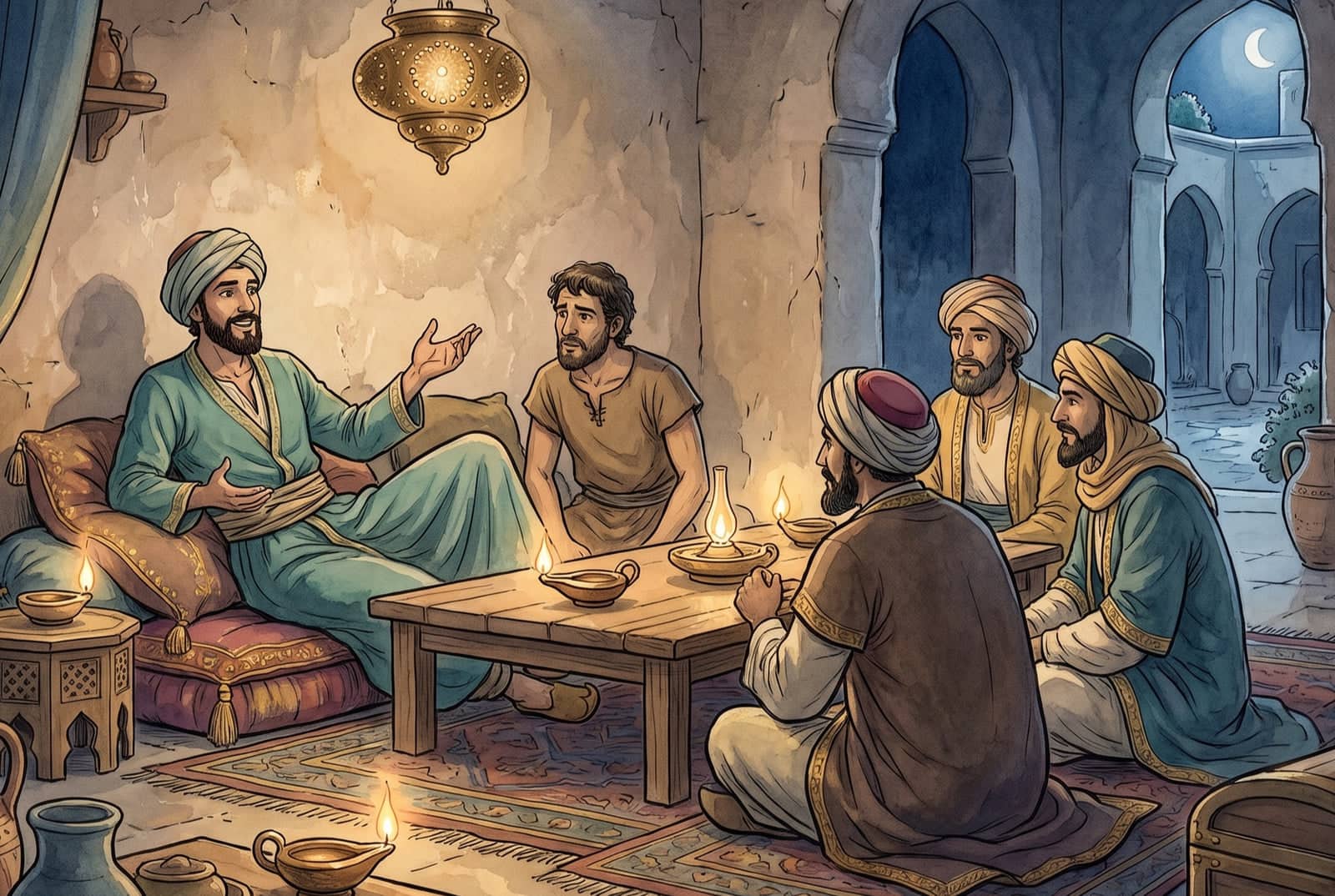
I inherited a great deal of money from my parents, and being young and foolish I spent it on every kind of pleasure without a thought for tomorrow. Then one day I counted what was left and saw how little it was. Riches take wing and fly away if you handle them as badly as I was handling mine, and there is no misery in the world like being old and poor. So I made up my mind.
I sold everything I owned at public auction, gathered together the last of my fortune, and went down to Basra. There I joined a company of merchants who traded by sea, and together we fitted out a ship and set sail.
We took our course eastward toward the Indies, with the coast of Persia on our left hand and the coast of Arabia on our right. For the first days the roll of the ship made me wretchedly ill, but I soon got my sea legs, and from that hour to this I have never been seasick again.
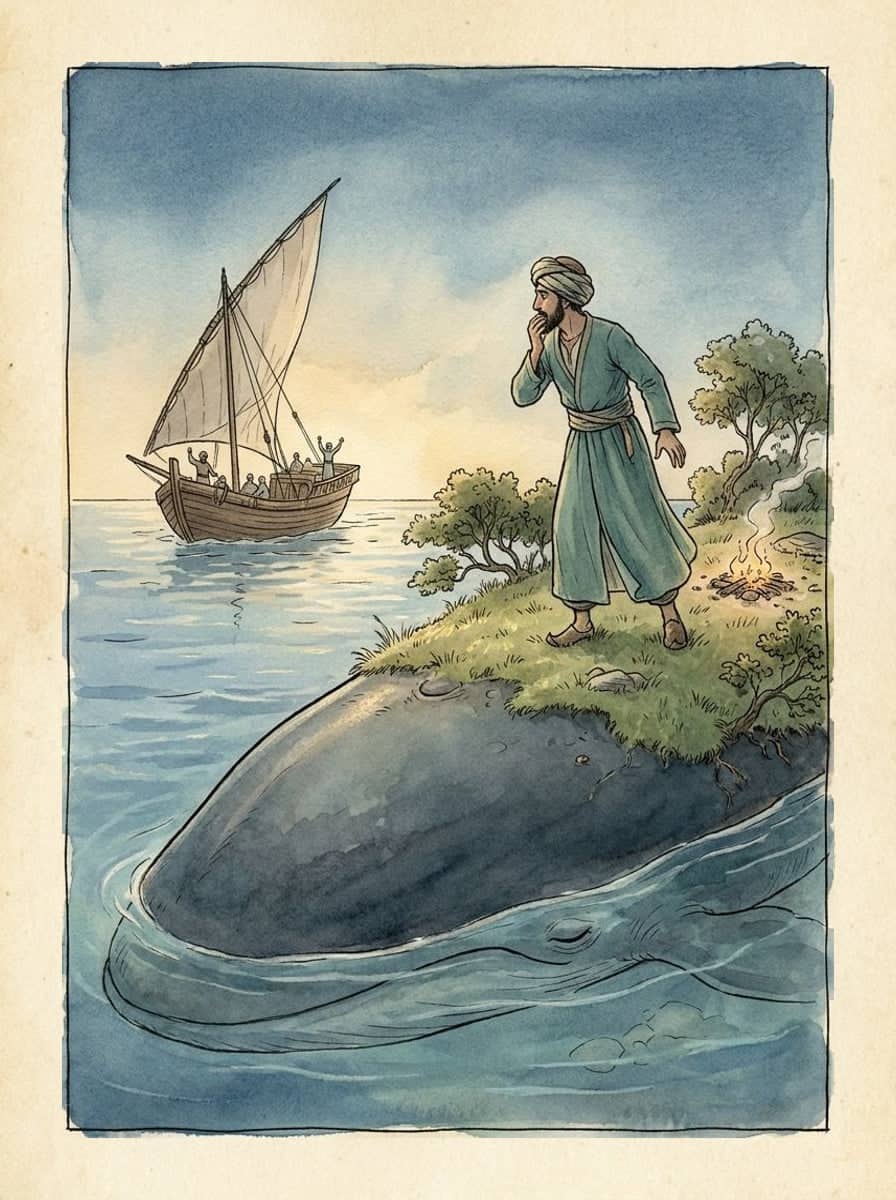
We put in at one island after another, selling our goods and buying others, and then one day the wind dropped away altogether and left us becalmed beside a small island that rose only a little above the water and was as green as a meadow. The captain had the sails furled and gave leave to anyone who wished to go ashore and stretch his legs. I was among the first into the boat.
We wandered about for a while. Then we gathered the wood we had brought with us, lit a fire, and sat down to enjoy the food we had carried from the ship.
The island shuddered under us. It heaved like some great creature turning in its sleep, and from the ship came shouts:
“Come back! Come back for your lives! It is no island. It is a whale asleep on the water, and your fire has woken it!”
Those who were nearest the boat threw themselves into it. Others leapt into the sea and swam. I was still running when the whale went down, and the water closed over the green meadow as though it had never been there. My hands found one of the planks we had brought for the fire, and I held on.
Just then a breeze sprang up. Aboard the ship there was such confusion, hauling in the swimmers, taking up the boat, hoisting the sails to catch the wind, that nobody thought to count us and nobody missed me. I watched the ship grow small, and then it was gone, and I was alone on the sea with a piece of wood.
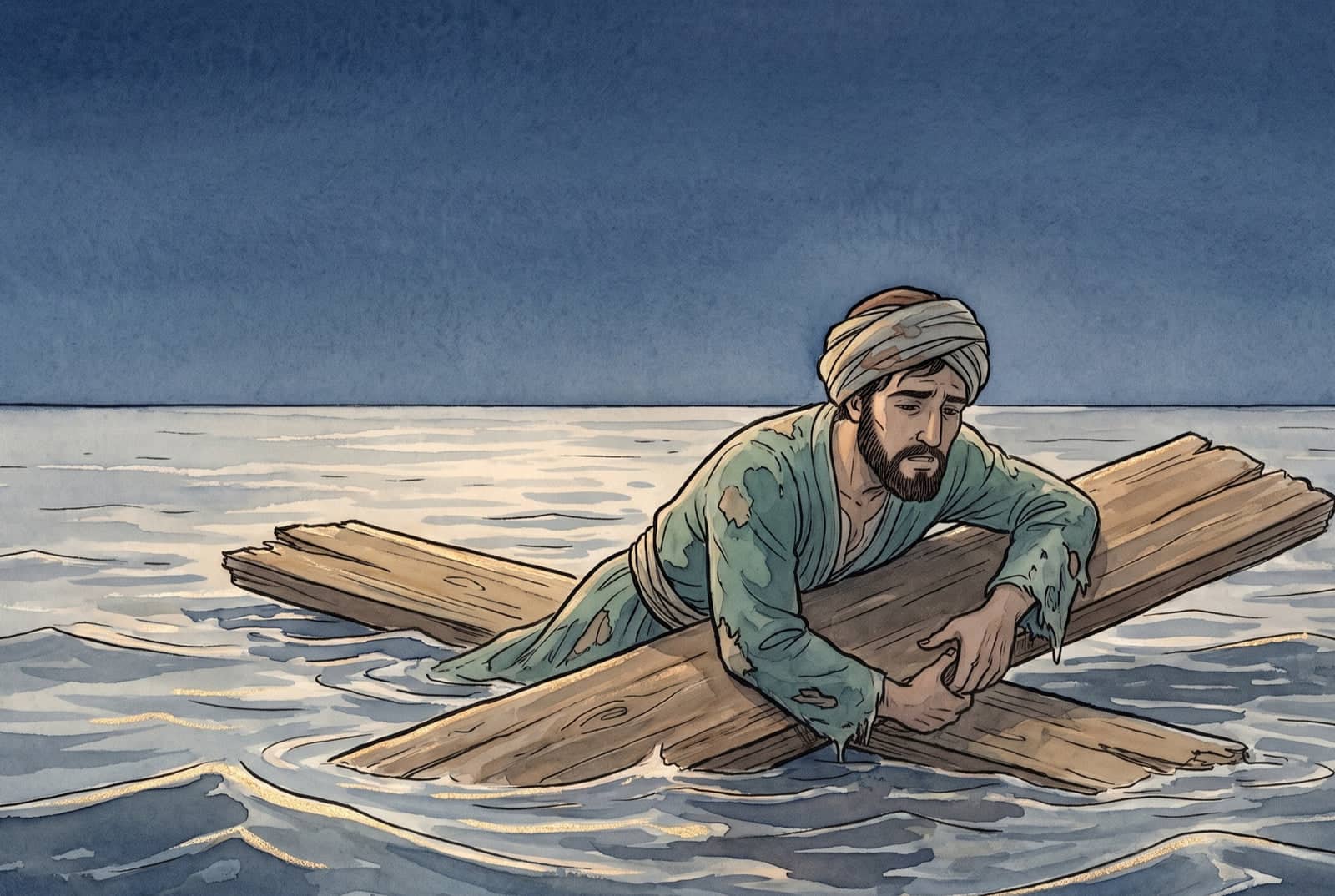
All that day the waves carried me where they pleased, beating me this way and that. Night came, and I no longer believed I would see the morning, but still I clung to my plank. And when the light came at last, it showed me land.
The cliffs were high and steep, and I could never have climbed them but for the roots of trees that pushed out here and there from the rock. I hauled myself up by them and lay down on the grass at the top, more dead than alive, and did not stir until the sun stood high.
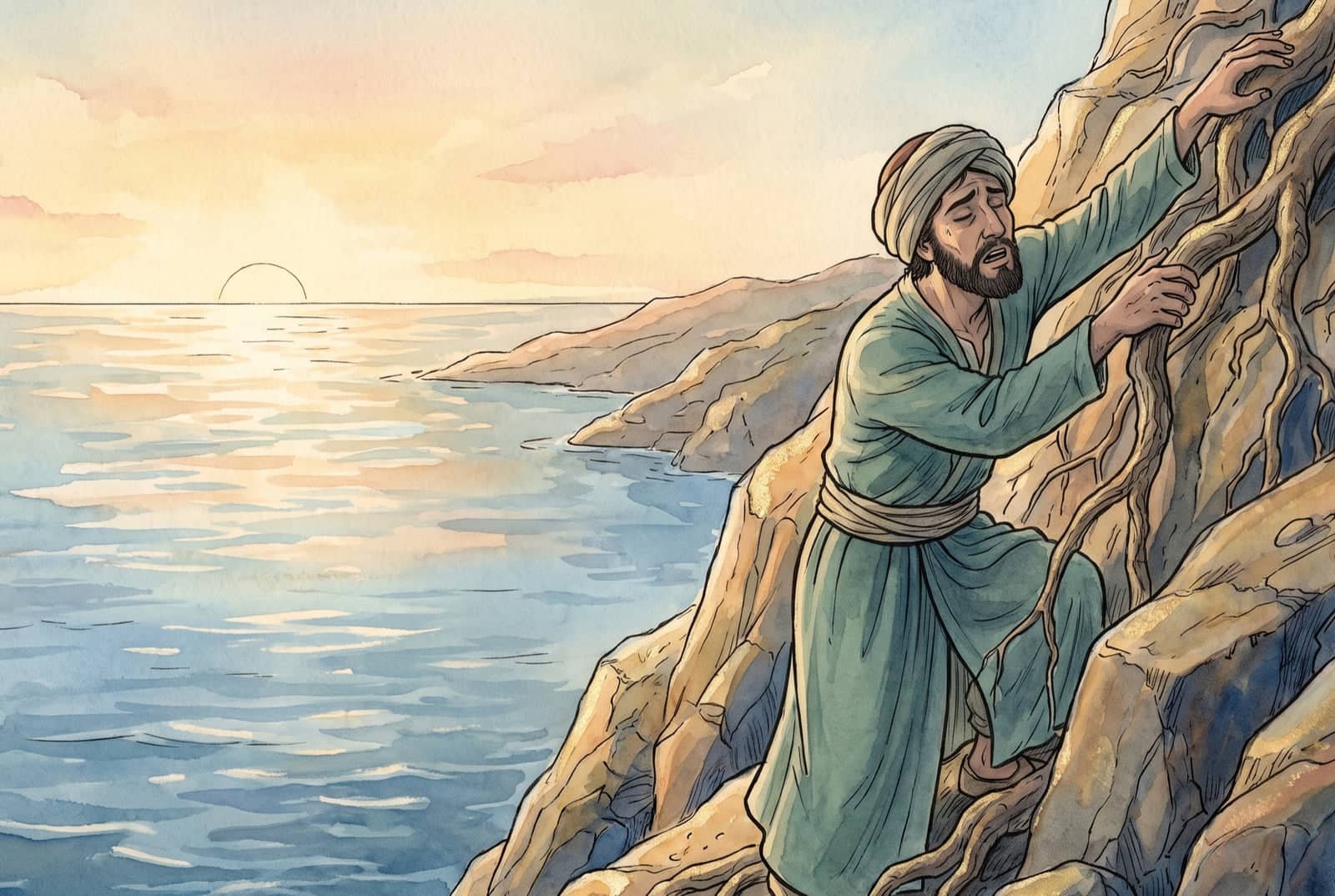
Then hunger got me back on my feet. I found herbs that were good to eat and a spring of clear cold water, and when I had drunk and rested a little I set out to see where I was.
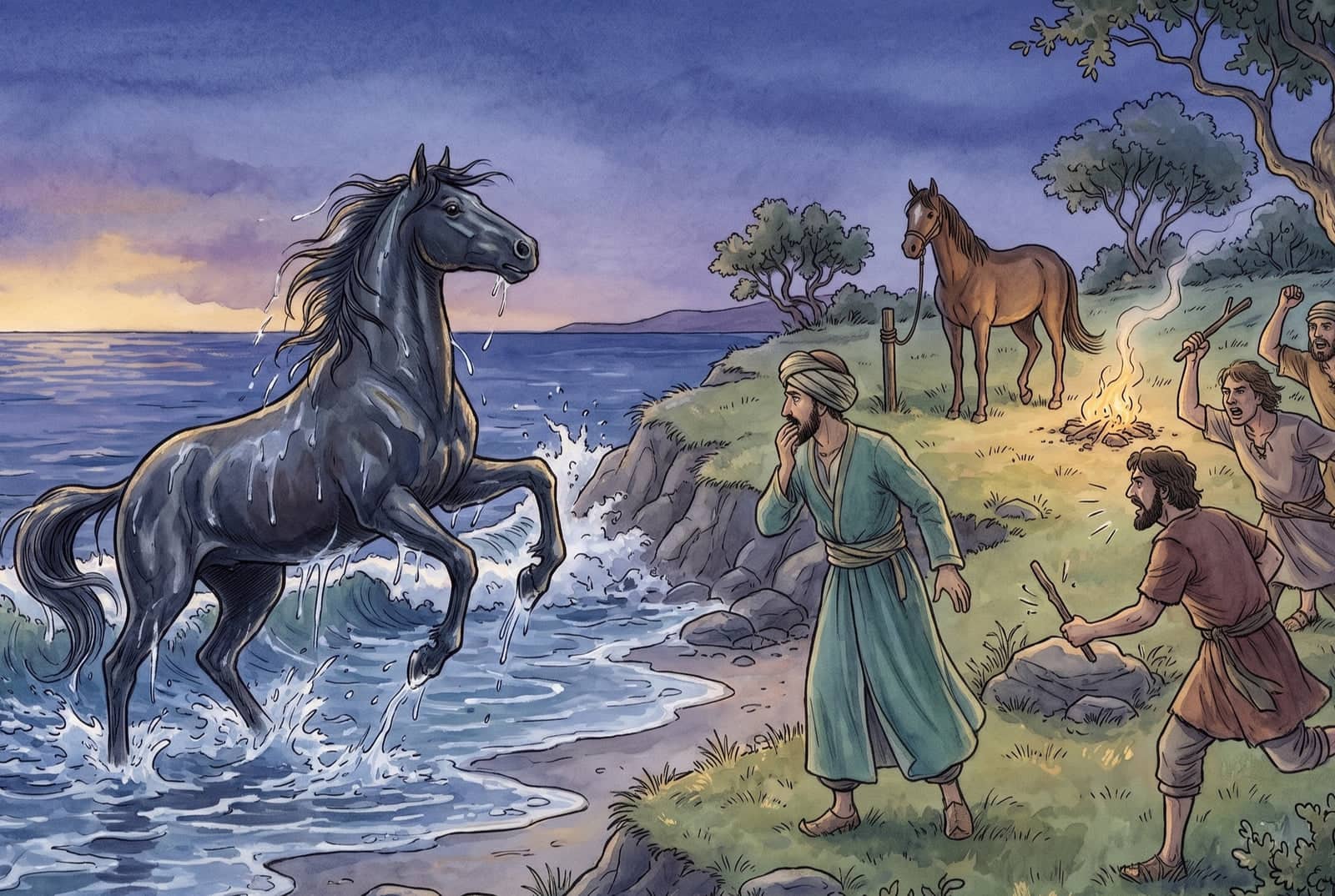
I came to a wide plain, and there in the middle of it a fine mare stood tethered to a stake. I was still staring at her and wondering how she had come to such a place when I heard voices talking somewhere under my feet. A moment later a man came up out of the ground, walked over to me, and asked who I was and how I came to be on the island.
I told him everything. He took me by the hand and led me down into a cave where his companions were sitting, and they were as astonished to see me as I was to find them there. They set food before me, and while I ate they told me who they were: grooms of Mihrage, the king of the island. Every year at that season they brought the king’s mares to this plain and tethered them, because a horse came up out of the sea to them, and the foals born afterwards belonged to the king and were the swiftest in the world.
“But that horse is a wild thing,” they said, “and afterwards he turns on the mare to devour her. So we run out shouting and beating on the rocks, and back he goes into the water.”
That very evening I saw it happen exactly as they had said. The horse rose out of the waves, and when he turned on the mare the grooms ran out shouting until he plunged back into the sea and was gone.
“You have come on a lucky day,” they told me. “Tomorrow we go home to our master. Had you missed us, you would never have found your way to the towns alone.”
So the next morning I went with them, and we came to the capital, which stood on the shore of the sea. I was brought before King Mihrage, and when he had heard my story he pitied me and gave orders that I should be well looked after and should want for nothing.
Since I was a merchant myself, I sought out the merchants of that city, especially those from far countries, hoping to hear news of Baghdad and to find some ship that would carry me home; for vessels came into that harbor from every corner of the world. I heard a great many strange things and answered a great many questions about my own country, for I talked willingly with everyone who came to me.
To pass the time while I waited I sailed out to a little island called Cassel, which belonged to the king. The sailors swore that a spirit named Deggial lived there, and that on quiet nights you could hear drums beating across the water. I heard no drums. But I did see fish so long that our boat was a splinter beside them, and so timid that we had only to knock on a plank to send them fleeing, and other fish no longer than your arm, with round faces like owls.
One day, after I had come back, I went down to the quay where a ship had just dropped anchor and was unloading, and the merchants who owned the cargo were directing bale after bale to their warehouses. I walked closer, and on some of the packages I saw my own name.
I examined them carefully. There was no mistake. They were the goods I had put aboard at Basra.
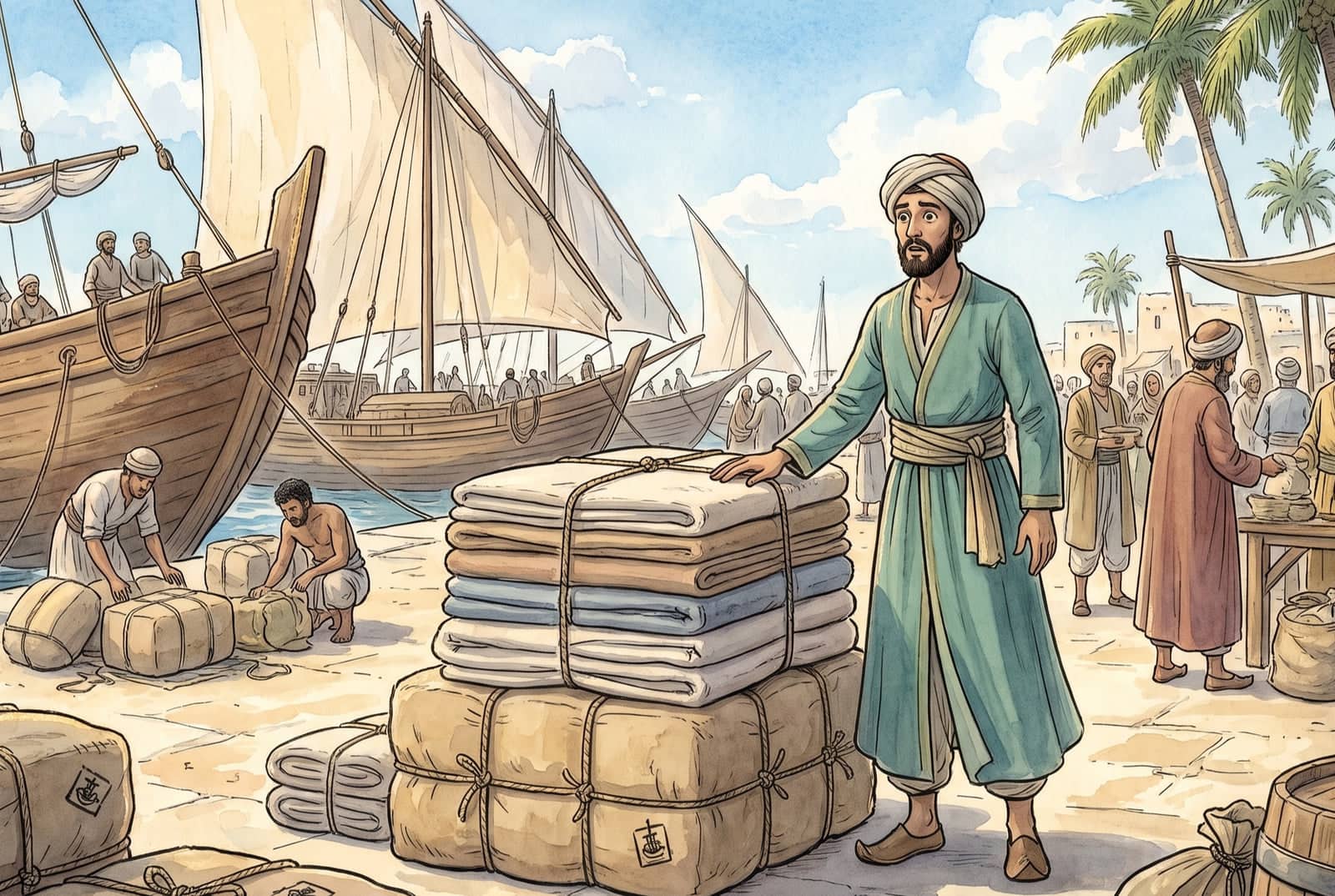
Then I looked at the ship’s captain and knew him too. He believed I had drowned, so I went up to him as a stranger and asked who owned the bales I had been looking at.
“They belonged,” he said, “to a merchant of Baghdad named Sinbad, who sailed with me. One day we came upon what we all took for an island, and he and several other passengers went ashore on it. It was no island. It was an enormous whale asleep on the water, and the moment it felt the heat of their fire on its back it dived into the deep. Several of the people on it were lost, and among them this unlucky Sinbad. The goods are his. I mean to sell them and keep the money for his family, if ever I should meet with them.”
“Captain,” I said, “I am that Sinbad you believe to be dead, and these are my goods.”
The captain stared at me. “Heaven help us, what is the world coming to! Is there not one honest man left in it? Sinbad drowned with that whale, as sure as I stand here, and here you stand and tell me you are he. You have the look of an honorable man, and yet you are willing to invent a shameless lie to get hold of what is not yours.”
“Have patience,” I said, “and do me the kindness of hearing my story.”
“Speak, then,” he answered. “I am listening.”
So I told him how I had clung to the plank, and how the waves had thrown me at last against the cliffs, and how the king’s grooms had found me on the plain and brought me to the palace. I could see that the captain was beginning to waver. Then some of the other merchants from his ship came up, and they knew me at once and were overjoyed to see me alive, and at last he knew me too.
He threw his arms around my neck. “God be praised that you came safe out of such danger! Here are your goods. Take them, they are yours, and do with them whatever you please.”
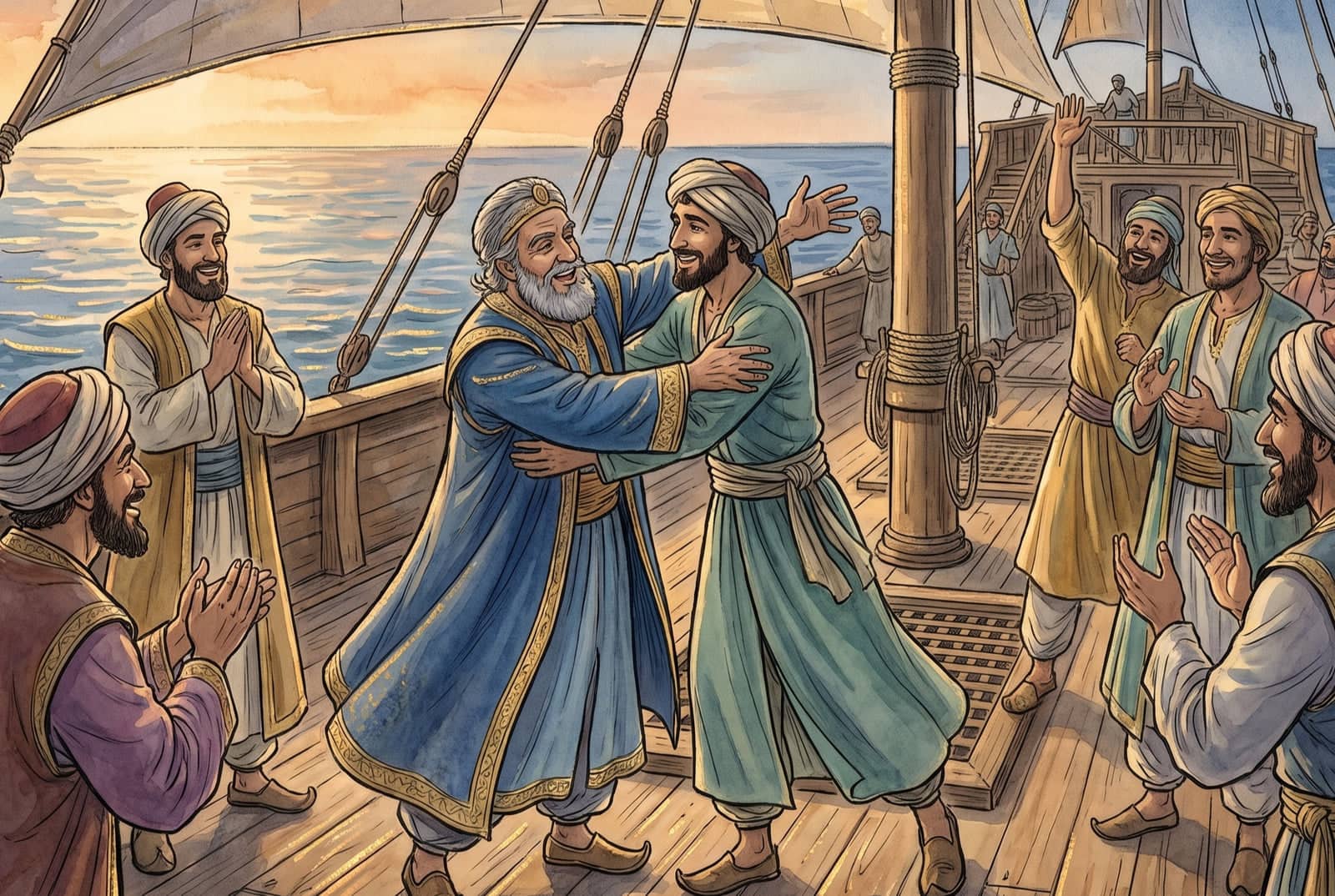
I thanked him and praised his honesty, and I begged him to accept several bales as a token of my gratitude, but he would not take a thing.
Out of the finest of my goods I made a present for King Mihrage, who could not think at first how a man who had lost everything came to have such treasures to give. When I explained how my bales had come back to me, he was glad for me, and he accepted my gift and made me a far richer one in return. Then I took my leave of him.
I traded the rest of my goods for sandalwood and aloes wood, camphor, nutmeg, cloves, pepper and ginger, and I sailed home aboard that same ship, and bought and sold so well along the way that I came into Basra with a hundred thousand gold coins, and from there home to Baghdad. My family welcomed me as joyfully as I welcomed them. I bought land, and built this house, and settled here to enjoy my life and to forget everything I had suffered.
Here Sinbad stopped, and signalled to the musicians, and the feasting went on until evening. When it was time for the guests to go home, he put a purse of a hundred gold coins into the porter’s hands.
“Take this, Hindbad,” he said, “and go home. But come again tomorrow, and you shall hear more.”
Hindbad went out so overcome by Sinbad’s generosity that he could hardly speak, and you may imagine how he was welcomed at home, where his wife and children blessed their good fortune for sending him such a friend.
The next day he came back in his best clothes, and Sinbad received him with open arms and seated him among the guests, and the feast began again as merrily as before.
Retold by Talerie from The Arabian Nights Entertainments (opens in a new window)License: Public domainCopy this text, adapt it, use it however you like. A link back to Talerie is appreciated but never required.CC0 1.0 (opens in a new window)