The Little Mermaid
16 min readages 6 and uptalerie.com/en/tales/the-little-mermaid
The Sea King’s youngest daughter gives her voice to a sea witch for human legs, to walk beside the prince she carried out of a shipwreck. When he marries another, she flings away the witch’s knife and rises from the foam among the daughters of the air, who win an undying soul by three hundred years of good deeds.
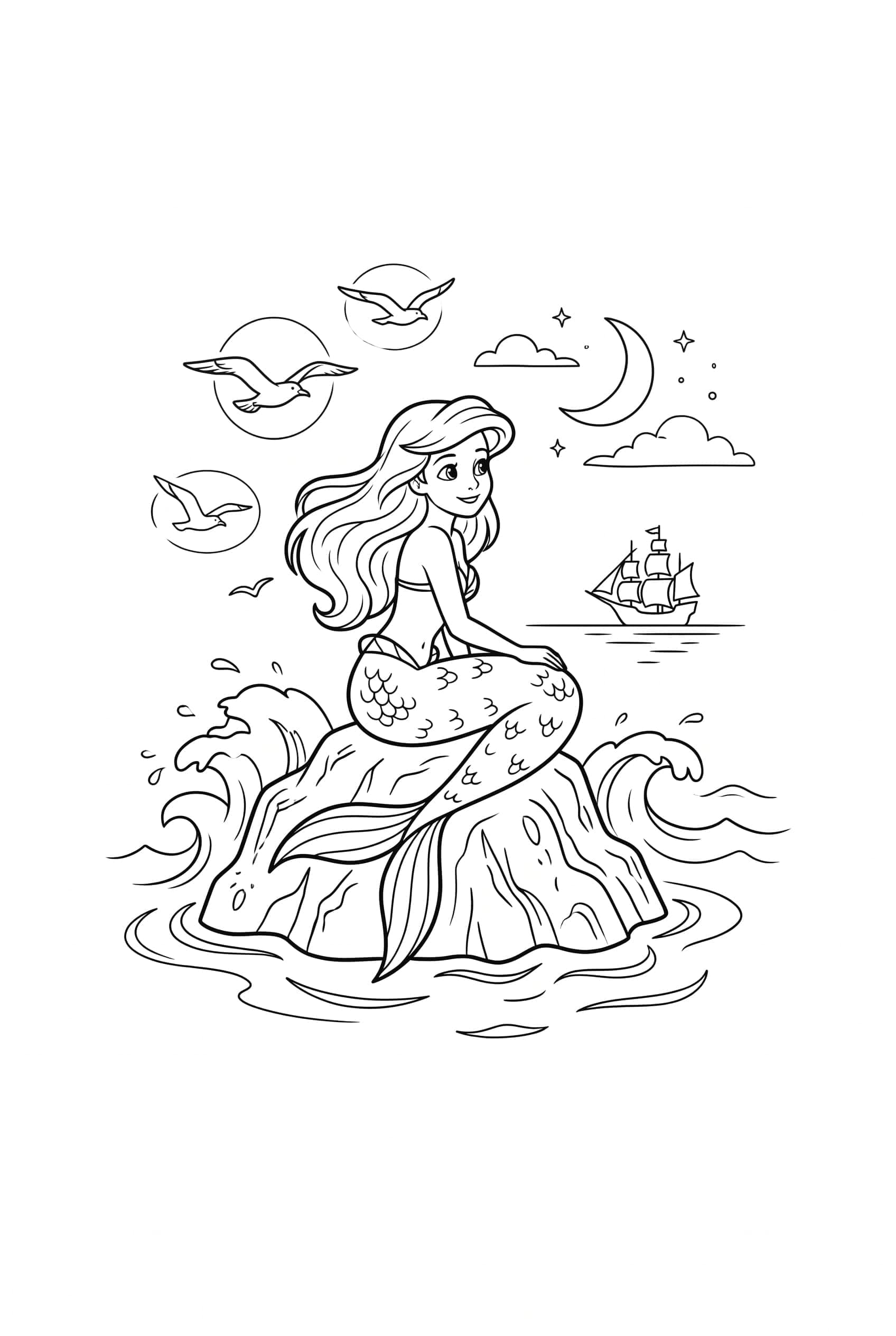
Far out at sea the water is as blue as a cornflower and deeper than any anchor rope can reach. Down there live the sea folk, in a coral palace with amber windows. The Sea King was a widower, and his old mother looked after his six daughters. The youngest was the loveliest, but like her sisters she had no feet: her body ended in a fish’s tail.
The youngest princess made her garden plot round like the sun and filled it with red flowers, and cared for nothing else except a marble statue of a boy that had sunk from a wreck. Best of all she loved to hear about the world above, and her grandmother told her of ships and towns, and of birds, which the old lady called fishes, for the child had never seen one.
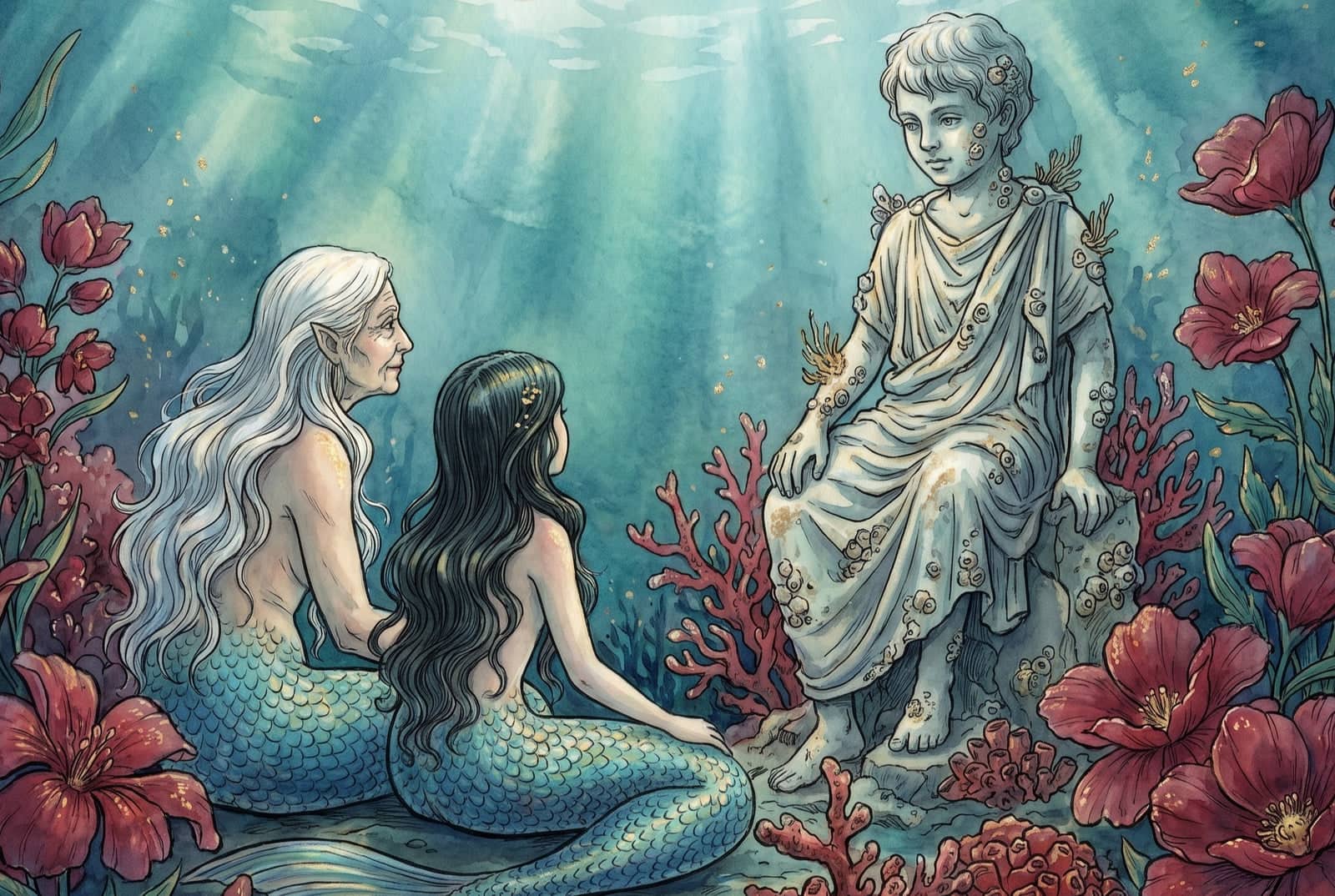
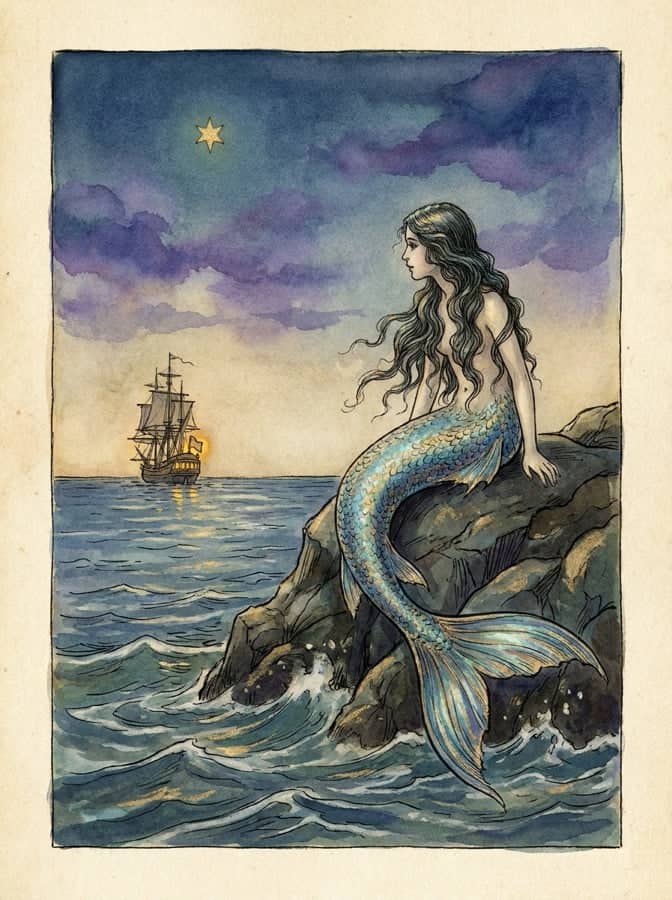
“When you are fifteen,” said her grandmother, “you may rise out of the sea and sit on the rocks in the moonlight and watch the great ships sail by.”
The eldest would be fifteen the next year, and each of the others was a year younger than the one before, so that when the eldest’s turn came the youngest still had five long years to wait.
Each sister came home with wonders. The eldest had watched a town where the lights twinkled like stars. The second rose at sunset, when the sky was gold and swans flew toward the sun. The third swam up a river, where children ran from her and a black animal barked so fiercely that she fled; she had never seen a dog. The fourth stayed far out, where whales spouted like fountains. The fifth sat on an iceberg while the ships steered wide of her.
When they were grown the sisters could rise whenever they pleased. On some evenings all five sang together on the water, and when they feared a ship would be lost they swam before it and begged the sailors not to be afraid; but the sailors took the singing for the wind. The youngest stood alone and watched them go, ready to cry, except that mermaids have no tears, and so they suffer more.
“If only I were fifteen,” she said. “I know I shall love that world up there, and all the people in it.”
At last her birthday came. Her grandmother set a wreath of white lilies in her hair and ordered eight great oysters to fasten themselves to her tail to show her high rank.
“But they hurt me,” said the little mermaid.
“Pride must suffer pain,” said the old lady.
She said farewell and rose as lightly as a bubble, just after sunset. A great ship lay becalmed with music on board. Whenever a wave lifted her she could see in through the cabin windows, where a young prince with dark eyes was keeping his sixteenth birthday. When he came on deck the rockets burst above him, and it seemed as if all the stars of heaven were falling around her.
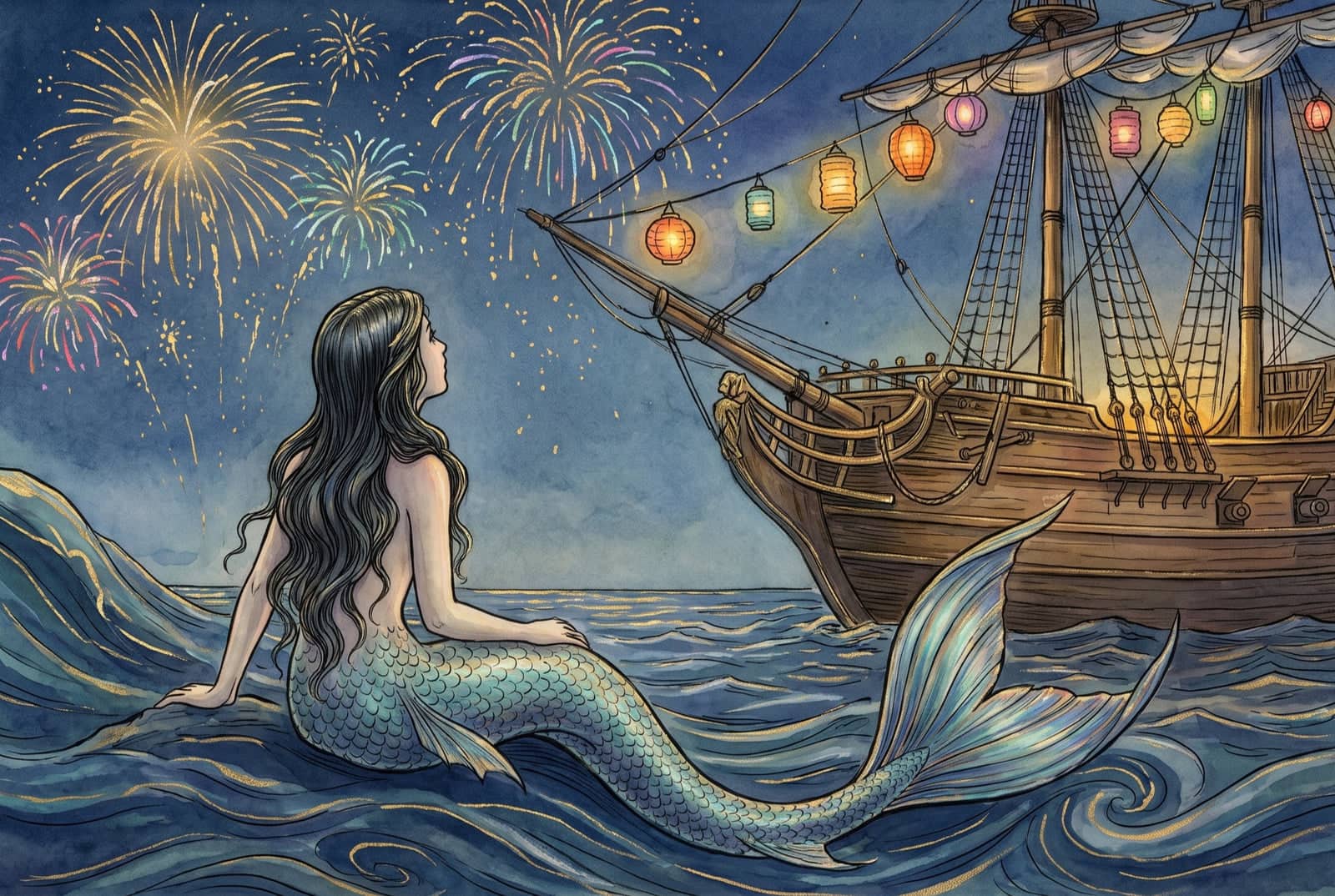
She could not take her eyes from the ship. But the sea began to heave, the clouds gathered, and the storm broke. The waves rose like mountains, and at last the planks gave way, the mast snapped like a reed, and the water rushed in.
In a flash of lightning she saw the prince sinking into the deep. For a moment she was glad, thinking he would come down to her; then she remembered that people cannot live under water. He must not die. She swam in among the drifting timbers until she found him, and held his head above the water while the sea carried them where it would.
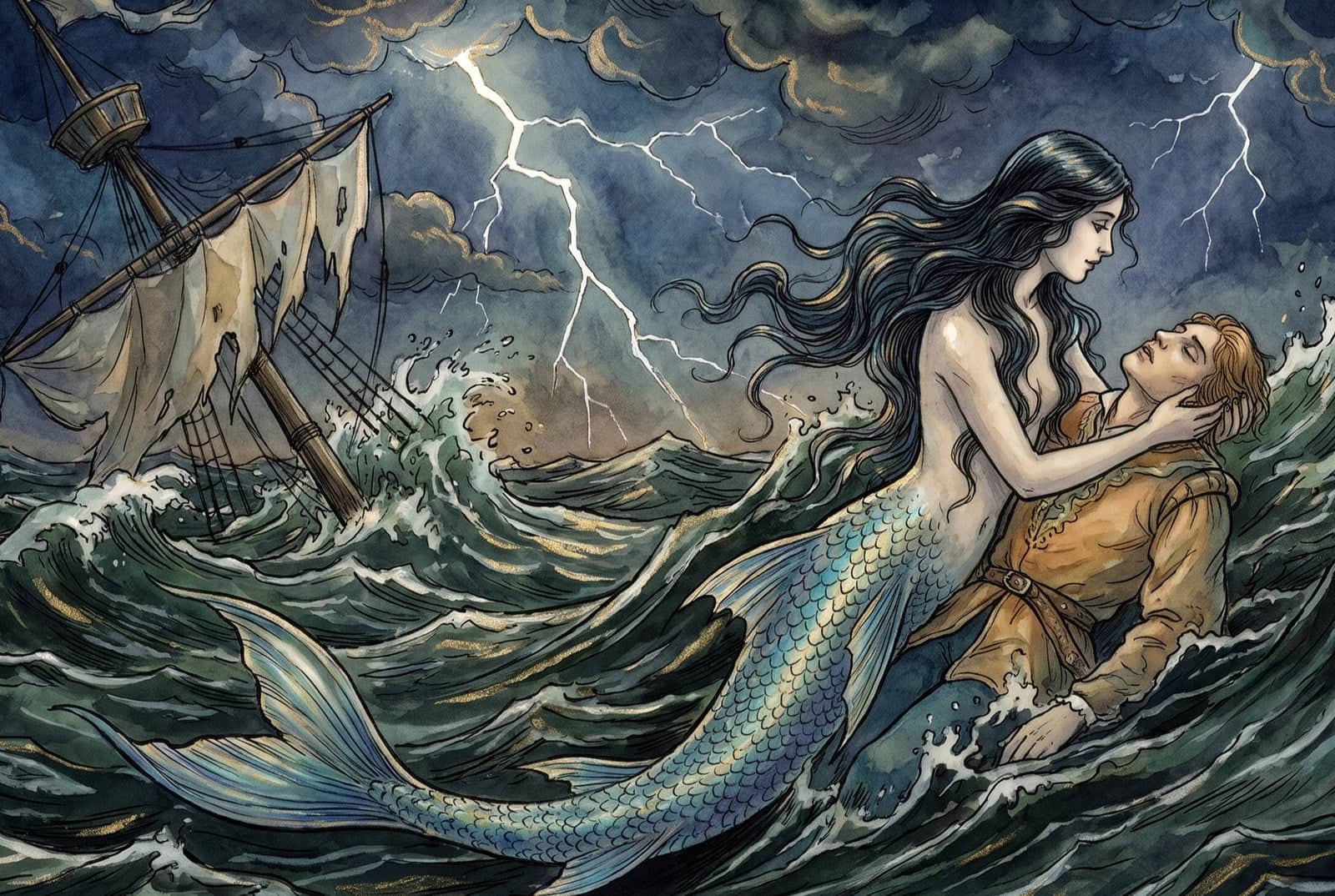
In the morning not a plank of the ship was left. The sun brought the color back into the prince’s face, but his eyes stayed closed. She kissed his forehead and laid him on the fine sand of a quiet bay. Bells rang in a white building nearby, and she hid among the rocks. A girl found him and ran for help, and the little mermaid saw the prince open his eyes and smile at the people around him. He had no smile for her, for he did not know who had saved him, and sorrowfully she swam home.
Evening after evening she rose to the place where she had left him, but she never saw the prince, and her garden grew wild. At last she told her sisters, and one of them knew where the prince’s palace stood.
“Come, little sister,” said the others, and they linked arms and rose to the surface close by the place.
After that she spent many an evening below his marble steps, watching the prince in the moonlight. She loved human beings more and more, and wished she could walk among them, so she went to her old grandmother.
“If people are not drowned,” she asked, “do they live forever?”
“They die too,” said the old lady, “and sooner than we do. We live three hundred years, and when we come to an end we turn into foam on the water. People have a soul that lives on after the body is dust, and rises past the stars into a glorious place we shall never see.”
“I would give all my hundreds of years to be a human being for a single day,” said the little mermaid. “Is there nothing I can do to win an undying soul?”
“Only this,” said the old lady. “If a man loved you more than his father and mother, and he let a priest lay his right hand in yours, then his soul would flow into your body and you would share in the happiness of human beings. But that can never happen.”
The little mermaid sighed and looked at her tail.
“Let us be cheerful,” said her grandmother. “This evening there is a ball at court.”
In the crystal hall, where blue fire burned in great shells, the little mermaid sang more sweetly than anyone. But she was thinking of the prince and of the soul she did not have, and she slipped out while the singing went on. “I will go to the sea witch,” she thought. “I have always been afraid of her, but perhaps she can help me.”
So she set out for the roaring whirlpools behind which the witch lived. Beyond them lay warm bubbling mud, and then a wood where every tree was a polyp, with slimy arms that held fast whatever the sea brought them: oars and rudders and white bones. She nearly turned back, but she thought of the prince and darted through as a fish shoots through the water.
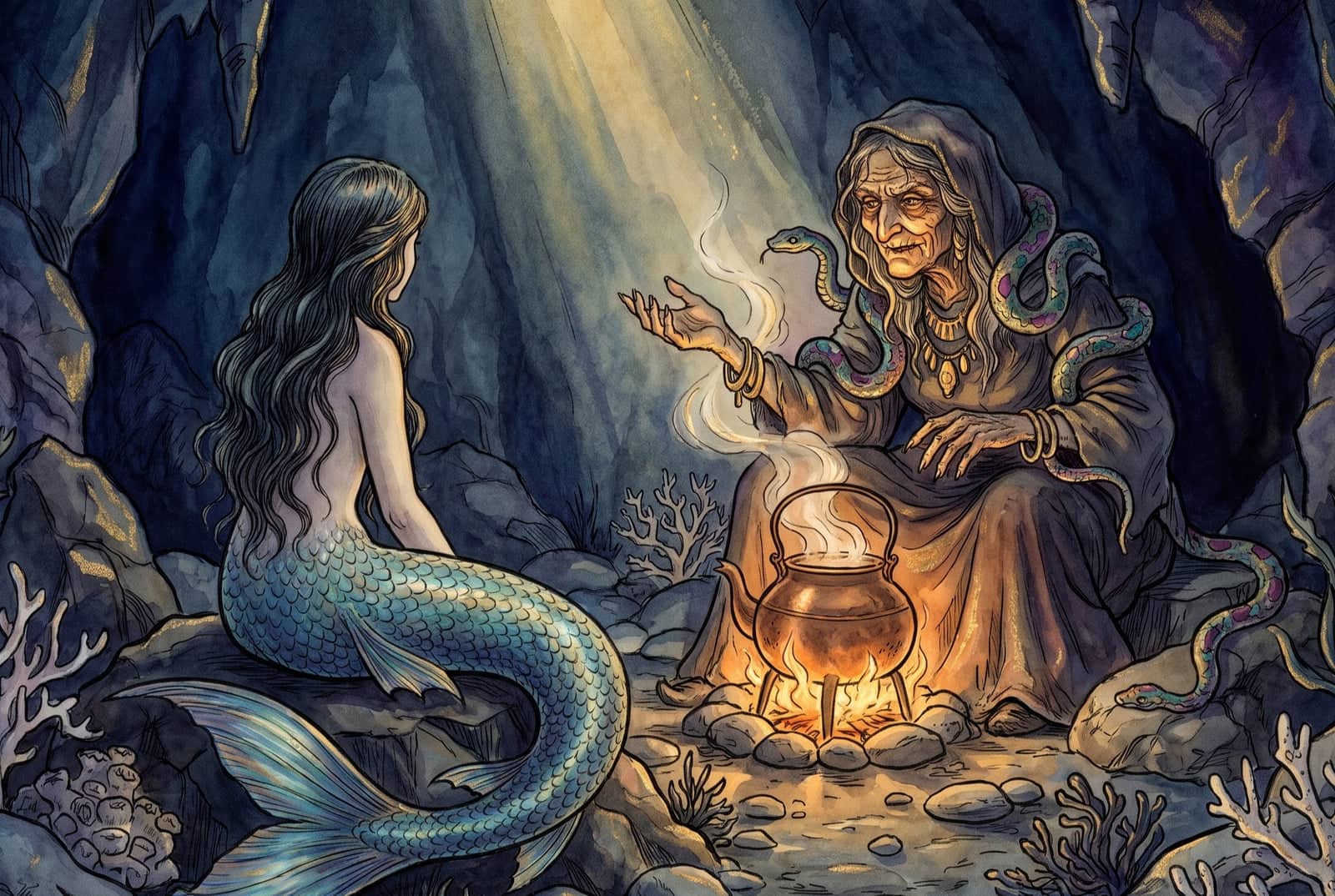
In a clearing stood a house built from the bones of drowned sailors, and there sat the sea witch, with fat water snakes crawling over her.
“I know what you have come for,” said the witch. “It is a foolish wish, and it will bring you sorrow. Swallow my drink on the shore before sunrise, and your tail will shrink into what people call legs. It will hurt as if a sword went through you, and at every step afterwards it will feel as though you walked on sharp knives. If you can bear that, I will help you.”
“I can bear it,” said the little princess, and her voice shook.
“But think again. Once you take a human shape you can never be a mermaid, and never come back to your father’s palace. And if the prince does not marry you, you will never have an undying soul. On the first morning after he marries another, your heart will break and you will become foam on the water.”
“I will do it,” said the little mermaid, and she went pale as death.
“But I must be paid, and what I ask is not a small thing. You have the sweetest voice down here. That voice you must give to me.”
“If you take my voice,” said the little mermaid, “what is left to me?”
“Your lovely face, the way you move, and your speaking eyes. With those you can win any heart. Well, have you lost your courage?”
“Let it be so,” said the little mermaid.
Then the witch set her kettle on the fire, and when the drink boiled it sounded like an animal weeping. She took the little mermaid’s voice away, so that she could never speak or sing again.
She did not dare go home to her father’s palace, now that she was silent and was leaving her family forever. She stole into the garden, took one flower from each of her sisters’ beds, and rose up through the dark water.
The sun had not yet risen when she climbed the prince’s marble steps and drank. It was as if a sword went through her, and she fell down as though dead. When the sun rose she woke, and the prince stood before her. Her tail was gone, and she had the prettiest little white feet a girl could have. He asked who she was, and she could only look at him, for she had no voice. Every step was as the witch had promised, but she bore it and walked at his side as lightly as a bubble.
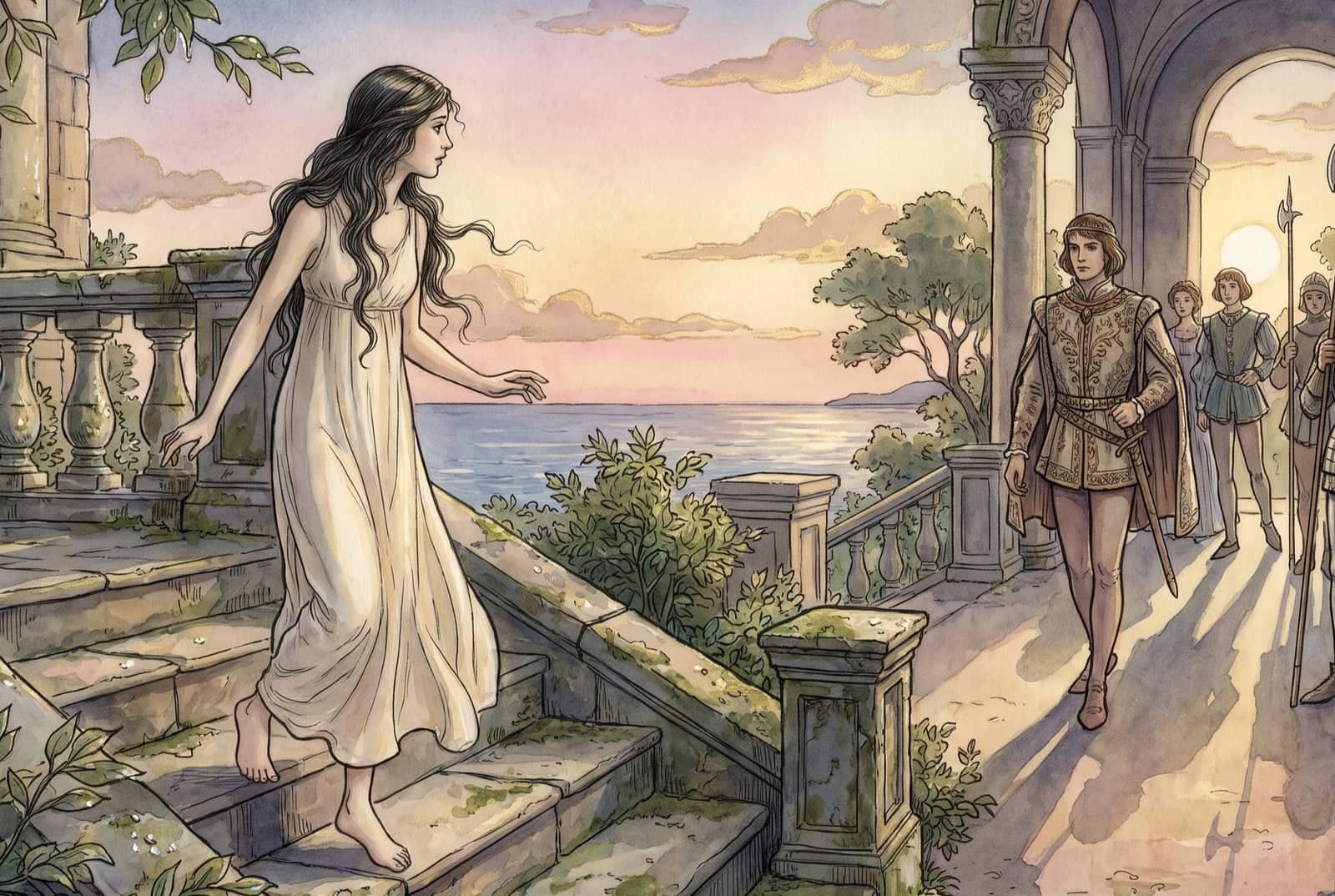
Girls in silk and gold sang before the prince, and that grieved her, for she knew how much more sweetly she had once sung. Then she rose on the tips of her toes and danced as no one had ever danced. The prince called her his little foundling, and she danced again to please him, though each step was like treading on knives.
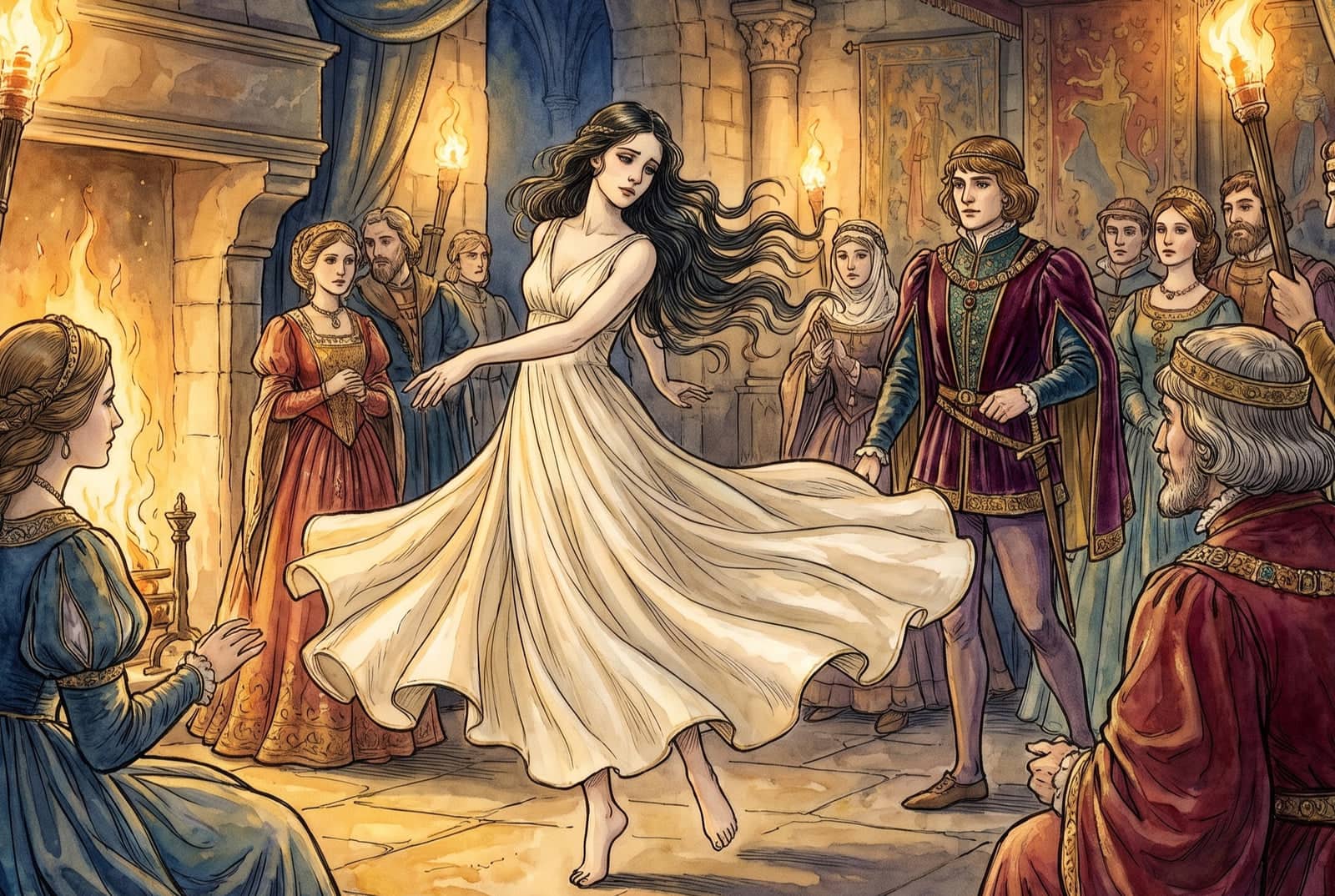
She slept on a velvet cushion outside his door, and he had a page’s suit made for her, so that they could ride out together into the mountains. Her feet hurt more than anyone knew, but she only laughed and followed him. Her sisters came up arm in arm to sing to her, and once she saw her old grandmother and the Sea King himself far off.
Day by day she grew dearer to the prince, and he loved her as one loves a good child; but it never entered his head to make her his wife, and unless he married her she could never have an undying soul.
“Do you not love me best of all?” her eyes seemed to ask, when he took her in his arms and kissed her forehead.
“You are the dearest to me,” said the prince, “for you have the kindest heart. And you are like a girl I once saw. I was on a ship that was wrecked, and the waves carried me ashore near a holy temple. The youngest of the girls who serve there found me and saved my life. She is the only one I could love, but you are so like her that my good fortune has sent you to me instead.”
“He does not know that it was I who saved his life,” thought the little mermaid. She sighed, for she could not weep. “But that girl will never leave the temple, and I am beside him every day. I will love him and give my life for him.”
Soon it was said that the prince must marry the daughter of a neighboring king. “My parents wish me to see her,” he told the little mermaid, “but they will not make me bring her home as my bride. If I ever had to choose, I would sooner choose you, my silent foundling with the speaking eyes.”
One night, as they sailed to the neighboring kingdom, she looked down through the water and thought she could make out her father’s castle. Then her sisters rose on the waves and wrung their white hands. She waved and smiled, but the cabin boy came along, and they dived.
The next morning the ship sailed into a beautiful harbor. The princess had been brought up in a holy house, people said; and when at last she came, the little mermaid had to admit that she had never seen a lovelier face.
“It was you,” said the prince, “who saved my life when I lay on the shore,” and he took his blushing bride in his arms. “I am too happy. You will be glad for me,” he said to the little mermaid, “for you love me more than anyone does.”
She kissed his hand, and it seemed to her that her heart was breaking already, for the morning after his wedding would be the end of her. All the bells rang, and the little mermaid carried the bride’s train; but she heard nothing of the music, for she was thinking of the night that was coming.
That evening they came aboard the ship. When it grew dark the sailors danced, and the little mermaid danced with them, turning in the air like a swallow. Her feet hurt as though they were cut, but a sharper pain was in her heart, for this was the last evening she would see him.
Long after midnight only the helmsman stood awake. The little mermaid leaned on the rail and looked east for the first light of morning, which would be the end of her. Then her sisters rose out of the water, as pale as she was, and their long hair had been cut away.
“We have given our hair to the witch,” they said, “so that she would help you tonight. She has given us a knife. Before the sun rises you must strike the prince with it, and then your feet will grow together into a fish’s tail again, and you will come back to us and live out your three hundred years. Be quick. Do you not see the red streaks in the sky?” Then they sighed and sank beneath the waves.
She drew back the curtain of the bridal tent and saw the bride asleep with her head on the prince’s breast. She bent down and kissed his forehead, and looked at the brightening sky, and then at the knife, and then at the prince, who was whispering his bride’s name in his sleep. The knife trembled in her hand. Then she flung it far out into the waves, and threw herself from the ship into the sea.
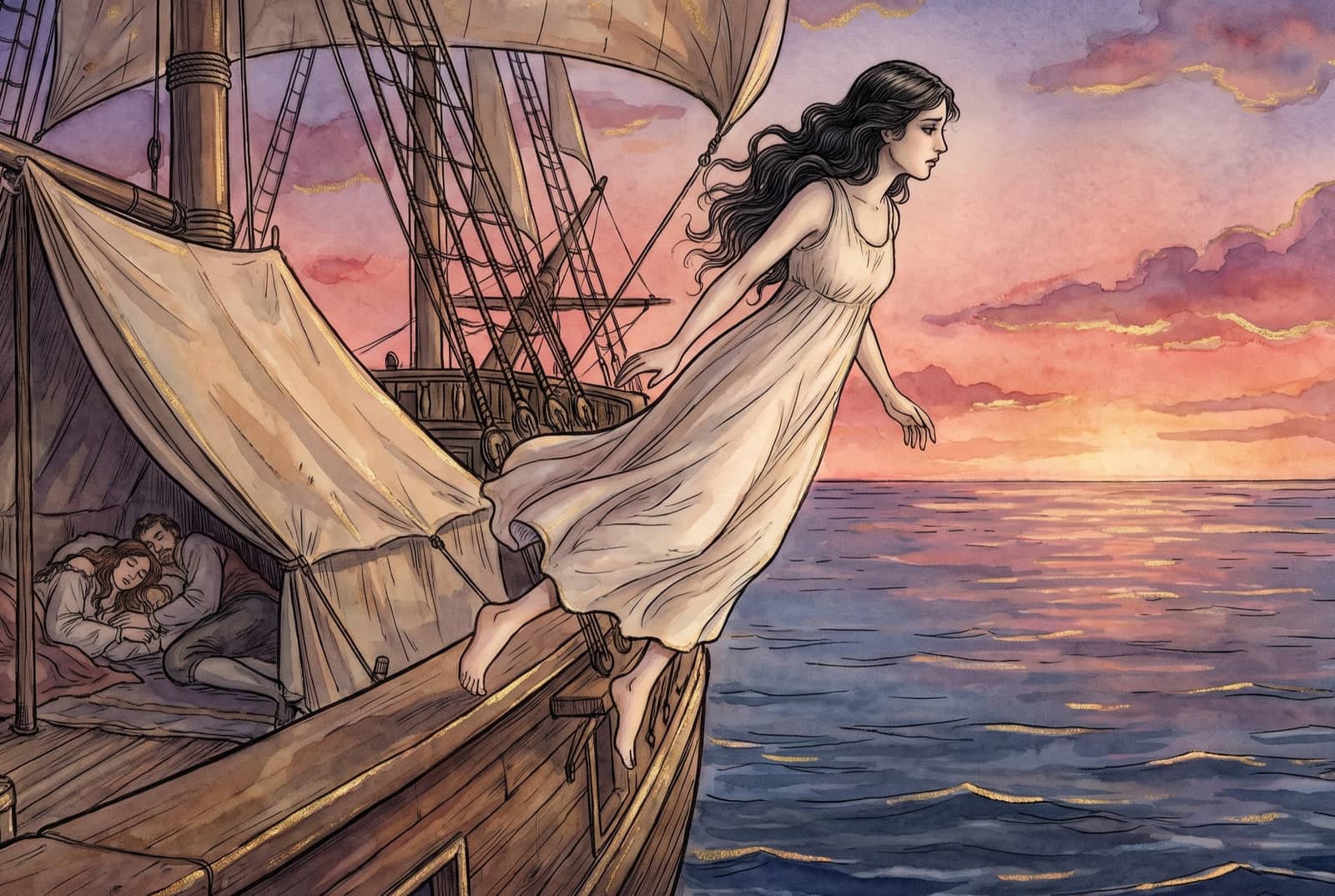
The sun rose, and its warm rays fell on the cold foam, and the little mermaid did not feel that she was dying. Above her floated hundreds of lovely transparent beings; she could see the white sails of the ship straight through them. She had a body like theirs, and she was rising higher and higher out of the foam.
“Where am I?” she asked, and her own voice sounded like theirs, so beautiful that no music on earth could match it.
“Among the daughters of the air,” one of them answered. “A mermaid can win an undying soul only if a human being loves her. We have no soul either, but we can make one for ourselves by our good deeds. We fly to hot countries and cool the air that carries sickness, and we spread the scent of flowers. When we have striven for three hundred years to do all the good we can, we are given an undying soul. You have striven with your whole heart, just as we do, and now you may win one in the same way.”
The little mermaid lifted her clear eyes toward the sun, and for the first time she felt them filling with tears. On the ship the prince and his bride were searching for her, gazing sadly at the pearly foam. Unseen, she kissed the bride’s forehead and fanned a cool breath over the prince, and rose with the other children of the air to a rosy cloud.
“After three hundred years we shall float like this into the kingdom of heaven,” she said.
“And we may get there sooner,” whispered one of her companions. “We fly unseen into houses where there are children, and for every good child we find, a year is taken from our three hundred. But when we see an unkind child we must weep, and every tear adds a day to our waiting.”
Retold by Talerie from Fairy Tales of Hans Christian Andersen (opens in a new window)Public domainCopy this text, adapt it, use it however you like. A link back to Talerie is appreciated but never required.CC0 1.0 (opens in a new window)