The Fisherman and His Soul
15 min readages 9 and uptalerie.com/en/tales/the-fisherman-and-his-soul
A young Fisherman cuts away his Soul to live under the sea with the little Mermaid he loves, but the Soul later lures him back and leads him into evil. When the Mermaid dies, the Fisherman drowns holding her, and strange white flowers from their grave move the Priest to bless the sea.
Every evening the young Fisherman went out on the sea and threw his nets into the water. One evening the net was so heavy that he could hardly haul it in, and when it rose at last, there was no fish in it at all, only a little Mermaid, fast asleep. Her hair was like a wet fleece of gold, her body was as white as ivory, and her tail was silver and pearl.
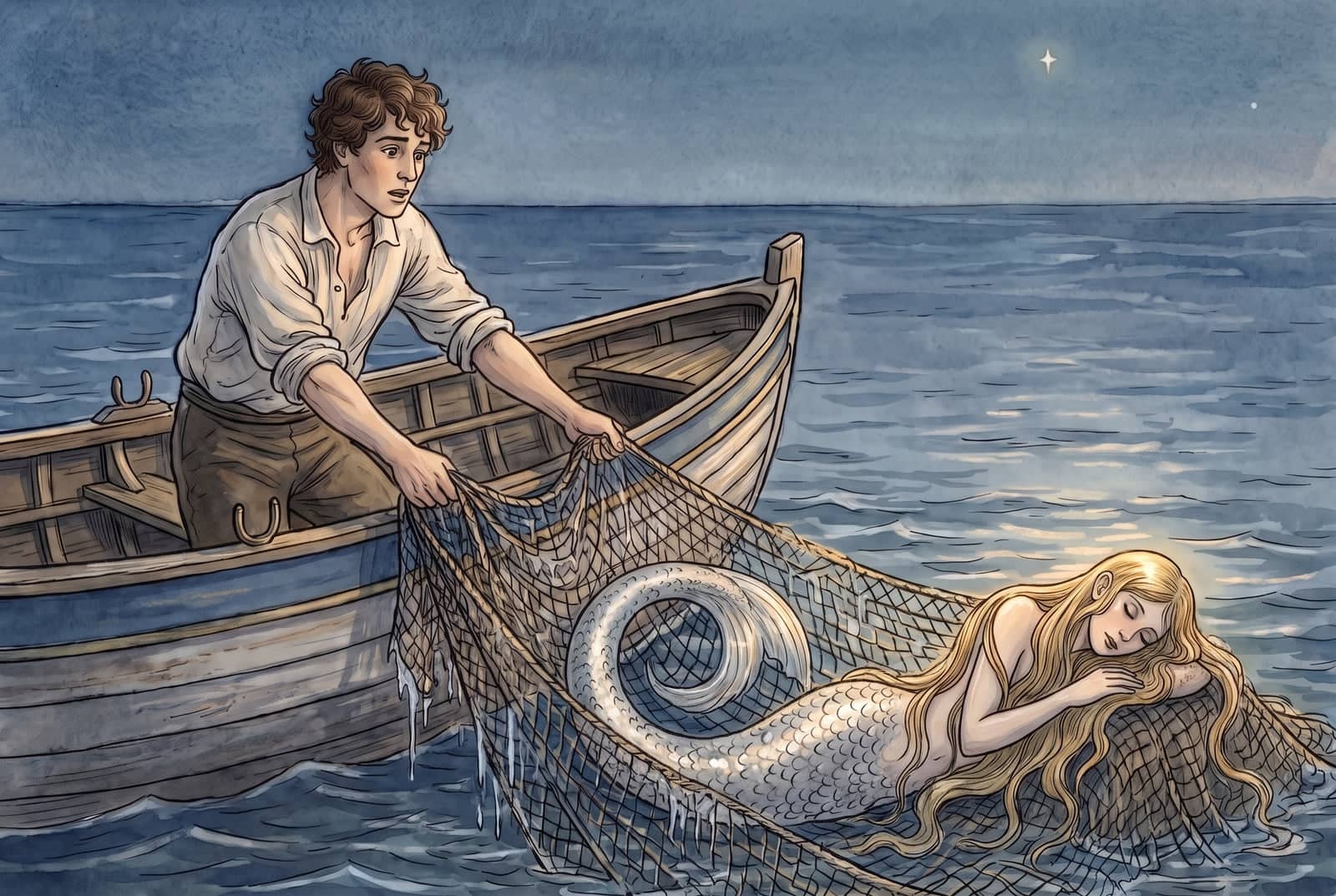
She was so beautiful that he took her in his arms. She woke with a cry like a startled gull and stared at him in terror with her mauve-amethyst eyes.
“Please let me go,” she said, weeping. “I am the only daughter of a king, and my father is old and alone.”
“I’ll let you go if you promise to come and sing to me whenever I call,” said the young Fisherman. “The fish love the song of the Sea-folk, and my nets will be full.”
So she swore it by the oath of the Sea-folk. He let her go, and she sank into the water, trembling with a strange fear.
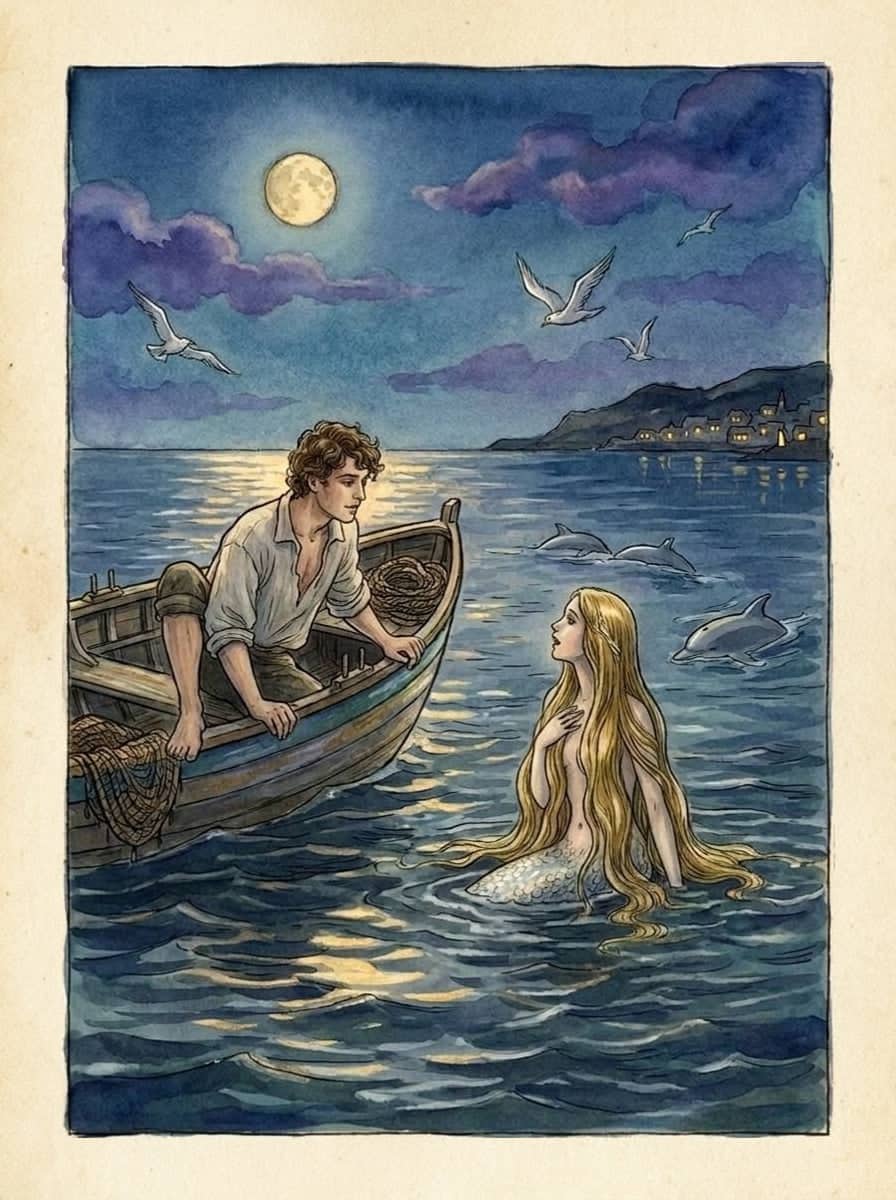
After that, every evening he called to her, and she rose from the sea and sang of the Tritons with long green beards, of the Sea-King’s palace of amber with its roof of emerald, and of the Mermen who play on harps. The fish came in from the deep to listen, and his nets were full.
But she would never come close enough for him to touch her. Her voice grew so sweet to him that he forgot his nets and his trade. He sat idle in his boat, listening, until the moon silvered his brown arms.
One evening he called, “Little Mermaid, little Mermaid, I love you. Take me for your bridegroom.”
She shook her head. “You have a human soul. If only you would send your soul away, then I could love you.”
“What use is my soul to me?” the young Fisherman said to himself. “I cannot see it. I may not touch it. I do not know it.” And he promised her that he would send it away and live with her at the bottom of the sea.
The little Mermaid laughed with pleasure and hid her face in her hands. But when he asked how it could be done, she said, “I don’t know. The Sea-folk have no souls,” and sank into the deep.
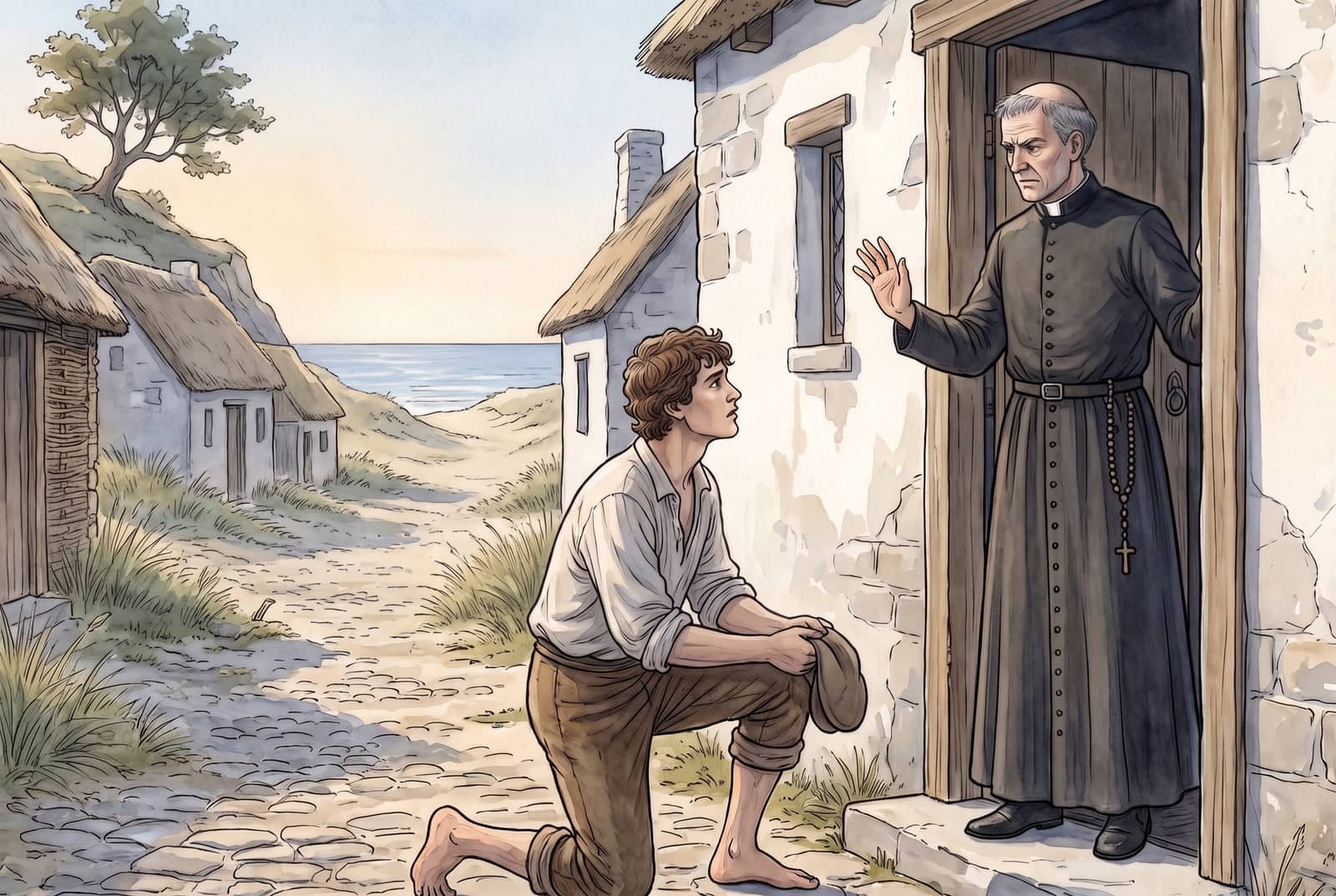
Early the next morning he went to the Priest and knelt before him. “Father, I love one of the Sea-folk, and my soul stands in my way. Tell me how to send it away. I cannot see it. I may not touch it. I do not know it.”
The Priest beat his breast. “The soul is worth all the gold in the world,” he said. “Put this out of your mind, my son, for it is a sin that cannot be forgiven. The Sea-folk are lost, and whoever has dealings with them is lost too. Cursed be the singers of the sea!” He gave him no blessing and drove him from his door.
Sadly the young Fisherman went down to the market-place and offered his soul to the merchants. “I cannot see it. I may not touch it. I do not know it.”
But they laughed at him. “A man’s soul isn’t worth a clipped piece of silver,” they said.
“How strange,” he thought. “The Priest says a soul is worth all the gold in the world, and the merchants say it isn’t worth a clipped piece of silver.”
At noon he remembered a young Witch who lived in a cave at the head of the bay, and he ran there at once. She knew he was coming, and she laughed and let down her red hair.
“What do you lack? What do you lack?” she cried. “Fish for your net? A storm to wash a ship’s treasure ashore? I serve one who is stronger than the wind. But it has a price, pretty boy, it has a price.”
“I want to send my soul away,” said the young Fisherman. “I cannot see it. I may not touch it. I do not know it.”
The Witch went pale. “Pretty boy, that is a terrible thing to do.”
He offered her his nets, his house, and his painted boat, but she only laughed.
“The one I serve is richer than all the kings of the world,” she said. “You must dance with me, pretty boy. Tonight there is a Sabbath on the mountain, and He will be there.” And she swore by the hooves of the goat to tell him the secret afterward.
The young Fisherman ran home full of joy. In her cave the Witch looked into her mirror and clenched her fists. “He should have been mine,” she muttered. “I am as fair as she is.”
That night he climbed the mountain and waited under a hornbeam tree. At midnight the witches came flying like bats, and last of all came the young Witch with her red hair streaming. She led him into the moonlight, and they danced round and round until the earth spun beneath him.

Then he noticed a man in black velvet standing in the shadow of a rock. His face was pale, his lips were like a proud red flower, and his eyes followed the young Fisherman everywhere. A dog howled, the dancers stopped, and two by two they knelt and kissed the man’s hands.
“Come, let us worship,” whispered the Witch. But as the young Fisherman drew near, he made the sign of the Cross without knowing why. The witches screamed like hawks and flew away, and the man in black velvet rode off, looking back at him sadly.
The Witch tried to fly too, but the young Fisherman caught her by the wrists. She wept and pressed her face to his, whispering that she was as fair as any daughter of the sea.
He pushed her away. “Keep your promise, or I will kill you for the false witch you are.”
She turned gray and gave him a little knife with a handle of green viper’s skin. “What men call the shadow of the body is the body of the soul,” she said. “Stand on the shore with your back to the moon, cut your shadow away from your feet, and tell your soul to leave you.”
So he went down to the shore and stood with his back to the moon, and his shadow lay before him.
“If you must send me away,” said his Soul, “give me your heart to take with me. The world is cruel, and I am afraid.”
“My heart belongs to my love,” he answered, and with the little knife he cut away his shadow. It rose up and stood before him, and it looked just like him.
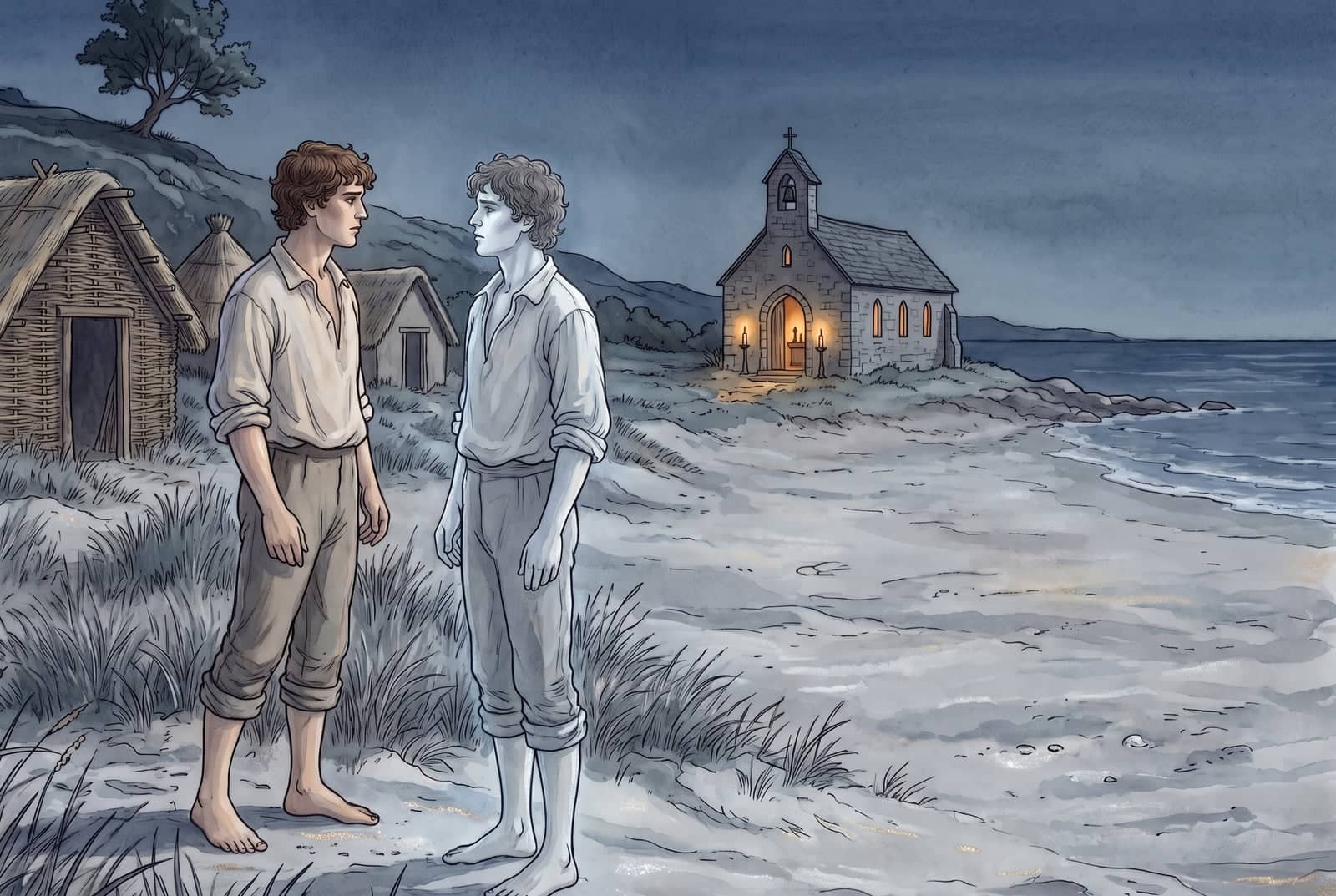
“Once every year I will come to this place and call you,” said the Soul.
The young Fisherman plunged into the water, and the little Mermaid rose to meet him and kissed him. The Soul watched from the lonely beach, and then went away weeping over the marshes.
When a year had passed, the Soul came to the shore and called. The young Fisherman rose from the deep and said, “Why do you call to me?”
“Come nearer, that I may speak with you, for I have seen marvelous things,” said the Soul.
So he lay in the shallow water and listened. The Soul had gone East with a caravan, and the chief of the caravan showed it the heads of five men cut off in battle. In a temple far away it withered a priest’s hand and blinded him, and it healed him only when he promised to show it his god: the Mirror of Wisdom. “I have hidden it a day’s journey from here,” said the Soul. “Let me come back into you, and you will be wiser than all the wise men.”
“Love is better than Wisdom,” cried the young Fisherman, “and the little Mermaid loves me.”
“There is nothing better than Wisdom,” said the Soul.
“Love is better,” answered the young Fisherman, and he plunged into the deep, and the Soul went away weeping.
When the second year had passed, the Soul came to the shore and called. The young Fisherman rose from the deep and said, “Why do you call to me?”
“Come nearer, that I may speak with you, for I have seen marvelous things,” said the Soul.
So he lay in the shallow water and listened. The Soul had gone South, to an Emperor whose slave struck at it with a great scimitar, but the blade passed through it without harming it. The Emperor killed the slave so that the man could never tell of his master’s shame. Afterward the Emperor offered the Soul half his treasure, but it took only a little leaden ring. “It is the Ring of Riches, and I have hidden it a day’s journey from here,” said the Soul. “Take it, and you will be richer than all the kings of the world.”
“Love is better than Riches,” cried the young Fisherman, “and the little Mermaid loves me.”
“There is nothing better than Riches,” said the Soul.
“Love is better,” answered the young Fisherman, and he plunged into the deep, and the Soul went away weeping.
When the third year had passed, the Soul came to the shore and called. The young Fisherman rose from the deep and said, “Why do you call to me?”
“Come nearer, that I may speak with you, for I have seen marvelous things,” said the Soul.
So he lay in the shallow water and listened. “In a city a day’s journey from here,” said the Soul, “a girl dances at an inn by a river. Her face is veiled, but her feet are bare, and they move over the carpet like little white pigeons.”
Then the young Fisherman remembered that the little Mermaid had no feet and could not dance. “It is only a day’s journey,” he thought, “and I can come back to my love.” He strode out of the water and held out his arms, and his Soul ran to him with a cry of joy and went back into him.
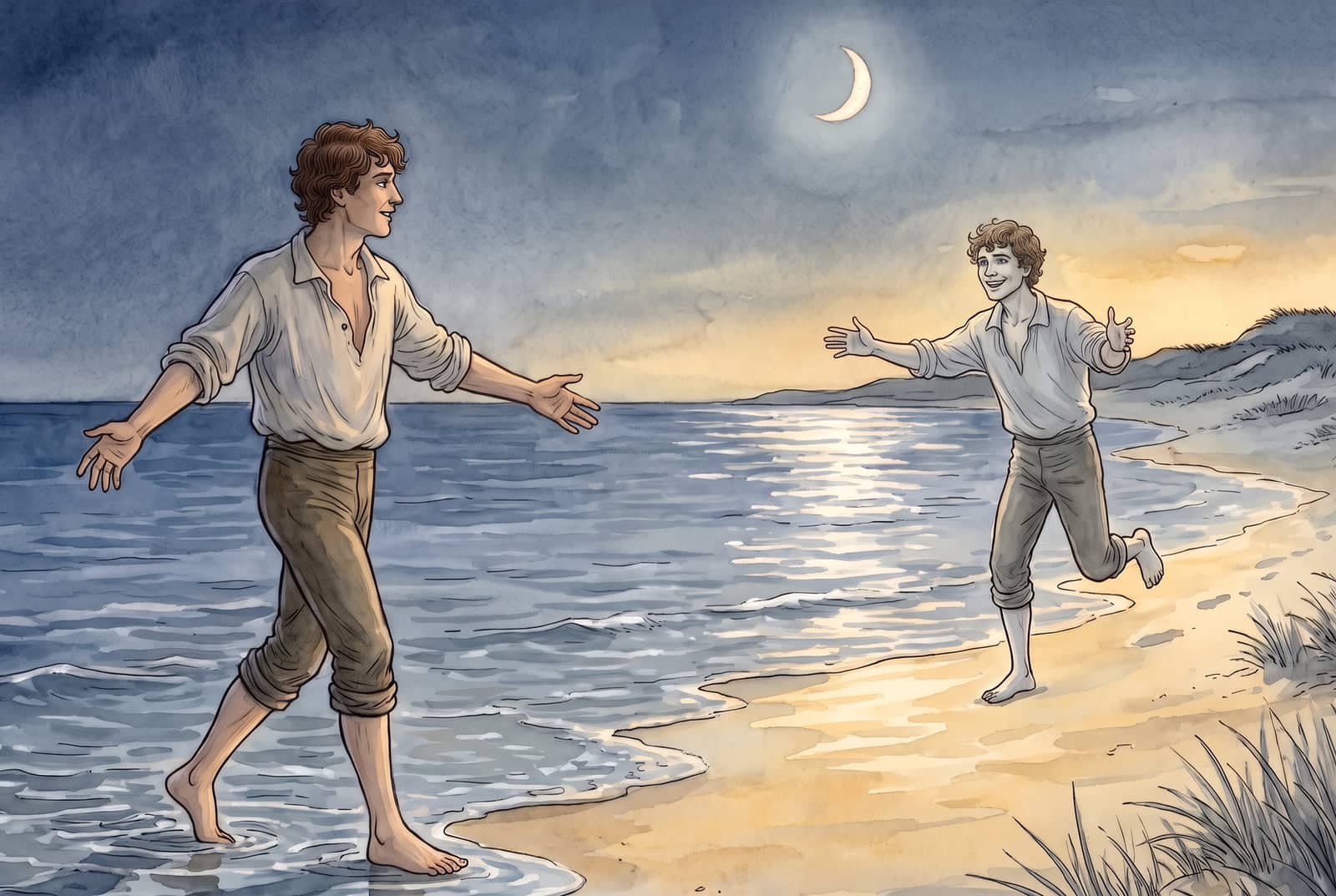
They traveled all night and all day, and in the evening they came to a city. In the Street of the Jewelers his Soul told him to steal a silver cup, and he did. Outside the city he threw the cup away and asked, “Why did you make me do such an evil thing?”
“Be at peace, be at peace,” answered his Soul.
In the second city his Soul told him to strike a child who stood by a jar of water, and he beat the child until it cried. Outside the city he asked again, “Why did you make me do such an evil thing?”
“Be at peace, be at peace,” answered his Soul.
In the third city there was no river and no inn. A kind merchant took the young Fisherman home and gave him a bed. But before dawn his Soul told him to kill the merchant and rob him. The young Fisherman crept into the merchant’s room, but the merchant woke, and the young Fisherman struck him down, took the nine purses of gold, and fled.
Outside the city he beat his breast. “Why did you make me do such an evil thing?”
“Be at peace, be at peace,” answered his Soul.
“I cannot be at peace!” cried the young Fisherman. “I hate everything you have made me do.”
“When you sent me into the world, you gave me no heart,” said his Soul. “So I learned to do all these things and to love them.”
The young Fisherman threw down the purses. He turned his back to the moon and tried once more to cut his shadow away with the little knife.
But his Soul did not stir. “A man may send his soul away once in his life,” it said, “but whoever takes it back must keep it forever. The Witch never told you that, for she is true to the one she serves.”
The young Fisherman fell on the ground and wept. When day came, he tied his hands so that he could not do his Soul’s bidding, sealed his lips so that he could not speak its words, and went back to the little bay.
There he untied his hands, unsealed his lips, and called to the little Mermaid, but she did not come. He built a hut in a cleft of the rock and stayed. Every morning he called to the Mermaid, every noon he called her again, and at night he spoke her name. For a year his Soul tempted him with evil, and for another year with good, but he would not listen, so great was his love.
At the end of the second year the Soul said, “Let me enter your heart, so that I may be one with you again.”
“Surely you may come in,” said the young Fisherman.
“I can find no way in,” cried his Soul. “Your heart is too full of love.”
Just then a great cry of mourning came from the sea. The young Fisherman ran down to the shore, and the black waves laid something whiter than silver at his feet. It was the little Mermaid, and she was dead.
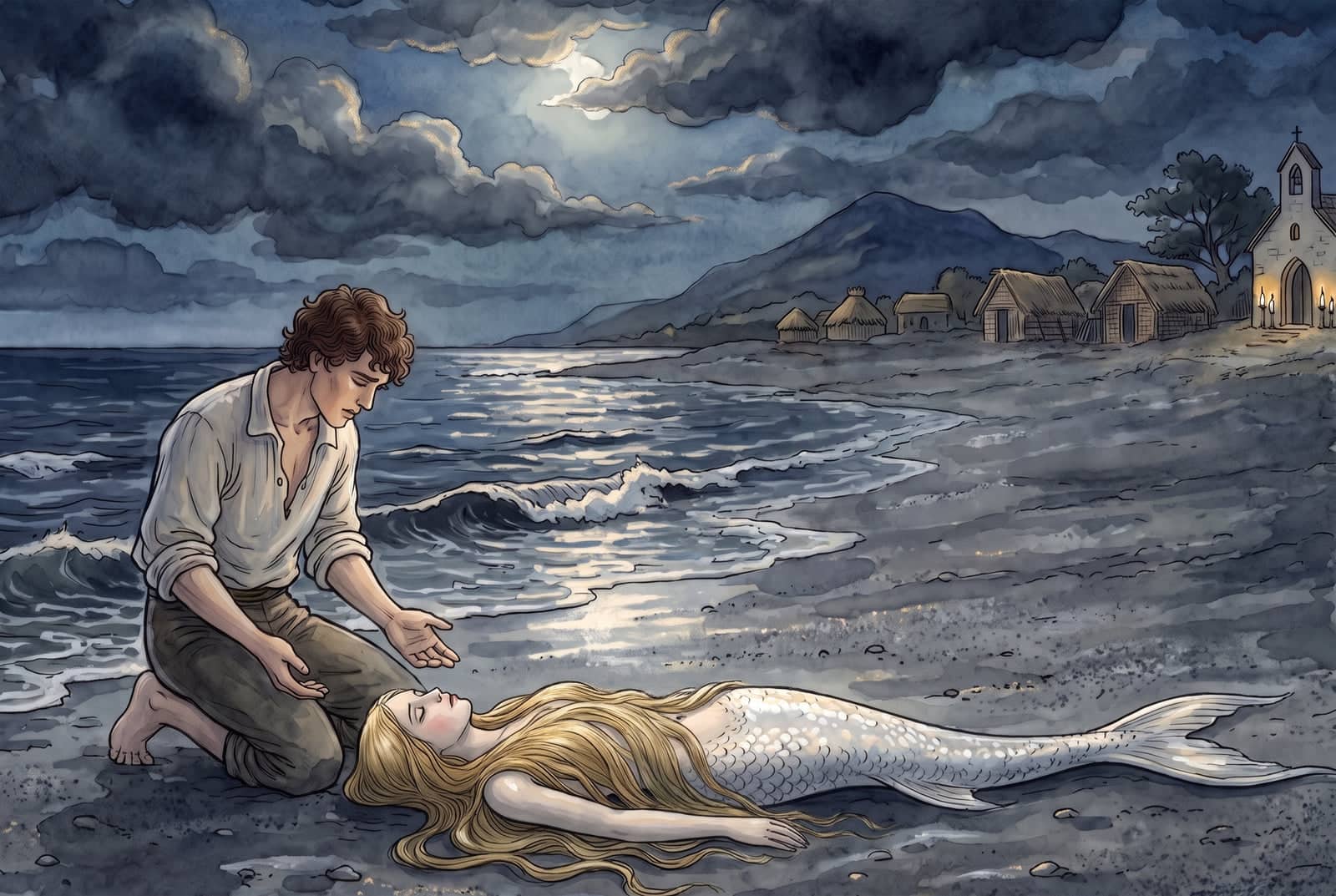
He threw himself down beside her and kissed her cold lips. The sea came nearer, and his Soul begged him to run.
But he stayed. “Love is better than wisdom,” he told her, “and more precious than riches, and fairer than the feet of the daughters of men. Now that you are dead, I will die with you.”
As the waves rose around him, he kissed her cold lips again, and his heart broke from the fullness of his love. Through the break the Soul found its way in and was one with him as before. And the sea covered the young Fisherman with its waves.
In the morning the Priest came down to bless the sea and found the young Fisherman drowned on the shore with the little Mermaid in his arms. He drew back and cursed them both, and he would not bless the sea. He had them buried in the corner of the Fullers’ Field with no mark above them, so that no one would know where they lay.
Three years later, on a holy day, the Priest went to the chapel to preach about the wrath of God. But the altar was covered with strange white flowers that no one had ever seen before, and their beauty troubled him. Other words came to his lips, and he spoke not of the wrath of God but of the God whose name is Love, and he did not know why.
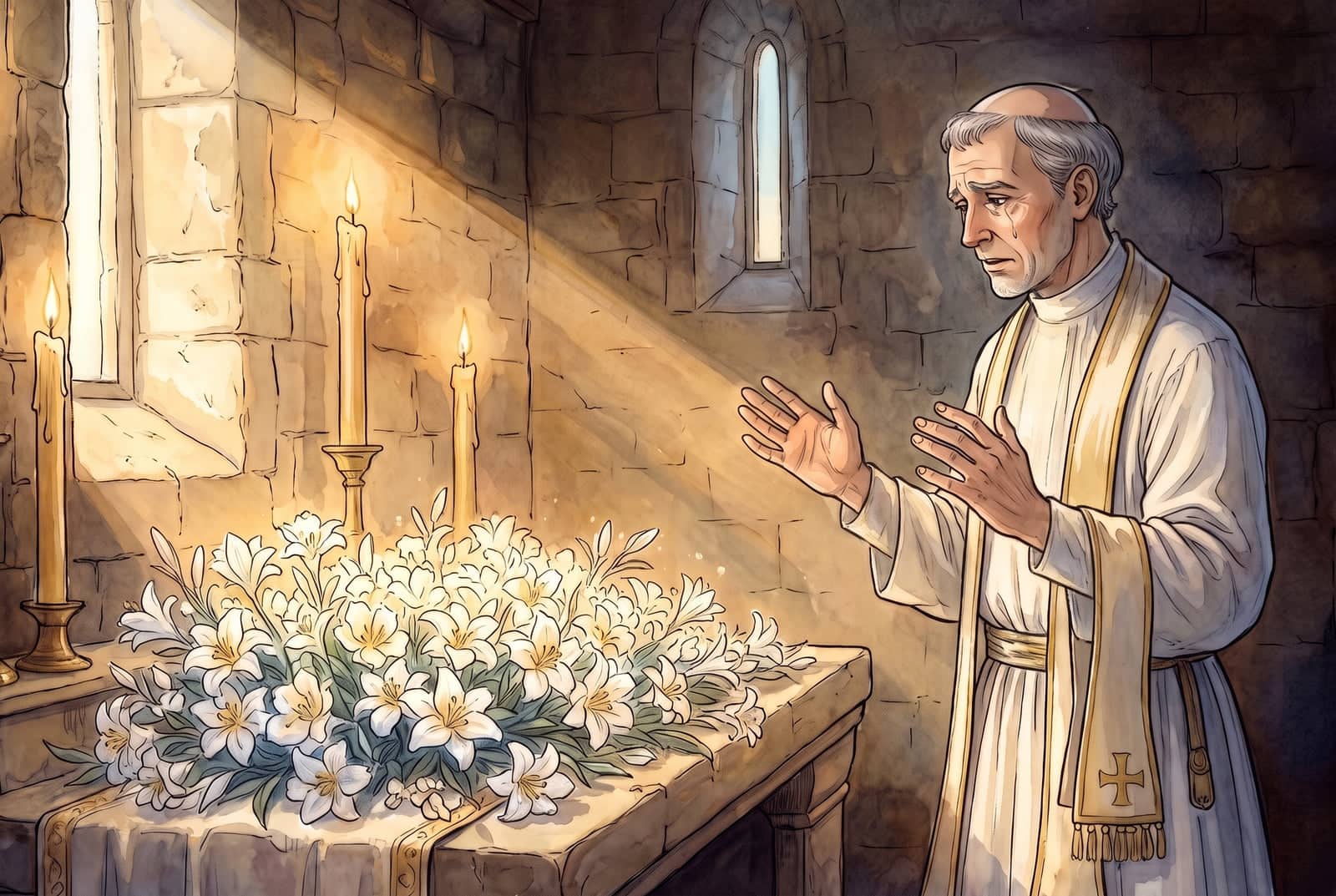
“Where do those flowers come from?” he asked afterward.
“From the corner of the Fullers’ Field,” the deacons told him.
The Priest trembled, and he went home and prayed.
At dawn the next day he went down to the shore and blessed the sea and all the wild things in it, and the Fauns of the woods, and everything in God’s world.
Yet no flowers ever grew in that corner of the Fullers’ Field again. And the Sea-folk never came back into the bay, for they had gone away to another part of the sea.
Retold by Talerie from A House of Pomegranates (opens in a new window)License: Public domainCopy this text, adapt it, use it however you like. A link back to Talerie is appreciated but never required.CC0 1.0 (opens in a new window)