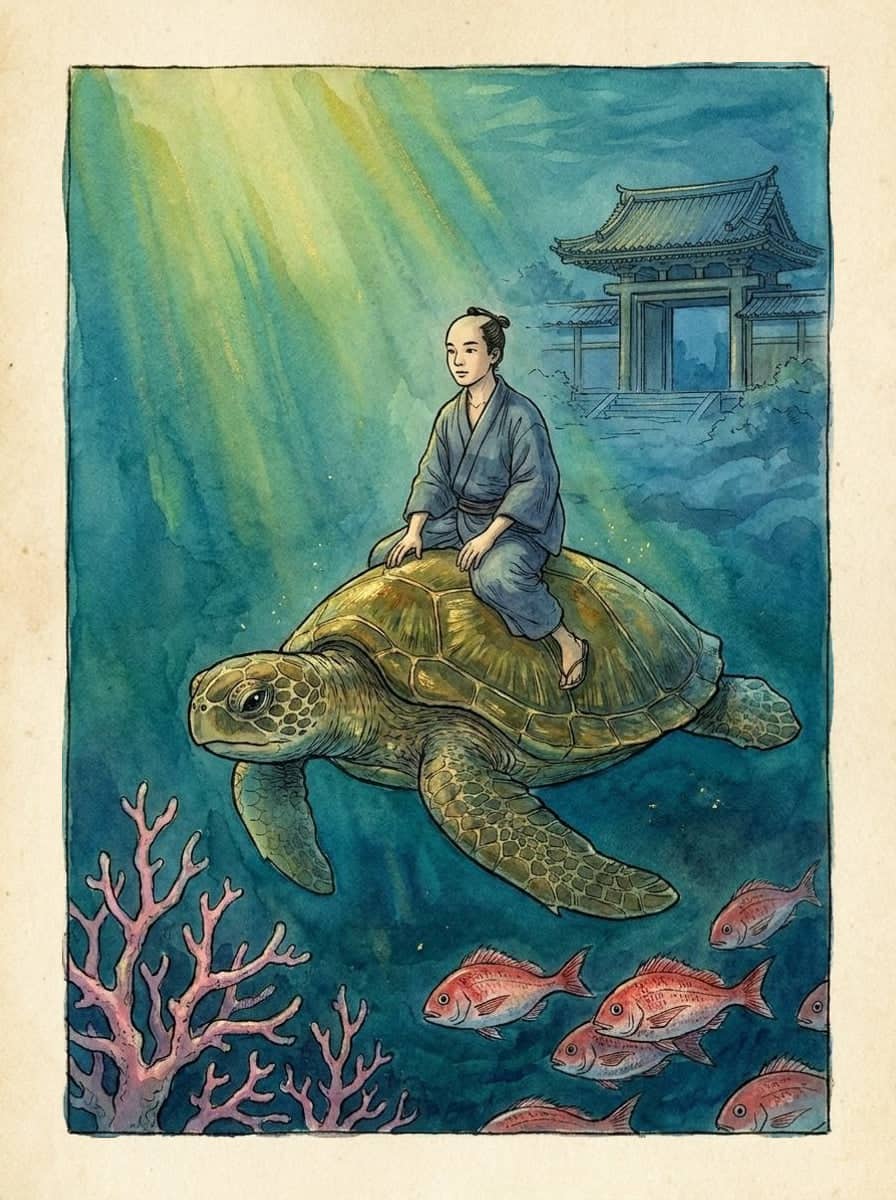
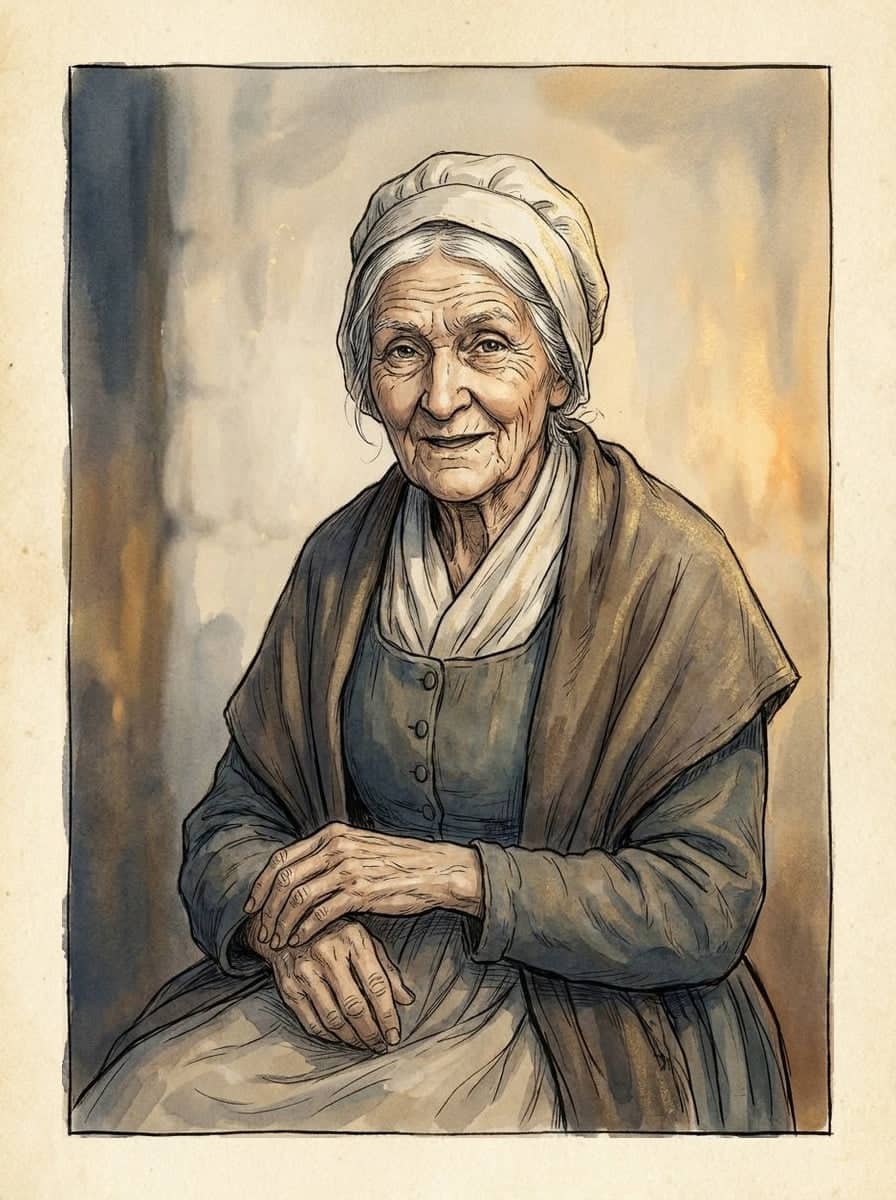
Urashima Taro, a kind young fisherman, rescues a tortoise and is carried down to the Dragon King’s palace, where the princess becomes his bride. Back home he learns that three hundred years have passed, and on the beach he opens the box the princess told him never to open, grows very old and dies.
Long, long ago, in the little fishing village of Mizunoe on the shore of Japan, there lived a young fisherman named Urashima Taro. He was the best fisherman in all the countryside.
But the village knew him best for his kind heart. In all his life he had never hurt a living thing, great or small. As a boy he would never join the other children in teasing animals, and they had laughed at him for it.
One soft summer evening, Urashima was walking home from a day at sea when he came upon a crowd of shouting children. They had caught a tortoise. One boy pulled it this way, another pulled it that way, and two more were poking and banging at its shell.
“Look here, boys,” said Urashima. “You are treating that tortoise so badly that it will soon die!”
“Who cares?” called one of the older boys. “Come on, keep going!”
Urashima smiled at them. “I’m sure you are all good, kind boys. Won’t you give me the tortoise?”
“Why should we?” said another. “We caught it ourselves.”
“That’s true,” said Urashima. “So I’ll buy it from you.” He held up a string of coins, threaded through the holes in their centers. “You can buy anything you like with these. They’re worth much more to you than a poor tortoise.”
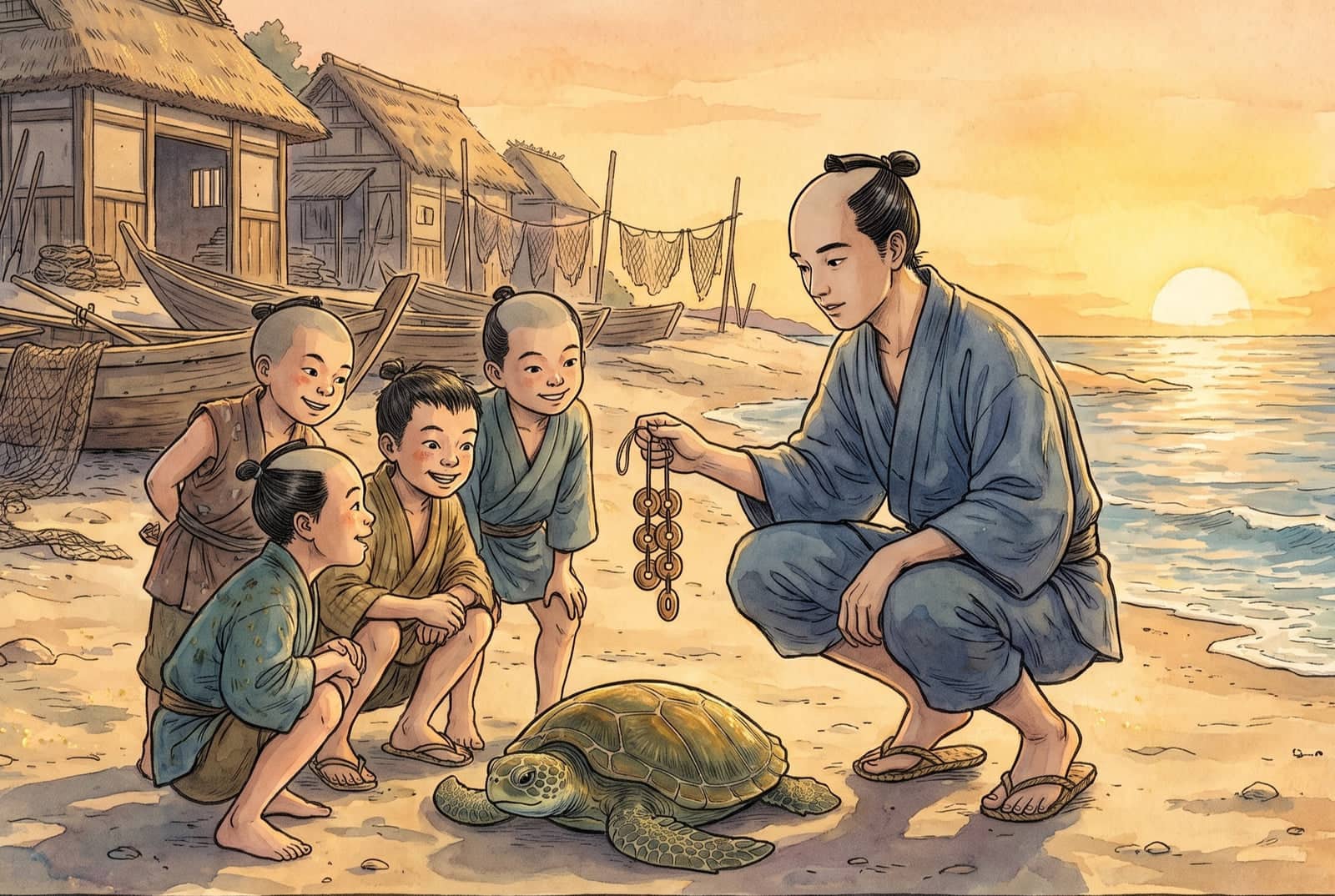
The boys were not really bad, only full of mischief, and his warm smile won them over. Their leader held out the tortoise, took the coins, and they all ran off laughing.
Urashima stroked the tortoise’s back. “There, there, you’re safe now,” he said softly. “They say a stork lives a thousand years, but a tortoise lives ten thousand. Those boys nearly cut your long life short. Now go home to the sea, and don’t get caught again. Next time there may be no one to save you.”
He carried it down to the rocks, set it in the water, and watched it swim away. Then he went home, for he was tired and the sun had set.
The next morning Urashima rowed out as usual. The sea and the sky were soft and blue in the summer haze, and his boat drifted on and on, until the other fishing boats were far behind.
He felt unusually happy that morning, though he could not say why. And he found himself wishing that, like the tortoise, he had thousands of years to live instead of a short human life.
Suddenly he heard his name.
“Urashima! Urashima!”
The voice came over the water, clear as a bell and soft as the summer wind. He stood up and looked all around, but there was no boat anywhere, near or far.
Then he saw a tortoise swimming beside him. It was the very same one he had rescued the day before.
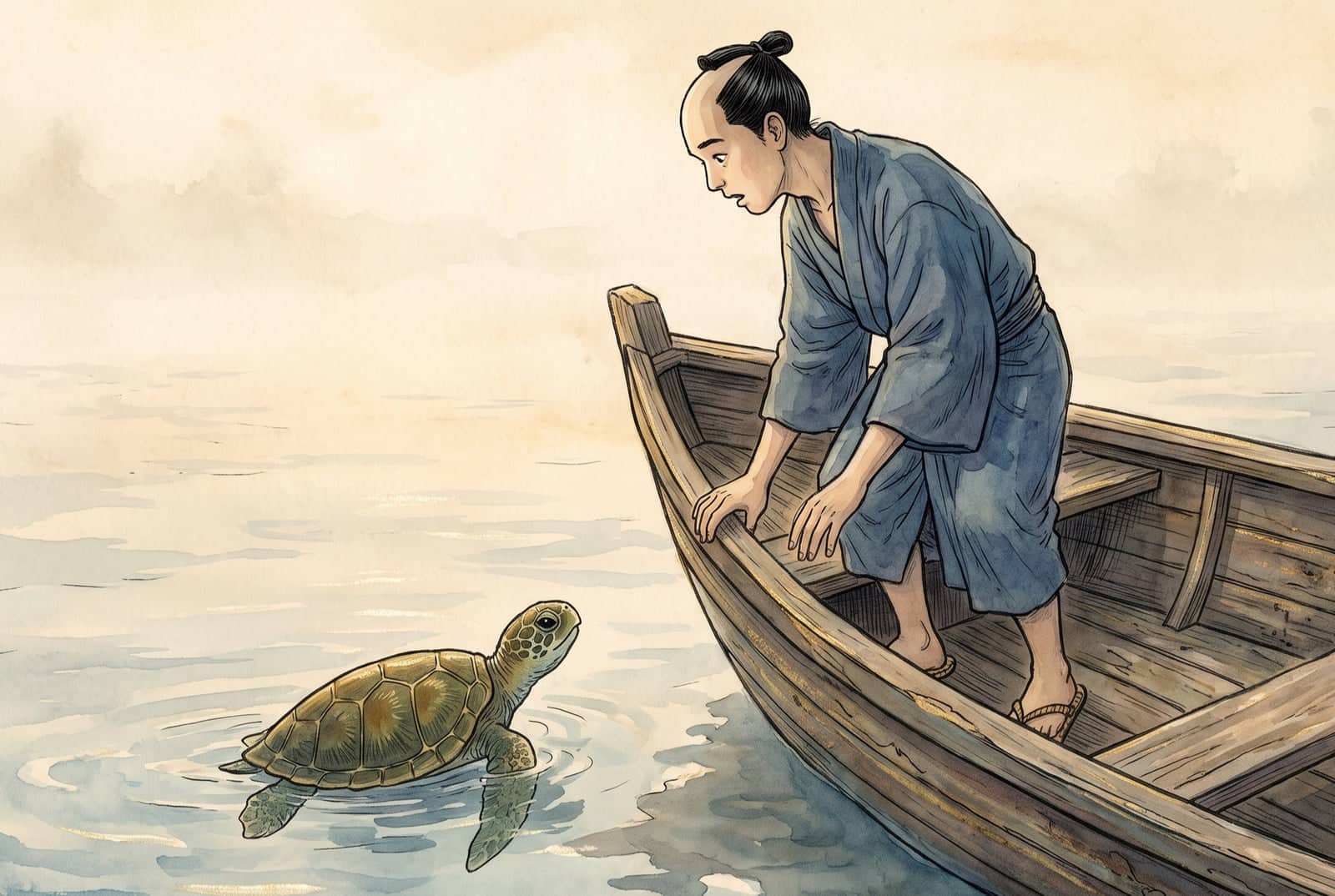
“Well, Mr. Tortoise,” said Urashima, “was it you who called me?”
The tortoise nodded several times. “Yes, it was me. Yesterday you saved my life, and I have come to thank you.”
“How very polite of you,” said Urashima. “Come up and dry your back in the sun.”
So the tortoise climbed into the boat, and after a friendly chat it asked, “Urashima, have you ever seen the Palace of the Dragon King of the Sea?”
The fisherman shook his head. “The sea has been my home all my life, and I have often heard of that kingdom under the waves, but I have never seen it. It must be very far away, if it is real at all.”
“It is far down at the bottom of the sea,” said the tortoise, “but if I take you, we will get there quickly. I would be glad to be your guide.”
“I would love to go,” said Urashima, “but I’m only a man. I can’t swim the way you can.”
“You don’t need to swim. Ride on my back.”
“On your little back?”
“Climb on and see!”
Urashima looked, and to his amazement the tortoise had grown so large that a man could easily sit on its shell. “Well then, Mr. Tortoise,” he laughed, “here I go!” And he jumped on.
The tortoise, as calm as if this happened every day, dove into the sea. Down and down they went, and for a long time they traveled through the water. Urashima never grew tired, and his clothes never got wet.
At last a magnificent gate came into view, and behind it the long, sloping roofs of a palace.
“That is the gate of the Dragon King’s palace,” said the tortoise. “Didn’t we get here quickly? Now you must walk the rest of the way.”
The gatekeeper, who was a fish, led them through at once. The sea bream, the flounder, the cuttlefish and all the Dragon King’s lords came out, bowing low.
“Welcome, Urashima, welcome to the palace of the Dragon King of the Sea! You have come so far.” And the whole company of fish led him inside.
At the doors of the inner palace, a princess came out with her ladies to greet him. She was more beautiful than any human being. Her robes were red and soft green, like the underside of a wave, with gold threads shimmering in the folds. Her long black hair flowed over her shoulders, and her voice sounded like music across the water.
Urashima was so full of wonder that he could not say a word. Before he could even bow, the princess took his hand and led him to the place of honor in a beautiful hall.
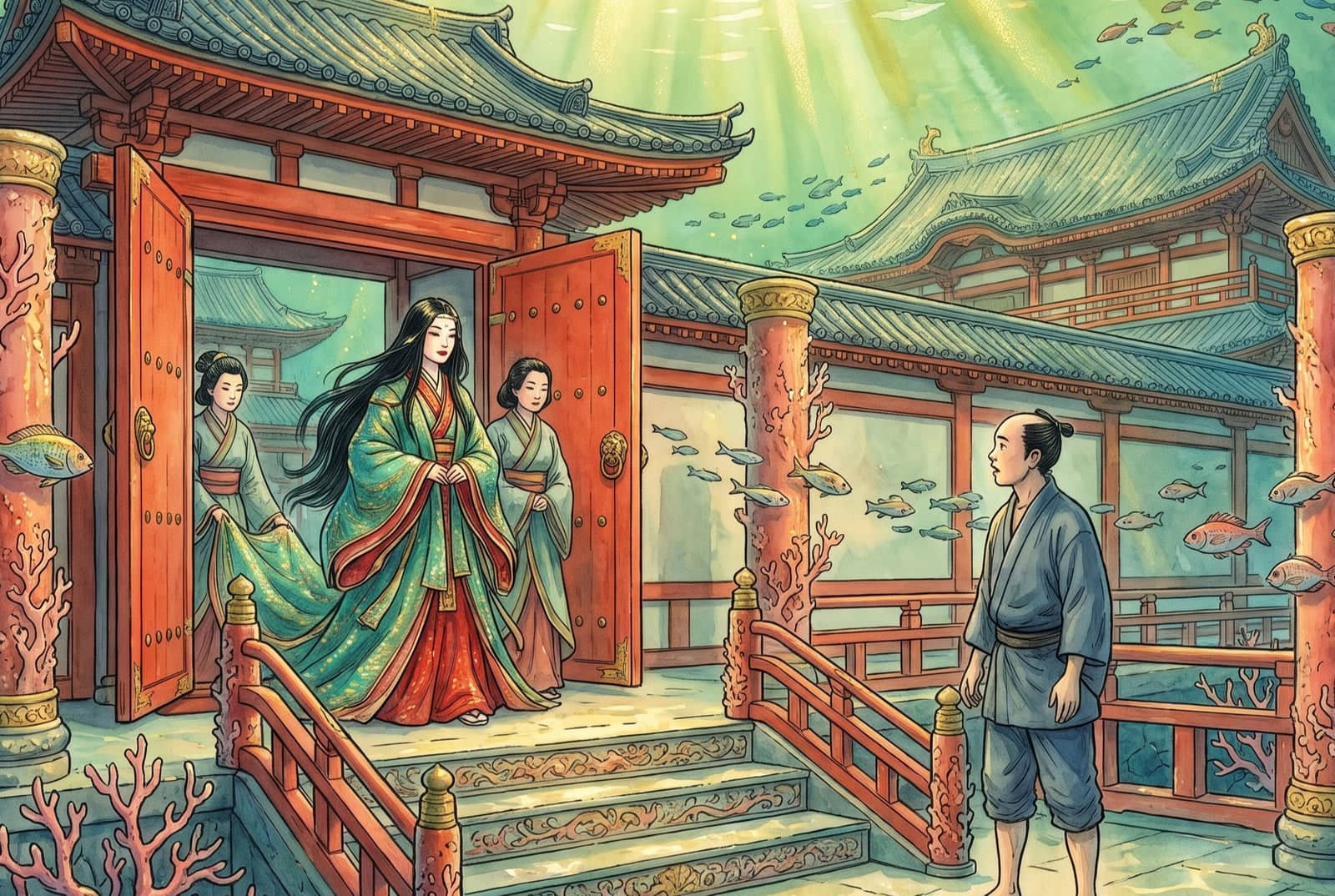
“Urashima Taro,” she said, “welcome to my father’s kingdom. Yesterday you set a tortoise free. I sent for you to thank you for saving my life, because I was that tortoise. If you wish, you may stay here forever, in the land of eternal youth, where summer never ends and sorrow never comes. And if you will have me, I will be your bride.”
Urashima’s heart filled with joy, and he wondered if it was all a dream. “There is nothing I could want more,” he said, “than to stay here with you in this beautiful land.”
Then a line of fish in long, flowing robes came slowly into the hall, carrying coral trays piled with delicacies of fish and seaweed. The wedding was celebrated with dazzling splendor. Music played, songs were sung, and fish with silver scales and golden tails swam in from the waves to dance. Urashima had never been so happy in all his life.
After the feast, the princess showed her husband the wonders of that enchanted land, where youth and joy go hand in hand and time can never touch them.
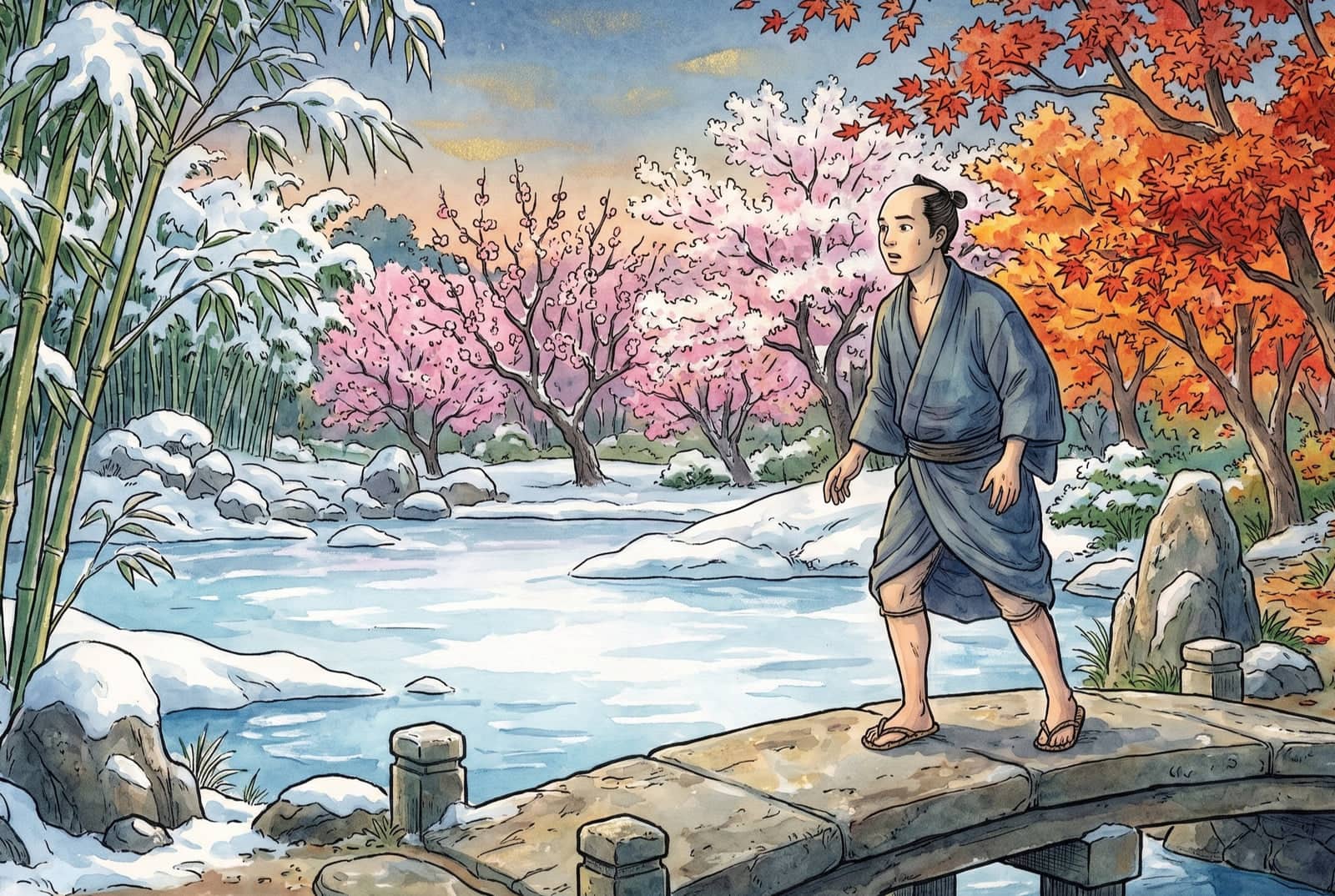
But to Urashima, the garden was even more wonderful, because in it all four seasons could be seen at once.
To the east, the plum and cherry trees were in full bloom. Nightingales sang along the pink paths, and butterflies flitted from flower to flower.
To the south, every tree was green with summer, and the cicadas and crickets sang loudly.
To the west, the autumn maples blazed like a sunset sky, and the chrysanthemums were at their very best.
To the north, Urashima gave a start. The ground was white with snow, the bamboo was heavy with it, and the pond was thick with ice.
Every day brought new joys and new wonders, and Urashima was so happy that he forgot everything: his home, his country, even his own father and mother. Three days went by, it seemed, without a single thought of them.
Then all at once Urashima remembered who he was, and that he did not belong in this wonderful land.
“Oh dear!” he said to himself. “I have an old father and mother at home. They must be so worried, since I never came back. I must go to them right away.”
Urashima went to his wife, whose name was Princess Otohime, and bowed low. “You have been kinder to me than words can tell,” he said. “But now I must say goodbye. I have to go back to my old parents.”
Princess Otohime began to cry. “Aren’t you happy here, Urashima? Why must you hurry? Stay with me just one more day!”
But Urashima had remembered his parents, and in Japan a child’s duty to his parents comes before everything, even before happiness or love.
“I must go,” he said. “It isn’t that I want to leave you. Let me go for one day, and then I will come back.”
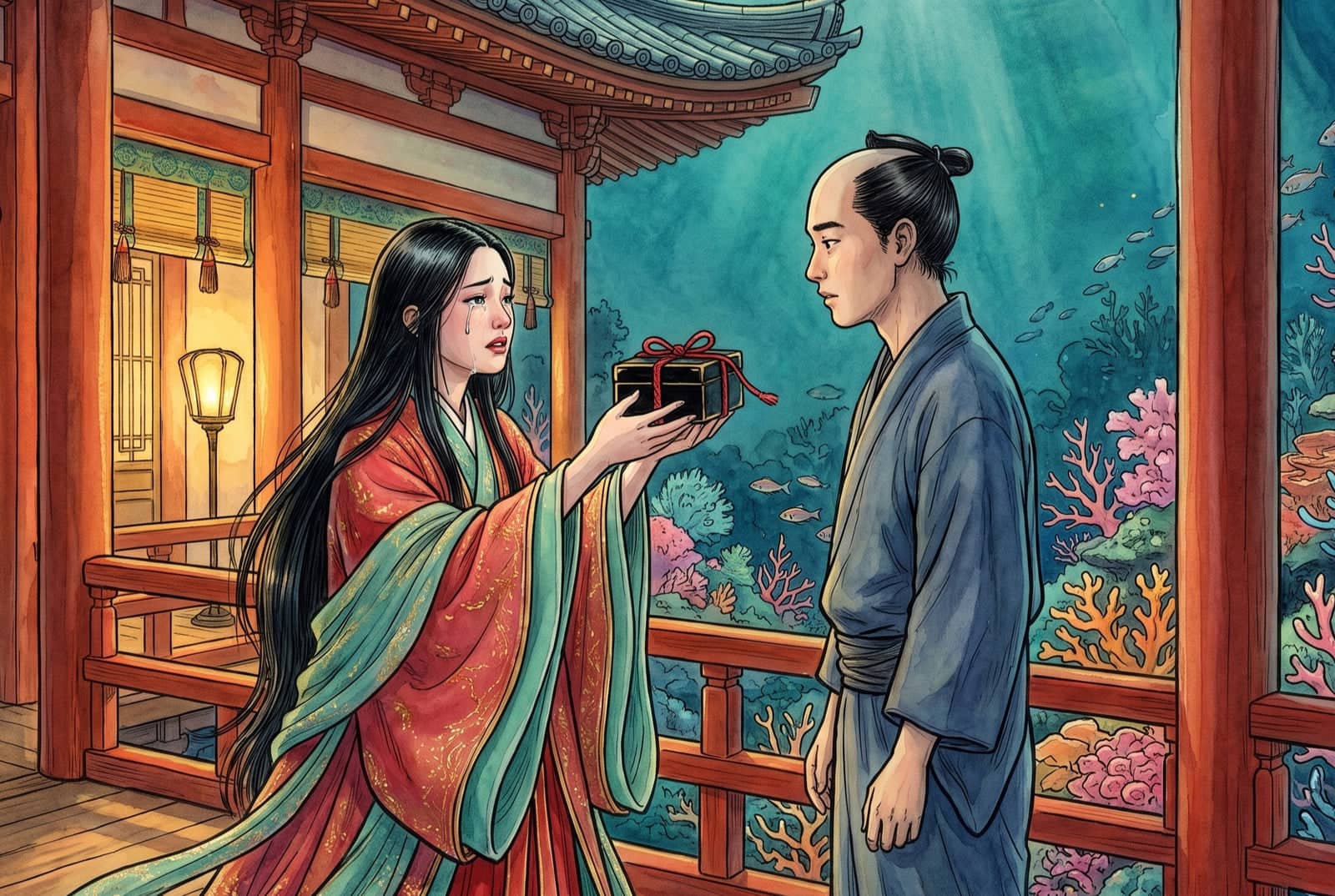
“Then there is nothing to be done,” said the princess sadly. “Take this with you, as a sign of our love.”
She gave him a beautiful lacquered box, tied with a cord and tassels of red silk.
“What is this box?” asked Urashima.
“It is the tamate-bako, the Box of the Jeweled Hand,” said the princess, “and inside is something very precious. You must never open this box, whatever happens! If you open it, something dreadful will happen to you. Now promise me that you will never open it!”
And Urashima promised that he would never, ever open the box, whatever happened.
The princess and her ladies walked with him down to the shore, where a large tortoise was waiting. Urashima climbed onto its back and was carried away over the shining sea. He waved to Otohime until he could not see her anymore, and the palace roofs vanished in the distance. Then he turned eagerly toward home and watched for the blue hills to rise.
At last the tortoise brought him into the bay he knew so well. Urashima stepped onto the beach, and the tortoise swam away, back to the Dragon King’s kingdom.
But why does a strange fear come over Urashima as he stands there? Why does he stare at the people walking by, and why do they stop and stare back? The beach is the same, and the hills are the same, but not one face is a face he knows.
Urashima hurried to his old home. Even that looked different, but there was a house in the same spot.
“Father, I’m home!” he called. But a stranger came out of the door.
Perhaps his parents had moved while he was away, Urashima thought. Still, he began to feel strangely uneasy.
“Excuse me,” he said, “until a few days ago I lived in this house. My name is Urashima Taro. Where have my parents gone?”
The man looked bewildered. “You are Urashima Taro?”
“Yes, I am Urashima Taro!”
The man laughed. “You mustn’t make jokes like that. A man called Urashima Taro did once live in this village, but that story is three hundred years old. He couldn’t possibly be alive today!”
Urashima was frightened. “Please don’t joke with me. I really am Urashima Taro, and I haven’t lived for three hundred years. Four or five days ago I was living right here!”
The man grew serious. “The Urashima Taro I have heard of lived three hundred years ago. Perhaps you are his ghost, come back to visit your old home?”
“I’m no ghost!” cried Urashima. “I’m a living man. Can’t you see my feet?” And thump, thump, he stamped on the ground, first with one foot and then with the other, for everyone knew that ghosts in Japan have no feet.
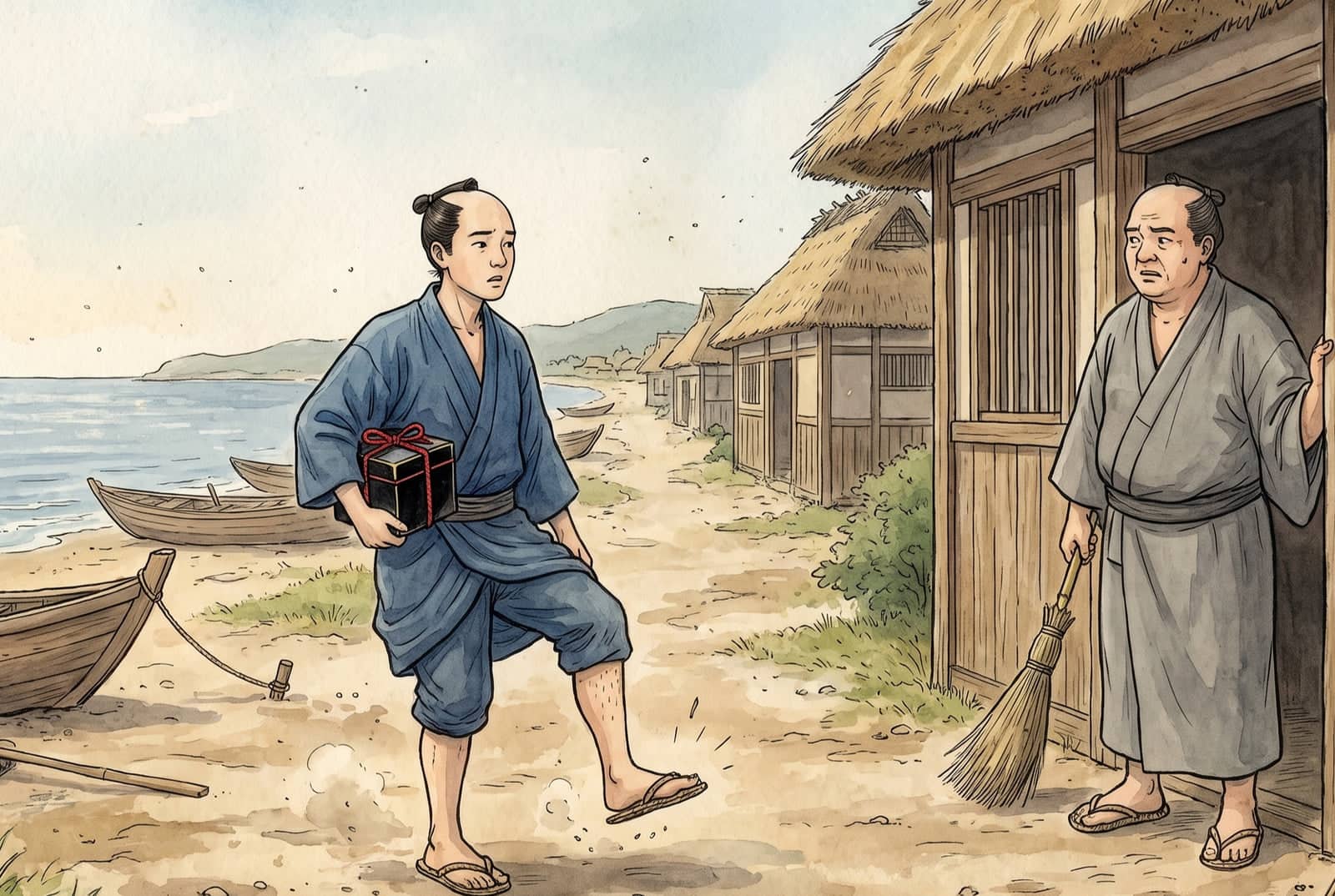
“All I know is that Urashima Taro lived three hundred years ago,” the man insisted. “It’s written in the village records.”
Urashima looked around, lost and troubled. Everything was a little different, and slowly a terrible feeling came over him that the man was telling the truth.
The few days he had spent in the Dragon King’s palace had not been days at all. They had been hundreds of years, and his parents and everyone he had ever known were long gone.
There was no reason to stay. He had to get back to his wife beneath the sea.
Urashima went back down to the beach, holding the box the princess had given him. But which way should he go? He could never find the path alone.
Then he thought of the tamate-bako.
“The princess told me never to open it,” he said to himself. “But now I have no home, and I have lost everything I loved, and my heart is so heavy. Surely, if I open the box, I will find something to show me the way back to my princess. There’s nothing else left for me to do. Yes, I will open it!”
And so he gave in, and tried to tell himself that breaking his promise was the right thing to do.
Slowly, very slowly, he untied the red silk cord and lifted the lid. And what did he find? Only a beautiful little purple cloud, which rose out of the box in three soft wisps. For a moment it hung around his face, as if it did not want to leave, and then it drifted away over the sea like mist.
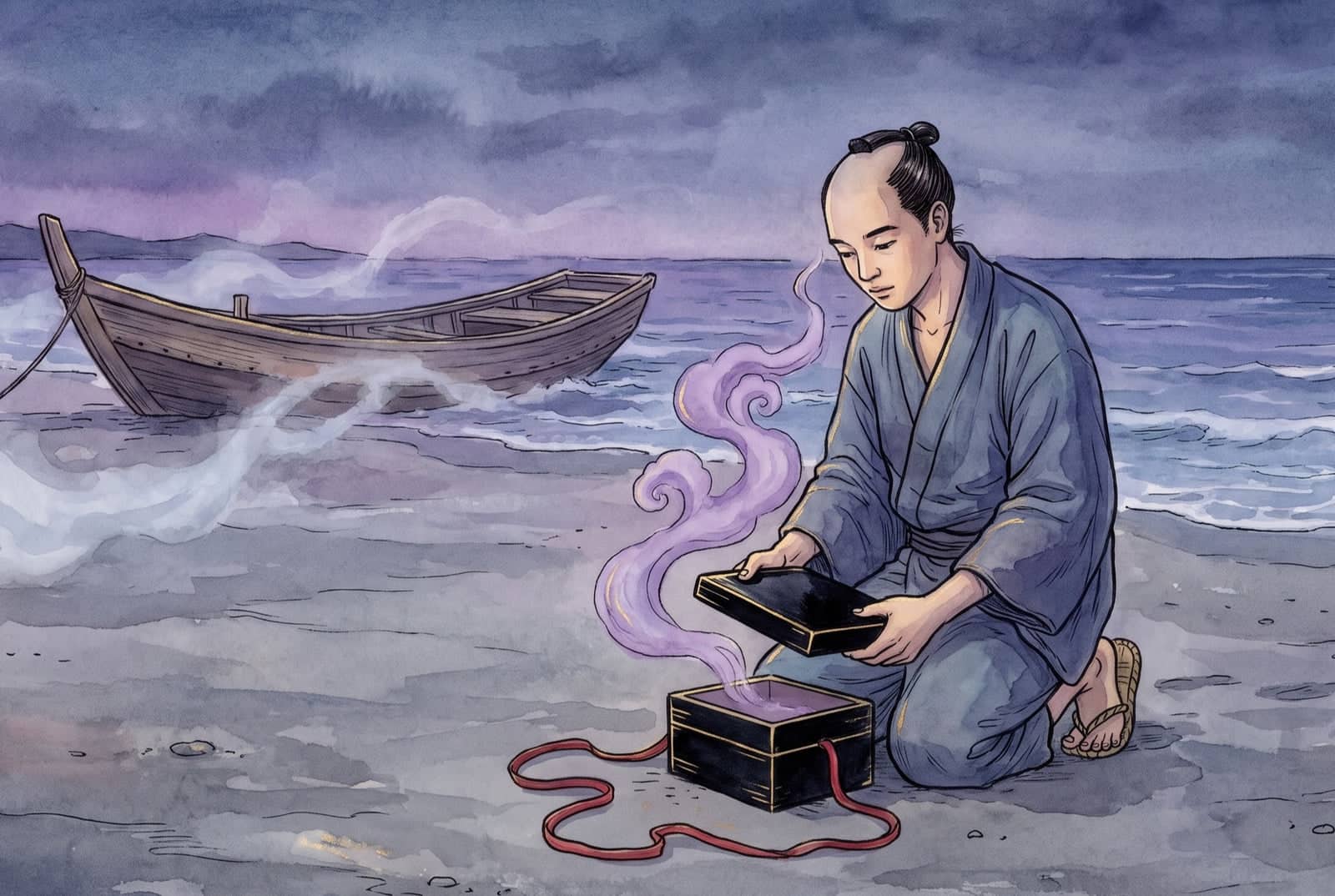
Until that moment Urashima had looked like a strong young man of twenty-four. Now, all at once, he became very, very old. His back bent, his hair turned snowy white, his face filled with wrinkles, and he sank down on the beach and died.
Poor Urashima! Because he broke his promise, he could never go back to the Dragon King’s kingdom or to the lovely princess beneath the sea.
So, little ones, always listen to those who are wiser than you, for not listening is where so many sorrows begin.
Retold by Talerie from Japanese Fairy Tales (opens in a new window)License: Public domainCopy this text, adapt it, use it however you like. A link back to Talerie is appreciated but never required.CC0 1.0 (opens in a new window)