A statue covered in gold stands over a city he cannot reach, and asks a swallow to carry his ruby, his sapphire eyes and his gold leaf to the poor. The swallow stays through the frost until his strength fails, the prince’s leaden heart cracks, and an angel brings both to God as the most precious things in the city.
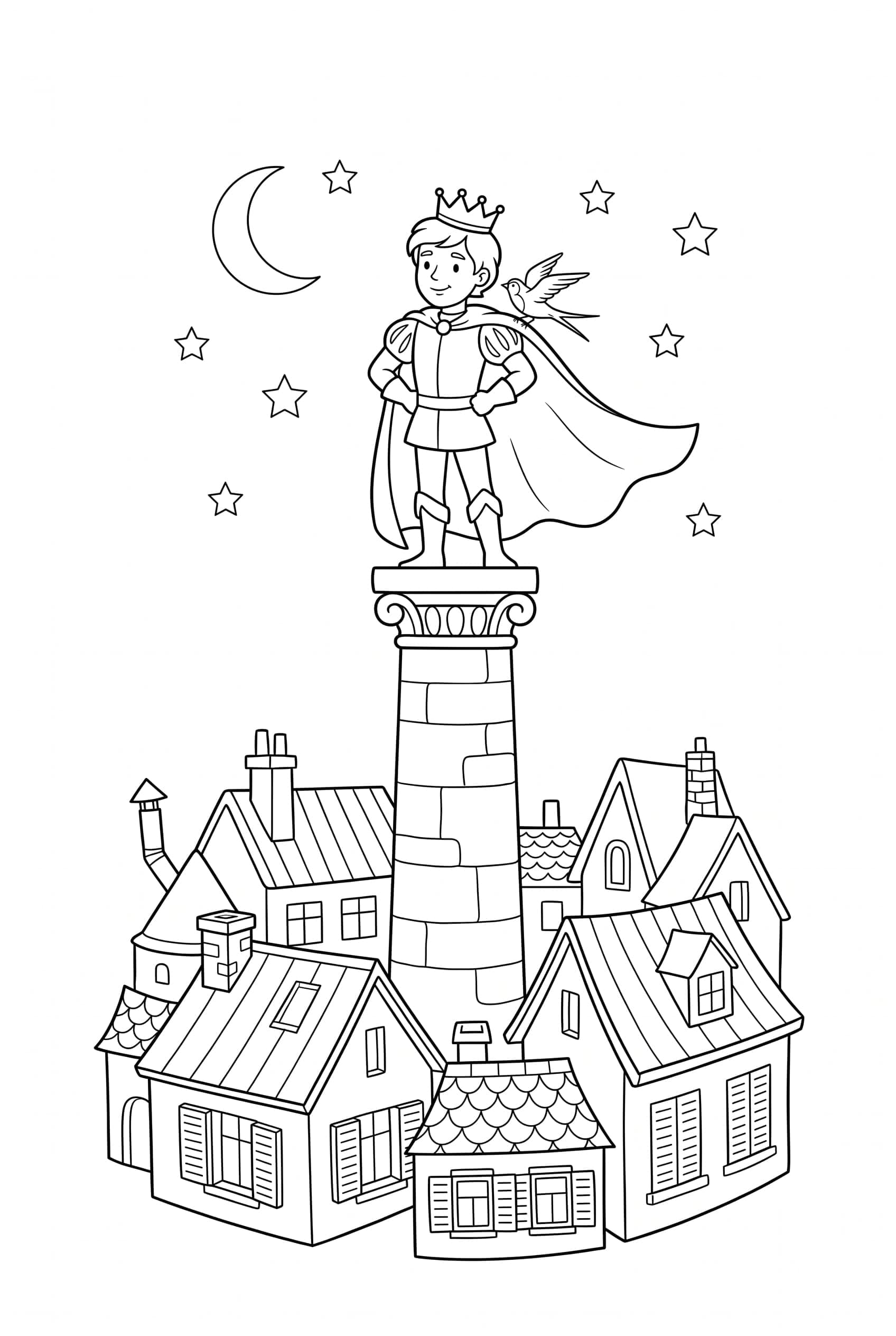
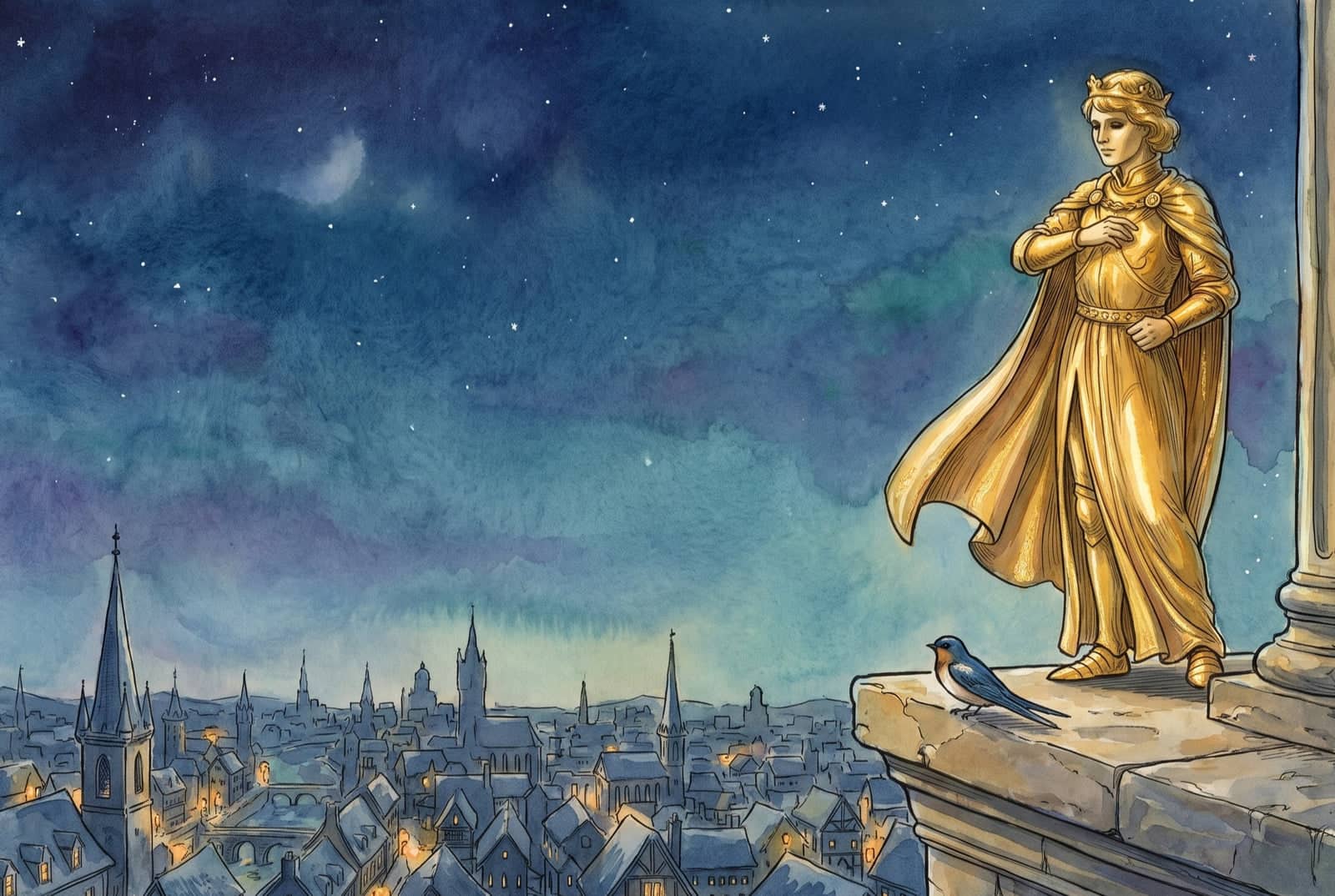
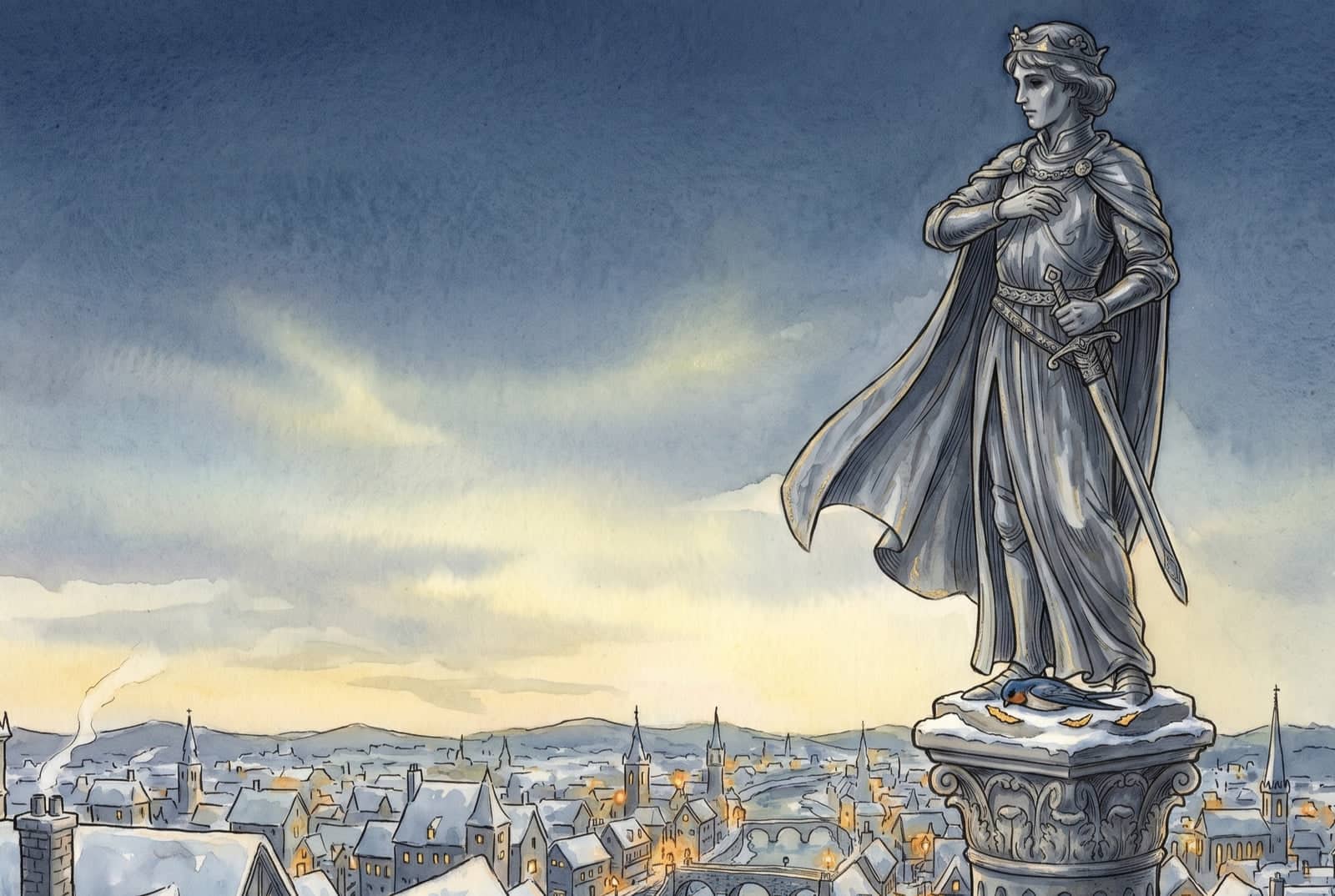
High above the city, on a tall column, stood the statue of the Happy Prince. He was covered all over with thin leaves of fine gold. For eyes he had two bright sapphires, and a great red ruby glowed on the hilt of his sword.
Everybody admired him.
“He is as beautiful as a weathercock,” said one of the town councillors, who wanted people to think he had an eye for art. “Only not quite so useful,” he added quickly, in case they thought he had no sense.
“Why can’t you be like the Happy Prince?” asked a sensible mother of her little boy, who was crying for the moon. “The Happy Prince never dreams of crying for anything.”
“He looks just like an angel,” said the children from the charity school, coming out of the cathedral in their scarlet cloaks and their clean white pinafores.
One night a little swallow flew over the city. His friends had gone away to Egypt six weeks before, but he had stayed behind, because he was in love with a reed.
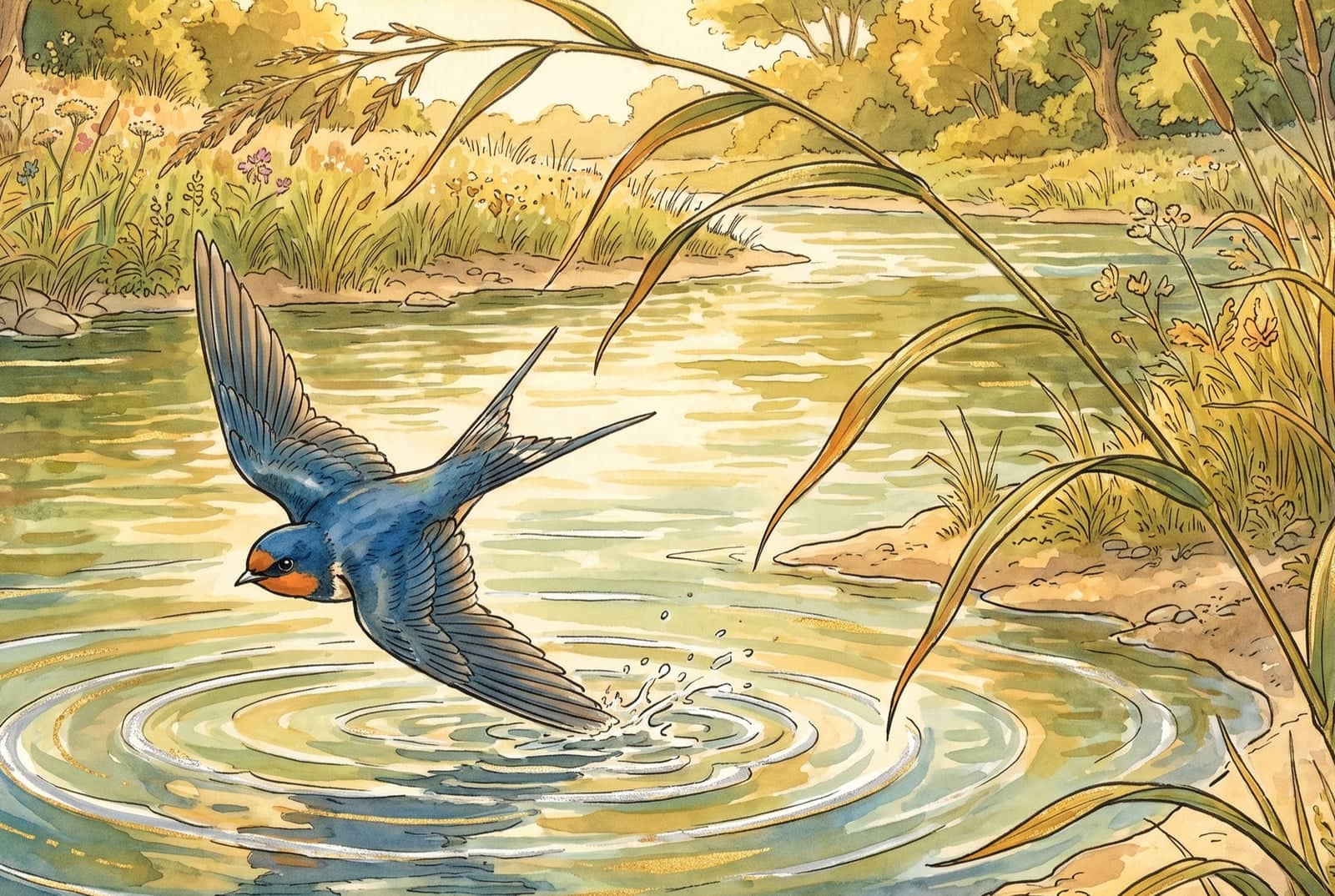
“Shall I love you?” asked the swallow, who liked to come straight to the point. The reed made him a low bow, and he flew round and round her, touching the water with his wings and making little silver ripples. That was his courtship, and it lasted all summer.
“What a ridiculous match,” chirped the other swallows. “She has no money, and far too many relations.” Then autumn came, and away they all flew.
Once they had gone, the swallow felt lonely, and he began to tire of her.
“Will you come away with me?” he asked her at last. But the reed shook her head. She was far too fond of her home.
“Then you have only been playing with me,” he cried. “I am off to the pyramids. Goodbye!” And away he flew.
All day long he flew, and at nightfall he came to the city. “Where shall I stay?” he said. “I hope the town has made arrangements for me.”
Then he saw the statue on the tall column.
“I shall stay up there,” he cried. “A fine spot, with plenty of fresh air.” And he settled down between the feet of the Happy Prince.
“A golden bedroom,” he said softly, and he made ready to sleep. But just as he was tucking his head under his wing, a large drop of water fell on him.
“How very odd,” he cried. “There is not a cloud in the sky, the stars are clear and bright, and still it is raining.”
Then another drop fell.
“What use is a statue if it cannot even keep the rain off?” he said. “I must find myself a good chimney pot.” And he made up his mind to fly away.
But before he could open his wings, a third drop fell, and he looked up.
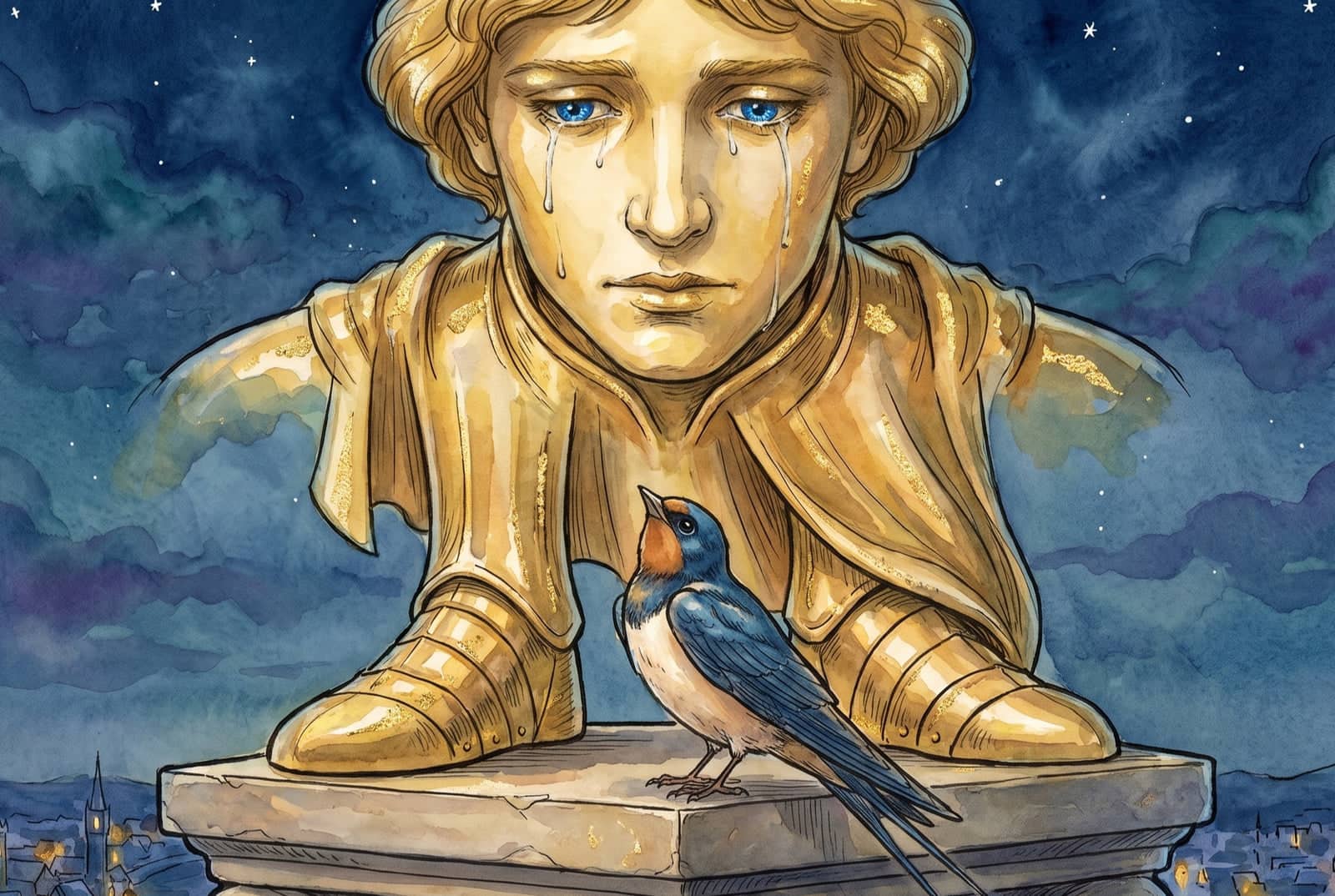
The eyes of the Happy Prince were full of tears, and the tears were running down his golden cheeks. His face was so beautiful in the moonlight that the little swallow was filled with pity.
“Who are you?” he said.
“I am the Happy Prince.”
“Then why are you crying?” asked the swallow. “You have soaked me through.”
“When I was alive and had a human heart,” answered the statue, “I did not know what tears were. I lived in a palace where sorrow was not allowed in, and I danced and played there all day long.”
“A high wall ran round the garden,” the prince went on, “and I never once thought to ask what lay beyond it. My courtiers called me the Happy Prince, and happy I was, if pleasure is the same thing as happiness. So I lived, and so I died.”
“Now they have set me up so high that I can see all the ugliness and all the misery of my city. And though my heart is made of lead, I cannot help weeping.”
“So he is not solid gold after all,” thought the swallow, who was much too polite to say such a thing out loud.
“Far away in a little street,” the statue went on, in a low, musical voice, “there is a poor house with an open window, and through it I can see a woman sitting at a table. Her face is thin and tired, and her hands are red and pricked all over by the needle, for she is a seamstress.”
“She is embroidering passion flowers on a satin gown for one of the queen’s maids of honour. In a bed in the corner her little boy lies ill with a fever, asking for oranges, and she has nothing to give him but river water.”
“Swallow, Swallow, little Swallow, will you not bring her the ruby out of my sword? My feet are fastened to this pedestal, and I cannot move.”
“I am expected in Egypt,” said the swallow. “My friends are flying up and down the Nile, and sleeping in the tomb of an old king.”
“Swallow, Swallow, little Swallow,” said the prince, “will you not stay with me for one night, and be my messenger? The boy is so thirsty, and his mother so sad.”
“I don’t think I care for boys,” answered the swallow. “Last summer the miller’s sons were always throwing stones at me.”
But the Happy Prince looked so sad that the little swallow was sorry. “It is very cold here,” he said, “but I will stay with you for one night, and be your messenger.”
“Thank you, little swallow,” said the prince.
So the swallow lifted the great ruby out of the prince’s sword and flew away with it in his beak, over the roofs of the town.
He passed the palace, where he heard the sound of dancing. A beautiful girl came out onto the balcony with the young man who loved her.
“How wonderful the stars are,” he said to her, “and how wonderful is the power of love.”
“I do hope my dress will be ready in time for the ball,” she answered. “I ordered passion flowers to be embroidered on it, but the seamstresses are so slow.”
He passed over the river, where the lanterns swung from the masts of the ships, and came at last to the seamstress’s house. The boy was tossing with fever, and his mother had fallen asleep over her work, she was so tired.
In hopped the swallow, and laid the great ruby on the table beside the woman’s thimble. Then he flew softly round the bed, fanning the boy’s forehead with his wings.
“I feel so much cooler,” said the boy. “I must be getting better.” And he sank into a lovely, easy sleep.
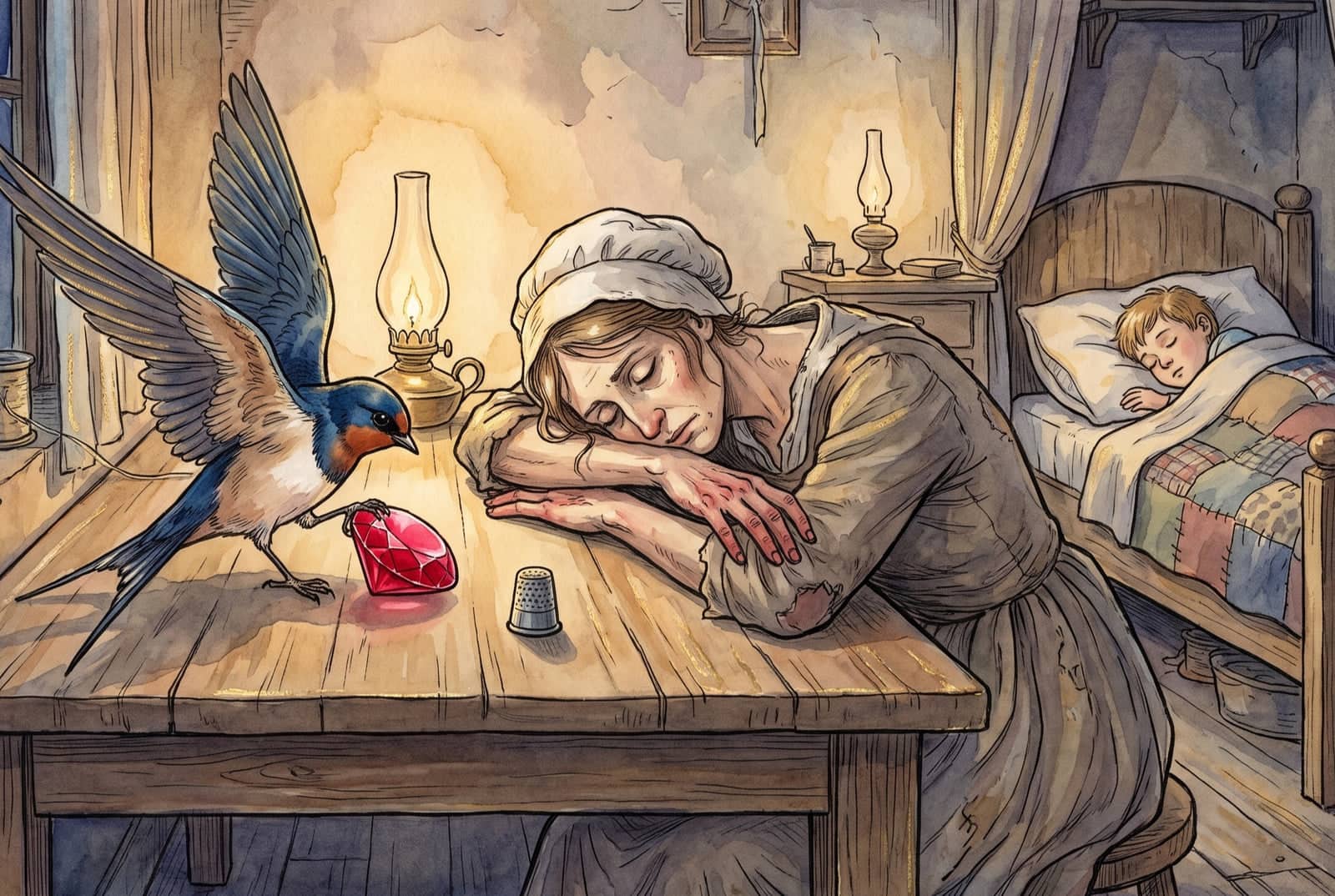
Then the swallow flew back and told the prince what he had done. “It is a strange thing,” he said, “but I feel quite warm now, though the night is so cold.”
“That is because you have done a kind thing,” said the prince. The little swallow began to think about that, and then he fell asleep. Thinking always made him sleepy.
When day broke, the swallow was in high spirits. “Tonight I go to Egypt,” he said.
When the moon rose he flew back to the Happy Prince. “Have you any messages for Egypt?” he called. “I am just leaving.”
“Swallow, Swallow, little Swallow,” said the prince, “will you not stay with me one night longer?”
“I am expected in Egypt,” answered the swallow. “Tomorrow my friends fly on up the Nile, where the lions come down at noon to drink.”
“Swallow, Swallow, little Swallow,” said the prince, “far across the city a young man sits in an attic room, bent over a desk of papers. He is trying to finish a play for the theatre, but there is no fire in his grate, and he is too cold and too hungry to write another word.”
“I will wait with you one night longer,” said the swallow, who really had a good heart. “Shall I take him another ruby?”
“I have no ruby left,” said the prince. “My eyes are all I have now, and they are rare sapphires, brought out of India a thousand years ago. Take one of them to him. He will sell it, and buy food and firewood, and finish his play.”
“Dear prince,” said the swallow, “I cannot do that.” And he began to cry.
“Swallow, Swallow, little Swallow,” said the prince, “do as I command you.”
So the swallow took out the prince’s eye and flew to the attic room. The young man had his head in his hands and never heard the flutter of wings, and when he looked up, the sapphire lay among his papers.
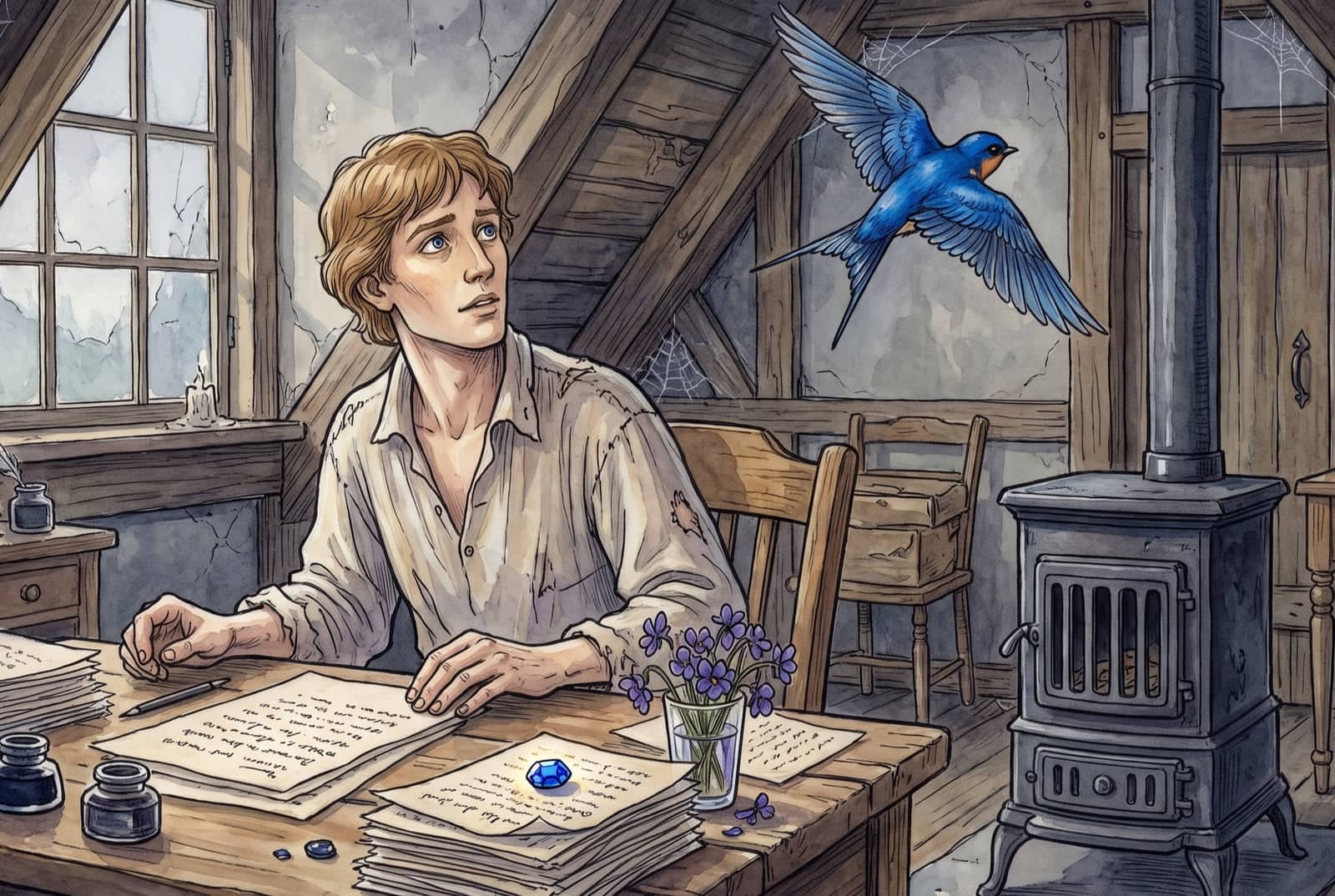
“Somebody thinks well of my work at last,” he cried. “Now I can finish my play.” And he looked altogether happy.
The next day the swallow flew down to the harbour, and at moonrise he came back to the Happy Prince.
“I have come to say goodbye,” he cried.
“Swallow, Swallow, little Swallow,” said the prince, “will you not stay with me one night longer?”
“It is winter,” answered the swallow, “and the snow will soon be here. In Egypt the sun lies warm on the green palm trees.”
“Dear prince, I must leave you, but I will never forget you, and next spring I will bring you two jewels in place of the ones you gave away. The ruby shall be redder than a red rose, and the sapphire as blue as the sea.”
“Down in the square,” said the Happy Prince, “there stands a little girl who sells matches. She has dropped them in the gutter and they are all spoiled, and she is crying, for her father will punish her if she brings home no money. She has no shoes, and her little head is bare.”
“Take out my other eye and give it to her, and her father will not be angry.”
“I will stay with you one night longer,” said the swallow, “but I cannot take your other eye. You would be quite blind then.”
“Swallow, Swallow, little Swallow,” said the prince, “do as I command you.”
So he took out the prince’s other eye and darted down with it. He swooped past the little match girl and slipped the jewel into the palm of her hand. “What a lovely piece of glass!” she cried, and she ran home laughing.
Then the swallow came back to the prince. “You are blind now,” he said, “so I will stay with you always.”
“No, little swallow,” said the poor prince, “you must go away to Egypt.”
“I will stay with you always,” said the swallow, and he slept at the prince’s feet.
All the next day he sat on the prince’s shoulder and told him stories of the far countries he had seen, and of the sphinx who is as old as the world and knows everything.
“Dear little swallow,” said the prince, “you tell me of marvellous things. But more marvellous than any of them is the suffering of men and women. Fly over my city, little swallow, and tell me what you see.”
So the swallow flew over the great city, and saw the rich making merry in their beautiful houses while the beggars sat at their gates. He flew into dark lanes, where hungry children looked out at the black streets.
Under the arch of a bridge two little boys lay in each other’s arms, trying to keep warm. “How hungry we are,” they said.
“You must not lie here,” shouted the watchman, and out they went into the rain.
Then the swallow flew back and told the prince what he had seen.
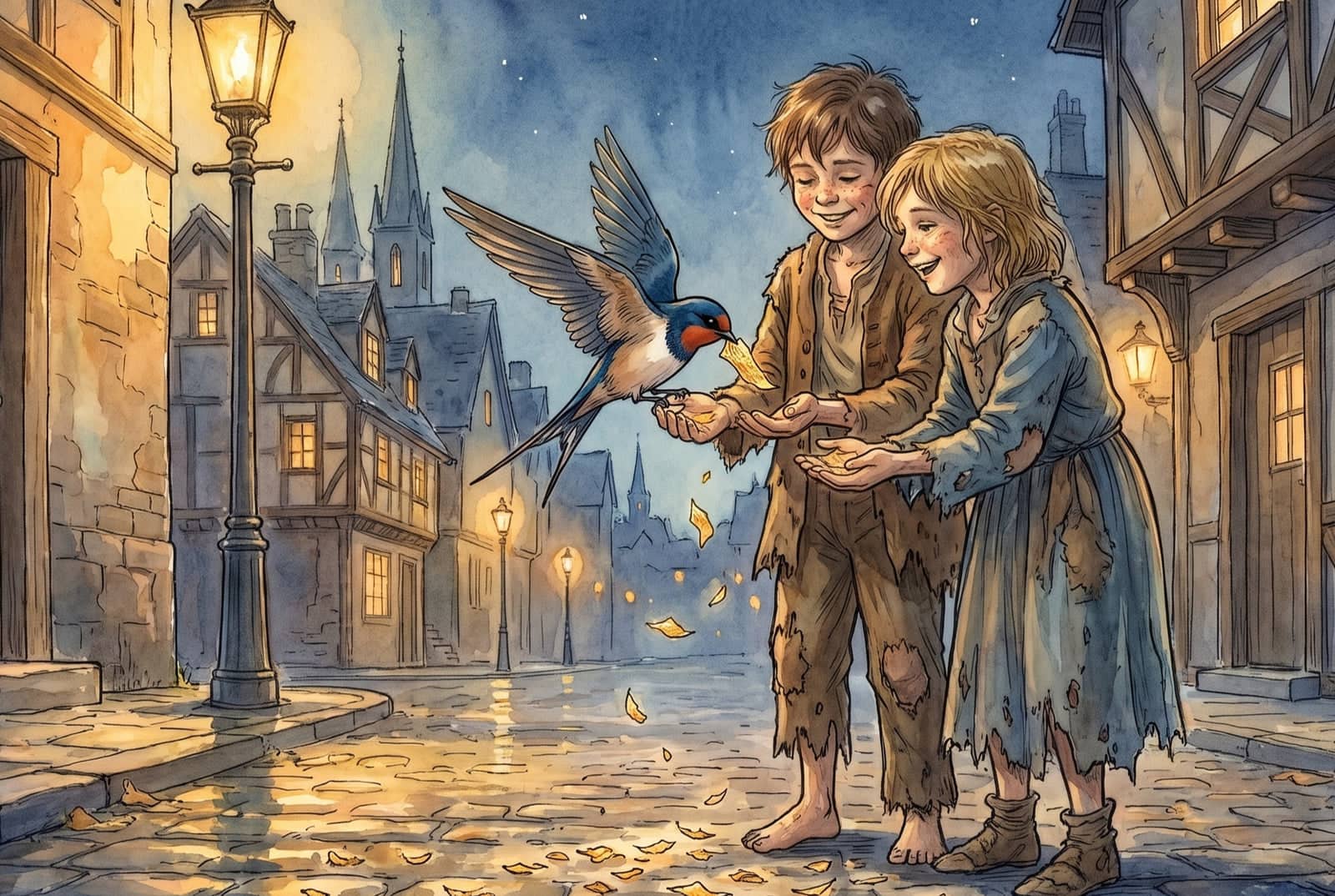
“I am covered with fine gold,” said the prince. “You must take it off, leaf by leaf, and give it to my poor. The living always think that gold can make them happy.”
Leaf after leaf of the fine gold the swallow picked off, until the Happy Prince looked quite dull and grey. Leaf after leaf he carried down to the poor, and the children’s faces grew rosy. “We have bread now!” they cried.
Then the snow came, and after the snow the frost.
The poor little swallow grew colder and colder, but he would not leave the prince. He loved him far too well. He picked up crumbs outside the baker’s door, and tried to keep warm by beating his wings.
But at last he knew that his strength was going. He had just enough left to fly up to the prince’s shoulder one more time.
“Goodbye, dear prince,” he whispered. “Will you let me kiss your hand?”
“I am glad you are going to Egypt at last, little swallow,” said the prince. “You have stayed too long here. But you must kiss me on the lips, for I love you.”
“It is not to Egypt that I am going,” said the swallow. “I am going to the house of sleep, where all journeys end.”
And he kissed the Happy Prince on the lips, and sank down at his feet, and was still.
At that moment a strange crack sounded inside the statue, as if something had broken. The leaden heart had snapped clean in two. It certainly was a dreadfully hard frost.
Early the next morning the mayor was walking through the square below with the town councillors. As they passed the column he looked up.
“Dear me, how shabby the Happy Prince looks,” he said.
“How shabby indeed!” cried the town councillors, who always agreed with the mayor.
“The ruby has fallen out of his sword, his eyes are gone, and he is not golden any more,” said the mayor. “He is hardly better than a beggar.”
“Hardly better than a beggar,” said the town councillors.
“And here is a dead bird at his feet!” the mayor went on. “We really must make a rule that birds are not allowed to die here.” And the town clerk wrote the suggestion down.
So they pulled down the statue of the Happy Prince. “As he is no longer beautiful, he is no longer useful,” said the professor of art at the university.
Then they melted the statue down, and the mayor called a meeting to decide what to do with the metal. “We must have another statue,” he said, “and it shall be a statue of me.”
“Of me,” said each of the town councillors, and they began to quarrel. The last I heard of them, they were quarrelling still.
“How odd,” said the foreman at the foundry. “This broken lead heart will not melt. We shall have to throw it away.” So they threw it on a rubbish heap, where the little swallow was lying too.
“Bring me the two most precious things in the city,” said God to one of his angels, and the angel brought him the leaden heart and the little bird.
“You have chosen well,” said God, “for in my garden of paradise this little bird shall sing for evermore, and in my city of gold the Happy Prince shall praise me.”
Retold by Talerie, Source: The Happy Prince and Other Tales (opens in a new window)
License: Public domainCopy this text, adapt it, use it however you like. A link back to Talerie is appreciated but never required.CC0 1.0 (opens in a new window)