 Original
A kind young fisherman saves a tortoise and rides on its back to the Sea King’s palace, where the princess who was that tortoise becomes his bride. When Urashima goes home, three hundred years have passed, and as he opens the princess’s forbidden box, a purple cloud rises and he becomes very old and falls dead.
Long, long ago, in the province of Tango, on the shore of Japan, there was a little fishing village called Mizunoe, and in it lived a young fisherman named Urashima Taro. His father had been a fisherman before him, and the son had inherited his skill twice over, for Urashima was the best fisherman in all that part of the country. He could catch more bonito and sea bream in a day than his friends could catch in a week.
Yet in the little village Urashima was known less for his skill at sea than for his kind heart. In all his life he had never hurt any living thing, great or small. When he was a boy, the other children had always laughed at him, because he would never join them in teasing animals; instead he always tried to stop their cruel games.
One soft summer evening Urashima was walking home after a day’s fishing when he came upon a group of children. They were all shouting at the tops of their voices, and when he went over to see what the matter was, he saw that they were tormenting a tortoise. One boy pulled it this way, another boy pulled it that way, a third was beating it with a stick, and a fourth was hammering on its shell with a stone.
Urashima felt very sorry for the poor tortoise, and he made up his mind to rescue it. He spoke to the boys.
“Listen, boys, you’re treating that poor tortoise so badly that it will soon die!”
The boys were at the age when children seem to enjoy being cruel to animals, and they paid no attention to Urashima’s gentle scolding. They went on teasing the tortoise just as before, and one of the older boys answered him.
“Who cares if it lives or dies? We don’t. Come on, everybody, keep going!”
And they began to treat the poor creature more cruelly than ever. Urashima waited a moment, thinking over the best way to deal with them. He decided he would try to talk them into giving him the tortoise, so he smiled at them and said:
“I’m sure you’re all good, kind boys! Now, won’t you give me that tortoise? I would like to have it so very much!”
“No, we won’t give you the tortoise,” said one of the boys. “Why should we? We caught it ourselves.”
“That’s true,” said Urashima, “but I’m not asking you to give it to me for nothing. I’ll pay you for it. How does that sound, boys?” He held up his money, a row of coins threaded on a string through the holes in their middles. “Look, boys, you can buy anything you like with this. You can do far more with this money than with that poor tortoise. There, see what good boys you are to listen to me.”
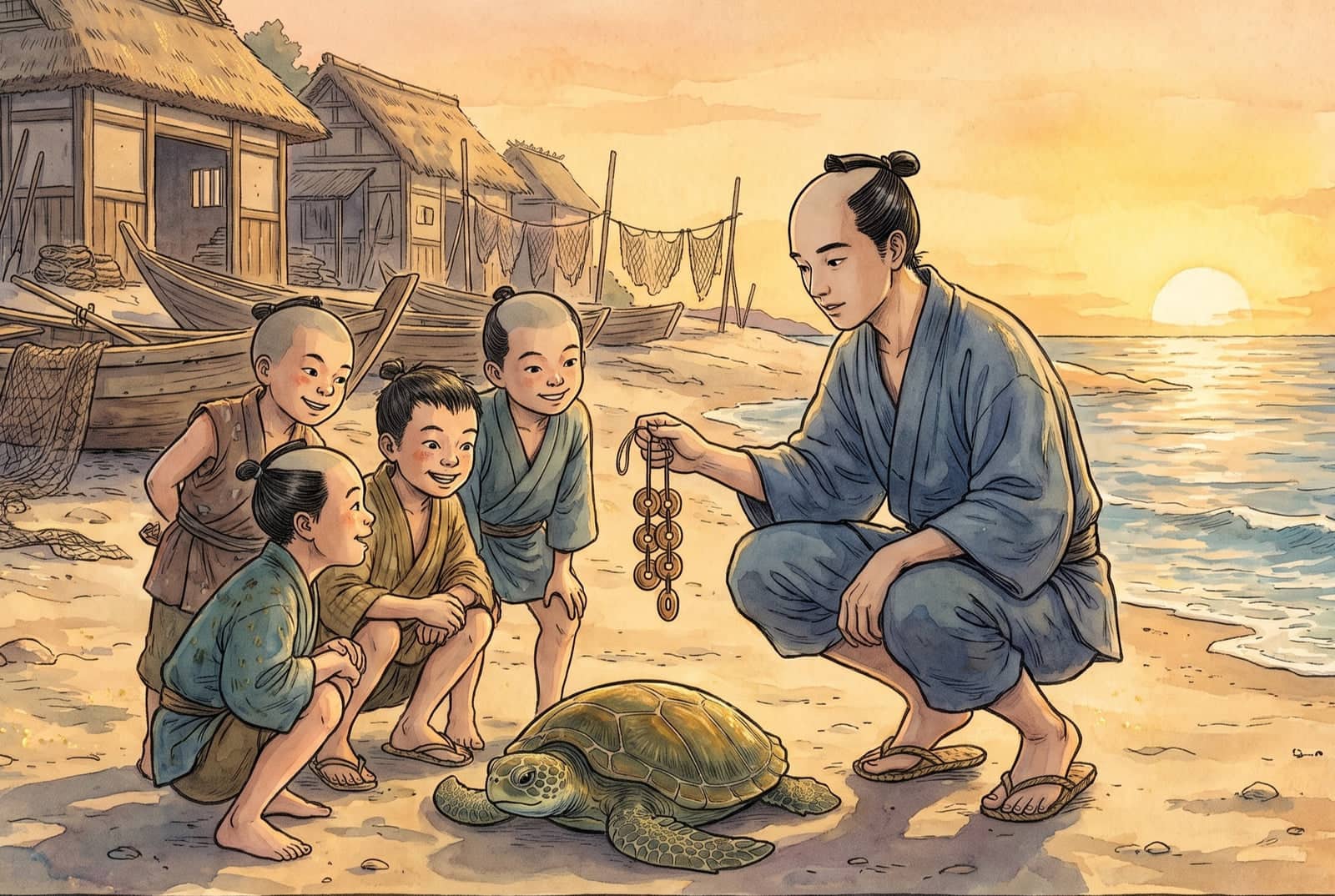
The boys weren’t bad boys at all, only mischievous, and as Urashima talked, his kind smile and gentle words won them over, and they came around to his way of thinking. One by one they drew closer, and the leader of the little gang held out the tortoise to him.
“All right, mister, you can have the tortoise if you give us the money!” So Urashima took the tortoise and handed the money to the boys, who called to one another and ran off, and were soon out of sight.
Then Urashima stroked the tortoise’s back, and as he stroked it he said:
“Oh, you poor thing! Poor thing! There, there, you’re safe now! They say a stork lives for a thousand years, but a tortoise lives for ten thousand. You have the longest life of any creature in the world, and those cruel boys very nearly cut that precious life short. Luckily I happened to be passing by and saved you, so your life is still your own. Now I’m going to take you straight back to your home in the sea. Don’t let yourself be caught again, because next time there may be nobody there to save you!”
All the while he was talking, the kind fisherman was walking quickly down to the shore and out onto the rocks. There he put the tortoise into the water and watched it disappear, and then he turned for home himself, because he was tired and the sun had already set.
The next morning Urashima went out in his boat as usual. The weather was fine, and the sea and sky were both blue and soft in the gentle haze of the summer morning. He pushed out to sea dreamily, casting his line as he went. Soon he had left the other fishing boats far behind, and his boat drifted farther and farther out across the blue water. For some reason he could not explain, he felt unusually happy that morning, and he could not help wishing that he, like the tortoise he had set free the day before, had thousands of years to live instead of his own short human life.
All at once Urashima was startled out of his daydream by the sound of his own name.
“Urashima! Urashima!”
Clear as a bell and soft as the summer wind, the name came floating over the sea.
Urashima stood up and looked in every direction, thinking that one of the other boats must have caught up with him. But however hard he stared across the wide water, there was no boat anywhere, so the voice could not have come from any human being.
Puzzled, Urashima looked all around him again, and he saw that a tortoise had come up beside the boat without his noticing. To his surprise, it was the very tortoise he had rescued the day before.
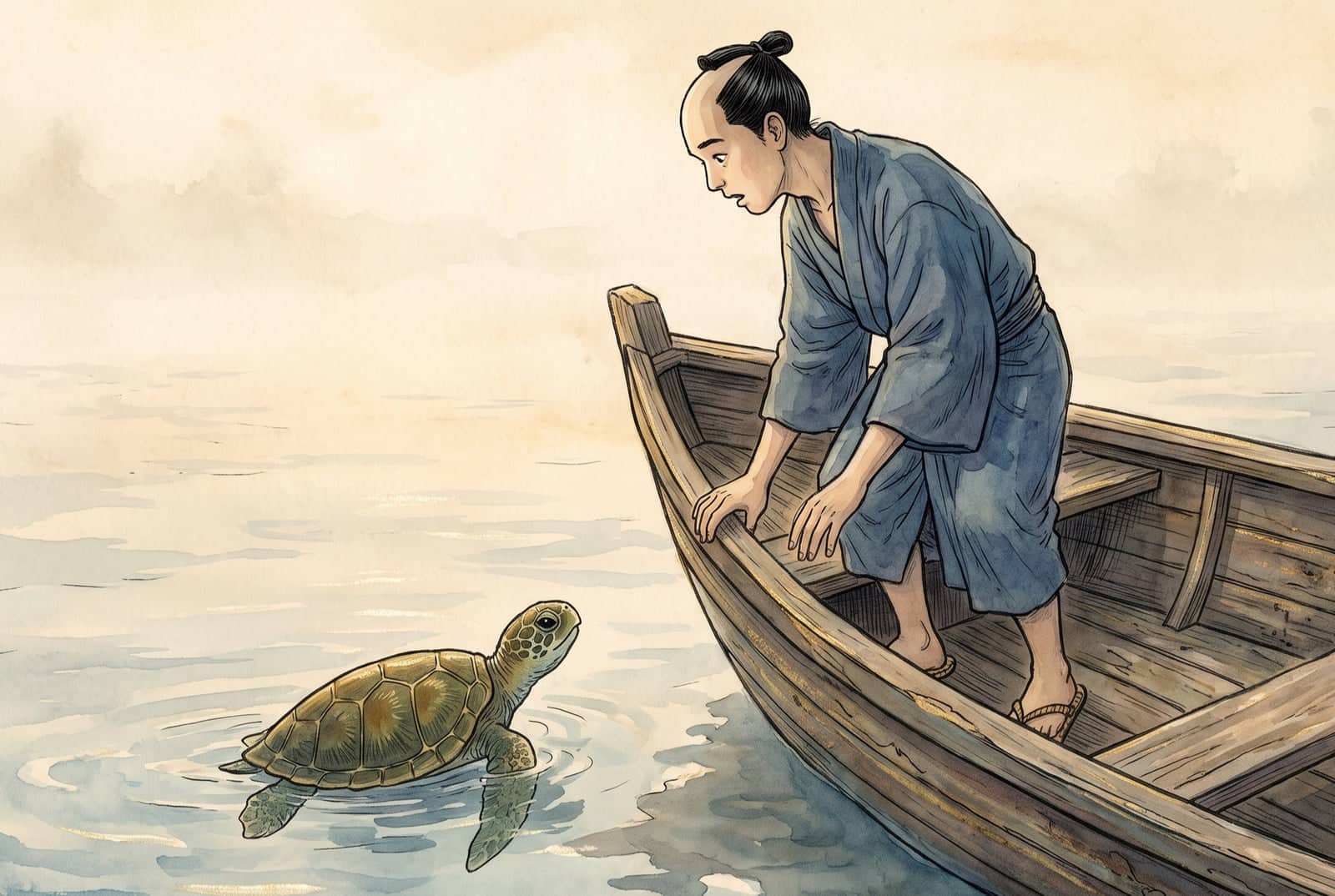
“Well, Mr. Tortoise,” said Urashima, “was it you who called my name just now?”
The tortoise nodded its head several times and said:
“Yes, it was me. Yesterday, thanks to you, my life was saved, and I have come to thank you and to tell you how grateful I am for your kindness.”
“Well, well,” said Urashima, “that’s very polite of you. Come up into the boat. I’d offer you a pipe, but you’re a tortoise, so I don’t suppose you smoke.” And the fisherman laughed at his own joke.
“Hee hee hee hee!” laughed the tortoise. “Rice wine is what I like best, but I don’t care for tobacco.”
“Well, well,” said Urashima, “I’m very sorry I have no rice wine in my boat to offer you, but come up and dry your back in the sun. Tortoises always love doing that.”
So the tortoise climbed into the boat, with the fisherman helping it, and after a good many polite compliments, the tortoise said:
“Urashima, have you ever seen the palace of the Dragon King of the Sea?”
The fisherman shook his head. “No. Year after year the sea has been my home, and I’ve often heard of the Dragon King’s realm under the waves, but I’ve never set eyes on that wonderful place. It must be very far away, if it’s there at all!”
“Is that really true? You’ve never seen the Sea King’s palace? Then you have missed one of the most wonderful sights in the whole world. It lies far away at the bottom of the sea, but if I take you there, we will soon arrive. If you would like to see the Sea King’s land, I will be your guide.”
“I’d love to go there, of course, and it’s very kind of you to think of taking me. But you must remember that I’m only a poor human being, and I can’t swim the way a sea creature like you can...”
Before the fisherman could say any more, the tortoise interrupted him.
“What? You won’t need to swim at all. If you ride on my back, I’ll carry you there without any trouble on your part.”
“But,” said Urashima, “how could I possibly ride on your little back?”
“It may sound ridiculous to you, but I promise you can. Try it right now! Just come and climb onto my back, and see whether it’s as impossible as you think!”
As the tortoise finished speaking, Urashima looked at its shell, and, strange to say, he saw that the creature had suddenly grown so big that a man could easily sit on its back.
“This is strange indeed!” said Urashima. “Well then, Mr. Tortoise, if you’ll allow me, I’ll climb on your back. Up we go!” he cried as he jumped on.
The tortoise, as calmly as if this were the most ordinary thing in the world, said:
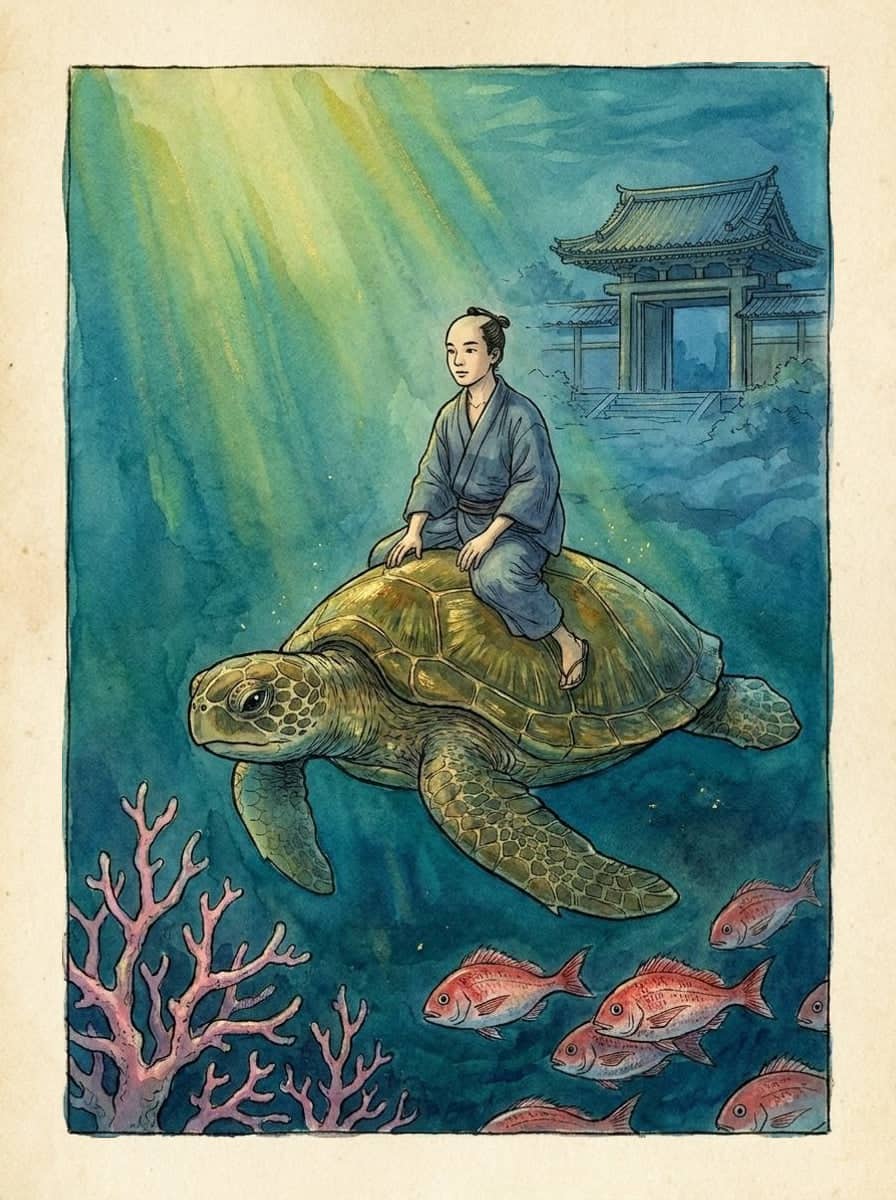
“Now we’ll set off. Just sit back and hold on.” With those words it leaped into the sea with Urashima on its back, and down through the water it dived. For a long time the two strange companions traveled through the sea. Urashima never grew tired, and his clothes never got wet. At last, far away in the distance, a magnificent gate appeared, and behind the gate, on the horizon, the long sloping roofs of a palace.
“Oh!” cried Urashima. “That looks like the gate of some great palace coming into view! Mr. Tortoise, can you tell me what that place is?”
“That is the great gate of the Dragon Palace, and the big roof you see behind it is the Sea King’s palace itself.”
“Then at last we’ve come to the realm of the Sea King and to his palace,” said Urashima.
“Yes, indeed,” answered the tortoise, “and don’t you think we got here very quickly?” As it was speaking, the tortoise reached the side of the gate. “Here we are. From here you’ll have to walk, if you please.”
Then the tortoise went ahead and spoke to the gatekeeper.
“This is Urashima Taro, from the land of Japan. I have had the honor of bringing him to this kingdom as a guest. Please show him the way.”
At once the gatekeeper, who was a fish, led them through the gate.
The red sea bream, the flounder, the sole, the cuttlefish and all the chief lords of the Dragon King of the Sea came out, bowing courteously, to welcome the stranger.
“Honored Urashima, honored Urashima! Welcome to the Sea Palace, home of the Dragon King of the Sea. Three times welcome, for you have come from such a faraway country! And you, Mr. Tortoise, we are deeply grateful to you for all your trouble in bringing Urashima here.” Then, turning back to Urashima, they said, “Please follow us this way.” From then on the whole company of fish became his guides.
Urashima was only a poor fisherman and did not know how to behave in a palace. Yet, strange as it all was, he did not feel awkward, and he calmly followed his kind guides into the inner palace. When he reached the doors, a beautiful princess came out with her maidens to welcome him. She was more beautiful than any human being. She wore flowing robes of red and soft green, like the underside of a wave, and golden threads glimmered in the folds of her gown. Her lovely black hair streamed over her shoulders in the style of a king’s daughter of many hundreds of years ago, and when she spoke, her voice sounded like music over the water. Urashima gazed at her in wonder and could not say a word. Then he remembered that he ought to bow, but before he could bow low, the princess took him by the hand, led him to a beautiful hall, brought him to the seat of honor at the far end, and asked him to sit down.
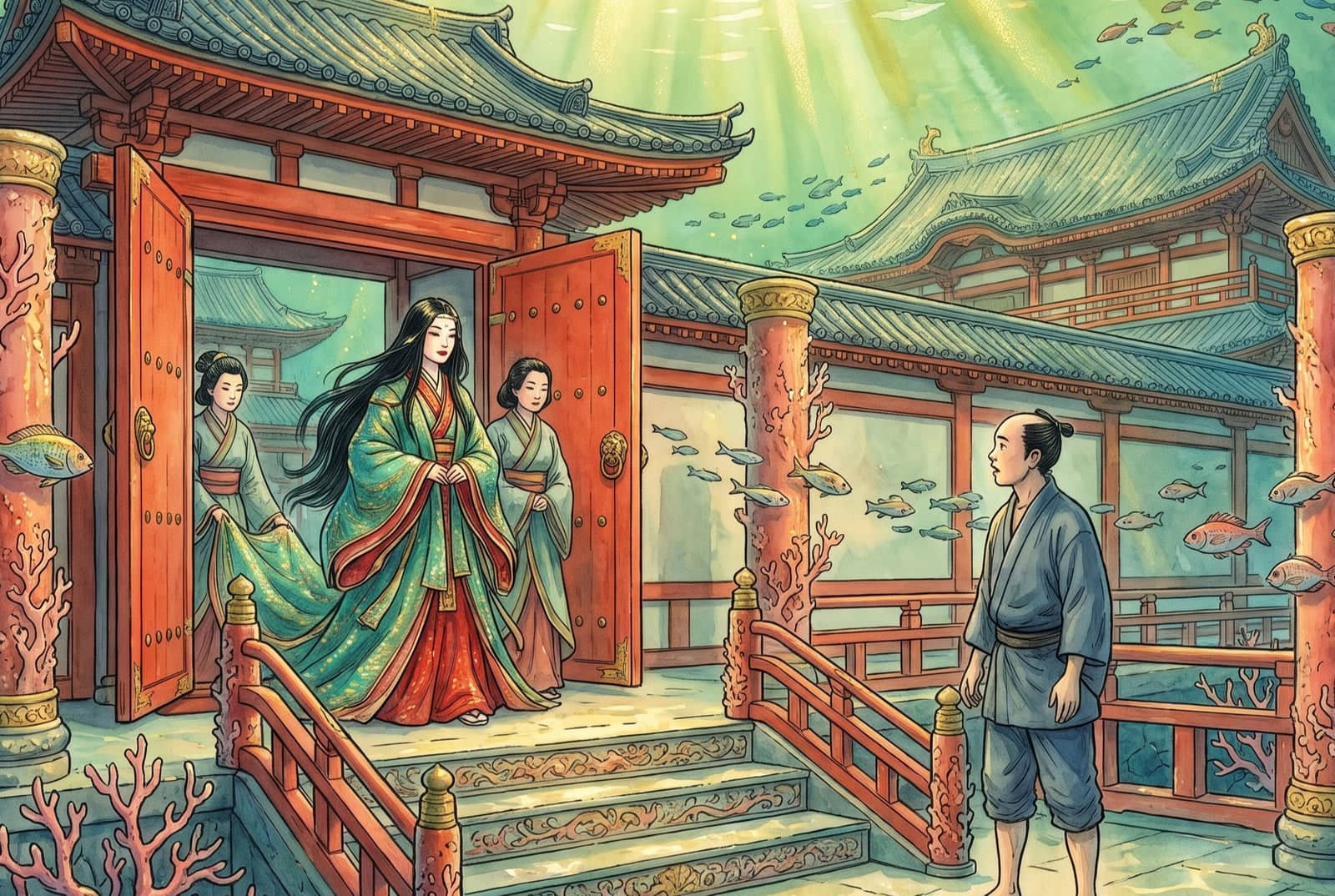
“Urashima Taro, it gives me the greatest pleasure to welcome you to my father’s kingdom,” said the princess. “Yesterday you set a tortoise free, and I sent for you to thank you for saving my life, because I was that tortoise. Now, if you like, you may live here forever, in the land of eternal youth, where summer never dies and sorrow never comes. I will be your bride, if you will have me, and we will live together happily ever after!”
As Urashima listened to her sweet words and gazed at her lovely face, his heart filled with wonder and joy, and he answered her, wondering all the while whether it was only a dream.
“Thank you a thousand times for your kind words. There is nothing I could wish for more than to be allowed to stay here with you in this beautiful land, which I have often heard of but never seen until today. It is the most wonderful place I have ever seen.”
While Urashima was speaking, a procession of fish appeared, all dressed in long, trailing ceremonial robes. One by one, silently and with stately steps, they came into the hall, carrying coral trays of delicacies made from fish and seaweed, such as no one could ever dream of, and this wonderful feast was set before the bride and groom. The wedding was celebrated in dazzling splendor, and there was great rejoicing throughout the Sea King’s realm. As soon as the young couple had sealed their vows by sharing the wedding cup of wine, three times three sips, music was played and songs were sung, and fish with silver scales and golden tails came in from the waves and danced. Urashima enjoyed himself with all his heart. Never in his life had he sat down to such a marvelous feast.
When the feast was over, the princess asked her bridegroom whether he would like to walk through the palace and see everything there was to see. So the happy fisherman followed his bride, the Sea King’s daughter, and she showed him all the wonders of that enchanted land, where youth and joy go hand in hand and neither time nor age can touch them. The palace was built of coral and decorated with pearls, and its wonders were beyond words.
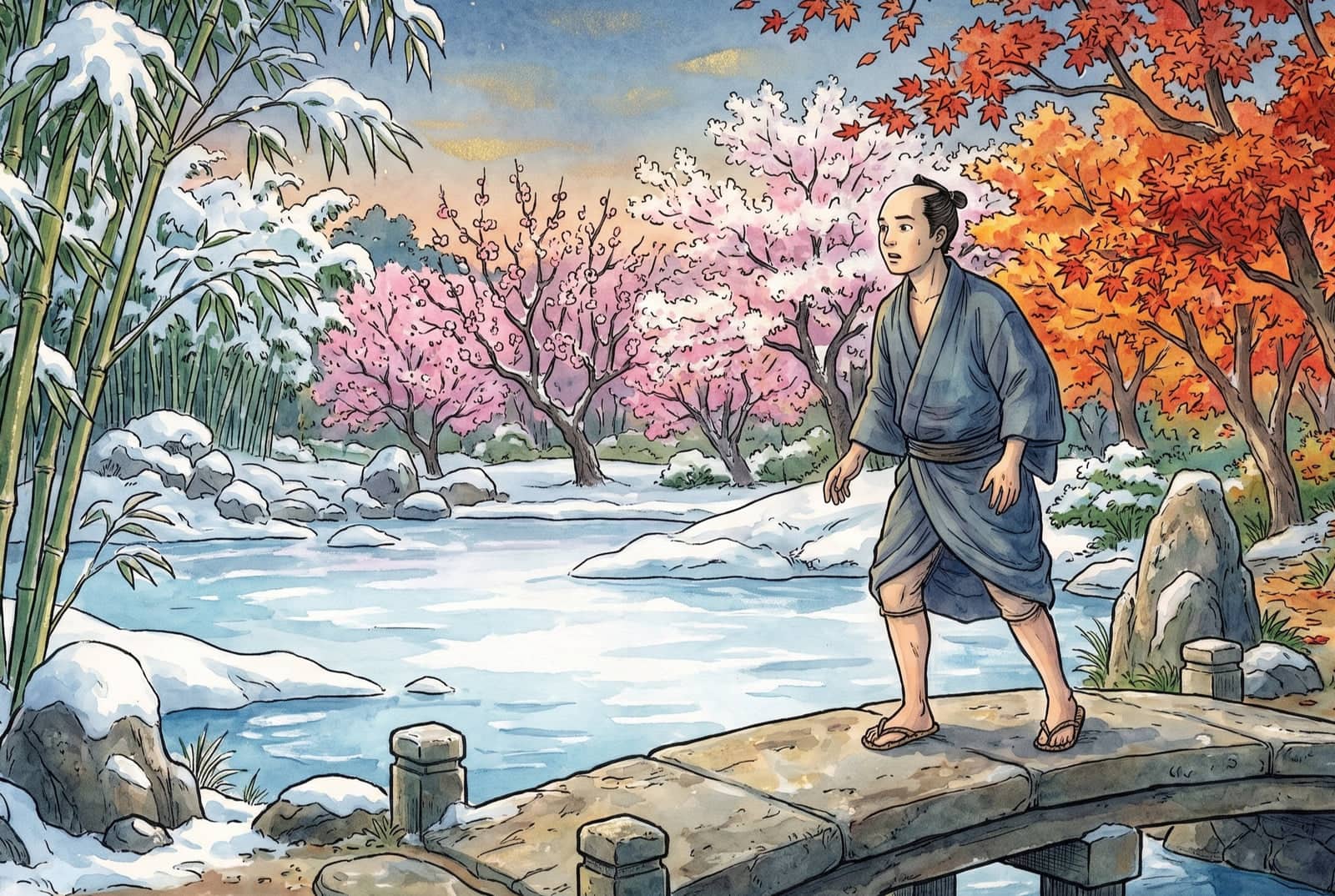
But to Urashima, even more wonderful than the palace was the garden around it. There you could see the scenery of all four seasons at the same time: the beauties of summer and winter, spring and autumn, were all spread out at once before the astonished visitor.
First, when Urashima looked to the east, he saw plum and cherry trees in full bloom; nightingales sang along the pink avenues, and butterflies flitted from flower to flower.
When he looked to the south, all the trees were green in the fullness of summer, and the cicadas by day and the crickets by night sang loudly.
When he looked to the west, the autumn maples blazed like a sunset sky, and the chrysanthemums were at their very best.
When he looked to the north, the change made Urashima start, for the ground was silvery white with snow, the trees and bamboos were covered with snow too, and the pond was thick with ice.
Every day brought new joys and new wonders for Urashima, and his happiness was so great that he forgot everything, even the home he had left behind, his parents and his own country. Three days passed without his once thinking of all he had left. Then he came to his senses. He remembered who he was, and that he did not belong in this wonderful land or in the Sea King’s palace, and he said to himself:
“Oh dear! I mustn’t stay here any longer, because I have an old father and mother at home. What can have happened to them all this time? How worried they must have been these past days when I didn’t come home as usual. I must go back at once, without letting another day go by.” And he began to get ready for the journey in great haste.
Then Urashima went to his beautiful wife, the princess, bowed low before her, and said:
“Truly, I have been very happy with you for a long time, Princess Otohime, and you have been kinder to me than any words can say. But now I must say goodbye. I must go back to my old parents.”
Then Princess Otohime began to weep, and she said softly and sadly:
“Aren’t you happy here, Urashima, that you want to leave me so soon? Why such a hurry? Stay with me just one more day!”
But Urashima had remembered his old parents, and in Japan duty to one’s parents is stronger than anything else, stronger even than pleasure or love. He would not be persuaded, and he answered:
“No, I really must go. Don’t think that I want to leave you. It isn’t that. I must go and see my old parents. Let me go for one day, and I will come back to you.”
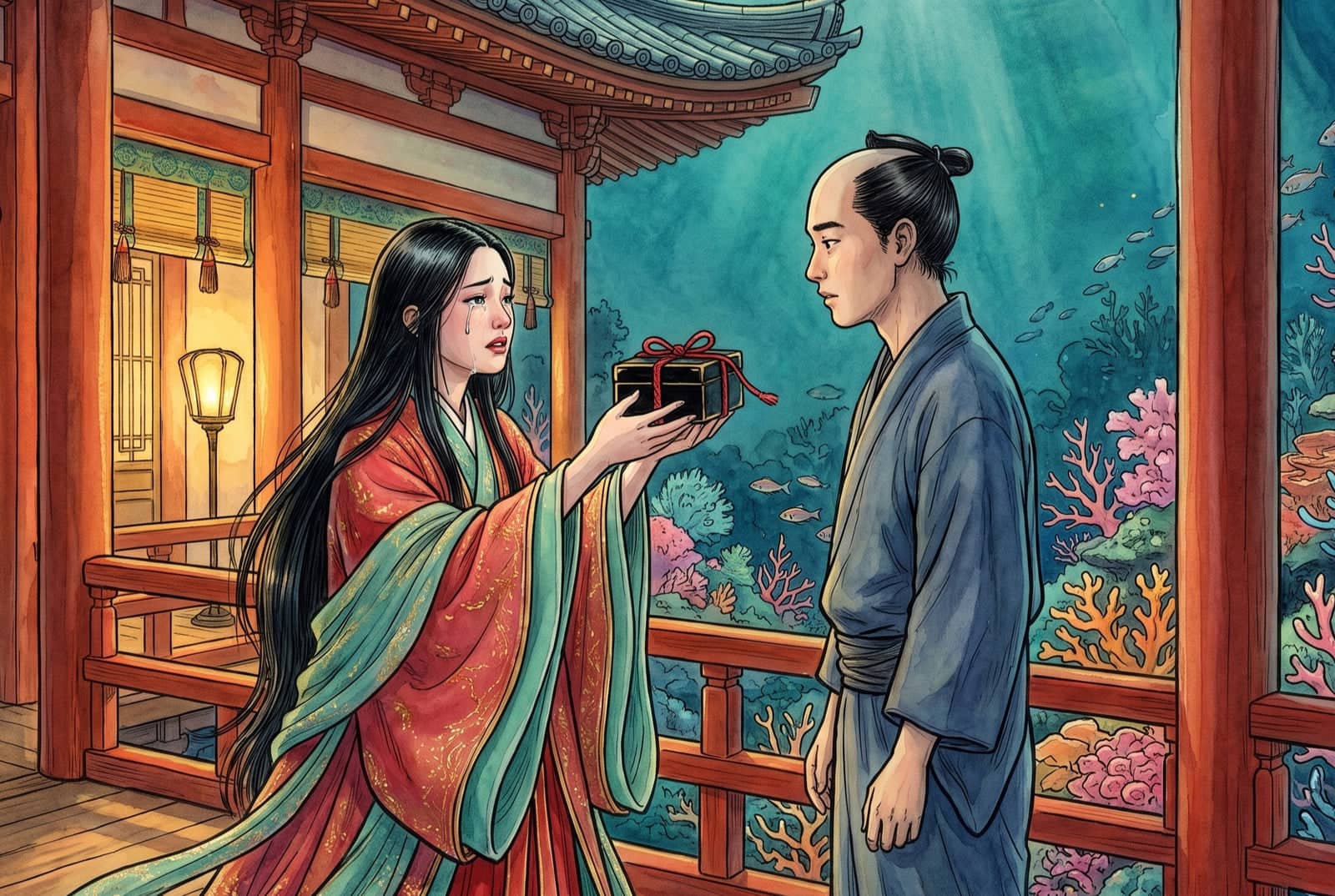
“Then,” said the princess sorrowfully, “there is nothing to be done. I will send you back today to your father and mother, and instead of trying to keep you one more day, I will give you this as a token of our love. Please take it with you.” And she brought him a beautiful lacquered box, tied around with a silk cord and tassels of red silk.
Urashima had already received so much from the princess that he felt a little uneasy about accepting the gift, and he said:
“It doesn’t seem right for me to take yet another gift from you after all the kindness you’ve shown me, but since it is your wish, I will.” Then he added, “Tell me, what is this box?”
“That,” answered the princess, “is the tamate-bako, the Box of the Jeweled Hand, and something very precious is inside it. You must not open this box, whatever happens! If you open it, something dreadful will happen to you! Now promise me that you will never open this box!”
And Urashima promised that he would never, ever open the box, whatever happened.
Then Urashima said goodbye to Princess Otohime and went down to the seashore, with the princess and her maidens following him, and there he found a large tortoise waiting for him.
He quickly climbed onto the creature’s back and was carried away over the shining sea toward the east. He kept looking back to wave to Princess Otohime until at last he could see her no more, and the land of the Sea King and the roofs of the wonderful palace were lost in the far, far distance. Then, with his face turned eagerly toward his own land, he watched for the blue hills to rise on the horizon ahead of him.
At last the tortoise carried him into the bay he knew so well, to the very shore he had set out from. He stepped onto the beach and looked around him, while the tortoise swam away, back to the Sea King’s realm.
But what was this strange fear that seized Urashima as he stood there looking around? Why did he stare so hard at the people passing by, and why did they in turn stop and stare at him? The shore was the same and the hills were the same, but the people he saw walking past had faces quite different from the ones he had known so well before.
Wondering what it could mean, Urashima walked quickly toward his old home. Even that looked different, but a house still stood on the spot, and he called out:
“Father, I’m home!” He was just about to go in when he saw a strange man coming out.
“Perhaps my parents moved while I was away and have gone to live somewhere else,” the fisherman thought. Somehow he began to feel strangely uneasy, though he could not tell why.
“Excuse me,” said Urashima to the man, who was staring at him, “but until a few days ago I lived in this house. My name is Urashima Taro. Where have my parents gone? I left them here.”
A deeply bewildered look came over the man’s face, and, still staring at Urashima, he said:
“What? You’re Urashima Taro?”
“Yes,” said the fisherman, “I am Urashima Taro!”
“Ha, ha!” laughed the man. “You mustn’t make jokes like that. It’s true that once upon a time a man called Urashima Taro lived in this village, but that’s a story three hundred years old. He couldn’t possibly be alive now!”
When Urashima heard these strange words he was frightened, and he said:
“Please, please, don’t joke with me. I’m terribly confused. I really am Urashima Taro, and I certainly haven’t lived for three hundred years. Until four or five days ago I lived right here. Please stop joking and tell me.”
But the man’s face grew graver and graver, and he answered:
“You may be Urashima Taro or you may not, I don’t know. But the Urashima Taro I’ve heard of is a man who lived three hundred years ago. Perhaps you’re his ghost, come back to visit your old home?”
“Why are you making fun of me?” said Urashima. “I’m no ghost! I’m a living man. Ghosts have no feet, so look at mine!” And thump, thump, he stamped on the ground, first with one foot and then with the other, to show the man.
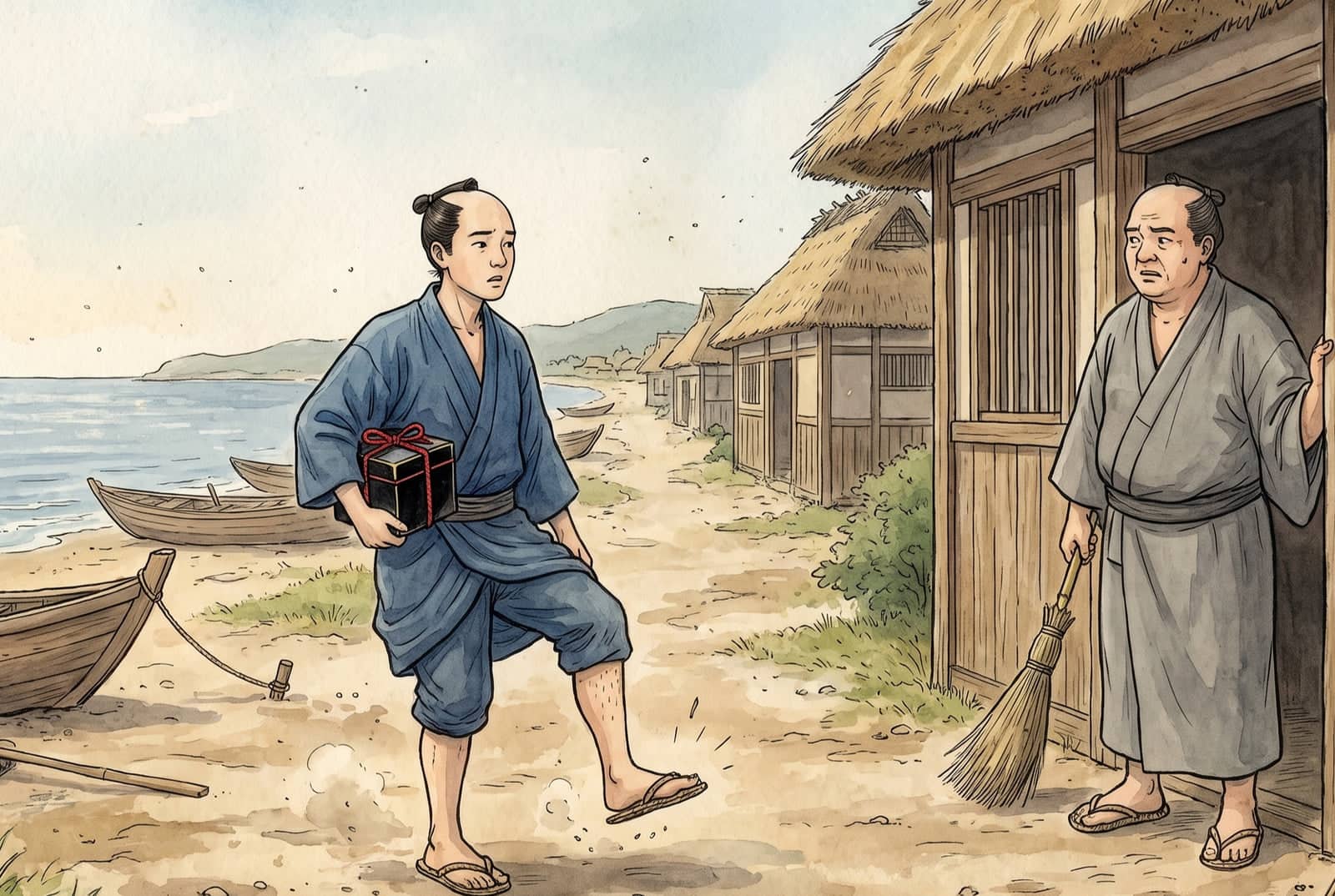
“But Urashima Taro lived three hundred years ago, that’s all I know. It’s written in the village records,” the man insisted, for he could not believe the fisherman.
Urashima was lost in confusion and distress. He stood looking all around him, and indeed everything looked different from what he remembered before he went away. A terrible feeling came over him that what the man said might be true. He seemed to be in a strange dream. The few days he had spent in the Sea King’s palace beyond the sea had not been days at all. They had been hundreds of years, and in that time his parents had died, and so had everyone he had ever known, and the village had written down his story. There was no use staying here any longer. He must get back to his beautiful wife beyond the sea.
Urashima made his way back to the beach, carrying in his hand the box the princess had given him. But which way should he go? Suddenly he remembered the box, the tamate-bako.
“When the princess gave me this box, she told me never to open it, and she said there was something very precious inside. But now that I have no home, now that I have lost everything that was dear to me here, and my heart is breaking with sorrow, surely if I open the box now I will find something to help me, something that will show me the way back to my beautiful princess across the sea. There’s nothing else left for me to do. Yes, yes, I will open the box and look inside!”
And so he gave in and decided to disobey, and he tried to convince himself that he was doing the right thing by breaking his promise.
Slowly, very slowly, Urashima untied the red silk cord, and slowly, wondering, he lifted the lid of the precious box. And what did he find? Strange to say, only a beautiful little purple cloud, which rose out of the box in three soft wisps. For a moment it covered his face and hovered over him, as if it were unwilling to leave, and then it drifted away like mist over the sea.
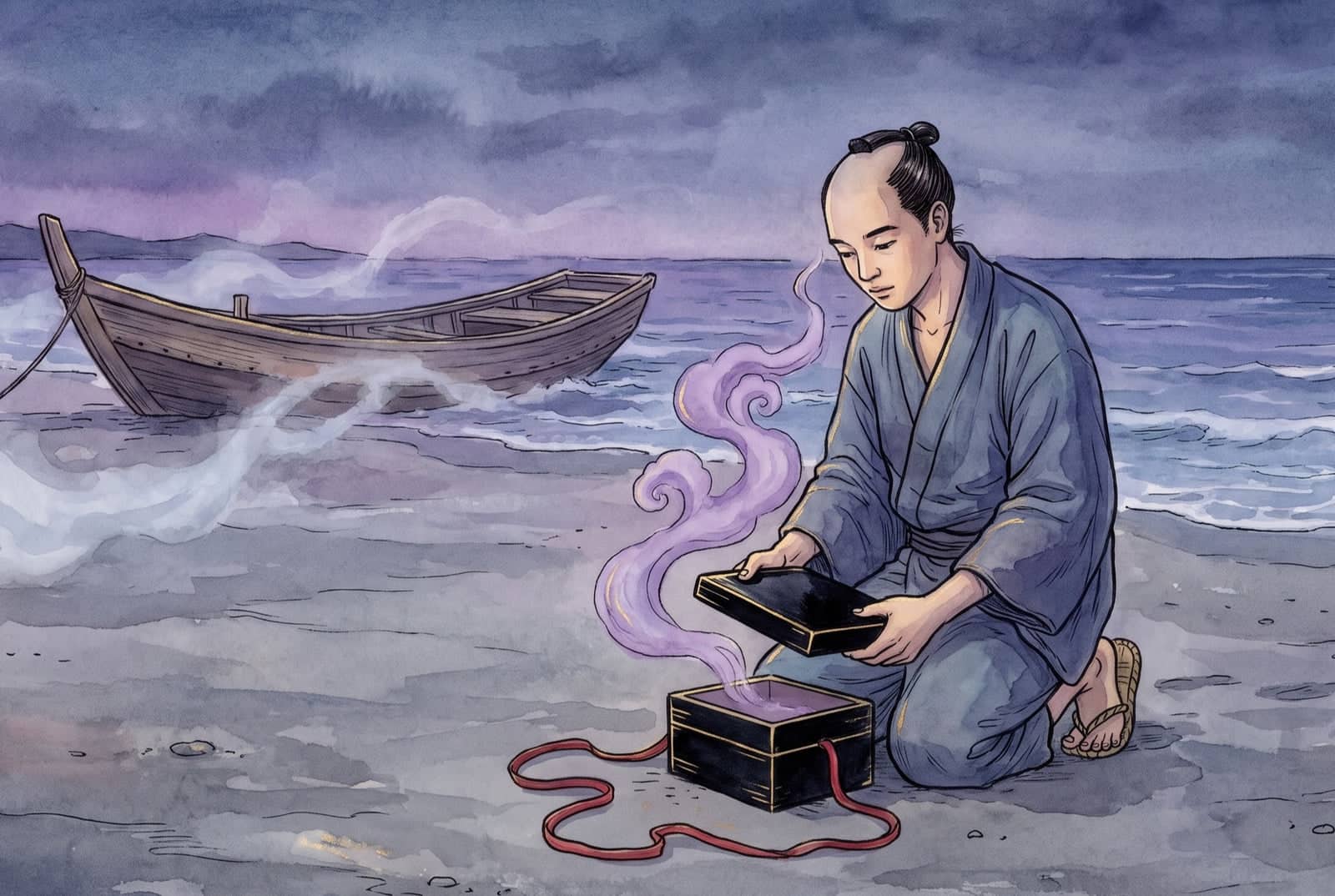
Urashima, who until that moment had been like a strong and handsome young man of twenty-four, suddenly became very, very old. His back bent double with age, his hair turned snowy white, his face became wrinkled, and he fell down dead on the beach.
Poor Urashima! Because he disobeyed, he could never return to the Sea King’s realm or to the lovely princess beyond the sea.
Little children, never disobey those who are wiser than you, for disobedience was the beginning of all the miseries and sorrows of life.
Retold by Talerie from Japanese Fairy Tales (opens in a new window)License: Public domainCopy this text, adapt it, use it however you like. A link back to Talerie is appreciated but never required.CC0 1.0 (opens in a new window)