The Fisherman and the Jinni

10 min readages 6 and uptalerie.com/en/tales/the-fisherman-and-the-jinni
A poor old fisherman pulls a sealed brass jar from the sea, and the jinni inside swears to kill him, but the fisherman tricks him back into it. Set free once more, the jinni leads him to a lake of colored fish, and the sultan pays the fisherman four hundred gold pieces, so his wife and children have all they need.
Once upon a time there was a fisherman so old and so poor that he could barely feed his wife and three children. Every day he went out to fish very early, and he had made himself a rule: he would never cast his nets more than four times a day.
One morning he set out by moonlight and came down to the shore. He took off his clothes and threw his nets, and as he hauled them in he felt a great weight. He thought he had caught a big fish and was very pleased. But when the nets came in, there was no fish in them at all, only the body of a dead donkey, and he was bitterly disappointed.
The donkey had torn his nets in several places. When he had mended them, he cast a second time. Again he felt a great weight, and again he thought the nets were full of fish. But all he found was a large basket full of mud and rubbish.
“O Fortune,” he cried, “don’t play such tricks on me! I’m only a poor fisherman, and I can hardly feed my family.”
He threw the rubbish away, washed the mud out of his nets, and cast them a third time. This time he pulled in nothing but stones, shells, and mud. He was close to despair.
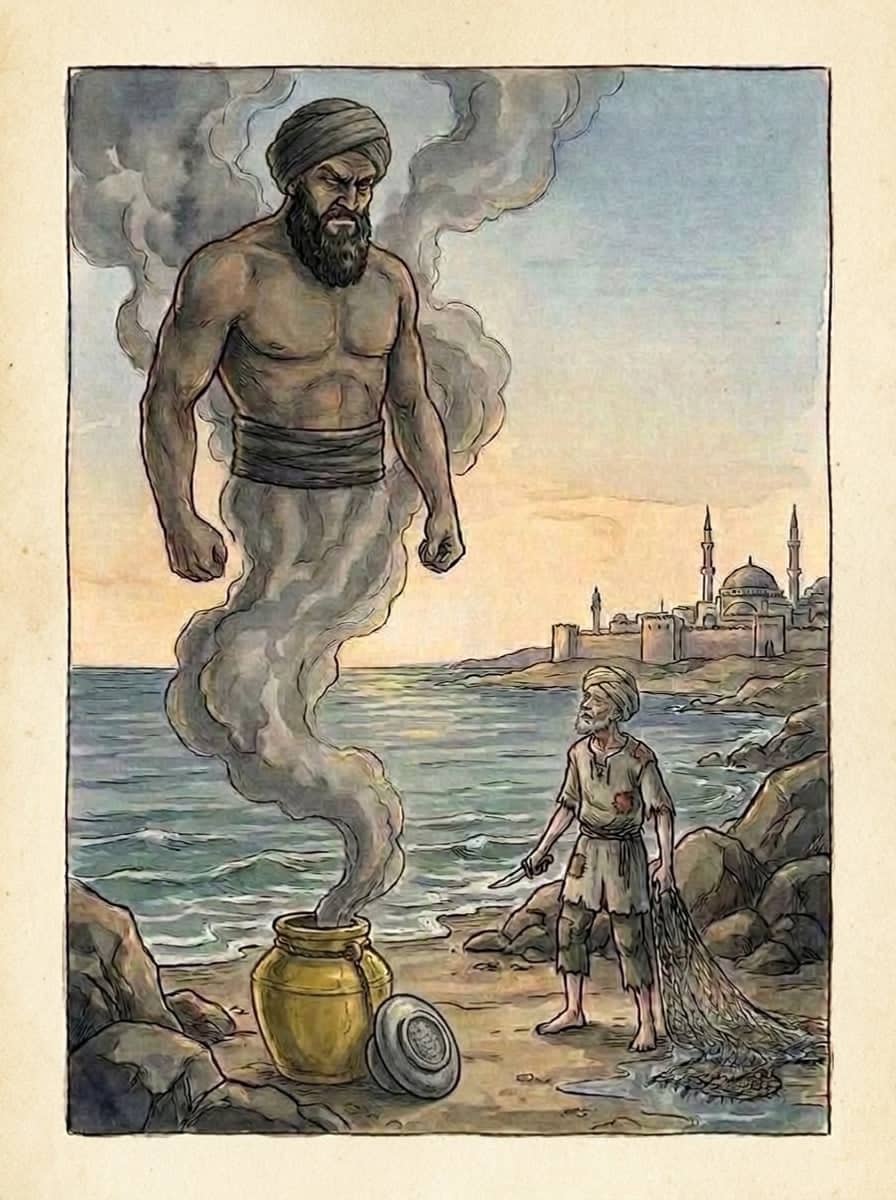
Then he cast his nets for the fourth and last time. They came in so heavy that he had to struggle to drag them ashore, but again there was no fish. Instead he found a jar of yellow brass, so heavy that it seemed to be full of something. Its mouth was stoppered with lead, and the lead was stamped with a seal.
The fisherman was delighted. “I’ll sell it for the brass,” he said, “and with the money I’ll buy a measure of wheat.”
He turned the jar this way and that and shook it to hear whether anything rattled. He heard nothing. Still, he felt sure that a jar sealed so carefully must hold something precious. So he took out his knife and, with a little effort, pried the lid open. He tipped the jar upside down, but nothing came out, and he was very surprised.

He set the jar down in front of him and was looking at it closely when a thick smoke began to pour out of it, so thick that he had to step back. The smoke rose up to the clouds and spread over the sea and the shore in a heavy mist. When the last of it had left the jar, it drew together into one great mass, and the mass became a jinni twice as tall as the tallest giant.
At the sight of such a terrible creature, the fisherman wanted to run away, but he was shaking so hard that he could not take a single step.
“Great king of the jinn,” the jinni cried, “I will never disobey you again!”
When he heard those words, the fisherman found his courage.
“What are you saying, great jinni?” he asked. “Tell me who you are and how you came to be shut up in that jar.”
The jinni gave him a haughty look. “Speak to me more politely, fisherman,” he said, “before I kill you.”
“Kill me?” cried the fisherman. “Why would you kill me? I’ve only just set you free. Have you forgotten that already?”
“No,” said the jinni, “but that will not stop me. I will grant you one favor only: you may choose how you are going to die.”
“But what have I done to you?” asked the fisherman.
“I cannot treat you any other way,” said the jinni. “If you want to know why, listen to my story.
“I rebelled against the king of the jinn. To punish me, he shut me up in this brass jar and pressed his seal into the lead of the lid, and that seal is magic enough to keep me in. Then he had the jar thrown into the sea.
“In the first hundred years of my prison, I vowed that whoever freed me would be rich, and his family too after he died. But that century passed, and no one came. In the second century, I vowed to give my rescuer all the treasures in the world, and still no one came. In the third, I promised to make him a king, to stay always at his side, and to grant him three wishes every day. That century passed like the other two, and I was still a prisoner.
“At last I grew furious at being shut away so long, and I swore that if anyone ever let me out, I would kill him at once, and let him choose only how he would die. And since you are the one who freed me today, choose how you will die.”
The fisherman was miserable. “What bad luck that I ever set you free!” he said. “I beg you, spare my life.”
“I have told you already,” said the jinni, “that it is impossible. Choose quickly. You are wasting time.”
The fisherman began to think of a plan.
“Since I must die,” he said, “I ask you, on your honor, to answer one question before I choose. Were you really inside that jar?”
“Yes, I was,” said the jinni.
“I can’t believe it,” said the fisherman. “That jar couldn’t hold even one of your feet. How could your whole body fit inside? I won’t believe it unless I see it with my own eyes.”
At once the jinni began to turn into smoke. As before, the smoke spread over the sea and the shore. Then it gathered itself together and flowed back into the jar, slowly and steadily, until nothing at all was left outside. A voice spoke from inside. “Well, doubting fisherman, here I am inside the jar. Do you believe me now?”

The fisherman did not answer. He snatched up the lead lid and clapped it down on the jar.
“Now, jinni,” he cried, “it’s your turn to beg, and your turn to choose how you will die! But no, I have a better idea. I’ll throw you back into the sea where I found you. Then I’ll build a house on this shore to warn every fisherman who comes here never to pull up a wicked jinni like you, who swore to kill the man who set him free.”

The jinni struggled with all his might to get out, but the magic of the seal held him fast.
So he tried cunning instead. “If you take off the lid,” he said, “I will reward you.”
“No,” said the fisherman. “If I trust you, I’m afraid you’ll treat me the way a certain Greek king treated the physician Douban. If that king had spared the physician, he would not have died himself. You’re no different. Now I’m going to throw you into the sea.”
“My friend,” said the jinni, “don’t do such a cruel thing. Let me out, and I will make you rich.”
The thought of never being poor again was more than the fisherman could resist.
“If you give me your promise,” he said, “I’ll open the lid. I don’t think you’ll dare break your word.”
The jinni promised, and the fisherman lifted the lid. Out came the smoke, and when the jinni had taken his own shape again, the first thing he did was kick the jar far out into the sea.
The fisherman was terrified, but the jinni only laughed. “Don’t be afraid,” he said. “I did it to give you a fright. I mean to keep my word. Take your nets and follow me.”
The jinni strode on ahead, and the fisherman followed, still not quite trusting him. They passed the town, climbed a mountain, and went down the other side into a wide plain, where a large lake lay between four hills.
When they reached the lake, the jinni said, “Cast your nets and catch some fish.”
The water was full of fish, so the fisherman did as he was told, expecting a good catch. But what a surprise he had! The fish were of four different colors: some were white, some red, some blue, and some yellow. He caught four, one of each color. He had never seen anything like them, and he could not stop admiring them, thinking all the while how much money they would bring.
“Take these fish to the sultan,” said the jinni. “He will give you more money for them than you have ever had in your life. You may come and fish in this lake every day, but take care to cast your nets only once a day, or harm will come to you. Do as I say, and you will be glad you did.”
With that he stamped his foot on the ground. The earth opened, and when he had gone down into it, it closed again at once.

The fisherman made up his mind to do exactly as the jinni had said. He did not cast his nets a second time, but walked into the town and took his fish straight to the palace.
When the sultan saw the fish, he was amazed. He looked at them one by one, and when he had admired them long enough, he turned to his grand vizier.
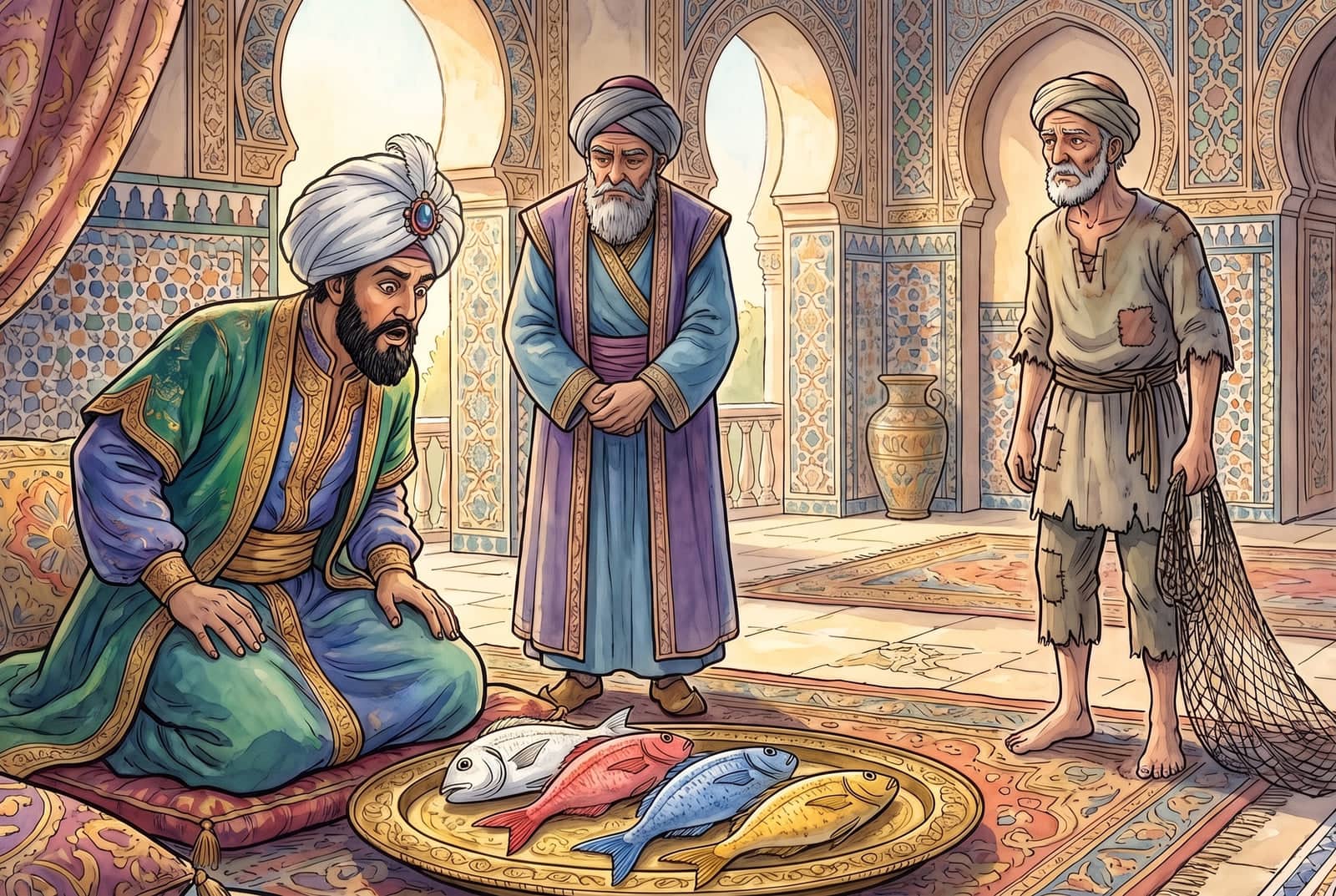
“Take these fish to the skillful cook the Emperor of the Greeks sent me,” he said. “I think they must taste as good as they look.”
The vizier carried them to the cook himself. “Here are four fish that have just been brought to the sultan,” he told her. “He wants you to cook them for him.”

Then he went back to the sultan, who told him to pay the fisherman four hundred gold pieces. The fisherman had never held so much money in his life, and he could hardly believe his good fortune. He went straight home and used it well, and from then on his wife and children had everything they needed.
Retold by Talerie from The Arabian Nights Entertainments (opens in a new window)License: Public domainCopy this text, adapt it, use it however you like. A link back to Talerie is appreciated but never required.CC0 1.0 (opens in a new window)