A poor woodcutter leaves his seven sons deep in the forest, and the smallest boy leads his brothers to a house where an ogre sharpens a knife for them. While the ogre sleeps on a rock, the boy pulls the seven-league boots off him, then comes home with the ogre’s riches and sees his father and brothers provided for.
Once upon a time a woodcutter and his wife had seven children, all of them boys, and they were very poor, for not one of the seven could yet earn his bread. The youngest was born hardly bigger than a thumb, and so they called him Hop-o’-My-Thumb. He seldom spoke, and his family took his silence for slowness, though he was the cleverest of them all and listened to everything.
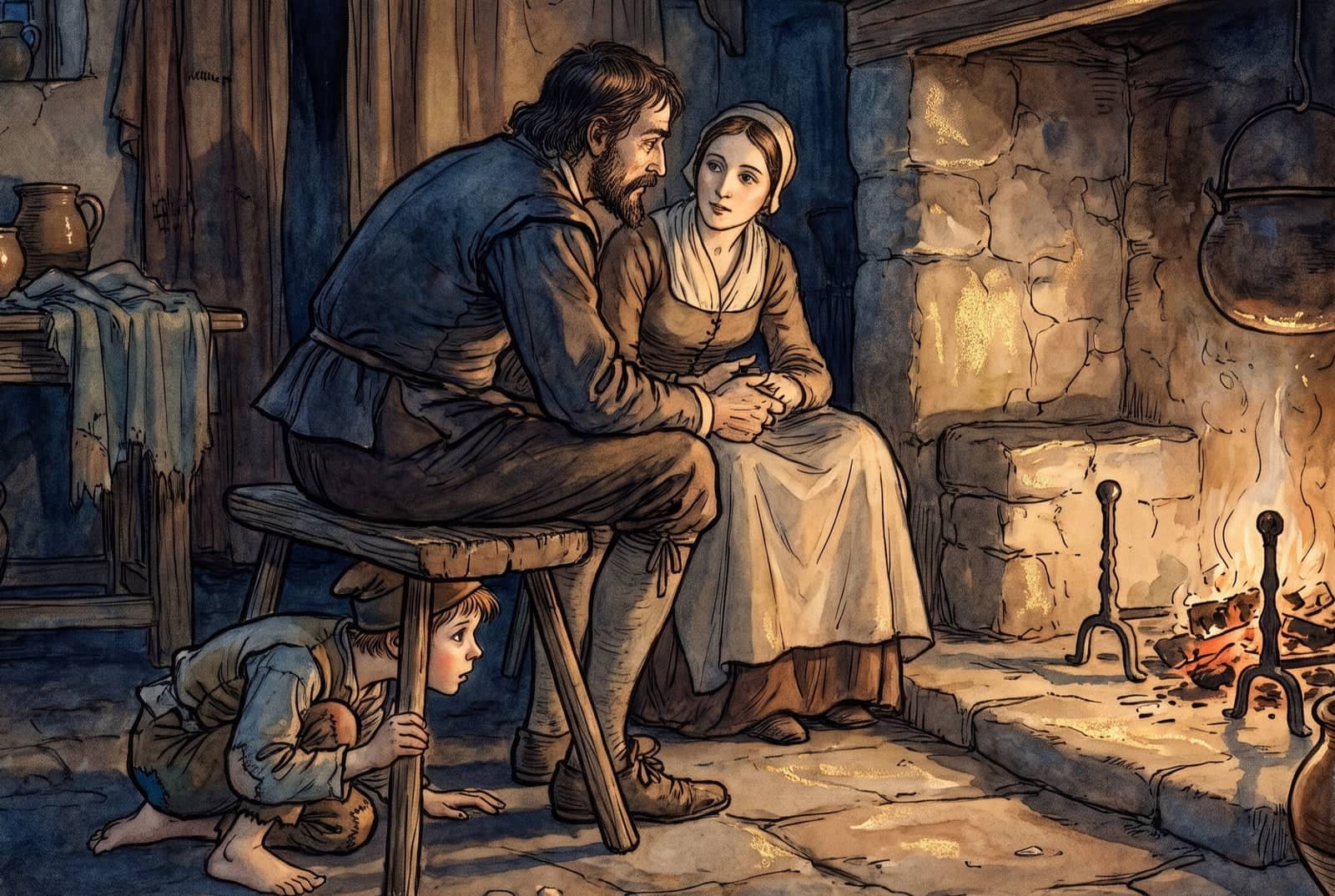
Then came a hard year, and the hunger was so great that the parents made up their minds to be rid of their children. One evening, when the boys were in bed, the woodcutter sat by the fire with his wife and spoke with a heavy heart.
“You can see we cannot feed them any longer,” he said. “Tomorrow I shall take them deep into the forest, and while they are busy with the sticks we can slip away. I will not watch them starve in front of me.”
“Leave your own children?” cried his wife. “How could you do it?”
He told her again how poor they were, but she could not agree: she was poor, but she was their mother. Then she thought of them going hungry day after day, and at last she gave in, and cried herself to sleep.
Hop-o’-My-Thumb heard every word. He had crept out of bed and slipped under his father’s stool to listen, and he lay awake all night. At first light he filled his pockets with little white pebbles from the brook, and told his brothers nothing.
They went into a part of the forest so thick that ten paces apart they could not see one another. The woodcutter set to cutting wood and the boys to gathering twigs, and their parents drew off little by little, then slipped away down a side path.
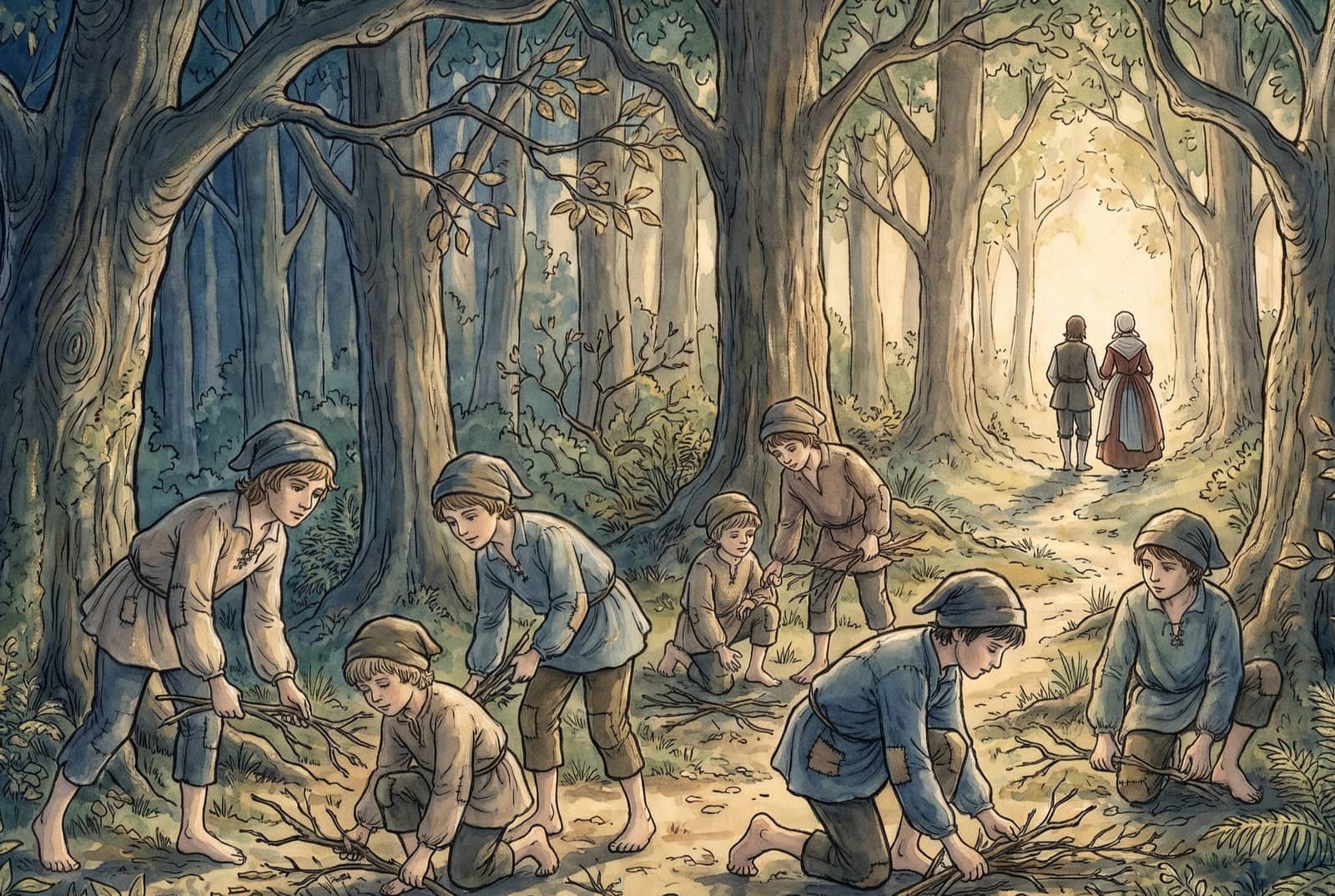
When the children found themselves alone they cried with all their might. Hop-o’-My-Thumb let them cry, for as he walked he had been dropping his white pebbles along the path.
“Don’t be afraid, brothers,” he said. “Father and Mother have left us here, but I shall bring you home. Only follow me.”
He led them home by the way they had come. They did not dare go in, but pressed against the door to listen.
Meanwhile the lord of the village had sent the woodcutter ten crowns, long owed and long given up for lost. The woodcutter’s wife ran to the butcher and bought three times as much meat as two could eat, and when they had eaten she began to cry.
“Where are our poor children now? They would make a fine meal of what is left. It was you who wanted to lose them, William, and the wolves may have eaten them already. Oh, where are my poor children?”
She said it so loudly that the boys at the door heard her, and they all called out together,
“Here we are! Here we are!”
She ran to open the door and hugged them one after another.
“How glad I am to see you, my dears! And look at the mud on you. Come and let me wash your faces.”
They sat down and ate, all telling at once how frightened they had been, and the joy of having them home lasted as long as the ten crowns.
When the money was gone the old misery came back, and the parents made up their minds to lose the children again, further off this time.
They could not talk of it quietly enough to keep it from Hop-o’-My-Thumb, but when he got up early for pebbles the door was double-locked. So when his mother gave each of them a piece of bread for breakfast, he put his in his pocket, to drop in crumbs along the way.
Their father and mother led them into the thickest, darkest part of the forest and slipped away. Hop-o’-My-Thumb was not troubled, for he believed the bread would show him the road. But not one crumb was left: the birds had eaten it all.
Now they were truly lost, for the more they walked the further they wandered. Night came, and a great wind rose that frightened them terribly. On every side they thought they heard wolves coming for them, and the rain soaked them to the skin.
Hop-o’-My-Thumb climbed to the top of a tree, and far off, beyond the forest, he saw a small light like a candle.
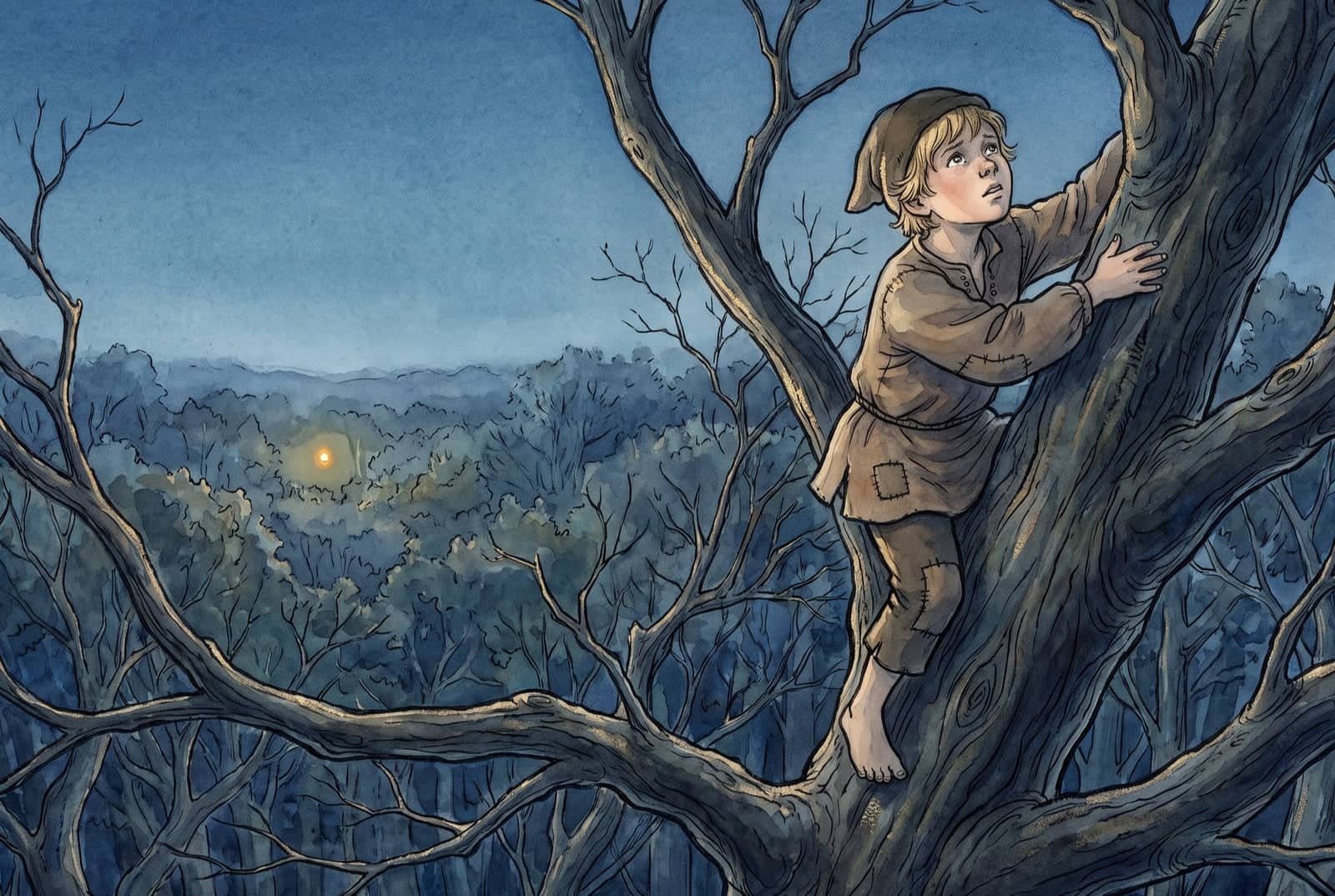
They reached the house at last, though they had lost sight of the light every time they went down into a hollow. A kindly woman opened the door, and Hop-o’-My-Thumb told her they were poor children lost in the forest, and begged for a bed. She looked at them, so many and so small, and began to cry.
“My poor children,” she said, “do you know where you have come to? This is the house of an ogre who eats little children.”
“Oh, madam,” answered Hop-o’-My-Thumb, trembling, and his brothers with him, “the wolves will certainly eat us tonight if you do not take us in. If it must be one or the other, we would rather it were the gentleman.”
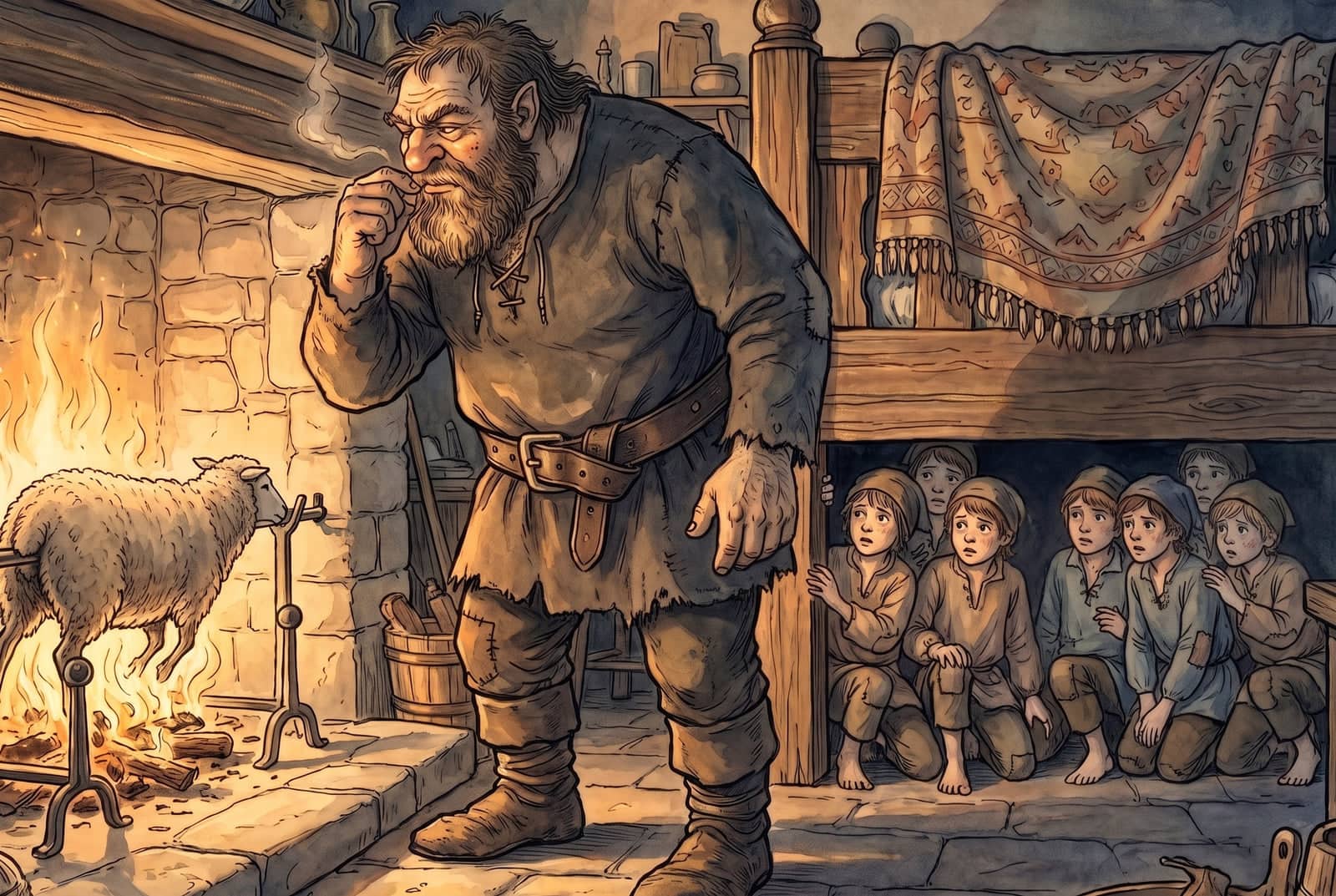
The ogre’s wife thought she could hide them until morning, so she let them in and sat them by a good fire, where a whole sheep was turning on the spit for the ogre’s supper.
They were barely warm when three or four great blows shook the door. The ogre’s wife pushed the boys under the bed and let her husband in. He asked whether supper was ready, sat down to eat, and then began to sniff to right and left, and said he smelled fresh meat.
“It must be the calf I have just dressed that you smell,” said his wife.
“I smell fresh meat, I tell you,” said the ogre, looking at her sideways, and he got up from the table and went straight to the bed.
“So this is how you would cheat me,” he said. “Here is game come just in time for three ogres who are to visit me.”
He pulled the boys out one after another. They knelt and begged for mercy, but this was the cruelest of all ogres, who was already devouring them with his eyes. He fetched a great knife and sharpened it on a long stone, and had hold of one of them when his wife spoke.
“What do you want with them at this hour? And you have so much meat still: a calf, two sheep and half a pig.”
“You are right,” said the ogre. “Give them a good supper so they don’t grow thin, and put them to bed.”
The ogre went back to his wine, delighted at the feast he would give his friends, and drank so many glasses more than usual that he had to go to bed.
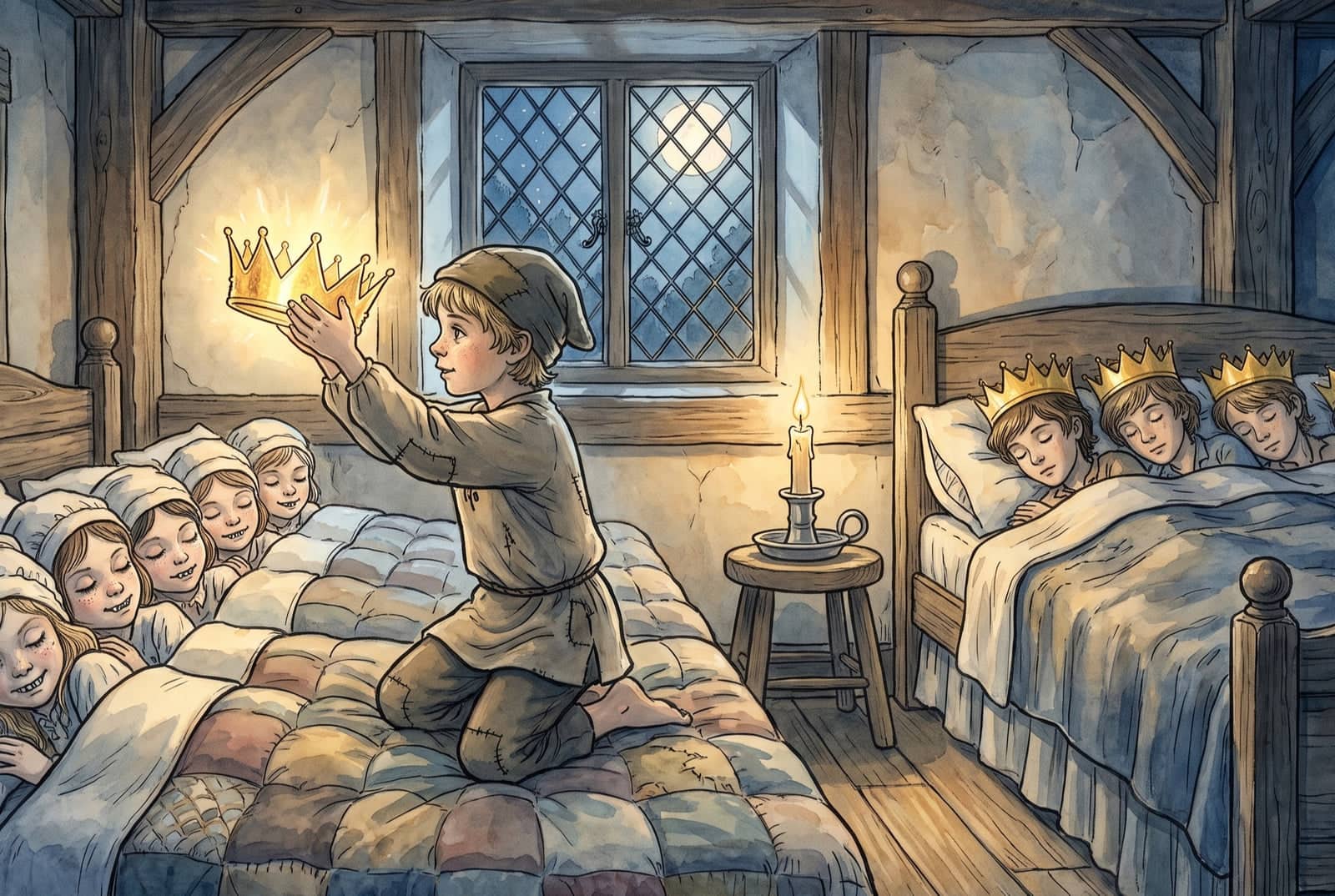
The ogre had seven daughters, still only children. They had beautiful clear skins, from eating fresh meat like their father, but little round gray eyes, hooked noses and very large mouths with long sharp teeth. All seven slept in one big bed, each with a gold crown on her head, and the ogre’s wife put the seven boys in another bed of the same size in the same room.
Hop-o’-My-Thumb had noticed the crowns, and he was afraid the ogre might not wait for morning. So about midnight he got up, took the seven nightcaps and set them softly on the heads of the seven daughters, and put the gold crowns on his brothers’ heads and his own, so that the ogre should take each for the other.
It fell out exactly as he had thought. At midnight the ogre woke, sorry he had put off till tomorrow what he might have done that night, and he took up his great knife.
“Let us see how our young rascals are getting on,” he said. “Better to get it over with.”
He groped his way up to the room. All the boys were asleep but Hop-o’-My-Thumb, who was very much afraid when the ogre’s hand felt his head, as it had felt his brothers’. Then the ogre touched the gold crowns.
“Well,” he said, “I was about to make a fine piece of work of it. I drank too much last night.”
Then he crossed to his daughters’ bed and felt the boys’ nightcaps.
“Ah, here they are,” he said, “our fine fellows. Now to work.”
And in the dark, never once guessing, he did to his own seven daughters what he had meant to do to the boys. Then, well pleased with his night’s work, he went back to bed and was soon snoring.
At the first snore Hop-o’-My-Thumb woke his brothers, and they crept down into the garden, climbed the wall, and ran nearly all night without knowing where.
When the ogre woke he told his wife to go up and dress those little rascals from last night. Never dreaming what he meant, she went upstairs and found her seven daughters, and understood what had been done in the dark. She fainted away, and the ogre came up after her and saw for himself what he had done.
“What have I done!” he cried. “They shall pay for it, the wretches, and pay for it now.”
He threw a jug of water in his wife’s face to bring her round.
“Give me my seven-league boots,” he said, “and I shall catch them.”
He set off, and after running a long way in every direction he came on the very road the children were walking, no more than a hundred paces from home. They saw him stepping from hill to hill and crossing rivers as easily as little brooks, and Hop-o’-My-Thumb pushed his six brothers into a hollow rock and squeezed in after them.
The ogre was worn out, for seven-league boots tire a man terribly, and by chance he sat down to rest on the very rock they were hiding under. He fell asleep and snored so frightfully that the children were as afraid as when he stood over them with his knife. Hop-o’-My-Thumb told his brothers to run home while the ogre slept, and they took his advice.
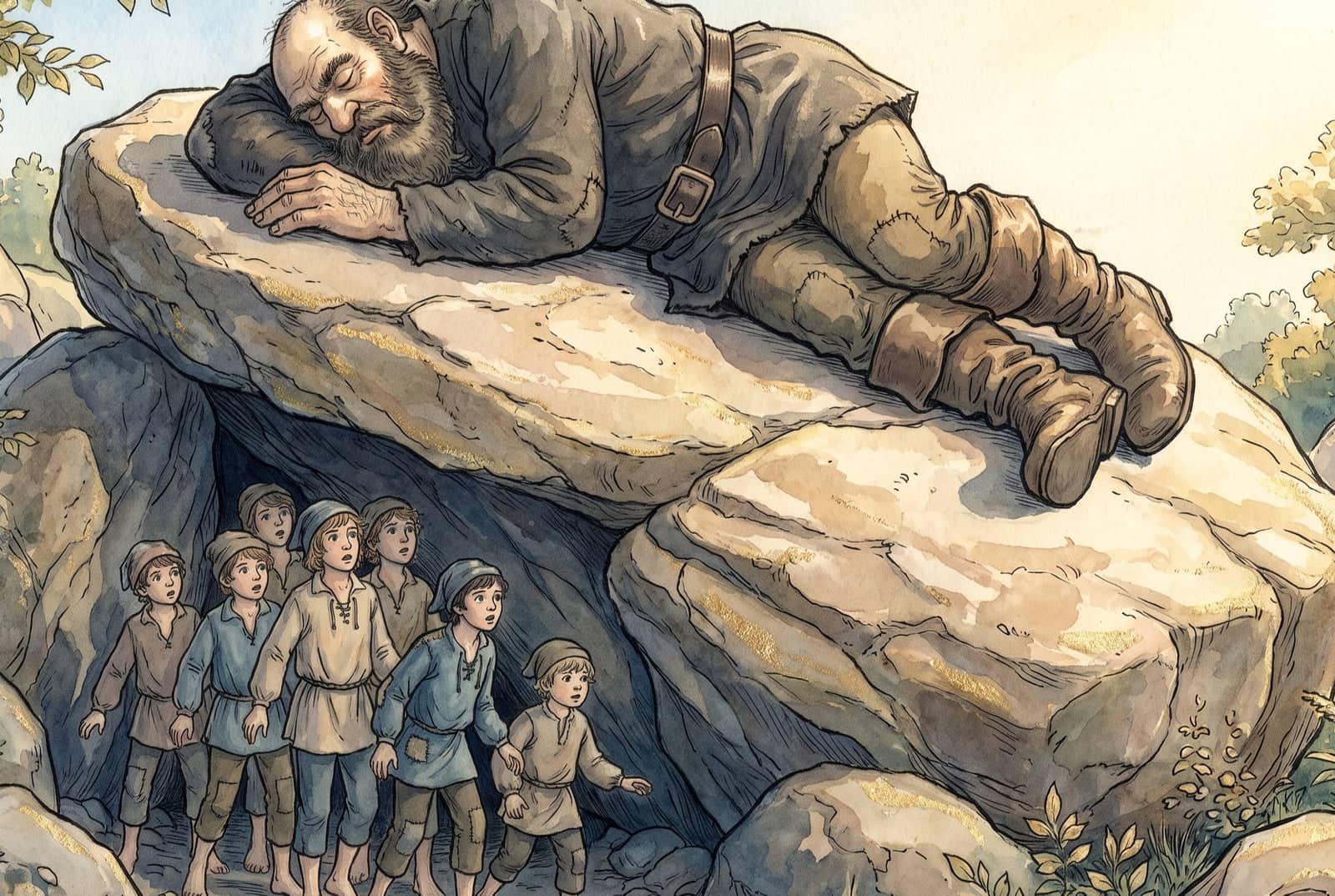
Then Hop-o’-My-Thumb drew the boots gently off the ogre’s feet and put them on. They were huge, but they were fairy boots, which grew larger or smaller to fit whoever wore them, so that they might have been made for him.
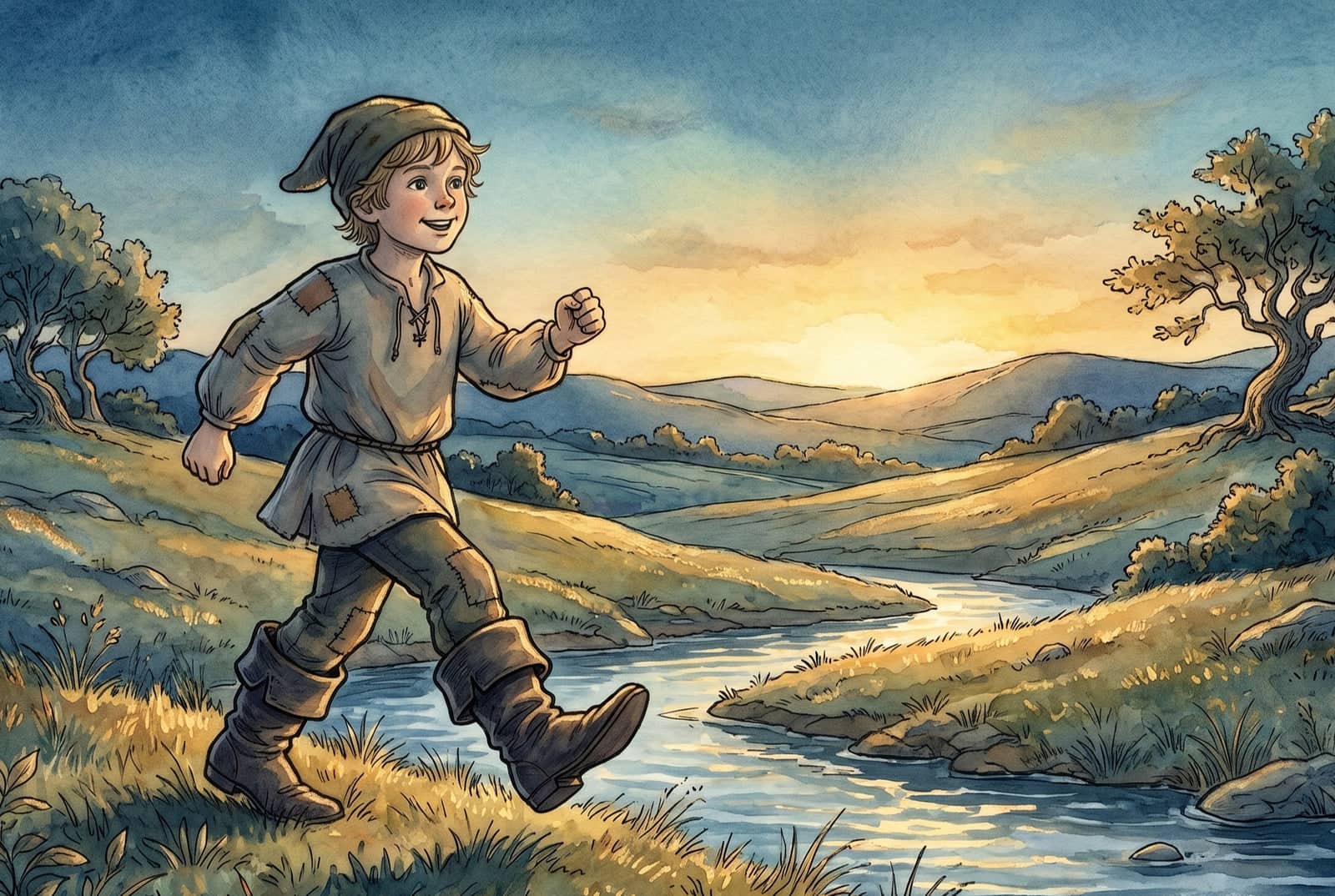
He went straight to the ogre’s house, where he found the ogre’s wife weeping beside her daughters.
“Your husband is in great danger,” he said. “Robbers have taken him, and have sworn to kill him unless he gives them all his gold and silver. He caught sight of me as they stood over him, and begged me to tell you to send everything of value he has and keep nothing back. He sent me in his seven-league boots, so that you should not take me for a cheat.”
The good woman was badly frightened and gave him at once all that she had, for the ogre was a very good husband, whatever he did to little children. So Hop-o’-My-Thumb came home loaded with the ogre’s riches, and there was great joy at the sight of him.
Some people will not agree about that last part. They say he never robbed the ogre at all, but took only the seven-league boots, which the ogre used for nothing except running after little children. With those boots on, they say, he went to the court, offered to bring the king news of an army two hundred leagues away before the end of the day, and was back that same evening. After that the king paid him well to carry his orders.
When he had been a courier long enough to put by a great deal of money, they say, Hop-o’-My-Thumb went home to his father, and nobody can imagine the joy at seeing him again. He made his whole family comfortable and bought posts for his father and his brothers, so that not one of them ever wanted for anything again.
Retold by Talerie from Le Petit Poucet (opens in a new window)License: Public domainCopy this text, adapt it, use it however you like. A link back to Talerie is appreciated but never required.CC0 1.0 (opens in a new window)