
A girl no bigger than a thumb is stolen away in her walnut shell by a toad, carried up a tree by a beetle and promised to a mole in black velvet. The swallow she nursed through the winter carries her over the sea to the warm lands, where a flower prince crowns her queen of every flower.
There was once a woman who longed for a little child of her own and did not know where to find one, so she went to an old witch. “Can you tell me where I might get a tiny child?” she asked.
“That is easily managed,” said the witch. “Here is a barleycorn. It is not the kind that grows in the fields or feeds the hens. Plant it in a flowerpot and see what happens.”
The woman paid twelve shillings for it and planted it at home. At once a tulip came up, its petals shut tight as a bud. “What a beautiful flower,” she said, and kissed the red and yellow petals. It opened with a soft pop, and there on the green velvet heart of the flower sat a girl hardly half as tall as a thumb. They called her Thumbelina.
A polished walnut shell was her cradle, violet petals her mattress and a rose petal her blanket. By day she rowed a floating tulip petal across a plate of water, with two oars of white horsehair, and she sang more sweetly than anyone had ever heard.
One night, as she lay asleep under her rose petal, a big wet toad came creeping through a broken pane in the window and hopped onto the table.
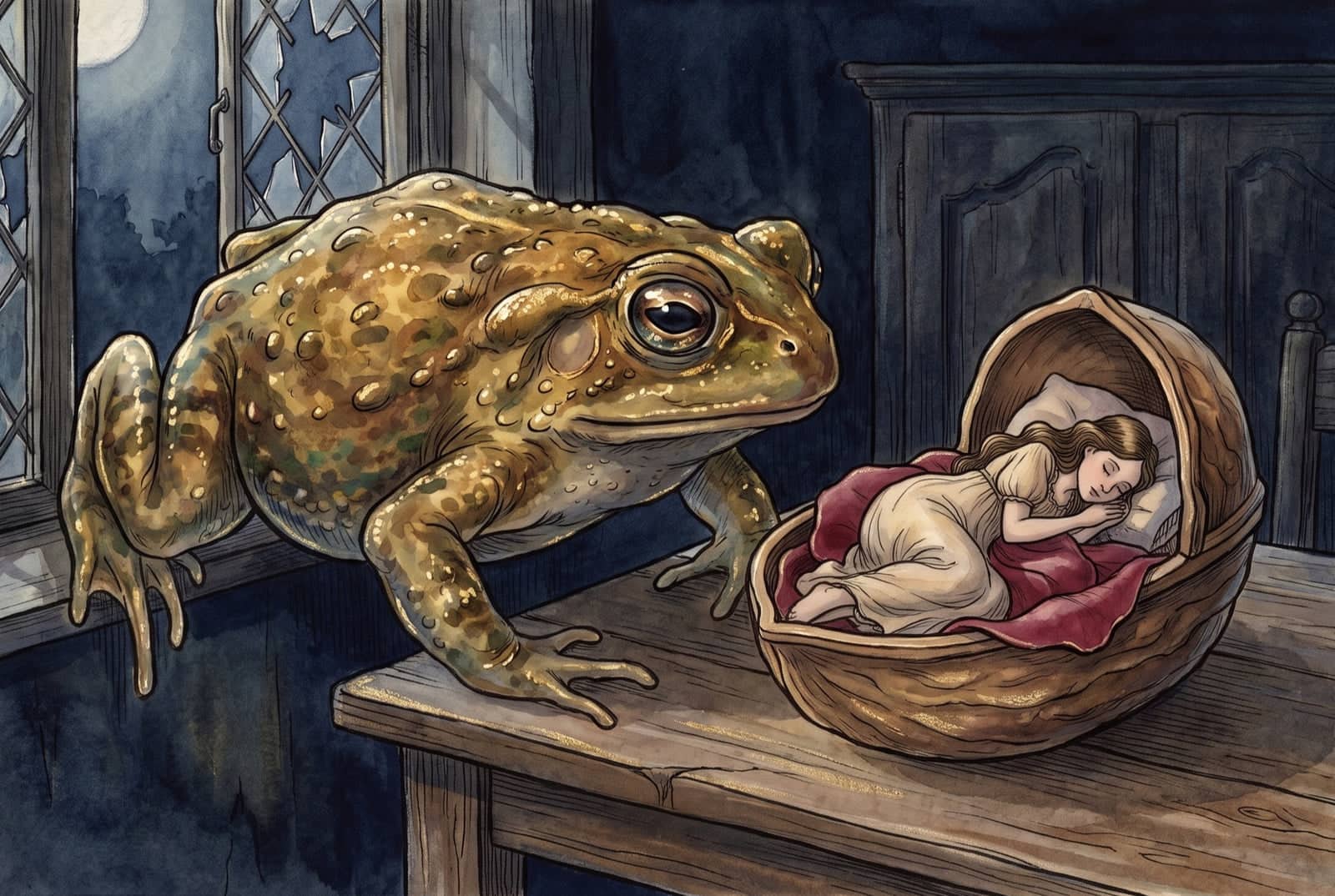
“What a lovely wife she would make for my son,” said the toad, and she carried the walnut shell out through the window and down into the garden.
A wide stream ran along the garden’s edge, and the toad lived on its marshy bank with her son, who was uglier still. When he saw the girl in her elegant bed, all he could say was, “Croak, croak, brekekekex!”
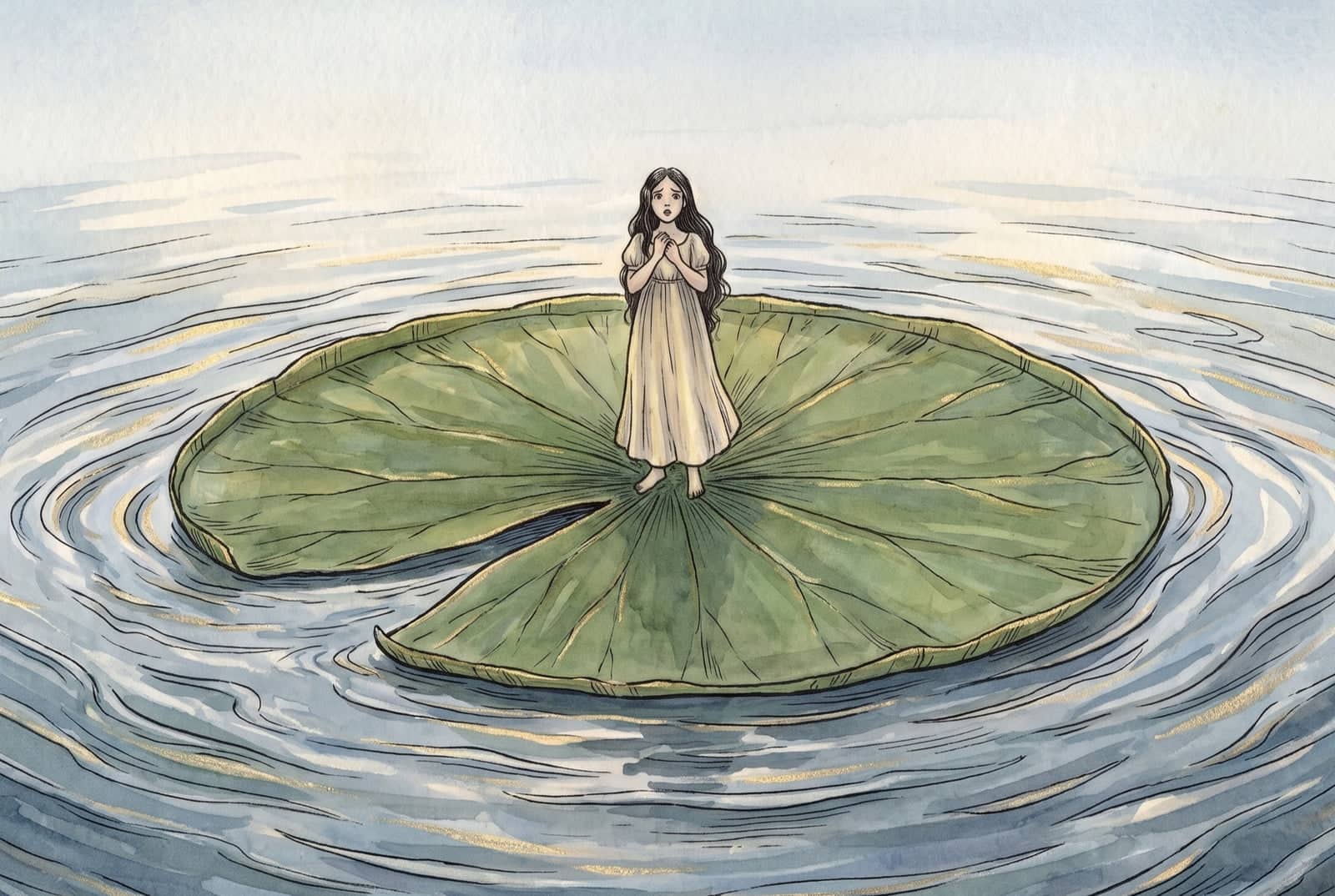
“Not so loud, or you will wake her,” said the old toad. “She could still run off, for she is as light as swan’s down. We shall set her on a water lily leaf in the stream; it will be an island to her, and she cannot escape while we make ready the room down in the marsh.”
So the toad left the walnut shell on the largest leaf, far from the bank. Thumbelina woke and cried bitterly, for there was water on every side and no way to the land. Then the toad swam out with her son to fetch the bed for the bridal chamber. “Here is my son,” she said. “He will be your husband, and you will live splendidly down in the marsh.”
“Croak, croak, brekekekex!” was all her son could say.
They swam away with the bed, and Thumbelina wept, for she could not bear to have the toad’s ugly son for a husband. But the little fish had heard every word, and when they saw how pretty she was they could not let her go to the toads. So they gnawed through the stalk that held the leaf, and away it floated with her, beyond the toad’s reach.
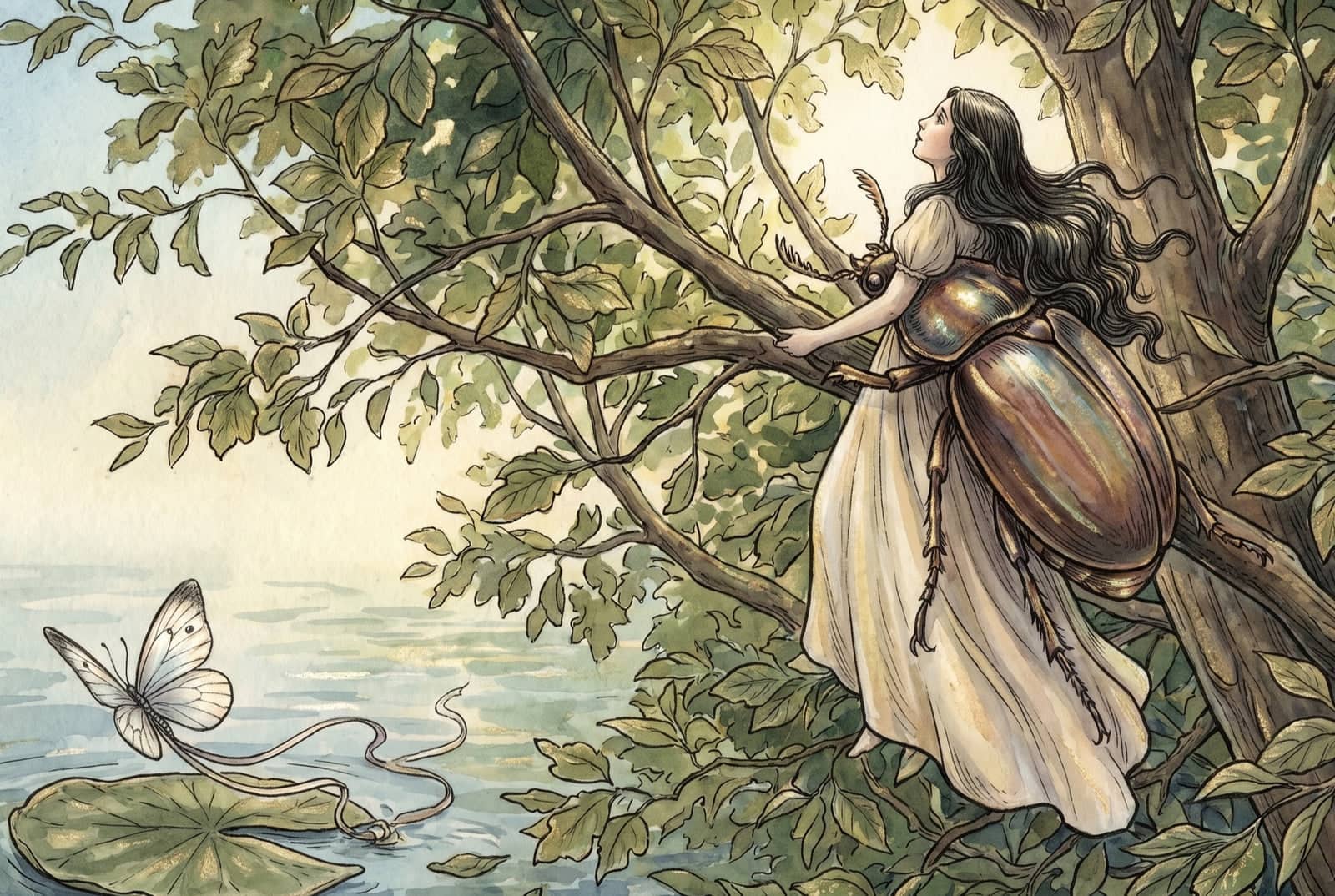
A white butterfly settled on the leaf, and she tied one end of her sash round him and the other to the leaf, so that it glided faster than before.
Then a large beetle came flying by. He caught her round the waist and carried her up into a tree, while the leaf floated on with the butterfly tied to it. Thumbelina was frightened, and sorriest of all for the butterfly, who could not work himself loose. The beetle fed her honey and told her she was pretty, though she was nothing like a beetle.
Later the other beetles came to call, looked her over and turned up their feelers.
“She has only two legs,” said one. “What a poor sight.”
“And no feelers at all,” said another.
“Look how thin her waist is. Why, she is like a human being!”
“How ugly she is,” they all agreed, though Thumbelina was as pretty as could be. The beetle believed them at last and set her down on a daisy, and there she wept, because even the beetles did not want her.
All that summer she lived alone in the wood, in a bed of woven grass under a clover leaf, on honey and dew. Then came the winter, the long cold winter. The birds flew away, the trees went bare, and her clover leaf shrivelled to a dry stalk. Her clothes were in rags, and every snowflake that fell on her was like a shovelful thrown over one of us, for she was only an inch high.
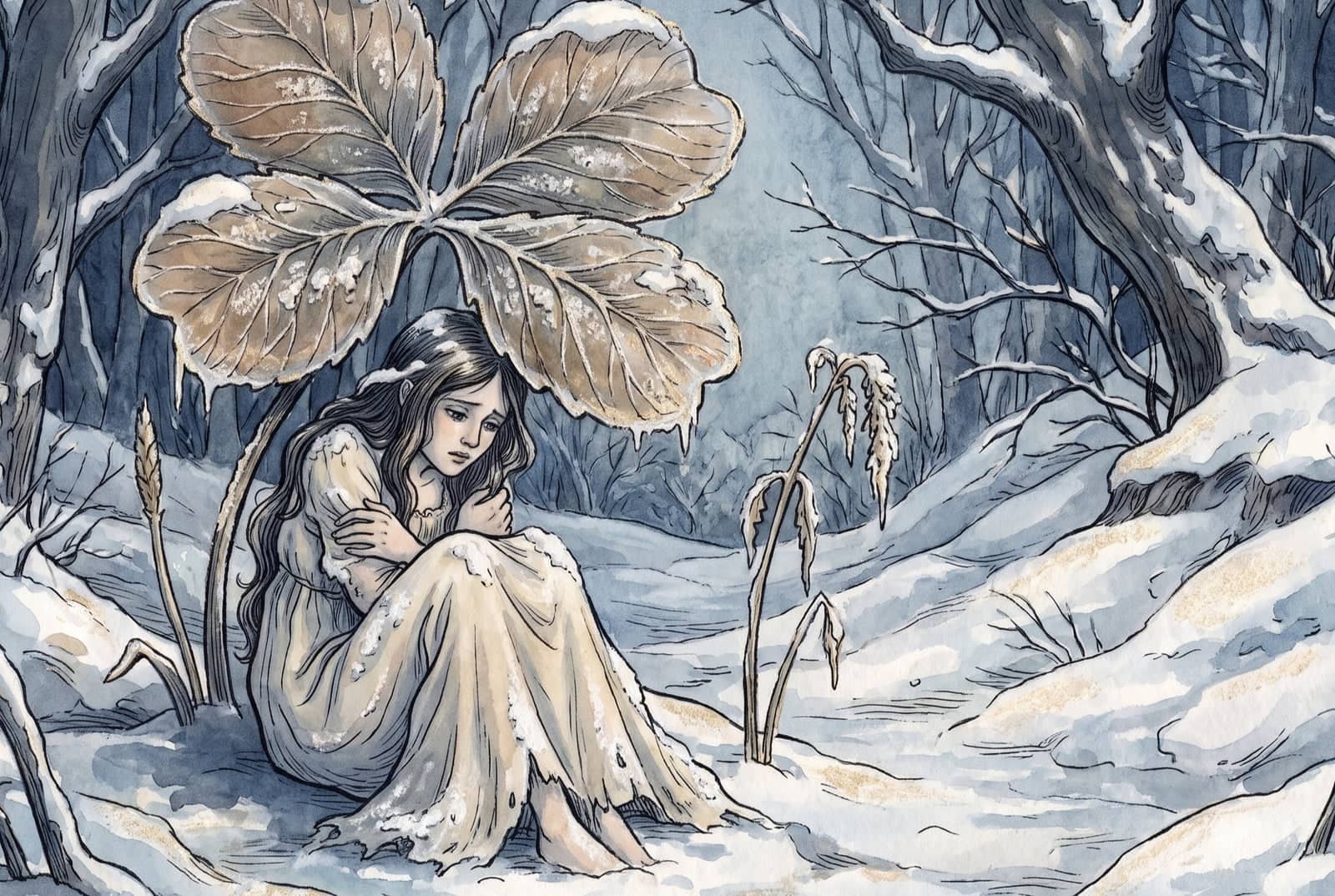
Beyond the wood lay a wheat field, long since cut, and the dry stubble was a forest to struggle through. At last she came to the door of a field mouse, who had a warm burrow and a room full of grain. Thumbelina stood there like a beggar girl and asked for a piece of barleycorn, for she had not eaten in two days.
“You poor little thing,” said the field mouse, who was a kind old soul. “Come in and have dinner with me. You may stay all winter, if you keep my rooms clean and tell me stories, for I do love a story.” So Thumbelina stayed.
“We shall have a visitor soon,” said the field mouse. “My neighbor is rich, with great rooms and a coat of black velvet. If only you could get him for a husband. He cannot see, so tell him your prettiest stories.”
But the neighbor was a mole, and Thumbelina cared nothing for him. He came all the same, rich and learned, with no patience for the sun or for flowers, which he had never seen. She had to sing for him, and she sang “Ladybug, ladybug, fly away home” and other songs she knew, and the mole fell in love with her voice, though he said nothing yet.
He had lately dug a long passage from his house to theirs, and asked them not to be frightened by the dead bird lying in it. He went ahead with a piece of rotten wood for a lantern, and where the bird lay he pushed his nose against the roof until daylight came down. On the floor lay a swallow, his wings pressed to his sides and his head drawn in under his feathers. The cold had been too much for him.
It made Thumbelina sad, for she loved the little birds that had sung for her all summer. But the mole pushed the swallow aside with his crooked legs. “There will be no more singing out of him. A bird has nothing but his tweet, tweet, and then the winter comes and he starves.”
“Quite so,” said the field mouse. “What does all that twittering come to? Hunger and cold.”
Thumbelina said nothing. But when the other two had turned their backs, she smoothed aside the feathers on his head and kissed his closed eyes. “Perhaps it was you who sang to me so sweetly in the summer,” she said.
That night she could not sleep. She wove a soft blanket of hay, carried it to the bird and tucked the soft down of the flowers along his sides, so that he might lie warm in the cold earth.
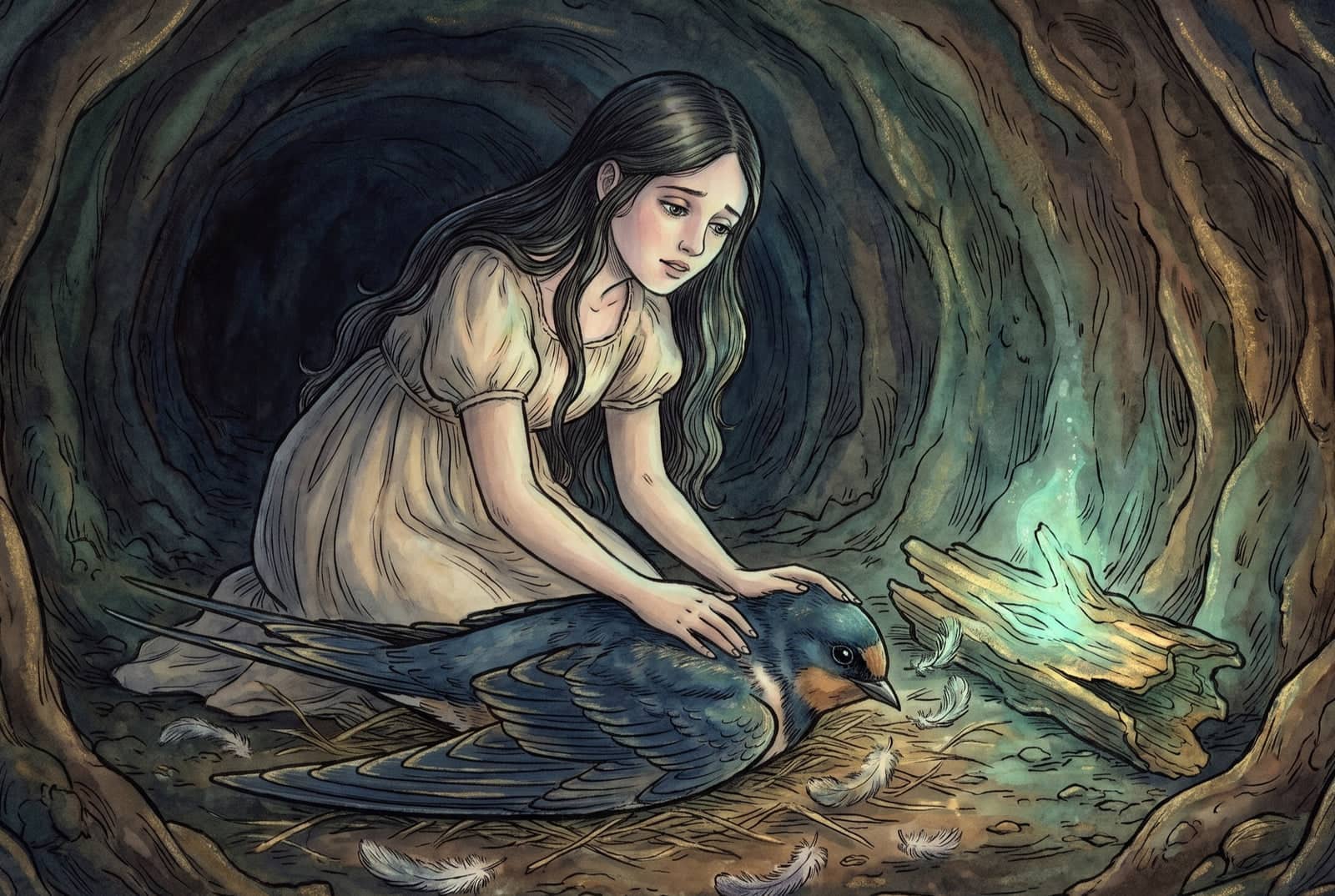
“Goodbye, you dear little bird,” she said. “Thank you for your singing in the summer, when the trees were green and the sun shone warm upon us.” Then she laid her head against his breast, and started back, for something inside him went thump, thump. It was his heart. He was not dead, only numb with cold, and her warmth had brought him back to life.
Thumbelina trembled, for the bird was large beside her, but she took courage and packed the down thicker round him. The next night she crept back to him. He was alive, but very weak, and could barely open his eyes to look at her by the glimmer of a piece of rotten wood she had brought for a lantern.
“Thank you, you kind little child,” said the sick swallow. “I am so beautifully warm. Soon I shall have my strength back and fly out in the sunshine again.”
“It is cold out of doors,” she said. “It is snowing and freezing. Stay in your warm bed. I will look after you.”
She brought him water in a flower petal, and he told her how he had torn a wing on a thornbush, fallen behind the other swallows, and dropped at last to the ground, remembering nothing after that.
All winter he stayed there and she nursed him, and neither the mole nor the field mouse knew, for they had no love for swallows. When spring came, the swallow said goodbye, and Thumbelina opened the hole overhead. The sunshine poured in, and he asked her to sit on his back and fly with him into the green woods. But she knew how it would grieve the old field mouse.
“No, I cannot,” said Thumbelina.
“Goodbye then, goodbye, you good, sweet girl,” said the swallow, and he flew out into the sunshine. She watched him go with tears in her eyes.
“Tweet, tweet,” sang the bird, and away he went into the green wood.
The wheat above the burrow grew tall, and to Thumbelina, only an inch high, it was a thick forest. She was not allowed out into the sunshine, and she grew unhappy.
“You are to be married, Thumbelina,” said the field mouse. “My neighbor has asked for you. Now you must sew your wedding clothes, woollen and linen both, for nothing must be wanting when you are the mole’s wife.”
So Thumbelina turned the spindle, and four hired spiders wove day and night, while the mole came each evening to talk of the wedding, which was to be when summer was over. Morning and evening she slipped out to see a scrap of blue sky between the ears of wheat, and wished for the swallow. But he never came.
When autumn came, her wedding things were ready. “In four weeks you shall be married,” said the field mouse. Thumbelina wept and said she would not have the tiresome mole.
“Stuff and nonsense,” said the field mouse. “Don’t be stubborn, or I shall bite you with my white teeth. The queen herself has no velvet as fine as his.”
So the wedding day came, and the mole with it, to take her away under the ground where she would never see the sun again. The field mouse let her look at it once more from the door.
“Goodbye, bright sun,” she said, stretching her arms toward it, and walked a little way out among the stubble. “Goodbye,” she said, putting her arms round a little red flower. “Give my love to the little swallow, if ever you see him.”
“Tweet, tweet,” came suddenly from over her head. There was the swallow, and he was overjoyed to see her. She told him, crying as she told it, how she was to marry the ugly mole and live where the sun never shone.
“The cold winter is coming,” said the swallow. “I am flying to the warm countries. Will you come with me? You can sit on my back and tie yourself on with your sash. Away from the ugly mole and his dark rooms, over the mountains to where it is always summer and the flowers are lovelier than you have ever seen. You saved my life when I lay frozen in that passage.”
“Yes, I will come with you,” said Thumbelina. She climbed onto his back, set her feet on his outspread wing and tied her sash to one of his strongest feathers.
The swallow rose high and flew over forest and sea, above the mountains where the snow never melts. Thumbelina crept in under his warm feathers and put out only her head, to see the country below.
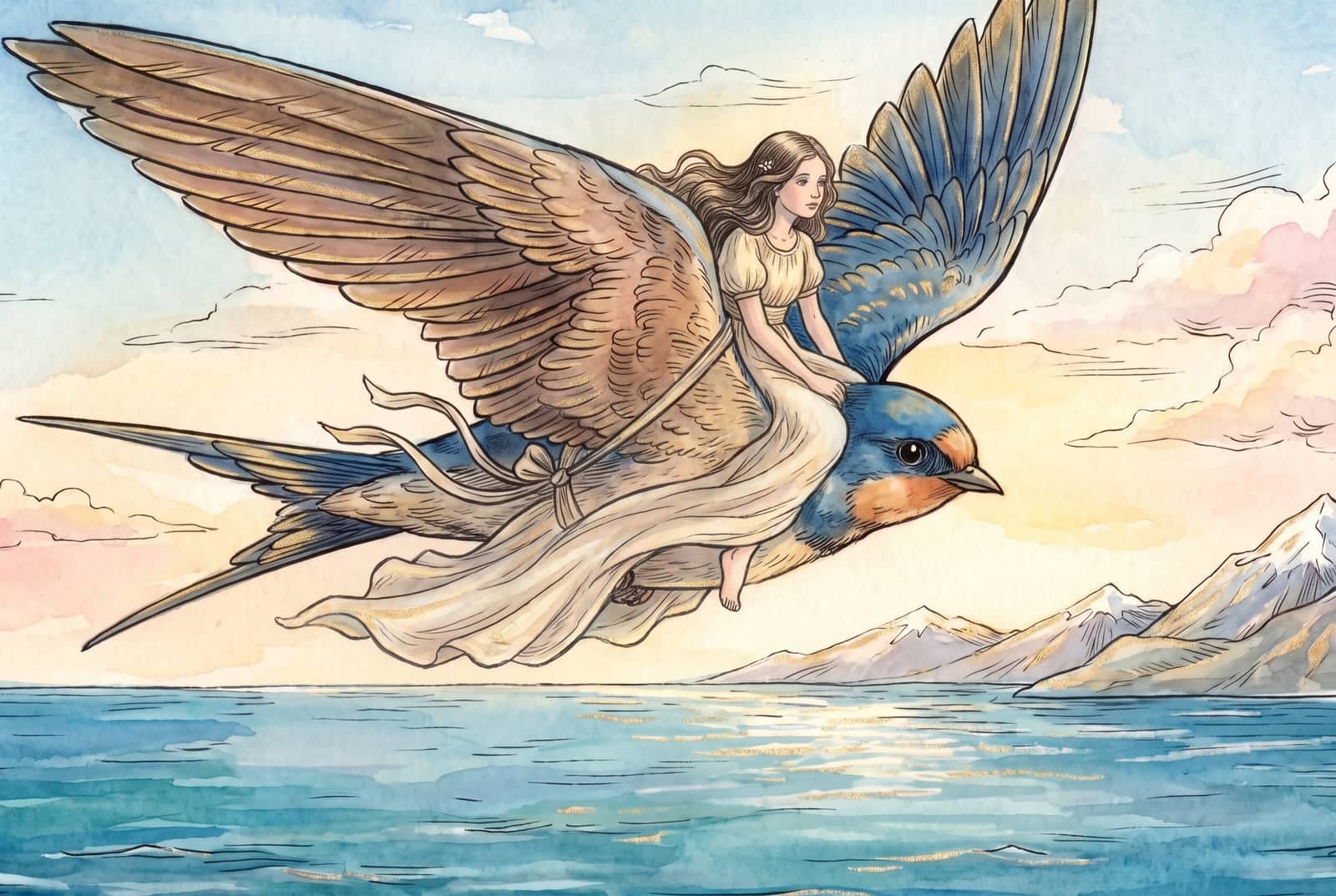
At last they came to the warm lands, where the sun shone brighter and the sky seemed twice as high. Grapes hung along the hedges, lemons and oranges in the woods, and children played in the lanes with bright butterflies. Beside a blue lake stood a palace of white marble, with swallows’ nests along the top. One of them was his.
“This is my house,” said the swallow, “but you would not be comfortable up here. Choose one of the flowers below, and I will set you in it, and you shall have all you wish for.”
“How lovely that would be,” she said, and clapped her little hands.
A marble pillar lay broken in three, and between the pieces grew the most beautiful white flowers. The swallow set her on one of the broad petals. In the middle of the flower sat a little man no bigger than Thumbelina herself, white and clear as glass, with a gold crown and lovely wings. He was the angel of the flower, for such a one lives in every flower, and he was king over them all.
“Oh, how beautiful he is,” Thumbelina whispered to the swallow.
The little prince was frightened at first by the swallow, a giant of a bird beside anyone so small; but when he saw Thumbelina he was delighted. He took the gold crown from his head and set it on hers, and asked her name, and whether she would be his wife and queen over all the flowers. Here was a very different husband from the son of the toad or the mole, and she said yes.
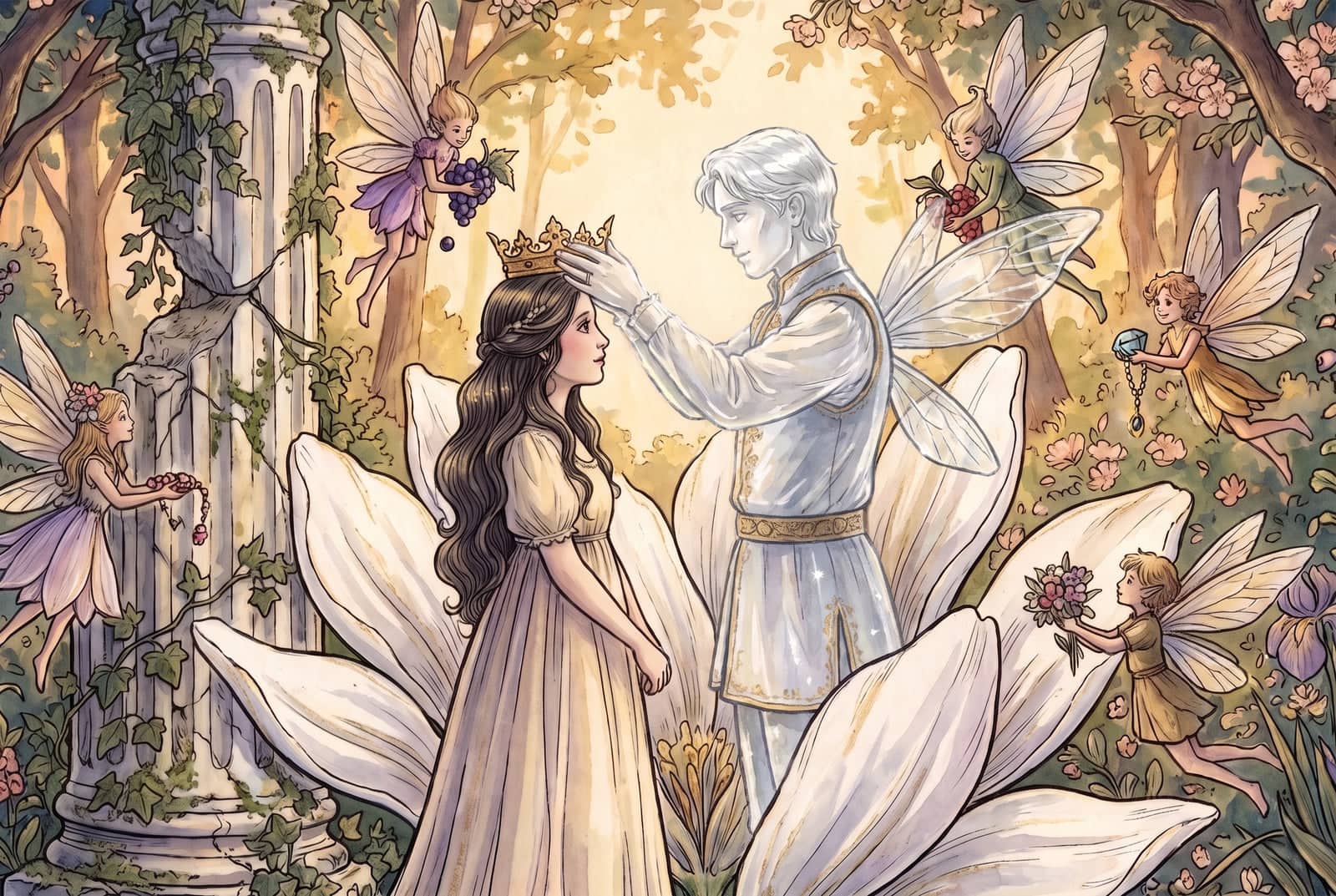
Out of every flower came a lady and a lord with presents for her, and the best of all was a pair of wings from a great white fly, fastened to her shoulders so that she too could fly from flower to flower. The little swallow sang the wedding song from his nest, though his heart was sad, for he would rather never have parted from her.
“You must not be called Thumbelina any more,” said the angel of the flowers. “It is an ugly name, and you are far too pretty for it. We shall call you Maia.”
“Goodbye, goodbye,” said the little swallow with a heavy heart, and flew back from the warm countries all the long way to Denmark. There he had a nest above the window of the man who knows how to tell fairy tales. He sang “Tweet, tweet” to him, and that is how we come to know the whole story.
Retold by Talerie from Fairy Tales of Hans Christian Andersen (opens in a new window)License: Public domainCopy this text, adapt it, use it however you like. A link back to Talerie is appreciated but never required.CC0 1.0 (opens in a new window)
