Skip to content
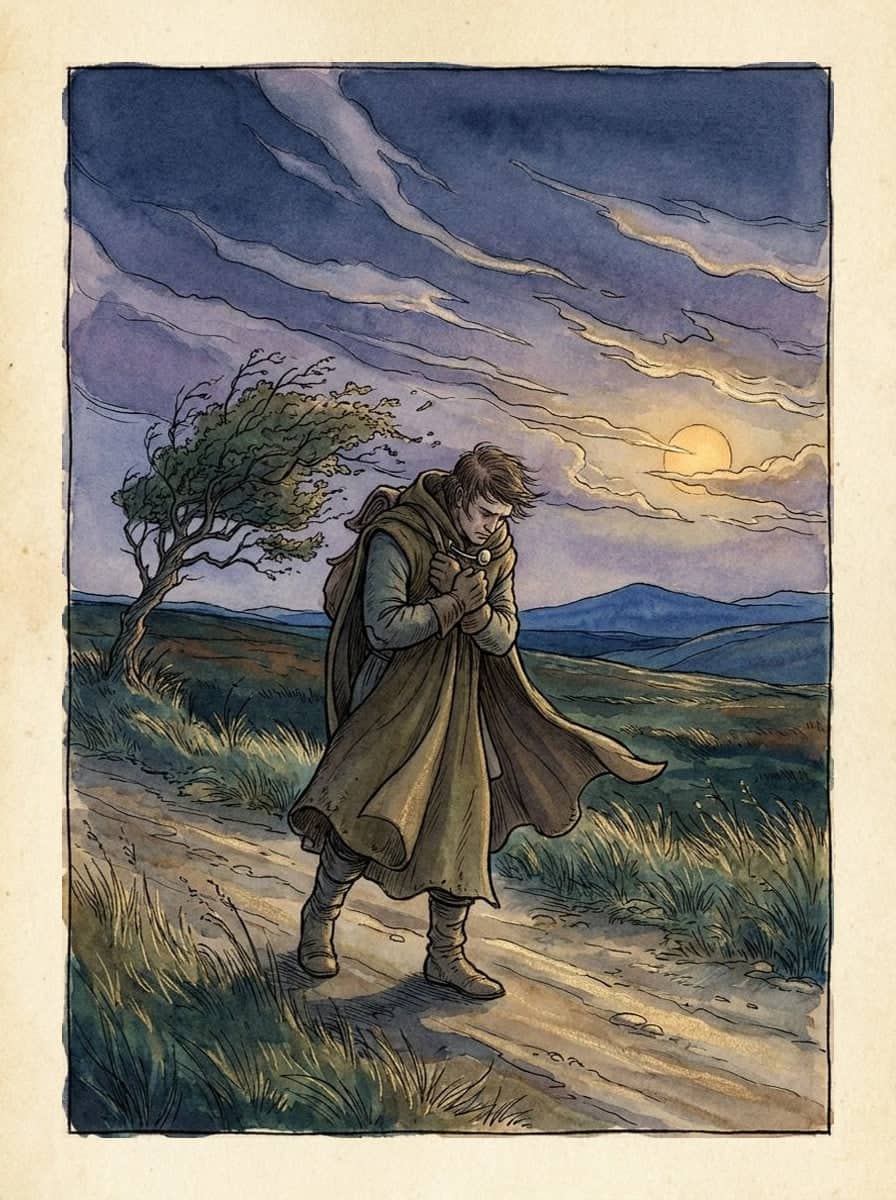
A man walks a dirt road over open grassland, both hands clutching his cloak shut, head bowed into the wind, a small gold sun low in the torn clouds.

The North Wind and the Sun
Aesop

2 min read ages 4 and up

The North Wind and the Sun argue over which of them is stronger. They settle on a test: whoever gets the heavy cloak off a traveler on the road below wins. The Wind goes first.


High above a quiet country road, the North Wind and the Sun fell into an argument, and neither of them would give way.

“I am the stronger of us two,” said the North Wind. “I can bend an oak until it groans.”

“I do not think you are,” said the Sun. “But we can put it to the test.”

Just then a traveler came along the road below them, walking steadily, with a heavy cloak fastened at his throat.

“There is our test,” said the Sun. “Whichever of us can get that cloak off the man is the stronger.”

The North Wind agreed at once, and he claimed the first turn.

He drew a long breath and gathered up every scrap of his force. Then he came whirling down on the road, cold and furious, flattening the grass on either side.

He caught at the cloak and hauled at it, as though he meant to tear it away from the man in one great effort.

But the traveler only bent his head and held on. The harder the Wind blew, the tighter the man gripped his collar, and the closer he pulled the cloak around him.

The Wind blew until the dust rose and the trees roared. When at last he had nothing left, he drew back, out of breath, and the cloak was exactly where it had been.

“My turn,” said the Sun.

He did not rush. He parted the clouds and began to shine down on the road, mild and steady and warm.

The wind dropped. The dust settled.

The traveler straightened up. The warmth crept into his shoulders, and after a little while he stopped, unhooked the clasp at his throat, and walked on with the cloak hanging open.

Then the Sun shone out in his full strength. The road turned bright, the air grew heavy with heat, and before the traveler had gone many steps more he was glad to pull the cloak right off.

He folded it over his arm and finished his journey lighter than before.
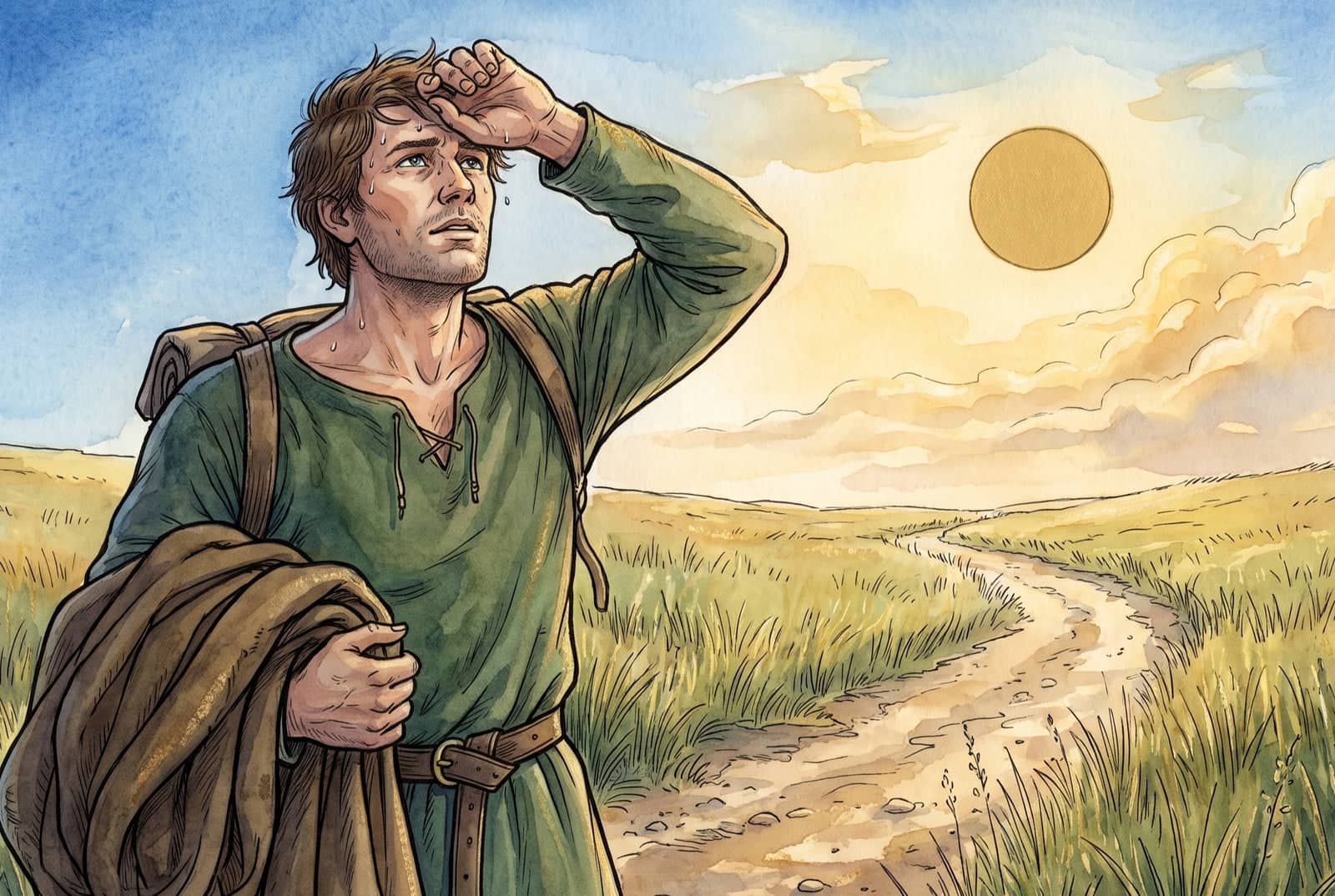
A man in a green tunic carries his folded cloak over one arm, one hand raised to his sweating brow, his face turned up to a gold sun over open grass.

The North Wind watched him go and said nothing at all.

How did you like this fable?

Retold by Talerie from Aesop’s Fables: a new translation (opens in a new window) Public domain

Similar fables

About this fable

The North Wind and the Sun is a fable credited to Aesop. In the Greek version, which Émile Chambry printed as number 73 of his edition, the Wind and the Sun quarrel over which of them is stronger and settle it by seeing who can get a traveler out of his clothes.

We retell it in English from V. S. Vernon Jones, who gives it in a single paragraph followed by the moral “Persuasion is better than force.” Ours runs to seventeen short paragraphs, gives the North Wind a boast and the Sun the idea for the test, and closes with a moral of our own.

Two texts compared: the Greek fable and Vernon Jones

Greek (Chambry, no. 73)Vernon Jones (1912)
Who sets the testnobody; the two decide togethernobody: “At last they agreed”
What must come offthe traveler’s clothesthe traveler’s cloak
Against the windthe man puts on a second garmentthe man wraps the cloak closer
The Wind’s turn endshe gives up and leaves it to the Sunnot said; the Sun’s turn simply comes
The Sunmild at first, then hottergentle at first, then full strength
The endthe man undresses and bathes in a riverthe man throws off the cloak and walks on
Moralpersuasion often works better than violence“Persuasion is better than force”
Show more

How our version tells it

The North Wind boasts that he can bend an oak until it groans, and when a traveler comes along the road with a heavy cloak fastened at his throat, the Sun proposes the test: whichever of them gets the cloak off the man is the stronger. The Wind goes first and blows until he is out of breath, but the harder he blows, the tighter the man holds his collar. Then the Sun parts the clouds and shines mildly. The traveler unhooks the clasp and walks on with the cloak hanging open, and when the Sun shines out in full strength, the man is glad to pull it off, folds it over his arm and goes on lighter than before. The North Wind watches him go without a word.

Vernon Jones has no boast, no clouds and no proposal from the Sun; we added them. Like him, we end with the cloak off and the man walking on, with no bath. Nothing in the story is frightening, and nobody is hurt.

Other tellings, and another North Wind

George Fyler Townsend keeps the Greek ending: his traveler takes off one garment after another and bathes in a stream. In Joseph Jacobs’s version it is the Sun who suggests the contest and then hides behind a cloud while the Wind blows. Jacobs’s moral is “Kindness effects more than Severity.” In a note, Jacobs names Babrius and Avianus among others who told the fable. Roger L’Estrange has the Wind throw hail in the man’s face, and in the heat the man ends up lying down in a cool shade. La Fontaine’s verse fable “Phébus et Borée” is set in autumn: the traveler is a rider, and the Wind wrecks roofs and boats on its way. La Fontaine’s moral, “Plus fait douceur que violence,” means that gentleness achieves more than violence.

The North Wind also appears in our East of the Sun and West of the Moon, where he carries the girl over the sea on his back; that tale is not a version of this fable.

Sources

Period texts

Commentary

Catalog

Claims checked against these sources on October 30, 2026.

Coloring pages to print

Where else to find this fable