Skip to content
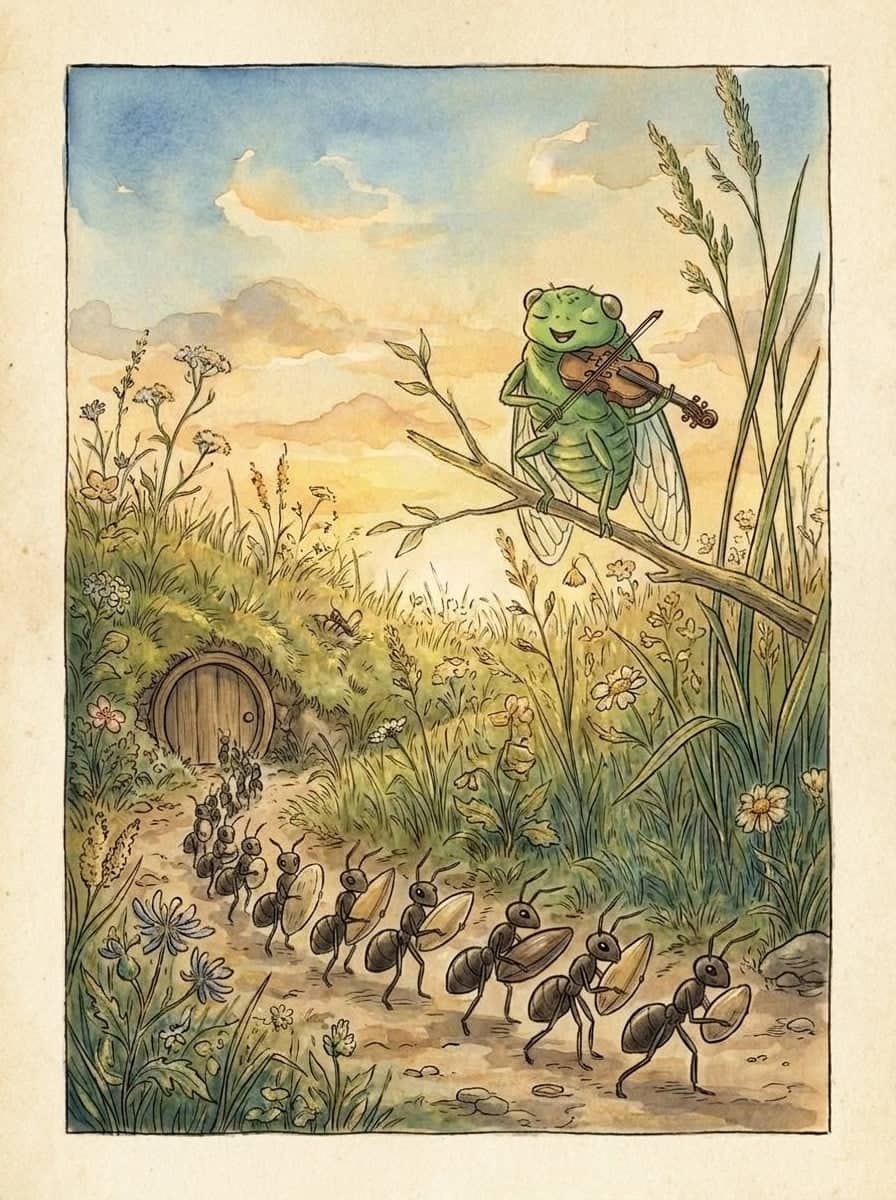
A grasshopper fiddles with its eyes closed, perched on a twig in warm evening light, as a line of ants carries grain along a path to a round door in a hillside.

The Ant and the Grasshopper
Aesop

1 min readages 3 and up

A hungry grasshopper begs a group of ants for a few grains of wheat one winter morning, admitting she spent the whole summer singing instead of storing food. The ants chuckle among themselves, telling her she can do no better than spend the winter dancing, and they go back to their work.


One bright winter morning, some ants were busy spreading out their store of wheat to dry, for the long autumn rains had left every grain of it damp.

Along came a grasshopper, thin and shivering, and she begged them to spare her a few grains.

“Please,” she said. “I’m simply starving.”

The ants stopped work for a moment, which they hardly ever did.
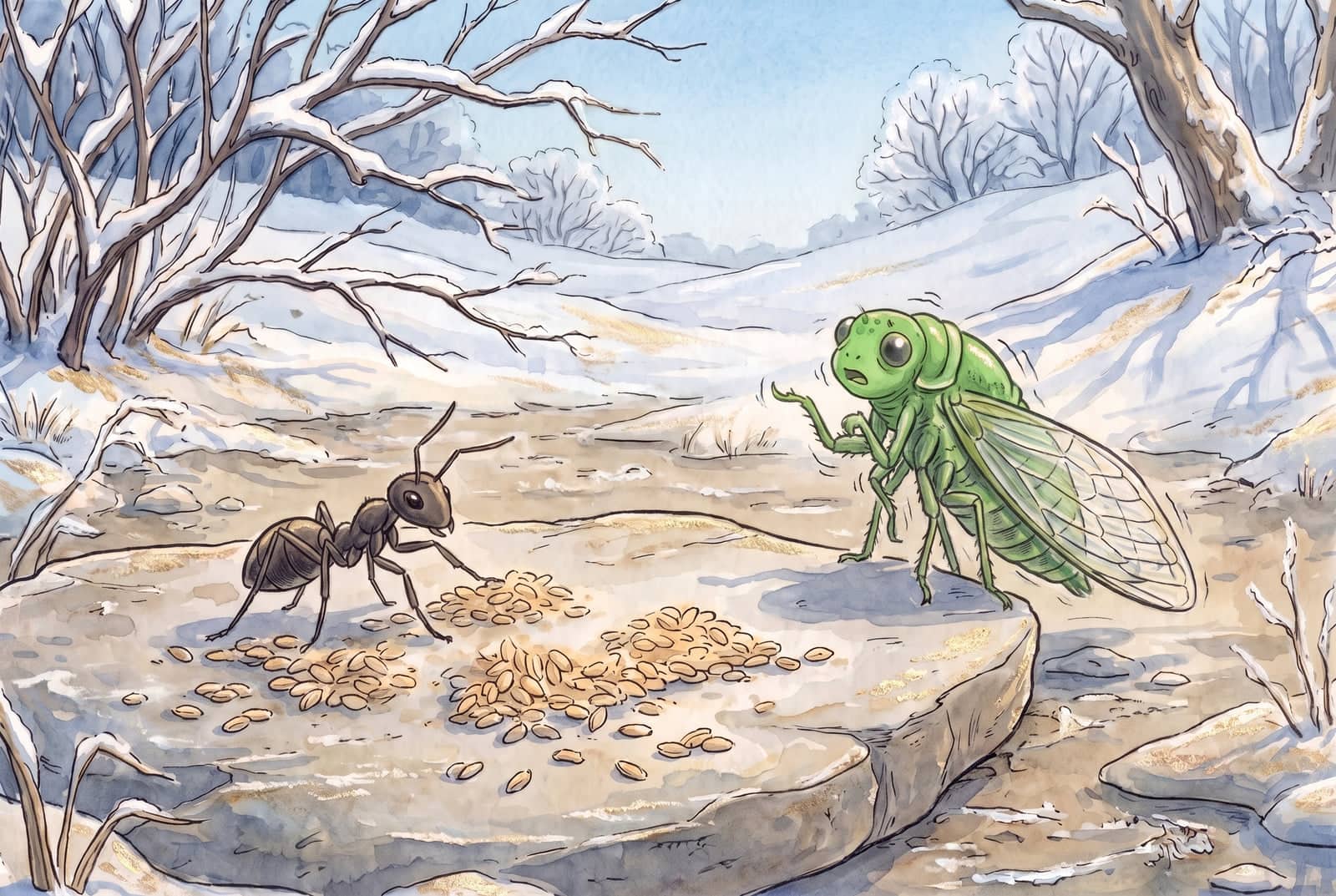
On a bright winter morning an ant spreads wheat to dry on a flat stone, while a shivering, worried grasshopper raises one foreleg to beg.

“May we ask,” they said, “what you were doing with yourself all last summer? Why didn’t you gather food for the winter?”

“The truth is,” the grasshopper answered, “I was so busy singing that I never found the time.”

“Well then,” said the ants, “if you spent the summer singing, you can’t do better than spend the winter dancing.”

And they chuckled among themselves and went back to their work.

Retold by Talerie from Aesop’s Fables: a new translation (opens in a new window)License: Public domain

Similar tales

Frau Holle

7 min readages 4 and up

Thumbelina

14 min readages 5 and up

About this fable

The Ant and the Grasshopper is one of the fables credited to Aesop. Émile Chambry’s edition gives it as a short piece of Greek prose: ants are drying their wet grain in winter when a hungry singer, a cicada in Chambry’s translation, asks them for food. They ask why it gathered nothing in summer and laugh at its answer.

V. S. Vernon Jones put the fable into English as “The Grasshopper and the Ants”, and his scene keeps close to the Greek one: winter, several ants drying damp corn, the laugh. Our retelling follows his translation but goes by the title Joseph Jacobs gave the fable. Vernon Jones gives no moral, so the one under our text is ours.

Two English versions: Vernon Jones and Jacobs

Vernon Jones (1912)Jacobs (1894)
TitleThe Grasshopper and the AntsThe Ant and the Grasshopper
Seasonwintersummer, then winter
Antsseveral, drying damp cornone carrying an ear of corn; in winter, the ants
The talkin winter, about last summerin summer, the Ant’s advice
What is askeda few grainsnothing; a chat in summer
Last wordssummer singing, winter dancingno dancing line
The endthe ants chuckle and go on workingthe Grasshopper dying of hunger
Moralnoneprepare for the days of necessity
Show more
if you spent the summer singing, you can’t do better than spend the winter dancing.
V. S. Vernon Jones, 1912: If you spent the summer singing … you can't do better than spend the winter dancing.

What our text does

We tell the fable in eight short paragraphs where Vernon Jones has one, and nothing new happens in them. A few small touches are ours: the long rains that left the grain damp are autumn rains, and the grasshopper arrives thin and shivering. She asks for a few grains because she is starving; she does not ask for a loan. The ants want to know what she did all summer, she says she was too busy singing, and they reply that she might as well spend the winter dancing, then chuckle and go back to their work.

Nothing frightening happens here. The ants give the grasshopper no grain, but the fable does not say what becomes of her. The moral printed under it, “Work done while the weather is good is what feeds you when it turns”, is our own.

La Fontaine, Fabre and a fable with other ants

La Fontaine made the fable the first one of his first book, in verse. His cicada goes to a single ant, a neighbour, and asks to borrow some grain until the new season, promising to pay it back with interest. The ant is no lender; it asks what the cicada did in the warm weather and closes with “Eh bien ! dansez maintenant.” The naturalist Jean-Henri Fabre wrote a whole chapter against the fable: according to him, there are no cicadas left by winter, they cannot eat grain, and in real life it is the ant that takes from the cicada.

The Queen Bee, also on our site, has ants in it too, but there they help the youngest brother, and it is a different story altogether.

Sources

Period texts

Commentary

Catalogue

Claims checked against these sources on October 14, 2026.

Coloring pages to print

Where else to find this fable