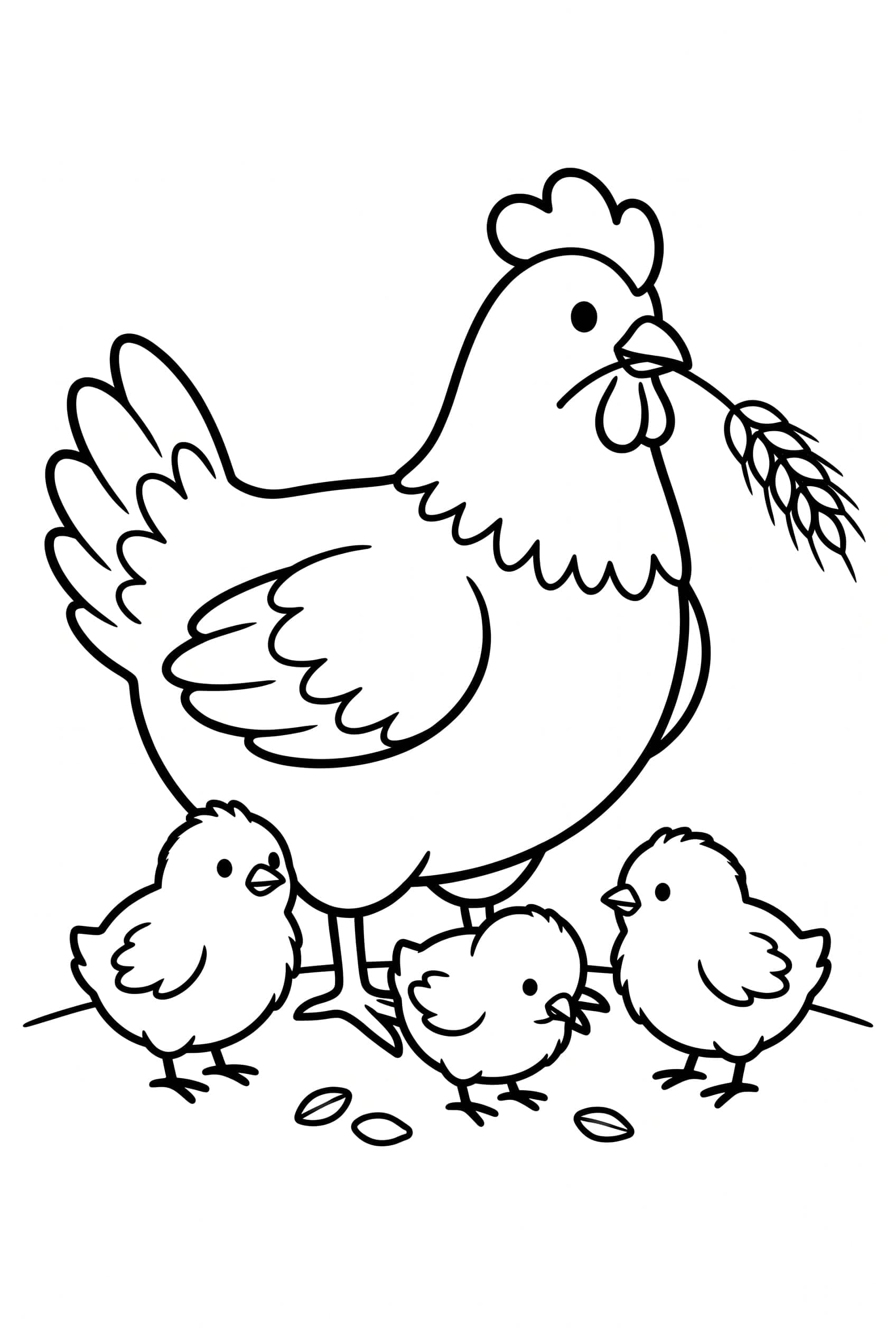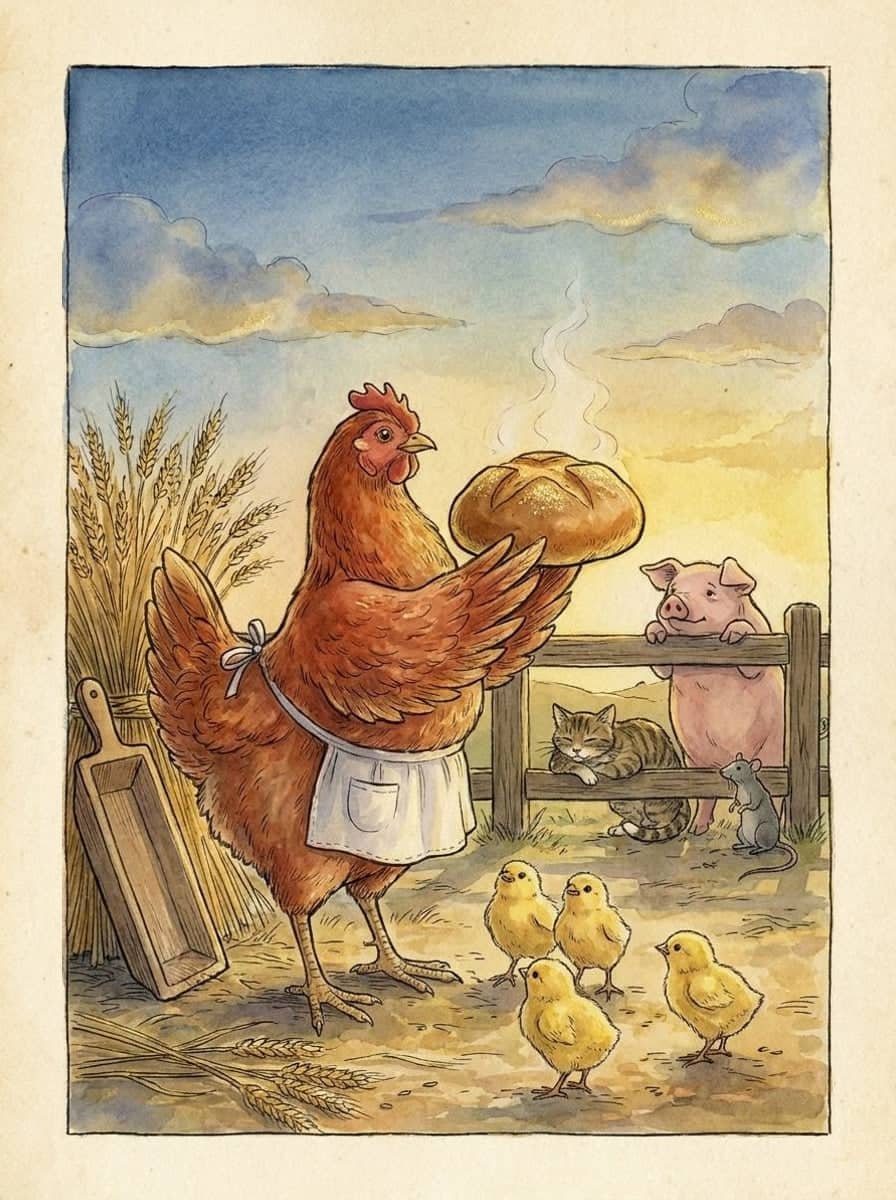
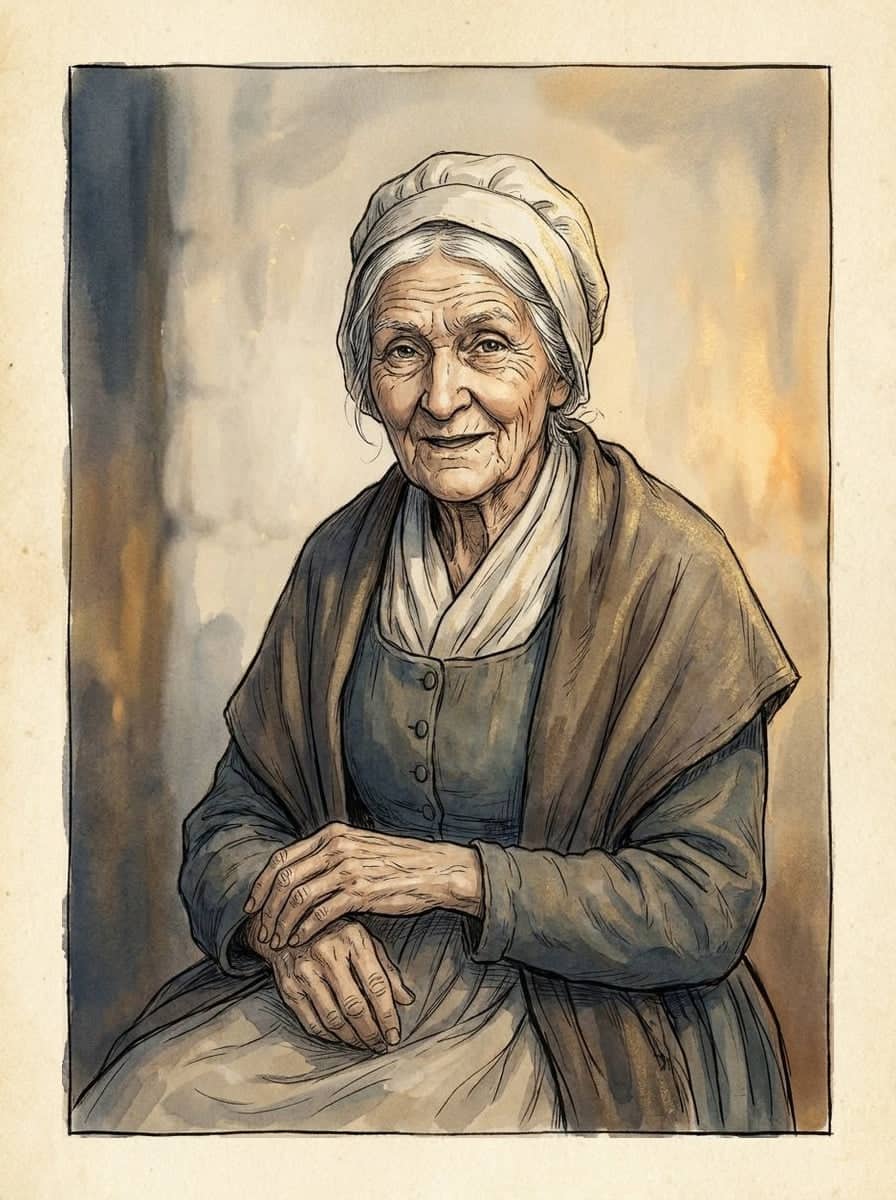
The Little Red Hen turns up a Seed and learns that it is a Wheat Seed, which could one day be bread. Her days are already full of worms and chicks. She calls across the barnyard to the Pig, the Cat, and the great fat Rat, who are idle all day long, to ask who will plant the Seed.
A Little Red Hen lived in a barnyard. All day long she went up and down it with her quick, busy step, scratching the ground for worms.
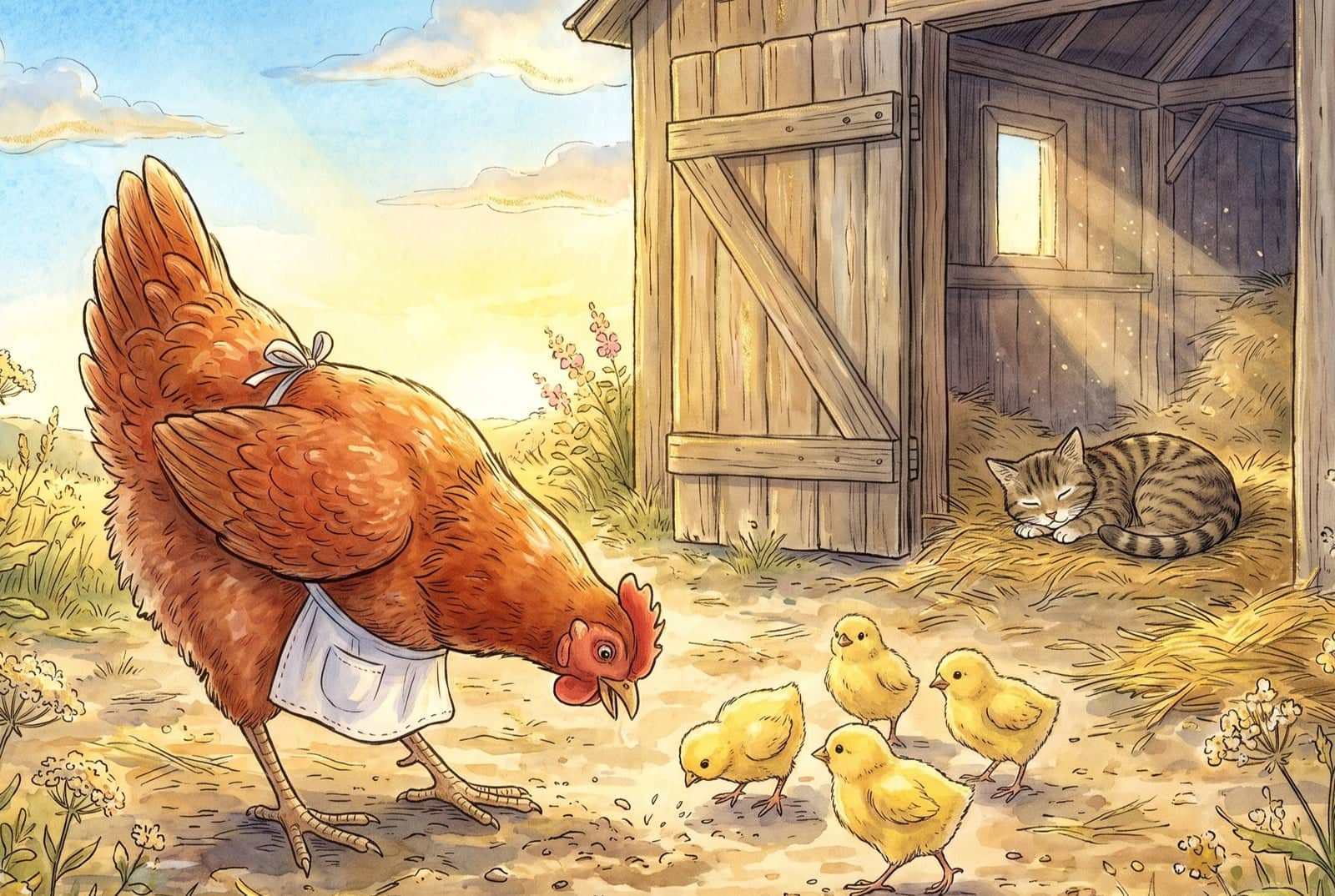
She loved a plump worm dearly, and she was sure her chicks could not thrive without one. Every time she turned one up she called, “Chuck-chuck-chuck!” and her chickies came running.
Then she shared out the best pieces among them. A busy little body she was, from first light until dark.
In the barn doorway a Cat lay napping. She would not even stir herself to chase the Rat, who ran wherever he pleased.
And as for the Pig in the sty, nothing in the world troubled him, so long as he could eat and grow fat.
One day the Little Red Hen found a Seed.
She knew only bugs and worms, though, and this thing was long and slender, so she took it for some new and very fine sort of meat. She gave it a careful little nibble. It tasted nothing like a worm.
So she carried it about the barnyard and asked everyone she met what it might be.
At last she found out. It was a Wheat Seed, and if it were planted it would grow up tall; and when it was ripe the grain could be ground into flour, and the flour made into bread.
Once she knew that, she knew the Seed ought to be planted. But her days were already full of hunting food for herself and her chicks, and she could not see where the time was to come from.
So she thought of the Pig, who had hour after empty hour on his hands, and of the Cat, who had nothing whatever to do, and of the great fat Rat and his idle afternoons. She called out loudly:
“Who will plant the Seed?”
The Pig said, “Not I.”
The Cat said, “Not I.”
The Rat said, “Not I.”
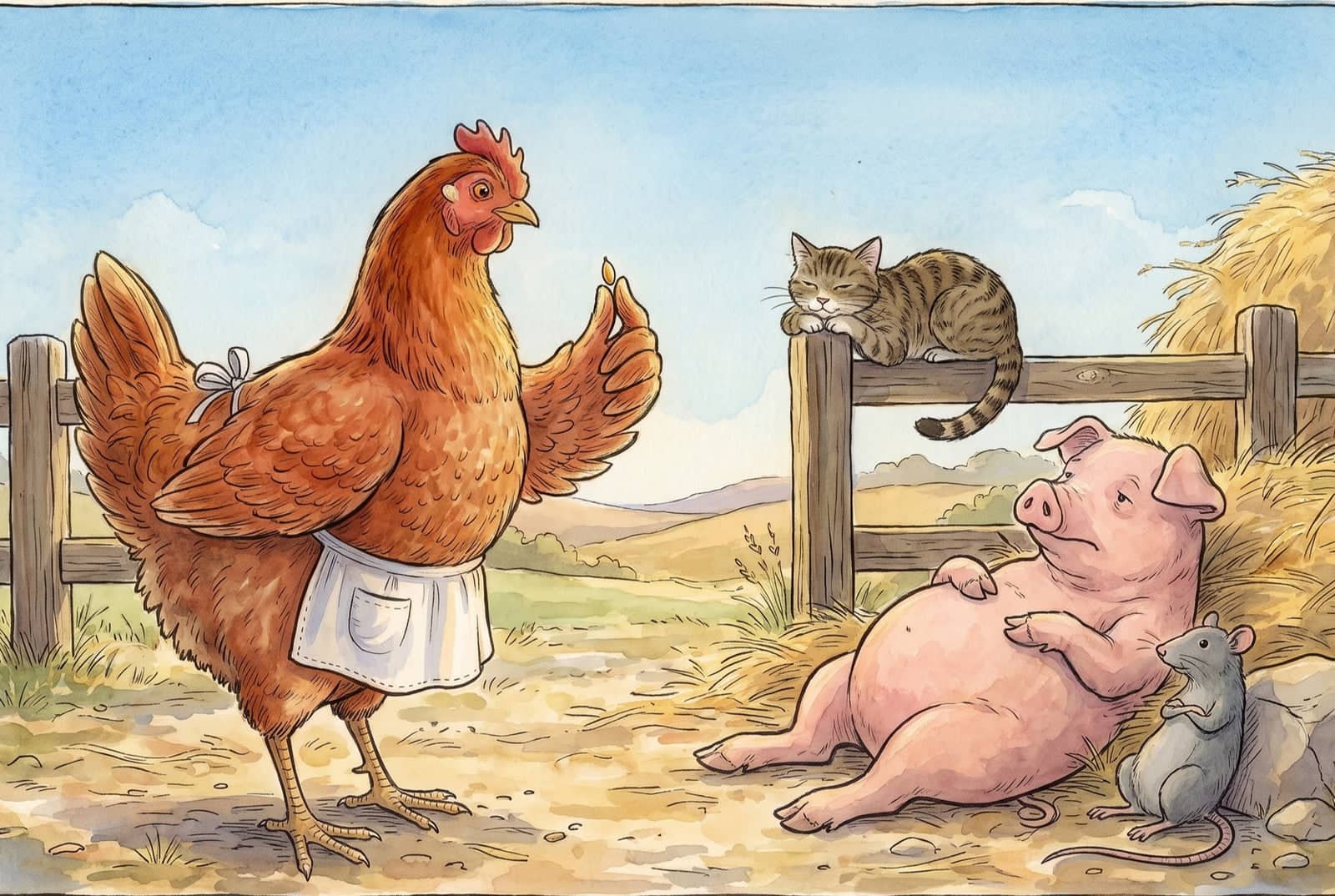
“Well, then,” said the Little Red Hen, “I will.”
And she did.
Then she went back to her daily rounds through the long summer days, scratching for worms and feeding her chicks. The Pig grew fat, and the Cat grew fat, and the Rat grew fat. And the Wheat grew tall and golden, and ripened for the harvest.
One morning the Little Red Hen noticed how high the Wheat stood and how full the grain had swelled. She ran about the barnyard, calling briskly:
“Who will cut the Wheat?”
The Pig said, “Not I.”
The Cat said, “Not I.”
The Rat said, “Not I.”
“Well, then,” said the Little Red Hen, “I will.”
And she did.
She fetched the sickle from among the farmer’s tools in the barn, and she cut down the whole tall plant herself.
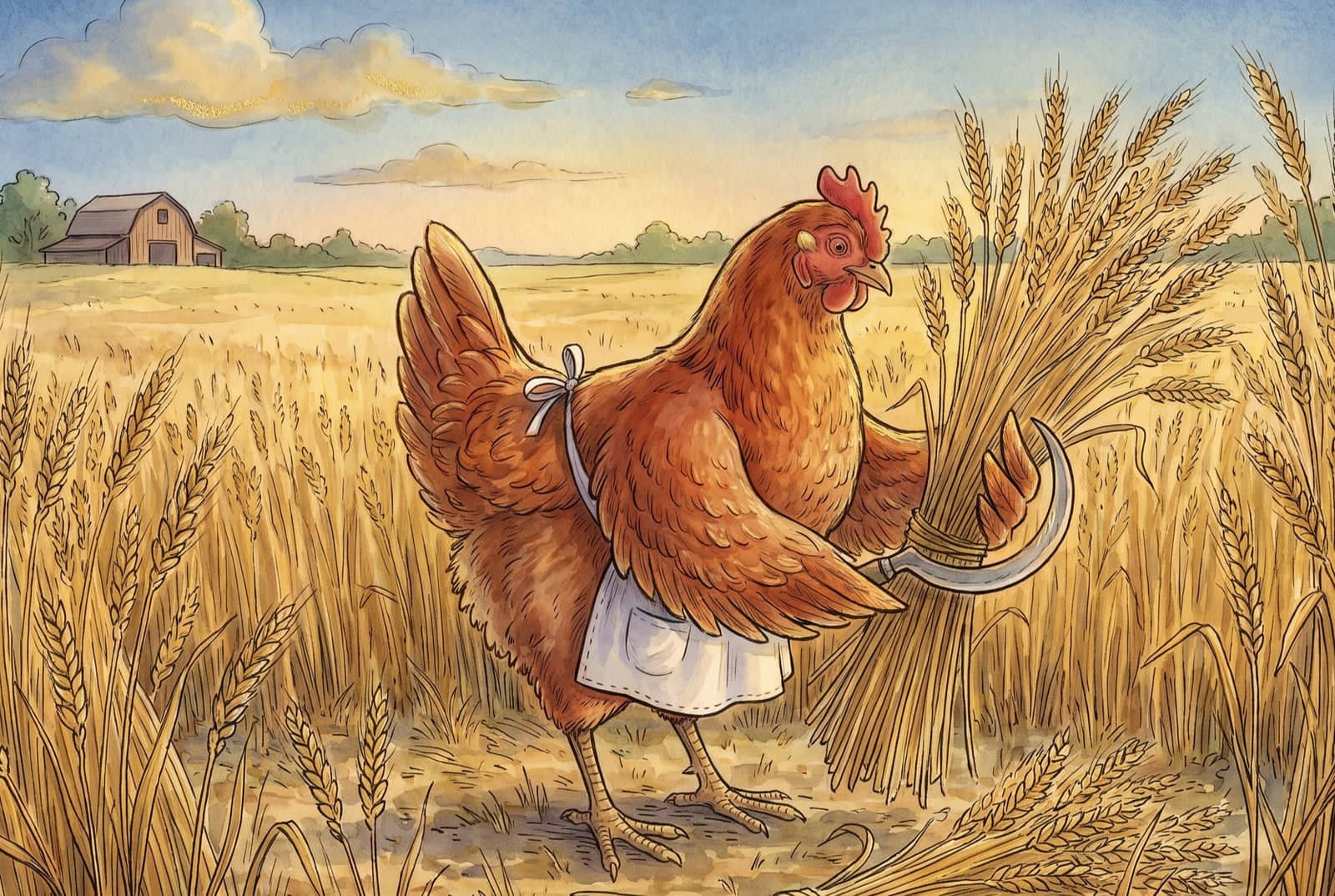
The Wheat lay on the ground, ready to be gathered and threshed. But just then her newest, yellowest, downiest chicks set up a peep-peep-peeping, announcing to the whole barnyard, and to their mother most of all, that they were being shamefully neglected.
Poor Little Red Hen. She hardly knew which way to turn. Her children pulled her one way, and the Wheat, which was her own doing and nobody else’s, pulled her the other.
Still, she called out in her most hopeful voice:
“Who will thresh the Wheat?”
The Pig grunted, “Not I.”
The Cat mewed, “Not I.”
The Rat squeaked, “Not I.”
The Little Red Hen looked, it must be said, rather discouraged. “Well, then,” she said, “I will.”
And she did. First she fed her babies and settled them for their afternoon nap, and only then did she go out and thresh the Wheat.
When it was done she called, “Who will carry the Wheat to the mill to be ground?”
The Pig turned his back on her and said, “Not I.”
The Cat turned her back on her and said, “Not I.”
The Rat turned his back on her and said, “Not I.”
“Well, then,” said the Little Red Hen, “I will.”
And she did.
She shouldered the sack of Wheat and trudged off along the road to the mill, which was a long way off. There she asked to have the grain ground into fine white flour.
When the miller handed her the sack again, she carried it the whole way home with her quick, busy step.
Even under such a load she managed to snap up a juicy worm here and there, and she still had one to spare for the babies when she reached them. The little fluff-balls were so glad to see her. For the first time, they truly understood what a mother they had.
After a day like that she went to her roost early, before the colors even came into the sky at sunset, which was her usual hour.
She would gladly have slept late in the morning. But her chicks joined the dawn chorus of the hen yard, and that was the end of any such comfort.
Even as she opened one sleepy eye, the thought came to her that today, somehow, that Wheat must be turned into bread.
She had never baked in her life. Still, anyone can bake who follows a recipe carefully, and she knew quite well that she could do it if she had to.
So when her children had been fed and brushed and made fresh for the day, she went and hunted up the Pig, the Cat and the Rat. She was still certain, after everything, that one day they would help her. She sang out:
“Who will make the bread?”
The Pig said, “Not I.”
The Cat said, “Not I.”
The Rat said, “Not I.”
Poor Little Red Hen. Her hopes sank once more.
“Well, then,” she said, “I will.”
And she did.
She put on a fresh apron and a spotless cook’s cap. First she set the dough, as is proper, and left it to rise.
When the time came she brought out the molding board and the baking tins, molded the bread, divided it into loaves, and put them into the oven to bake.
All the while, the Cat sat by giggling and chuckling to herself.
Close at hand the vain Rat powdered his nose and admired himself in a looking glass.
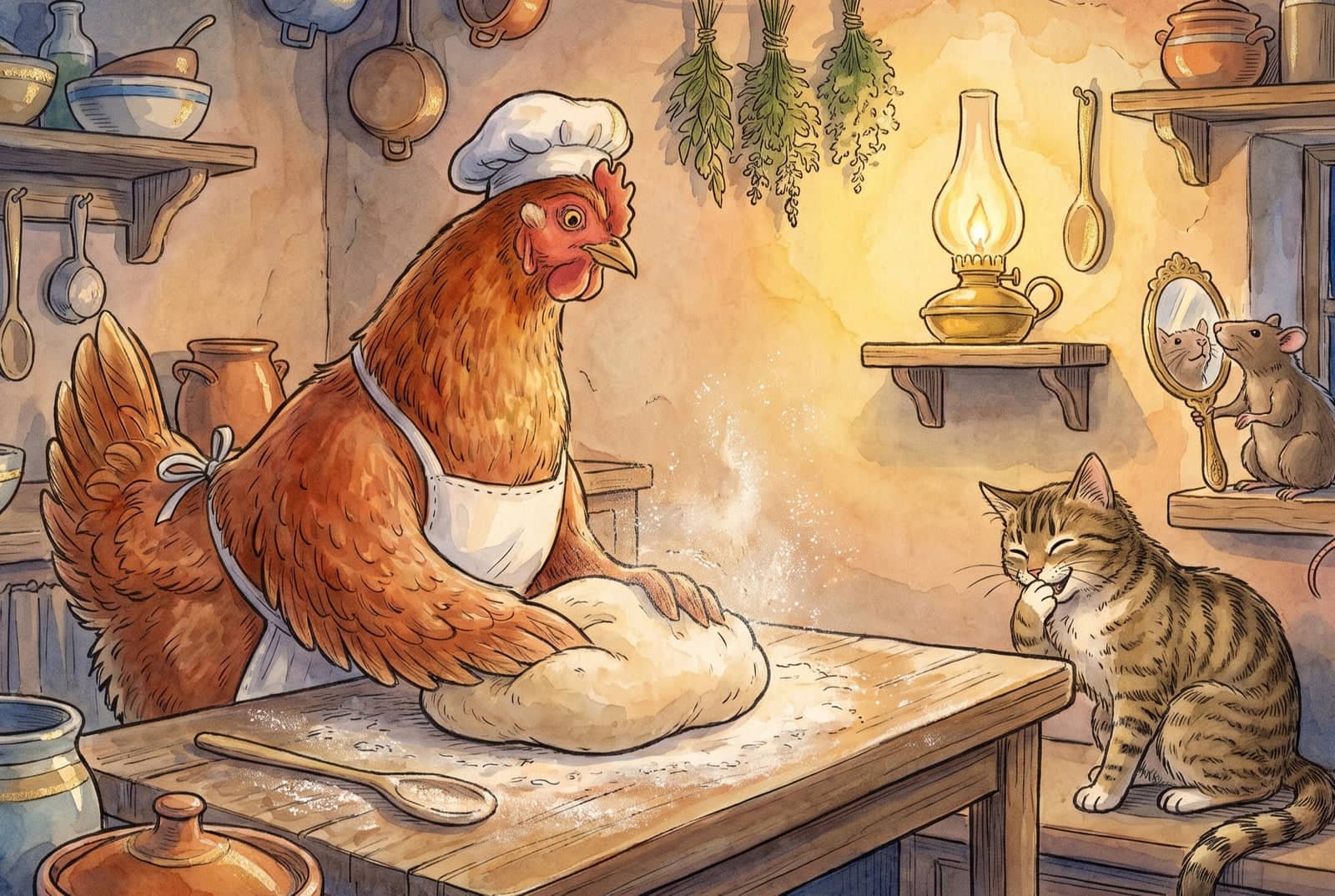
And somewhere in the distance the dozing Pig snored long, slow snores.
At last the great moment came. A wonderful smell floated out on the autumn breeze, and all over the barnyard the animals lifted their noses and sniffed the air with delight.
The Little Red Hen came to the oven with her quick, busy step, looking perfectly calm. Inside she could hardly keep herself from dancing and singing, for had she not done every last bit of the work on this wonderful bread?
She did not know yet whether it would be fit to eat. But when the loaves came out, round and brown, they were baked to perfection.
Then, most likely because she had gotten into the habit of asking, the Little Red Hen called out:
“Who will eat the Bread?”
Every animal in the barnyard was watching hungrily, licking its lips.
The Pig said, “I will.”
The Cat said, “I will.”
The Rat said, “I will.”
But the Little Red Hen said:
“No, you won’t. I will.”
And she did.
Retold by Talerie from The Little Red Hen (opens in a new window) Public domain Copy this text, adapt it, use it however you like. A link back to Talerie is appreciated but never required. CC0 1.0 (opens in a new window)