 Original
The Little Mermaid
51 min readages 8 and uptalerie.com/en/tales/the-little-mermaid-original
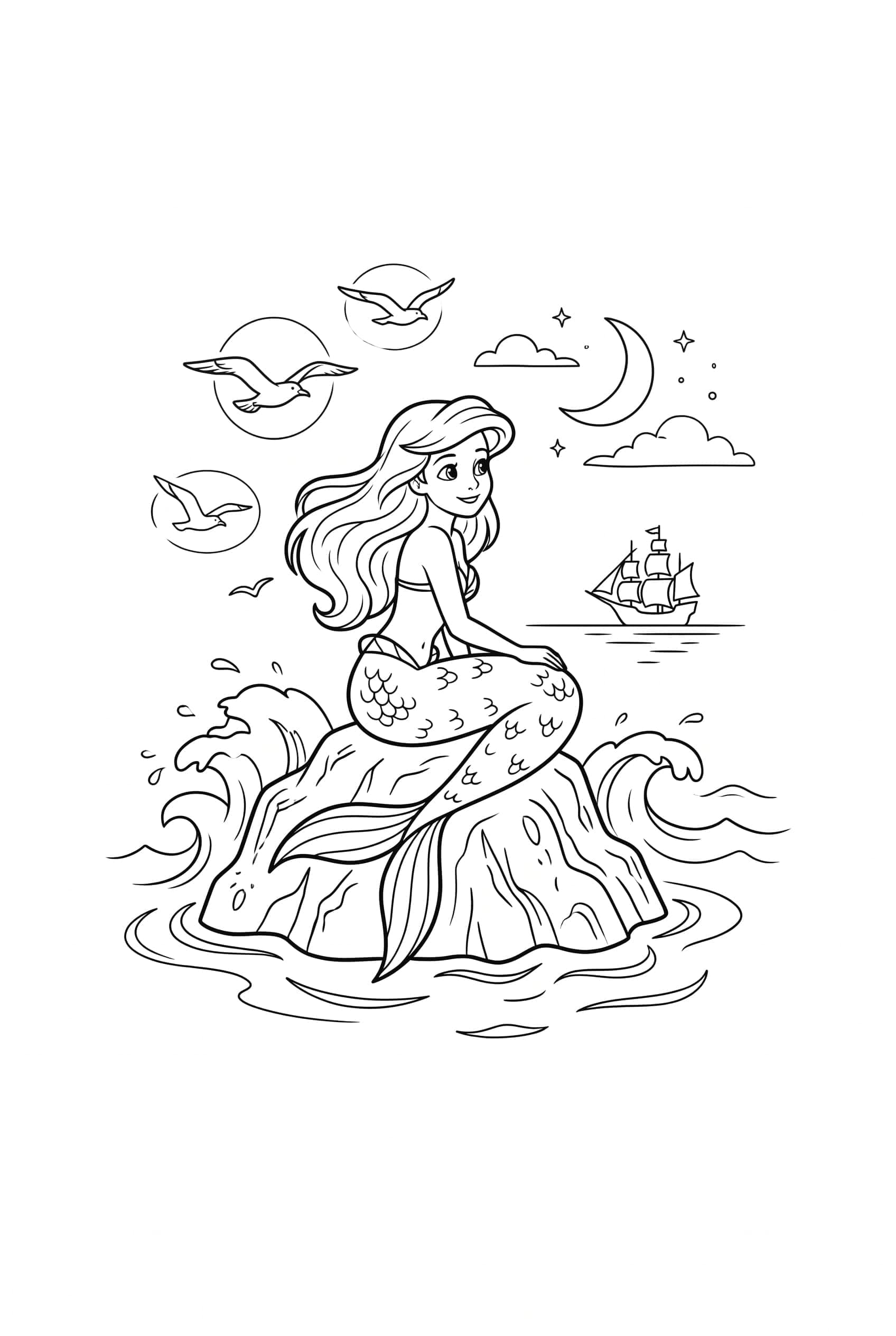
The youngest daughter of the Sea King saves a drowning prince, then gives her voice to the sea witch for legs that hurt like knives at every step. On the morning after the prince marries another, the mermaid’s sisters bring her a knife from the witch, but she throws it into the sea and joins the daughters of the air.
Far out at sea the water is as blue as the petals of the loveliest cornflower and as clear as the purest glass, but it is very deep, deeper than any anchor rope can reach. Many church towers would have to be set one on top of another to stand on the bottom and still show above the water. Down there the sea people live.
Now, you must not think that there is nothing down there but bare white sand. The strangest trees and plants grow in that place, with stems and leaves so supple that they stir at the smallest movement of the water, as if they were alive. All the fish, the little ones and the great ones, slip between the branches the way birds slip between the trees up here. And in the deepest spot of all stands the Sea King’s castle. Its walls are of coral and its tall pointed windows are of the clearest amber, and the roof is made of shells that open and close as the water flows over them. It is a beautiful thing to see, for a shining pearl lies in every one of them, and a single pearl of that kind would be worth a great deal in a queen’s crown.
The Sea King down there had been a widower for many years, and his old mother kept house for him. She was a clever woman, though very proud of her noble birth, and for that reason she wore twelve oysters on her tail, while the other great ladies were allowed only six. In everything else she deserved high praise, above all for the care she took of the little sea princesses, her granddaughters. They were six beautiful children, but the youngest was the loveliest of them all. Her skin was as clear and fine as a rose petal and her eyes were as blue as the deepest sea, but like all the others she had no feet: her body ended in a fish’s tail.
All day long the sisters could play down in the castle, in the great halls where living flowers grew out of the walls. The big amber windows were opened, and then the fish swam in to them, just as the swallows fly in to us when we open our windows. Only these fish swam right up to the princesses, ate out of their hands and let themselves be stroked.
Outside the castle there was a great garden with fire-red and dark blue flowers. The fruit shone like gold, and the blossoms burned like little flames, and stems and leaves moved without stopping. The ground itself was the finest sand, but blue as a sulphur flame. Over everything lay a strange blue gleam. You would sooner have believed that you were standing high in the air with nothing but sky above you and below you than that you were on the floor of the sea. When the water was still you could catch sight of the sun. It looked like a purple flower with all the light of the world streaming out of its cup.
Each of the little princesses had her own small plot in the garden, where she could dig and plant as she pleased. One shaped her flower bed like a whale, another liked hers better in the shape of a little mermaid, but the youngest made hers quite round, like the sun, and put in it only flowers that shone as red as the sun does. She was a strange child, quiet and full of thoughts, and when her sisters showed off the curious things they had taken from wrecked ships, she wanted nothing at all except her rose-red flowers, which were like the sun up above, and one beautiful marble statue. It was a handsome boy, cut out of clear white stone, who had come down to the floor of the sea when a ship went to pieces. Beside the statue she planted a rose-red weeping willow. It grew wonderfully well and hung its fresh branches over the boy and down toward the blue sand, where the shadow showed violet and moved as the branches moved. It looked as if the crown of the tree and its roots were playing together and wanted to kiss each other.
Nothing gave her greater joy than to hear about the world of human beings. Her old grandmother had to tell her everything she knew about ships and towns, about people and animals. What seemed most beautiful of all to her was that up on the earth the flowers had a scent, for down on the floor of the sea they had none, and that the woods were green, and that the fish you saw there among the branches could sing so loudly and so sweetly that it was a delight to hear them. It was the little birds the grandmother called fish, for otherwise the children would not have understood her, never having seen a bird.
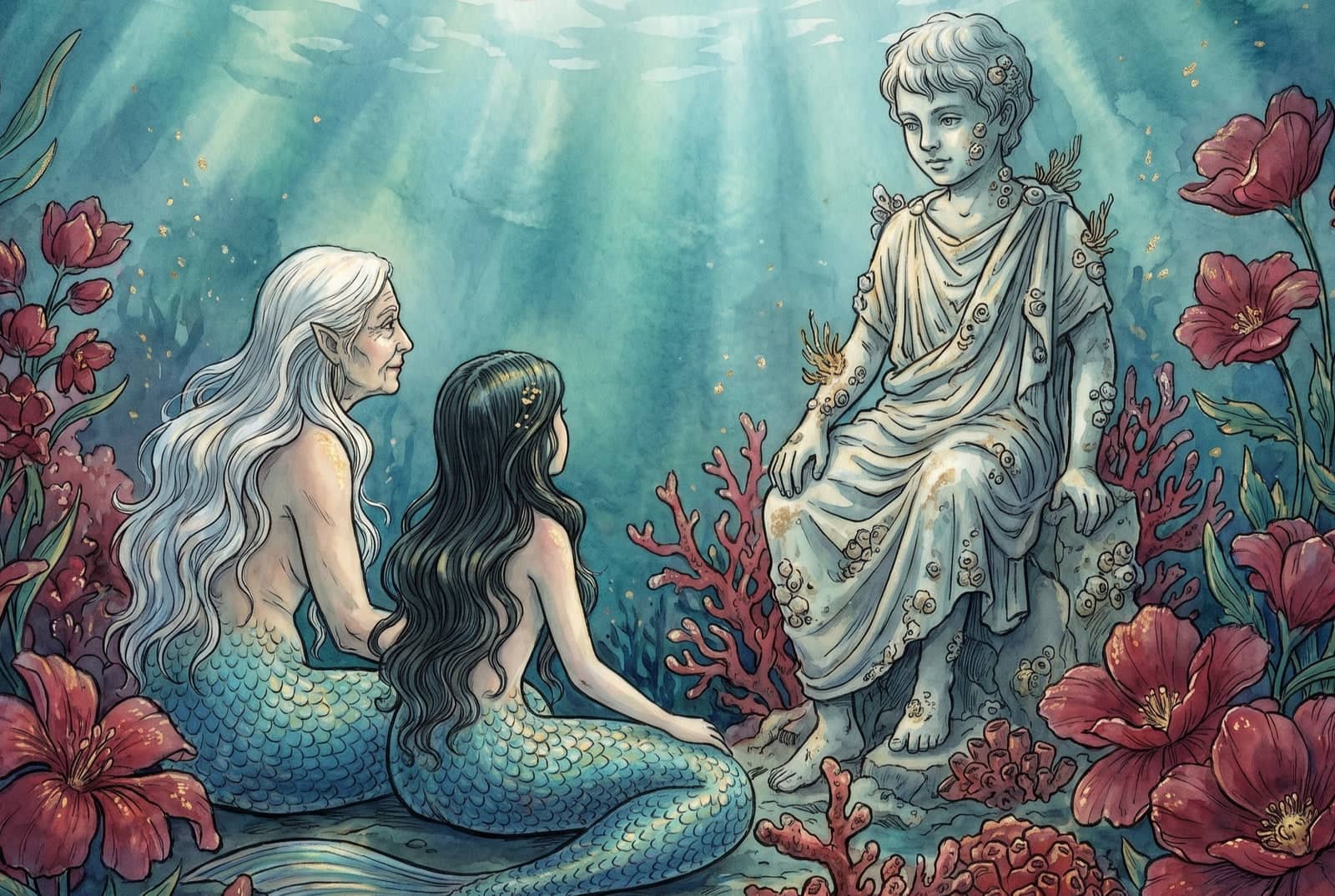
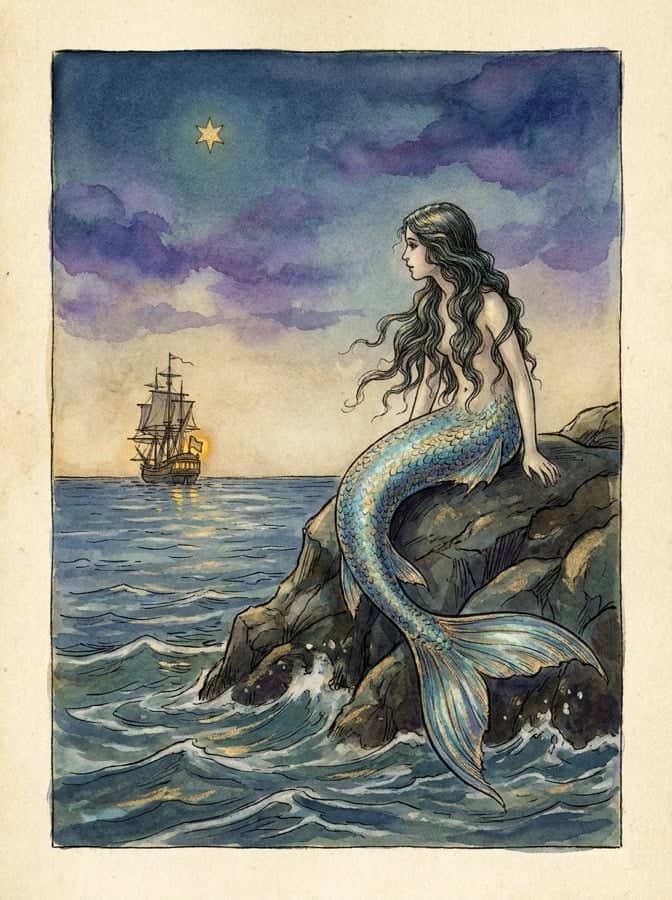
“When you are fifteen years old,” said the grandmother, “you will have leave to rise up out of the sea, to sit on the rocks in the moonlight and watch the great ships go sailing past. You will see forests and towns then.”
In the coming year the eldest of the sisters would be fifteen, but each of the others was a year younger than the one before, so that when the eldest’s turn came the youngest of them still had five whole years to wait before she could come up from the floor of the sea and see how things look with us. But each promised to tell the others what she had seen and what she had found most beautiful on that first day, for their grandmother never told them enough, and there was so much they wanted to know.
None of them longed for it as the youngest did, and she was the one who had the longest to wait, the quiet one, always full of her own thoughts. Many a night she stood at the open window and looked up through the dark blue water, where the fish splashed about with their fins and their tails. She could see the moon and the stars. They shone quite pale, of course, but through the water they looked much larger than they do to our eyes. And when something like a black cloud slid along beneath them, she knew it was either a whale swimming above her or a ship with many people on board, and those people certainly never thought that a lovely little mermaid was standing down below, stretching her white hands up toward the keel.
Now the eldest princess was fifteen years old and was allowed to rise above the surface of the sea.
When she came back she had a hundred things to tell, but the loveliest of all, she said, was to lie on a sandbank in the calm sea in the moonlight and look at the coast close by with its great town, where the lights twinkled like a hundred stars, and to hear the music and the noise and the rattle of carriages and voices, and to see the many church towers and hear their bells ringing.
Oh, how the youngest sister listened. And afterward, when she stood at the open window in the evening and looked up through the dark blue water, she thought of the great town with all its noise and bustle, and then she believed she could hear the church bells ringing all the way down to her.
The next year the second sister was given leave to rise up through the water and swim wherever she liked. She came up just as the sun was going down, and that sight, she said, was the loveliest of all. The whole sky had looked like gold, and as for the beauty of the clouds, she could not describe it. Red and violet, they had sailed away above her, and faster than the clouds a flock of wild swans had flown like a long white veil across the water to where the sun stood. She had swum toward it too, but the sun sank, and the rosy light went out on the face of the sea and in the clouds.
The year after that the third sister went up. She was the boldest of them all, and so she swam up a broad river that flowed into the sea. She saw glorious green hills with vines growing on them, and castles and manor houses looking out from splendid woods. She heard all the birds singing, and the sun shone so warm that she often had to dive under the water to cool her burning face. In a little bay she came upon a whole crowd of human children. They were quite naked and were splashing about in the water, and she wanted to play with them, but they ran away in fright, and then a little black animal came, a dog, though she had never seen a dog before, and it barked at her so terribly that she grew frightened and made for the open sea. But she could never forget the splendid woods, the green hills and the sweet children who could swim in the water although they had no fish’s tail.
The fourth sister was not so bold. She stayed far out in the wild sea and said that there it was most beautiful of all. You could see for many miles around you, and the sky stood above like a great glass bell. She had seen ships, but only far off, so that they looked like gulls. The playful dolphins had turned somersaults, and the great whales had spouted water out of their nostrils until it looked like a hundred fountains playing all around her.
Then it was the fifth sister’s turn. Her birthday came in the winter, and so she saw what the others had not seen the first time. The sea looked quite green, and great icebergs floated everywhere. Each one looked like a pearl, she said, and yet they were far taller than the church towers that people build. They took the strangest shapes and glittered like diamonds. She had sat down on one of the biggest of them and let the wind play with her long hair, and all the sailing ships tacked away in fright from where she sat. Toward evening the sky clouded over. Lightning flashed and thunder rolled, while the black sea lifted the great blocks of ice high up and let them shine in the red flashes. On every ship the sails were taken in, and there was fear and dread on board, but she sat quietly on her floating iceberg and watched the blue lightning run in zigzags down into the gleaming sea.
The first time each of the sisters came up above the water she was enchanted by all the new and beautiful things she saw. But now that they were grown girls and had leave to go up whenever they wished, they stopped caring about it. They longed to be home again, and after a month they said that down below with them it was loveliest of all, and that home was the pleasant place to be.
Still, many an evening the five sisters would link their arms and rise up in a row through the water. They had glorious voices, lovelier than any human voice, and when a storm was gathering and they thought that ships might be lost, they swam in front of them and sang sweetly of how beautiful it is on the floor of the sea, begging the sailors not to be afraid to come down. But the sailors could not understand the words and thought it was the storm, and they never came to see the splendor down below either, for when the ship went under, the people drowned and came to the Sea King’s castle as dead bodies.
When the sisters rose up like this in the evening, arm in arm, high through the water, the smallest sister stood all alone and looked after them, and she felt as though she must cry. But a mermaid has no tears, and so she suffers all the more.
“Oh, if only I were fifteen years old,” she said. “I know I shall love that world up there, and the people who live and keep house in it.”
At last she was fifteen.
“There, now you are grown up,” said her grandmother, the old queen mother. “Come and let me dress you like your sisters.” She set a wreath of white lilies on her hair, and every petal of every flower was half a pearl, and the old lady made eight great oysters clamp themselves to the princess’s tail to show her high rank.
“That hurts so,” said the little mermaid.
“Pride must bear its pinch,” said the old lady.
Oh, how gladly she would have shaken off all this grandeur and laid aside the heavy wreath. Her red flowers in the garden suited her far better, but there was nothing she could do about it now. “Goodbye,” she said, and she rose light and clear as a bubble up through the water.
The sun had just gone down as she lifted her head above the surface, but all the clouds still glowed like roses and gold, and in the middle of the pale red air the evening star shone bright and beautiful. The air was mild and fresh and the sea was calm. There lay a great ship with three masts. Only a single sail was up, for not a breath of wind was stirring, and the sailors sat about in the rigging and along the yards. There was music and singing, and as it grew dark, hundreds of colored lanterns were lit, so that it looked as though the flags of all the nations were waving in the air. The little mermaid swam right up to the cabin window, and every time the water lifted her she could look in through the clear panes at the many finely dressed people standing inside. But the handsomest of them was the young prince with the great black eyes. He was certainly not much over sixteen. It was his birthday, and that was why there was all this splendor. The sailors danced on the deck, and when the young prince stepped out, more than a hundred rockets went up into the air. They lit everything as bright as day, so that the little mermaid was badly frightened and dived under the water. But she soon put her head out again, and then it seemed to her as if all the stars of heaven were falling down to her. Never had she seen such fireworks. Great suns spun and threw off sparks, splendid fish of fire flew into the blue air, and everything was mirrored in the clear, still sea. On the ship itself it was so bright that you could see every little rope, and the people far more plainly still. Oh, how handsome the young prince was. He pressed the hands of everyone there and smiled, while the music rang out into the glorious night.
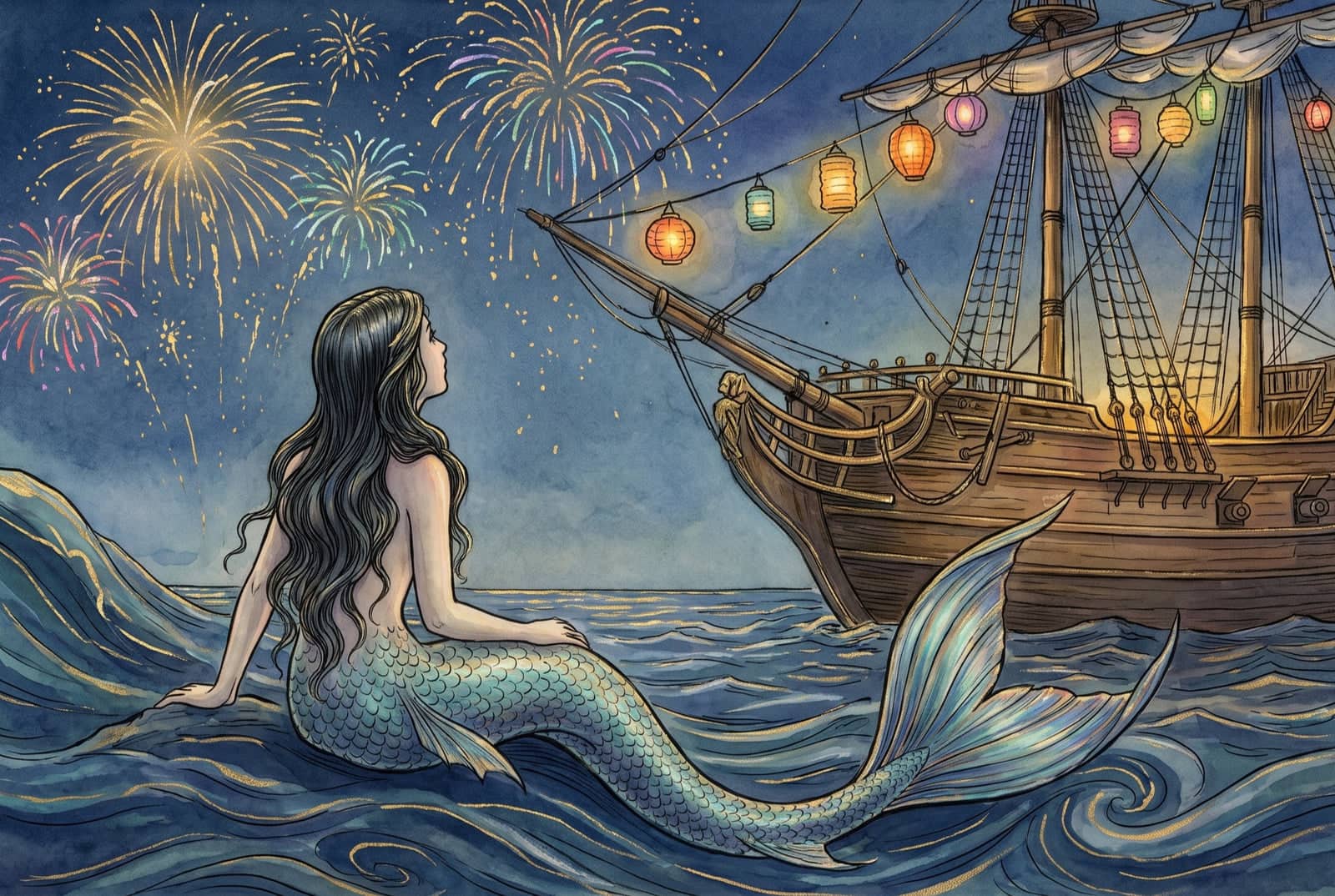
It grew late, but the little mermaid could not turn her eyes away from the ship or from the beautiful prince. The colored lanterns were put out, no more rockets went up and no more cannon were fired, but deep down in the sea there was a humming and a rumbling. Meanwhile she sat on the water and rocked up and down, so that she could keep looking into the cabin. Then the ship began to move faster. One sail after another was spread. Now the waves came harder, great clouds gathered, and there was lightning far away. Oh, it was going to be an ugly night. So the sailors took in the sails again. The great ship went rocking on its flying course over the wild sea. The water rose up like huge black mountains that wanted to break over the mast, but the ship dived down like a swan between the high waves and let itself be lifted again on the towering water. To the little mermaid this seemed a merry ride, but it did not seem so to the sailors. The ship groaned and cracked, the thick planks bent under the heavy blows, the sea broke into the hold, the mast snapped in the middle as if it were a reed, and the ship rolled onto its side while the water came pouring in. Now the little mermaid saw that they were in danger, and she herself had to watch out for the beams and pieces of the ship that were drifting on the water. For a moment it was so black that she could see nothing at all, and then, when the lightning came, it was so bright again that she could make out everyone on board. Above all she was looking for the young prince, and she saw him sink into the deep sea as the ship broke apart. At first she was quite glad, for now he was coming down to her. But then she remembered that people cannot live in the water, and that he could never come down to her father’s castle except as a dead man. No, he must not die. So she swam in among the beams and planks that were drifting on the sea and forgot completely that they could have crushed her. She dived deep under the water and rose again between the waves, and at last she reached the prince, who could not keep himself afloat any longer in that stormy sea. His arms and legs were beginning to fail him, his beautiful eyes were closing, and he would have died if the little mermaid had not come. She held his head above the water and let the waves carry them both wherever they would.
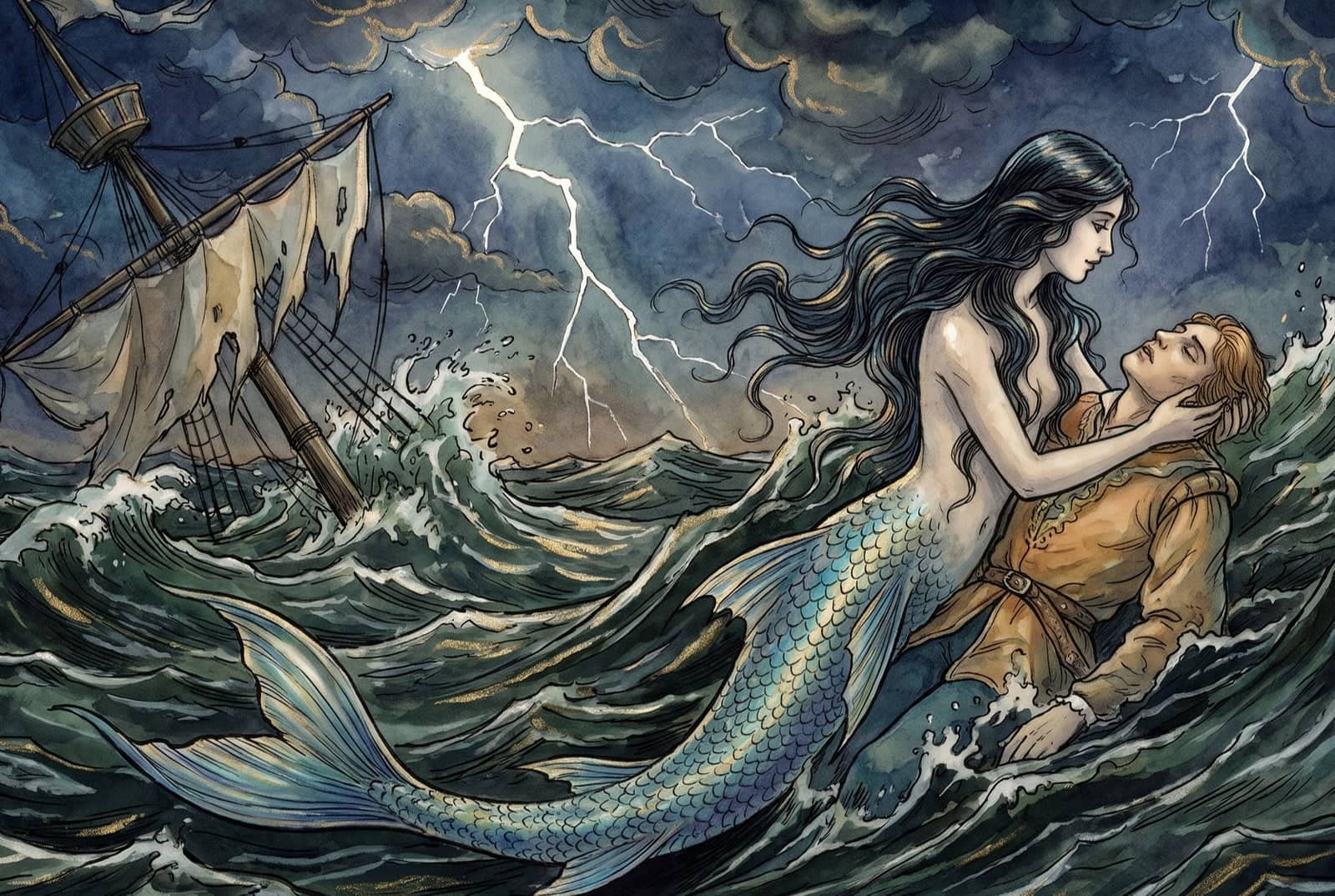
In the morning the bad weather was over. Not a splinter of the ship was to be seen. The sun rose red and shining out of the water, and it was as though the prince’s cheeks took life from it, but his eyes stayed closed. The mermaid kissed his high, handsome forehead and stroked back his wet hair. He seemed to her like the marble statue in her little garden. She kissed him again and wished that he might live.
Then she saw dry land before her, high blue mountains with white snow shining on their peaks as if a flock of swans were lying there. Down by the coast were glorious green woods, and in front of them stood a church, or perhaps a convent, she could not be sure which, but a building of some kind it was. Lemon and orange trees grew in the garden, and tall palms stood before the gate. Here the sea made a little bay, still and very deep. She swam with the handsome prince straight in toward the rocks, where the fine white sand had been washed up, and she laid him down in the sand, taking great care that his head lay high in the warm sunlight.
Now all the bells rang in the great white building, and a number of young girls came out through the garden. Then the little mermaid swam farther off, behind some high stones that stood up out of the water, and she laid sea foam over her hair and her breast so that nobody could see her little face, and she watched to see who would come to the poor prince.
It was not long before a young girl came that way. She seemed very frightened, but only for a moment. Then she fetched several people, and the mermaid saw the prince come back to life and smile at them all. But he sent no smile to her. He did not know, of course, that it was she who had saved him. And she felt very heavy at heart, and when he was led away into the great building she dived sadly under the water and went home to her father’s castle.
She had always been quiet and full of her own thoughts, but now she became far more so. Her sisters asked her what she had seen the first time up above, but she told them nothing.
Many an evening and many a morning she rose to the place where she had left the prince. She saw the fruit in the garden ripen and be picked, she saw the snow melt on the high mountains, but the prince she never saw, and so she always came home sadder than before. Then her only comfort was to sit in her little garden and put her arms around the beautiful marble statue that looked like the prince. But she gave up caring for her flowers. They grew like a wilderness out over the paths and wove their long stems and leaves into the branches of the trees, so that it became dark down there.
At last she could not bear it any longer and told one of her sisters, and at once the others knew as well, but nobody else, except these and a few other mermaids who told it only to their closest friends. One of them knew who the prince was. She had seen the feast on the ship too, and she could say where he came from and where his kingdom lay.
“Come, little sister,” said the other princesses, and with their arms around each other they rose in a long row out of the sea at the place where they knew the prince’s castle stood.
It was built of a pale yellow shining stone, with great marble stairs, and one of them ran right down into the sea. Splendid gilded domes rose above the roof, and between the pillars that went around the whole building stood marble figures that looked as though they were alive. Through the clear glass of the tall windows you could see into glorious halls, where costly silk curtains and carpets hung and all the walls were covered with great paintings, so that it was a real pleasure to look at them. In the middle of the largest hall a great fountain splashed. Its jets reached high up toward the glass dome in the ceiling, and through it the sun shone down on the water and on the beautiful plants growing in the wide basin.
Now she knew where he lived, and she was there many an evening and many a night on the water. She swam far closer to the land than any of the others would have dared. She even went up the narrow channel under the splendid marble balcony that threw a long shadow across the water. There she would sit and look at the young prince, who believed he was quite alone in the bright moonlight.
Many an evening she saw him sail out with music in his fine boat with the flags flying. She peeped out through the green reeds, and if the wind caught her long silver-white veil and anyone saw it, he thought it was a swan spreading its wings.
Many a night, when the fishermen were out at sea with their torches, she heard them say many good things about the young prince, and it made her glad that she had saved his life when he was drifting half dead on the waves. She thought how firmly his head had rested against her breast and how warmly she had kissed him then. But he knew nothing of it and could not even dream of her.
More and more she began to love human beings, and more and more she wished she could walk about among them, for their world seemed to her far larger than her own. They could fly over the sea in ships and climb the high mountains above the clouds, and the lands they owned stretched away with woods and fields farther than she could see. There was so much she wanted to know, but her sisters could not answer everything, and so she asked her grandmother, who knew that upper world very well and quite rightly called it the lands above the sea.
“If people are not drowned,” asked the little mermaid, “can they live forever? Do they not die as we do here below in the sea?”
“Yes,” said the old lady, “they must die too, and their span of life is even shorter than ours. We can live to be three hundred years old, but when we stop being here we are only turned into foam on the water, and we do not even have a grave down here among those we love. We have no immortal soul. We never live again. We are like the green reed: once it is cut through, it can never grow green again. People, on the other hand, have a soul that lives forever, that goes on living after the body has turned to earth. It rises up through the clear air, up to the shining stars. Just as we come up out of the water and see the lands of the world, so they rise to unknown and glorious places that we shall never get to see.”
“Why did we not get an immortal soul?” asked the little mermaid sadly. “I would give all the hundreds of years I have to live, if I could be a human being for a single day and then have the hope of sharing in that heavenly world.”
“You must not think about that,” said the old lady. “We are far happier and far better off than the people up there.”
“So I shall die, then, and drift as foam on the sea, and never hear the music of the waves or see the beautiful flowers and the red sun. Can I do nothing at all to win an immortal soul?”
“No,” said the old lady. “Only if a man loved you so much that you were more to him than his father and his mother, if he clung to you with all his thoughts and all his love and let the priest lay his right hand in yours with a promise to be faithful here and for all eternity, then his soul would flow over into your body and you too would have a share in the happiness of human beings. He would give you a soul and keep his own as well. But that can never happen. The very thing that is beautiful here in the sea, your fish’s tail, they think ugly up there on the earth. They simply know no better. Up there you must have two clumsy props, which they call legs, in order to be thought beautiful.”
Then the little mermaid sighed and looked sadly at her fish’s tail.
“Let us be cheerful,” said the old lady. “Let us leap and spring through the three hundred years we have to live. That is long enough, truly, and afterward we can rest all the better for it. This evening we are to have a court ball.”
And that was a splendor such as no one ever sees on the earth. The walls and the ceiling of the great dancing hall were of thick but clear glass. Several hundred huge shells, rose-red and grass-green, stood in rows along each side with a blue fire burning in them, which lit the whole hall and shone out through the walls, so that the sea outside was lit as well. You could see the countless fish, great and small, swimming up against the walls of glass. On some of them the scales shone purple-red, on others they looked like silver and gold. Through the middle of the hall flowed a broad stream, and on it the mermen and mermaids danced to their own sweet singing. People on the earth have no voices as lovely as those. The little mermaid sang most beautifully of them all, and the whole court clapped for her with hands and tails, and for a moment she felt joy in her heart, for she knew that she had the loveliest voice of any on earth or in the sea. But soon she thought again of the world above her. She could not forget the handsome prince, nor her grief that she had no immortal soul as he had. So she stole out of her father’s castle, and while everything inside was singing and gladness, she sat sorrowful in her little garden. Then she heard the hunting horn ringing down through the water, and she thought: he is surely sailing up there now, the one my heart is set on, in whose hand I would gladly lay the happiness of my life. I will risk everything to win him and an immortal soul. While my sisters are dancing in my father’s castle I will go to the sea witch, of whom I have always been so much afraid. Perhaps she can advise me and help me.
Then the little mermaid went out of her garden toward the roaring whirlpools, behind which the witch lived. She had never gone that way before. No flowers grew there, no seagrass. Nothing but the bare gray sandy bottom stretched toward the whirlpools, where the water spun round like roaring mill wheels and dragged everything it caught down with it into the depths. Right through the middle of those grinding whirlpools she had to pass to reach the sea witch’s country, and for a long stretch after that there was no other road than over warm bubbling mud, which the witch called her peat bog. Behind it stood her house, in the middle of a strange wood. All the trees and bushes there were polyps, half animal and half plant, and they looked like hundred-headed snakes growing up out of the earth. All their branches were long slimy arms with fingers like supple worms, and joint by joint they moved, from the root to the very tip. Everything they could seize hold of in the sea they wound themselves around and never let go of again.
The little mermaid stopped in front of them, quite terrified. Her heart beat with fear, and she almost turned back. But then she thought of the prince and of the human soul, and her courage came back to her. She bound her long flying hair tightly around her head, so that the polyps could not catch her by it. She folded both hands across her breast and darted forward as a fish darts through the water, in between the ugly polyps, which stretched their supple arms and fingers out after her. She saw how each of them held something it had seized, gripped fast by hundreds of little arms as strong as iron bands. People who had died at sea and sunk far down could be seen as white skeletons in the polyps’ arms. They held ships’ oars and chests, and skeletons of land animals, and a little mermaid whom they had caught and choked, and that was the most terrible sight of all to her.
Now she came to a great marshy clearing in the wood, where big fat water snakes rolled about and showed their ugly whitish-yellow bellies. In the middle of the clearing stood a house built of the white bones of drowned people, and there sat the sea witch, letting a toad eat out of her mouth, the way people let a little canary eat sugar. She called the ugly fat water snakes her little chickens and let them roll about on her broad spongy breast.
“I know quite well what you want,” said the sea witch. “It is stupid of you, but you shall have your way, for it will bring you sorrow, my beautiful princess. You want to be rid of your fish’s tail and to have two props instead, so that you can walk like the people up there, and so that the young prince will fall in love with you and you can win him and an immortal soul.” And at that the witch laughed so loudly and so horribly that the toad and the snakes fell to the ground and lay there wriggling. “You have come just at the right time,” said the witch. “Tomorrow, once the sun is up, I could not help you until another year had gone by. I will make you a drink, and you must swim with it to the land before the sun rises, sit down on the shore there and drink it. Then your tail will part and shrink into what people call a pretty pair of legs. But it will hurt. It will be as though a sharp sword went through you. Everyone who sees you will say that you are the loveliest human child they have ever set eyes on. You will keep your gliding step, and no dancer will ever move as lightly as you. But every step you take will feel as if you were treading on a sharp knife, and as if your blood must flow. If you are willing to suffer all this, then I will help you.”
“Yes,” said the little mermaid in a trembling voice, and she thought of the prince and of the immortal soul.
“But remember,” said the witch, “once you have taken human shape, you can never be a mermaid again. You can never come down through the water to your sisters or to your father’s castle. And if you do not win the prince’s love, so that he forgets his father and mother for your sake and clings to you with body and soul and has the priest lay your hands together, so that you are man and wife, then you will get no immortal soul. On the first morning after he marries another, your heart will break and you will become foam on the water.”
“I will do it,” said the little mermaid, and she was pale as death.
“But you must pay me as well,” said the witch, “and it is not a small thing that I ask. You have the most beautiful voice of all down here on the floor of the sea, and no doubt you think you can charm him with it. But that voice you must give to me. The best thing you own is what I want for my precious drink. I must give you my own blood in it, so that the drink can be sharp as a two-edged sword.”
“But if you take my voice,” said the little mermaid, “what is left to me?”
“Your beautiful shape,” said the witch, “your gliding step and your speaking eyes. With those you can turn a human heart well enough. Come, have you lost your courage? Put out your little tongue and I will cut it off in payment, and you shall have the strong drink.”
“Let it be done,” said the little mermaid.
And the witch set her kettle on the fire to boil the magic drink. “Cleanliness is a fine thing,” she said, and scoured out the kettle with the snakes, which she had tied into a great knot. Then she scratched her own breast and let her black blood drip into it. The steam took the strangest shapes, so that anyone would have grown afraid. Every moment the witch threw in something new, and when the kettle boiled it sounded like a crocodile weeping. At last the drink was ready, and it looked like the clearest water.
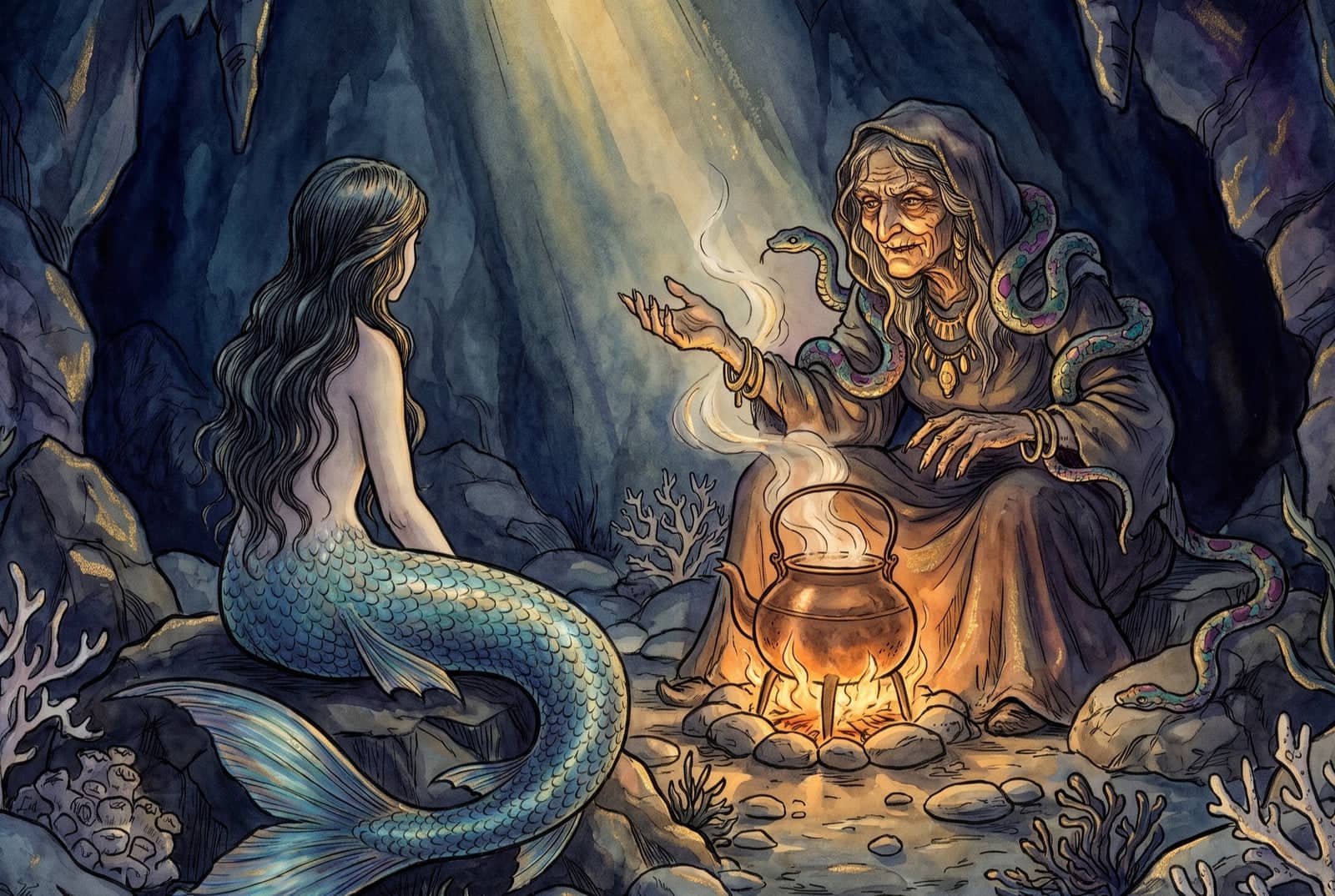
“There you have it,” said the witch, and she cut off the little mermaid’s tongue, so that now she was without a voice and could neither sing nor speak.
“If the polyps should catch hold of you as you go back through my wood,” said the witch, “just throw one single drop of this drink over them, and their arms and fingers will burst into a thousand pieces.” But the little mermaid had no need to do it. The polyps drew back in fright when they caught sight of the shining drink, which glowed in her hand like a twinkling star. So she came quickly through the wood, the bog and the roaring whirlpools.
She could see her father’s castle. The torches in the great dancing hall had been put out, and they were surely all asleep inside, but she did not dare to go and look for them, now that she had no voice and meant to leave them forever. It was as though her heart would break with sorrow. She stole into the garden, took a flower from each of her sisters’ flower beds, blew a thousand kisses toward the castle and rose up through the dark blue sea.
The sun had not yet risen when she caught sight of the prince’s castle and climbed the splendid marble stairs. The moon was shining wonderfully clear. The little mermaid drank the burning, biting drink, and it was as if a two-edged sword went through her fine body. She fainted at it and lay there like one dead. When the sun shone out over the sea she woke and felt a cutting pain, but right in front of her stood the handsome young prince. He fixed his coal-black eyes on her, so that she cast her own down, and then she saw that her fish’s tail was gone and that she had the daintiest little white legs any girl could have. But she had no clothes, and so she wrapped herself in her long thick hair. The prince asked who she was and how she had come there, and she looked at him gently and yet so sadly with her dark blue eyes, for speak she could not. Then he took her by the hand and led her into the castle. Every step she took was as the witch had said it would be, as if she trod on sharp needles and knives, but she bore it gladly. At the prince’s side she went as lightly as a soap bubble, and he and all the rest wondered at her lovely gliding walk.
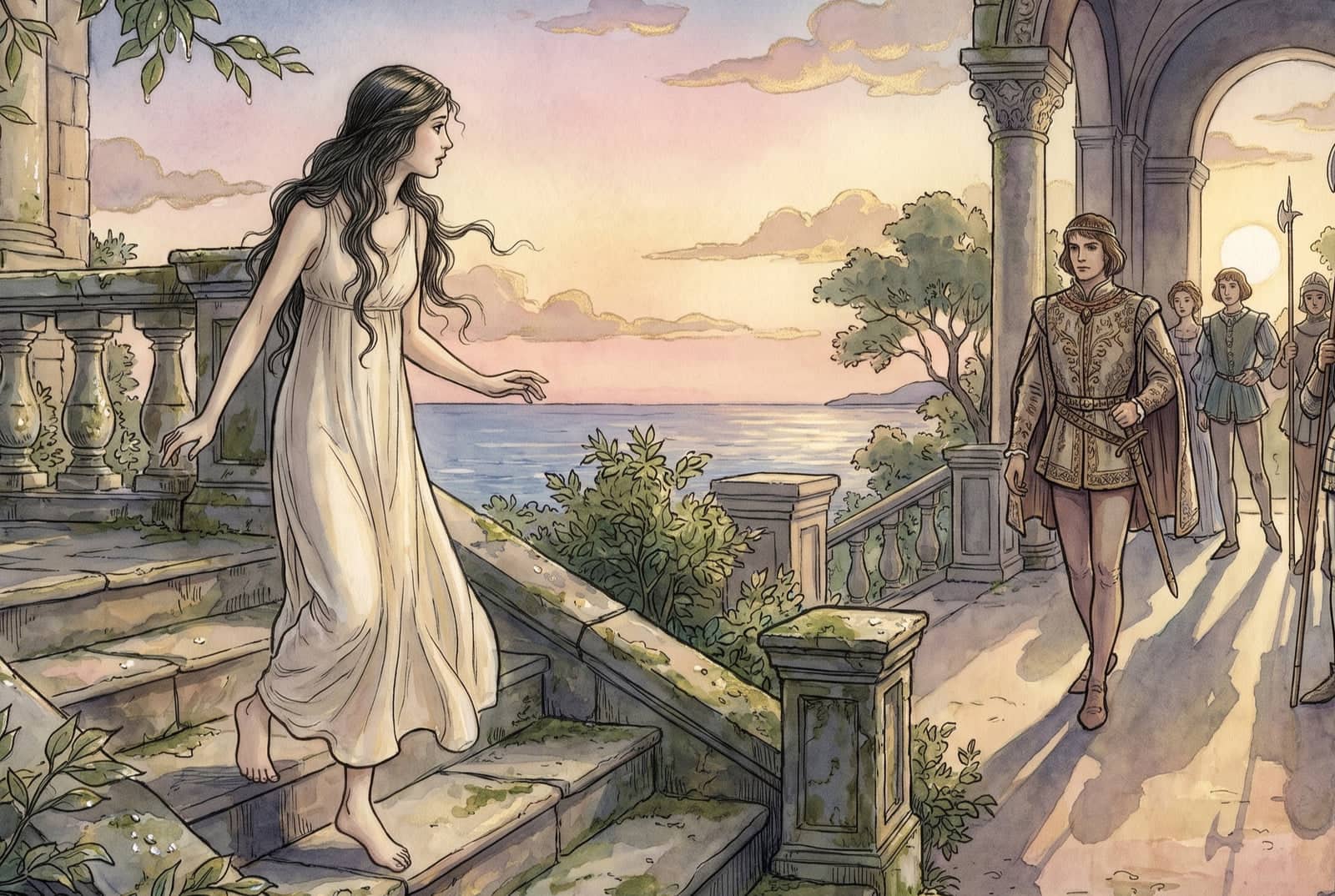
She was given glorious clothes of silk and muslin to wear. In the castle she was the most beautiful of them all, but she had no voice and could neither sing nor speak. Lovely slave girls, dressed in silk and gold, came forward and sang before the prince and his royal parents. One of them sang more beautifully than all the others, and the prince clapped his hands and smiled at her. Then the little mermaid grew heavy at heart. She knew that she herself had sung far more beautifully, and she thought: oh, if only he knew that I gave my voice away for all eternity to be near him.
Now the slave girls danced dainty, gliding dances to the loveliest music, and then the little mermaid lifted her beautiful white arms, rose on the tips of her toes and glided over the floor, dancing as no one had ever danced before. At every movement her beauty showed more clearly, and her eyes spoke deeper to the heart than the singing of the slave girls.
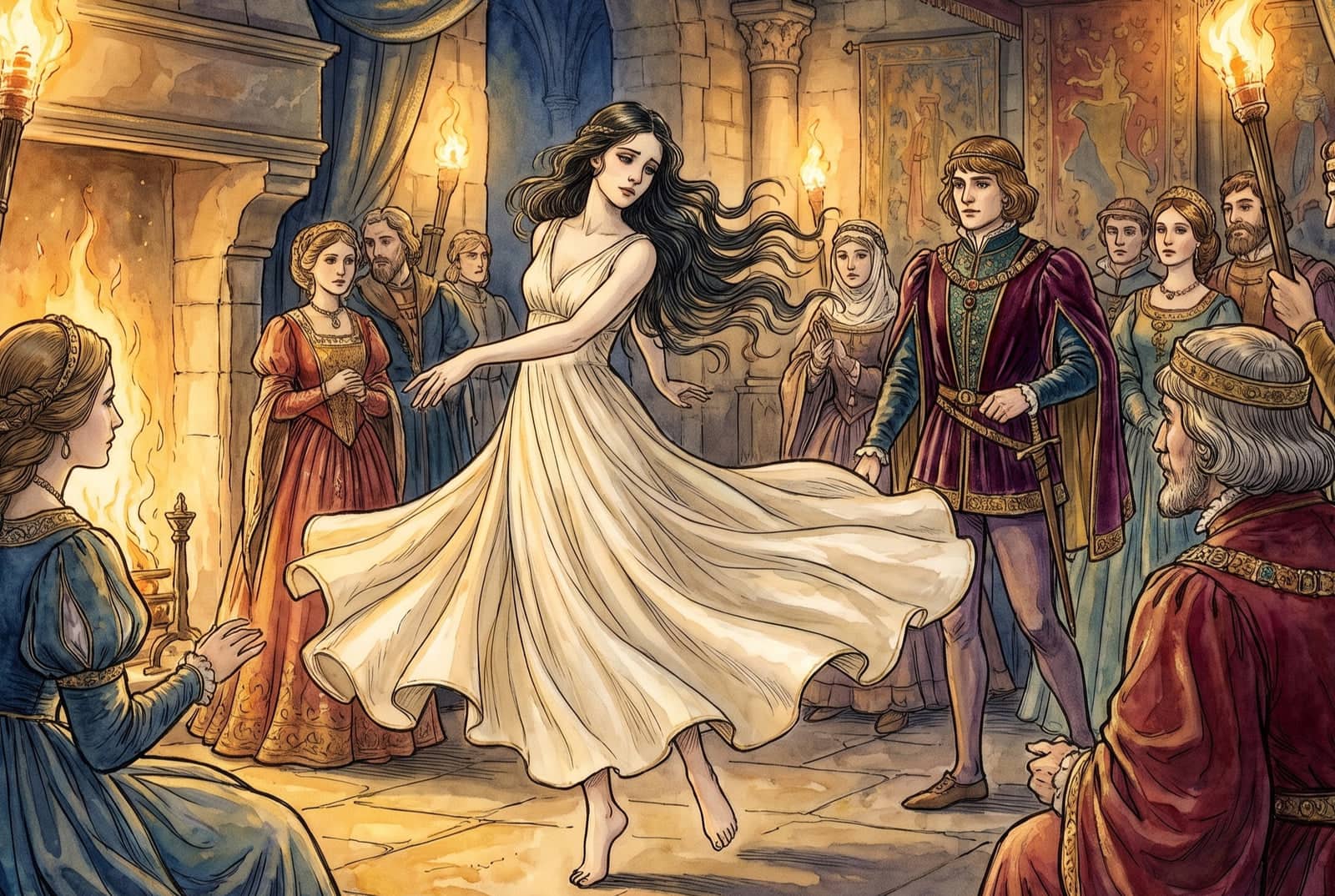
Everyone was enchanted by it, and the prince most of all, who called her his little foundling. And she danced more and more, though every time her foot touched the ground it was as if she trod on sharp knives. The prince said that she should always stay with him, and she was given leave to sleep outside his door on a velvet cushion.
He had a page’s suit made for her, so that she could go riding with him. They rode through the sweet-smelling woods, where the green branches brushed their shoulders and the birds sang behind the fresh leaves. She climbed the high mountains with the prince, and although her tender feet bled so that even the others could see it, she only laughed at it and went on following him, until they saw the clouds sailing beneath them like a flock of birds on their way to strange countries.
At home in the prince’s castle, when the others slept at night, she would go out on the broad marble stairs. It cooled her burning feet to stand in the cold seawater, and then she thought of those down below in the deep.
One night her sisters came arm in arm. They were singing sadly as they floated on the water, and she waved to them, and they knew her and told her how she had grieved them all. After that they visited her every night, and once, far out, she caught sight of her old grandmother, who had not been above the surface of the sea for many years, and of the Sea King with his crown on his head. They stretched their hands out toward her, but they did not dare come as near the land as her sisters did.
Day by day she grew dearer to the prince. He loved her as one loves a good and dear child, but it never came into his head to make her his queen. And his wife she had to become, or she would get no immortal soul, and on the morning after his wedding she would turn to foam on the sea.
“Do you not love me best of them all?” the eyes of the little mermaid seemed to say, when he took her in his arms and kissed her beautiful forehead.
“Yes, you are dearest to me,” said the prince, “for you have the best heart of them all. You are the most devoted to me, and you are like a young girl I once saw and shall surely never find again. I was on a ship that was wrecked, and the waves cast me ashore near a holy temple where several young girls served. The youngest of them found me on the shore and saved my life. I saw her only twice. She is the only one in this world I could love, but you are like her, and you almost drive her image out of my soul. She belongs to the holy temple, and so my good fortune has sent you to me. We shall never part.”
Ah, he does not know that it was I who saved his life, thought the little mermaid. I carried him over the sea to the wood where the temple stands. I sat behind the foam and watched to see whether anyone would come. I saw the pretty girl he loves better than me. And she sighed deeply, for weep she could not. The girl belongs to the holy temple, he said. She will never come out into the world, and they will not meet again. I am with him, I see him every day. I will care for him and love him and give up my life for him.
But now the prince was to be married, people said, and to take the neighboring king’s beautiful daughter for his wife, and that was why so splendid a ship was being fitted out. The prince is going to look at the neighboring king’s lands, so it was given out, but it is really to see the neighboring king’s daughter. A great company was to go with him. The little mermaid shook her head and smiled. She knew the prince’s thoughts far better than all the rest of them.
“I must travel,” he had said to her. “I must see the beautiful princess. My parents wish it, but they will not force me to bring her home as my bride. I cannot love her. She is not like the beautiful girl in the temple, whom you resemble. If I ever had to choose a bride, it would sooner be you, my silent foundling with the speaking eyes.” And he kissed her red mouth, played with her long hair and laid his head against her heart, so that it dreamed of human happiness and of an immortal soul.
“You are not afraid of the sea, my silent child?” he said, as they stood on the splendid ship that was to carry him to the neighboring king’s country. And he told her of storms and of calms, of strange fish in the deep and of what the divers had seen down there, and she smiled at his stories, for she knew better than anyone what went on at the bottom of the sea.
In the moonlit night, when everyone was asleep except the helmsman who stood at the wheel, she sat at the ship’s rail and stared down through the clear water. She thought she could make out her father’s castle, and high up on it her grandmother with the silver crown on her head, staring up through the rushing currents at the keel of the ship. Then her sisters came up out of the water and looked at her sadly and wrung their white hands. She waved to them and smiled and wanted to tell them that she was well and happy, but the ship’s boy came near, and the sisters dived down, so that he believed the white he had seen was foam on the sea.
The next morning the ship sailed into the harbor of the neighboring king’s splendid city. All the church bells rang, and trumpets were blown from the high towers, while the soldiers stood with flying colors and glittering bayonets. Every day brought a festival with it. Balls and parties followed one after another, but the princess was not there yet. She was being brought up far away in a holy temple, they said, where she was learning every royal virtue. At last she arrived.
The little mermaid was eager to see her beauty, and she had to admit it: a lovelier creature she had never seen. Her skin was fine and clear, and behind the long dark lashes smiled a pair of faithful dark blue eyes.
“It is you,” said the prince, “you who saved me when I lay like a dead man on the shore.” And he pressed his blushing bride in his arms. “Oh, I am too happy,” he said to the little mermaid. “The best I ever dared hope for has come to me. You will be glad of my happiness, for you wish me well more than any of them.”
And the little mermaid kissed his hand, and already it seemed to her that she felt her heart breaking. The morning after his wedding would bring her death and turn her into foam on the sea.
All the church bells rang. The heralds rode through the streets and proclaimed the betrothal. On every altar sweet oil burned in precious silver lamps. The priests swung the censers, and bride and bridegroom gave each other their hands and received the bishop’s blessing. The little mermaid was dressed in silk and gold and held the bride’s train, but her ears did not hear the festive music and her eyes did not see the holy ceremony. She was thinking of the night of her death, and of everything she had lost in this world.
That same evening the bride and the bridegroom went aboard the ship. The cannon thundered, all the flags waved, and in the middle of the ship a costly tent of gold and purple had been raised, with the most beautiful cushions in it. There the bridal pair were to sleep in the cool, quiet night.
The sails swelled in the wind, and the ship glided lightly and almost without motion over the clear sea.
When it grew dark, colored lamps were lit and the sailors danced merrily on the deck. The little mermaid could not help thinking of the first time she had risen out of the sea, when she had looked on the same splendor and the same joy. And she whirled into the dance with the others, hovering as the swallow hovers when it is chased, and everyone cheered her in wonder. Never had she danced so gloriously. It cut like sharp knives into her tender feet, but she did not feel it, for something cut more painfully still through her heart. She knew that this was the last evening she would see him, the one for whom she had left her family and her home, given away her lovely voice and borne endless pain day after day, without his ever guessing it by a single thought. It was the last night she would breathe the same air as he did, or see the deep sea and the starry sky. An everlasting night without a thought and without a dream was waiting for her, who had no soul and could win none. And there was joy and gladness on the ship until long past midnight, while she laughed and danced with the thought of death in her heart. The prince kissed his beautiful bride, and she played with his black hair, and arm in arm they went to their rest in the splendid tent.
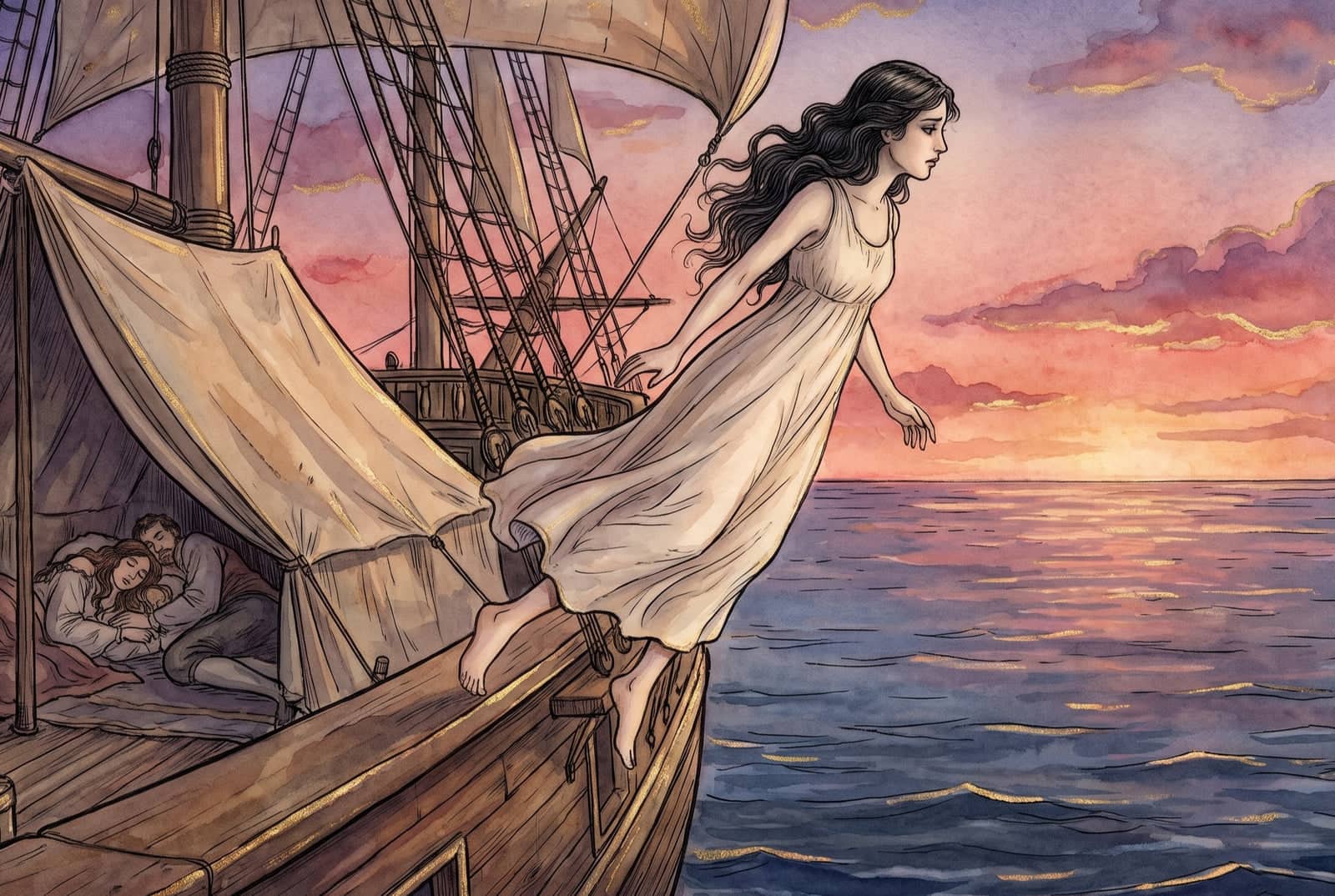
It grew still on the ship. Only the helmsman stood at the wheel. The little mermaid laid her white arms on the ship’s rail and looked to the east for the red of morning. The first ray of the sun, she knew, would kill her. Then she saw her sisters rise out of the water. They were pale as she was. Their long beautiful hair no longer blew in the wind. It had been cut off.
“We have given it to the witch, so that we could bring you help and you would not have to die tonight. She has given us a knife. Here it is. Do you see how sharp it is? Before the sun rises you must drive it into the prince’s heart, and when his warm blood splashes on your feet they will grow together into a fish’s tail, and you will be a mermaid again. You can come down to us and live out your three hundred years before you turn into dead, salt sea foam. Make haste. He or you must die before the sun comes up. Our old grandmother grieves so for you that her white hair has fallen out, as ours fell under the witch’s scissors. Kill the prince and come back to us. Make haste. Do you see the red streak in the sky? In a few minutes the sun will rise, and then you must die.” And they gave a deep sigh and sank beneath the waves.
The little mermaid drew back the purple curtain of the tent and saw the beautiful bride resting her head on the prince’s breast. And she bent down and kissed him on his beautiful forehead, and looked at the sky, where the red of morning shone brighter and brighter, and looked at the sharp knife, and fixed her eyes on the prince again, who in his dream spoke his bride’s name. Only she was in his thoughts, and the knife trembled in the mermaid’s hand. But then she threw it far out into the waves. They shone red where it fell, and it looked as if drops of blood were welling up out of the water. Once more she looked at the prince with eyes already growing dim, and then she threw herself from the ship into the sea and felt her body dissolving into foam.
Now the sun rose up out of the sea. Its rays fell so mild and so warm on the cold sea foam, and the little mermaid felt nothing of death. She saw the bright sun, and above her hovered hundreds of clear and glorious creatures. She could see the white sails of the ship and the red clouds of the sky right through them. Their speech was music, but so ethereal that no human ear could hear it, just as no earthly eye could see them. Without wings they floated through the air by their own lightness. The little mermaid saw that she had a body like theirs, and it lifted more and more out of the foam.
“Where am I going?” she asked, and her voice sounded like the voices of the others, so ethereal that no music on earth could match it.
“To the daughters of the air,” they answered her. “A mermaid has no immortal soul, and she can never have one unless she wins the love of a human being. Her life in eternity hangs on a power that is not her own. The daughters of the air have no immortal soul either, but by good deeds they can make one for themselves. We fly to the warm countries, where the heavy air of the plague kills people, and there we fan them cool. We spread the scent of the flowers through the air and send out refreshment and healing. When we have striven for three hundred years to do all the good that lies in us, we receive an immortal soul and take our part in the everlasting happiness of human beings. You, poor little mermaid, have striven with your whole heart for the very thing we strive for. You have suffered and endured, you have raised yourself into the world of the spirits of the air, and now, by good works, you can make an immortal soul for yourself after three hundred years.”
And the little mermaid lifted her clear eyes toward God’s sun, and for the first time she felt tears in them. On the ship there was noise and life again. She saw the prince with his beautiful bride searching for her, and they gazed in sorrow at the pearly foam, as if they knew that she had thrown herself into the waves. Unseen, she kissed the bride’s forehead, fanned the prince, and rose with the other children of the air to the rose-red cloud that was sailing through the sky.
“After three hundred years we shall float like this into the kingdom of God.”
“And we can get there sooner still,” whispered one daughter of the air. “Unseen we float into the houses of people where there are children, and for every day on which we find a good child, one who is the joy of his parents and deserves their love, God shortens our time of trial. The child does not know when we fly through the room, and when we smile with joy over it, a year is taken from the three hundred. But when we see a naughty and a wicked child, we must shed tears of sorrow, and every tear adds a day to our time of trial.”
Retold by Talerie from Fairy Tales of Hans Christian Andersen (opens in a new window)License: Public domainCopy this text, adapt it, use it however you like. A link back to Talerie is appreciated but never required.CC0 1.0 (opens in a new window)