 Original
In Sherwood Forest, Robin Hood and his merry men take from greedy lords and churchmen to help the poor, until King Richard, disguised as an abbot, knocks Robin down and pardons the band. Years later the prioress of Kirklees betrays the old outlaw, and Robin makes Little John promise to spare the treacherous nun.
“And what about Peter the Plowman? He was a good friend of mine.”
“Alas, Peter the Plowman has been hanged, and his wife and little ones have been turned out of their home to beg.”
Young Robin Hood’s father, with his son at his side, had met a man from his old village and was eagerly asking him how all his old neighbors were getting along. But much of the news was sad, for these were evil times in England. The Normans had conquered the country and were now its lords and officials, and they cruelly oppressed the common people, who were Saxons. Robin’s father said not a word, though his face grew very sad, but the boy beside him burst out in anger.
“But why would anyone do such a thing? Peter the Plowman was one of the best men I ever knew, and his wife was as good and kind as an angel.”
“Because he shot deer in the king’s forest. But if ever a man had a reason for breaking the law, he did. The huntsmen had ridden through his fields and ruined his crops. The tax collector had taken everything he owned, and his children were crying with hunger. He shot the deer so they would have something to eat, but the sheriff caught him and hanged him for it. And as for why his wife and her fatherless children were put out of their home, the abbot wanted that bit of ground to make his garden bigger, so out the poor things had to go.”
“It’s a shame!” cried the boy, his eyes flashing. “Laws like that are wicked laws, and they ought to be broken. The greedy lords and the rich, lazy churchmen strip the people bare and roll in money while everyone else is starving.”
“Hush, boy, hush,” said the man who had brought the news, with a warning look. “Our England is cruelly misgoverned, it’s true, but it isn’t safe to say so. The very walls have ears, and many a man has been hanged for letting his tongue wag too freely, as well as for shooting the king’s deer.”
“But the king, surely the king is good,” said the boy, faltering. He had been taught to love and honor the king.
“The king would be a good king if he would stay at home and govern his people. But he is always off at war, and the nobles and officers he puts in charge grind the people the way a miller grinds wheat between his great millstones. The rich grow richer and greedier all the time, and the poor grow poorer and more wretched.”
“When I am a man,” said the boy, Robin Hood, “I will make the rich give up part of their wealth to the poor, and then everyone will have enough.”
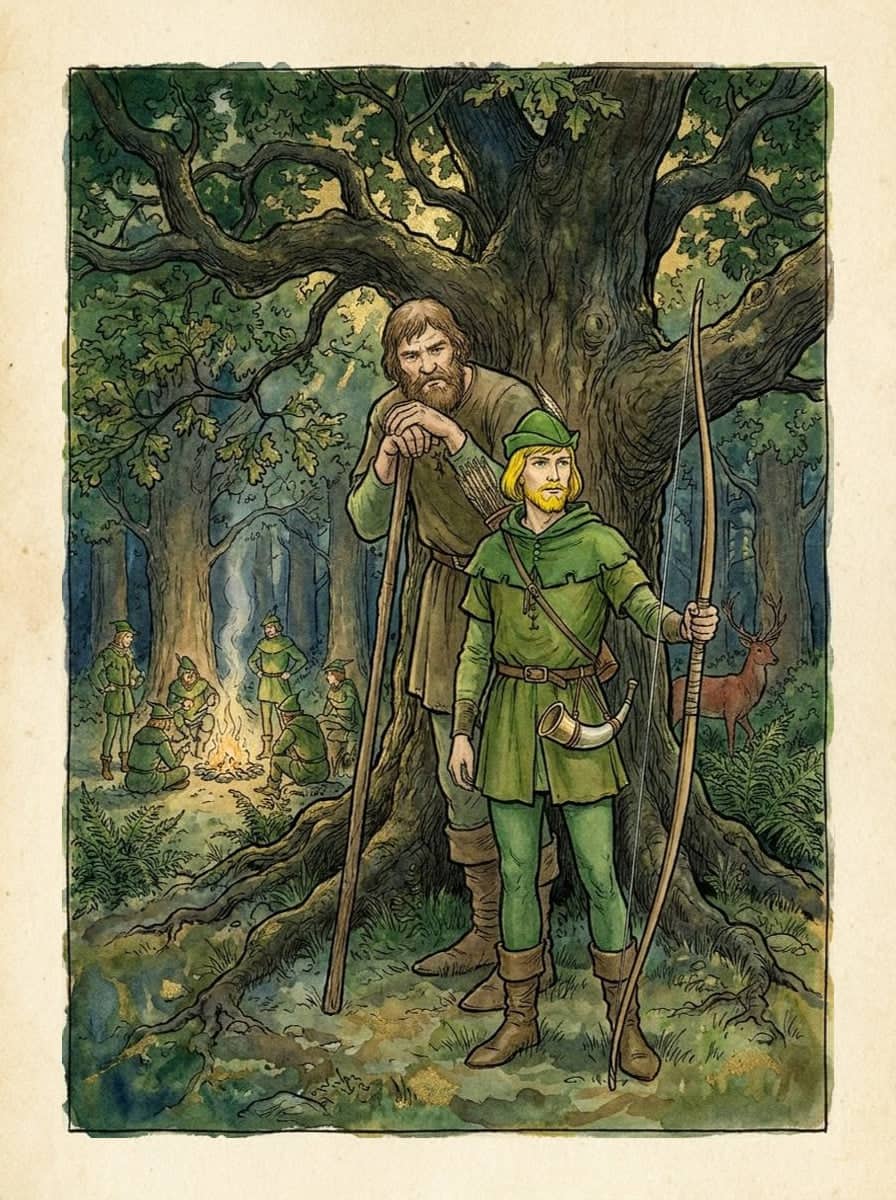
Perhaps it is no wonder, given the evils of those times, that when this boy grew up he did exactly what he had said. He gathered a band of men around him in the forest, all sworn to take from the rich the wealth they had gotten unjustly and to lend a helping hand to the poor. The Normans called them “highway robbers,” but the common people called them “the merry men of the greenwood” and loved them, for many a poor family had been helped out of trouble by them. By our standards their robbing was certainly wrong, but Robin Hood did not think so. He took from the rich what they had wrung unjustly from the poor and gave it back to the poor, and he believed that was right. Outlaw though he was, he always stood for justice and fair dealing as he saw them. He was loyal to the king, even while he resisted the unjust demands made in the king’s name. He was loyal to the church, and he prayed with deep reverence for himself and his band. It was his pride that neither he nor his men had ever harmed a woman, burned a haystack, robbed a farmer, or hurt a parish priest. The Normans did all of these things, and beside them Robin Hood’s standards were wonderfully high.
Robin was trying to set things right, and though he went about it the wrong way, he still did a great deal of good. An old ballad says of him:
Christ have mercy on his soul,Christ who died upon the rood!For he was a good outlawand did the poor much good.
Robin was brave and kind and always merry, and all the English people, except those who oppressed England, loved him with all their hearts and delighted in his adventures. The tales of what he did were made into songs and sung beside every fireside, and no man was better loved than this outlaw with a price on his head.
Sherwood Forest was a pleasant place for anyone who did not fear hardship, and Robin Hood and his men came to love every tree that grew there and every bird that sang. They did not mind having no houses to live in. They built shelters of bark and logs against the rain, but mostly they lived in the open. They laid down rushes and spread deerskins over them, and they slept under the stars. They cooked over a great fire built beside a big tree, and they sat on the ground to eat.
There were more than a hundred men in Robin Hood’s band, and every one of them was devoted to him and obeyed his slightest word. They were the best archers, the best wrestlers, the best runners and the best fighters with cudgel and quarterstaff in all the country, and they kept getting better, for they practiced every single day.
Robin Hood himself was the best archer in all the land. Even the king had heard of his wonderful marksmanship, and though he knew Robin was an outlaw, he felt an admiring, almost fond regard for this bold man who could shoot so marvelously well. But the greedy lords and churchmen who oppressed the people hated Robin Hood, and the sheriff of Nottingham hated him most of all and wanted nothing more than to see him hang from the gallows.
The sheriff was a cruel, hard man with no kindness in his heart, and all his spite was turned against Robin Hood, because every time he tried to catch Robin, Robin outwitted him. Just now he was angrier than ever. He had sent a messenger with a warrant for Robin Hood’s arrest, and merry Robin had met the messenger and treated him to a feast, and then, while the man was asleep after his dinner, had stolen the very warrant out of his pocket. So the messenger had to go back to the sheriff with neither prisoner nor warrant. It was plainly no use sending men after Robin with warrants. Robin had to be lured into their hands.
“I have it,” said the sheriff of Nottingham at last, with a very sour look on his grim face. “I’ll catch him by a trick. I’ll proclaim a great archery festival and invite all the best archers in England to come and shoot. For the prize I’ll offer an arrow of beaten gold. That is sure to bring Robin Hood and his men here, and then I’ll catch them and hang them.”
And Robin Hood and his men did come to the archery contest. But they did not come in the suits of Lincoln green they wore in the forest. Each man dressed up to look like someone else. Some came as barefoot friars, some as traveling tinkers or tradesmen, some as beggars and some as country peasants. And Robin Hood was the hardest of all to recognize.
“Don’t go, master,” his men had begged him. “This contest is nothing but a trap to catch you. The sheriff and his men will be watching for you, and they’ll know you by your hair and your eyes and your face and your height, whatever clothes you wear. The sheriff has set up this festival for one reason only, to lure you to your death. Don’t go.”
But Robin Hood only laughed merrily.
“Why, as for my yellow hair, I can stain it with walnut juice. As for my eyes, I can cover one of them with a patch, and then no one will know my face. I would be ashamed to be afraid, and if an adventure is a little dangerous, I like it all the better.”
So Robin Hood went, dressed from head to toe in tattered scarlet, the raggedest beggar ever seen in Nottingham. The field where the contest was to be held was a splendid sight. Row upon row of benches had been built there for the gentlefolk, who sat in their finest clothes, brighter than birds of paradise. The sheriff and his wife were dressed in velvet, he in purple and his lady in blue, and their rich robes were trimmed with ermine. Broad gold chains hung around their necks, and the sheriff’s shoes had wonderfully pointed toes tied up with golden chains. Oh, they were splendidly dressed, and if their faces had been kind they would have looked beautiful. But their faces were full of pride and hate. The sheriff kept looking spitefully around for Robin Hood, and he grew very cross when he could not find him.
But Robin was there, though the sheriff did not see him. He stood in his ragged beggar’s clothes not ten feet from the sheriff.
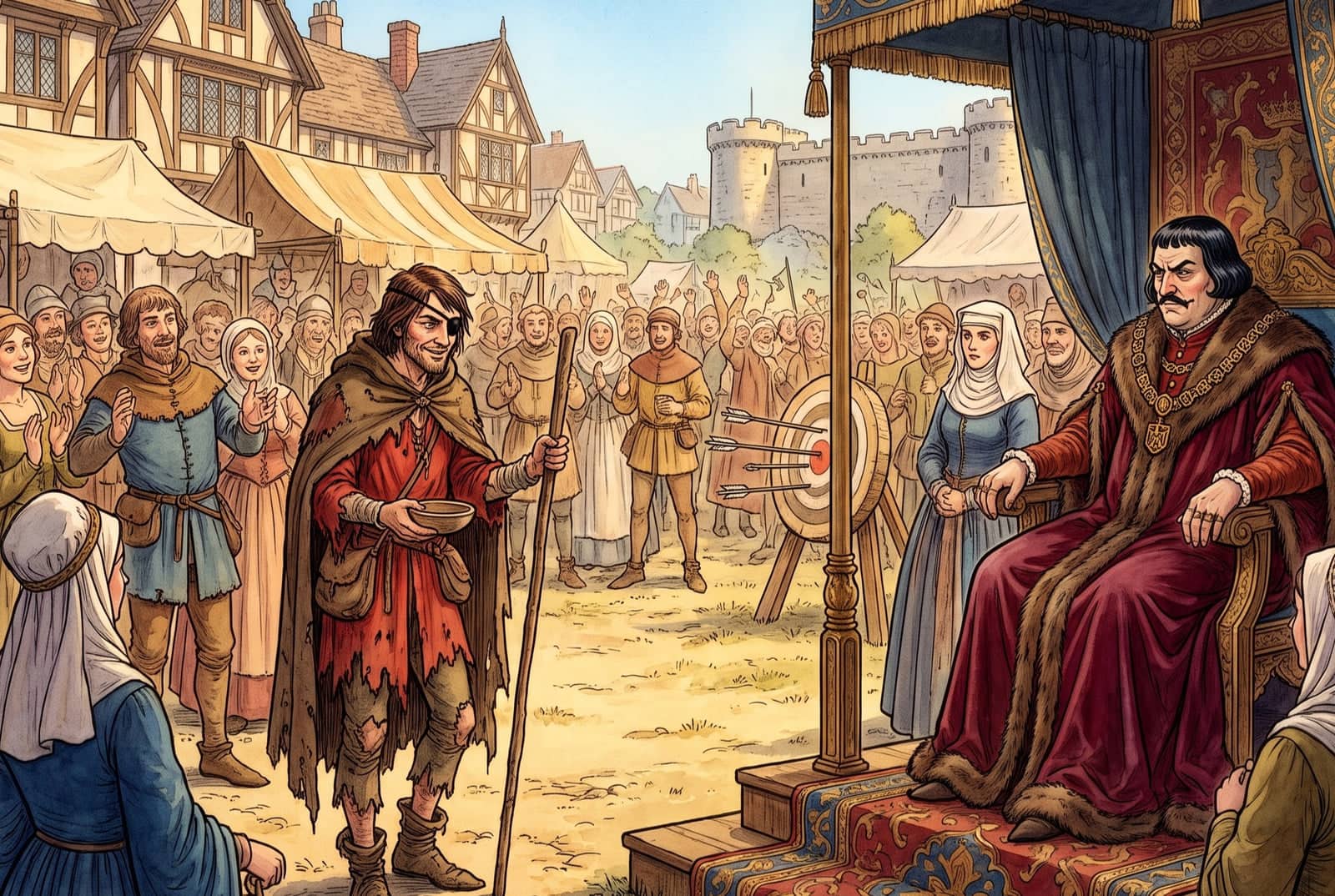
The targets were set up eighty yards from where the archers would stand. A great many archers came to shoot, and each was to have one shot. Then the ten who shot best would shoot two arrows each, and the three best of those ten would shoot three arrows apiece. Whoever came nearest the center of the target would win the prize.
The sheriff glared at the ten.
“I was sure Robin Hood would be among them,” he said to the man-at-arms beside him. “Couldn’t one of these ten be Robin Hood in disguise?”
“No,” answered the man-at-arms. “Six of them I know well. They are the best archers in England: Gill o’ the Red Cap, Diccon Cruikshank, Adam o’ the Dell, William o’ Leslie, Hubert o’ Cloud and Swithin o’ Hertford. Of the other four, one is too tall, one is too short and one is not broad enough in the shoulders to be Robin Hood. That leaves only this ragged beggar, and his hair and beard are much too dark to be Robin Hood’s, and besides, he is blind in one eye. Robin Hood is safe in Sherwood Forest.”
Even as he spoke, the man-at-arms was glad. He was only a common soldier, and he loved Robin Hood and wished him no harm. Robin escaped the sheriff so often because the common people, even the sheriff’s own men, were his friends. The gatekeepers shut their eyes when he went through the gates, so they could say they had not seen him, and when people heard of some evil planned against him, many sent him warning. But even the man-at-arms who loved him did not recognize Robin Hood that day.
The ten made wonderful shots. Not one arrow landed outside the rings around the center. But when the last three shot, it was more wonderful still. The first arrow of Gill o’ the Red Cap struck only a finger’s width from the center, and his second struck nearer still. But the beggar’s arrow struck the very center of the target. Adam o’ the Dell, who still had one shot left, unstrung his bow when he saw it.
“For more than eighty years I have drawn a bow, and I have beaten many a rival, but I can never better that,” said the old archer.
The golden arrow belonged to the tattered beggar, but the sheriff’s face was very sour as he handed it over. He tried to coax the beggar into his own service, promising him high wages.
“You are the best archer I have ever seen,” the sheriff said. “I’d say you shoot even better than that scoundrel and coward Robin Hood, who didn’t dare show his face here today. Will you enter my service?”
“No, I will not,” answered the stranger in scarlet, and the sheriff gave him such a spiteful look that Robin knew it was wise to get away. All the way back to Sherwood Forest, the sheriff’s words rankled.
“I can’t bear to have even my enemy think I am a coward,” Robin said to his men. “I wish there were some way to tell the sheriff that it was Robin Hood who won his golden arrow.”
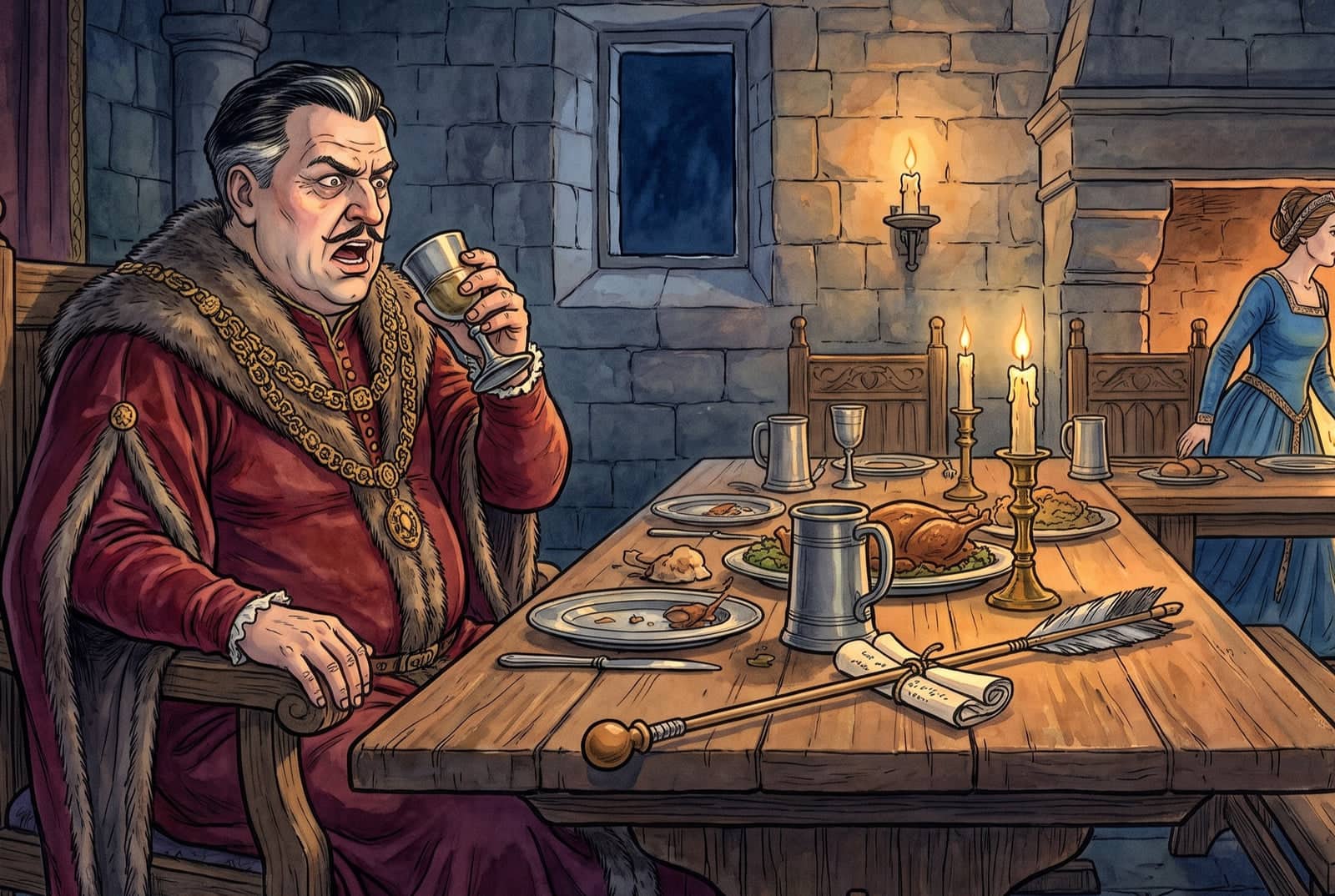
And they found a way. That evening the sheriff sat at supper, and although it was a fine supper, his face was gloomy.
“I thought I could catch that scoundrel Robin Hood with this archery contest,” he said to his wife, “but he was too much of a coward to show his face.”
Just then something flew in through the window and fell rattling among the dishes on the table. It was a blunted arrow fletched with gray goose feathers, with a scrap of writing tied to it. The sheriff unrolled the scrap. It said that it was Robin Hood who had won the golden arrow. When the sheriff read it, even his wife thought it best to slip away, for he was now the crossest man in all Nottingham.
This is the story of how Robin found his right-hand man and dearest friend, Little John. Little John was one of the tallest and strongest young men who ever walked through a forest. When Robin Hood first saw him, Robin was walking along the edge of the forest and came to a narrow bridge over a stream. The bridge was so narrow that only one person could cross at a time, and it so happened that Robin Hood stepped onto one end just as Little John stepped onto the other.
“Go back and let the better man cross first,” called Robin Hood, who did not care a bit but wanted to see what the tall young man would do.
“Stand back yourself. I am the better man,” cried the stranger.
“Then let us fight for it,” said Robin Hood, who loved a good bout more than his dinner.
“With all my heart,” answered the stranger.
So Robin cut himself a stout oak stick to serve as a quarterstaff, for he would have thought it shameful to use his bow and arrows when the other man had no such weapon. Then they faced each other as cheerfully as two boys wrestling for fun.
“Whoever knocks the other into the water is the better man,” said Robin. And the fight with the staffs began. What a fight it was! They struck again and again, but each was so skillful at warding off the other’s blows that neither could knock the other down. Both took many hard knocks and bruises, but neither thought of stopping. For a whole hour they fought there on the bridge without either getting the better of the other, and then for another hour. At last Robin gave the stranger a terrible whack that made him stagger, but the stranger came back with a crack on the head that drew blood. Robin swung at him savagely, but the stranger dodged the blow and struck Robin one that tumbled him straight into the water.
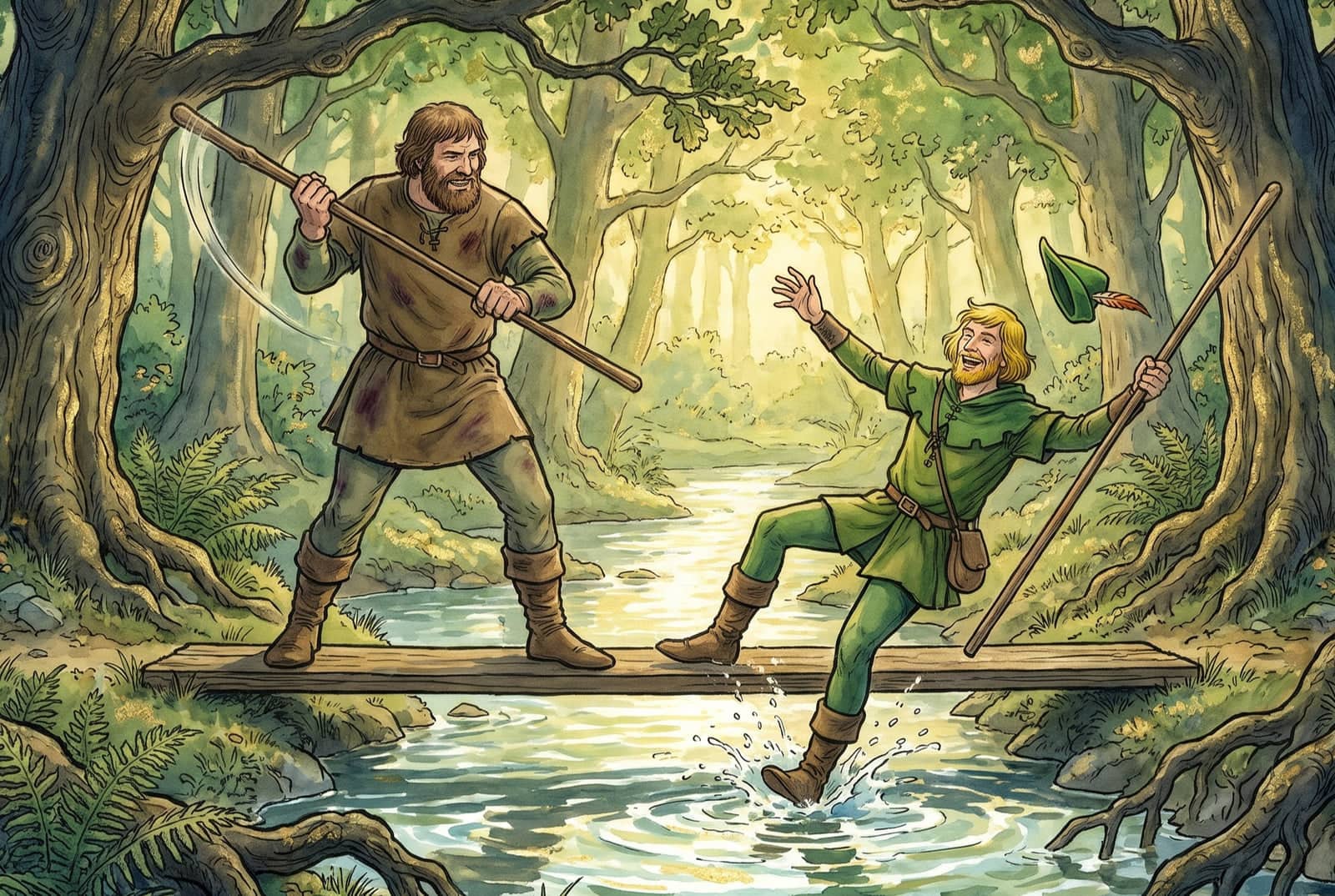
Robin lay there looking up and laughing, for Robin Hood never held a grudge.
“You have a mighty strong hand with a staff. I have never been beaten before,” he laughed. He splashed ashore and took the stranger by the hand.
“I like you,” he said. “Now watch, and I will show you something.”
Robin put his horn to his lips and blew, and up came forty of his men, all dressed in Lincoln green and carrying bows and arrows and swords.
“What’s this, master?” said the one in front. “You’re all bruised and soaked to the skin.”
“That sturdy fellow there has given me a thrashing and tumbled me into the water,” Robin said.
“Then he’ll get a soaking and a thrashing himself,” said Will Stutely, stepping forward angrily, and half a dozen others followed him, all eager to carry out his threat. But Robin Hood ordered Will back.
“No,” he said, “it was a fair fight, and he won. I wouldn’t have you hurt him for anything. But he is a brave, strapping young man, and I would gladly have him in our band. Will you join my men?” he asked the astonished stranger. “I am Robin Hood, and my band is the finest in all England.”
Hardly a man in the country would not have trembled at that name. But John Little, the young stranger, was afraid of no one.
“If any man among you can shoot a better arrow than I can, I will,” he said.
“Well, I will try,” said Robin. He sent Will Stutely to fix a piece of white bark, four fingers wide, on an oak tree eighty yards away.
“Now choose any of our bows and arrows to shoot with,” Robin told the stranger.
The stranger chose the very stoutest bow. He aimed his arrow carefully and sent it down the path, and it struck the very center of the mark. All of Robin Hood’s men caught their breath in amazement.
“That is a fine shot indeed,” said Robin Hood warmly. “No one could better it, but perhaps I can spoil it.”
Robin shot an arrow of his own, and it flew so straight and swift that it struck the stranger’s arrow and split it clean in two. Everyone who saw it cried out that there had never been such shooting before.
“Now, won’t you join my band?” said Robin Hood with a smile.
“With all my heart,” answered the stranger, and from that moment he loved Robin as his dearest friend.
“What’s your name?” asked Will Stutely, taking out a writing tablet as if to write it down.
“John Little,” answered the young stranger.
“I don’t like that name,” said merry Will. “This fellow is far too small to be called John Little. Let’s christen him all over again: Little John.”
So they held a christening, with a great deal of fun, and from that day on Little John was Robin’s right-hand man and second in command of the band. He served Robin truly and faithfully for many years and loved him better with every year that passed.
The next story is about a merry friar and how he came to join Robin Hood’s band. But it begins with a sad young man with a harp in his hand, who could sing as sweetly as a thrush but thought he would never sing again, because his heart was breaking. Robin Hood and his men found him in the forest, lying face down on the ground and sobbing as if he would cry his eyes out.
“Get up! Get up!” shouted Will Stutely, poking him with his foot. “I hate to see a big young fellow sniveling like a fourteen-year-old girl over a dead bird.”
But Robin Hood told the others to stand back, and he touched the young man kindly.
“You are in trouble,” he said. “Don’t mind what these fellows say. They are rough, but their hearts are kind. Come with me and tell me what is wrong.”
“Everything is wrong,” said Allen-a-Dale miserably, and it was true that things were going very badly for him. His true love, Ellen, who had promised to marry him, had been forced to give him up and promise her hand to a rich old knight, who had won her father’s favor with his money.
“She will marry the old knight if her father tells her to,” cried Allen-a-Dale, “because she thinks it right to be an obedient daughter. But I know it will break her heart, and she will die.”
“This shall not happen!” cried Little John, stepping forward. “Master, can’t we stop such a wrong?”
“We shall see,” answered Robin Hood.
“But she is to be married in two days,” said Allen-a-Dale.
“Then we will go to the church and see to it that she marries you instead of the old knight,” said Robin Hood. “But we will need to find a priest who will marry you.”
“Then I know just the priest,” said Will Scarlet. “Jolly Friar Tuck, who lives in Fountain Dale.”
“Then let’s go and fetch him at once. We have no time to lose,” said Robin Hood, and they set out without delay. Little John, Will Scarlet, young David of Doncaster and Arthur-a-Bland went with him. They all wore their best clothes.
“For,” said Robin Hood, “we must look fine when we go to a wedding.”
After walking a whole morning, they came to the bend in the river beyond which Friar Tuck lived. But the friar’s little dwelling was on the far side, and to reach it they would have to wade across.
“Well,” said Robin Hood, “if I had known I would have to wade the river, I wouldn’t have put on my best clothes.”
Robin left his men there, telling them to listen in case his horn should sound, and went on alone. As soon as he was out of their sight, he thought he heard voices. Two men seemed to be talking on the riverbank below, but their voices were wonderfully alike. Robin Hood crept to the edge and looked over.
There, with his broad back against a willow tree, sat a stout, brawny fellow in a friar’s robe, but no one else was with him. On his lap he held a great meat pie baked with young onions, and he was munching away at it heartily. As he ate he talked, and listening to him, Robin Hood nearly died laughing. For the merry friar was pretending to be two people. He would politely offer a piece of the pie first to his right hand and then to his left, and he did the same with a bottle of drink he had beside him. Robin watched until the pie and the bottle were both empty. Then the friar began urging his imaginary companion to sing.
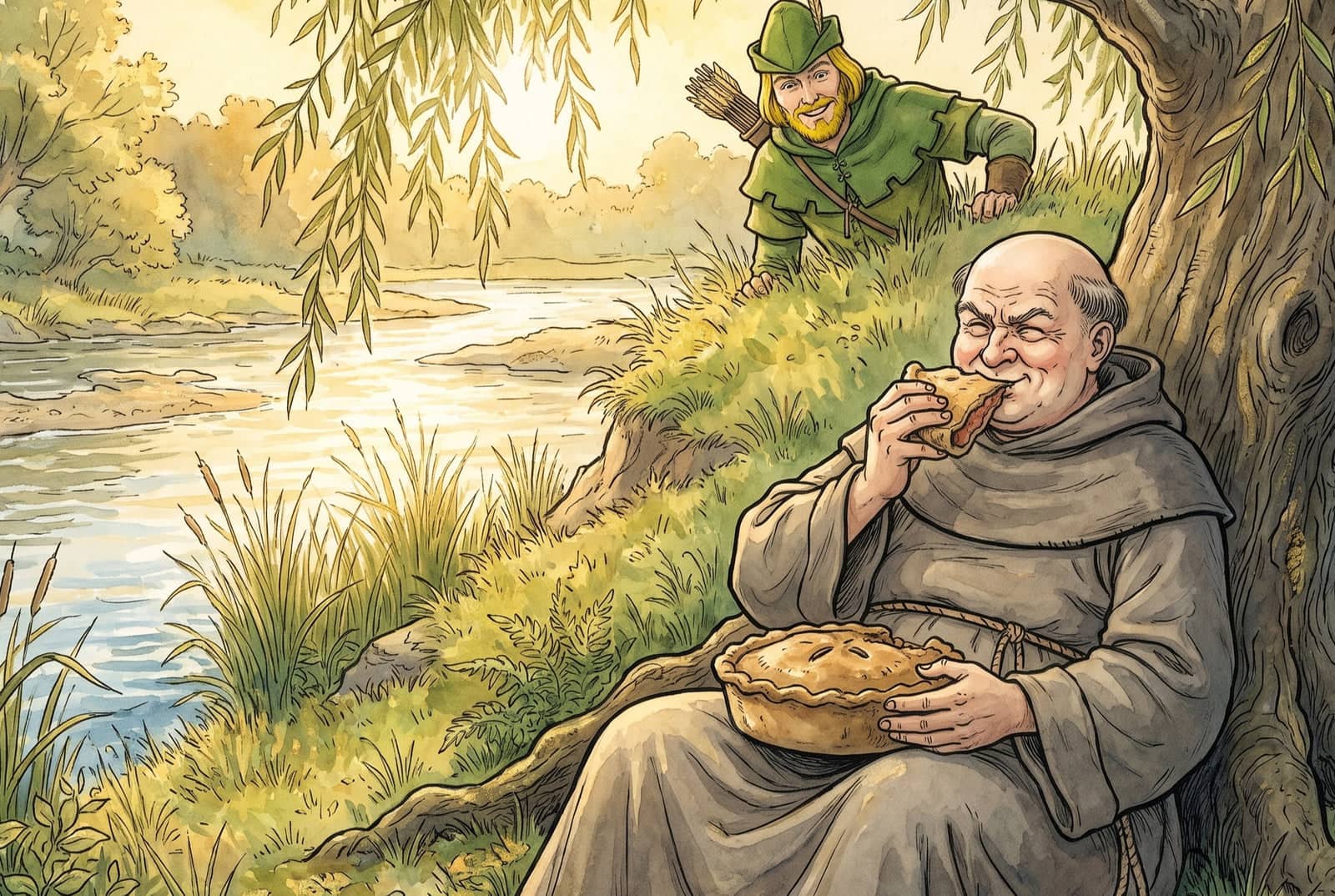
“Now, sweet lad,” the friar said to himself, “won’t you sing me a song?” And then he answered himself shyly.
“Oh, I don’t know. My voice is poor today. Please don’t ask me. Can’t you hear how I croak like a frog?”
Then the friar spoke again in his first voice.
“No, no, your voice is as sweet as any bullfinch’s. Come and sing, please. I would rather hear you sing than eat a fine feast.”
And so it went on until the friar began to sing, and he sang as two people, too. The song was a duet between a young man and a girl, and he sang the girl’s part very high and squeaky and the young man’s very deep and gruff. When the last chorus came, Robin Hood could hold back no longer and joined in the singing at the top of his voice.
The friar leaped up, crying, “What spy have we here?” and from under his robe he drew a sword as heavy and stout as any carried by Robin Hood’s band.
“Put away your sword, friend,” called Robin. “People who have sung together shouldn’t fight.” Then he jumped down beside the friar.
“Do you know the country around here, good holy man?” Robin asked.
“Yes, somewhat,” answered the friar cautiously.
“And do you know a place called Fountain Dale, and a certain monk known as the Curtal Friar of Fountain Abbey?”
“Yes, somewhat.”
“Is it across the river?” asked Robin Hood.
“Yes,” answered the friar.
“Do you know whether this friar is on the other side of the river right now, or on this side?” asked Robin.
“That,” the friar answered very slowly, “is something you will have to find out for yourself.”
This angered Robin, and indeed it was not at all polite.
“Well,” Robin said, “if I must cross the river, I must ask you to carry me over, for as you can see, my clothes are the kind that water would spoil.”
At first the friar was angry at being asked, but soon a different thought seemed to come to him, and he laughed.
“Well,” he said, “if holy Saint Christopher carried travelers across the river, perhaps I ought to do the same. Give me your sword so it won’t get wet, and I will carry you.”
So the friar tucked his own sword and Robin’s under his arm, bent his back for Robin to climb on, and waded across. He set Robin down very gently on the other bank, but he did not give him back his sword.
“Thank you, good father,” said Robin. “Give me my sword, and I will be on my way.”
“No, good young man,” answered the friar, pointing the sword at Robin. “You see, I got wet crossing the river. Now I must cross back, but I fear that if I get wet once more I may get a crick in my back that would get in the way of my prayers. I beg you, carry me back.”
The friar had the sword, and there was nothing for Robin to do but obey. So he carried the friar back, and it was harder work for him than it had been for the friar. But while they were in the stream, Robin managed to loosen Friar Tuck’s sword belt, and when they reached land he snatched it off. Now Robin Hood had both swords.
“Now carry me across again,” Robin said.
It is a long story, but the end of it is that Friar Tuck carried Robin Hood halfway across the river and there dumped him into the water “to cool off,” as he put it. Then Robin fought him, but though they fought with all their might for hours, neither could get the better of the other. So they stopped fighting and became friends, and Friar Tuck gladly agreed to go with Robin and marry Allen-a-Dale to his fair Ellen, whatever fuss it might stir up.
So Robin Hood and twenty of his merry men set out for the wedding, which was to be held in Emmet Church. Robin was dressed as a wandering minstrel, with a harp slung across his shoulders. He left most of his men hidden a little way from the church and went in boldly.
It was to be a very grand wedding, and the Bishop of Hereford himself was to perform the ceremony. The bishop arrived with a long train of followers, and as he came in he saw Robin with his harp beside the door.
“Now, who are you?” the bishop asked, well pleased, for everyone loved to see a minstrel.
“I am a harper from the north country,” answered Robin Hood. “I can play music such as no one else in all England can. There is magic in my harping, and if I play at this wedding, the fair bride will love the man she marries with her whole heart all her life long.”
“Well then, let him play,” said Sir Stephen, the old bridegroom. He knew it was her father’s will and not her own wish that made fair Ellen marry him. But he did not know that she loved someone else, for her father had kept it from him.
Then the bride’s father led in the bride, and she was the most beautiful girl anyone there had ever seen. But she was pale and wan, and she drooped on her father’s arm like a broken lily.
“What’s this?” cried Robin Hood. “A bride should look like a blushing rose. Tell me, maiden, are you marrying this knight of your own free will?”
“No, no,” sobbed fair Ellen. “I want to marry no one but my own true love, Allen-a-Dale the minstrel.”
“Then Allen-a-Dale you shall marry,” cried Robin Hood, and he put his horn to his lips and blew. The men of his band who had already come into the church, and Friar Tuck with them, came running down the aisles and gathered around him. Then all was confusion. The Bishop of Hereford, the prior of Emmet and all their followers ordered the people to seize Robin Hood, but no one would do it. The old knight who was the bridegroom tried to draw his sword, but he wore no sword on his wedding day.
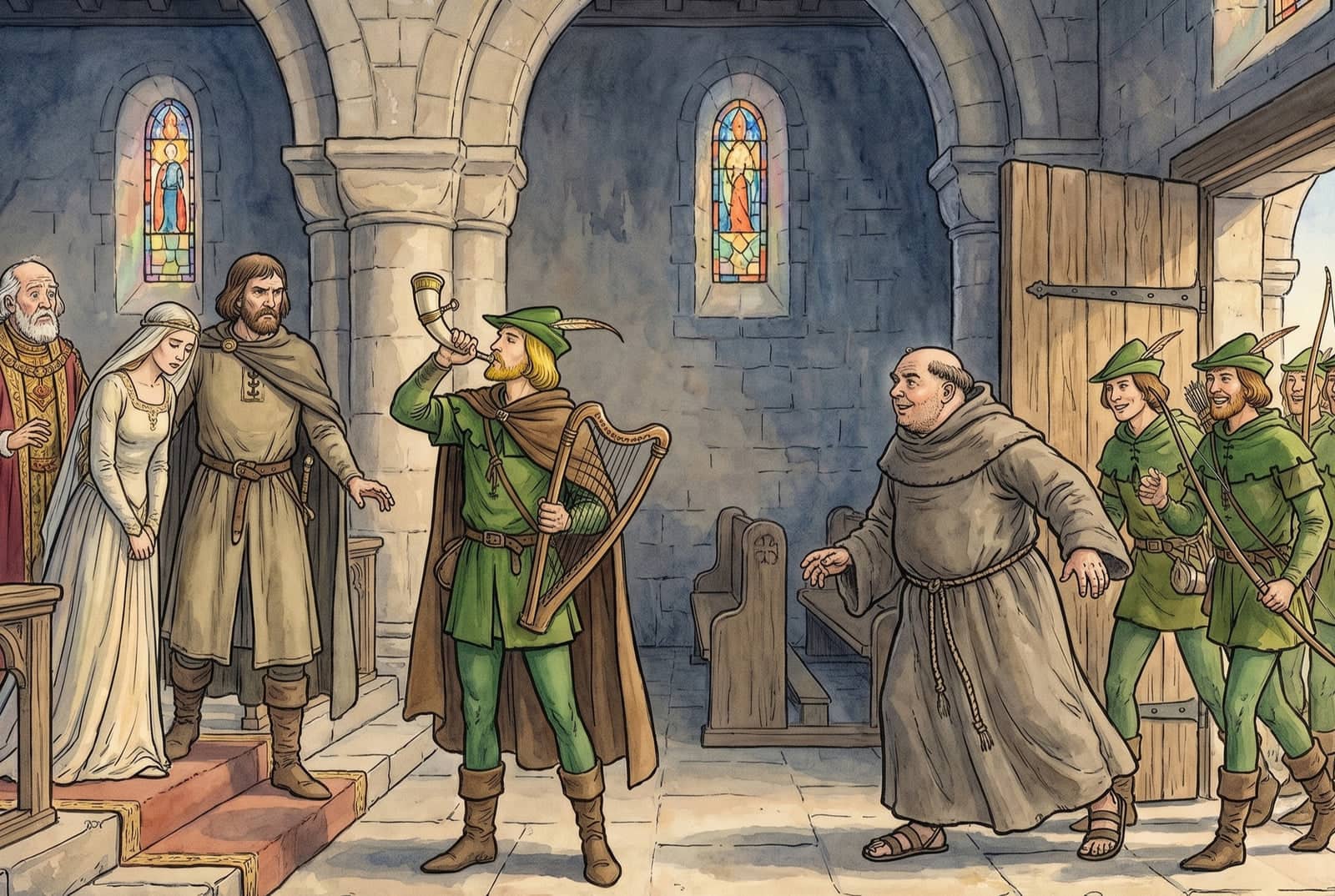
“At them, and kill them!” Sir Stephen cried to his men-at-arms.
But at that very moment the rest of Robin Hood’s men came running up at full speed, with swords drawn and bows and arrows slung on their backs.
“I am leaving,” said the bridegroom to the bride’s father. “I wouldn’t marry your daughter now for the whole kingdom of England.”
The prior of Emmet called his followers together and left as well, very much displeased, and the Bishop of Hereford would have gone too, but Robin told him to stay.
“Now,” said Robin, “we will have a wedding, and fair Ellen shall marry Allen-a-Dale.”
“You can’t,” said the prior of Emmet, turning back at the door. “You have no priest to marry them.”
“Am I not a priest?” bellowed Friar Tuck, so fiercely that the prior shook in his pointed shoes and hurried away.
“But the banns have not been called,” said the bride’s father.
“Then I will call them,” roared Friar Tuck, and the old song says that he called them three times, as many as the law required, and then, in case that was not enough, six times more.
“But I cannot marry without my father’s blessing,” sobbed Ellen, for she had always been an obedient daughter.
“There, there, don’t cry,” said Robin Hood gently. “I will get your father’s blessing for you.” Then he called to Will Stutely: “Give me the two bags of gold I told you to bring.”
Robin strode up to Ellen’s father with a bag of gold in each hand.
“Here are two hundred gold angels,” he said. “If you give your daughter your blessing on her wedding day, I will give you these as her dowry. If you don’t give her your blessing, she will be married all the same, but you won’t get a single penny.”
Ellen’s father looked at the gold and then at Robin Hood. He knew the knight was gone and would not come back.
“Well,” he said, though not happily, “I will give her my blessing.”
So the wedding went ahead, and when it was over they all went back to Sherwood Forest and held the merriest feast that was ever held in that merry place. Allen-a-Dale and his bride lived happily all the rest of their lives, and his songs made him famous all over England. As for Friar Tuck, he liked Robin Hood and his band so much that he never went back to Fountain Dale, but became one of Robin Hood’s merry men.
“We haven’t had any guests for a long time,” said Robin Hood one day. “Let’s go out and look for some. Little John, you go east and I will go west, and we’ll see whether we can find some greedy nobleman passing by, or a fat churchman who is carrying too much of this world’s goods and needs to be relieved of them for the good of the poor.”
Whenever Robin Hood and his men robbed someone (and they never troubled anyone but the rich who had made their wealth by grinding down the poor), they brought him into the forest and made a feast for him. After he had feasted, they told him he must pay the bill, and they took the goods or gold he carried and divided it into three piles. One third they gave back to him, one third they kept for themselves, and the last third they gave out to the poor. The rich shuddered at the mention of Robin Hood’s feasts, but the poor blessed his name.
So Little John and his part of the band went east, and they were lucky, for they brought back the rich Bishop of Hereford with five pack mules loaded with goods. But Robin Hood and his half of the band found only a sorrowful knight, who sighed as he rode along and seemed too sad to notice anything at all. Robin Hood laid his hand on the knight’s bridle and stopped his horse.
“Wait,” Robin said. “I want a word with you.”
“And who are you, to stop a peaceful traveler on the king’s highway?” asked the knight.
“Some call me an honest man and some call me a robber,” answered Robin Hood. “Either way, my men and I keep an inn in the forest, and we want you to stop there and feast with us. But I should tell you that we expect our guests to pay the bill.”
“I understand you,” answered the knight, “but I am no guest for you, for I have no money. I needed a great deal of money to save my son’s life, so I mortgaged my estate to the prior of Emmet. I could raise the money with a little more time, but he won’t give me a single day. He means to seize the estate and turn me out a beggar.”
“How much did you borrow from him?” asked Robin Hood.
“Only four hundred pounds. The estate is worth many times that, but he will show no mercy.”
“Have you no friends who could lend you the money?” asked Robin Hood.
“Alas, no,” answered the knight. “When things went well for me, I had many friends crowding around me, but now that trouble has come, they have all deserted me.”
“Well, men in trouble always have friends in Sherwood Forest,” answered Robin Hood. “Come with me as a guest who pays nothing, and we will find a way to help you.”
So they went on until they came to the great tree where Friar Tuck and half a dozen others were preparing the feast around a huge fire. There in the firelight sat the Bishop of Hereford under guard, with his pack mules and their loaded packs tied to the trees all around.
“Have mercy,” the bishop whined.
Robin Hood answered him sternly. “What mercy have you ever shown the poor? Men, open his packs!”
So they opened the packs, which were full of rich goods, and divided everything into three parts. Besides the goods there was a box holding fifteen hundred pounds in gold. Robin Hood gave the share set aside for the poor to the sorrowful knight.
“Since churchmen have robbed you, churchmen shall help you,” Robin said.
“Oh, thank you!” cried the knight, his sad face lighting up for the first time that day. “But I will not take it as a gift, only as a loan. I will pay it back, to the bishop or to you.”
The bishop nodded and opened his mouth to say, “Very well,” but Robin Hood cut him short.
“Pay it to me,” Robin said. “I will help the poor with it. The bishop would only stuff it into his own coffers and use it to make more money.”
So the knight who had been so sorrowful rode away free of all his troubles. The prior of Emmet was bitterly disappointed, for by cheating and trickery he had made sure that the poor knight, once in his clutches, could not get the money anywhere to buy back his lands, and he already counted them as his own. But he had to give them up, and that is another story, though there is no room to tell it here.
“I wish I could see Robin Hood,” said King Richard. “I wish I could see him and his men shoot and wrestle and do all the feats they are so wonderfully skilled at. But if they heard the king was coming, they would think it was only to arrest them and flee deep into the forest, and I would never catch a glimpse of them.”
King Richard spoke kindly, for he was a king who loved all manly sports and all who excelled at them.
“I would give a hundred pounds to see Robin Hood and his men in the greenwood,” he said.
“I can tell you how to see him for certain,” said one of the king’s trusted companions with a laugh. “Put on the robes of a fat abbot and ride through Sherwood Forest with a hundred pounds in your purse, and you are sure to see him and be feasted by him.”
“I’ll do it!” cried bluff King Richard, slapping his knee. “It will be a splendid joke.”
So the king and seven of his companions dressed themselves as an abbot and seven black friars and rode out along the highway toward Sherwood Forest. Robin Hood and his men stopped them and brought them to the Trysting Tree, and there they searched them and took the purse of gold. But they gave half the gold back to the king, for it was not their way to leave any man in need.
“Now we will give you a feast worth fifty pounds,” said Robin Hood.
“I have a good appetite for a feast,” said the false abbot, “but even more I want to see the archery and the wrestling and the quarterstaff fighting, and all the other things I am told you excel at.”
“You shall see the very best we can do,” answered Robin Hood. “But please, holy father, put back your cowl, so that you can enjoy this sweet evening air.”
“No,” answered the false abbot. “That cannot be, for my brothers and I have vowed not to let our faces be seen on this journey.”
“Very well, then,” said Robin Hood. “I never interfere with any man’s vows.” And he never dreamed that this was the king.
Robin’s men gave their guests a splendid feast of roast venison and pheasant, fish and wild fowl, all cooked to perfection over the roaring fire, and the best of drink. Then they set up the games.
The target was a garland of leaves and flowers, hung on a stake a hundred and twenty paces away. Only the very best archers could hit it at all.
“Now shoot!” said Robin Hood. “Each of you shall have three shots, and anyone who fails to put his arrows inside the garland shall forfeit the arrow and get a box on the ear besides, as hard as can be given.”
“Can anyone hit inside that little garland from so far away?” asked the king in amazement.
“Watch and see,” answered Robin Hood proudly.
First David of Doncaster shot, and he put all three arrows inside the garland while the king looked on in astonishment. Then came Midge, the miller’s son, and he too put all his arrows inside the garland. Then Wat the Tinker drew his bow, but he was unlucky, for one of his arrows missed the mark by two fingers’ width.
“Come here and take your punishment,” called Robin Hood. The king supposed that since Wat had missed by so little, he would get only a light tap, but Wat got a blow that sent him spinning head over heels across the grass.
“Ha, ha, ha!” laughed Wat’s comrades.
“Oho!” thought King Richard. “I’m glad I’m not in this.” But he was much impressed by the way Robin Hood’s men obeyed their leader. “They follow his orders better than my servants follow mine,” the king thought.
The shooting went on. A few men missed and got tremendous blows.
Robin Hood shot last. His first arrow split a piece off the stake the garland hung on. His second lodged barely an inch from the first. But the last arrow he shot had faulty feathers, and it swerved to one side and struck an inch outside the garland.
The whole company roared with good-natured laughter, for they very seldom saw their master miss.
“Go and take your punishment, master,” said Midge, the miller’s son. “I hope it’s as heavy as Wat’s.”
“Well,” said Robin Hood, “I will forfeit my arrow to our guest and take my blow from him.”
Merry Robin was being a little crafty here. He did not mind hard knocks at all, but he did not like the thought of being sent sprawling in front of his band. Churchmen had soft hands, and their strongest blows were feeble, for they did no work and seldom used their muscles. But the false abbot bared an arm so thick and muscular that the yeomen stared. Robin Hood stood squarely in front of him, and the abbot struck a blow that would have felled an ox. Down went Robin Hood, rolling over and over on the ground, and his men fairly shouted with laughter.
“Well,” said Robin Hood, sitting up half dazed, “I didn’t think there was an arm in England that could strike a blow like that. Who are you, man? I’ll wager you are no churchman, whatever you look like.”
Then Richard threw back his cowl, and Robin knew his king. If Robin had been a disloyal man as well as an outlaw, he would have trembled then. But though he knelt at the king’s feet and signaled all his men to kneel, his voice was not ashamed.
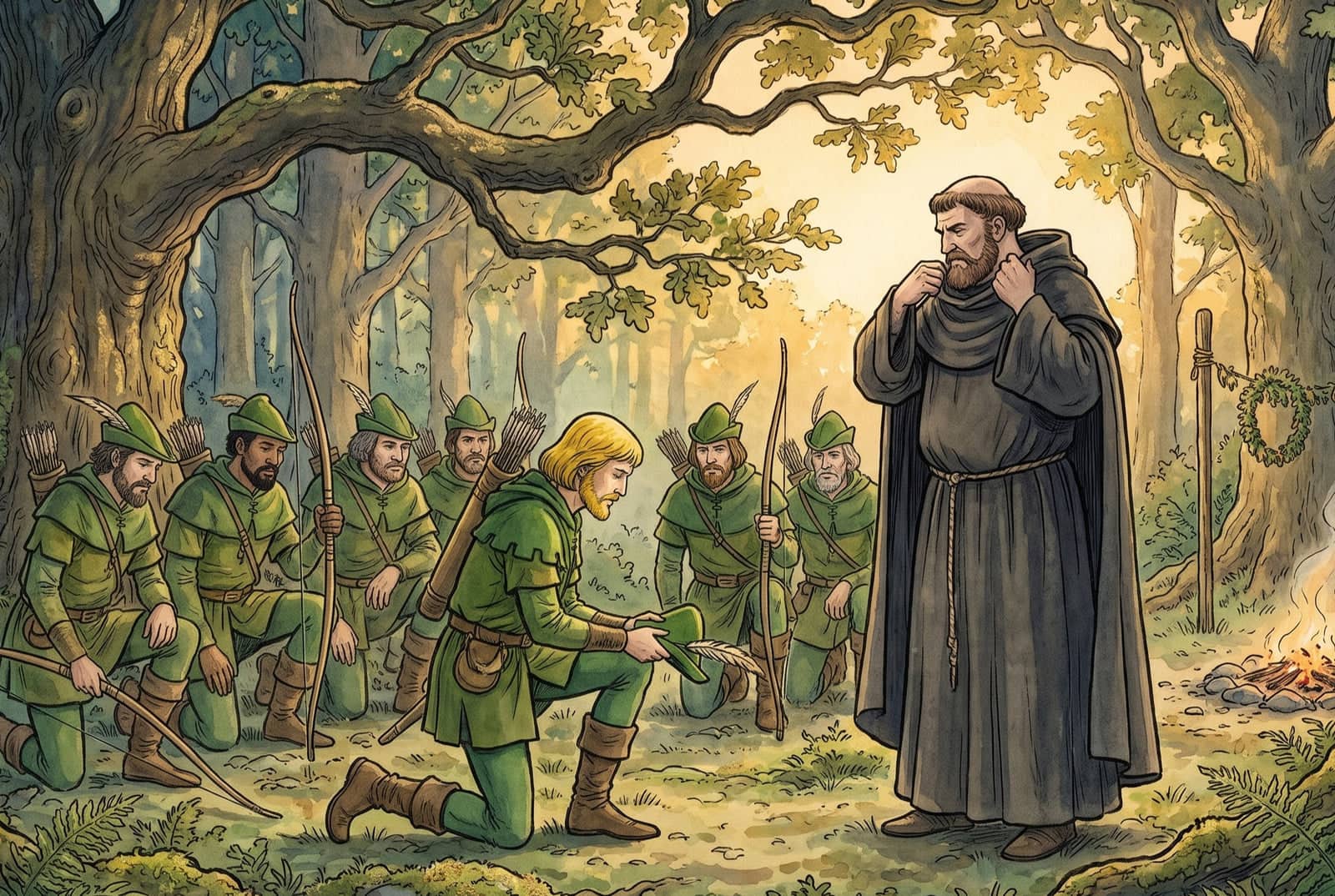
“Your Majesty,” he said, “you have no subjects in all England more loyal to you than I and my merry men. We have done no harm except to certain greedy rich men who oppressed your people. We ask your pardon if we have done wrong, and we beg your protection, and we swear that we will always serve you faithfully.”
The king looked down in amazement that an outlaw should speak like this. But he knew men, and he knew what people said of Robin Hood. He knew, too, that Robin was the best archer in all England, and he wanted him among his own followers.
“I will forgive all your lawbreaking,” the king said, “if you will come with me to my court and serve me there. You shall bring Little John and Will Scarlet and Allen-a-Dale, who is the sweetest singer I have ever heard. The rest of your men I will make royal rangers, since I judge that they can guard Sherwood Forest better than anyone else.”
So Robin Hood left the greenwood and went to the king’s court, and he served King Richard well. But he did not like being shut up at court, and he could not stand the idle merrymaking and the jealousy of the courtiers. After King Richard died, his brother John took the throne, and John was one of the worst kings who ever ruled England. Then Robin Hood went back to the forest, his merry men gathered around him once more, and once again they became outlaws. And there in the forest he lived until he died.
This is how Robin Hood died. He had grown to be an old man, and he fell ill with a fever.
“I will go to my cousin, the prioress of Kirklees, for she knows a great deal about healing,” he said. “I will ask her to bleed me, so that I may get well.”
In those days women knew more about healing than anyone else. Robin Hood’s cousin owed him a great deal, for it was he who had gotten her the good position of prioress. But she loved one of his enemies, and she betrayed him.
The prioress opened a vein in Robin’s arm, but she did not close it again. Then she left him alone in a high room at the very top of the priory to bleed to death. All day long he bled, until he was so weak he could hardly move. But in the evening he managed to raise his horn to his lips and blow. The blast was faint, but Little John heard it, for although the prioress had refused to let him in, he had stayed as close to his dear master as he could all day long.
The prioress had locked the great front door so that he could not come in, so Little John seized a huge stone mortar that three men could not ordinarily lift and hurled it against the door, smashing it in. He dashed up the winding stairs, and no one could stop him until he reached the room under the eaves where his master lay. But he saw at a glance that Robin Hood was dying.
“Master,” Little John cried, “I will burn this priory down over the heads of these wicked nuns, whose mistress has betrayed you so horribly.”
“No, no,” said Robin Hood, with a smile that was weak but wonderfully sweet. “I have never hurt a woman in my life, nor let my men do it. I could not allow such a thing now.”
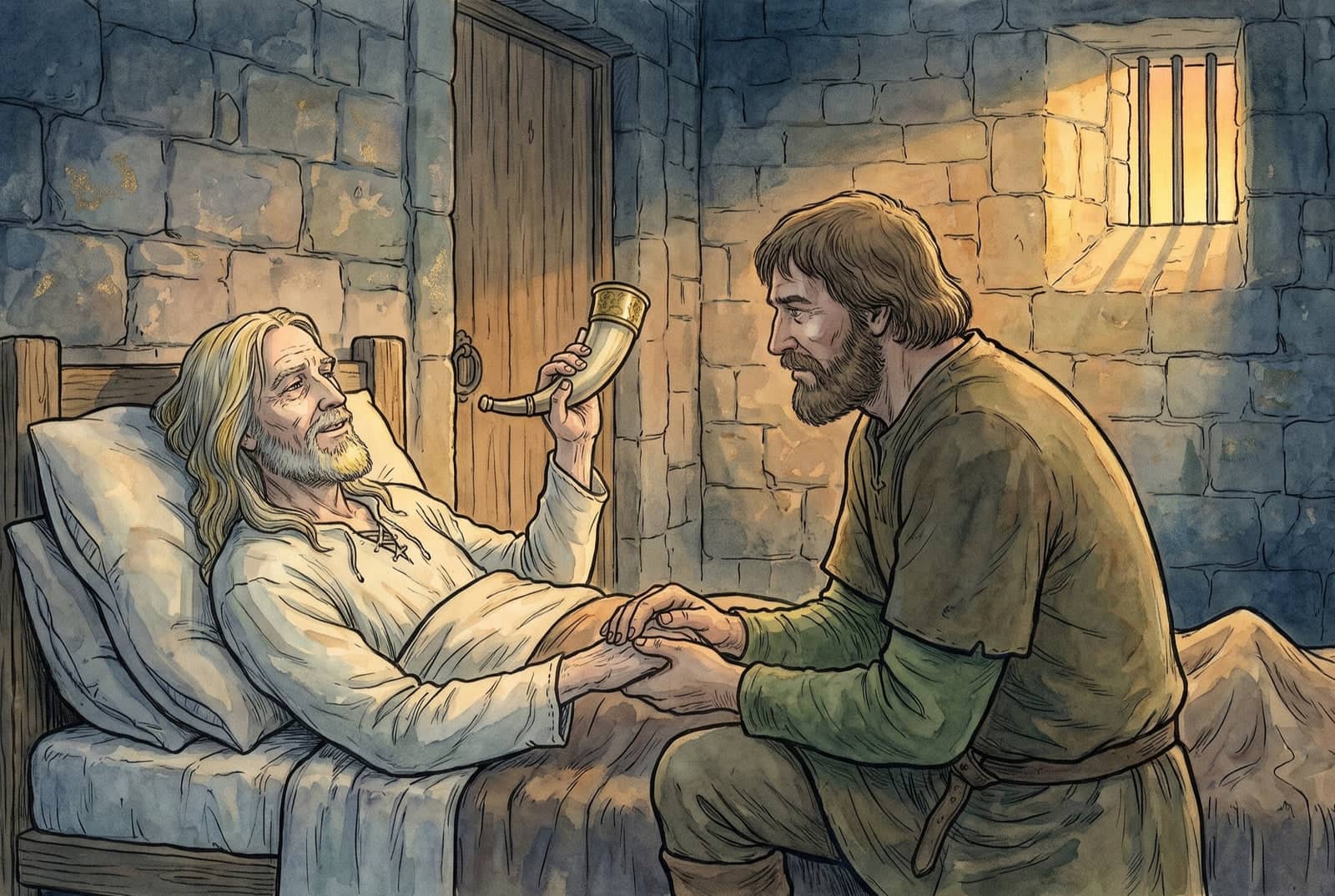
And with almost his last breath he made Little John promise to do no harm to the treacherous nun who had killed him.
Retold by Talerie from Stories of Robin Hood (opens in a new window)License: Public domainCopy this text, adapt it, use it however you like. A link back to Talerie is appreciated but never required.CC0 1.0 (opens in a new window)