 Original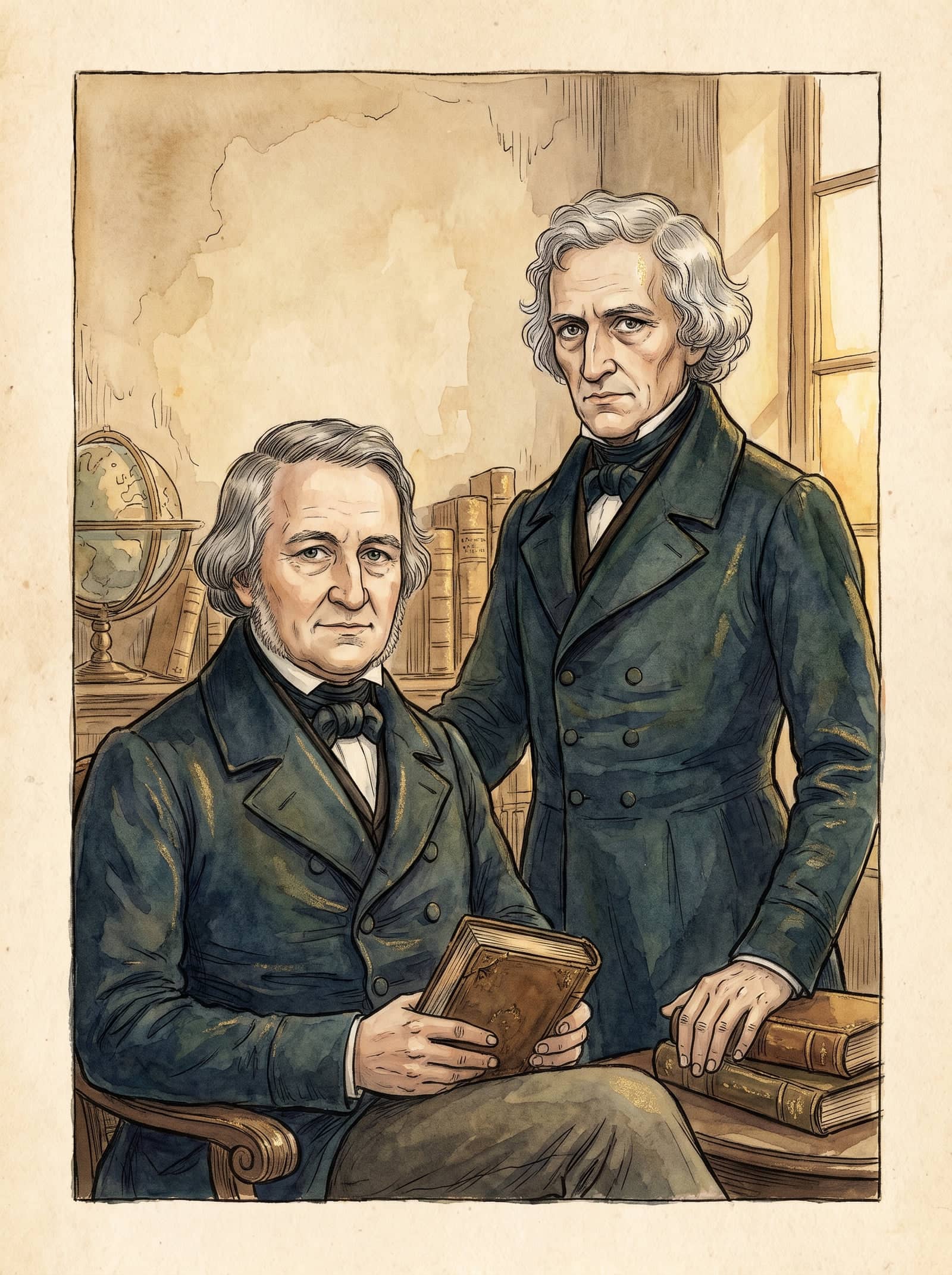
A king’s youngest son spares a fox, rides on its tail, and wins the golden bird, the golden horse, and the princess of the golden castle. He marries the princess, and when at last he shoots the fox and cuts off its head and paws, the fox turns into the princess’s brother, freed from a spell.
Once upon a time there was a king who had a beautiful garden behind his palace, and in that garden stood a tree that bore golden apples. When the apples were nearly ripe, they were counted, but the very next morning one was missing. The king was told, and he ordered that a watch be kept under the tree every night.
The king had three sons. As soon as night fell, he sent the eldest into the garden, but at midnight the young man could not keep his eyes open, and the next morning another apple was gone.
The following night the second son kept watch, and he did no better. As soon as the clock struck twelve he fell asleep, and in the morning another apple was gone.
Now it was the third son’s turn. He was ready and willing, but the king did not trust him much and thought he would be of even less use than his brothers. In the end, though, he let him go. The youngest lay down under the tree and did not let sleep get the better of him.
When the clock struck twelve, something rustled through the air, and in the moonlight he saw a bird flying toward him, its feathers all shining with gold. The bird landed on the tree and had just pecked off an apple when the youngest shot an arrow at it. The bird flew away, but the arrow had grazed its feathers, and one golden feather drifted down.
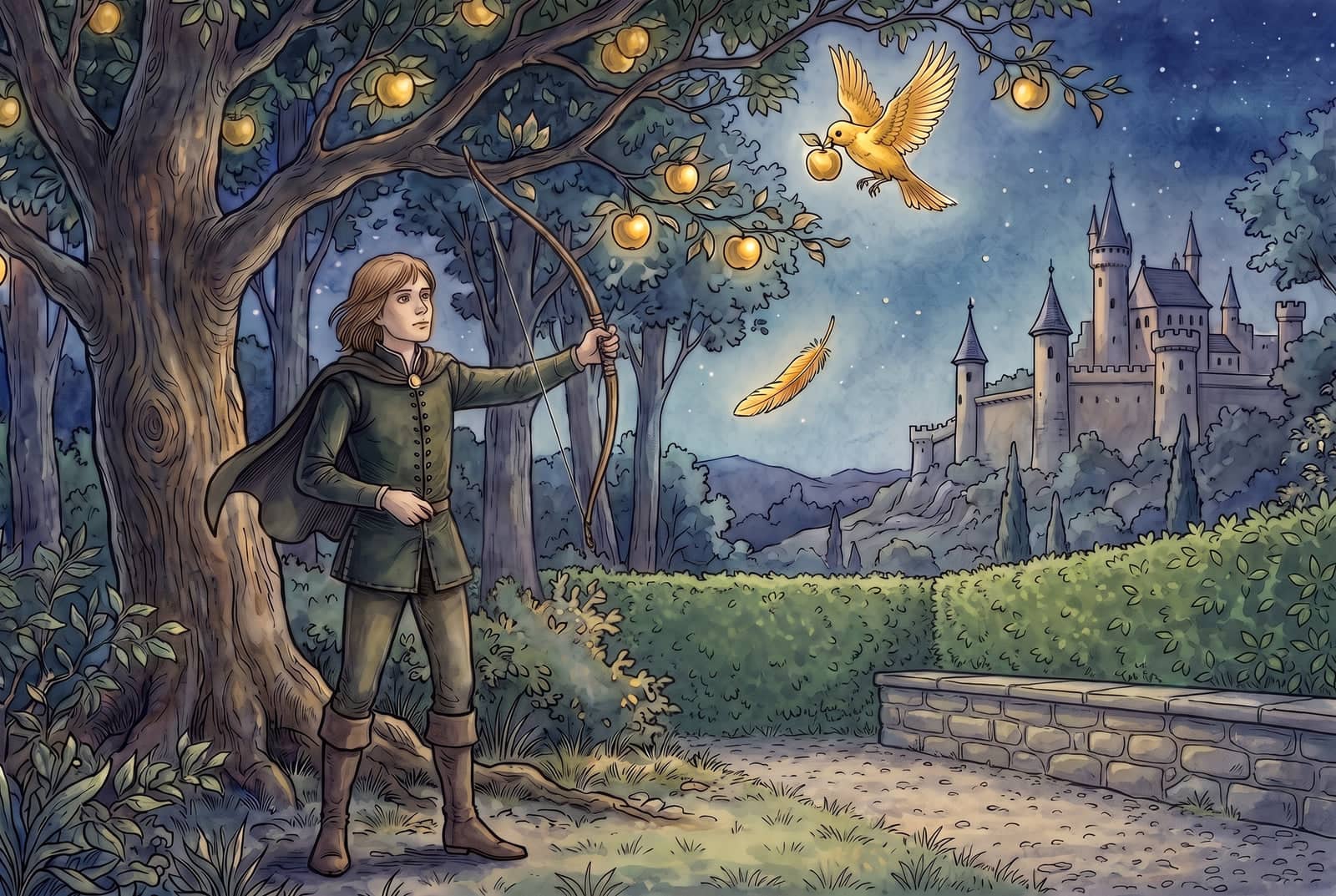
He picked it up, and the next morning he took it to the king and told him what he had seen in the night. The king called his council together, and every one of them declared that a feather like this was worth more than the whole kingdom.
“If the feather is so precious,” said the king, “then one alone is no use to me. I must have the whole bird, and I will!”
The eldest son set out. He trusted his own cleverness and was sure he would find the golden bird easily. When he had gone some way, he saw a fox sitting at the edge of a forest, so he raised his gun and took aim.
“Don’t shoot me!” cried the fox. “In return I’ll give you some good advice. You’re looking for the golden bird, and this evening you’ll come to a village where two inns stand facing each other. One is brightly lit, and everyone inside is having a merry time. Don’t go in there. Go into the other one, even if it looks shabby to you.”
“How could a silly animal like that give anyone sensible advice?” thought the eldest son, and he pulled the trigger. But he missed, and the fox stretched out his tail and ran off into the forest.
So the eldest went on his way, and in the evening he came to the village with the two inns. In one there was singing and dancing; the other looked poor and gloomy. “I’d be a fool,” he thought, “to go into that wretched place and pass by the good one.” So he went into the cheerful inn, spent his days there feasting and making merry, and forgot the bird, his father, and all good advice.
Some time passed, and month after month the eldest son still did not come home. So the second son set out to look for the golden bird. The fox met him just as he had met his brother and gave him the same good advice, but the second son paid no attention to it. When he came to the two inns, his brother was standing at the window of the one where the music was playing, calling out to him, and the second son could not resist. He went inside and lived for nothing but pleasure.
Again some time passed, and then the king’s youngest son asked to set out and try his luck, but his father would not hear of it.
“It’s no use,” said the king. “He has even less chance of finding the golden bird than his brothers, and if anything goes wrong, he won’t know what to do. He isn’t very bright, even on a good day.” But the youngest gave him no peace, and in the end the king let him go.
Once again the fox was sitting at the edge of the forest. He begged for his life and offered his good advice. The king’s son had a kind heart, and he said, “Don’t be afraid, little fox. I won’t hurt you.”
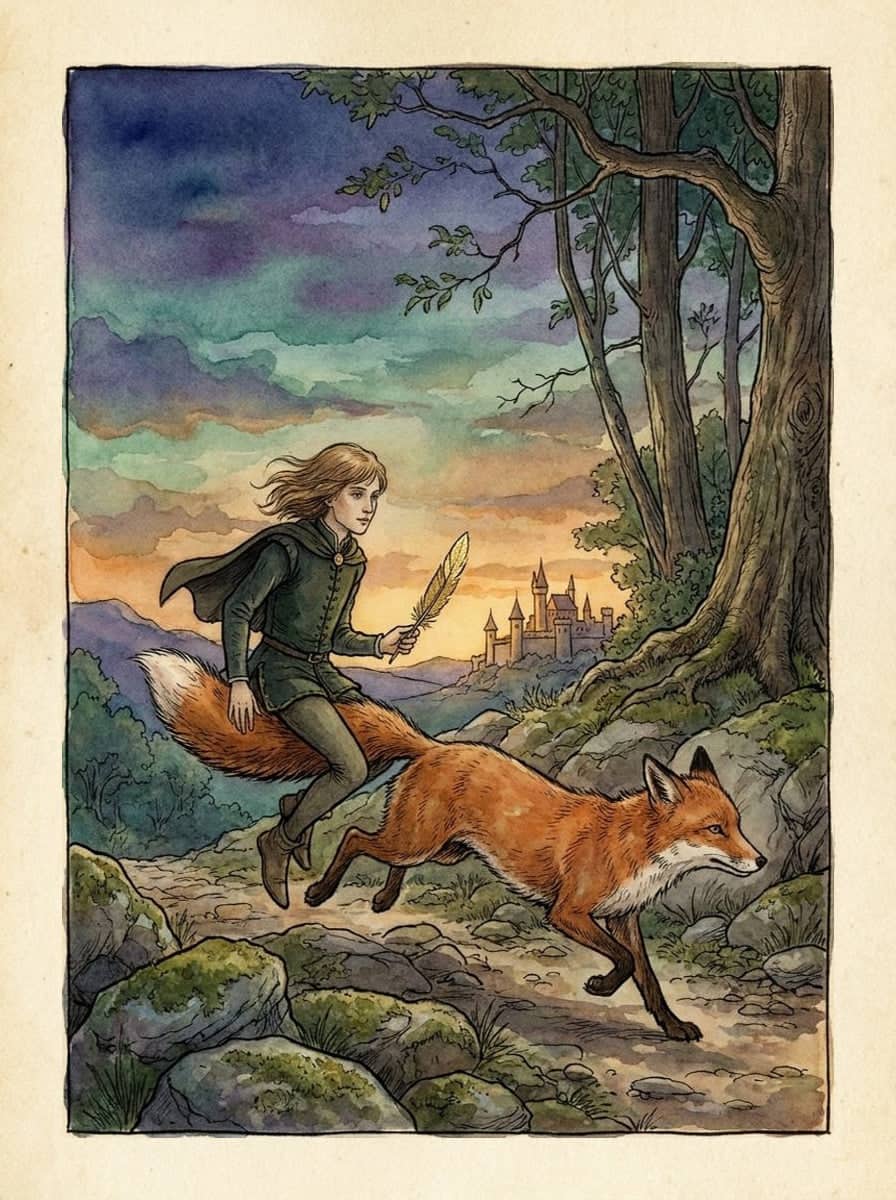
“You won’t be sorry,” answered the fox. “And so that you can travel faster, climb on and sit on my tail.”
The king’s son had hardly sat down when the fox began to run, and away they went over hill and dale, so fast that the wind whistled through his hair.
When they reached the village, the king’s son got down. He followed the good advice and, without so much as a glance around, went into the humble inn, where he spent a quiet night.
The next morning, as soon as he came out into the open fields, there was the fox, already waiting for him.
“I’ll tell you what to do next,” said the fox. “Keep going straight ahead, and in the end you’ll come to a castle with a whole troop of soldiers lying in front of it. Don’t worry about them, for they’ll all be asleep and snoring. Walk right through the middle of them and straight into the castle, and go through all the rooms until at last you come to a chamber where a golden bird hangs in a wooden cage. Beside it stands an empty golden cage, just for show. But be careful not to take the bird out of its plain cage and put it into the fine one, or things will go badly for you.”
With these words the fox stretched out his tail again, the king’s son sat down on it, and away they went over hill and dale, so fast that the wind whistled through his hair.
When he reached the castle, he found everything just as the fox had said. He went into the chamber where the golden bird sat in its wooden cage, with a golden one standing beside it, and the three golden apples lay scattered around the room. “It would be silly,” he thought, “to leave such a beautiful bird in that plain, ugly cage.” So he opened the little door, took hold of the bird, and put it into the golden cage.
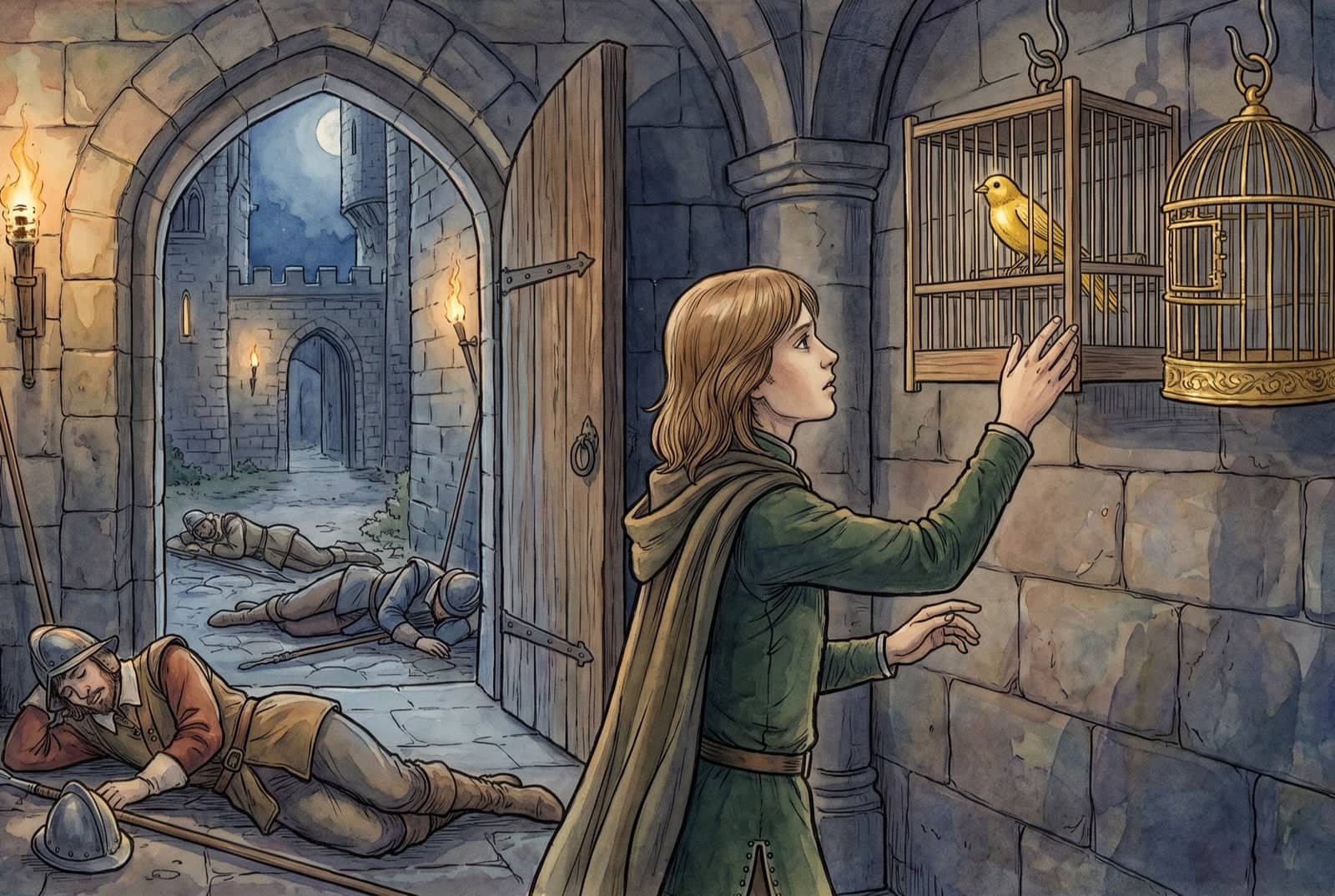
At that very moment the bird let out a piercing shriek. The soldiers woke up, rushed in, and dragged him off to prison. The next morning he was brought before a court, and since he confessed everything, he was sentenced to death.
The king of the castle, however, said he would spare the young man’s life on one condition: he must bring him the golden horse, which ran faster than the wind. If he did, he could have the golden bird as a reward as well.
The king’s son set off, sighing and miserable, for where would he ever find the golden horse? Then all at once he saw his old friend the fox sitting by the road.
“You see,” said the fox, “this is what comes of not listening to me. Still, take heart. I’ll look after you and tell you how to get to the golden horse. Go straight on, and you’ll come to a castle where the horse stands in the stable. The grooms will be lying in front of the stable, but they’ll be asleep and snoring, and you can quietly lead the golden horse out. Only be careful about one thing: put the plain saddle of wood and leather on it, and not the golden one that hangs close by, or things will go badly for you.”
Then the fox stretched out his tail, the king’s son sat down on it, and away they went over hill and dale, so fast that the wind whistled through his hair.
Everything happened just as the fox had said. The king’s son came to the stable where the golden horse stood, but just as he was about to put the plain saddle on it, he thought, “It would be a shame for such a beautiful animal not to have the fine saddle it deserves.”
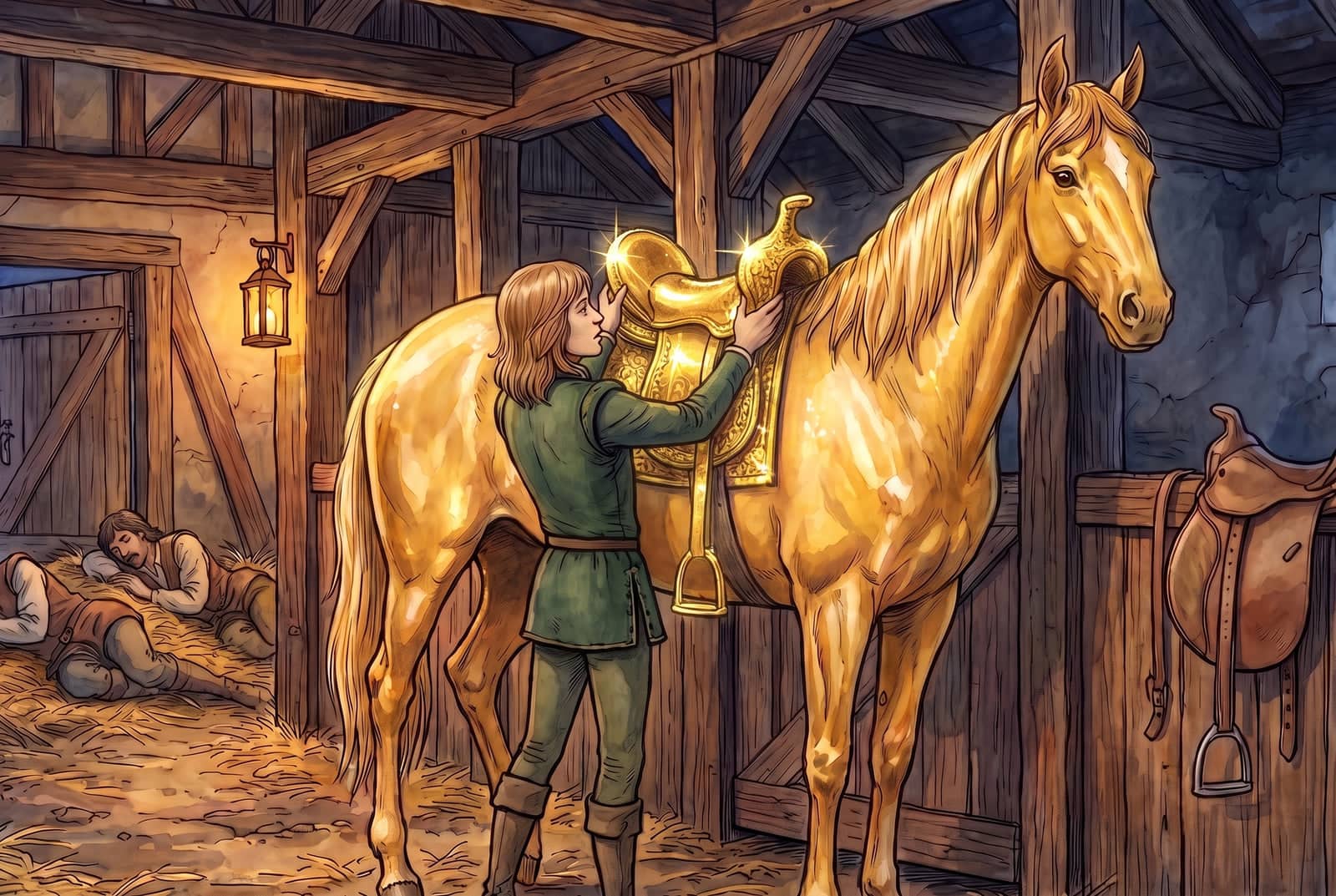
But the golden saddle had hardly touched the horse when it began to neigh loudly. The grooms woke up, seized him, and threw him into prison. The next morning the court sentenced him to death, but the king promised to spare his life, and to give him the golden horse as well, if he could bring him the beautiful princess from the golden castle.
With a heavy heart the young man set out once more, but luckily for him he soon came upon the faithful fox.
“I really ought to leave you to your bad luck,” said the fox, “but I feel sorry for you, and I’ll help you out of trouble one more time. This road leads straight to the golden castle. You’ll get there by evening, and at night, when everything is quiet, the beautiful princess goes to the bathhouse to bathe. As she goes in, run up to her and give her a kiss. Then she’ll follow you, and you can take her away with you. Only don’t let her say goodbye to her parents first, or things will go badly for you.”
Then the fox stretched out his tail, the king’s son sat down on it, and away they went over hill and dale, so fast that the wind whistled through his hair.
When he reached the golden castle, it was just as the fox had said. He waited until midnight, when everyone lay fast asleep and the beautiful princess was on her way to the bathhouse. Then he sprang out and kissed her. She said she would gladly go with him, but she begged him, weeping, to let her say goodbye to her parents first. At first he refused, but when she cried harder and harder and fell at his feet, he gave in at last.
No sooner had the princess reached her father’s bedside than he and everyone else in the castle woke up, and the king’s son was seized and thrown into prison.
The next morning the king said to him, “Your life is forfeit. You can save it only if you take away the mountain that stands in front of my windows and blocks my view, and you must finish the work within eight days. If you do it, you shall have my daughter as your reward.”
The king’s son set to work at once. He dug and shoveled without stopping, but after seven days he saw how little he had done: all his work had come to almost nothing. He grew very sad and gave up all hope. But on the evening of the seventh day the fox appeared.
“You don’t deserve my help,” he said, “but go and lie down and sleep, and I’ll do the work for you.”
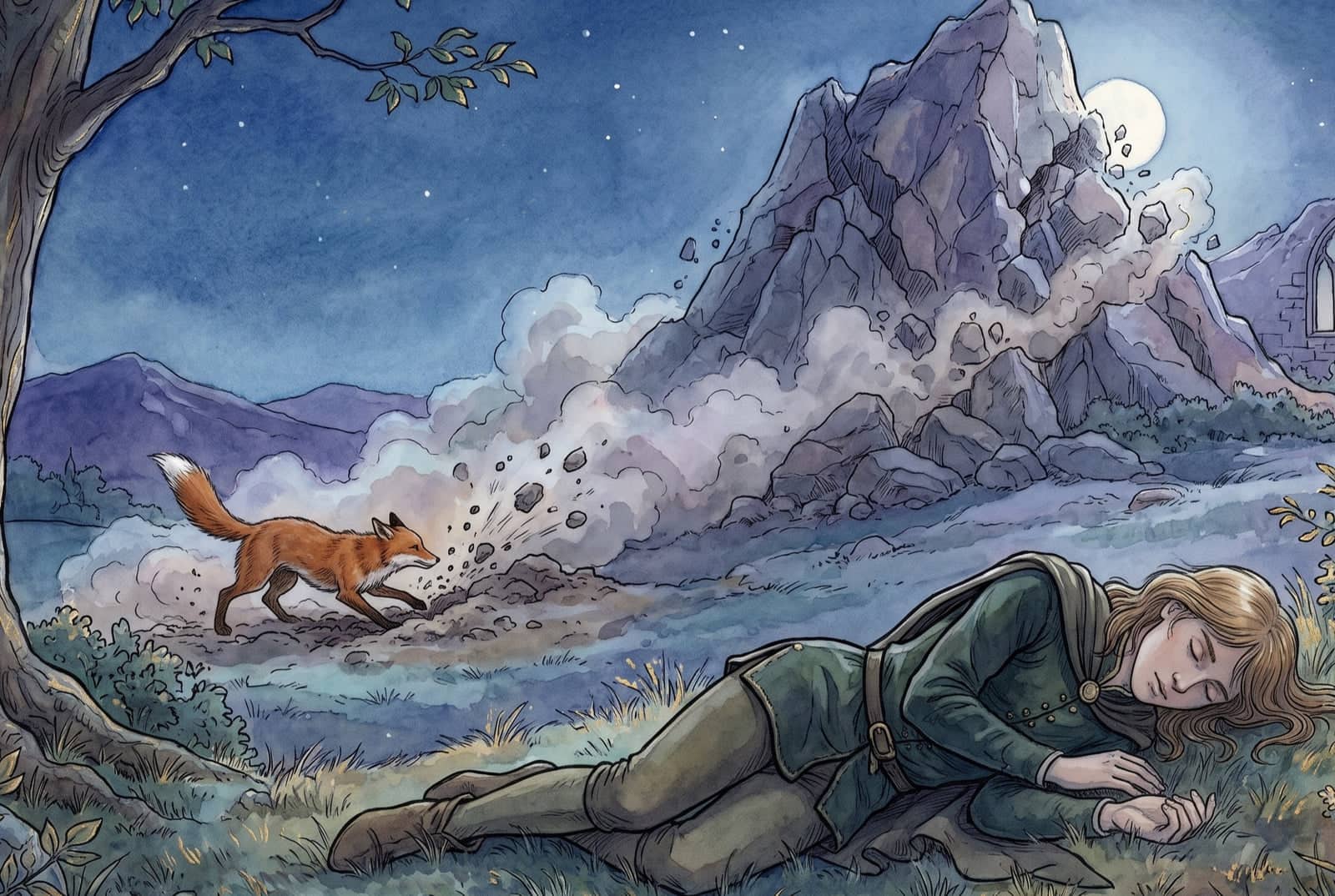
The next morning, when the king’s son woke up and looked out the window, the mountain was gone. Full of joy, he ran to the king and told him the task was done, and whether the king liked it or not, he had to keep his word and give him his daughter.
So the two of them set off together, and before long the faithful fox caught up with them.
“You certainly have the best prize of all,” he said, “but the golden horse belongs with the princess of the golden castle too.”
“How can I get it?” asked the king’s son.
“I’ll tell you,” answered the fox. “First take the beautiful princess to the king who sent you to the golden castle. There will be such rejoicing as no one has ever seen. They’ll gladly give you the golden horse and lead it out to you. Mount it at once and reach down to shake everyone’s hand goodbye, and last of all the beautiful princess’s. As soon as you have hold of her hand, swing her up onto the horse and gallop away. No one will be able to catch you, for that horse runs faster than the wind.”
Everything went off well, and the king’s son carried off the beautiful princess on the golden horse.
The fox did not stay behind. “Now I’ll help you get the golden bird as well,” he said. “When you come near the castle where the golden bird is kept, let the princess get down, and I’ll take care of her. Then ride the golden horse into the castle courtyard. There will be great rejoicing at the sight, and they’ll bring the golden bird out to you. As soon as you have the cage in your hand, gallop back to us and pick up the princess again.”
The plan worked, and the king’s son was about to ride home with his treasures when the fox said, “Now you must reward me for my help.”
“What do you want for it?” asked the king’s son.
“When we come to that forest over there, shoot me dead and cut off my head and paws.”
“That would be a fine way to thank you,” said the king’s son. “I can’t possibly do that.”
“If you won’t do it, I must leave you,” said the fox. “But before I go, I’ll give you one more piece of good advice. Watch out for two things: don’t buy anyone off the gallows, and don’t sit on the edge of any well.” And with that he ran off into the forest.
The young man thought, “What a strange animal, with such odd notions! Who would ever buy anyone off the gallows? And I’ve never once felt like sitting on the edge of a well.”
He rode on with the beautiful princess, and his road led him back through the village where his two brothers had stayed. There was a great crowd and a great deal of noise, and when he asked what was going on, he was told that two men were about to be hanged. As he came closer, he saw that they were his own brothers, who had been up to all kinds of wicked tricks and had squandered everything they owned. He asked whether they could be set free.
“If you’ll pay for them,” the people answered. “But why would you waste your money buying freedom for such wicked men?”
He did not think twice. He paid for them, and when they were released, they all went on their way together.
They came to the forest where the fox had first met them. It was cool and pleasant there, so the two brothers said, “Let’s rest by the well for a while, and eat and drink.”
The king’s son agreed. While they talked, he forgot the fox’s warning and sat down on the edge of the well, never suspecting any harm. But the two brothers pushed him over backward into the well, took the princess, the horse, and the bird, and went home to their father.
“We’ve brought you the golden bird,” they said, “and we’ve won the golden horse too, and the princess from the golden castle.”
There was great rejoicing. But the horse would not eat, the bird would not sing, and the princess sat and wept.
The youngest brother, however, was not dead. By good luck the well was dry, and he had fallen onto soft moss without being hurt, but he could not climb out again. Even in this trouble the faithful fox did not abandon him. The fox came leaping down into the well and scolded the young man for forgetting the fox’s advice.
“Still, I can’t leave you like this,” the fox said. “I’ll help you back up into the daylight.” He told the king’s son to take hold of his tail and hold on tight, and then he pulled him up.
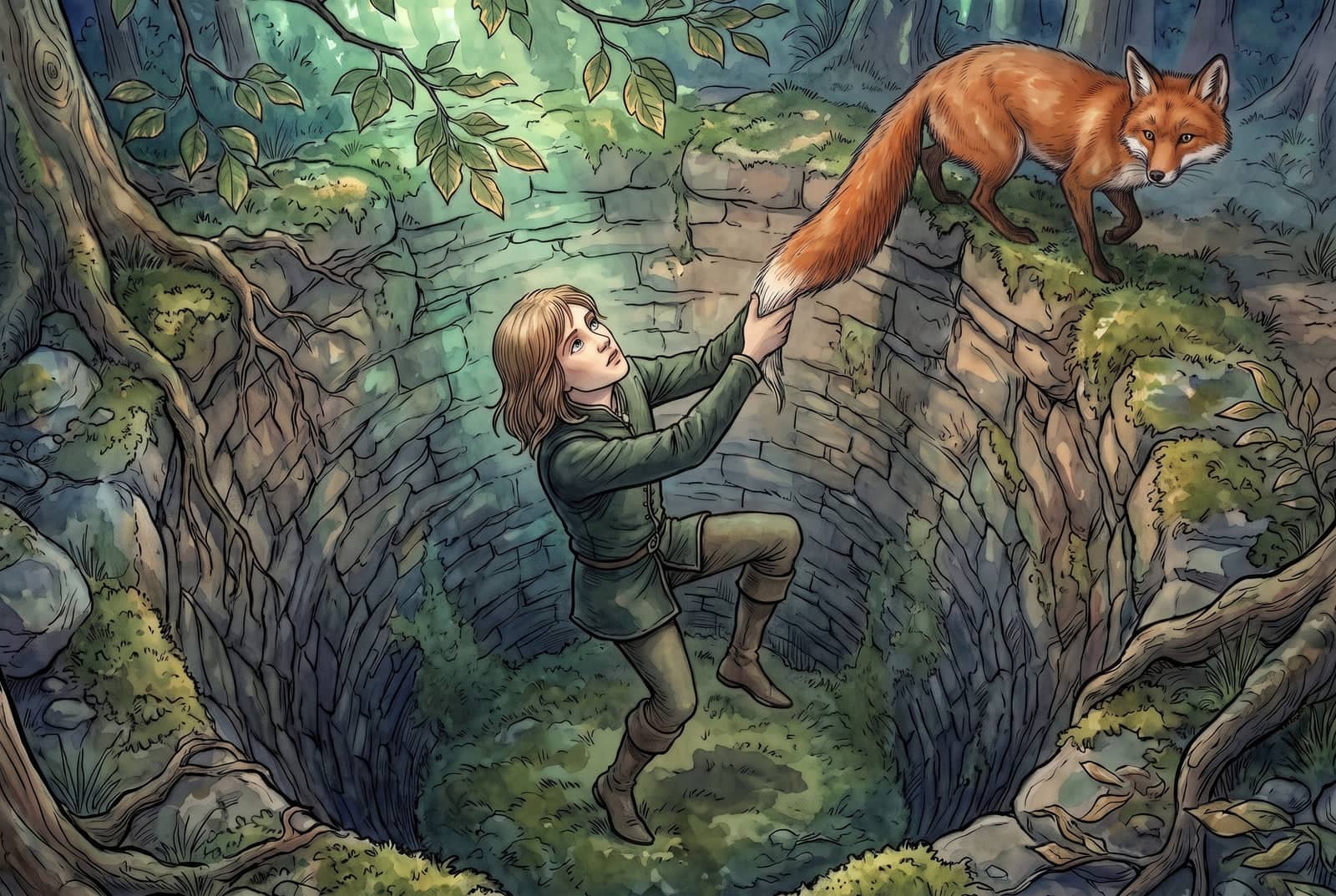
“You’re not out of danger yet,” said the fox. “Your brothers weren’t sure you were dead, so they’ve posted guards all around the forest with orders to kill you if you show your face.”
A poor man was sitting by the road, and the king’s son changed clothes with him. Dressed like that, he made his way to his father’s palace.
No one recognized him, but the bird began to sing, the horse began to eat, and the beautiful princess stopped weeping.
“What does this mean?” asked the king in astonishment.
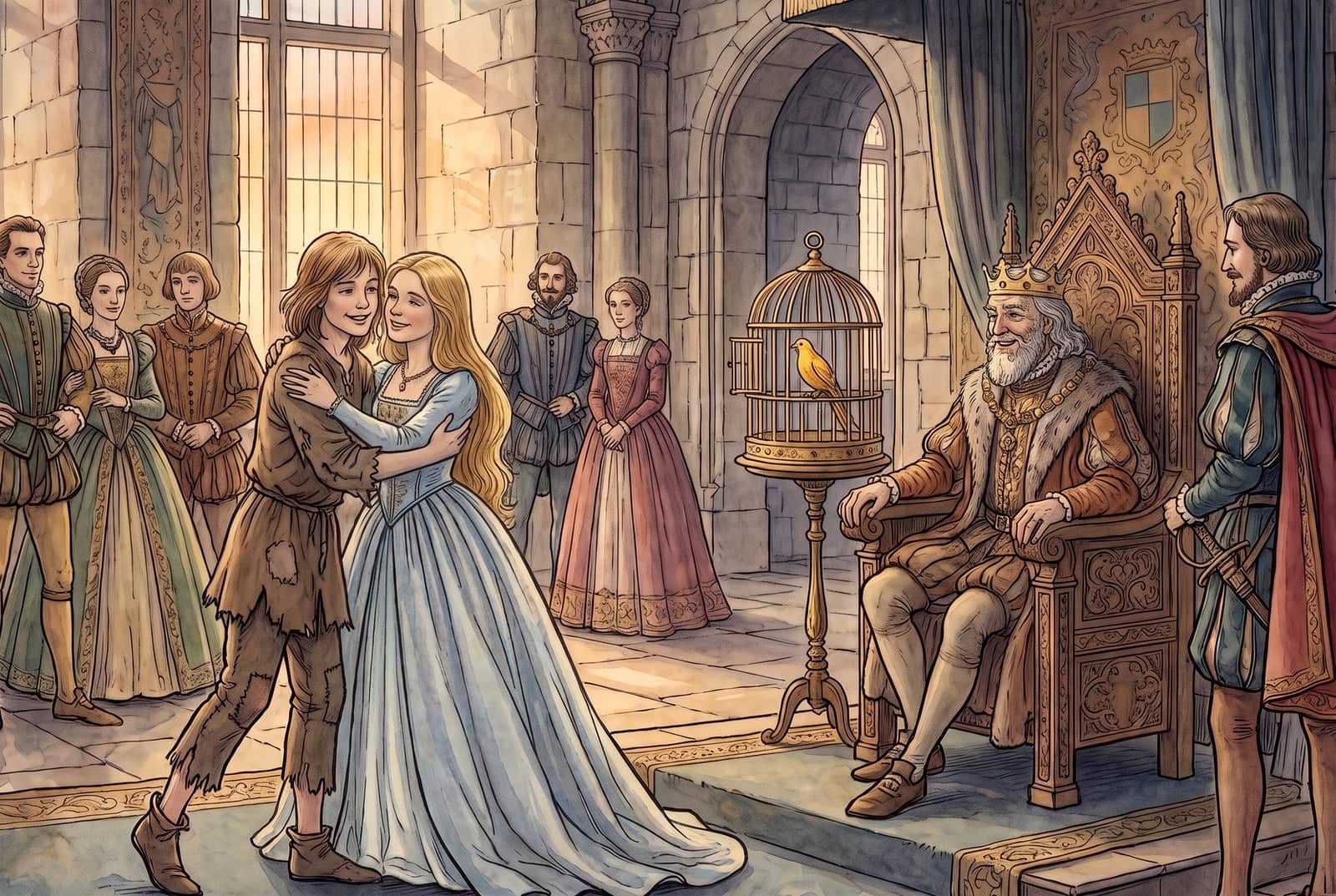
“I don’t know,” said the princess, “but I was so sad, and now I’m so happy! I feel as if my true bridegroom had come.” She told the king everything that had happened, even though the two brothers had threatened to kill her if she gave anything away.
The king ordered everyone in his castle to be brought before him. Among them came the youngest son in his ragged clothes, but the princess knew him at once and threw her arms around his neck. The wicked brothers were seized and put to death, and the king’s son married the beautiful princess and was named heir to the throne.
But what became of the poor fox? Long afterward, the king’s son was walking in the forest again one day when the fox met him and said, “You have everything you could wish for now, but there is no end to my misery, and yet it is in your power to set me free.” And once more, in tears, the fox begged the king’s son to shoot him dead and cut off his head and paws.
This time the king’s son did it. No sooner was it done than the fox turned into a man, and he was none other than the beautiful princess’s brother, freed at last from the spell that had been laid on him. And after that, their happiness was complete for as long as they lived.
Retold by Talerie from Household Tales by Brothers Grimm (opens in a new window)License: Public domainCopy this text, adapt it, use it however you like. A link back to Talerie is appreciated but never required.CC0 1.0 (opens in a new window)