Joseph and the Coat of Many Colors
15 min read ages 6 and up talerie.com/en/tales/joseph-and-the-coat-of-many-colors
Jacob loves Joseph best of all his twelve sons and gives him a coat of many colors. His brothers hate him for it, and they hate him even more when he tells his dreams of sheaves and stars bowing down to him. Then Jacob sends him alone to find them with the flocks near Dothan.
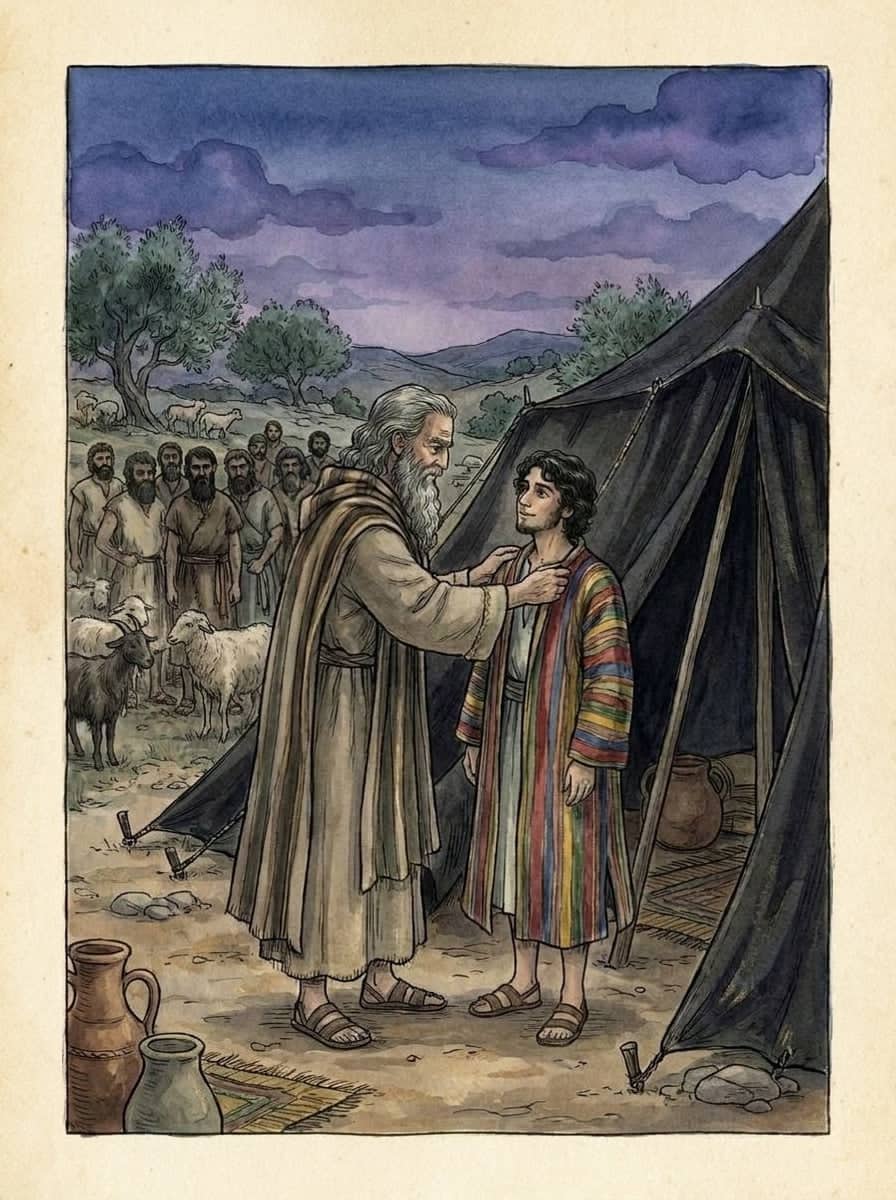
Jacob lived in the land of Canaan with his twelve sons. The one he loved best was Joseph, the son of his old age, and when Joseph was seventeen, Jacob made him a coat of many colors. His brothers saw that their father loved Joseph most, and they hated him for it.
One night Joseph had a dream. “Listen,” he told his brothers. “We were tying up sheaves of grain in the field, and my sheaf stood up straight, and your sheaves gathered around it and bowed down to mine.”
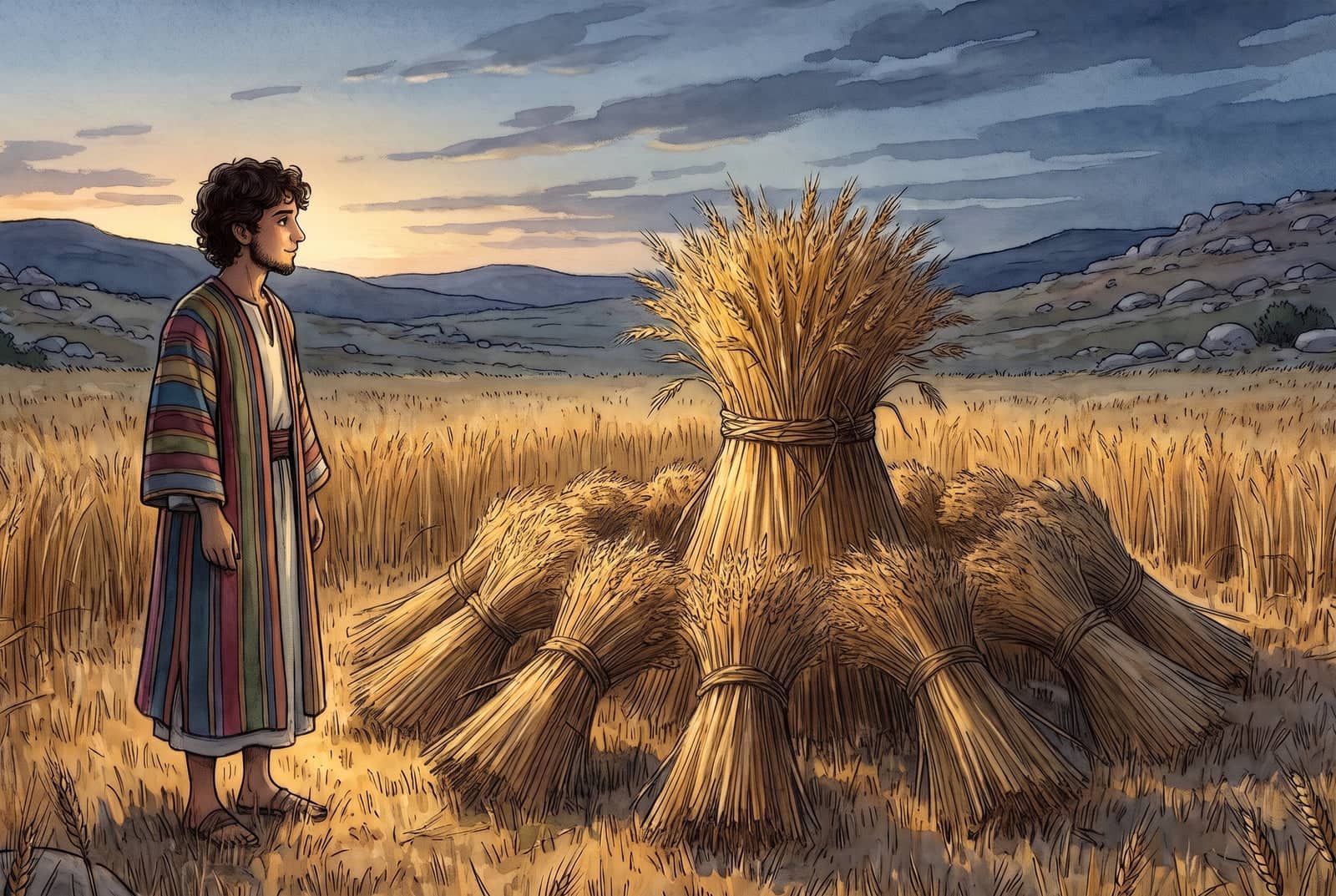
“So you think you’re going to rule over us?” his brothers said, and they hated him even more.
Then Joseph had another dream, and this time he told it to his father as well: the sun, the moon, and eleven stars were bowing down to him. Jacob scolded him. “Are your mother and I and your brothers really going to bow to the ground in front of you?” he said. The brothers were jealous, but their father did not forget the dream.
One day Jacob sent Joseph to see how his brothers were doing with the flocks far from home. Joseph set out from Hebron and found them near Dothan.
They saw him coming from far away. “Here comes the dreamer,” they said to one another. “Let’s kill him and throw him into a pit. We’ll say a wild animal ate him. Then we’ll see what becomes of his dreams.”
But Reuben, the eldest, wanted to save him. “Don’t shed any blood,” he said. “Throw him into this pit, but don’t lay a hand on him.” Reuben meant to come back later and take Joseph home.
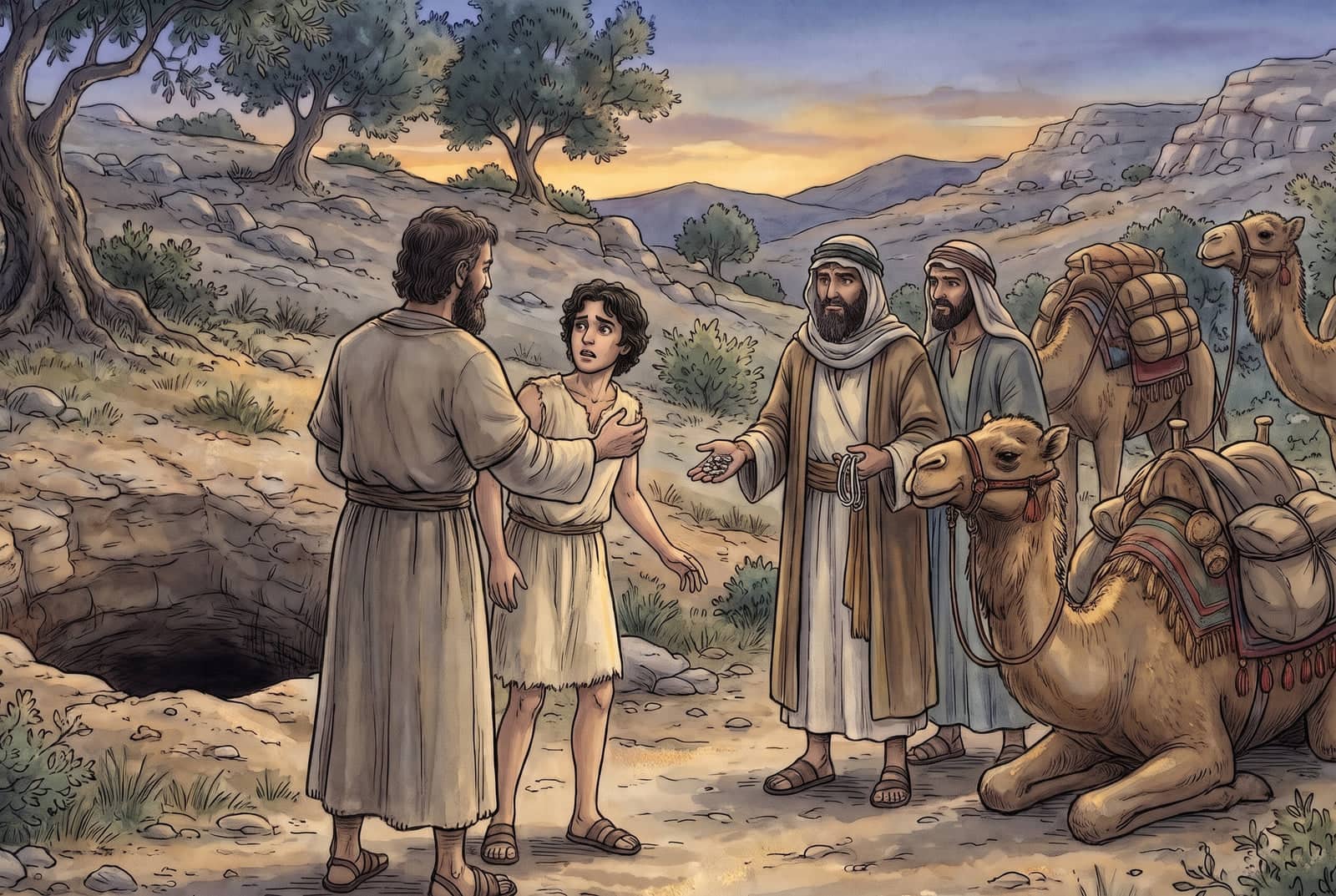
So when Joseph reached them, they stripped off his coat of many colors and threw him into the pit. It was a dry pit. Then they sat down to eat.
Just then a caravan of Ishmaelite traders came along, their camels loaded with spices for Egypt.
“What do we gain by killing our brother?” said Judah. “Let’s sell him to these traders instead. After all, he’s our own flesh and blood.”
The others agreed. They pulled Joseph out of the pit and sold him to the Ishmaelite traders for twenty pieces of silver, and the traders took him away to Egypt. When Reuben came back and found the pit empty, he tore his clothes in grief.
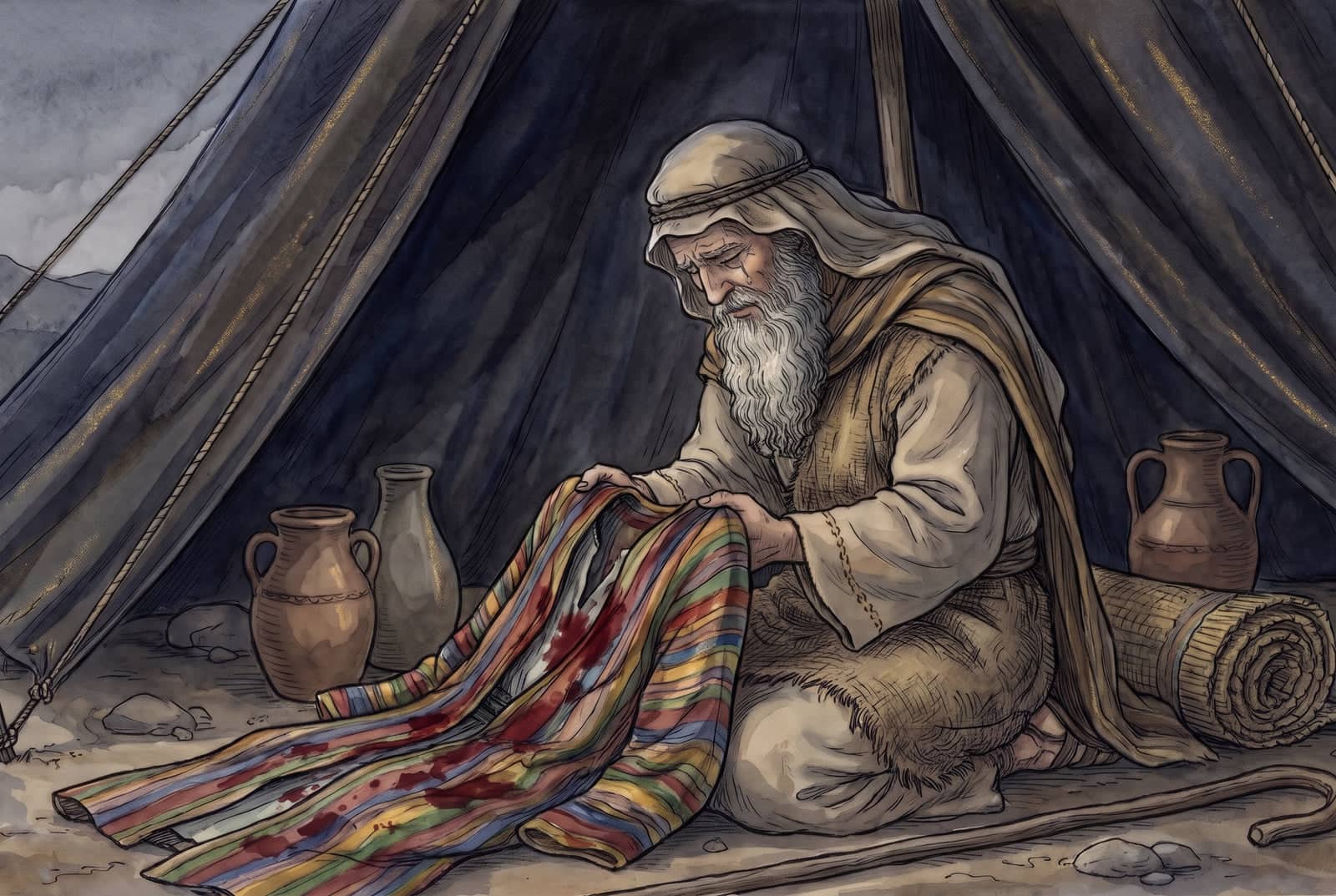
Then the brothers killed a young goat, dipped Joseph’s coat in its blood, and brought it to their father. Jacob recognized it at once. “It’s my son’s coat,” he said. “A wild animal has killed him.” He put on rough sackcloth and would not be comforted. “I will go down to my grave mourning for my son,” he said.
In Egypt the traders sold Joseph to Potiphar, the captain of Pharaoh’s guard. God was with Joseph, and everything he did went well, so Potiphar put him in charge of his whole house.
Joseph had grown into a handsome young man, and Potiphar’s wife wanted him for herself. Day after day she asked him to be with her, and day after day he refused. “My master trusts me with everything here,” he told her. “How could I do such a wicked thing and sin against God?”
One day, when none of the servants were in the house, she caught hold of his cloak. Joseph left it in her hand and ran. Then she lied to her husband. “That Hebrew servant came after me,” she said, “but I screamed, and he ran off and left his cloak behind.”
Potiphar was furious, and he had Joseph thrown into the king’s prison. But even there God was with Joseph, and the prison warden soon put him in charge of all the prisoners.
Some time later, Pharaoh’s chief cupbearer and chief baker were put in the same prison. One night each of them had a dream, and in the morning Joseph found them worried.
“We had dreams,” they said, “and no one can tell us what they mean.”
“Only God can explain dreams,” said Joseph. “Tell them to me.”
The chief cupbearer went first. “I saw a vine with three branches,” he said. “It blossomed, and its grapes ripened. I squeezed them into Pharaoh’s cup and gave it to him.”
“The three branches are three days,” said Joseph. “Within three days Pharaoh will give you back your place. When all is well with you, please remember me and tell Pharaoh about me. I have done nothing to deserve this prison.”
Then the chief baker told his dream. “I had three white baskets on my head,” he said, “full of baked goods for Pharaoh, and birds were eating them.”
“The three baskets are three days,” said Joseph. “Within three days Pharaoh will have you put to death and hanged.”
Three days later, on his birthday, Pharaoh gave the chief cupbearer his old place back, but he had the chief baker hanged, just as Joseph had said. And the cupbearer forgot all about Joseph.
Two whole years went by. Then Pharaoh dreamed that seven fat cows came up out of the Nile, and after them seven thin, ugly cows that ate the fat ones up. He woke, then slept again and dreamed of seven full ears of grain on one stalk, swallowed up by seven thin ears scorched by the east wind.
In the morning Pharaoh was troubled. He sent for all the magicians and wise men of Egypt, but not one of them could tell him what his dreams meant.
Then the chief cupbearer spoke up. “I have a confession to make,” he said. “When I was in prison, a young Hebrew there explained my dream and the baker’s, and everything happened just as he said.”
Pharaoh sent for Joseph at once, and they hurried him out of the dungeon.
“I hear that you can explain dreams,” said Pharaoh.
“I cannot,” said Joseph, “but God will give Pharaoh the answer he needs.”
So Pharaoh told him the dreams, and Joseph said, “The two dreams are one. God has shown Pharaoh what he is about to do. The fat cows and the full ears are seven years of great harvests. The thin cows and the scorched ears are seven years of famine that will follow. Let Pharaoh put a wise man over the land, and let him store a fifth of every harvest in the cities during the good years, so there will be food when the famine comes.”
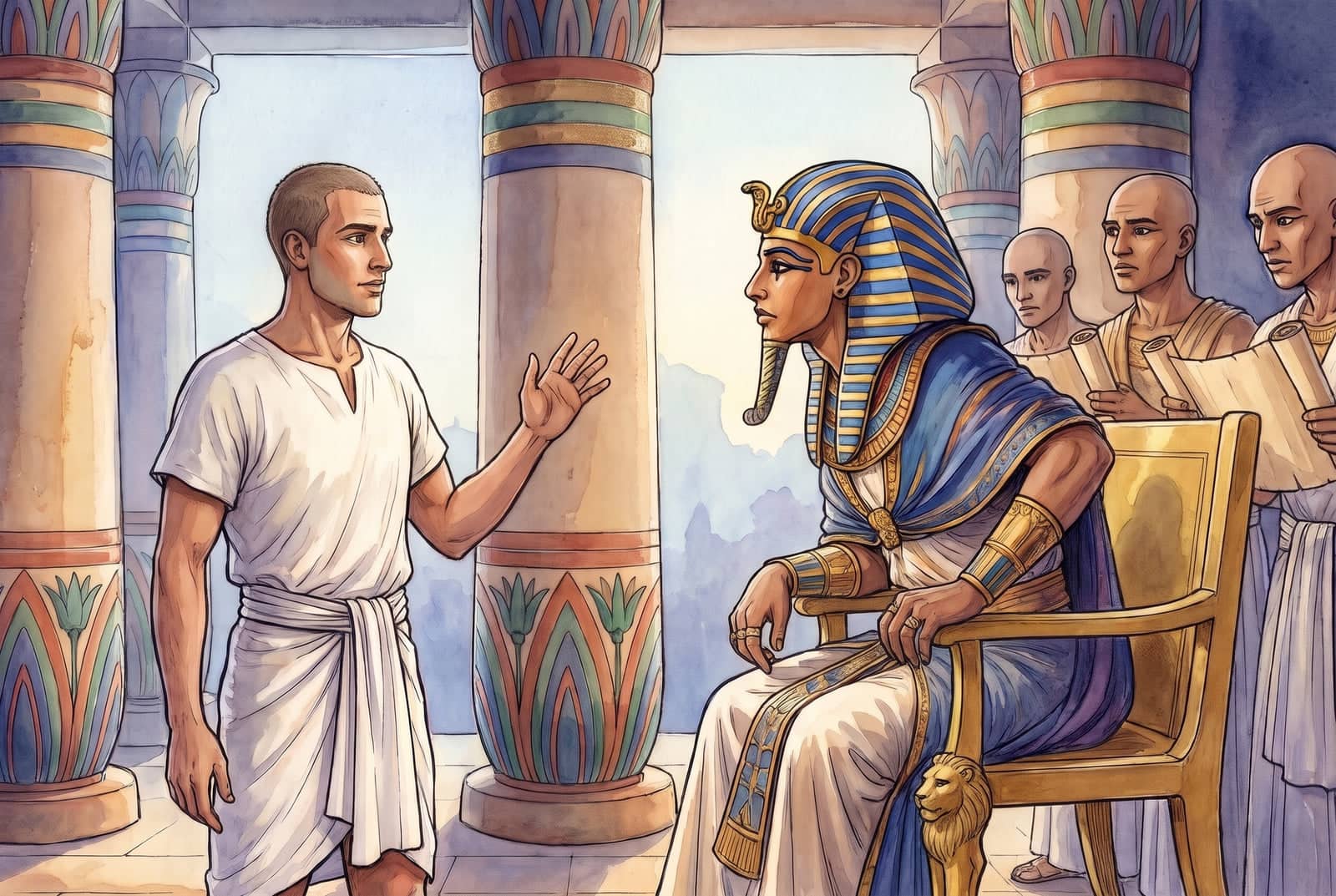
Pharaoh liked the plan. “Since God has shown you all this,” he said, “there is no one as wise as you. I am putting you in charge of the whole land of Egypt. Only I, on my throne, will be greater than you.”
He put his own ring on Joseph’s finger, dressed him in fine linen, and hung a gold chain around his neck. Joseph rode in Pharaoh’s second chariot, and people ran ahead of it calling, “Bow down!” Pharaoh also gave him a wife, Asenath, and she bore him two sons, Manasseh and Ephraim.
Joseph was thirty years old. For seven years the land gave huge harvests, and Joseph stored grain in every city, as much as the sand of the sea, until there was too much to count. Then the famine began, just as he had said. It spread to every land, but in Egypt there was bread, and people came from everywhere to buy grain from Joseph.
The famine reached Canaan too. “There is grain in Egypt,” Jacob told his sons. “Go and buy some, so that we can live and not die.”
So ten of the brothers went to Egypt. But Jacob kept Benjamin, the youngest, at home. Benjamin was Joseph’s brother by the same mother, and Jacob was afraid something might happen to him.
When the brothers came before the governor of Egypt, they bowed down with their faces to the ground. They did not know him, but Joseph knew them at once, and he remembered his dreams. He spoke to them harshly, like a stranger, through an interpreter. “You are spies!” he said.
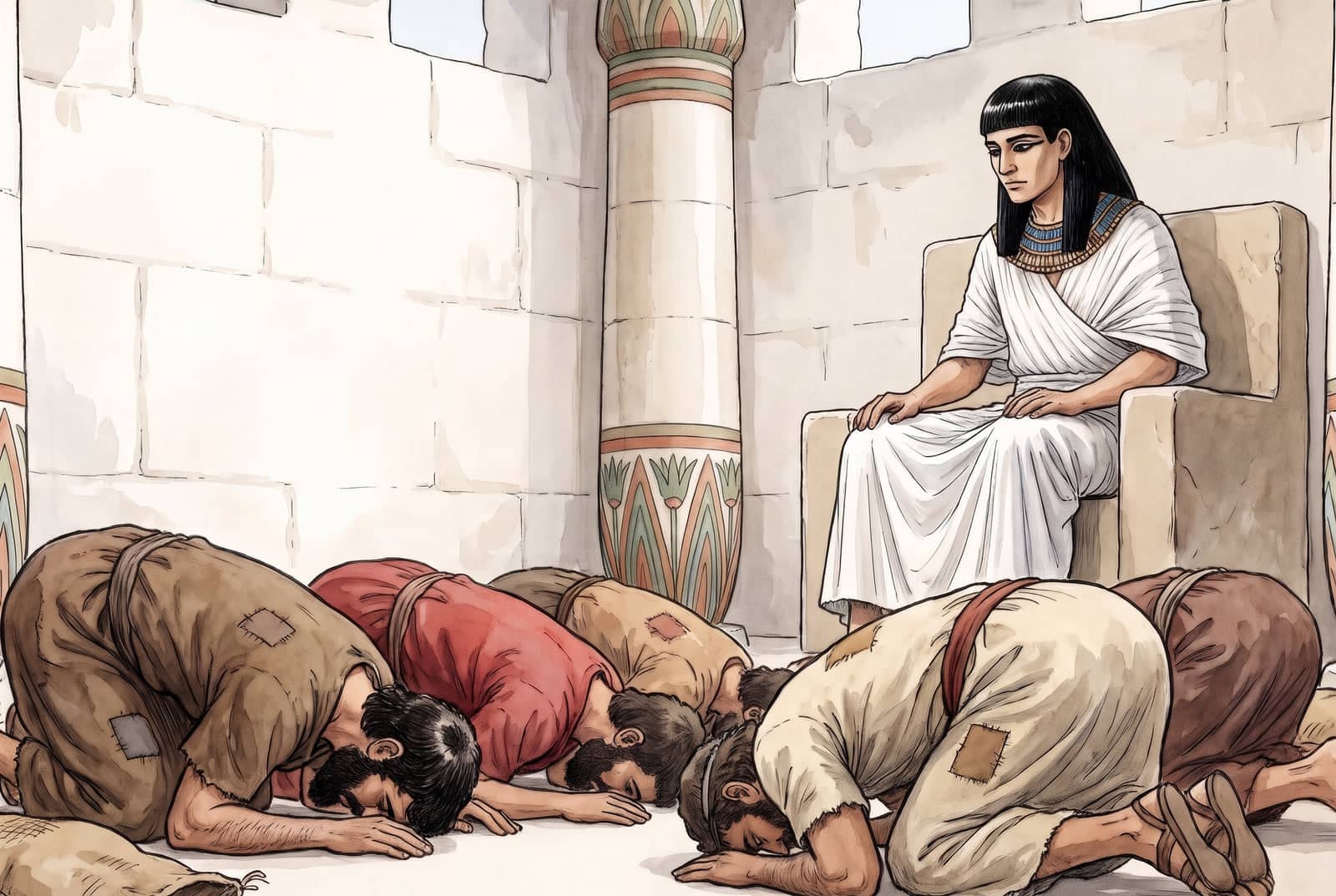
“No, my lord,” they said. “We are honest men, twelve sons of one father. The youngest is at home, and one is gone.”
“Prove it,” said Joseph, and he kept them in prison for three days. Then he said, “One of you will stay here. The rest of you may take grain home to your families. But bring your youngest brother to me, and then I will know you are telling the truth.”
The brothers spoke to one another in their own language. “We are being punished because of Joseph,” they said. “We saw how frightened he was when he begged us for mercy, and we would not listen.”
“Didn’t I tell you not to harm the boy?” Reuben said. “Now we are paying for it.”
They did not know Joseph understood every word. He turned away and wept, then came back and had Simeon tied up before their eyes as a hostage.
Joseph gave orders to fill their sacks with grain and to put each man’s money back in his sack. On the way home one of the brothers found his money right at the mouth of his sack. Their hearts sank. “What has God done to us?” they said.
At home, as they emptied their sacks, every man found his money, and they were all afraid.
“You are robbing me of my children!” Jacob said. “Joseph is gone, Simeon is gone, and now you want to take Benjamin.”
“You may put my two sons to death if I don’t bring him back,” Reuben said.
But Jacob refused. “His brother is dead, and he is the only one left. If anything happens to him, the sorrow will bring my gray head down to the grave.”
The famine grew worse, and soon the grain from Egypt was gone. “Go back and buy us a little food,” Jacob said.
“The man warned us not to come back without our brother,” said Judah. “Send the boy with me, so that we can all live and not die. I will answer for him myself. If I don’t bring him back to you, let me bear the blame forever.”
At last Jacob agreed. “Take the man a gift of the best our land has,” he said, “and twice the money. Take your brother too. May God make the man kind to you. As for me, if I lose my children, then I lose them.”
So the brothers went down to Egypt with Benjamin and stood before Joseph. When Joseph saw Benjamin, he told his steward to bring the men to his house for a meal at noon.
The brothers were frightened, thinking of the money in their sacks, and at the door they told the steward about it.
“Don’t be afraid,” said the steward. “Your God must have put that treasure in your sacks. I received your money.” And he brought Simeon out to them.
When Joseph came home, the brothers bowed down to the ground again. He asked whether their old father was still alive. Then he looked at Benjamin, his own mother’s son. “May God be gracious to you, my son,” he said. Joseph was so moved that he hurried into another room and wept there.
When he had washed his face, he came back to the meal. The brothers were seated in order of age, from the eldest to the youngest, and they looked at one another in amazement. Benjamin was served five times as much as anyone else, and they ate and drank and were merry.
Then Joseph told his steward to fill the men’s sacks with grain, to put each man’s money back, and to hide his own silver cup in the youngest brother’s sack.
At first light the brothers set off with their donkeys. They had not gone far when the steward caught up with them. “Why have you repaid good with evil?” he said. “You have stolen my master’s silver cup.”
“We would never do such a thing!” they said. “If any of us has the cup, let him die, and the rest of us will be your master’s slaves.”
“Only the one who has it will be a slave,” said the steward. “The rest of you will go free.”
They opened their sacks, and the steward searched, beginning with the eldest and ending with the youngest. The cup was found in Benjamin’s sack. The brothers tore their clothes, loaded their donkeys, and all went back to the city together.
They threw themselves on the ground before Joseph.
“What can we say, my lord?” said Judah. “God has uncovered our guilt. We are all your slaves now.”
“No,” said Joseph. “Only the one who had the cup will be my slave. The rest of you, go home to your father in peace.”
Then Judah came closer. “Please, my lord,” he said, “don’t be angry with me. Our father is old, and this boy is the son of his old age. His brother is dead, and he is all that is left of his mother’s sons. Our father’s life is bound up with the boy’s. If we go home without him, our father will die of sorrow. I promised, ‘If I don’t bring him back to you, let me bear the blame forever.’ So please, let me stay here as your slave in his place, and let the boy go home with his brothers.”
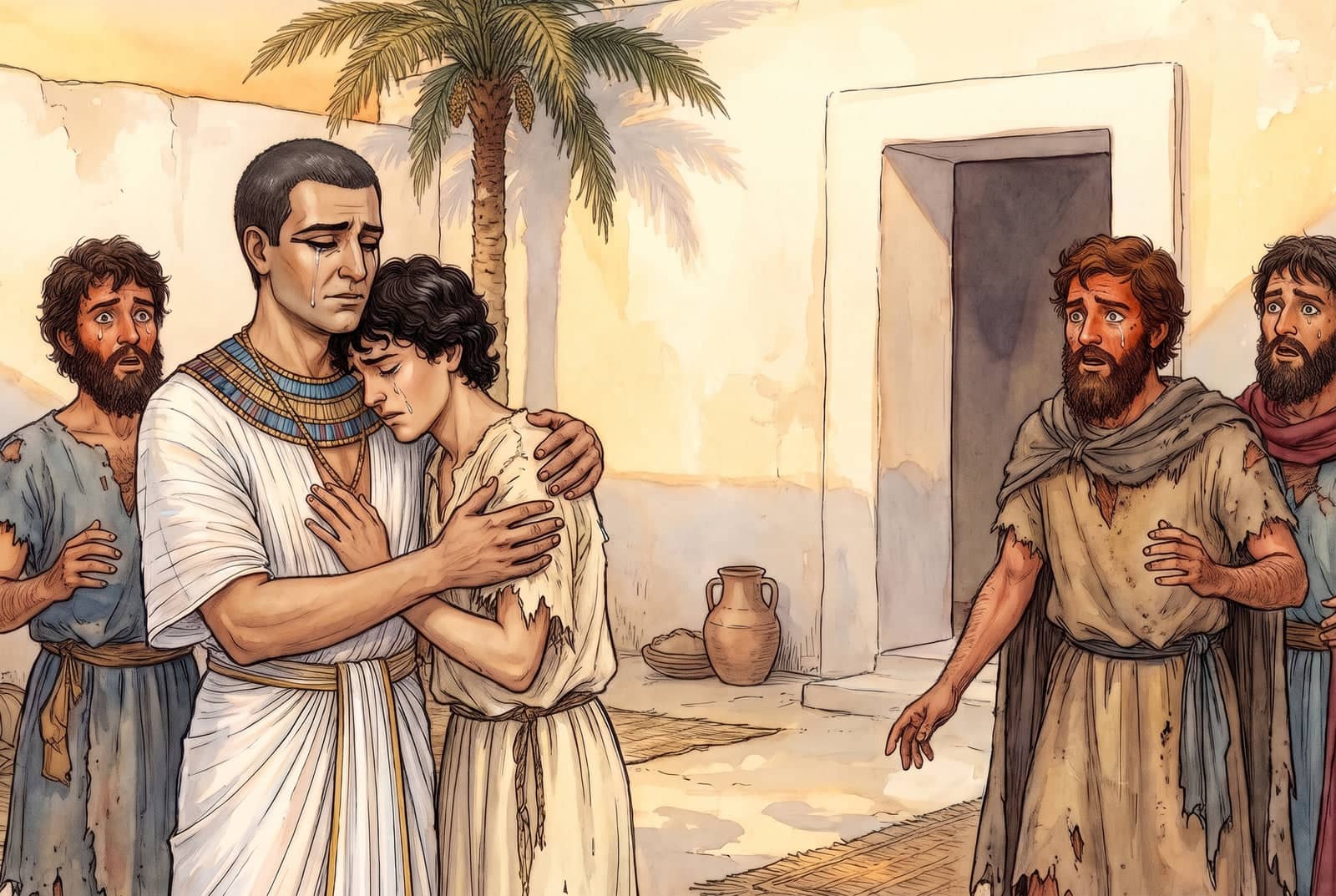
At that, Joseph could no longer hold back. “Send everyone out!” he cried to his servants. When he was alone with his brothers, he wept so loudly that the Egyptians heard it.
“I am Joseph!” he said. “Is my father still alive?” But his brothers were too stunned to answer.
“Come close to me,” Joseph said. “I am Joseph, your brother, the one you sold into Egypt. Don’t be upset, and don’t be angry with yourselves. It was not you who sent me here, but God, to save lives. There will be five more years of famine. Hurry back to my father and tell him to come down to me. He will live in the land of Goshen, near me, and I will take care of you all.”
Then he threw his arms around his brother Benjamin and wept, and Benjamin wept too. Joseph kissed all his brothers, and after that his brothers talked with him.
Pharaoh was pleased when he heard that Joseph’s brothers had come. “Let them take wagons from Egypt,” he told Joseph, “and bring their father and families here. The best of all Egypt will be theirs.”
So Joseph gave his brothers wagons and food for the journey, and he sent his father twenty donkeys loaded with grain and the best things of Egypt. To Benjamin he gave three hundred pieces of silver. As he sent his brothers off, he told them, “Don’t quarrel on the way.”
They came home to their father in Canaan. “Joseph is still alive!” they said. “He is governor over all the land of Egypt!” Jacob’s heart went numb; he could not believe them.
But they told him everything Joseph had said, and when Jacob saw the wagons Joseph had sent to carry him, his spirit came back to life.
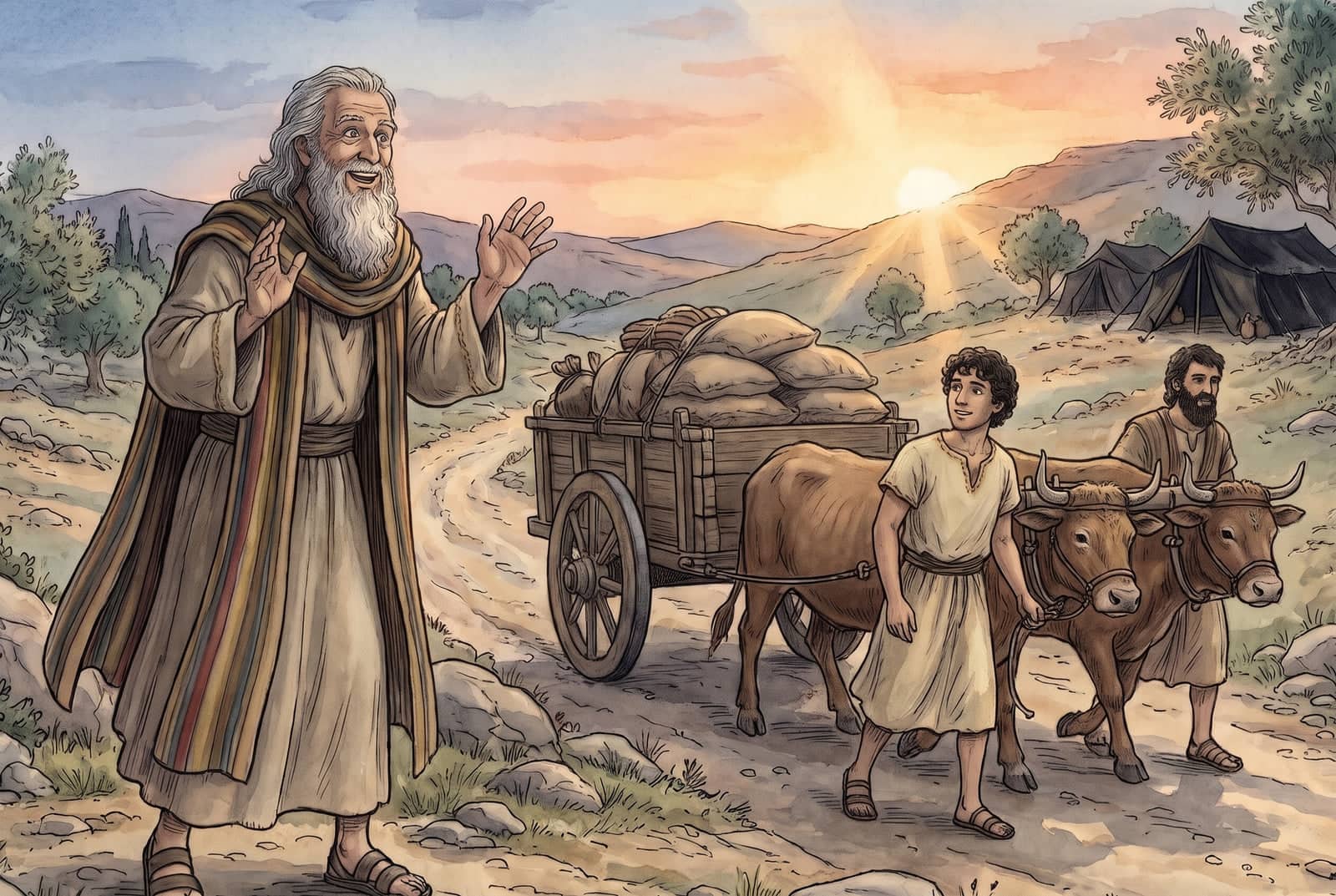
“It is enough,” he said. “My son Joseph is still alive. I will go and see him before I die.”
Retold by Talerie from King James Version (opens in a new window) Public domain Copy this text, adapt it, use it however you like. A link back to Talerie is appreciated but never required. CC0 1.0 (opens in a new window)