David, the youngest of Jesse’s eight sons, stays home in Bethlehem to look after his father’s sheep. Sent to the army camp with bread for his brothers, he hears a giant named Goliath shout the challenge he has made morning and evening for forty days, and every soldier runs from him in fear.
The Philistines gathered their armies for war and camped between Socoh and Azekah, in the land of Judah. King Saul gathered the Israelites and camped beside the Valley of Elah. The Philistines stood on a hill on one side, the Israelites stood on a hill on the other, and the valley lay between them.
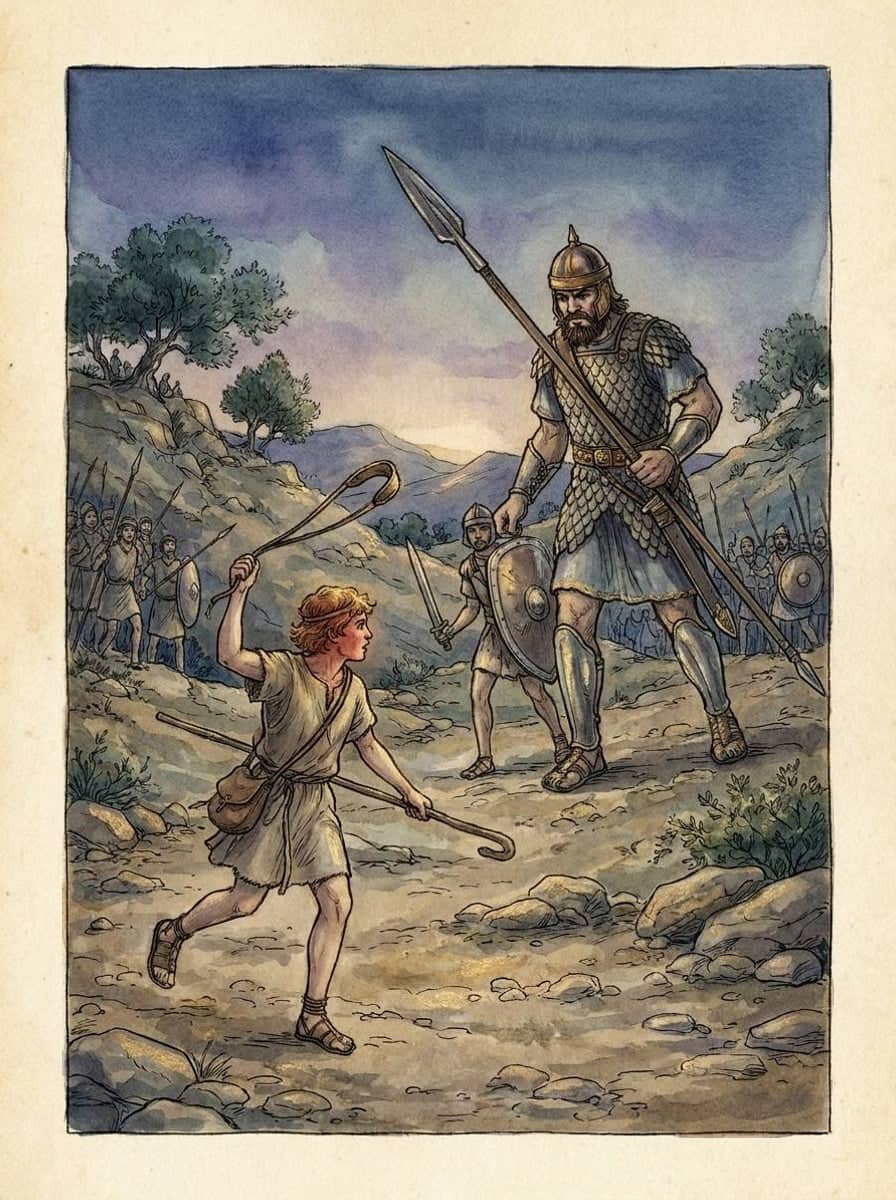
Out of the Philistine camp came a champion named Goliath, from the city of Gath. He was a giant of a man, taller than any soldier on either hill. He wore a bronze helmet and a coat of bronze scales so heavy that an ordinary man could hardly have lifted it. Bronze guards covered his legs, and a bronze javelin hung across his back. The shaft of his spear was as thick as the beam of a weaver’s loom, and its iron point was huge and heavy. His shield-bearer walked in front of him.
Goliath stood and shouted across the valley to the army of Israel. “Why have you come out and lined up for battle? I am a Philistine, and you are Saul’s servants. Choose a man and send him down to me. If he can fight me and kill me, we will be your servants. But if I beat him and kill him, you will be our servants.”
“I defy the armies of Israel today!” he roared. “Give me a man, and let us fight it out.”
When Saul and the Israelites heard this, they were terrified, and no one went down to meet him. Morning and evening, for forty days, Goliath came out and shouted the same challenge, and every time no one answered.
Far away in Bethlehem lived an old man named Jesse, who had eight sons. His three eldest, Eliab, Abinadab, and Shammah, had gone to war with King Saul. David was the youngest, and he stayed at home to look after his father’s sheep.
One day Jesse said to David, “Take this sack of roasted grain and these ten loaves of bread, and hurry to your brothers in the camp. Take these ten cheeses to their commander as well. See how your brothers are doing, and bring me back news of them.”

David got up early the next morning, left someone in charge of the sheep, and set off as his father had told him. He reached the camp just as the army was marching out to its battle lines, shouting the war cry. The Israelites and the Philistines stood facing each other, army against army. David left his load with the man in charge of the baggage, ran to the front line, and greeted his brothers.
While he was talking with them, Goliath came striding out from the Philistine ranks and shouted the same challenge as before. David heard every word. When the soldiers of Israel saw the giant, they all ran from him in fear.

“Have you seen this man?” they said to one another. “He comes out every day to defy Israel. The king will make whoever kills him very rich. He’ll give him his own daughter to marry, and his father’s family will never again owe the king taxes or service.”
David turned to the men standing near him. “What will be done for the man who kills this Philistine and takes away Israel’s shame?” he asked. “Who is this Philistine, that he dares to defy the armies of the living God?”
The men told him again what the king would do for the man who killed the giant.
Eliab, his eldest brother, heard David talking with the men, and he grew angry. “Why have you come down here?” he snapped. “And who’s looking after those few sheep out in the wilderness? I know how proud you are, and how wicked your heart is. You only came down to watch the battle.”
“What have I done now?” said David. “Can’t I even ask a question?”
David turned away from his brother, asked another man the same thing, and got the same answer as before.
Some of the soldiers heard what David had been saying and reported it to Saul, and the king sent for him.
“Don’t let anyone lose heart because of this Philistine,” David said to Saul. “I will go and fight him, Your Majesty.”
“You can’t go out against this Philistine and fight him,” Saul answered. “You’re only a boy, and he has been a warrior since he was young.”
But David said, “Your Majesty, I keep my father’s sheep. When a lion or a bear came and carried off a lamb from the flock, I went after the beast, hit it, and rescued the lamb from its mouth. And when it turned on me, I grabbed it by the beard, struck it, and killed it. I have killed both the lion and the bear, and this Philistine will be like one of them, because he has defied the armies of the living God. God saved me from the paw of the lion and the paw of the bear, and he will save me from the hand of this Philistine.”
“Go,” said Saul, “and may God be with you.”
Saul dressed David in his own armor. He put a bronze helmet on David’s head and a coat of mail on his body, and David buckled Saul’s sword on over the armor. Then David tried to walk, but he had never worn armor before.

“I can’t walk in all this,” David said to Saul. “I’m not used to it.” And he took it all off.
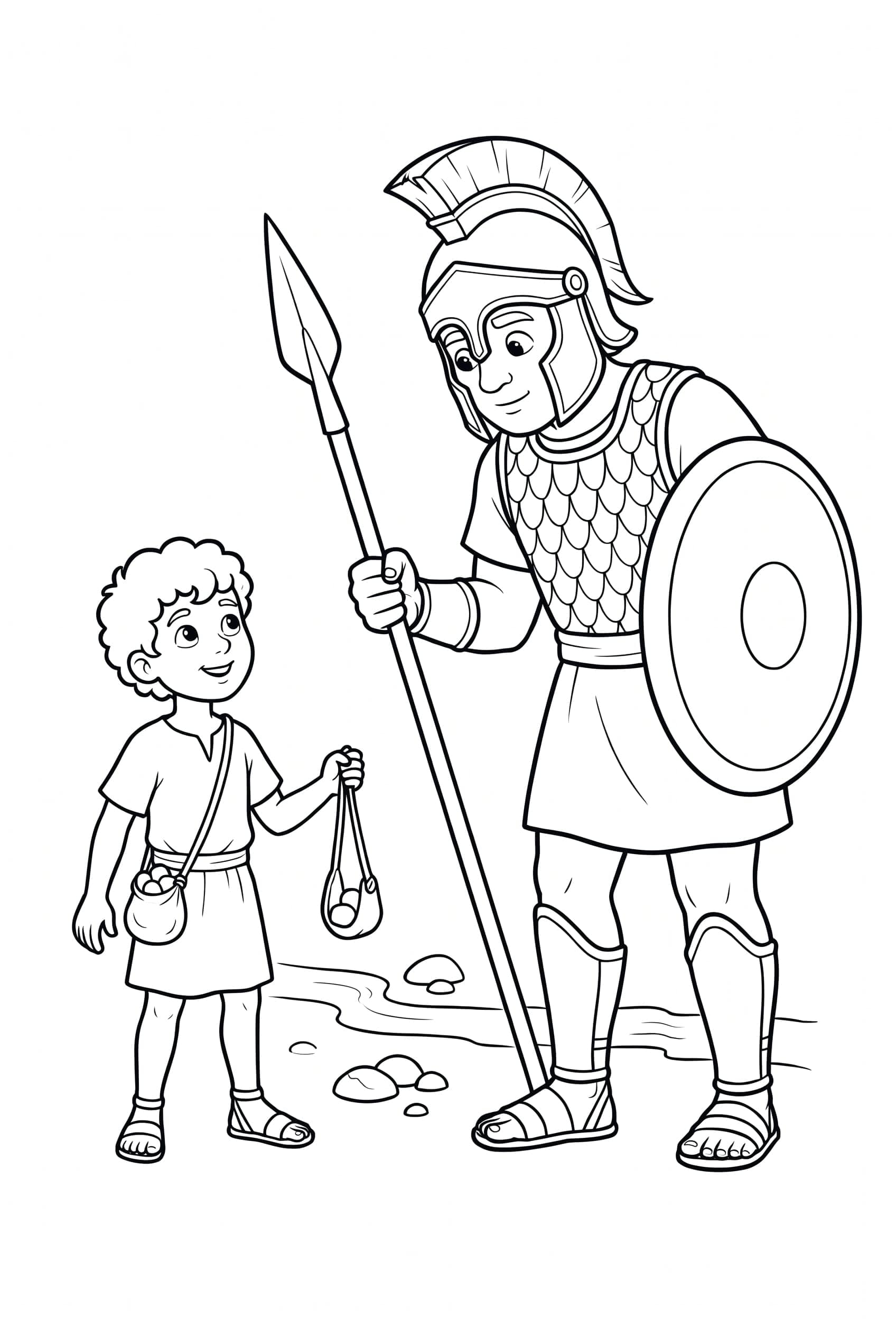
Instead he picked up his shepherd’s staff. He chose five smooth stones from the stream and put them in his shepherd’s bag. Then he took up his sling, a leather pouch on two long cords, and with it in his hand he went out to meet Goliath.

The giant came closer and closer, with his shield-bearer walking in front of him. He looked David over and saw only a youth, ruddy and handsome, and he sneered at him.
“Do you think I’m a dog, coming at me with sticks?” Goliath said, and he cursed David by the names of his gods. “Come here, and I’ll feed you to the birds and the wild animals!”
David answered, “You come against me with a sword, a spear, and a shield. But I come against you in the name of God, the God of the armies of Israel, whom you have defied. Today God will hand you over to me. I will strike you down and take your head, and it is the Philistine army that will feed the birds and the wild animals, not me. Then the whole world will know that there is a God in Israel. And everyone gathered here will know that God does not save with sword and spear. The battle belongs to God, and he will hand all of you over to us.”
As Goliath moved in to attack, David ran quickly toward him. He reached into his bag, took out a stone, and whirled it around in his sling. The stone flew and struck Goliath in the forehead. It sank in, and the giant fell face down on the ground.
So David overcame Goliath with a sling and a stone, and there was no sword in his hand.
The boy ran and stood on the fallen giant. Then he drew Goliath’s own sword from its sheath, and with it he killed the giant and cut off his head.
When the Philistines saw that their champion was dead, they turned and ran. The men of Israel rose up with a great shout and chased them down the valley and far along the road toward Gath. Then they came back and took everything that was left in the Philistine camp.

Earlier, as Saul watched David go out to face Goliath, he had turned to Abner, the commander of his army. “Abner, whose son is that young man?” he asked.
“As surely as you live, Your Majesty, I don’t know,” said Abner.
“Find out whose son he is,” said the king.
So when David came back from the fight, Abner took him and brought him before Saul. David was still holding Goliath’s head in his hand.
“Whose son are you, young man?” Saul asked.
“I am the son of your servant Jesse of Bethlehem,” David answered.
Retold by Talerie from King James Version (opens in a new window) Public domain Copy this text, adapt it, use it however you like. A link back to Talerie is appreciated but never required. CC0 1.0 (opens in a new window)