Rabbi Loew of Prague knows secrets of nature hidden from others, and his strange powers make people marvel. King Rudolf himself comes to see his wonders. Yet the greatest of them is a servant the rabbi has shaped out of clay and brought to life with a Hebrew charm in his mouth.
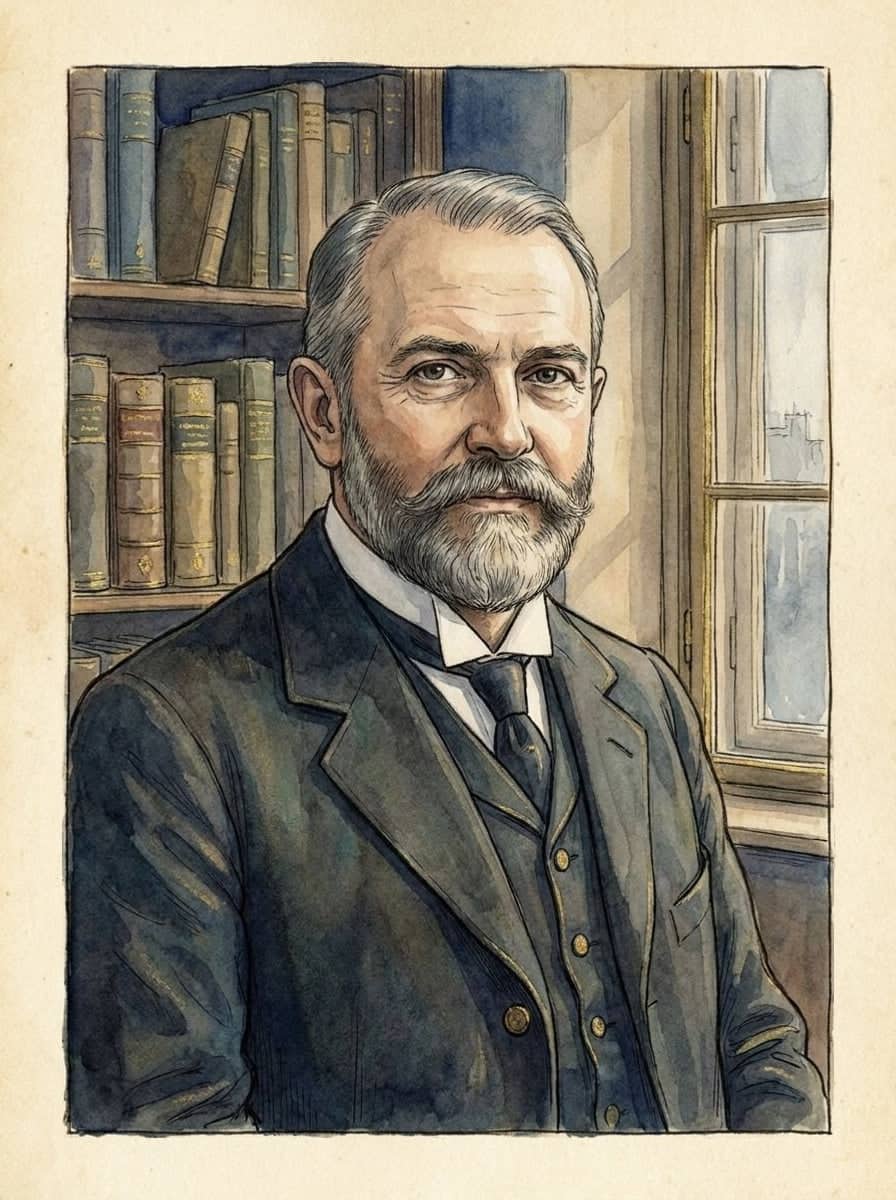
In the days when Rudolf II was king, there lived in the Jewish Town of Prague a man of great learning, Rabbi Judah Loew ben Bezalel. He was so tall that people called him the High Rabbi. He knew the Talmud and the Kabbalah through and through, and mathematics and the stars as well. He knew many of nature’s secrets that were hidden from others, and he could do such strange things that people marveled at his power.
Word of him spread far and wide, all the way up to Prague Castle and the court of King Rudolf. The king’s astronomer, Tycho Brahe, thought highly of the learned rabbi, and the king himself came to know him in a most unusual way.
The king had just ordered every Jew to leave Prague. Rabbi Loew had gone up to the castle to plead for his people, but he got nowhere: the guards would not even let him in to see the king. So he decided to wait for him in the middle of the Stone Bridge, for he had heard on good authority that the king would ride that way.
Before long the royal coach came down from the castle toward the Old Town, drawn by four horses in bright, gleaming harness, with a splendid escort of courtiers on horseback. When the people on the bridge saw it coming, they shouted at the rabbi.
“Get out of the way!”
The rabbi stood as if he had not heard, right in the path of the coach. Then the people began to jeer and to throw things at him. They hurled stones and mud, but what fell on him were flowers: on his cloak, on his head, and at his feet.

The coach came on, and the rabbi did not move a single step. The horses did not run him down. They stopped in front of him of their own accord, though the coachman never pulled on the reins.
Only then did the rabbi move. Bareheaded, he walked through the roses and the other flowers to the coach, knelt beside it, and begged the king to have mercy on his people. The king, astonished by the man and by what had just happened, told him to come to the castle. That was a great favor.
At the castle the rabbi won a second, greater one. His plea succeeded, and the Jews did not have to leave.
From then on Rabbi Loew was often invited to the castle, and he entertained the king for many an hour with his wonders. One day King Rudolf asked the rabbi to show him the patriarchs: Abraham, Isaac, and Jacob, and Jacob’s sons. The rabbi hesitated, but at last he agreed.
“Your Majesty, I will do it,” he said. “I ask only one thing. When the holy fathers appear, let no one so much as smile.”
The king and his courtiers promised, and they gathered in a quiet hall far from the rest of the castle. Eagerly they looked into a deep alcove by the window, where the tall rabbi stood solemn in the half-dark. Then he seemed to vanish into mist, and out of a gray cloud rose an old man, taller than any living man, in flowing robes, alone and brightly lit. He passed before everyone’s eyes in great majesty, and then all at once he was gone, as if snuffed out in the gray cloud. That was Abraham.
After him came Isaac, then Jacob and his sons, Judah, Reuben, Simeon, Issachar, and the others, one after another, and the king and his courtiers watched the forefathers of the Jewish people in solemn silence. Then out of the cloud came the last of Jacob’s sons, Naphtali, red-haired and freckled, trotting along in a hurry, as if afraid of being late, as if he were chasing the rest.
And the king could not help laughing.

The moment he laughed, Naphtali vanished, the cloud vanished, the whole vision was gone, and the great hall rang with cries of wonder and fear. The courtiers leaped from their seats, and everyone stared and pointed up at the painted ceiling.
It was moving. Slowly it was sinking, lower and lower, and the lofty hall shrank around them. The courtiers, white as death, tried to reach the door, but they could not move from the spot. They stood as if frozen. Everyone shouted to the rabbi, and the king shouted too.
“Rabbi! Rabbi, stop it!”
Then the rabbi stepped out of the alcove, stretched out his hands, and spoke some words. Before he had finished, the ceiling stopped and sank no farther. The king had no wish to see any more visions. He hurried out, and all his courtiers after him.
But the ceiling never went back up. Where it had stopped, there it stayed. The king never set foot in that hall again, and its doors were shut and never opened again.
Rabbi Loew did not fall out of favor over it. In fact King Rudolf himself came to visit him at home, an honor the Jewish Town had never known before. The rabbi was grateful, and to thank his king he prepared quite a surprise.
From the outside his house looked shabby, old and plain. But as soon as the king and his courtiers stepped through the low door, the king began to marvel. This was no ordinary entrance hall. It was a room in a prince’s palace, with a finely vaulted ceiling, paintings, and delicate plasterwork. The stairs, which in any other house would have been wooden, gleamed with marble wherever costly carpets did not cover them.
Those stairs led not to a plain family room but to a splendid hall hung with pictures and rare tapestries. Through open side doors the guests could see rows of rich chambers, and through one of them an open gallery built in the Italian style.
With great courtesy the rabbi led the king and his courtiers into a large room where a table had been laid, and begged the king to accept his hospitality. The king sat down, and the rabbi served him and all his company a feast as fine as any at the royal table.
The king was so delighted by the magic that had widened the little house and furnished it so richly that he stayed a long while and rode away very pleased. Many times after that he showed the learned rabbi his favor. And so that the visit of the king of Bohemia would never be forgotten, Rabbi Loew had a lion carved on his house beside his own sign, a bunch of grapes.
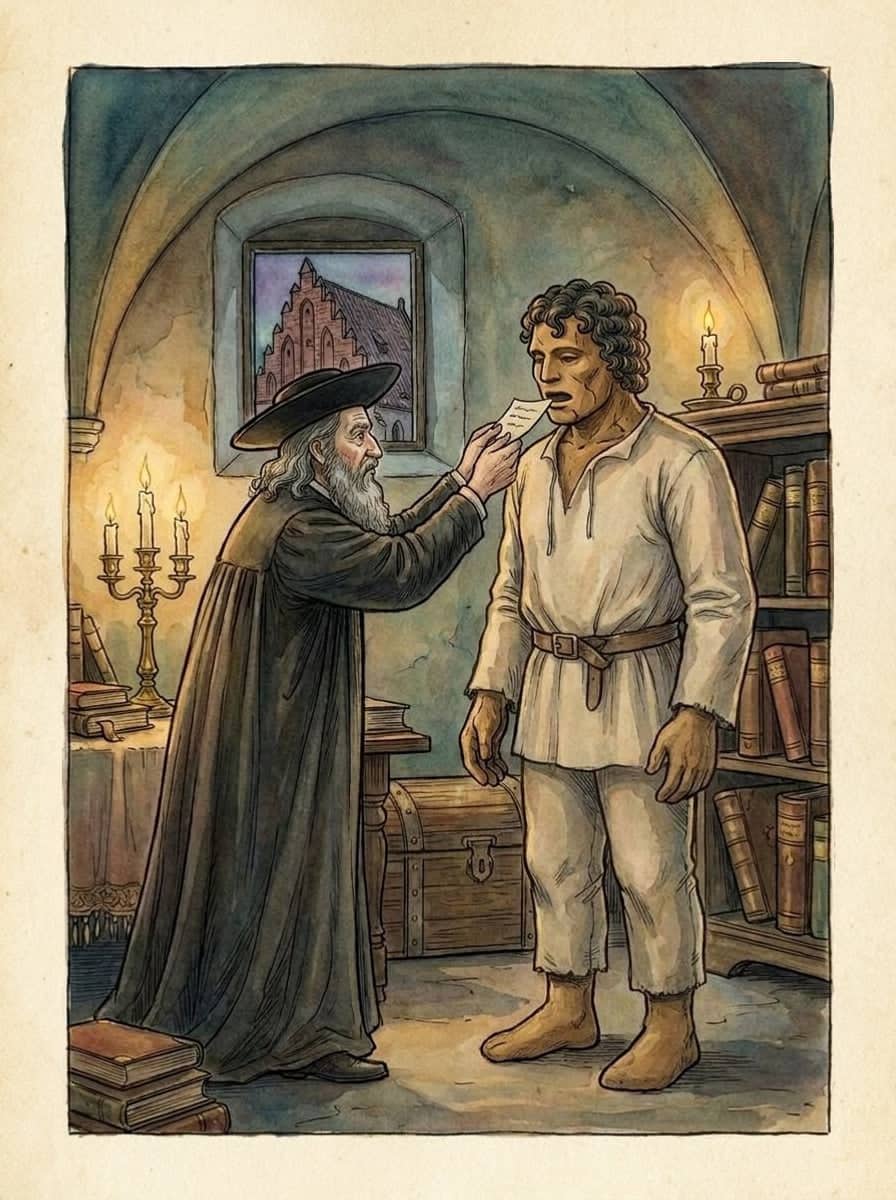
Yet a greater wonder than the patriarchs at the castle was the golem, the rabbi’s servant. Rabbi Loew had shaped him out of clay with his own hands and brought him to life by putting the shem into his mouth: a slip of paper bearing a Hebrew charm.
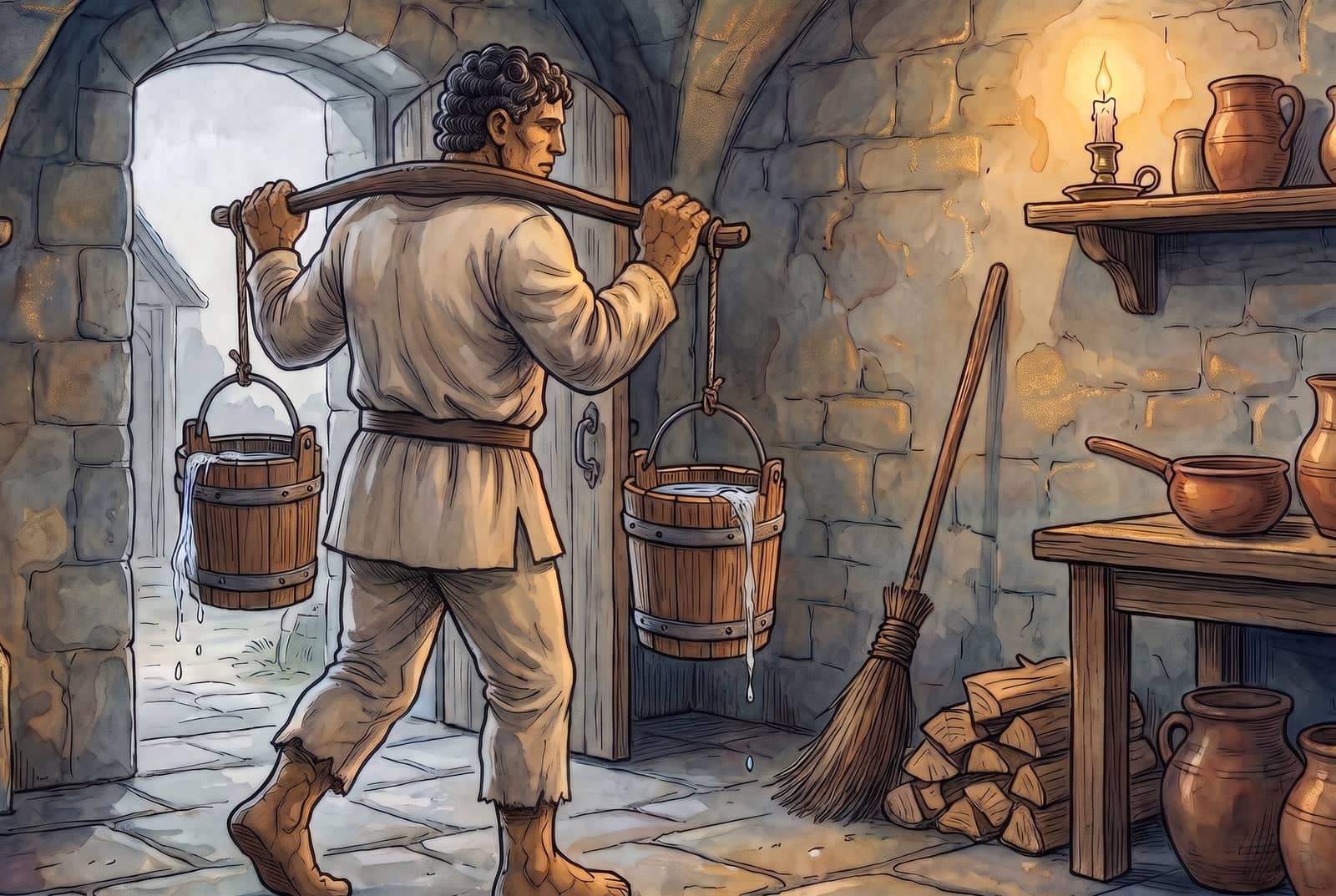
The golem did the work of two. He waited on the household, carried water, chopped wood, swept the floors, and did all the heavy work. He never ate, never drank, and never needed rest.
But every Friday evening, when the Sabbath began and all work had to stop, the rabbi took the shem out of his mouth. At once the golem went stiff. He stood in a corner like a lifeless doll, nothing but dead clay, until the Sabbath was over and the rabbi put the shem back into his mouth. Then the golem came to life again.
One Friday, though, as he was getting ready to go to the Old-New Synagogue to hallow the Sabbath, the rabbi forgot about the golem and left the shem in his mouth. He had only just stepped into the synagogue and begun the psalm when people came running after him from his house and from all the houses around. They were terrified. All at once they cried out that the golem was raging at home, that no one dared go near him, and that he would kill anyone who tried.
“Rabbi, come quickly! The golem has gone wild!”
For a moment the rabbi hesitated. The Sabbath was beginning, and he had already started the psalm. From now on any work at all, even the smallest effort, would be a sin. But he had not yet finished the psalm that hallows the day of rest, so the true Sabbath had not yet come. He rose and hurried home.
Before he even reached the house he heard dull thuds and crashing. He went in, while the others hung back a little way behind him in fear, and found everything wrecked: broken dishes, smashed and overturned tables, chairs, chests, and benches, and books flung everywhere. Indoors the golem had finished his work of ruin.
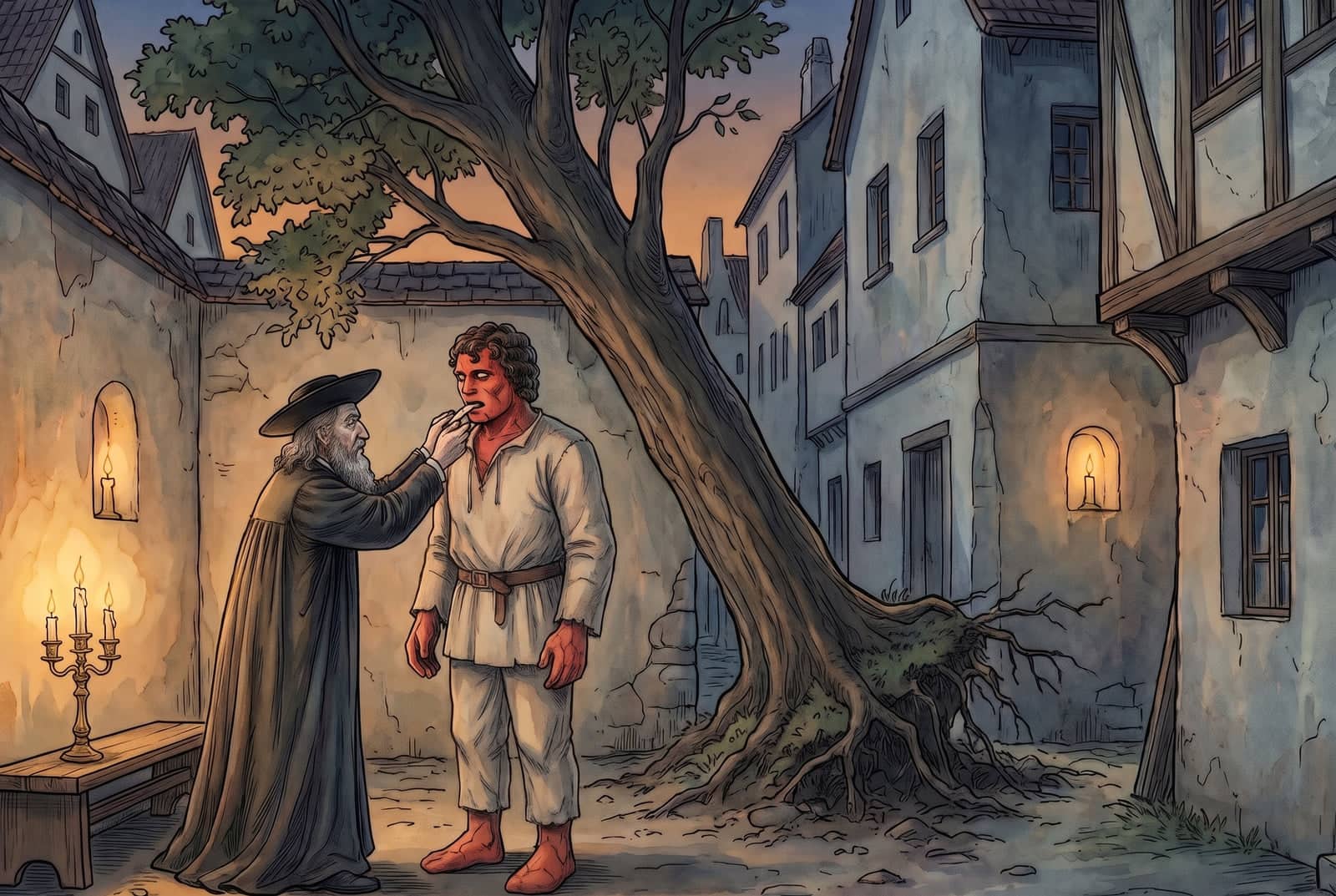
Now he was “working” in the yard. The hens, the chicks, the cat, and the dog all lay dead there, and he was tearing a thick linden tree out of the ground. His face was red, and his black curls flew about his forehead and cheeks as he wrenched up the tree as if it were a fence post.
The rabbi went straight up to him with his hands stretched out, looking him hard in the eye. The golem jerked as his master touched him. His eyes bulged, and he stared back at the rabbi, dazed, as if held fast by that powerful gaze. Then the rabbi reached between the golem’s teeth and, with one quick pull, drew the shem out of his mouth.
The golem dropped as if cut down. He fell to the ground and lay there limp, nothing now but a figure of clay. The people all around, young and old, shouted for joy, and now that they were brave again they came up to the fallen golem, laughing at him and calling him names.
The rabbi only drew a deep breath. He said not a word and walked back to the synagogue, where by the light of the lamps he began the psalm again from the beginning and hallowed the Sabbath.
The holy day of rest came and went, but Rabbi Loew never put the shem back into the golem’s mouth. So the golem never rose again. He stayed a figure of clay and was carried up to the attic, under the roof of the Old-New Synagogue, and there, in time, he crumbled to pieces.
Retold by Talerie from Staré pověsti české (opens in a new window) Public domain Copy this text, adapt it, use it however you like. A link back to Talerie is appreciated but never required. CC0 1.0 (opens in a new window)