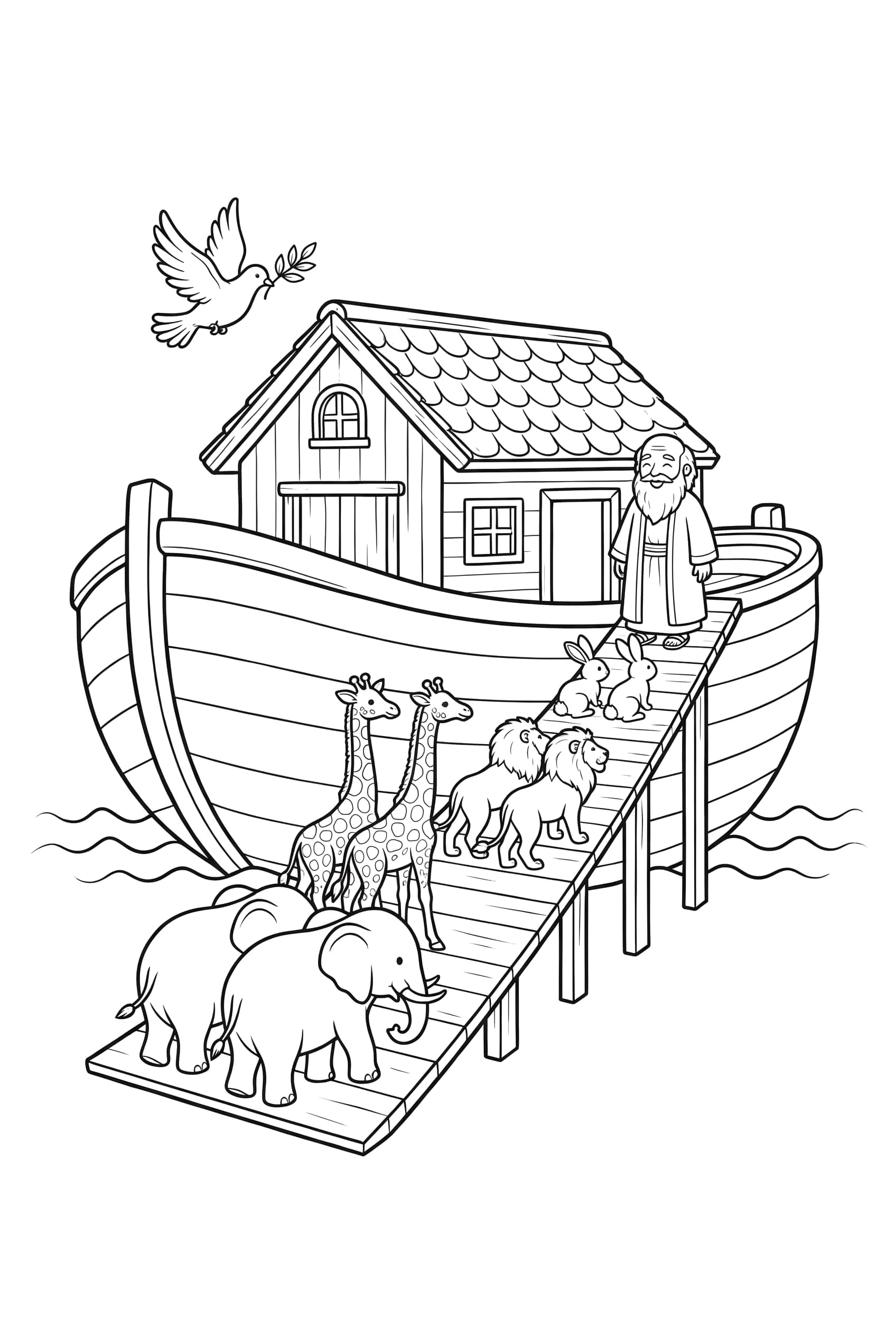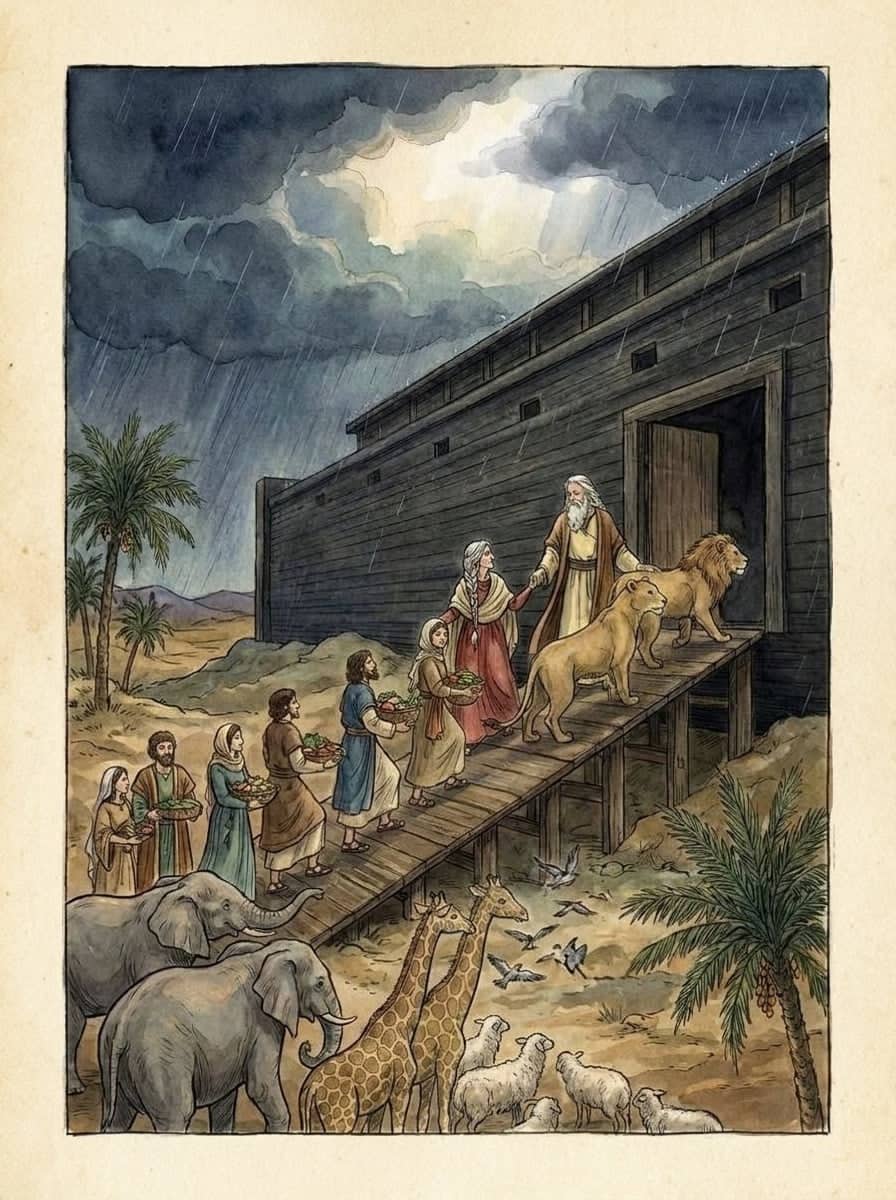
Noah is the one good man left in a world full of violence, and God tells him to build an ark. It must be huge, with three decks and rooms inside, coated with pitch inside and out. Two of every kind of creature will come to him, and in seven days the rain will begin.
In the early days of the world, people spread out over the whole earth. They had sons and daughters, and their families grew and grew. But as the years went by, they turned wicked. All they ever thought about was evil, and the earth was filled with violence.
God saw it, and it broke his heart that he had ever made people. “I will wipe them from the face of the earth,” God said, “the people and the animals, the creeping things and the birds of the air, because I am sorry that I made them.”
But there was one man God looked on with favor, and his name was Noah. Noah was good and honest, blameless among the people of his time, and he walked with God. He had three sons: Shem, Ham, and Japheth.
One day God spoke to Noah. “The end of everything that lives has come,” he said. “People have filled the earth with violence, and I am going to destroy them along with the earth. Build yourself an ark of wood. Make rooms inside it, and coat it with pitch inside and out. Make it huge, with three decks, one above the other. Put a window up under the roof and a door in its side.”
“I am going to bring a flood of water over the earth,” God went on, “to destroy every living thing that breathes under the sky. Everything on the earth will die. But with you I will make a covenant, a solemn promise. You will go into the ark, you and your wife, your sons and your sons’ wives, and you will live.”
“Bring into the ark two of every kind of living creature,” God said, “a male and a female, to keep them alive with you: two of every kind of bird, two of every kind of animal, and two of every kind of creature that creeps along the ground. They will come to you. And gather every kind of food there is and store it away, for you and for them.”
Noah did everything just as God commanded him.

When the ark was ready, God said to Noah, “Go into the ark, you and your whole family, for I have seen that you alone are good in this generation. Take seven of each kind of clean animal, the kind fit for an offering, male and female, and seven of each kind of bird as well, so that life will go on across the earth. Take one pair of all the other animals. In seven days I will send rain on the earth for forty days and forty nights, and I will wipe away every living thing I have made.”
And again Noah did everything God commanded him.
Noah was six hundred years old when the flood came. When the seven days were up, he went into the ark with his wife, his sons Shem, Ham, and Japheth, and his sons’ wives. The animals came to Noah two by two, male and female: wild animals and cattle, every creature that creeps on the ground, and birds of every kind, everything that had the breath of life. They went in just as God had commanded.
Then God shut the door behind them.
That same day all the springs deep under the earth burst open, and the floodgates of the sky opened wide. Rain poured down on the earth for forty days and forty nights.
The water rose and rose. It lifted the ark off the ground, and the ark floated on top of it. Higher and higher the water climbed, until even the highest mountains under the whole sky lay deep beneath it.

Every living thing on dry land died: the people, the animals, the creeping things, and the birds. Only Noah and those who were with him in the ark were left alive. For a hundred and fifty days the water covered the earth.
But God remembered Noah and all the animals with him in the ark. He sent a wind to blow over the earth, and the water began to go down. The springs of the deep were closed, the floodgates of the sky were shut, and the rain stopped. Slowly the water drained away, and at last the ark came to rest on the mountains of Ararat. The water kept going down, and months later the tops of the mountains could be seen.
Forty days after that, Noah opened the window he had made in the ark and sent out a raven. The raven flew back and forth until the water had dried up from the earth, but it brought him no sign.
Next Noah sent out a dove, to see whether the water had gone from the ground. But the dove found no place to rest her feet, because water still covered the whole earth, and she flew back to the ark. Noah reached out his hand, caught her, and brought her inside.
He waited seven more days and sent the dove out again. In the evening she came back to him, and there in her beak was a freshly picked olive leaf. Then Noah knew that the water had gone down.

He waited another seven days and sent the dove out once more. This time she did not come back.
Noah removed the covering of the ark and looked out, and he saw that the ground was dry. Still he waited, and only when the earth was dry all over did God speak to him.
“Come out of the ark,” God said, “you and your wife, your sons and their wives. Bring out every living thing that is with you, the birds, the animals, and all the creatures that creep along the ground, so that they can have young and spread out and fill the earth again.”
So Noah came out with his wife, his sons, and his sons’ wives, and after them came every animal, every creeping thing, and every bird, each with its own kind.
The first thing Noah did on dry land was to build an altar to God. He took some of the clean animals and birds and offered them on the altar as burnt offerings.
God smelled the pleasing aroma, and he said in his heart, “Never again will I curse the ground because of people, even though their hearts lean toward evil from the time they are young. Never again will I destroy every living thing, as I have done. As long as the earth lasts, seedtime and harvest, cold and heat, summer and winter, day and night will never stop.”
Then God blessed Noah and his sons. “Have many children,” he said, “and fill the earth.”
God went on, “Now I am making my covenant with you and with your children after you and with every living creature that came out of the ark with you. Never again will all life be cut off by the waters of a flood. Never again will there be a flood to destroy the earth.”
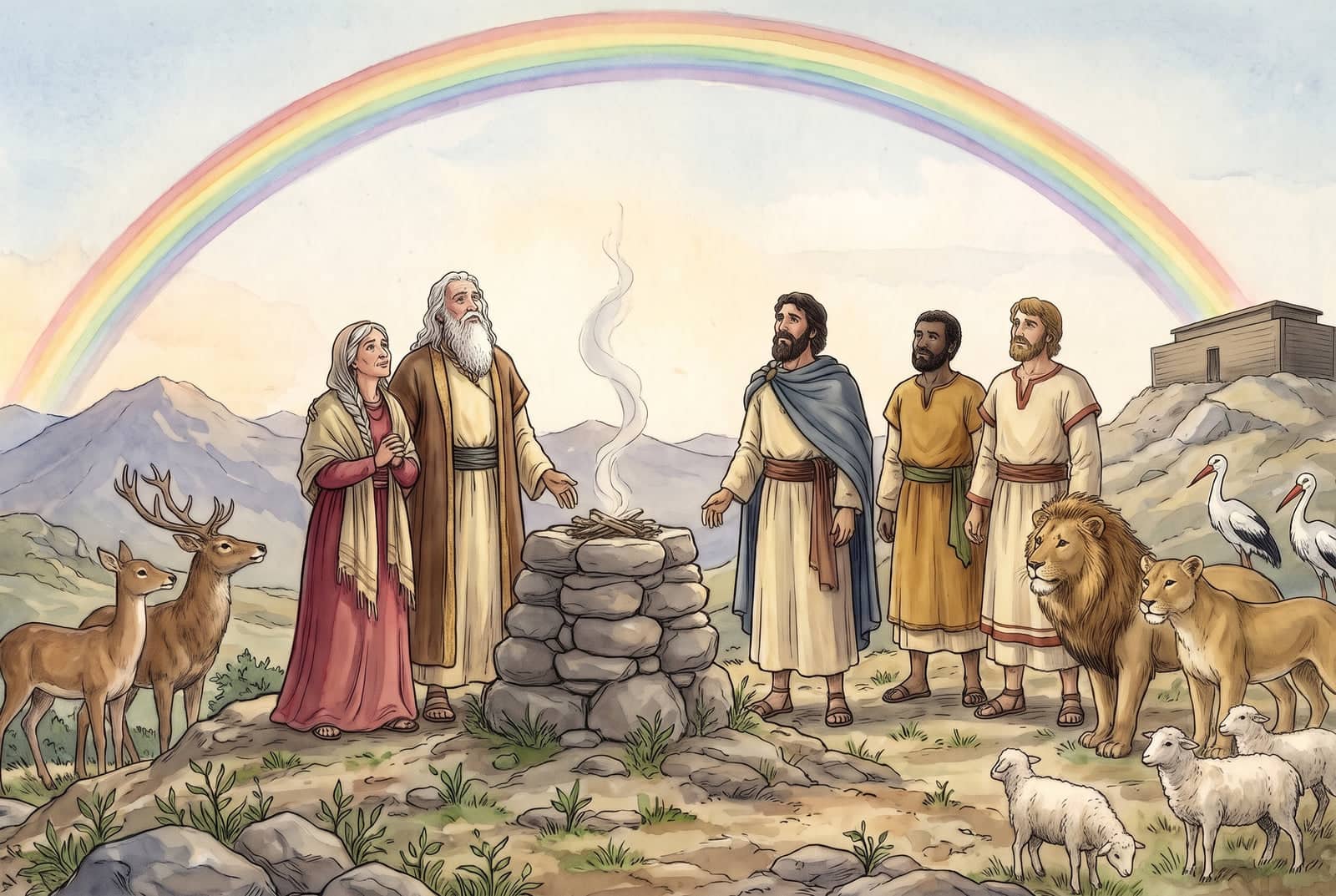
“And this is the sign of the covenant,” God said, “between me and you and every living creature with you, for all the generations to come. I have set my rainbow in the clouds. Whenever I bring clouds over the earth and the rainbow appears in them, I will see it, and I will remember my covenant with you and with every living thing. The waters will never again become a flood to destroy all life.”
Retold by Talerie from King James Version (opens in a new window) Public domain Copy this text, adapt it, use it however you like. A link back to Talerie is appreciated but never required. CC0 1.0 (opens in a new window)