The Legend of Sleepy Hollow
15 min readages 7 and uptalerie.com/en/tales/the-legend-of-sleepy-hollow
A gawky schoolmaster named Ichabod Crane courts Katrina Van Tassel, with the burly Brom Bones for a rival. Riding home at midnight he is chased to the church bridge by the Headless Horseman, and next morning the search turns up nothing but his hat and a smashed pumpkin.
On the eastern shore of the Hudson, where the river widens so far that the old Dutch sailors called it the Tappan Zee, lies a little valley folded in among high hills. It is one of the quietest places in the world. A brook slips through it with just enough murmur to send a person to sleep, and the people who live there go about half inside a daydream. The valley has been called Sleepy Hollow for longer than anyone can remember.
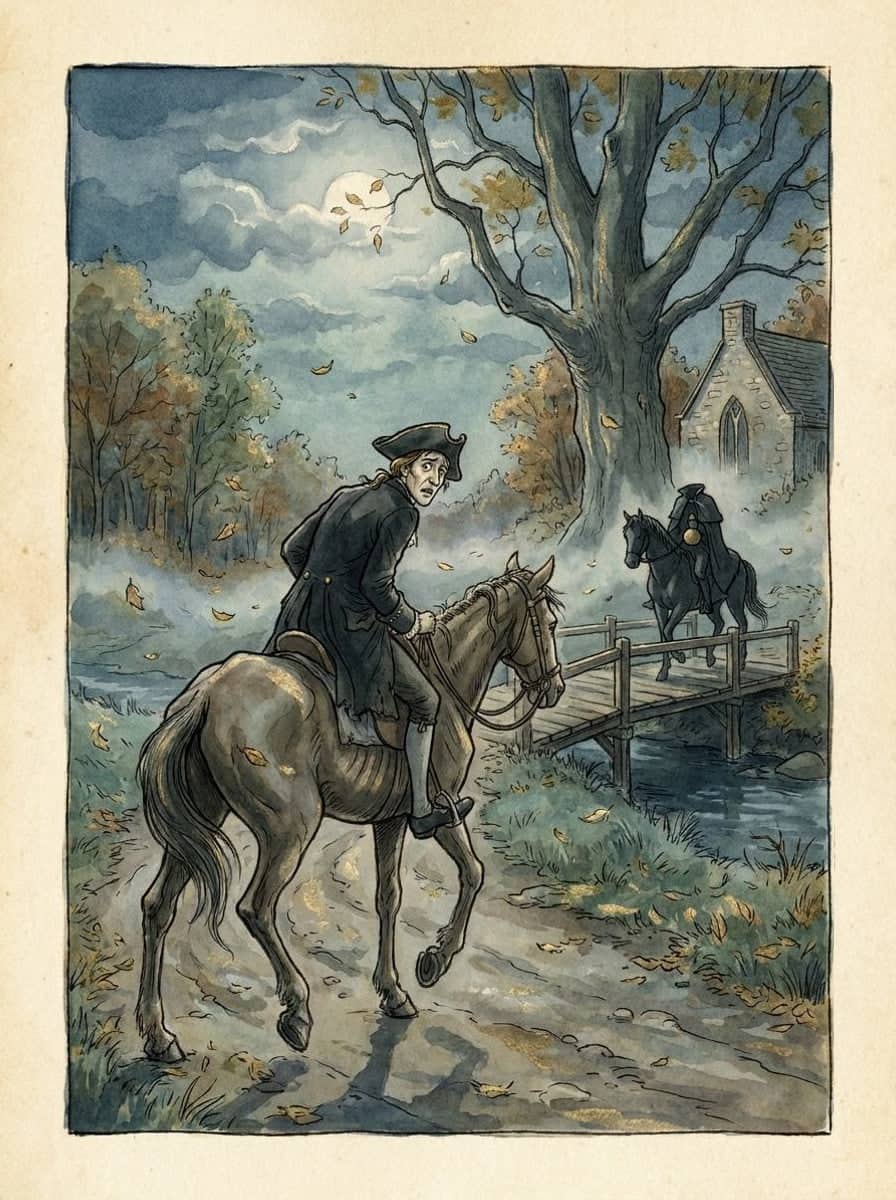
Of all the shapes said to haunt it, the greatest is a rider on horseback with no head. He was a soldier once, they say, a Hessian trooper whose head was carried off by a cannonball in some forgotten battle of the Revolutionary War, and he lies buried in the churchyard nearby. Every night he rides out to hunt for what he lost, and if he sweeps down the Hollow like a sudden wind, it is because he must be back among the graves before daylight. At every fireside in that country he is called the Galloping Hessian, or the Headless Horseman of Sleepy Hollow.
Long ago, a schoolmaster named Ichabod Crane came to teach in the valley, and his name suited him. He was tall and thin as a reed, with hands that dangled far out of his sleeves. His small flat head, with its big ears and long thin nose, sat on his spindle of a neck like a weathervane. Striding along a hilltop with his coat flapping, he might have been a scarecrow that had run off from a cornfield.
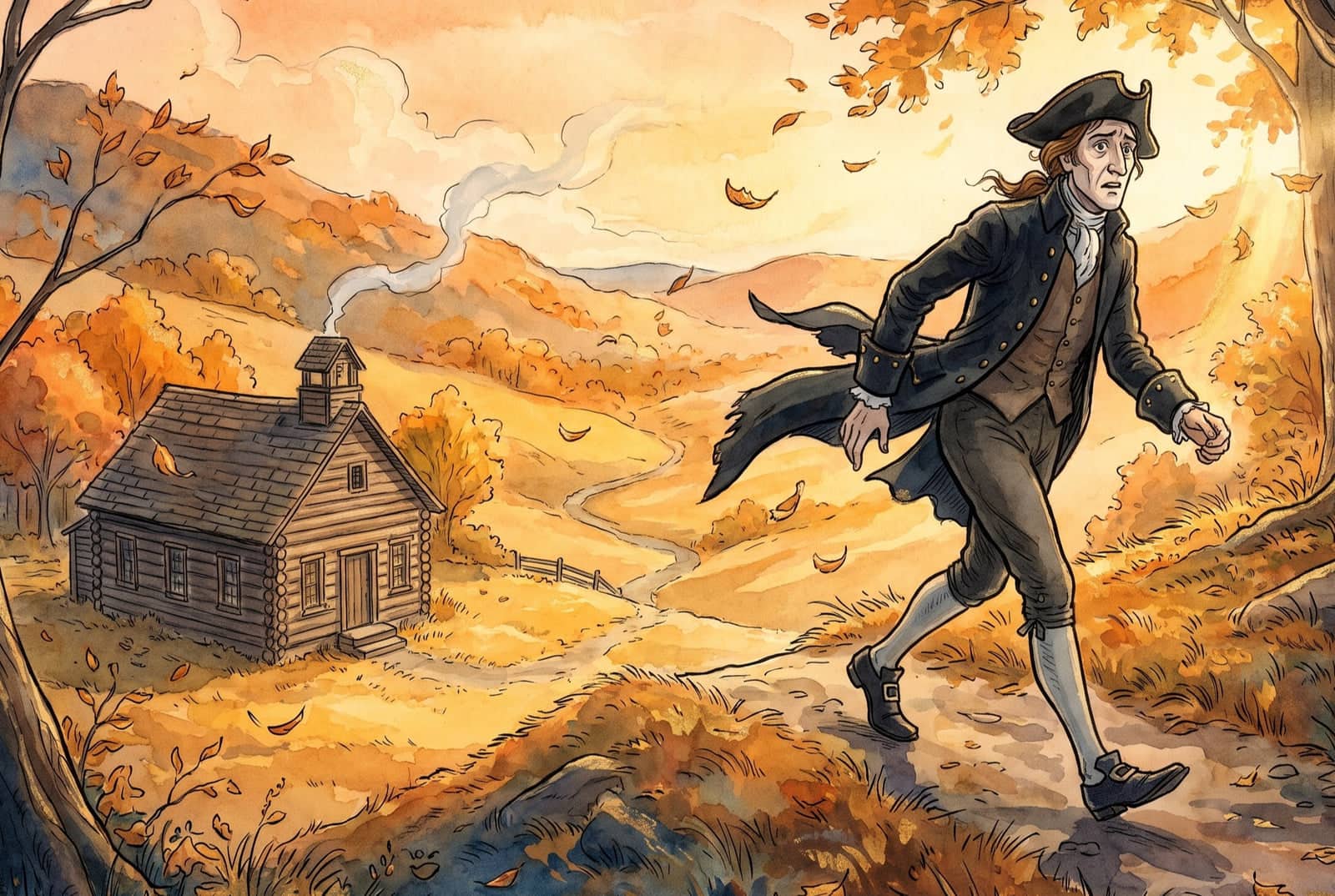
His school was one low room of logs, and he was no tyrant in it. His pay was small, so he boarded a week at a time with the farmers whose children he taught, making the rounds of the neighborhood with everything he owned tied up in a cotton handkerchief. He was the singing master besides, and led the singers in the church gallery every Sunday.
He was an odd mixture of shrewdness and simple belief. He knew Cotton Mather’s history of New England witchcraft almost by heart, and no story was ever too strange for him to swallow. He loved winter evenings with the old Dutch wives by the fire, listening to their tales of haunted brooks and haunted bridges and above all of the Galloping Hessian of the Hollow. It was delightful in a warm room, and dearly paid for on the walk home.
Then his path was crossed by something that troubles a man more than all the ghosts and goblins in the world, and that was a young woman.
Katrina Van Tassel came to his singing lessons one evening a week. She was eighteen, the only child of a well-to-do Dutch farmer, rosy as one of her father’s peaches, and famous through the whole country as much for what she stood to inherit as for her beauty. She knew it, too, and she was a bit of a flirt.
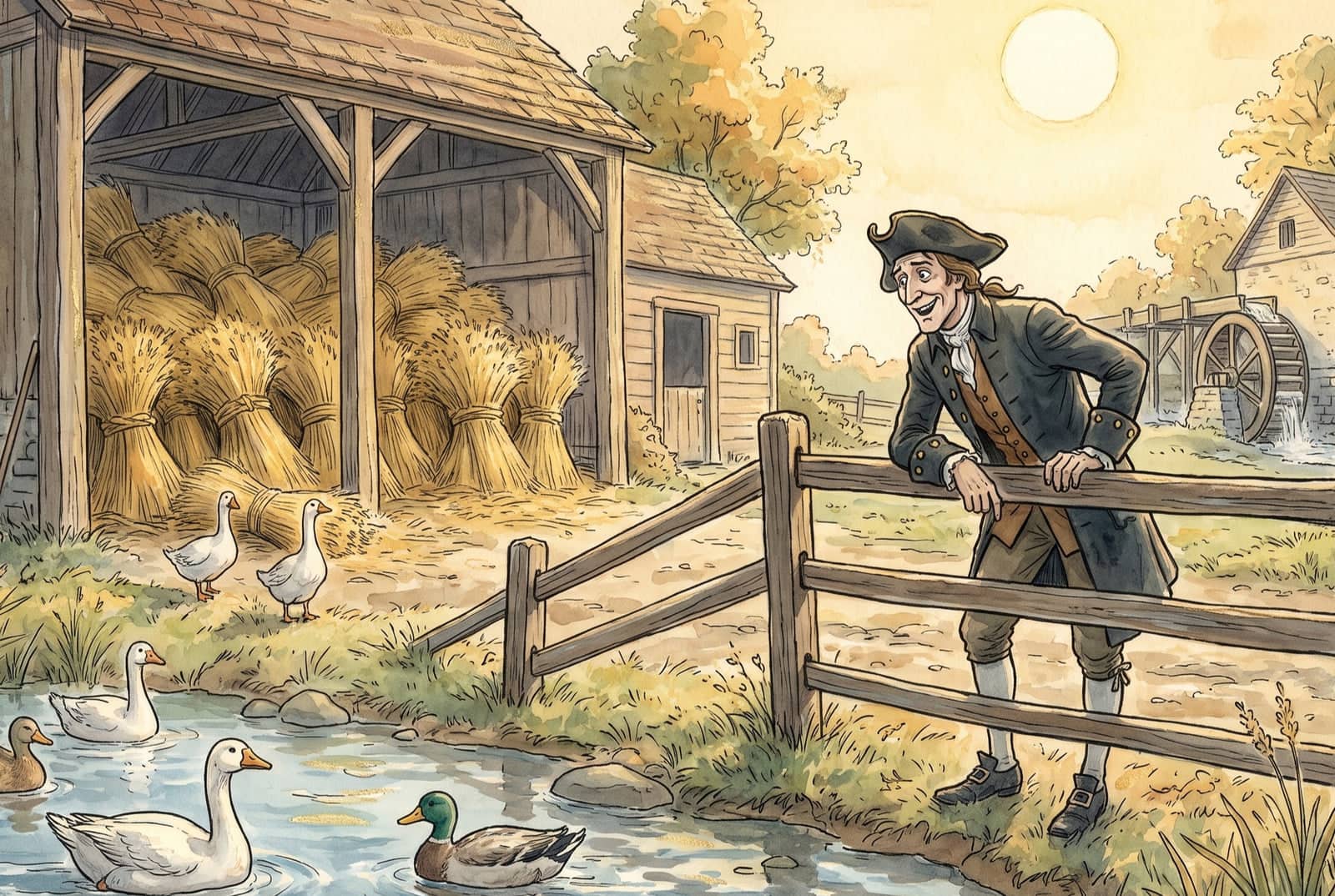
Ichabod had a soft and foolish heart, and it is no wonder she found favor in his eyes, especially after he had seen her father’s house. Beside it stood a barn as big as a church, so full that it seemed ready to burst at every crack, and geese and ducks sailed in fleets on the pond. The schoolmaster’s mouth watered: in his mind’s eye the geese were already swimming in their own gravy. From that hour his whole study was how to win the daughter of Van Tassel.
But a crowd of country admirers beset every door to her heart, and the most formidable of them was a broad, roaring, good-humored fellow named Abraham Van Brunt, whom everyone called Brom Bones for his enormous strength. He was famous as a horseman and first at every race, and there was more mischief than spite in him. When he and his companions went past the farmhouses at midnight with whooping and hallooing, the old women woke, listened until the clatter died away, and said, “There goes Brom Bones and his gang.”
Brom had picked out Katrina for his rough attentions, and it was whispered that she did not discourage him. When his horse stood tied to the Van Tassel fence on a Sunday evening, the other suitors gave up for the night.
Ichabod knew better than to meet such a rival in the open. Under cover of being the singing master he came often to the farmhouse, and he had nothing to fear from the parents: Balt Van Tassel let his daughter have her own way, and his busy little wife held that ducks and geese are foolish things and must be looked after, but girls can take care of themselves.
From the time those visits began the fortunes of Brom Bones went down, and a quiet, deadly feud grew up between the two. Brom would have liked to settle it by single combat, but Ichabod had heard him promise to fold the schoolmaster up and lay him on a shelf in his own schoolhouse, and never gave him the chance. So Brom was left with tricks. He and his riders smoked out the singing school by stopping up the chimney, broke in at night and turned everything upside down, and trained a dog to whine most pitifully and presented it to Katrina as a rival teacher of singing.
Matters stood so until one fine autumn afternoon, when a messenger came clattering up to the school door with an invitation for Ichabod to a merrymaking at the Van Tassel farm that very evening. The schoolroom turned into an uproar, books were flung aside, and the whole school was let loose an hour early.
Ichabod brushed his best and only suit of rusty black, and to arrive in proper style he borrowed a horse from the farmer he lodged with, a hot-tempered old Dutchman named Hans Van Ripper. The horse was called Gunpowder, a worn-out plow horse, gaunt and shaggy, one eye blind and staring, the other with a gleam of pure mischief.
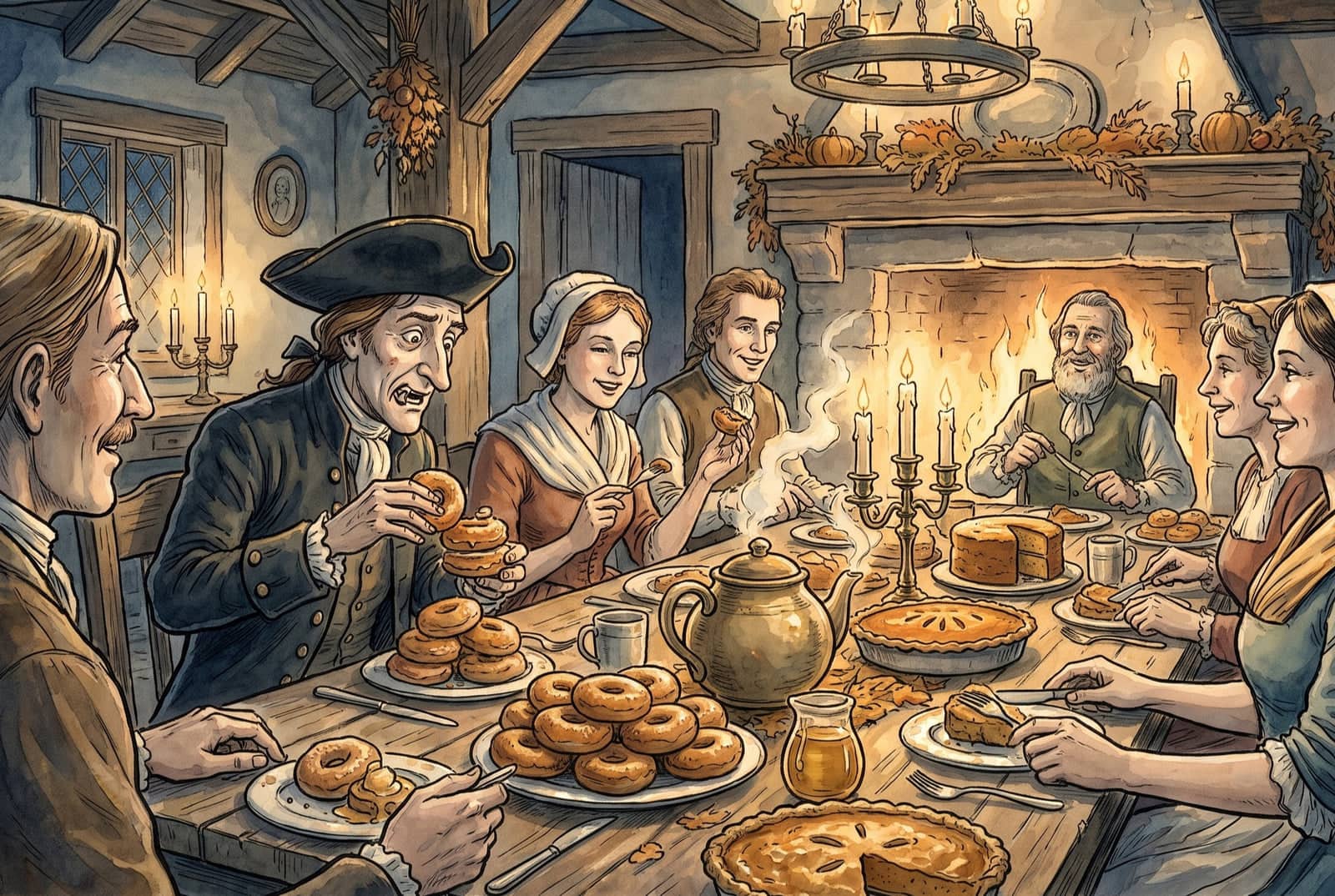
He rode over in the golden afternoon, his eye as always on the pumpkins turning their round bellies to the sun, and found the house already crowded. Brom Bones was there before him on his favorite horse Daredevil, which nobody else could manage. Inside, the tea table burst upon Ichabod like a vision: doughnuts and crullers, ginger cakes and honey cakes, apple pies and pumpkin pies, and the motherly teapot steaming in the middle of it all. He did full justice to every dish, chuckling to think that one day all of this might be his.
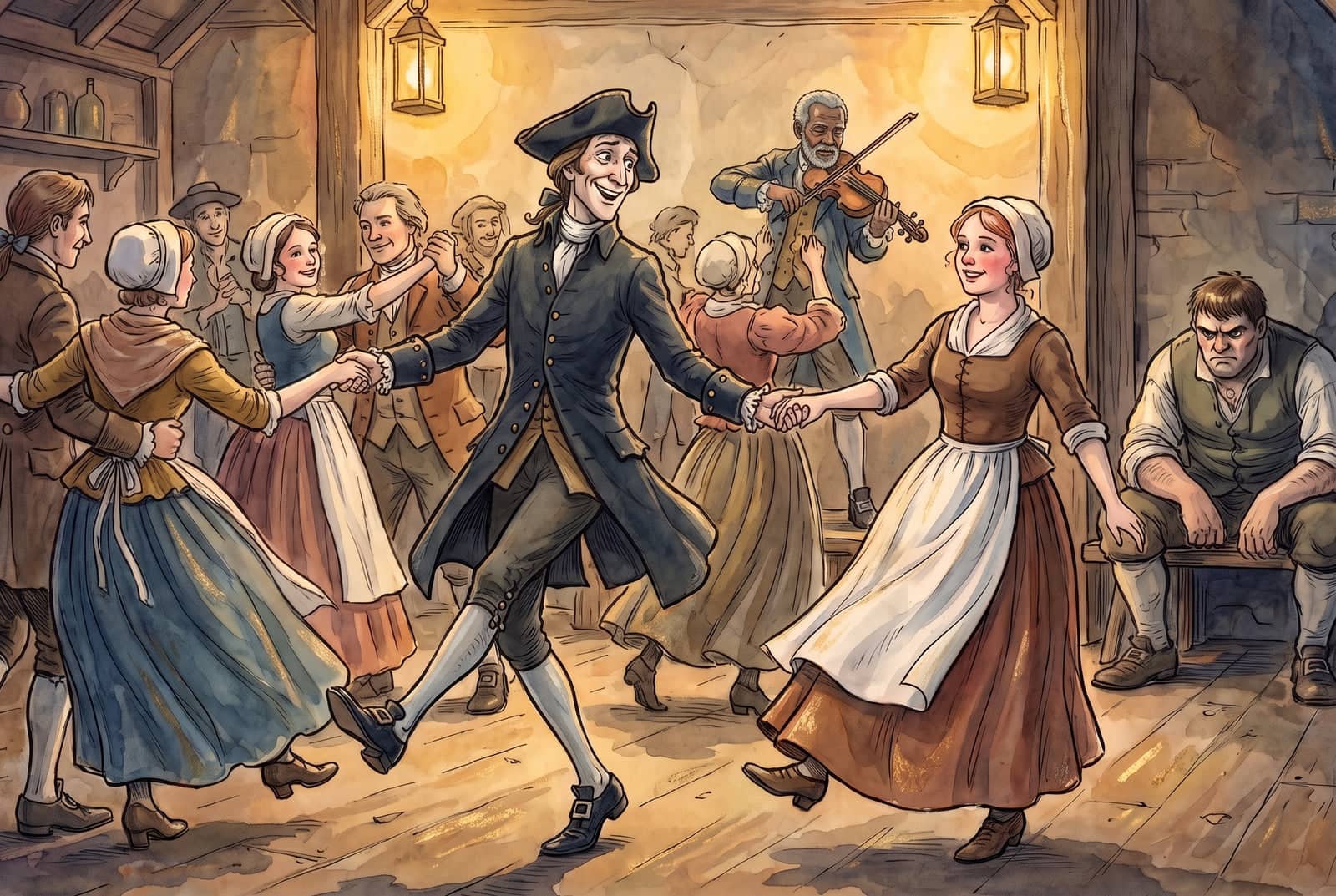
Then the fiddle called them to the dance, and Ichabod, who was as proud of his dancing as of his singing, had Katrina herself for a partner, while Brom Bones, sore with love and jealousy, sat brooding alone in a corner.
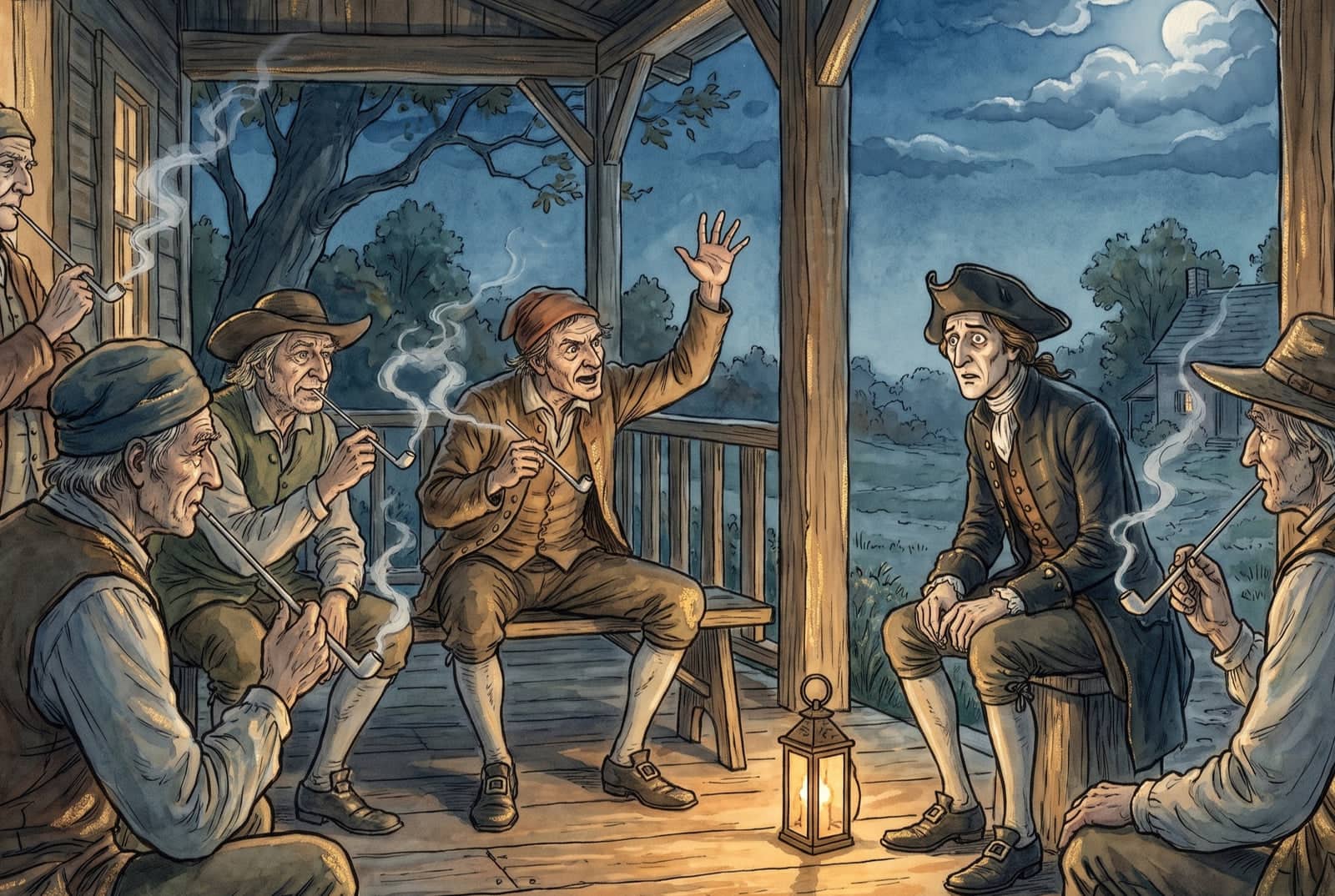
When the dancing ended, Ichabod drifted over to the older men smoking on the porch. They told long stories of the war, and then, better still, ghost stories: of the tree near which the unlucky Major André had been taken prisoner, and most of all of the headless horseman, lately seen on the roads again and said to tie his horse every night among the graves.
The church he haunts stands on a knoll among locust trees, and beside it a brook runs under a wooden bridge so thickly overhung with branches that the road is dark even at noon. That bridge is his favorite place. Old Brouwer, who did not believe in ghosts at all, had once been made to ride behind him over hill and swamp, and at the bridge the rider turned into a skeleton, tipped him into the brook and sprang away over the treetops with a clap of thunder.
Brom Bones capped the story at once, making light of the Galloping Hessian as no great horseman at all. Coming home one night from the next village, he said, he had been overtaken by the trooper himself and had offered to race him for a bowl of punch, and would have won it too, for Daredevil beat the goblin horse hollow; but at the church bridge the Hessian bolted and vanished in a flash of fire. All of it sank deep into Ichabod’s mind.
Then the party broke up. The wagons rattled away along the hollow roads until the house stood quiet and deserted. Ichabod stayed behind, as country lovers do, for a few words alone with the heiress, quite sure that he was on the high road to success. What passed between them nobody knows. Something must have gone wrong, though, for before very long he came out again looking desolate, woke his horse out of a comfortable dream and set off for home.
It was the very witching time of night, and the hour was as dismal as he was. Every ghost story he had heard that evening came crowding back. In the middle of the road stood an enormous tulip tree, which everyone knew as Major André’s tree. Ichabod began to whistle, and thought his whistle was answered; it was only a gust going sharply through the dry branches. Then he thought he saw something white hanging in the tree, and looked hard, and found a place where lightning had stripped the bark. Then he heard a groan, and his knees knocked against the saddle; it was one great bough rubbing on another as the breeze swayed them. He passed the tree safely, but more trouble lay ahead.
A couple of hundred yards on, a brook crossed the road and ran into a marshy glen, with a few rough logs laid side by side for a bridge under a cavernous gloom of oaks and grapevines. It was here that Major André had been captured, and the stream has been considered haunted ever since. Ichabod kicked his horse to dash across, but old Gunpowder went sideways instead and ran against the fence, then plunged into a thicket of brambles. Whip and heel together brought him snorting up to the bridge, where he stopped so suddenly that his rider was nearly thrown. Just then a splashing tread beside the bridge caught Ichabod’s ear. In the shadow of the trees he saw something huge and black and shapeless, gathered up in the dark like a giant waiting to spring.
The poor schoolmaster’s hair stood up on his head. It was too late to turn and run, and what good would running do against a thing that could ride on the wind? So he put on a show of courage and asked, in a voice that would not hold steady, “Who are you?”
He got no answer. He asked again, more shakily than before, and still there was no answer. He shut his eyes, thumped Gunpowder’s sides and broke out into a psalm tune. At that the shadow moved, and with a scramble and a bound it stood in the middle of the road: a rider of great size on a powerful black horse. He offered neither harm nor greeting, but kept to one side, jogging along on Gunpowder’s blind side.
Ichabod had no taste for such company, and remembering the story of Brom Bones he urged his horse on to leave the stranger behind. The stranger’s horse went faster too. Ichabod fell into a walk, meaning to drop back, and the other did the same. He tried to take up his psalm tune again, but his tongue stuck to the roof of his mouth. There was something dreadful in that dogged silence, and in a moment he understood it. They came up a rise that showed the stranger against the sky, huge and wrapped in a cloak, and Ichabod saw that the man had no head, and that the head he should have been wearing was carried before him on the saddle.
He rained kicks on Gunpowder and tried to bolt away, but the black horse sprang forward with him, and off they went through thick and thin, stones flying and sparks flashing at every bound. At the turning for Sleepy Hollow, Gunpowder swerved the other way and plunged downhill to the left, toward the bridge famous in every goblin story, with the white church on its knoll just beyond.
Halfway down the hollow the saddle girth gave way. Ichabod grabbed the pommel, then saved himself just in time by throwing his arms round Gunpowder’s neck, and the saddle fell into the road, where he heard it trampled by his pursuer. It was Hans Van Ripper’s Sunday saddle, but this was no time for small worries.
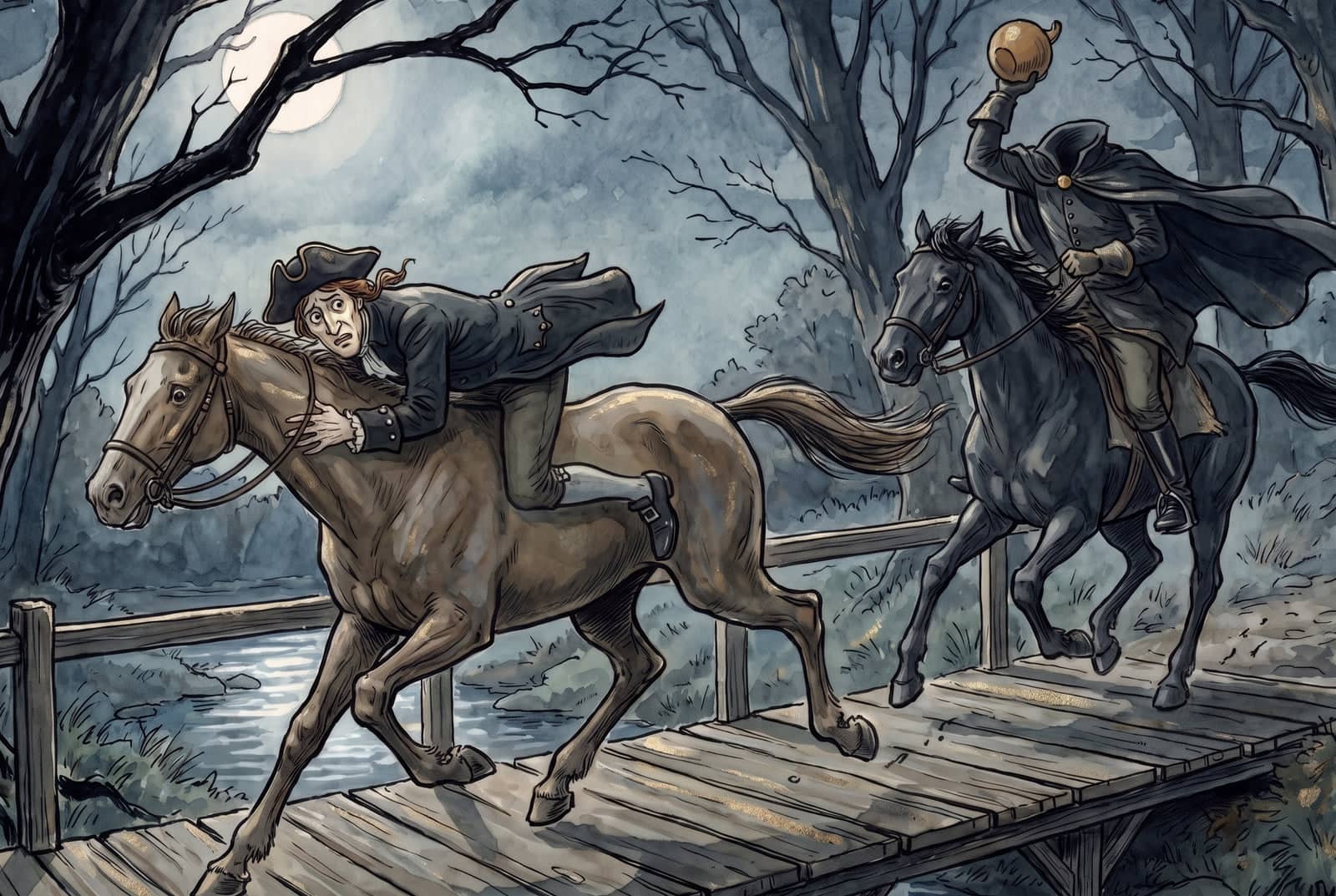
A break in the trees gave him hope. The trembling reflection of a star in the water told him the bridge was near, and the church walls glimmered dimly beyond. “If I can only reach that bridge,” he thought, “I am safe.” Just then he heard the black horse panting close behind him and fancied he could feel its hot breath. One more kick, and Gunpowder leapt onto the bridge, thundered over the planks and gained the other side. Ichabod looked back, expecting his pursuer to vanish in a flash of fire. Instead he saw the horseman rise in his stirrups and hurl the head straight at him. He tried to duck, but he was too late. Something struck him with a crash, and he was tumbled off into the dust, while Gunpowder and the black horse and the rider went past him like a whirlwind.
Next morning the old horse was found at his master’s gate without his saddle, cropping the grass. Ichabod did not come to breakfast, and dinner time came with no Ichabod. A search found the saddle trampled in the dirt on the road to the church, and the deep prints of hoofs leading down to the bridge; and beyond it, on the bank where the water runs deep and black, they found Ichabod’s hat, and beside it a smashed pumpkin.
The brook was searched, but the schoolmaster was nowhere to be found. Everything he owned came to two shirts and a half, a rusty razor, a dog-eared psalm book, and a sheet of paper blotted with attempts at a poem in honor of the heiress of Van Tassel. Hans Van Ripper put the paper straight into the fire and declared he would send his children to school no more, since he never knew any good come of all this reading and writing.
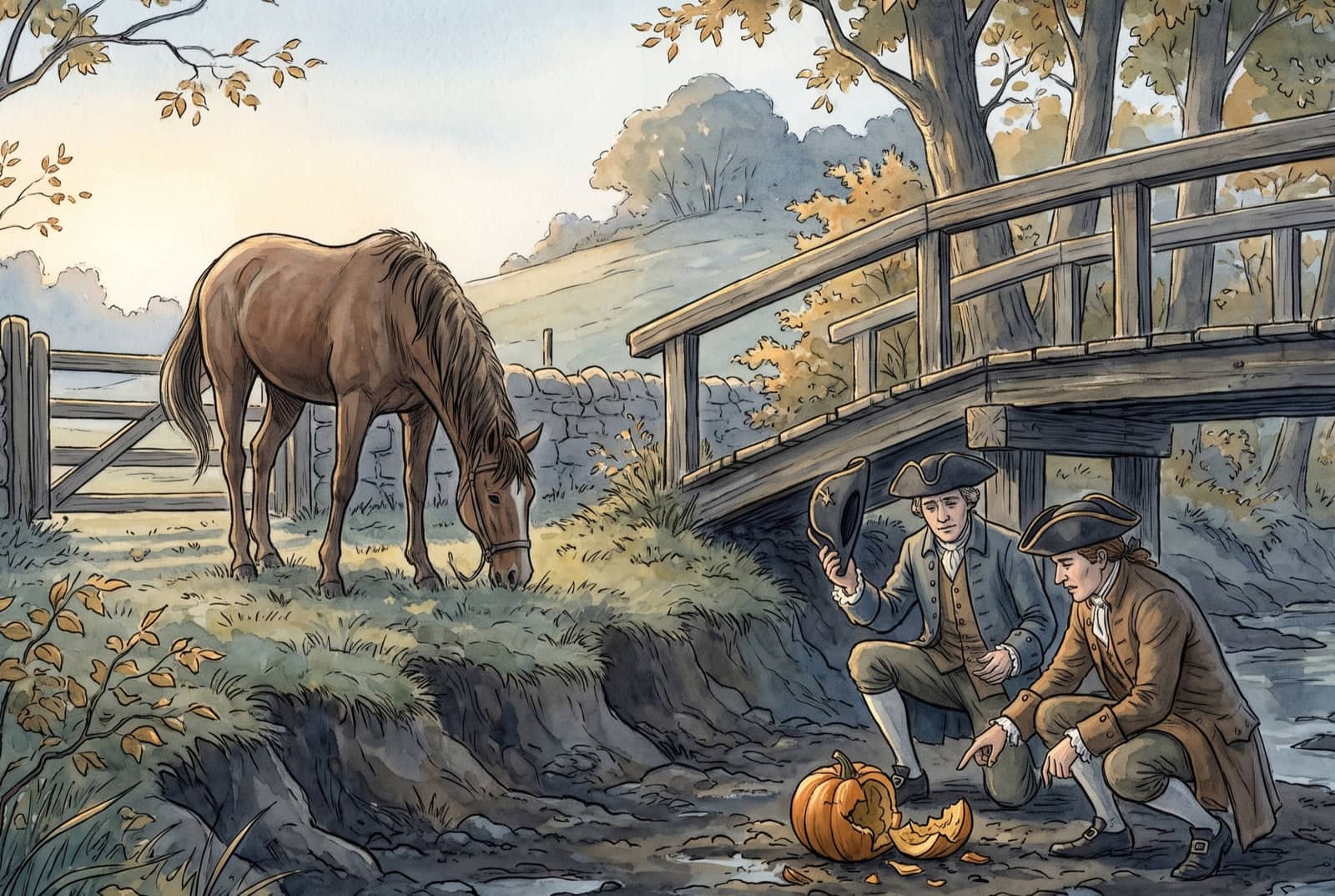
The whole neighborhood talked of nothing else at church the following Sunday. When they had considered the story of old Brouwer and the story of Brom Bones, they shook their heads and agreed that Ichabod had been carried off by the Galloping Hessian. Another schoolmaster reigned in his place, and the school was moved to a different corner of the hollow.
An old farmer who went down to New York some years afterward brought back a different account. He said Ichabod Crane was alive and well: he had left the neighborhood partly for fear of the goblin, partly for fear of Hans Van Ripper, and partly out of mortification at being so suddenly refused by the heiress, and had gone to a distant part of the country, where he kept school, studied law and ended as a respected judge. As for Brom Bones, who led the blooming Katrina to the altar not long after his rival disappeared, he always looked exceedingly knowing whenever the story was told, and burst out laughing every time anyone mentioned the pumpkin.
But the old country wives, who are the best judges of these matters, insist to this day that Ichabod was carried off by more than earthly means, and it is still a favorite story to tell beside the fire. The schoolhouse was left empty and soon fell to pieces, and they say that the poor schoolmaster’s ghost haunts it, and that the plowboy going home on a still summer evening has often thought he heard a voice far off, singing a sad psalm tune somewhere in the quiet of Sleepy Hollow.
Retold by Talerie from The Legend of Sleepy Hollow (opens in a new window)License: Public domainCopy this text, adapt it, use it however you like. A link back to Talerie is appreciated but never required.CC0 1.0 (opens in a new window)