A tramp asks for a roof for the night, but the old woman swears she hasn’t a crumb in the house. She is simply the stingiest woman for miles around. So he borrows a pot, fills it with water, and drops in a smooth gray stone.
There was once a tramp making his way through a forest. The houses stood so far apart that he had little hope of finding shelter before dark, and the evening was already coming down cold. Then he saw a light between the trees, and a little way ahead stood a cottage with a fire burning on the hearth. A warm hearth, and perhaps a bite of something as well, carried him the rest of the way to the door.
An old woman came out to meet him.
“Good evening, and well met,” said the tramp.
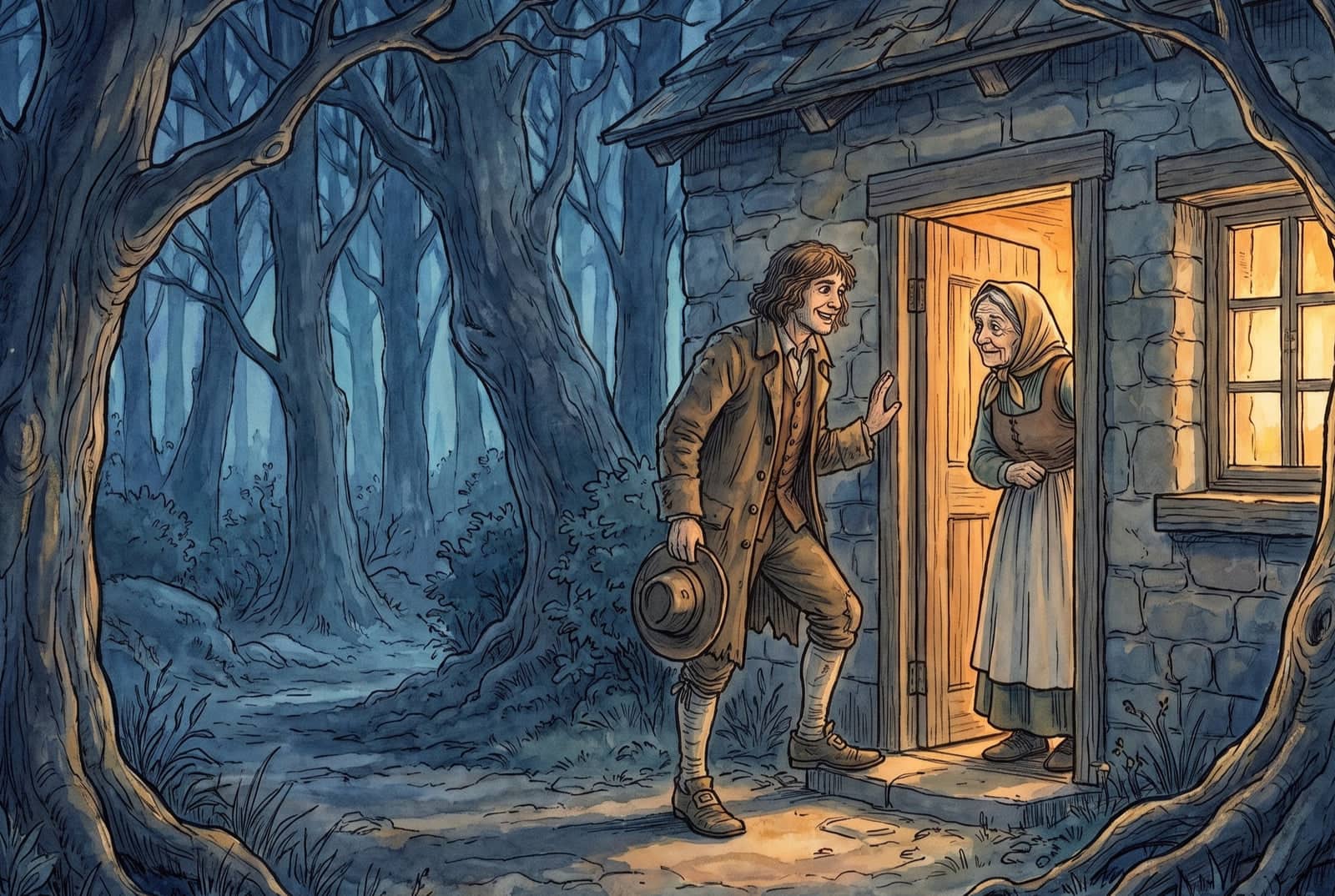
“Good evening,” said the woman. “Where do you come from?”
“South of the sun and east of the moon,” said the tramp. “And now I am on my way home again, for I have been everywhere in the world except right here.”
“Then you must be a great traveler,” said the woman. “And what is your business with me?”
“Only a roof for the night,” he said.
“I thought as much,” said the woman, “but you may as well walk straight on again. My husband is away, and my house is not an inn.”
“My good woman,” said the tramp, “you must not be so hard. We are both of us human beings, and human beings should help one another. So it is written.”
“Help one another?” said the woman. “Help? Did you ever hear the like? And who’s to help me, I should like to know? I haven’t a crumb in the house. No, you must look for a bed somewhere else.”
But the tramp was not the sort to give up at the first no. However much she grumbled, he went on asking and pleading like a hungry dog at a window, until at last she gave in and let him lie on the floor for the night.
That was very kind of her, he thought, and he thanked her for it, for he was a merry fellow and always had a rhyme ready.
Better a floor where the fire burns bright than the cold of the forest all night.
Once he was inside he could see that the woman was not nearly as poor as she claimed. She was simply the stingiest woman for miles around, and she grumbled from morning until night.
So he made himself pleasant, and asked in his most winning way whether there might be anything to eat.
“And where should I get it from?” said the woman. “I haven’t tasted a bite myself all day.”
But the tramp was a crafty one.
“Poor old granny, you must be starving,” he said. “Well then, I suppose I shall have to invite you to have something with me.”
“Have something with you!” said the woman. “You don’t look like a man who could offer anybody anything. What have you got, I should like to know?”
The tramp only smiled, and answered her with a rhyme.
Whoever roams both far and wide sees more than those who stay inside, and whoever has seen a thing or two will know a trick to see him through.
“Lend me a pot, granny,” he said.
The old woman grew curious, as you may imagine, and she let him have a pot.
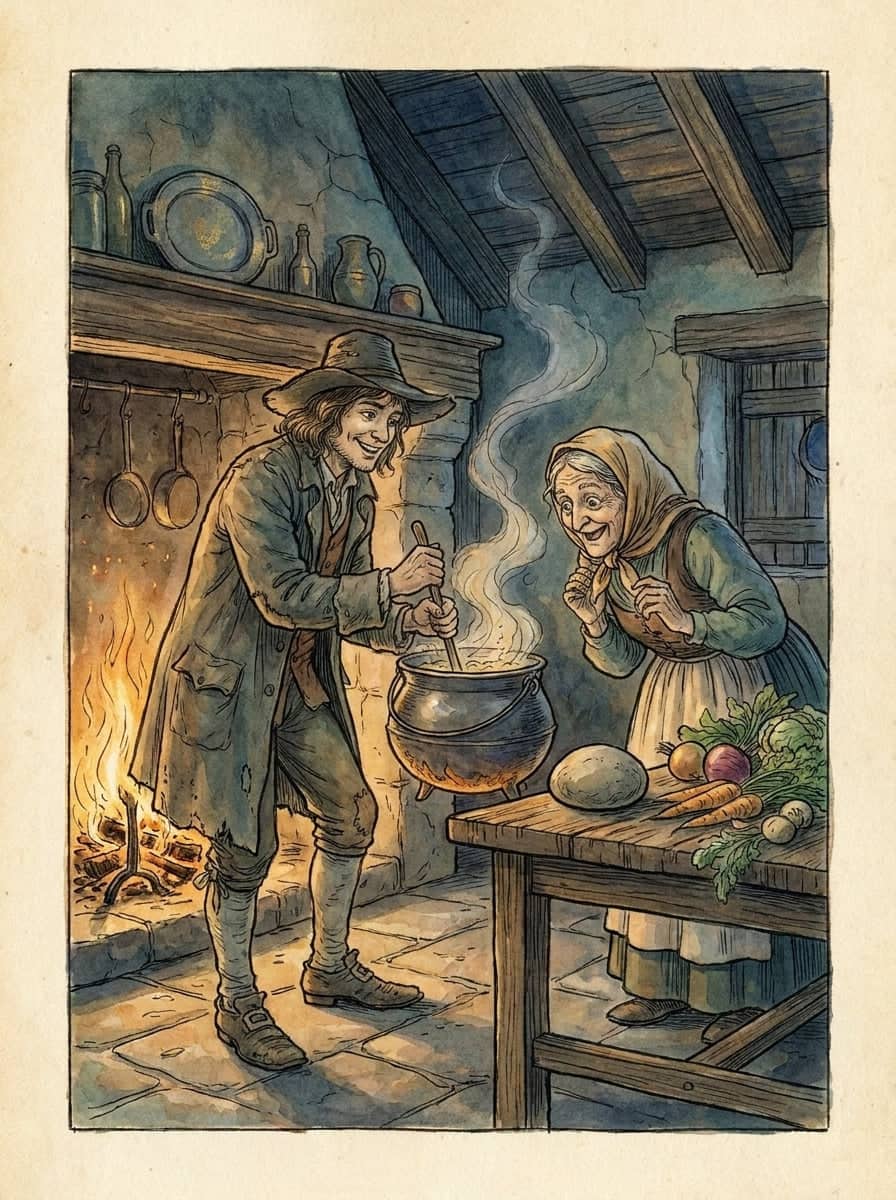
He filled it with water, set it on the fire, and blew until the flames stood up bright all around it. Then he took a smooth gray stone out of his pocket, turned it three times in his hand, and dropped it in.
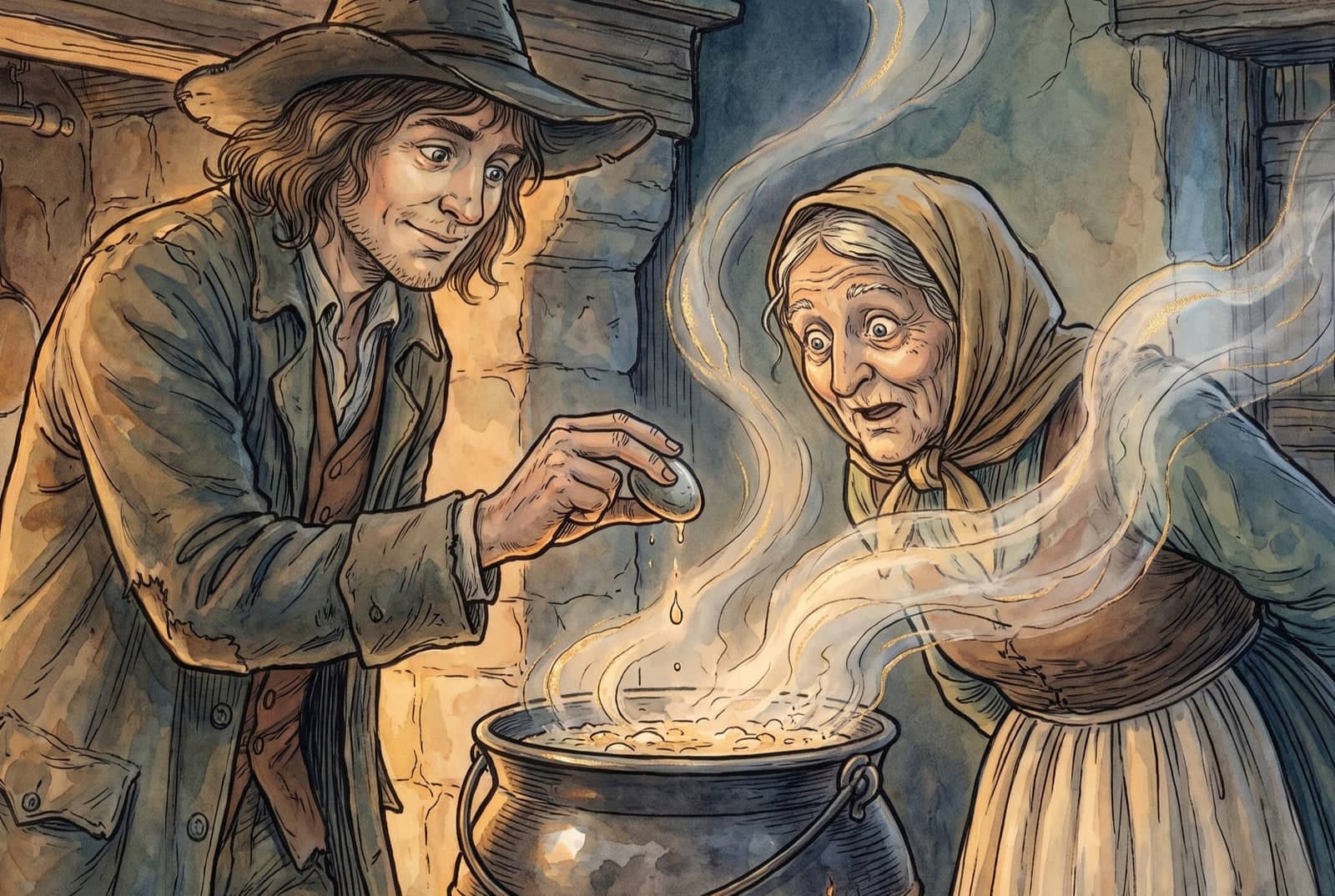
The woman stared.
“And what’s that going to be?” she asked.
“Stone soup,” said the tramp, and began to stir the water with a long wooden spoon.
“Stone soup?” said the woman.
“Yes. Stone soup,” said the tramp.
The old woman had seen a good deal in her life and heard more, but that anybody could make soup out of a stone was new to her.
“That is a thing poor folk ought to know,” she said. “I should like to learn how it is done.”
“A thing worth having is worth asking for,” said the tramp. If she wanted to learn, he said, she had only to watch, and he went on stirring.
The old woman crouched down by the hearth with her hands around her knees and her eyes following his hand as it went round and round.
“This generally makes a good soup,” he said, “though tonight it will likely be a thin one, for I have been making soup with this same stone all week. A handful of fine oatmeal would put it right. But what you have to go without, there is no use thinking more about.”
And he stirred again.
“Well now, I believe I have a scrap of flour somewhere,” said the old woman, and she went and fetched it, and it was good fine flour too.
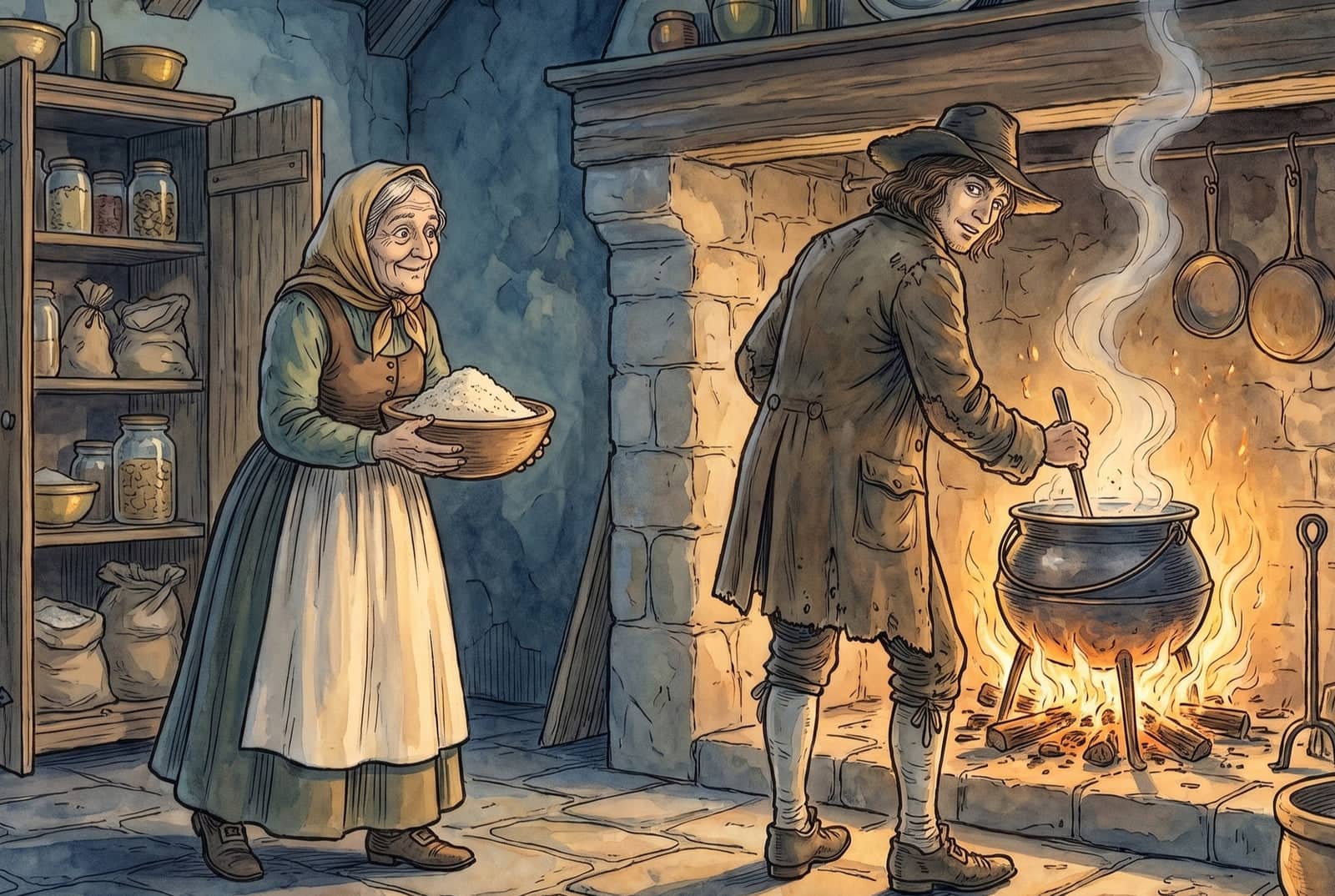
The tramp shook the flour into the pot and stirred, while the woman stared until her eyes were nearly starting out of her head.
“This is soup good enough for company already,” he said, adding one handful after another. “With a bit of salt beef in it and a few potatoes, it would be fit for the finest people in the land, however particular they were. But what you have to go without, there is no use thinking more about.”
When she thought it over properly, it turned out she did have potatoes, and a bit of beef besides, and she fetched them. He went on stirring, and she went on staring as hard as ever.
“This will be grand enough for the best in the land,” he said.
“Well, I never,” said the woman. “And all of it out of one stone!”
He really was a wonderful man, that tramp.
“If we had a little barley now, and a drop of milk, we could ask the king himself to sit down with us,” he said, “for this is what he has every blessed evening. I know it, because I was once in service under the king’s own cook.”
“Ask the king to sit down with us! Well, I never!” cried the woman, slapping her knees. She was quite overcome by the tramp and his grand connections.
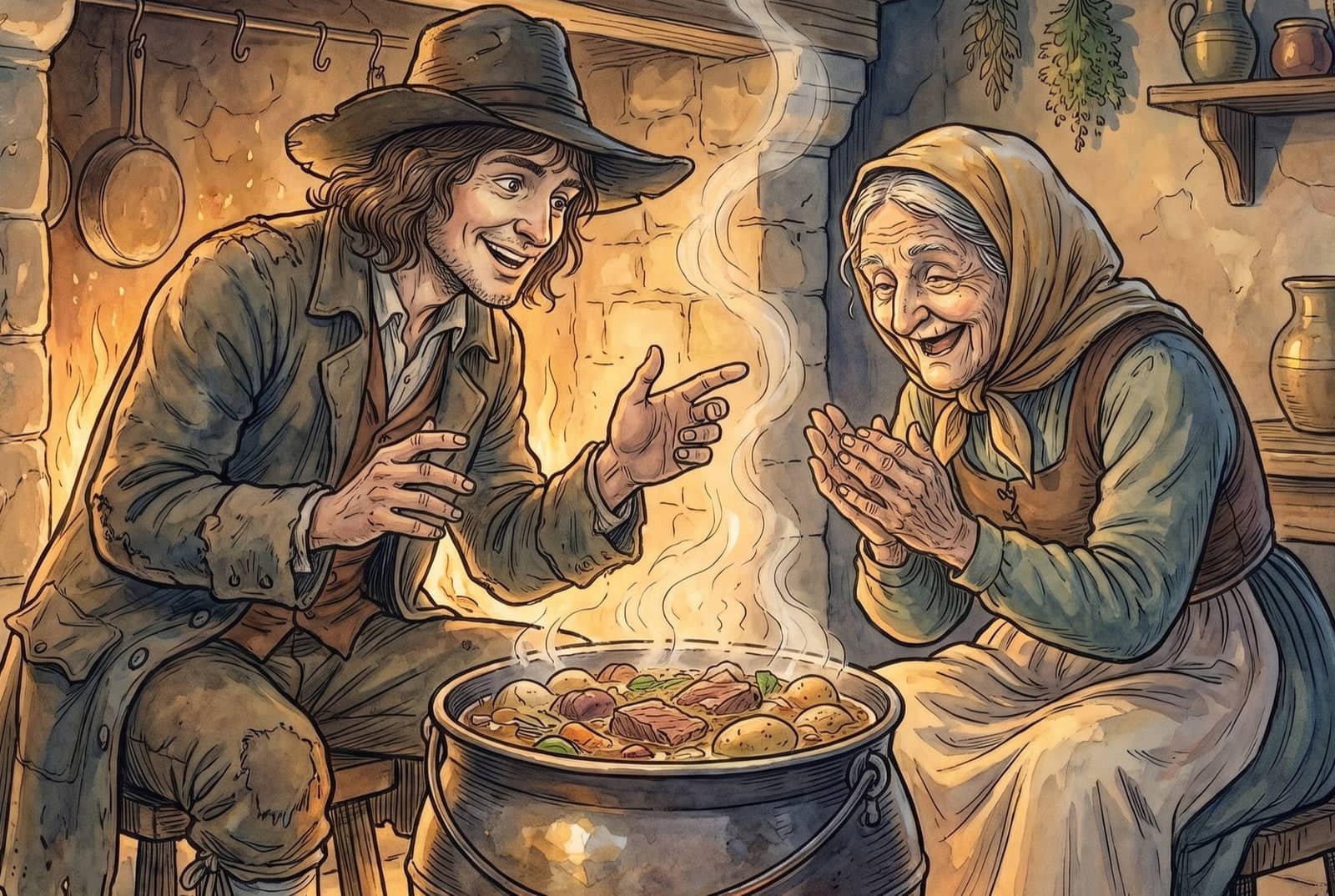
“But what you have to go without, there is no use thinking more about,” said the tramp.
Then she remembered that she did have a little barley after all; and as for milk, she was not quite out of that either, she said, for her best cow had just calved. And off she went to fetch both.
The tramp stirred, and the woman stared, one moment at him and the next at the pot.
Then all at once the tramp lifted out the stone.
“Now it’s ready, and now we shall have a proper feast,” he said. “Though with soup of this kind the king and the queen always take a drop of something and a slice of bread and butter at least, and they always have a cloth on the table when they eat. But what you have to go without, there is no use thinking more about.”
By now the old woman was feeling very fine and grand herself. If that was all it took to have the soup exactly as the king had it, she thought she might as well have it so for once, and play at being king and queen with the tramp. She went to her cupboard for the bottle and the little glasses, butter and cheese, smoked beef and veal, and a white cloth for the table, until it was all spread as if for company.
Never in her life had the old woman sat down to such a feast, and never had she tasted such soup. And made with nothing but a stone!
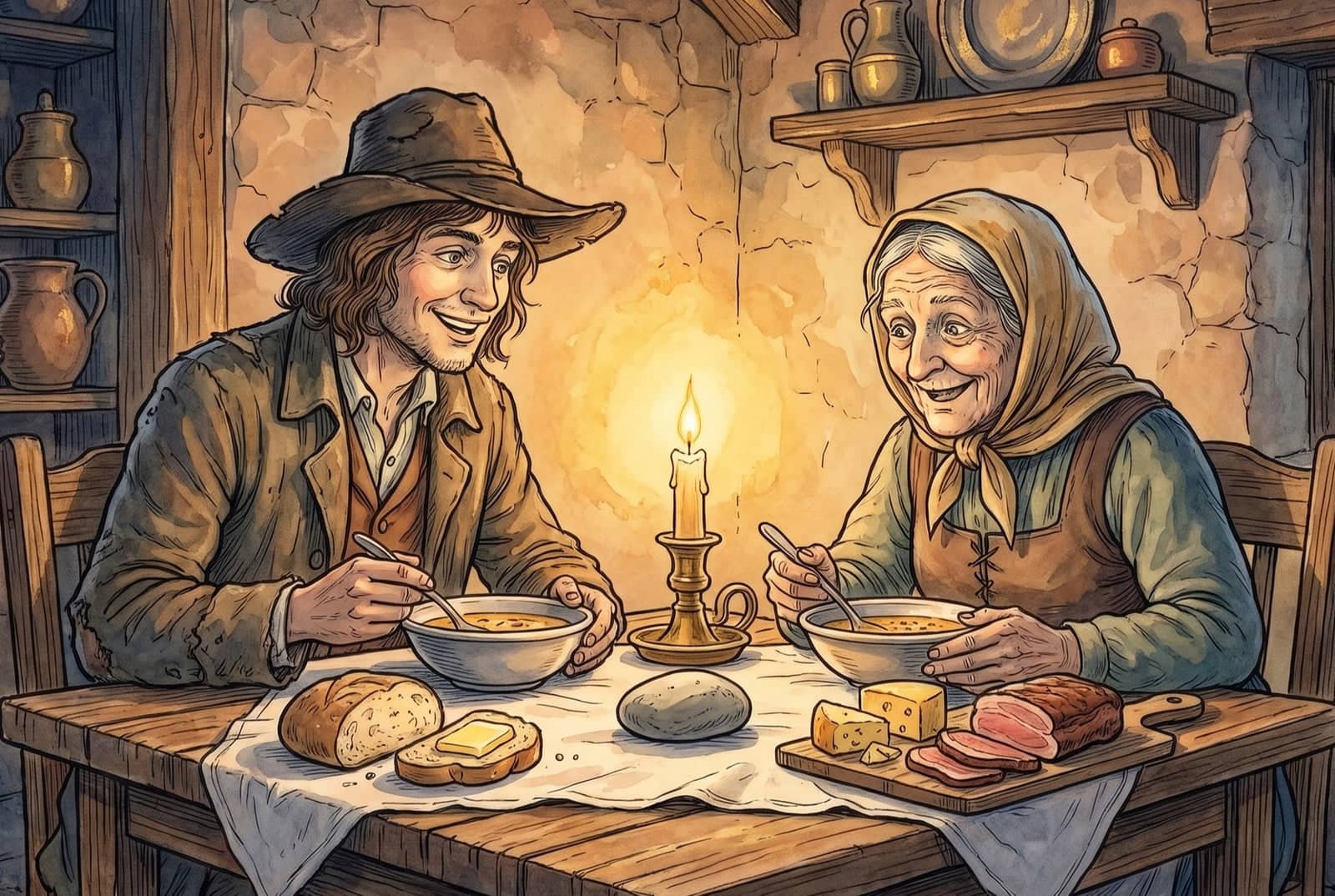
She was so pleased at having learned such a thrifty way of cooking that she could not do enough for the man who taught it to her.
So they ate and they drank, and they ate a little more, until they were both warm and tired and sleepy.
The tramp was ready to lie down on the floor. But that would never do, thought the old woman. No, that was out of the question.
“A grand person like you must have a bed to sleep in,” she said.
He did not need much persuading.
“It is like Christmas itself,” he said, “and a kinder woman I never met. Happy are they who fall in with good people.”
And he lay down in the bed and slept.
In the morning the first thing he was given was hot coffee and fresh bread. When he was leaving, the old woman put a bright silver coin into his hand.
“And thank you, thank you kindly, for what you have taught me,” she said. “Now I shall live in comfort, for I know how to make soup out of a stone.”
“It’s not so very difficult,” said the tramp as he went on his way, “so long as you have something good to put into it.”
The woman stood in her doorway looking after him.
“People like that,” she said, “don’t grow on trees.”
Retold by Talerie from Tales of Laughter (opens in a new window) Public domain Copy this text, adapt it, use it however you like. A link back to Talerie is appreciated but never required. CC0 1.0 (opens in a new window)