Skip to content
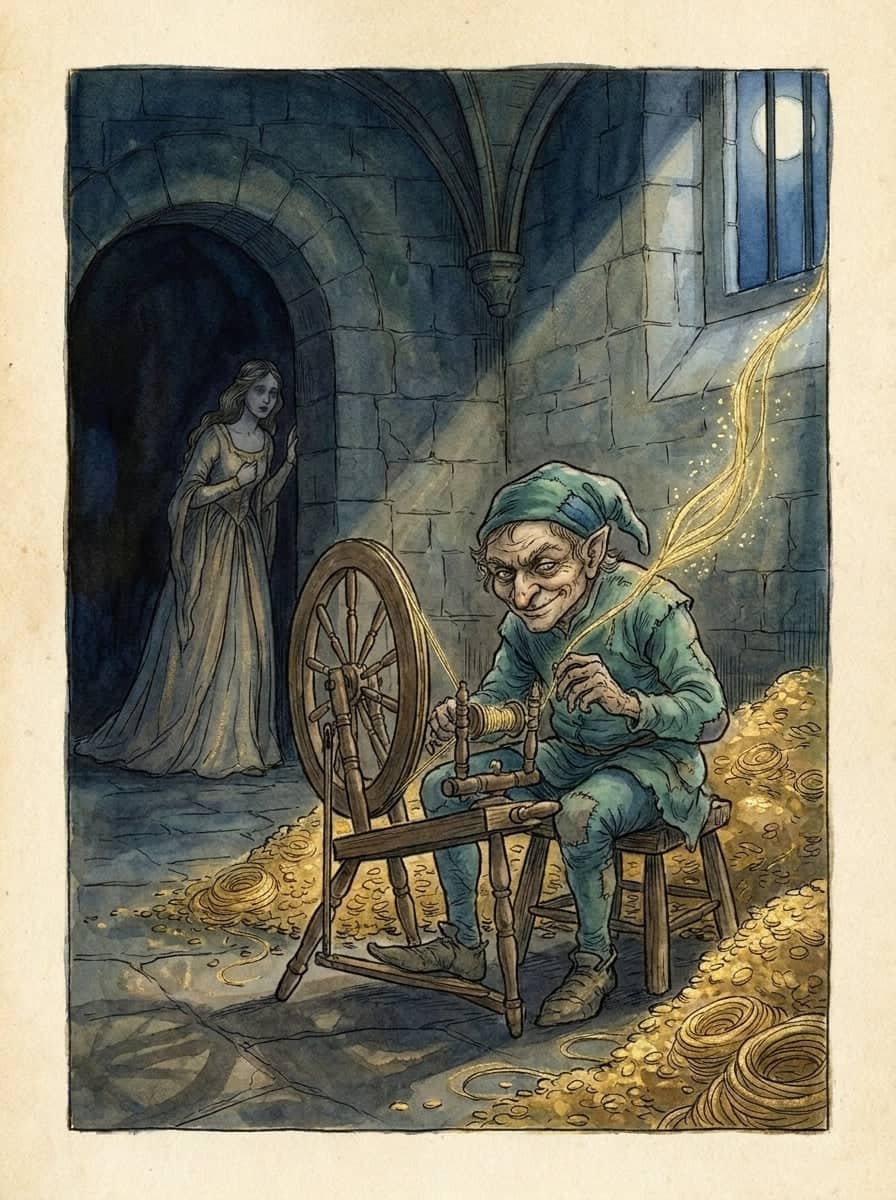
A strange little man spins straw into gleaming golden thread at a spinning wheel in a moonlit stone chamber heaped with gold.

Rumpelstiltskin

Brothers Grimm

4 min readages 6 and up

A miller’s daughter is shut in a room of straw and told to spin it into gold, but a little man spins it, taking her jewelry and a promise of her first child. When the Queen names him Rumpelstiltskin, the little man stamps his foot so deep into the ground that the earth closes over him, and the Queen keeps her child.


Once there was a poor miller who had a beautiful daughter. To make himself seem important, he told the King, “I have a daughter who can spin straw into gold.”
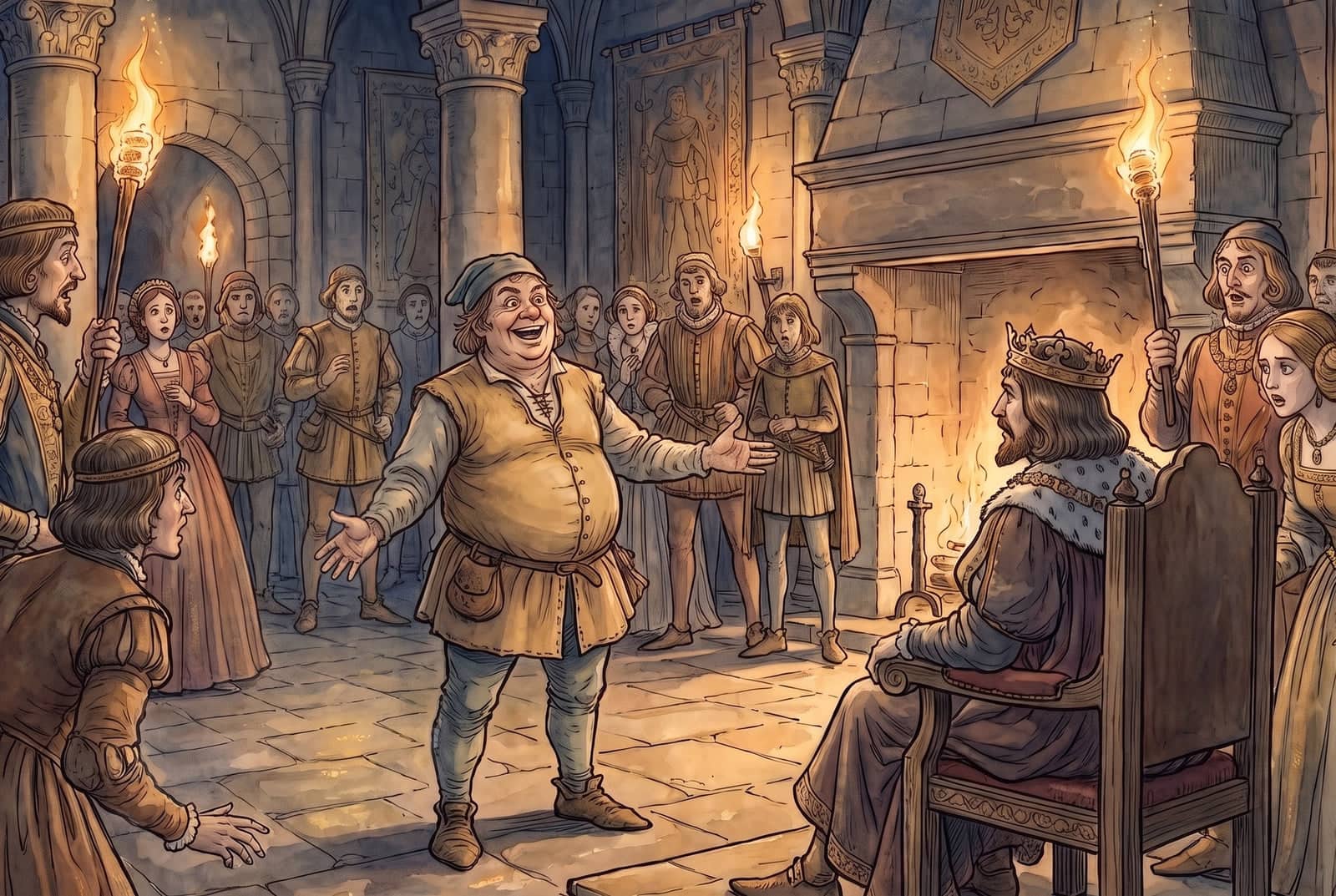
In a torch-lit hall, a stout, beaming miller boasts with open arms before the crowned king seated by the hearth, while courtiers look on in surprise.

“That is an art that pleases me,” said the King. “Bring her to my palace tomorrow.”

Next day he shut her in a room heaped with straw, gave her a wheel and said, “Spin it all into gold by morning, or it will cost you your life.”
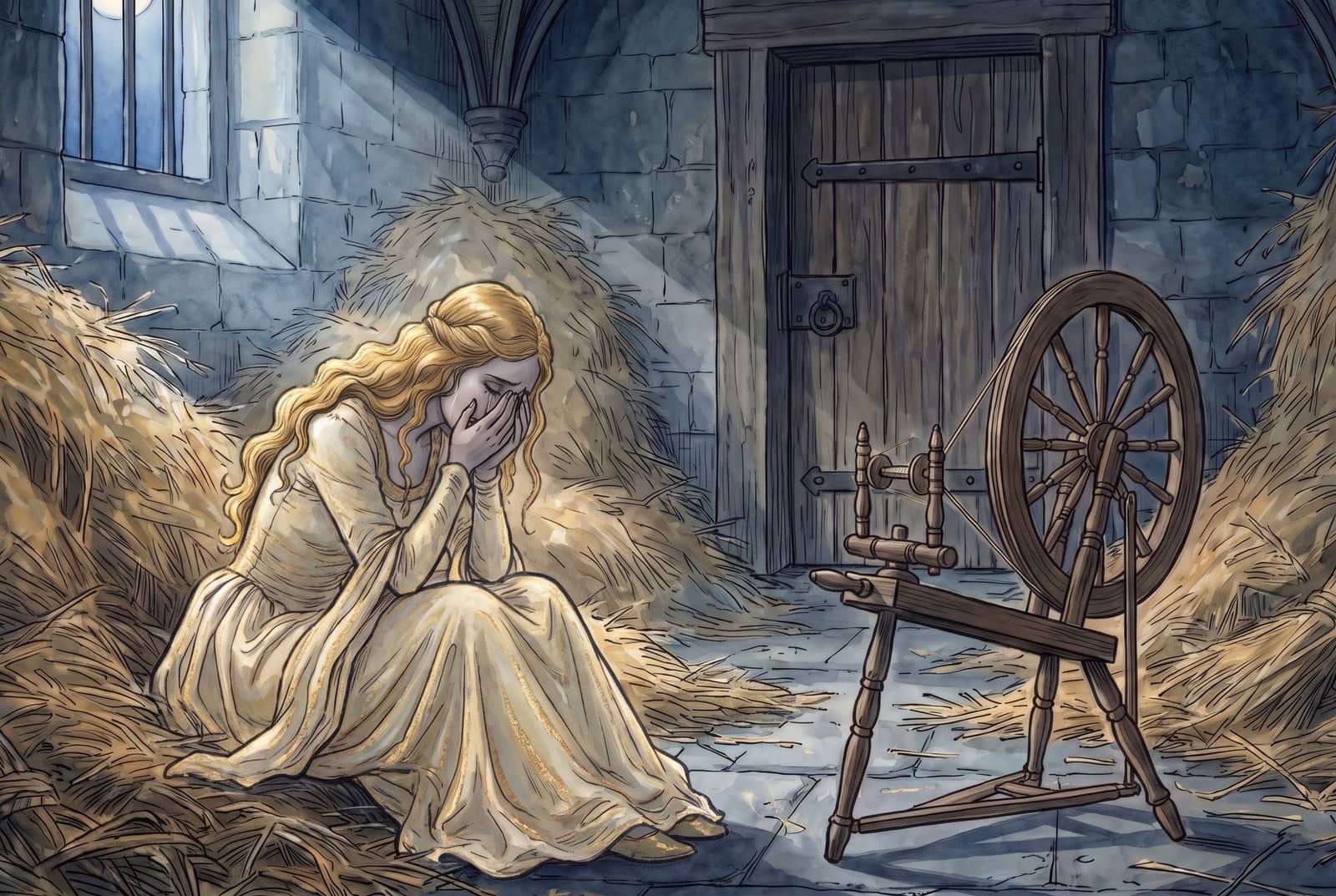
In a stone chamber heaped with straw, a fair-haired girl in a pale gown weeps into her hands beside an idle spinning wheel, moonlight at the barred window.

She knew nothing of such spinning, and began to weep. Then the door opened and a little man came in.

“Good evening, miller’s daughter,” he said. “Why are you crying so?”

“I must spin this straw into gold,” she answered, “and I do not know how.”

“What will you give me if I do it for you?”

“My necklace,” said the girl.

He took it, sat at the wheel, and whirr, whirr, whirr, three turns and the reel was full of gold. By morning it was all spun.

At sunrise the King saw the gold and grew greedier still. He shut her in a larger room of straw with the same command, and again the little man came.

“What will you give me if I spin this straw into gold for you?”

“The ring from my finger,” she answered.

He took the ring, and by morning that straw was gold too.

But it was not enough. The King led her to a room larger than either. “Spin this tonight, and you shall be my wife.”

When she was alone, the little man came a third time.

“What will you give me if I spin the straw once more?”

“I have nothing left to give,” she answered.

“Then promise me your first child, when you are Queen.”

Who knows if that will ever happen, thought the girl, and seeing no other way she promised. For that the little man spun the straw into gold once more. In the morning the King married her, and the miller’s daughter became Queen.

A year later she had a beautiful child and forgot the little man. Then one day he stood in her room.

“Now give me what you promised.”
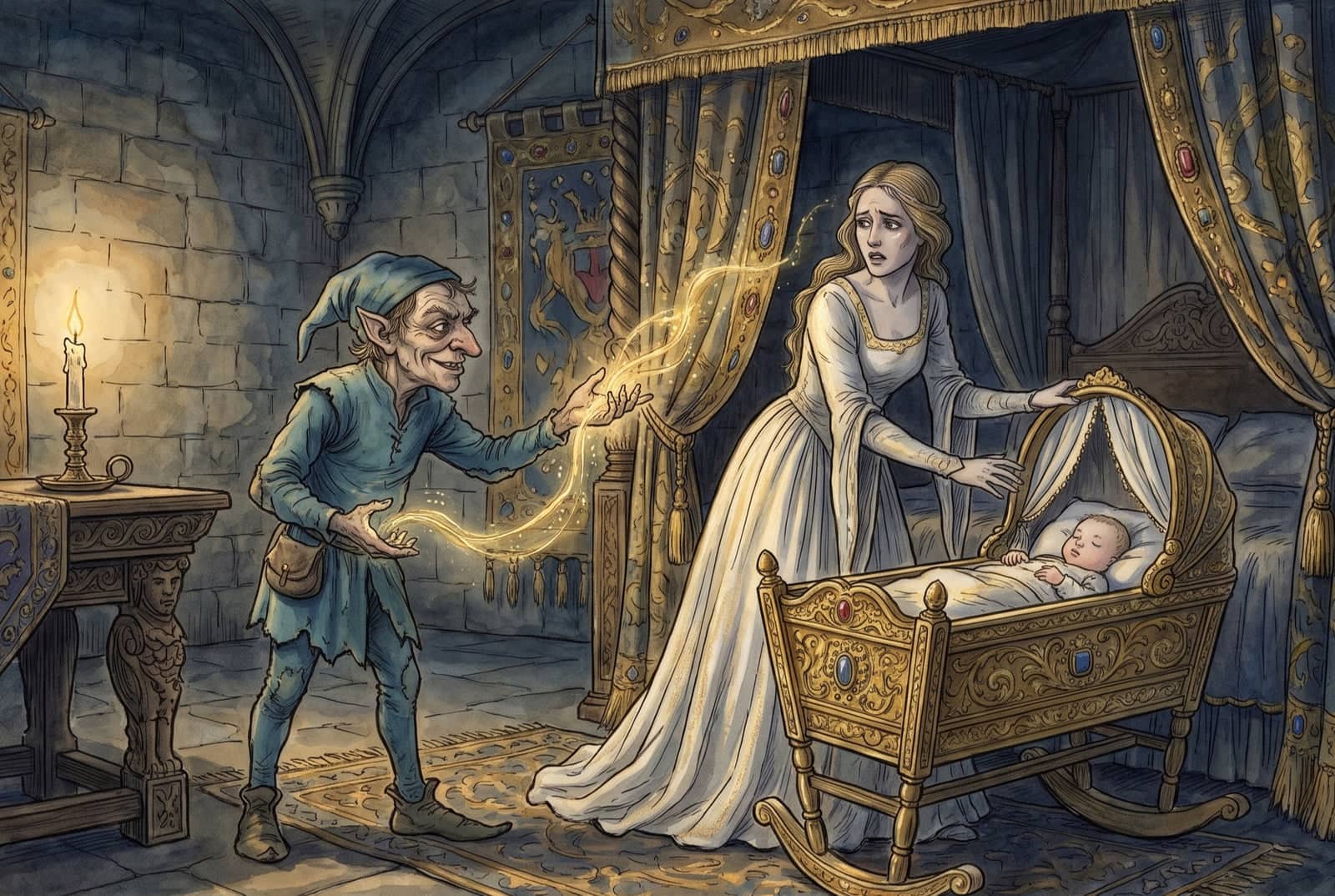
In a candlelit bedchamber, the little man reaches out with a hand trailing golden light as a tearful young queen stands beside her baby’s cradle.

She offered him all the riches of the kingdom for the child.

“No,” he said. “Something living is dearer to me than all the treasures in the world.”

Then she wept so bitterly that he took pity on her.

“I will give you three days,” he said. “If by then you know my name, you keep your child.”

The Queen sent a messenger far and wide for names, and when the little man came the next day, she tried Caspar, Melchior, Balthazar and every name she knew.

“That is not my name,” he said to each one.

On the second day she tried the strangest names of all. “Are you perhaps called Shortribs, or Sheepshanks, or Laceleg?”

“That is not my name,” he answered.

On the third day the messenger came back.

“I found no new name,” he said, “but by a high mountain where the fox and the hare say good night, I saw a little house with a fire before it, and a little man hopping round the fire on one leg and singing.”

This is what he sang:

Today I bake, tomorrow I brew,and the next day the Queen’s child I claim.How glad I am that nobody knewthat Rumpelstiltskin is my name.
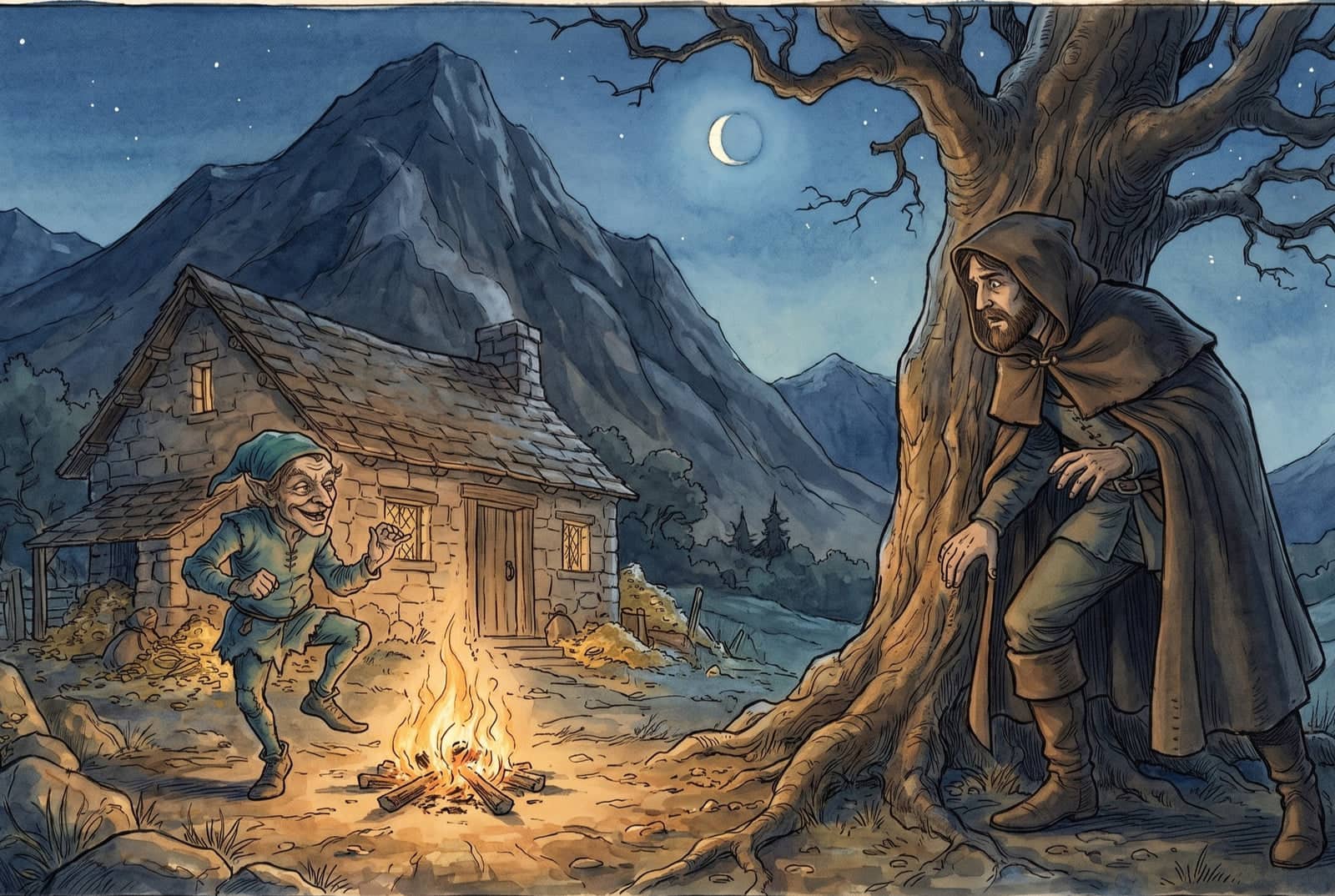
By a mountain campfire at night, a little man dances on one leg singing, while a bearded, cloaked man crouches unseen behind a tree and listens.

Then the little man came and asked, “Now, my Queen, what is my name?”

“Is your name Conrad?”

“No.”

“Is your name Harry?”

“No.”

“Then perhaps your name is Rumpelstiltskin?”

“The devil told you that! The devil told you that!” cried the little man.
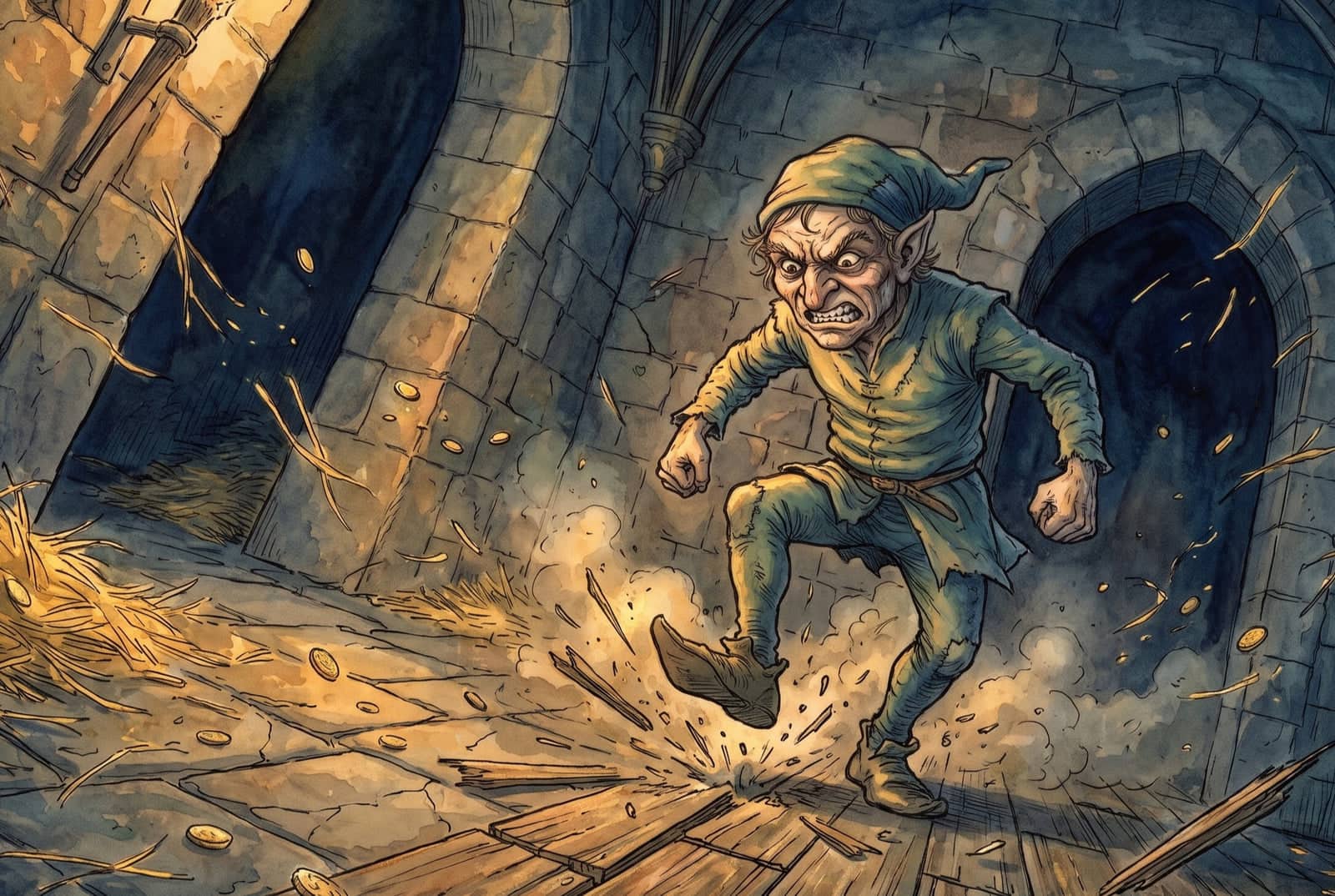
A furious little man stamps his foot through the floorboards of a straw-strewn stone room scattered with gold coins, his face twisted in rage.

In his rage he stamped his foot so deep into the ground that the earth closed over him, and he was gone. The Queen kept her child, and no one ever saw the little man again.

Retold by Talerie from Household Tales by Brothers Grimm (opens in a new window)License: Public domain

Similar tales

Baba Yaga

7 min readages 6 and up

Frau Holle

7 min readages 4 and up

Snow White

11 min readages 7 and up

Stone Soup

9 min readages 4 and up

About this tale

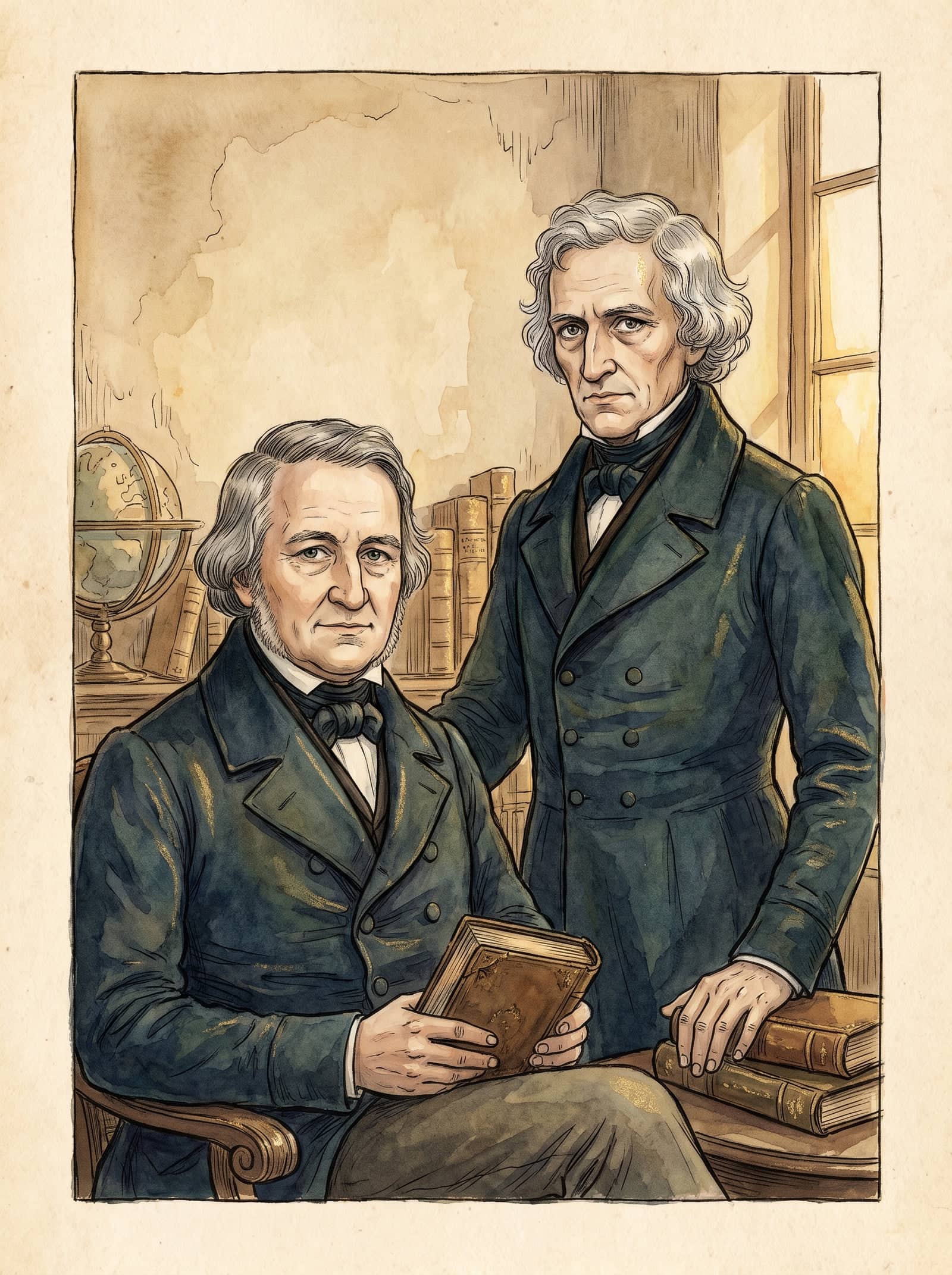
Rumpelstiltskin is a Grimm tale, first printed in Berlin in 1812 as number 55 of the opening volume of Children’s and Household Tales. The brothers heard it in Kassel from Dortchen Wild, who told it to them on 10 March 1811.

In 1812 the tale is short: the little man turns the straw into gold without a wheel, and in the end he runs off. In 1819 the Grimms enlarged it from three more tellings from Hesse, and he now tears himself in two. We follow the 1857 edition as Margaret Hunt put it into English.

Rumpelstiltskin in the Grimms’ editions of 1812 and 1857

The Grimms, 1812The Grimms, 1857
Told byDortchen Wild, Kassel 1811also the Hassenpflug family, Lisette Wild
The taskturn straw into goldspin straw into gold at a wheel
His pitynone, though she still gets three dayshe pities her and gives her three days
Days of guessingnone, she cannot think of a namethree days, a messenger, strange names
Who hears the namethe king, out huntingthe messenger
Last two guessesConrad, HeinrichKunz, Heinz
The endruns off and never comes backtears himself in two
Show more
Today I bake, tomorrow I brew,and the next day the Queen’s child I claim.How glad I am that nobody knewthat Rumpelstiltskin is my name.
Brothers Grimm, 1857: heute back ich, morgen brau ich, / übermorgen hol ich der Königin ihr Kind; / ach, wie gut ist daß niemand weiß / daß ich Rumpelstilzchen heiß!

What our text does

Our text tells the 1857 tale: the miller’s boast, the king’s threat of death, the necklace, the ring, the promise of the first child, three days to guess and the messenger who hears the song by the fire. The odd names of the second day are Hunt’s: Shortribs, Sheepshanks, Laceleg. The miller’s daughter has no name in the 1857 text, in Hunt or in ours, and she is not a princess; she becomes queen when the king marries her.

Of our two versions, the one marked Original stays nearer to Hunt, and the one marked Gentler is shorter. They differ at the end. In the Original, just as in 1857, the little man seizes his left foot and tears himself in two. In the Gentler one he stamps so hard that the earth closes over him, an ending of our own. The king’s threat is spoken but never carried out.

Related tales and one likeness

Folklorists list Rumpelstiltskin as tale type ATU 500. The name is older than the tale in print: in 1582 Fischart includes a game called “Rumpelestilt oder der Poppart” in a list of games. The oldest version Bolte and Polívka know is French, Marie Jeanne Lhéritier’s “Ricdin-Ricdon” (1705), where the bride has to remember the helper’s name rather than guess it. Among the British versions they list are “Tom Tit Tot” from Suffolk, “Duffy and the Devil” from Cornwall and “Whuppity Stoorie” from Scotland. The Grimms point out that the guessing of a name also turns up in Turandot.

Rapunzel is a different tale, but it shares one move with this one: there too a child is promised away before it is born.

Sources

Period texts

Commentary

Catalogue

Claims checked against these sources on October 13, 2026.

Coloring pages to print

Where else to find this tale