 Original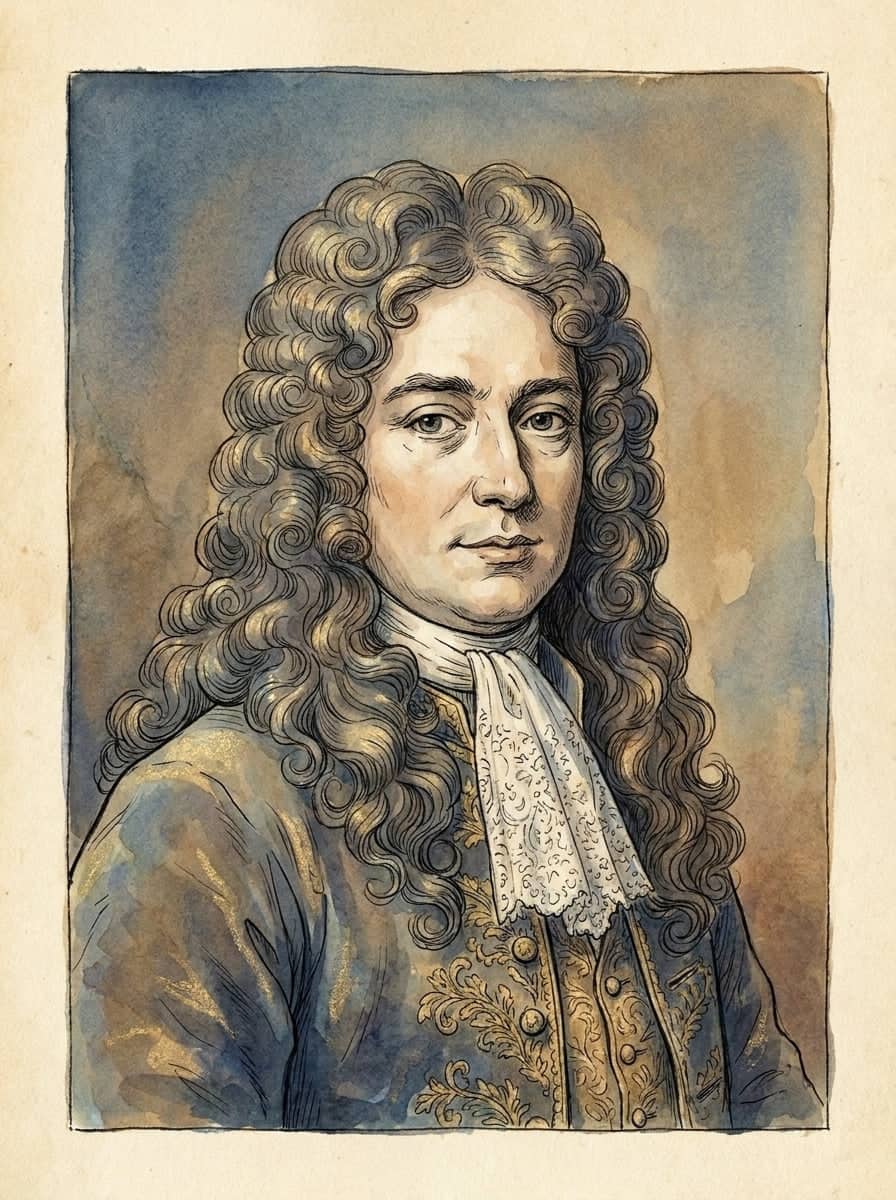
Wrapped in a donkey’s hide, a girl flees the king who raised her and now means to marry her, and takes work feeding turkeys on a farm. A ring baked into a cake fits no other maiden, and when Donkey Skin holds out her hand it slides on, the hide drops away, and her fairy godmother comes down before the wedding.
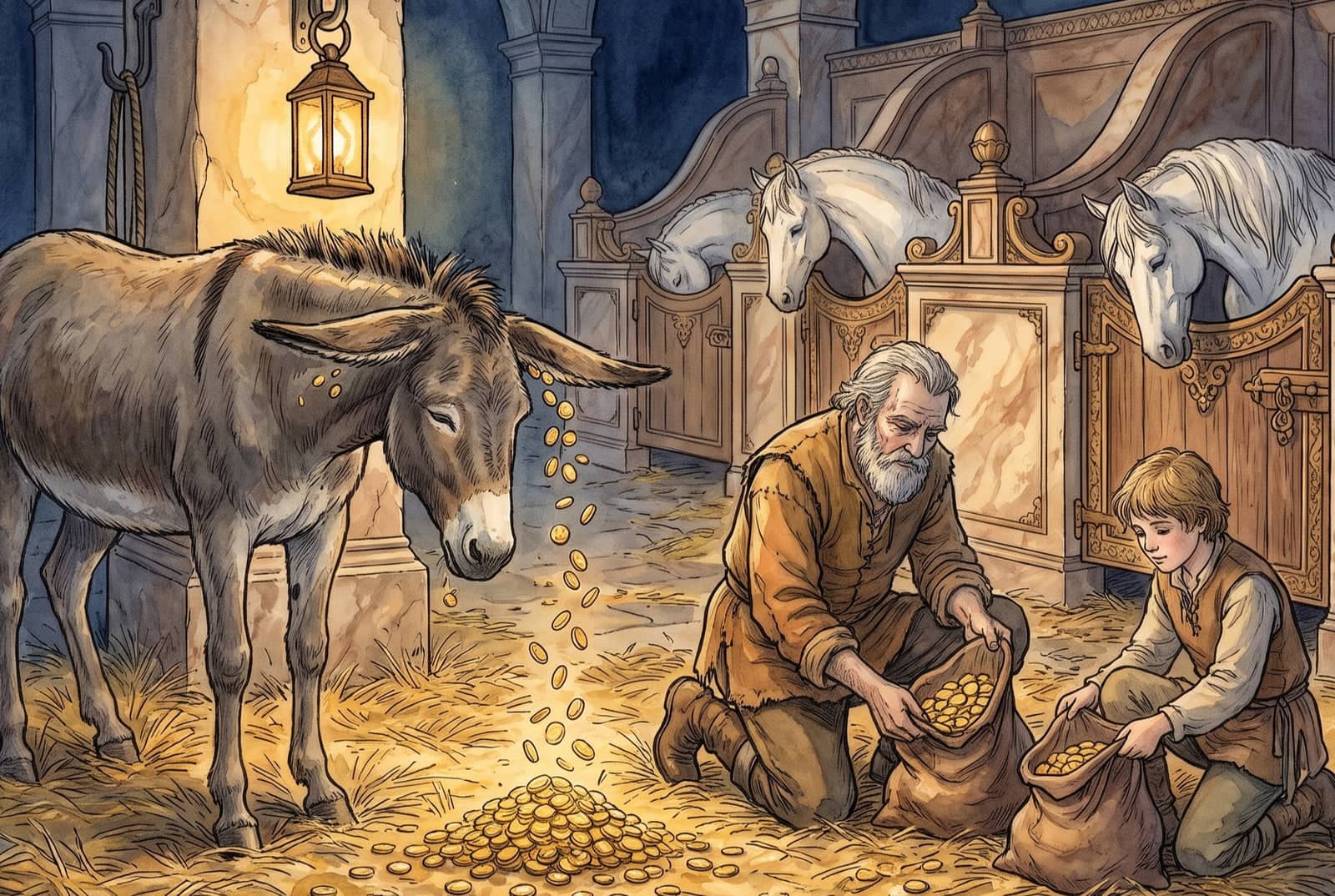
Once there was a king whose people loved him so well that he believed himself the happiest monarch in the world, and he had everything his heart could wish for. His palace was full of rare and curious things, his gardens full of the sweetest flowers, and in the marble stalls of his stables stood a row of milk-white Arabian horses with great brown eyes.
Travellers who had heard of the wonders the king had gathered came long distances to see them, and were surprised to find the finest stall of all given to a donkey with unusually large, drooping ears. It was a fine donkey, certainly, but nothing about it explained the care with which it was housed, and the visitors went away puzzled. They could not know that every night, while the creature slept, bushels of gold pieces tumbled out of its ears, and the stablemen gathered them up each morning.
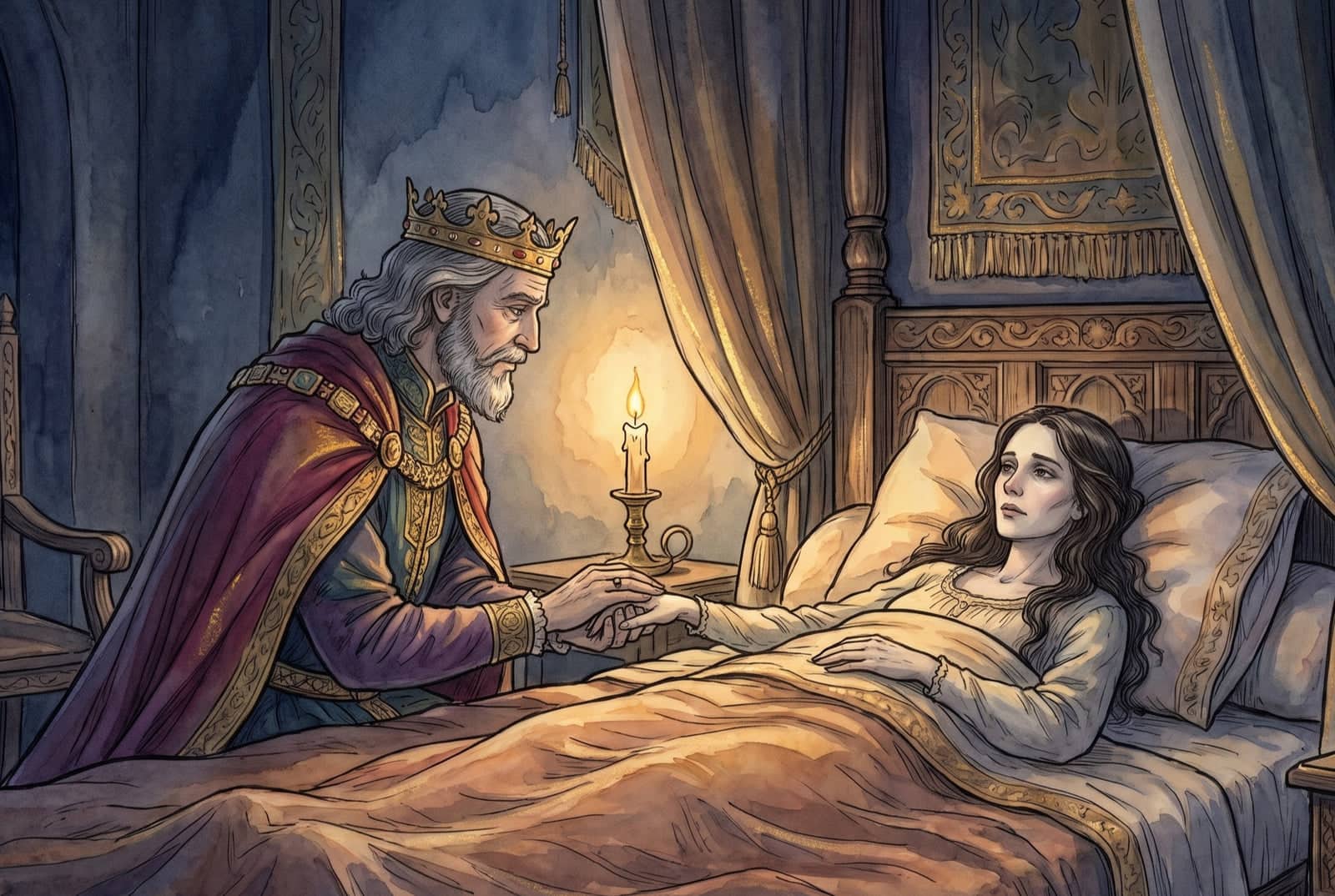
After many prosperous years a blow fell upon the king: his wife, whom he loved dearly, lay dying. Even then she thought first of his happiness, and gathering the last of her strength she said to him:
“Promise me one thing. You must marry again, I know that, for your people’s sake as well as your own. But do not go about it in a hurry. Wait until you have found a woman more beautiful and better formed than I am.”
“Do not speak to me of marrying,” the king sobbed. “Let me die with you instead.”
But the queen only smiled faintly, turned her face on the pillow, and died.
For some months the king’s grief was very great. Then, little by little, he began to forget, and his counsellors never stopped urging him to take another wife. At first he would not listen to them, but by and by he let himself be persuaded, with one condition only: the bride must be lovelier and better formed than the late queen, for he could not think of setting any lesser woman in her place.
Delighted, the counsellors sent envoys far and wide for portraits of the most famous beauties of every country. The painters did their best, but not one of those ladies could stand comparison for a moment with the queen who was gone.
Then one day, as the king turned away discouraged from a fresh set of pictures, his eye fell on his adopted daughter, who had lived in the palace since she was a baby. He saw all at once that if there was a woman on earth more lovely than the queen, it was this girl. He made his wishes known to her that very hour. But the girl had no ambition, and not the faintest desire to marry him. She was filled with dismay, and begged for time to think about it. That night, when the whole palace was asleep, she set out in a little cart drawn by a big sheep, and went to ask her fairy godmother what to do.
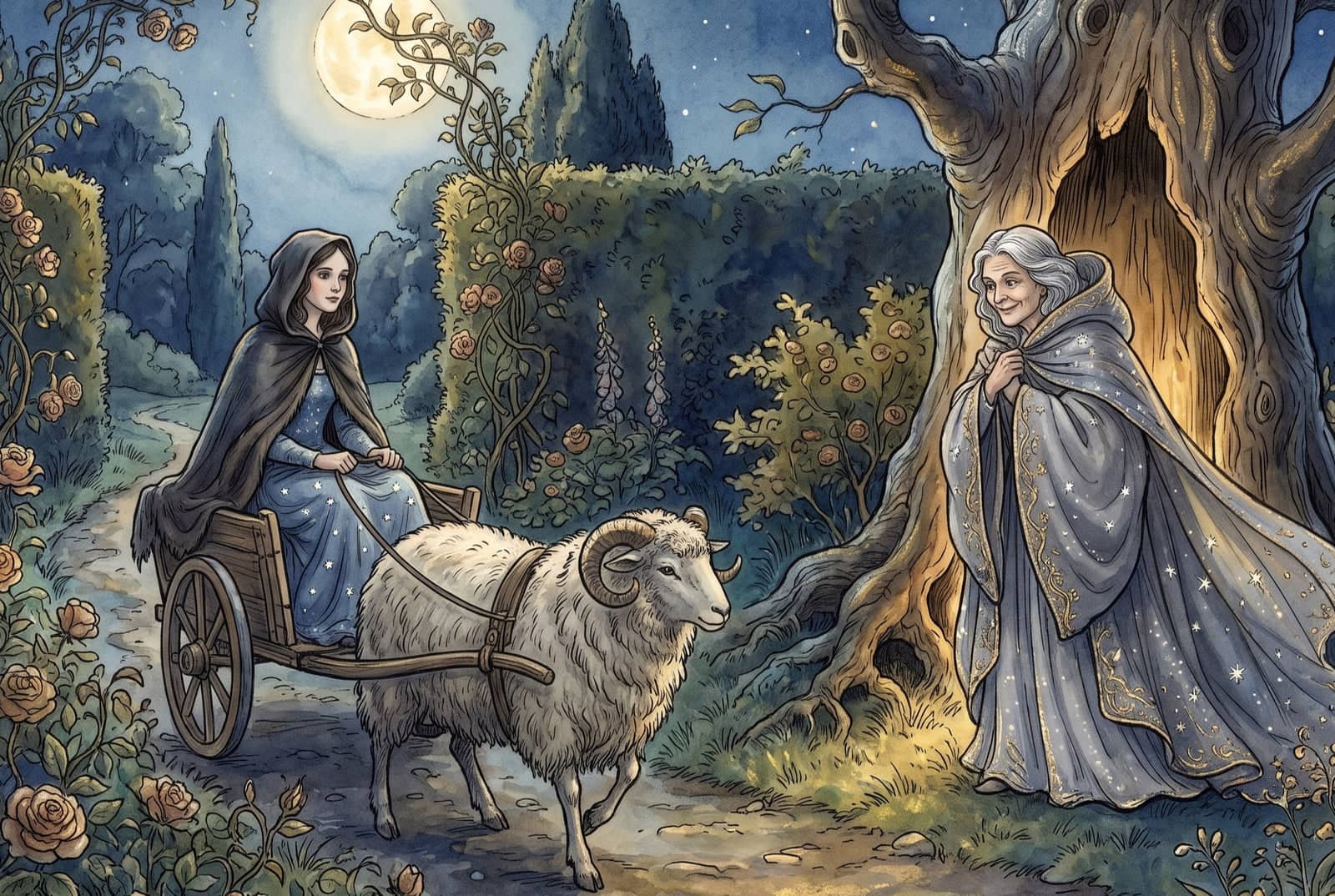
“I know what you have come to tell me,” said the fairy, as the girl stepped down from the cart. “If you do not wish to marry him, I will show you how it can be avoided. Ask him for a dress that matches the sky exactly. He will never be able to get one, and so you will be quite safe.”
The girl thanked her and went home again.
The next morning, when her father (for so she had always called him) came to see her, she told him she could give him no answer until he had given her a dress the colour of the sky. The king was overjoyed at so easy an answer. He sent for the finest weavers and dressmakers in the kingdom and ordered them to make the robe without an instant’s delay, or he would have their heads cut off. Terrified, they dyed and cut and stitched, and in two days they brought the dress back, and it looked as though it had been cut straight out of the heavens. The poor girl was thunderstruck and did not know which way to turn, so that night she harnessed her sheep again and went in search of her godmother.
“The king is cleverer than I thought,” said the fairy. “Tell him now that you must have a dress of moonbeams.”
The next day, when the king called the girl into his presence, she asked him for what her godmother had told her to ask.
“Madam, I can refuse you nothing,” he said, and he ordered his weavers to finish the dress within a day and a night, or every man of them should hang.
They worked at it with all their might, and by dawn the dress of moonbeams lay across her bed. The girl could not help admiring how beautiful it was, and then she began to cry, until the fairy heard her and came.
“Well, I would not have believed it of him,” said she. “But ask him for a dress of sunshine. I shall be surprised indeed if he manages that.”
The girl had little faith left in her godmother after two plans had failed, but she did not know what else to do, and so she asked her father for it.
The king made no difficulty at all. He even gave his finest rubies and diamonds to ornament the dress, which when finished blazed so that nobody could look at it except through smoked glasses.
When the princess saw it she pretended that the sight hurt her eyes, and went away to her room, where she found the fairy waiting, very much ashamed of herself.
“There is only one thing left to do,” cried the fairy. “You must ask him for the skin of the donkey he sets such store by. It is from that beast that all his great riches come, and I am certain he will never give it up.”
The princess was not so sure. Still, she went to the king and told him she could never marry him until he had given her the donkey’s skin.
The king was astonished and grieved by this new demand, but he did not hesitate for an instant. The donkey was killed, and its hide laid at the feet of the princess.
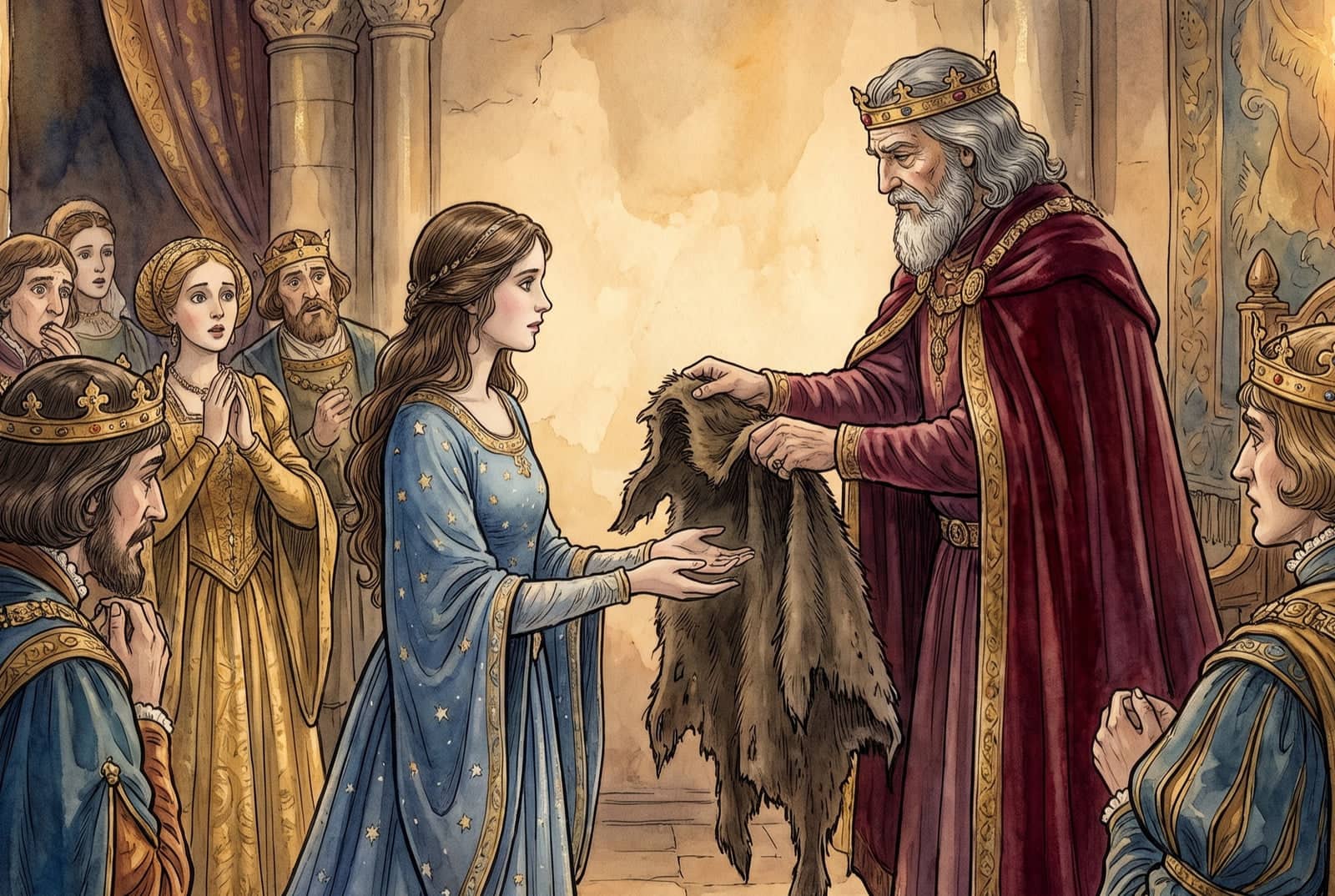
Seeing no escape from the fate she dreaded, the poor girl wept again and tore her hair. Then all at once the fairy stood before her.
“Take heart,” she said. “All will go well now. Wrap yourself in this skin, leave the palace, and go as far as you possibly can. I will look after you. Your dresses and your jewels will follow you underground, and whenever you need anything, strike the ground and you shall have it at once. But go quickly. There is no time to lose.”
So the princess wrapped herself in the donkey’s skin and slipped out of the palace without a soul seeing her.
The moment she was missed there was a great outcry, and every corner of the place was searched, likely and unlikely alike. The king sent parties of men along every road, but whenever they came near the girl the fairy threw an invisible cloak over her, and not one of them saw her.
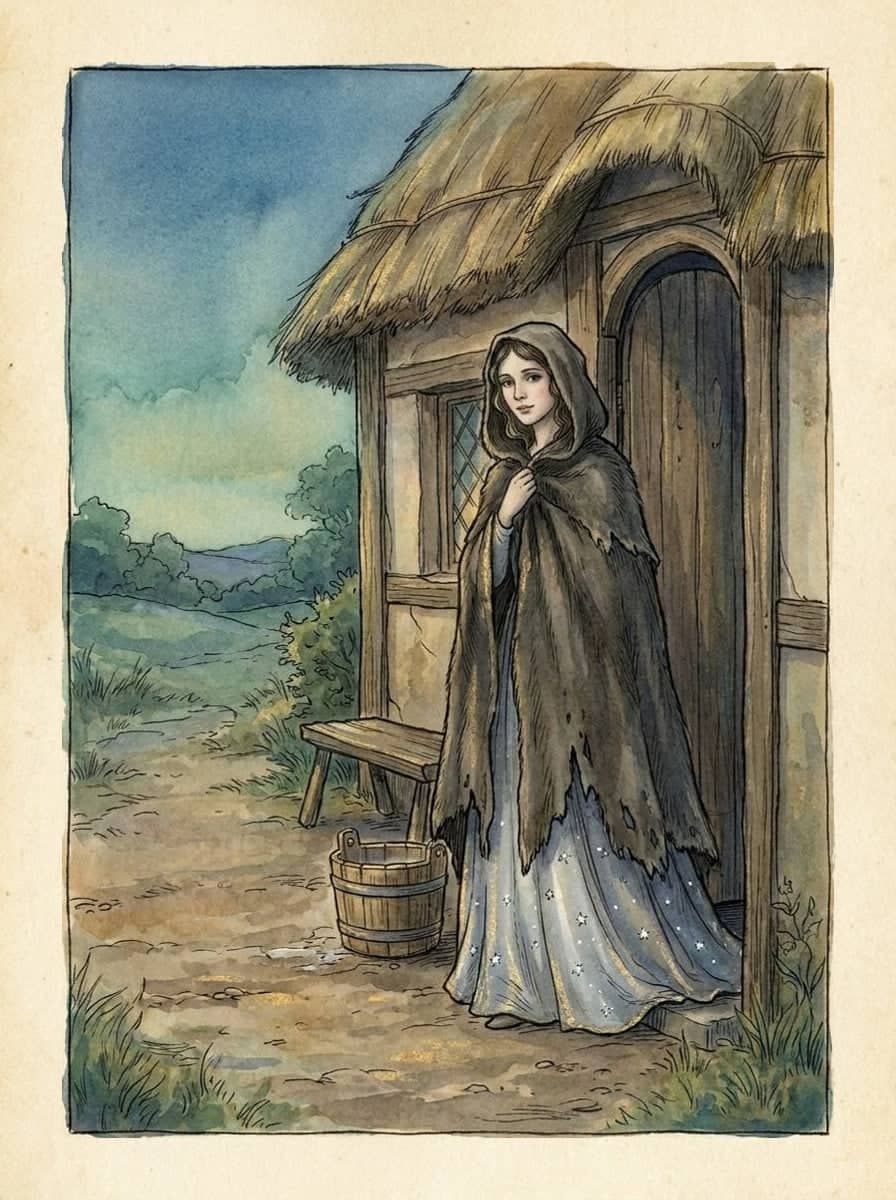
The princess walked on a long, long way, looking for somebody who would take her in and let her work for them. The cottagers she passed gave her food out of charity, but the donkey’s skin was so dirty that they would not let her through their doors, and her flight had been too hurried to leave her time to clean it.
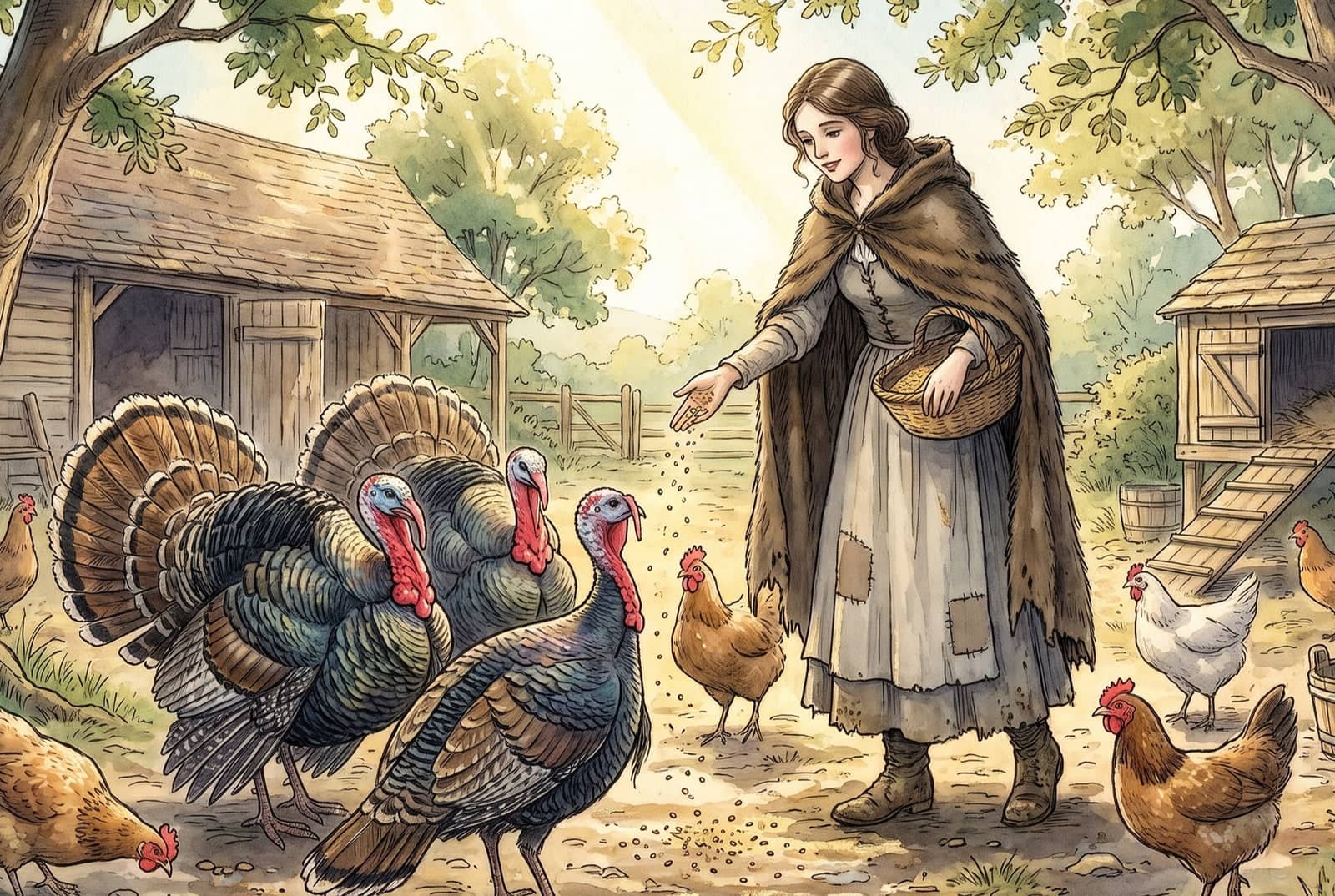
Tired and disheartened by her ill fortune, she was wandering one day past the gate of a farmyard just outside the walls of a large town, when she heard a voice calling her. She turned, and saw the farmer’s wife standing among her turkeys and making signs to her to come in.
“I want a girl to wash the dishes and feed the turkeys and clean out the pig-sty,” said the woman, “and to judge by your dirty clothes, you would not be too fine for the work.”
The girl accepted with joy and was set to work at once in a corner of the kitchen, where the farm servants came and made fun of her and of the donkey’s skin she was wrapped in. Little by little they grew so used to the sight of it that it stopped amusing them, and she worked so hard and so well that her mistress became fond of her. The princess was so clever at keeping sheep and herding turkeys that you would have thought she had done nothing else all her life.
One day she was sitting on the bank of a stream, grieving over her wretched lot, when she caught sight of herself in the water. The donkey’s head was drawn over her like a hood, hiding her hair and half her face, and the filthy matted hide covered her to the heels. It was the first time she had seen herself as other people saw her, and the sight filled her with shame. She threw off the disguise and went into the water, dipping under again and again until she shone like ivory. Going back, she had to put the skin on once more, dirtier than ever now; but she comforted herself with the thought that tomorrow was a holiday, and that for a few hours she could forget she was a farm girl and be a princess again.
So at break of day she struck the ground, as the fairy had told her, and in an instant the dress like the sky lay across her narrow bed. Her room was so small that the train had nowhere to spread out, so she pinned it up carefully while she combed her beautiful hair and piled it high on her head, the way she had always worn it. When she had finished she was so pleased with herself that she made up her mind never to let a chance pass of putting on her splendid clothes, even out in the fields with nobody to admire her but the sheep and the turkeys.
Now the farm was a royal farm, and one holiday, when Donkey Skin (for that was the name the servants had given the princess) had locked her door and dressed herself in the gown of sunshine, the king’s son rode in at the gate and asked whether he might rest a little after his hunting. Food and milk were set before him in the garden, and when he felt rested he got up and walked through the house, which was famous all over the kingdom for its age and its beauty. He opened one door after another, admiring the old rooms, until he came to a handle that would not turn. He stooped and put his eye to the keyhole, and what he saw astonished him: a beautiful girl in a dress so dazzling that he could hardly bear to look at it.
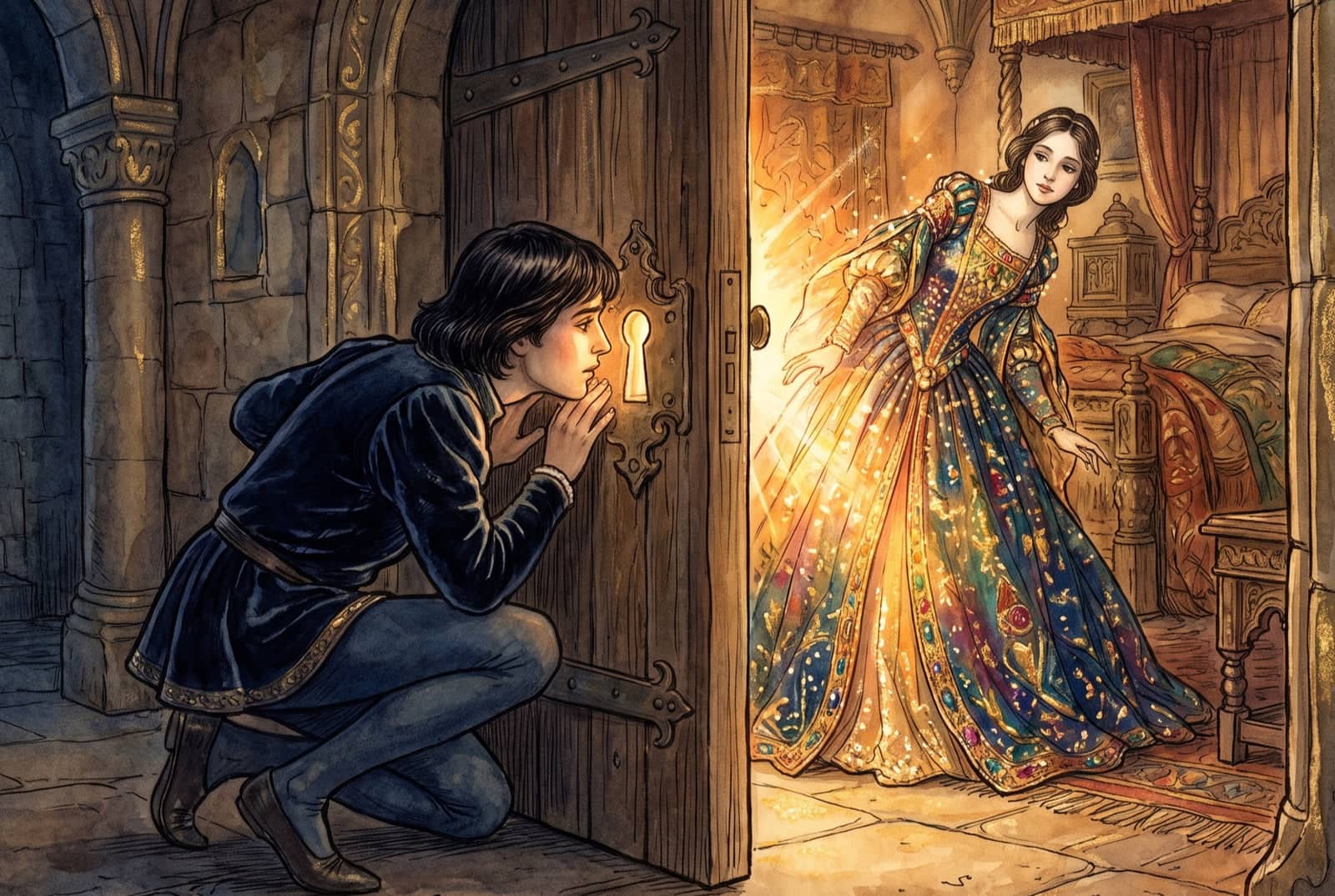
The dark passage seemed darker than ever when he turned away. He went back to the kitchen and asked who slept in the room at the end of that passage. The scullery maid, they told him, the one everybody laughed at and called Donkey Skin. There was some strange mystery here, he was sure, and he was just as sure that he would gain nothing by asking more questions. So he rode back to the palace with his head full of what he had seen through the keyhole.
All night long he tossed and turned, and in the morning he woke in a high fever. The queen, who had no other child and lived in perpetual anxiety over this one, gave him up for lost at once, and his illness puzzled the greatest doctors, who tried the usual remedies in vain. At last they told her that some secret sorrow must lie at the bottom of it, and she threw herself on her knees beside his bed and begged him to tell her his trouble. If it was ambition to be king, his father would gladly lay down the crown and let him reign in his place. If it was love, everything should be sacrificed to get him the wife he wanted, even the daughter of a king their country was at war with.
“Madam,” answered the prince, who was so weak that he could hardly speak, “do not think me so unnatural as to want my father’s crown. As long as he lives I shall be the most faithful of his subjects. And as for the princesses you speak of, I have seen none I could care for as a wife, though I would always obey your wishes, whatever they cost me.”
“Ah, my son,” she cried, “we will do anything in the world to save your life, and ours with it, for if you die we shall die too.”
“Well then,” said the prince, “I will tell you the only thing that will cure me. It is a cake made by the hand of Donkey Skin.”
“Donkey Skin?” cried the queen, who thought her son had lost his wits. “And who or what is that?”
“Madam,” said an attendant who had been with the prince at the farm, “Donkey Skin is, next to the wolf, the most disgusting creature on the face of the earth. She is a girl who goes about in a brown greasy hide, and lives at your farmer’s as the hen-wife.”
“Never mind that,” said the queen. “My son seems to have eaten some of her baking. It is a sick man’s whim, no doubt; but send to her at once and let her bake him a cake.”
The attendant bowed and told a page to ride with the message.
It is by no means certain that Donkey Skin had not caught sight of the prince, either when his eye was at the keyhole or from her little window above the road. But whether she had seen him or only heard him spoken of, the moment the queen’s command reached her she flung off the dirty skin, washed herself from head to foot, and put on a skirt and bodice of shining silver. Then she locked her door, took the richest cream, the finest flour and the freshest eggs on the farm, and set about making her cake.
As she was stirring the mixture in the pan, a ring that she sometimes wore in secret slipped off her finger and fell into the batter. Perhaps Donkey Skin saw it and perhaps she did not; either way she went on stirring, and soon the cake was ready for the oven. When it was baked a fine brown she took off her silver dress, put on her dirty skin again, and gave the cake to the page, asking him for news of the prince. But the page turned his head away and would not so much as answer her.
He rode back like the wind, and the moment he reached the palace he caught up a silver tray and carried the cake in to the prince. The sick man began to eat it so fast that the doctors were afraid he would choke, and indeed he very nearly did, for the ring was in one of the pieces he broke off. He worked it out of his mouth without anybody seeing.
As soon as he was left alone, he lay there with the ring, turning it over and over in his fingers. He kissed it a thousand times. Then he set himself to work out how he might see the girl it belonged to, for even he did not dare confess that he had seen Donkey Skin only through a keyhole, in case they laughed at so sudden a passion. All this worrying brought back the fever, which the cake had eased for a while, and the doctors, not knowing what else to say, told the queen that her son was simply dying of love. She ran to the king with the news, and as they hurried back to the prince’s bedside together, the prince slipped the ring under his pillow before they came in.
“My boy, my dear boy,” cried the king, “who is it you want to marry? We will give her to you for a bride, even if she is the lowest servant in the house. What is there in the whole world that we would not do for you?”
The prince, moved to tears, drew out from under his pillow the ring, an emerald of the purest water.
“Dear father, dear mother, let this be a proof that the girl I love is no peasant. The finger that ring fits has never been thickened by hard work. But be her station what it may, I will marry no other.”
The king and queen looked closely at the tiny ring and agreed that whoever wore it could be no mere farm girl. Then the king sent heralds and trumpeters through the town, summoning every maiden to the palace, and it was proclaimed that she whom the ring fitted should one day be queen.
First came the princesses, then the daughters of the duchesses, and so on down, each in her proper order. But not one of them could get the ring past the tip of her finger, to the great joy of the prince, whom the excitement was curing fast. When the high-born young ladies had all failed, the shopgirls and the chambermaids took their turn, with no better fortune.
“Call in the kitchen maids and the shepherdesses,” the prince commanded; but the sight of their fat red fingers satisfied everybody.
“There is not a woman left, your Highness,” said the chamberlain. The prince waved him aside.
“Have you sent for Donkey Skin, who made me the cake?” he asked. At that the courtiers began to laugh, and answered that they would never have dared bring so dirty a creature into the palace.
“Let someone go for her at once,” ordered the king. “I called for the presence of every maiden, high or low, and I meant it.”
The princess had heard the trumpets and the proclamations, and knew perfectly well that her ring was at the bottom of it all. She too had fallen in love with the prince, whether by sight or only by hearsay, and trembled for fear that somebody else’s finger might be as small as her own. So when the messenger rode up to the gate she was almost beside herself with delight. She had been hoping all along for such a summons, and had dressed with great care in the gown of moonlight, whose skirt was scattered over with emeralds. But when they began calling to her to come down, she hastily covered herself with her donkey-skin and said she was ready to go before his Highness. She was taken straight into the hall where the prince was waiting, and at the sight of the donkey-skin his heart sank. Had he been wrong after all?
“Are you,” he said, turning his eyes away as he spoke, “the girl who has a room in the furthest corner of the inner yard at the farmhouse?”
“Yes, my lord, I am,” she answered.
“Hold out your hand, then,” said the prince, feeling that he must keep his word whatever it cost him.
To the astonishment of everyone there, a little hand, white and delicate, came out from under the brown and dirty skin. The ring slipped on with the greatest ease, and as it did so the skin fell to the ground, and there stood a figure so beautiful that the prince, weak as he was, fell on his knees before her, while the king and queen rose from their places and held out their hands to her. Their welcome was so warm and their kindness so bewildering that the princess hardly knew how to answer them, when the ceiling of the hall opened and the fairy godmother came down, seated in a chariot made entirely of white lilac. In a few words she told them the princess’s whole history and how she came to be there, and without losing a moment, preparations of the most magnificent kind were begun for the wedding.
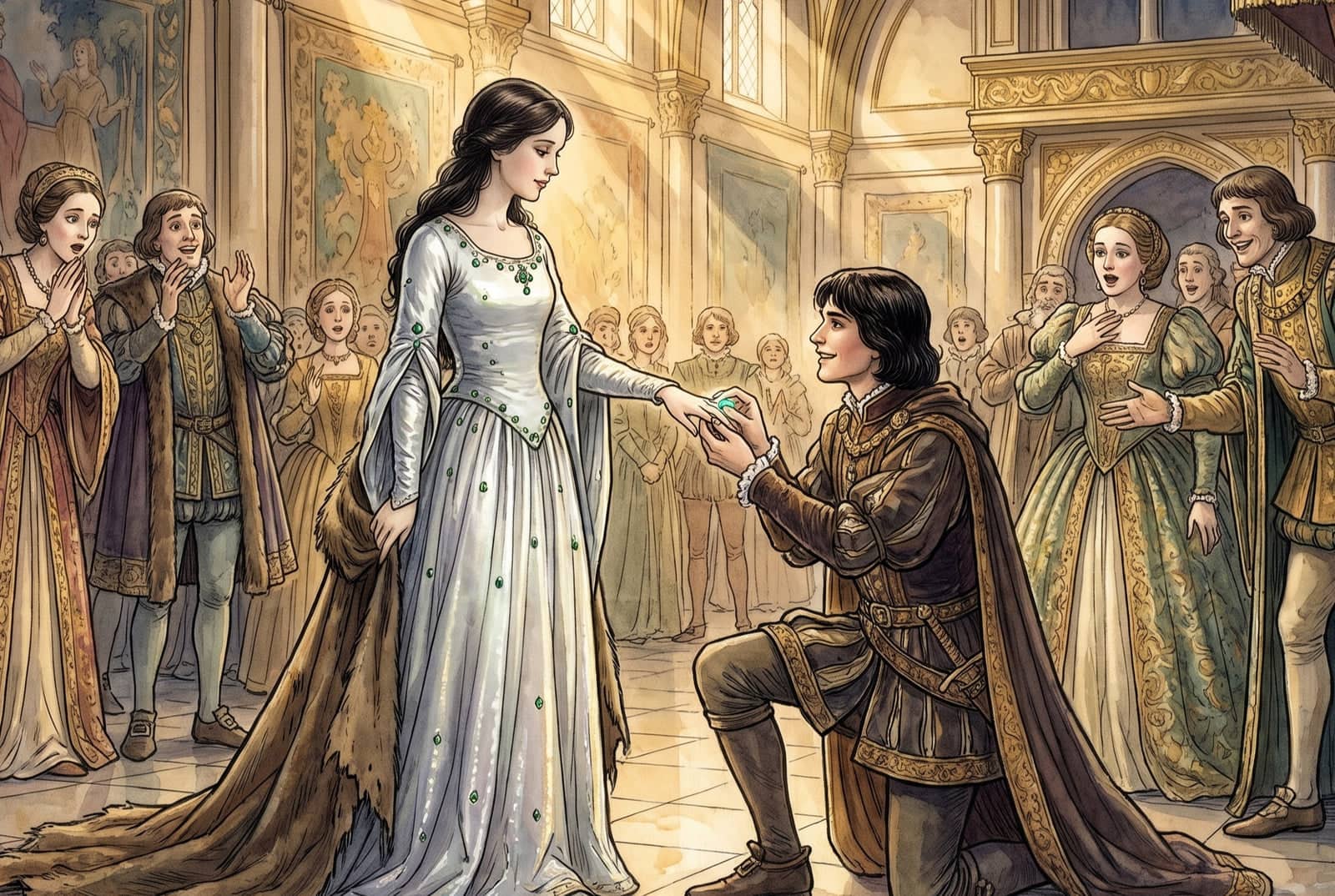
The kings of every country on earth were invited, and among them, of course, the princess’s adopted father, who by this time had married a widow; and not one refused. Each travelled in the way he thought most impressive, so that some were carried in litters, some came in carriages of every shape and kind, and the rest were mounted on elephants, on tigers, and even upon eagles. So splendid a wedding had never been seen before. When it was over, the prince’s father announced a coronation to follow it, for he and the queen were tired of reigning and the young couple must take their place. The rejoicings lasted three whole months, and then the new sovereigns settled down to govern their kingdom, and made themselves so much beloved by their people that when they died, a hundred years later, every man mourned them as his own father and mother.
Retold by Talerie, Source: The Grey Fairy Book (opens in a new window)
License: Public domainCopy this text, adapt it, use it however you like. A link back to Talerie is appreciated but never required.CC0 1.0 (opens in a new window)