 Original
A boy lets the wild man of the forest out from behind iron bars, and is carried away to guard a golden well that turns his hair to gold. Grown and working as a gardener’s boy, he wins a battle, catches three golden apples, and marries the princess, and Iron Hans comes to the wedding as a king freed from his spell.
Once there was a king who owned a great forest that stretched out beside his castle, full of every kind of wild game. One day he sent a huntsman into it to shoot him a deer, but the huntsman never returned. “Perhaps some misfortune has come to him,” the king said, and the next day he sent two more huntsmen to search for him. They too failed to come back. On the third day the king called together all his huntsmen and said, “Search the whole forest, and do not stop until you have found all three of them.” But none of these men came home either, nor was a single one of the hounds they had taken with them ever seen again. From that day on, no one dared set foot in the forest, and it lay silent and empty, so still that only an eagle or a hawk was ever seen passing over it.
Years went by this way, until a huntsman from another land came to the king looking for work, and offered to go into the dangerous forest himself. The king would not allow it. “It isn’t safe in there,” he said. “I’m afraid you’d fare no better than the others, and never come out again.”
“My lord, I’ll take that risk myself,” the huntsman answered. “I don’t know what it is to be afraid.”
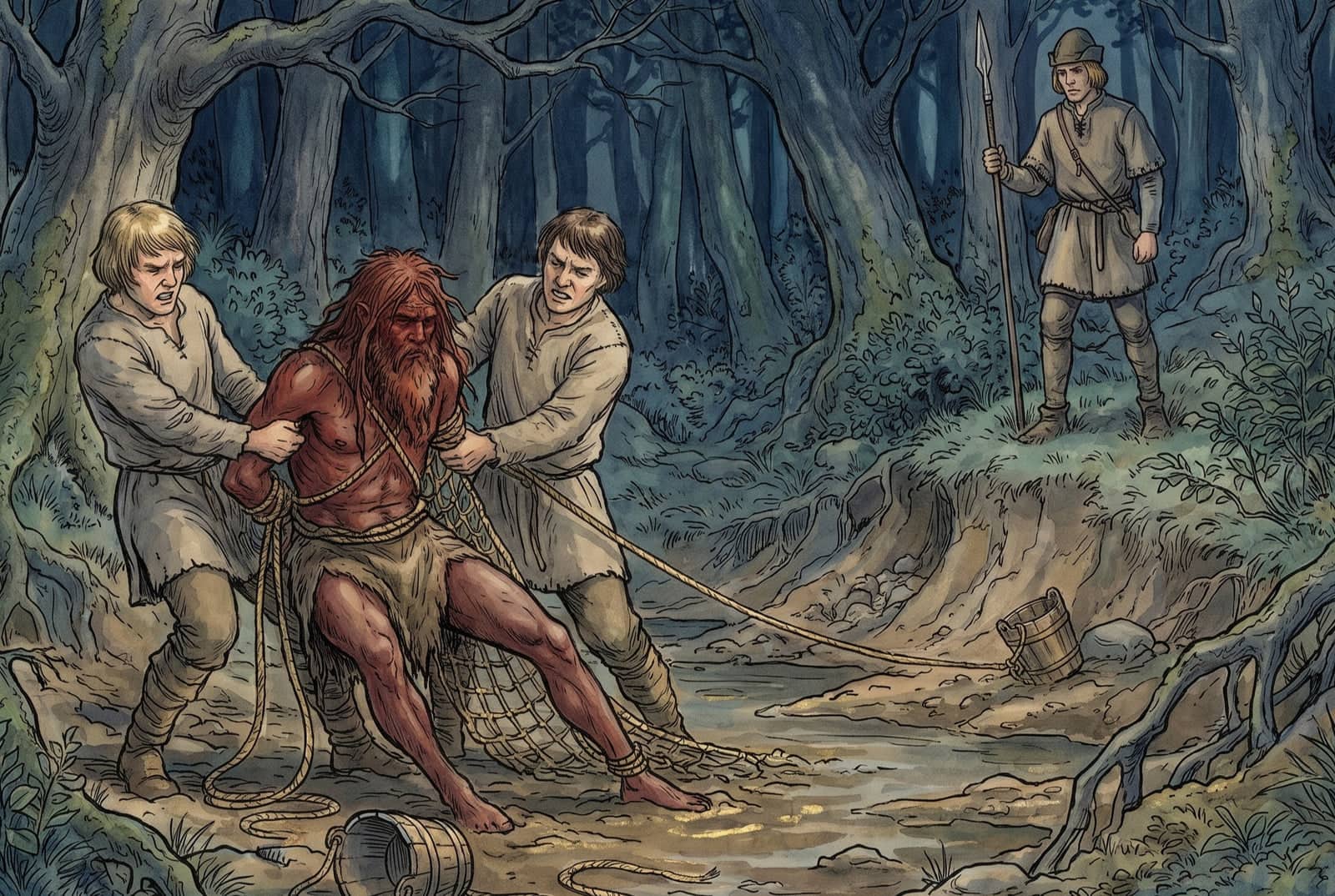
So the huntsman set out for the forest with his dog. Before long the dog picked up the scent of some game and ran after it, but the dog had gone only a few steps when it stopped short at the edge of a deep pool. A bare arm shot out of the water, seized the dog, and dragged it under. When the huntsman saw this, he went back and brought three men with buckets to bail out the pool. When at last they could see the bottom, there lay a wild man, his skin brown as rusted iron, his hair hanging down over his face all the way to his knees. They bound him with ropes and led him back to the castle, where he caused great astonishment. The king had him shut in an iron cage in the courtyard and declared that anyone who opened its door would be put to death; he gave the key to the queen herself to keep. From that time on, everyone could go into the forest again in safety.
The king had a son of eight, and one day, while the boy was playing in the courtyard, his golden ball rolled into the cage. He ran up to it and said, “Give me back my ball.”
“Not until you’ve opened the door for me,” the wild man answered.
“No,” said the boy. “I won’t do that. My father has forbidden it.” And he ran off.
The next day he came back and asked for his ball again. “Open my door,” the wild man said, but the boy would not. On the third day, with the king away hunting, the boy came once more and said, “I couldn’t open it even if I wanted to. I don’t have the key.”
“It’s under your mother’s pillow,” said the wild man. “You can fetch it there.”
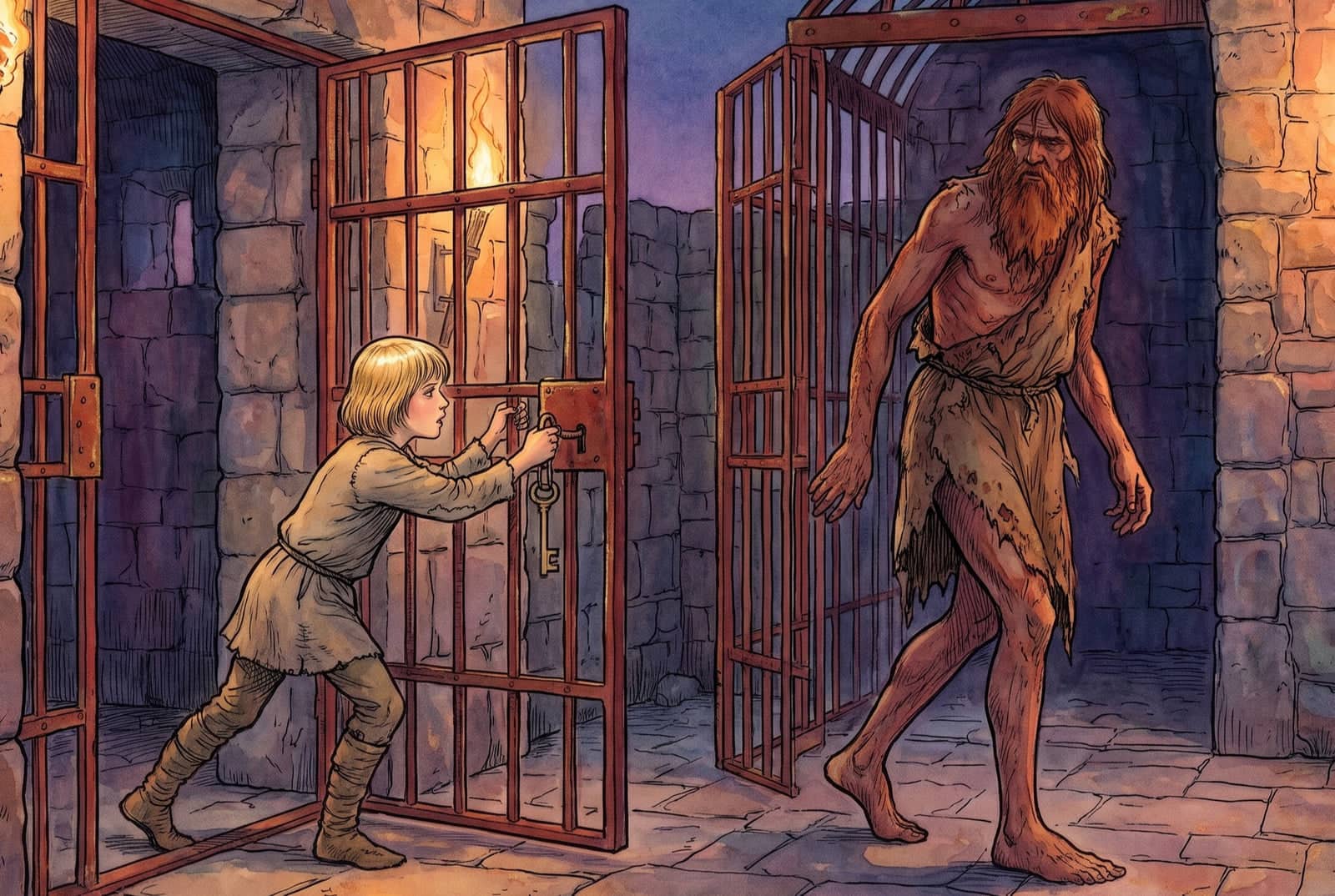
The boy wanted his ball so badly that he put every doubt out of his mind and brought the key. The door was heavy and opened only with difficulty, pinching his fingers as it swung wide. Once it was open, the wild man stepped out, handed him the golden ball, and hurried away. The boy grew frightened and ran after him, calling, “Wild man, don’t go! I’ll be beaten!” The wild man turned back, lifted the boy up, set him on his shoulders, and strode off into the forest at a great pace.
When the king came home and found the cage empty, he asked the queen what had happened. She knew nothing of it, and when she looked for the key, it was gone. She called for the boy, but no one answered. The king sent men to search the fields, but they found no trace of him, and he soon guessed the truth of it. A deep grief fell over the whole court.
When the wild man had carried the boy back into the depths of the forest, he set him down and said, “You will never see your father and mother again, but I will keep you with me, for you set me free, and I feel for you. Do everything I tell you, and you will do well. I have gold and treasure enough, more than anyone else alive.”
He made the boy a bed of moss to sleep on, and the next morning led him to a well. “Look,” he said. “This golden well is as bright and clear as crystal. Sit beside it and see that nothing falls in, or it will be fouled. I’ll come by every evening to see whether you’ve done as I told you.”
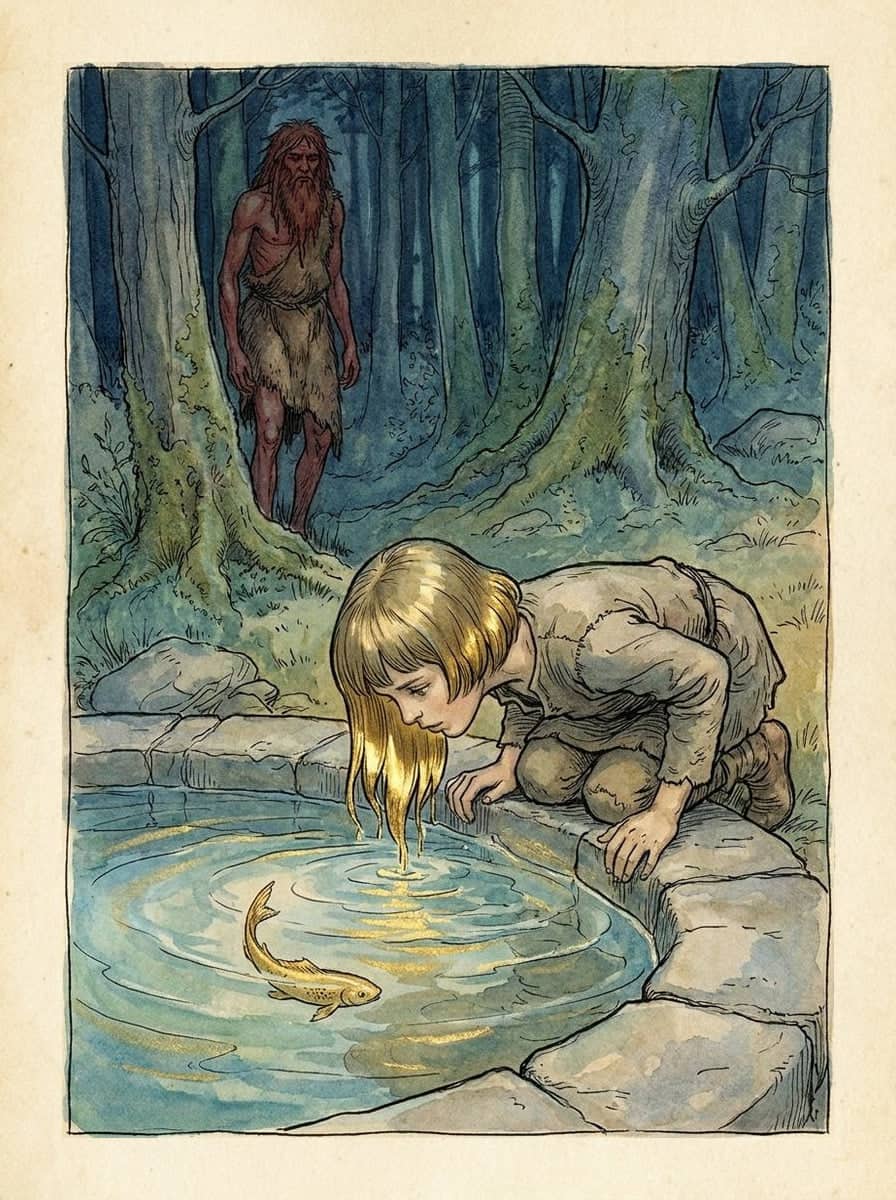
The boy sat down at the edge of the well and watched a golden fish or a golden snake glide by now and then, taking care that nothing fell in. But as he sat there, his finger began to ache so badly that without thinking he dipped it into the water. He pulled it out at once, but it had turned entirely to gold, and however hard he scrubbed, nothing would take the gold away. That evening Iron Hans came back, looked at the boy, and asked, “What has happened to the well?”
“Nothing, nothing at all,” the boy answered, hiding his finger behind his back so the man would not see it.
“You dipped your finger in the water,” said Iron Hans. “I’ll overlook it this once, but take care nothing falls in again.”
At first light the boy was back at the well, keeping watch. His finger ached again, and as he rubbed it across his head, a single hair slipped loose and fell into the water. He snatched it out quickly, but it had already turned to gold. When Iron Hans came, he already knew what had happened. “You’ve let a hair fall into the well,” he said. “I’ll let it pass once more, but if it happens a third time, the well will be fouled for good, and you can no longer stay with me.”
On the third day the boy sat by the well and did not move his finger, however much it hurt. But the hours dragged on, and he began to study his own face in the water. Leaning closer and closer, trying to look straight into his own eyes, he let his long hair slip from his shoulders into the well. He straightened up at once, but by then his whole head of hair had turned to gold and shone like the sun. You can imagine how frightened the poor boy was. He took his handkerchief and tied it around his head so the man would not see.
When Iron Hans arrived, he already knew everything. “Take off the handkerchief,” he said. The golden hair spilled out, and no excuse the boy could offer made any difference.
“You have not passed the test, and you can stay here no longer,” said Iron Hans. “Go out into the world, and there you will learn what poverty means. But since your heart is not a bad one, and since I wish you well, I will grant you this: if you ever fall into trouble, come to the forest and call out, ‘Iron Hans,’ and I will come to help you. My power is greater than you think, and I have gold and silver beyond counting.”
So the prince left the forest and walked on, by roads worn smooth and by no road at all, until at last he came to a great city. He looked there for work but found none, for he had learned no trade that could support him. At last he went to the palace and asked to be taken in. Nobody there knew quite what use to make of him, but they liked him well enough to let him stay, and in the end the cook took him on to carry wood and water and rake out the ashes.
One day, when no one else was at hand, the cook sent him to carry the food to the king’s own table, and since he did not want his golden hair seen, he kept his little cap on. The king had never seen the like of it, and said, “When you come to my table, you must take off your hat.”
“Oh, my lord, I cannot,” the boy answered. “I have an ugly sore on my head.”
At that the king summoned the cook and scolded him for taking such a boy into service, ordering the boy dismissed at once. But the cook felt sorry for him and passed him on to the gardener instead, to work as his boy.
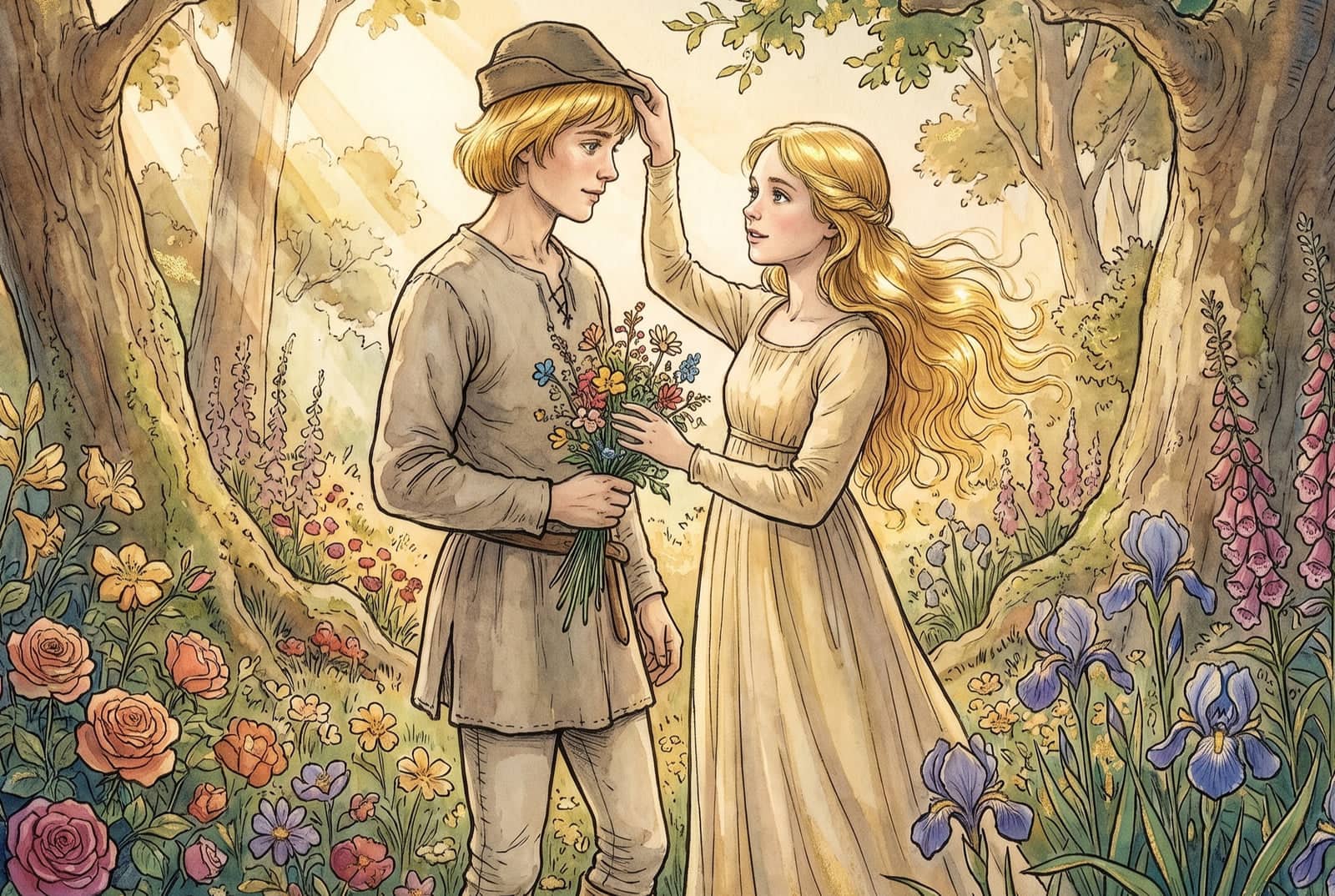
Now the boy had to plant and water, hoe and dig, and bear whatever wind and weather came. One summer day, as he worked alone in the garden, the heat grew so great that he took off his cap to cool his head. The sun struck his hair and set it glittering so brightly that the light flashed straight into the bedroom of the king’s daughter, and she sprang up to see what it was. She caught sight of the boy and called down to him, “Boy, bring me a bunch of flowers.”
He put his cap back on in a hurry, gathered wildflowers from the field, and tied them into a bunch. As he climbed the stairs with them, the gardener met him and said, “You can’t bring the princess flowers like these. Go back and find better ones, the finest and rarest you can.”
“Oh, no,” the boy said. “The wild ones smell sweeter, and she’ll like them better.”
When he came into her room, the princess said, “Take off your cap. It isn’t proper to keep it on in front of me.”
“I can’t,” he answered again. “My head is sore.”
She reached out and pulled the cap off anyway, and his golden hair tumbled down over his shoulders, a splendid sight. He tried to run, but she caught his arm and pressed a handful of gold coins on him. He took them away, but he cared nothing for gold, and gave the coins to the gardener for his children to play with. The next day the princess called for another bunch of field flowers, and when he brought them she grabbed at his cap again, but this time he held it fast with both hands. Again she gave him gold, and again he handed it to the gardener’s children. On the third day it went just the same: she could not get the cap from him, and he would not keep her money.
Not long after, war broke out and swept over the land. The king called his people together, uncertain whether he could stand against an enemy far stronger, with a mighty army behind it. Then the gardener’s boy spoke up. “I’m grown now, and I’ll go to the war too. Only give me a horse.”
The others laughed at him. “Find one for yourself once we’re gone,” they said. “We’ll leave you one in the stable.”
When the army had marched out, he went to the stable and led out the horse they had left him. It was lame in one leg and limped along, hobblety-jig, hobblety-jig, but he mounted it anyway and rode to the edge of the dark forest. There he called out three times, “Iron Hans!” so loudly that it rang through the trees. At once the wild man appeared and asked, “What do you want?”
“I want a strong horse,” said the young man, “for I am going to war.”
“You shall have that, and more besides,” said Iron Hans.
He went back into the forest, and it was not long before a stable hand led out a horse that snorted and stamped and could hardly be held, and behind it came a great troop of soldiers armed entirely in iron, their swords flashing in the sun. The young man handed his three-legged horse over to the stable hand, mounted the new one, and rode at the head of the troop. By the time he reached the battlefield, a great part of the king’s men had already fallen, and the rest were close to giving way. The young man charged in with his iron soldiers, broke over the enemy like a storm, and cut down all who stood against him. The enemy turned to flee, and he pursued them until not one man was left standing.
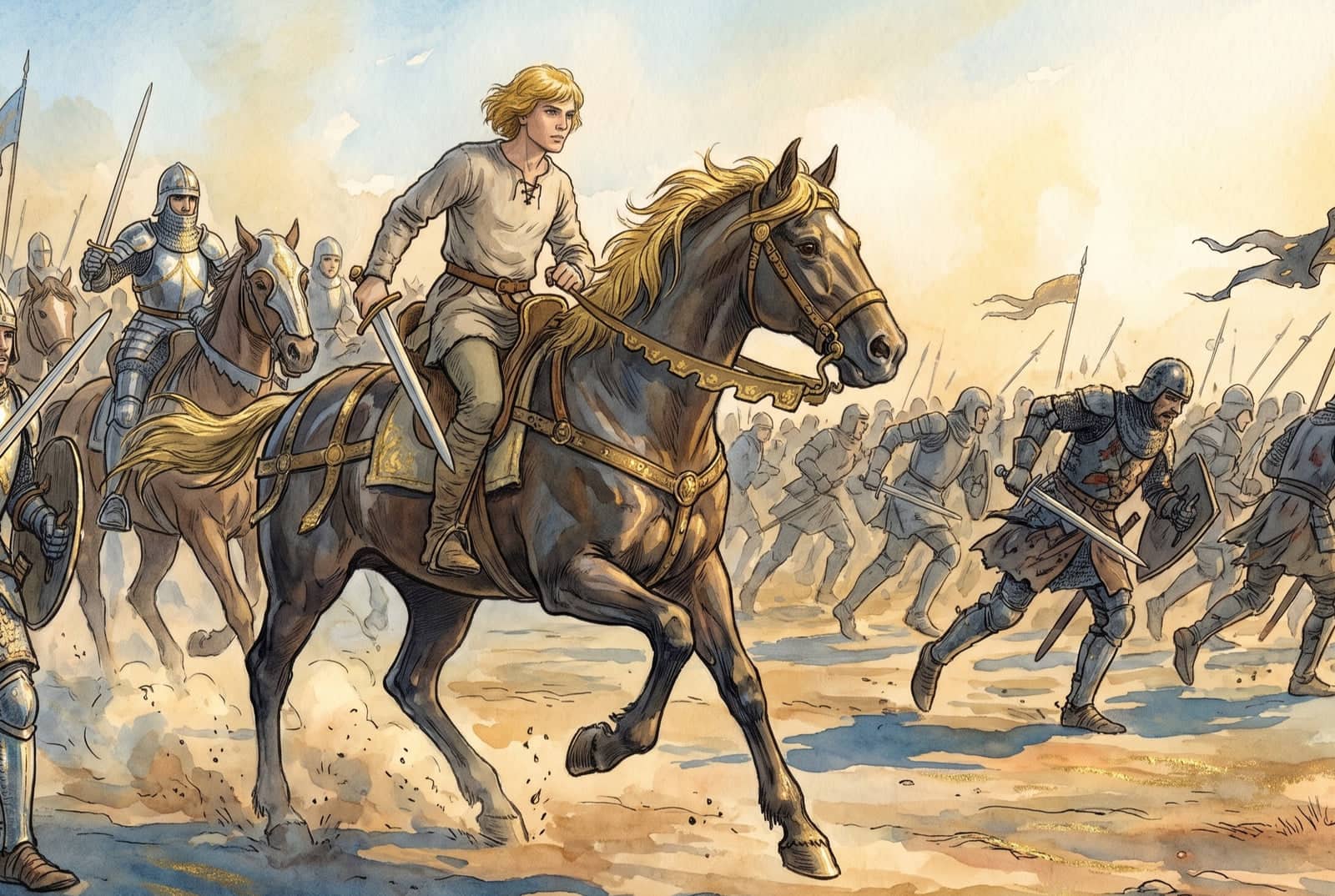
Instead of returning to the king, he led his troop back to the forest by side paths and called out again for Iron Hans. “What do you want?” asked the wild man.
“Take back your horse and your soldiers, and give me my three-legged horse again,” said the young man. It was done at once, and soon he was riding home on his lame old horse.
When the king reached his palace, his daughter came out to greet him and wish him joy of his victory. “It wasn’t I who won it,” he said. “A strange knight came to my aid with his own soldiers.” His daughter wanted to know who the knight was, but the king could not say. “He rode down the enemy, and I never saw him again,” he told her. She asked the gardener about his boy, and the gardener laughed. “He’s only just come home on his three-legged horse. The others have been mocking him, calling out, ‘Here comes our old hobblety-jig!’ They asked him what hedge he’d been sleeping under all this time. But he told them, ‘I did the best of anyone, and it would have gone badly without me,’ and they laughed at him harder still.”
The king said to his daughter, “I will hold a great feast, three days long, and you shall throw a golden apple among the knights. Perhaps the stranger will come for that.” When the feast was announced, the young man went out to the forest and called Iron Hans. “What do you want?” the wild man asked.
“I want to catch the princess’s golden apple.”
“That’s as good as done already,” said Iron Hans. “You shall have a suit of red armor besides, and ride a spirited chestnut horse.”
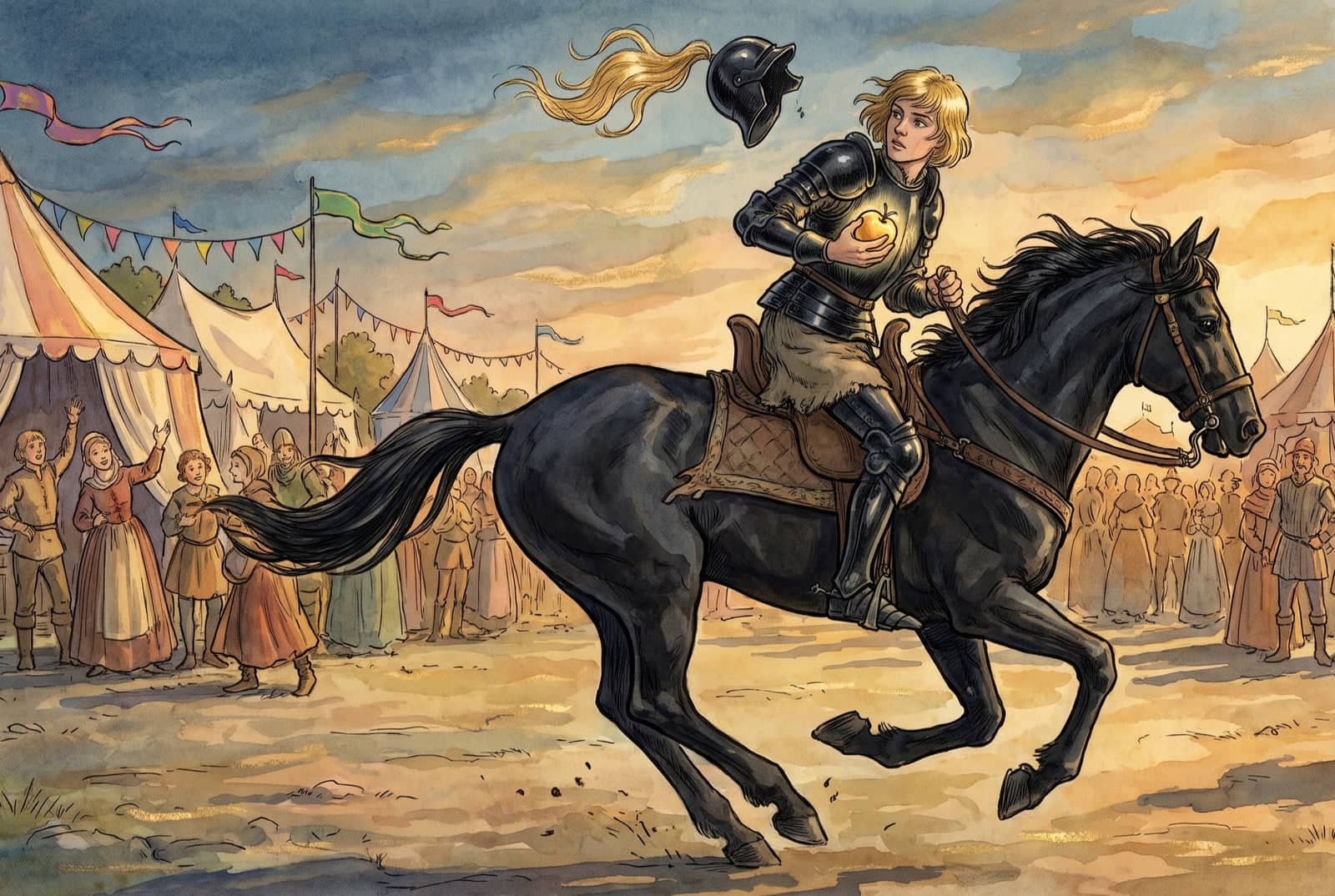
When the day came, he rode in among the other knights, and no one knew him. The princess stepped forward and threw a golden apple among them, and he alone caught it, then galloped away at once with it.
The next day Iron Hans dressed him as a white knight and gave him a white horse. Again he alone caught the apple, and again he did not linger but rode off with it. This angered the king, who declared that it was not to be allowed. “He must appear before me and give his name,” he said, and ordered that if the knight tried to leave again after catching the apple, he was to be chased down, and cut down if he would not return willingly.
On the third day Iron Hans gave him black armor and a black horse, and once more he caught the apple. But as he rode away with it, the king’s men pursued him, and one came close enough to wound his leg with the point of a sword. He escaped them still, but his horse leaped so hard that the helmet flew from his head, and they saw that his hair was gold. They rode back and told the king everything.
The next day the princess asked the gardener about his boy. “He’s at work in the garden,” the gardener said. “The strange fellow was at the feast too, it seems. He only got back last evening, and he’s shown my children three golden apples he says he won there.”
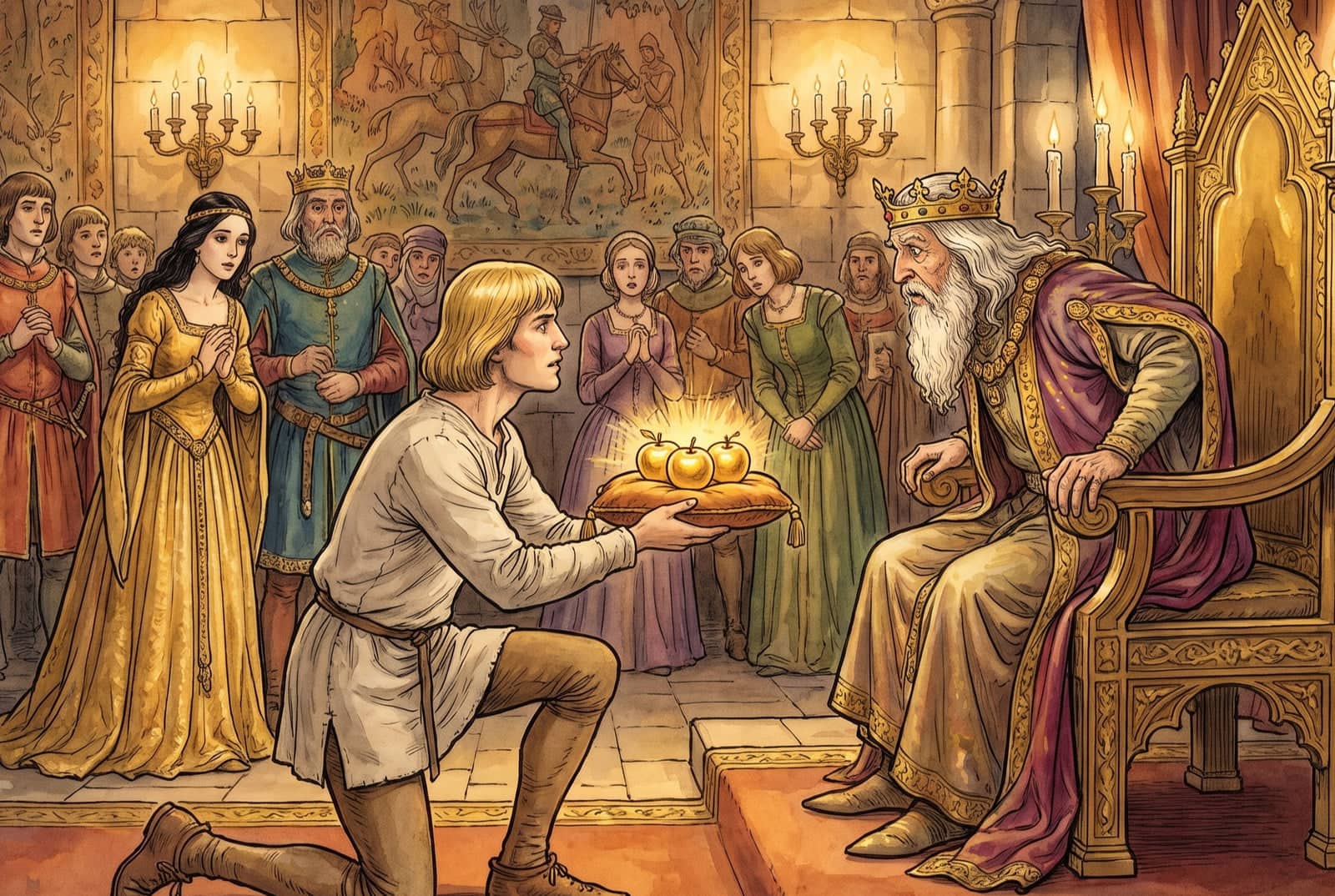
The king had him brought before him, and he came wearing his little cap as always. But the princess went up to him and pulled it off, and his golden hair fell over his shoulders, so handsome a sight that everyone was amazed.
“Were you the knight who came to the feast each day in different colors, and caught the three golden apples?” the king asked.
“Yes,” he answered. “Here are the apples.” He drew them from his pocket and handed them to the king. “And if you need further proof, here is the wound your men gave me when they chased me. I am also the knight who helped you win your battle against the enemy.”
“If you can do such deeds as that, you are no gardener’s boy,” said the king. “Tell me, who is your father?”
“My father is a great and powerful king, and I have gold enough for anything I could want.”
“Then I see I owe you my thanks,” said the king. “Is there anything I can do for you?”
“Yes,” the young man said. “Give me your daughter for my wife.”
The princess laughed. “He doesn’t waste time asking,” she said, “but I already knew from his golden hair that he was no gardener’s boy.” And she went to him and kissed him.
His father and mother came to the wedding, overjoyed, for they had long since given up all hope of ever seeing their son again. And as the wedding feast was underway, the music suddenly fell silent, the doors swung open, and a stately king entered with a great company of followers. He went straight to the young man, embraced him, and said, “I am Iron Hans. I was under a spell that made me a wild man, but you have set me free. Everything I own shall now be yours.”
Retold by Talerie, Source: Household Tales by Brothers Grimm (opens in a new window)
License: Public domainCopy this text, adapt it, use it however you like. A link back to Talerie is appreciated but never required.CC0 1.0 (opens in a new window)