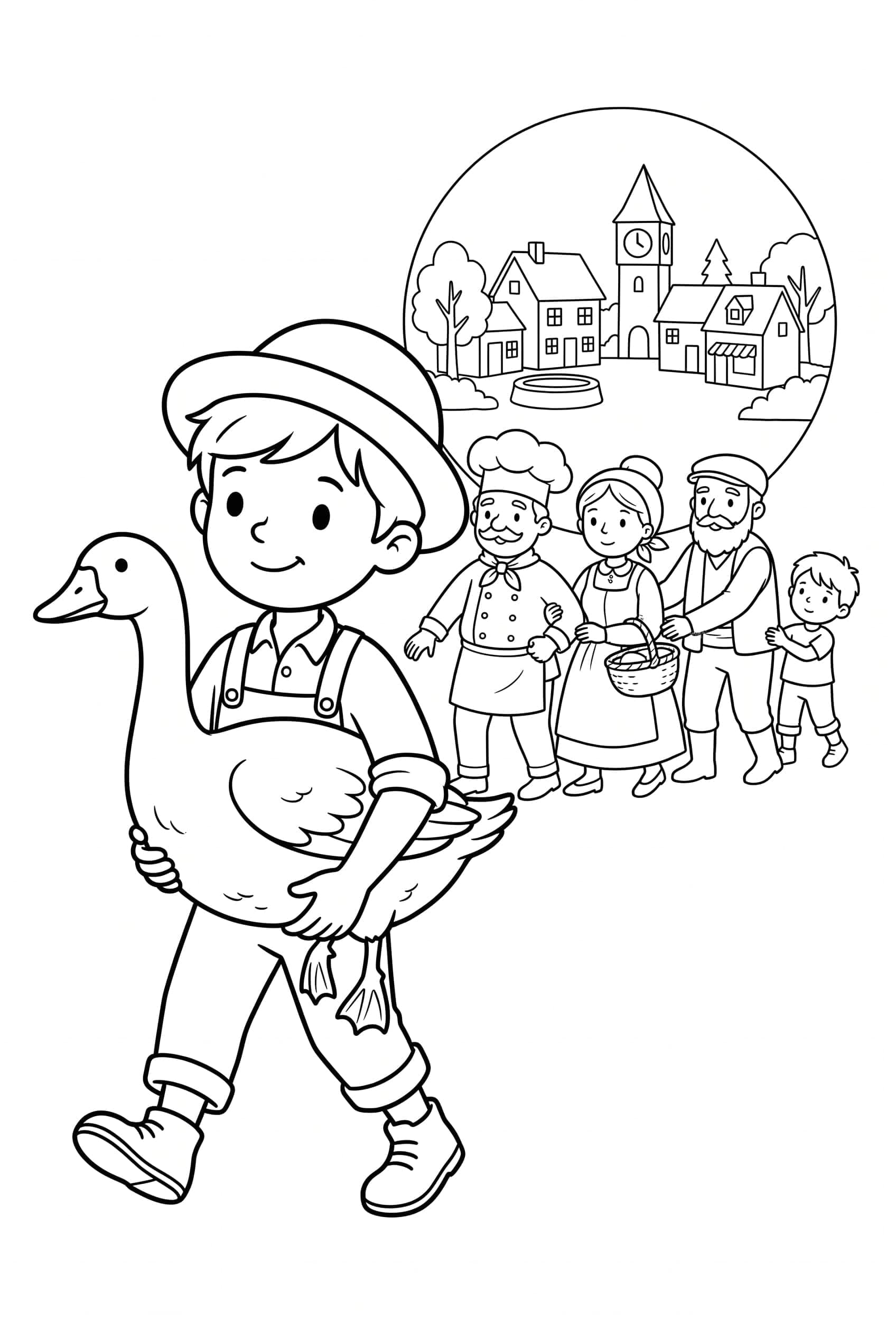
Mocked as a fool, Dummling shares his ash-cake with a little gray man and wins a golden goose that holds fast to whoever grabs it. A line of stuck villagers makes the king’s daughter laugh at last, and after a mountain of bread and a ship that goes sailing on land, Dummling marries her and inherits the kingdom.
There was once a man who had three sons. The youngest was called Dummling, which means Simpleton, and he was mocked and despised and pushed aside at every turn.
One day the eldest son wanted to go into the forest to cut wood, and before he left, his mother gave him a fine, sweet cake and a bottle of wine, so that he would not go hungry or thirsty on the way.
In the forest he met a little gray-haired old man, who wished him good day and said, “Give me a piece of your cake and a drink from your bottle. I am so hungry and thirsty.”
But the eldest son thought himself clever and answered, “If I give you my cake and my wine, I shall have none left for myself. Be off with you.” He left the little man standing there and went on his way.
He had barely begun to cut down a tree when his axe slipped and struck him in the arm, so that he had to go home and have it bound up. It was the little gray man’s doing, though the young man never knew it.
Then the second son went out to the forest, and his mother gave him a cake and a bottle of wine, just as she had given the eldest. The same little gray man met him too, and said, just as he had said to his brother, “Give me a piece of your cake and a drink from your bottle. I am so hungry and thirsty.”
“What I give to you is taken from me,” said the second son. “Be off.” He too left the old man standing and went on his way.
His punishment was no slower in coming than his brother’s had been. He had struck only a few blows at the tree when the axe caught his own leg, and he had to be carried home.
Then Dummling said, “Father, let me go and cut wood.”
But his father answered, “Your brothers hurt themselves at it. Leave it be. You understand nothing about such things.”
Dummling begged so long and so patiently that at last his father relented. “Go on, then,” he said. “A little hurt might make you wiser.” Dummling’s mother had no fine cake to give him this time, only one made with water and baked in the ashes of the hearth, and a bottle of sour beer besides.
When Dummling came to the forest, the little gray man met him too, and said, just as he had said to the others, “Give me a piece of your cake and a drink from your bottle. I am so hungry and thirsty.”
“I have only ash-cake and sour beer,” Dummling said, “but if that will do for you, let us sit down and share it.”
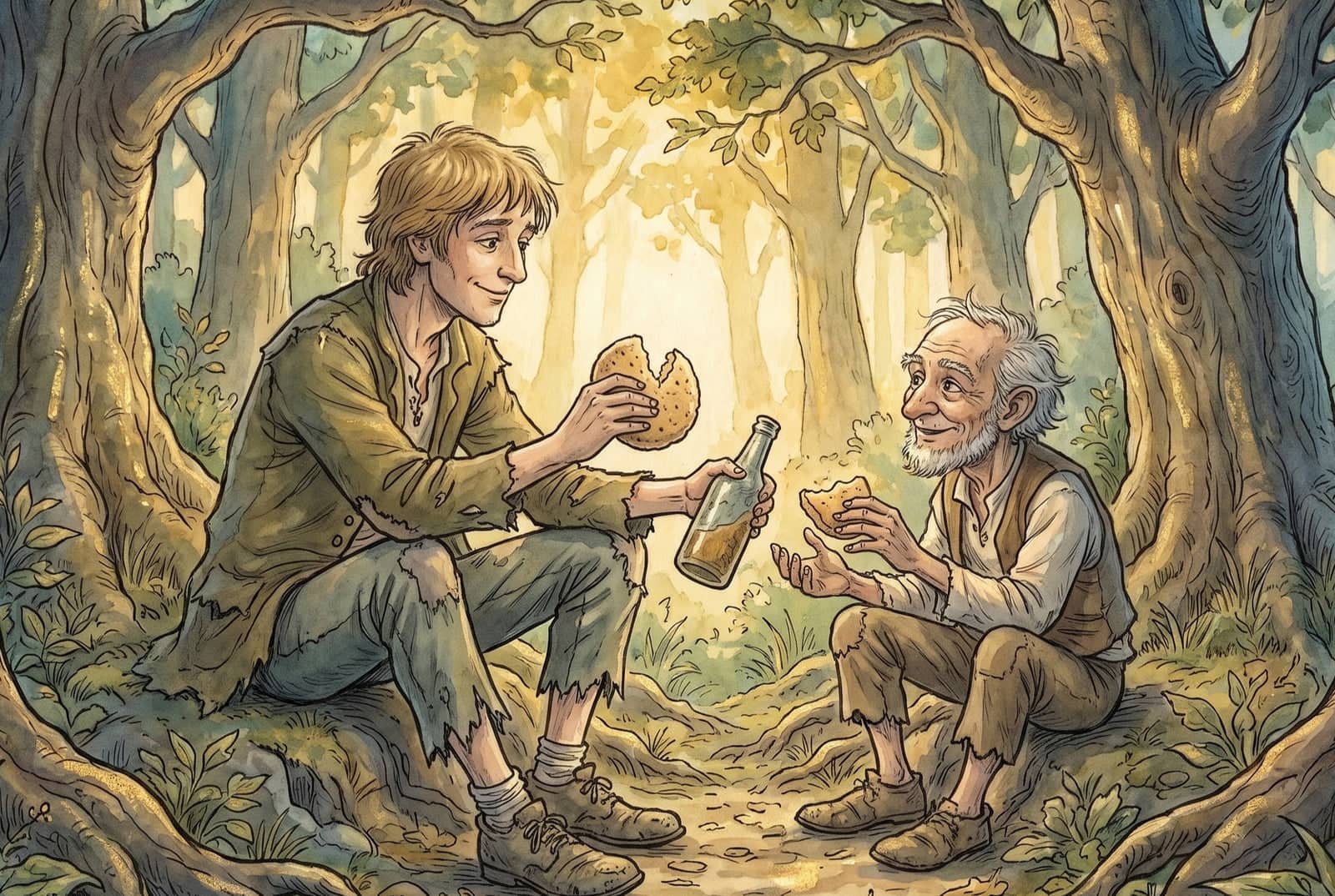
So they sat together, and when Dummling brought out his ash-cake, it had turned into a fine sweet cake, and the sour beer had become good wine. They ate and drank happily, and when they had finished, the little man said, “Because you have a good heart, and are willing to share what little you have, I will bring you good fortune. Over there stands an old tree. Cut it down, and you will find something in its roots.” Then he took his leave.
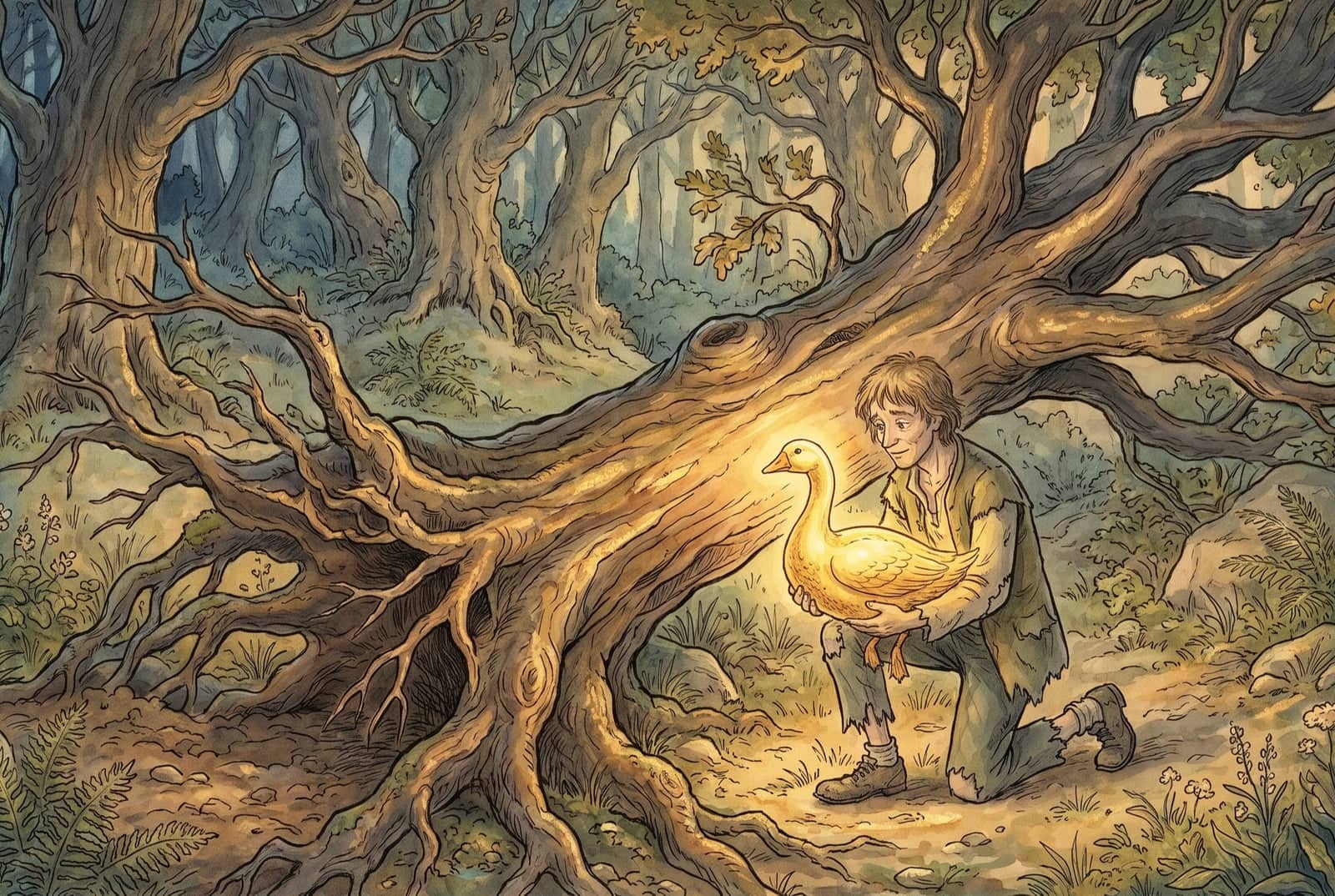
Dummling cut down the tree, and when it fell, there in the roots sat a goose with feathers of pure gold. He lifted her out, tucked her under his arm, and went on to an inn, meaning to spend the night there. Now the innkeeper had three daughters, and when they saw the golden goose, each of them longed to have one of her shining feathers for herself.
The eldest daughter thought, “I am sure I can find a moment to pluck out a feather,” and as soon as Dummling had stepped outside, she caught hold of the goose by the wing. But her hand stuck fast to it, and she could not pull free.
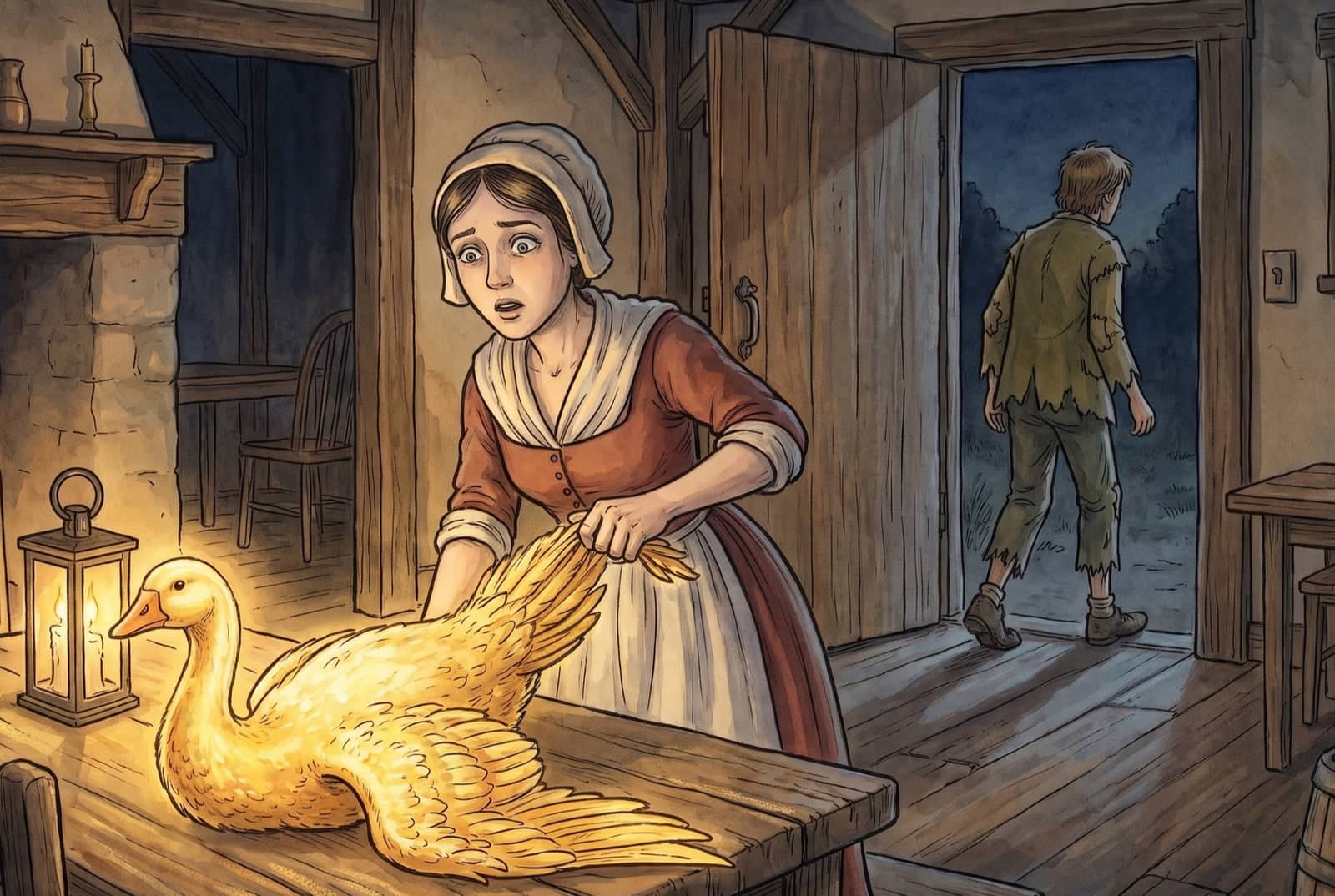
Soon after, the second daughter came, meaning only to steal a feather for herself, but the moment she touched her sister, she too stuck fast.
At last the third daughter came with the same thought in mind.
“Stay away!” the other two cried. “For pity’s sake, stay away!”
But she did not understand why she should. “If they can stand there,” she thought, “so can I,” and she ran to join them. The instant she touched her sister, she stuck fast as well. So the three of them had to spend the whole night standing beside the goose.
In the morning, Dummling tucked the goose under his arm and set off, giving no thought at all to the three girls trailing after him. They had no choice but to run behind him wherever he went, first to the left, then to the right, however his path happened to turn.
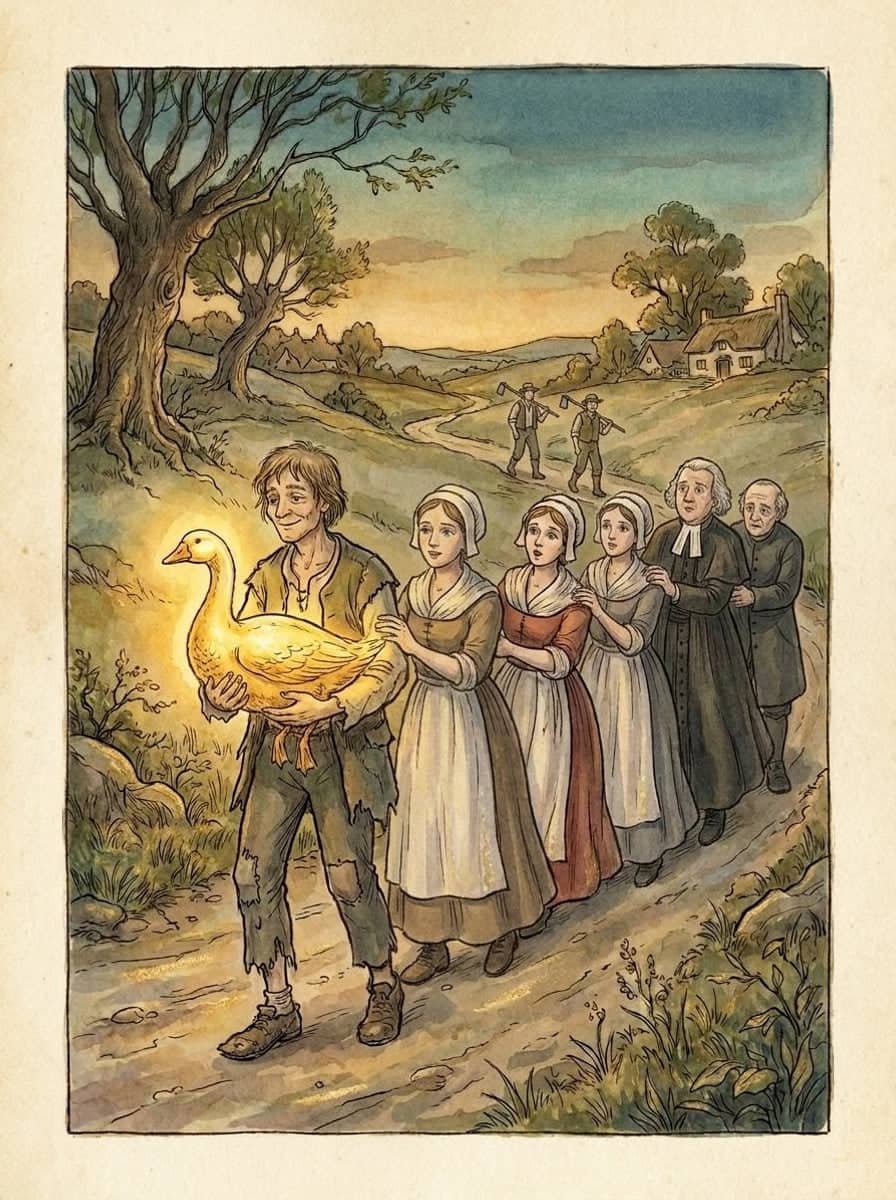
Out in the middle of a field they passed the parson, who stared at this strange little procession and cried, “Shame on you, you wicked girls, running across the fields after a young man like that! Is that seemly behavior?” So saying, he took hold of the youngest girl’s hand to pull her away, but the moment he touched her, he stuck fast too, and had to run along behind them all.
Not long after, the sexton came by and saw his own parson running after three girls. Astonished, he called out, “Now then, Parson, where are you off to in such a hurry? Don’t forget we have a christening to perform today!” and he hurried after him and caught his sleeve, only to find that he too was held fast.
As the five of them went trotting along one behind another, two farmhands came in from the fields with their hoes over their shoulders. The parson called to them and begged them to set him and the sexton free. But no sooner had they touched the sexton than they stuck fast as well, and now seven of them went running along behind Dummling and his golden goose.
Before long Dummling came to a city ruled by a king whose daughter was so solemn that no one had ever been able to make her laugh. The king had declared that whoever could make her laugh should marry her. When Dummling heard this, he brought his goose, with her whole trailing procession, before the king’s daughter. The moment she saw the seven of them running along one after another, she burst out laughing, and laughed so heartily that she could not stop.
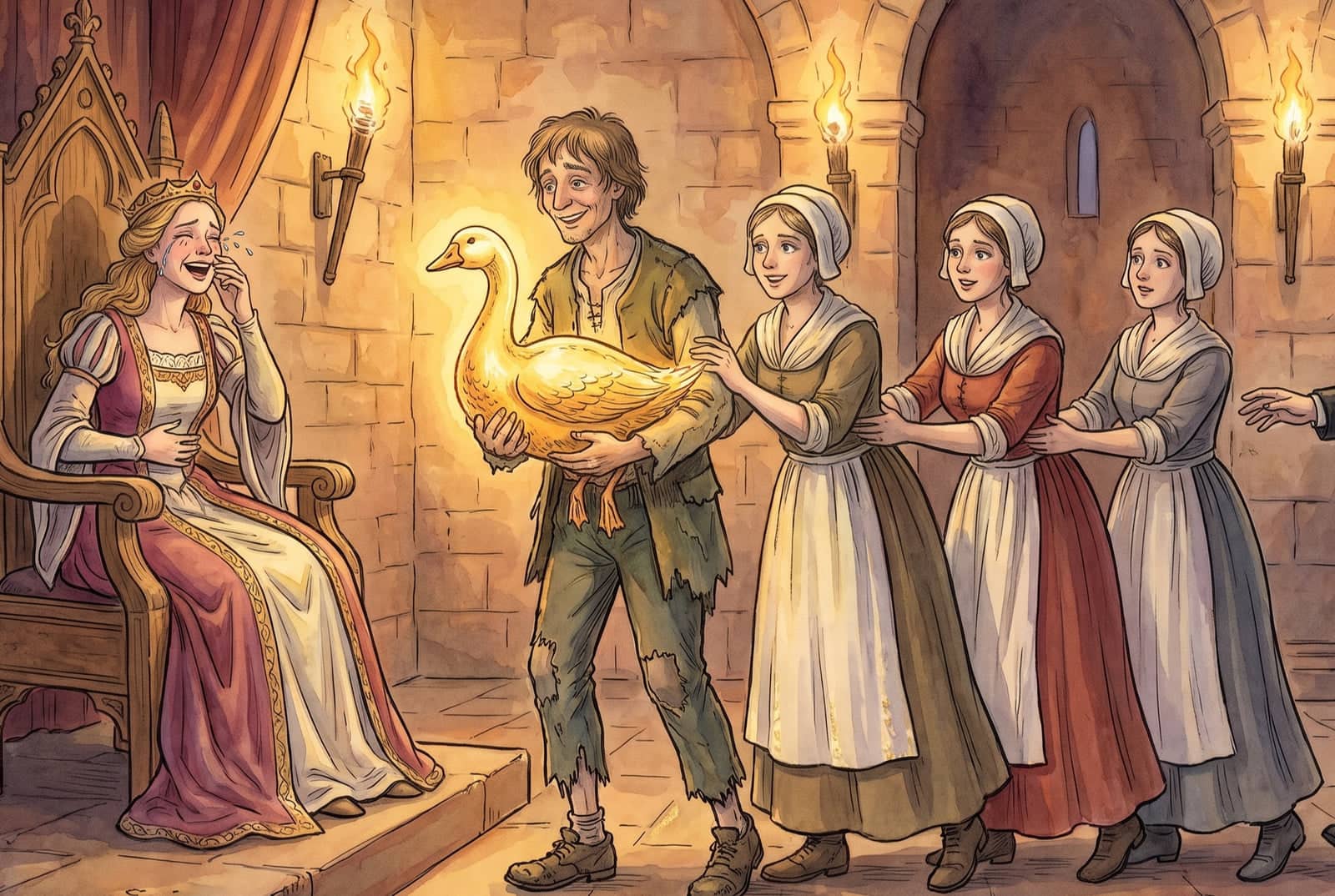
So Dummling asked for her hand in marriage. But the king did not care for this ragged suitor, and looked for ways to refuse him. He declared that Dummling must first bring him a man who could drink an entire cellar of wine dry.
Dummling thought at once of the little gray man, and went back into the forest, hoping for his help. On the very spot where he had cut down the tree, he found a man sitting with a most doleful face.
“I have such a thirst,” the man said, when Dummling asked what troubled him, “and nothing will quench it. Cold water does not agree with me, and though I have already emptied a whole barrel of wine, it was no more than a drop in the ocean.”
“I can help you with that,” said Dummling. “Only come with me, and you shall drink your fill.” He led the man down into the king’s cellar, and there the man set upon the great casks, drinking and drinking until his sides ached, and before the day was out, the whole cellar stood empty.
Dummling asked once more for his bride, but the king was loath to see his daughter carried off by a fellow everyone called a fool, and set another condition. Dummling must find a man who could eat an entire mountain of bread. Dummling went straight back into the forest, and on the very same spot he found a man drawing his belt tight around his middle, with a most miserable face.
“I have already eaten a whole ovenful of bread,” the man said, “but what good does that do, when a man is as hungry as I am? My stomach stays as empty as ever, and I must keep tightening my belt or starve outright.”
Dummling was glad to hear it, and said, “Get up and come with me. You shall eat your fill.” He led the man to the king’s court, where flour had been gathered from every corner of the kingdom and baked into a mountain of bread. The man from the forest planted himself before it and began to eat, and in a single day the whole mountain had vanished.
For the third time, Dummling asked for his bride, but the king tried once more to put him off, and demanded a ship that could sail on land as easily as on water. “The moment you come sailing up in such a ship,” he said, “you shall have my daughter for your wife.”
Dummling went directly into the forest, and there he found the little gray man to whom he had once given his cake.
“I drank for you, and I ate for you,” the little man said, “and now I will give you your ship as well. I do all this because you were kind to me.” And he gave Dummling the ship that could sail on land as easily as on water.
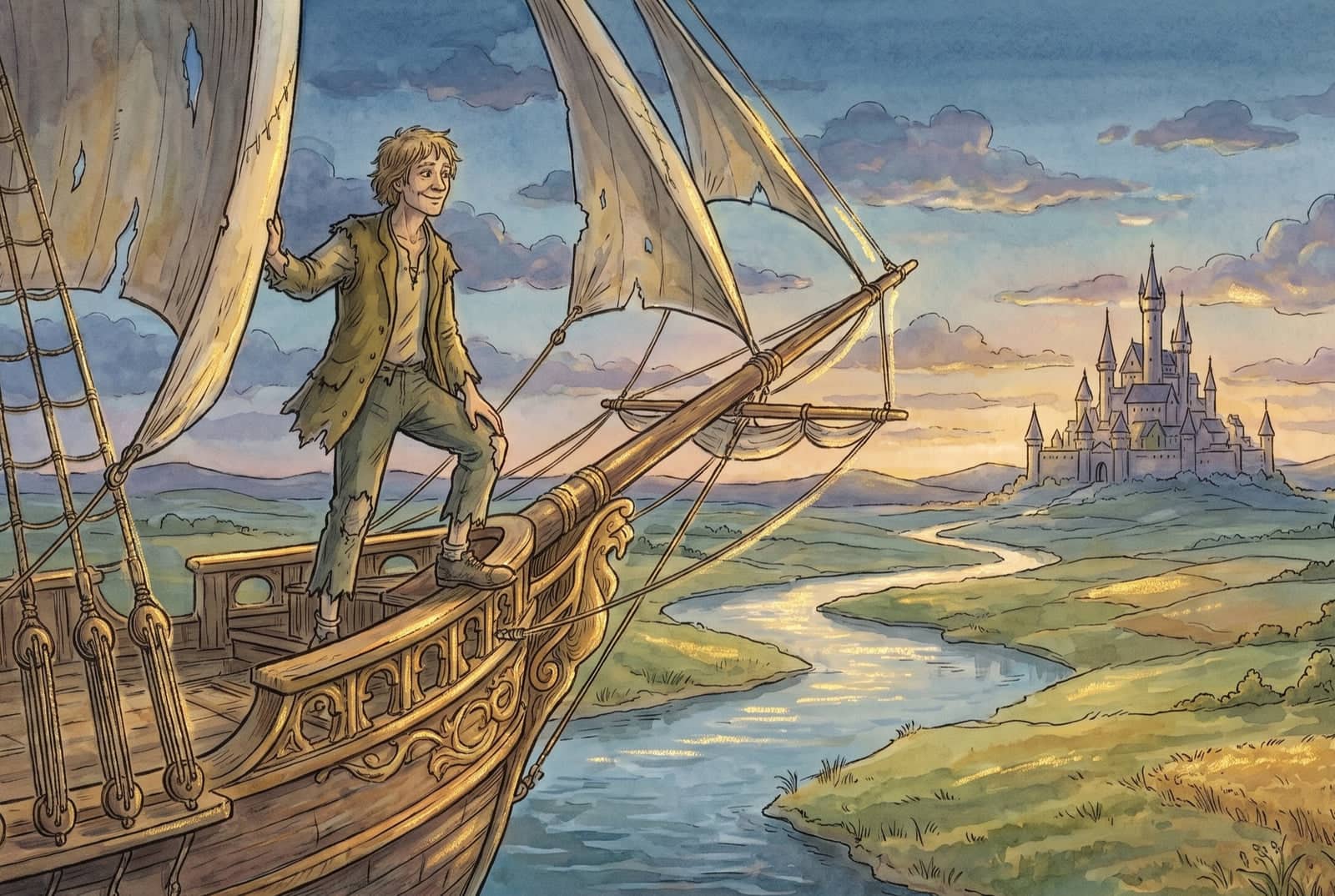
When the king saw the ship come sailing up, he could hold his daughter back no longer. So the wedding was celebrated, and when the old king died, Dummling inherited the kingdom, and he lived long and happily with his wife.
Retold by Talerie from Household Tales by Brothers Grimm (opens in a new window)License: Public domainCopy this text, adapt it, use it however you like. A link back to Talerie is appreciated but never required.CC0 1.0 (opens in a new window)