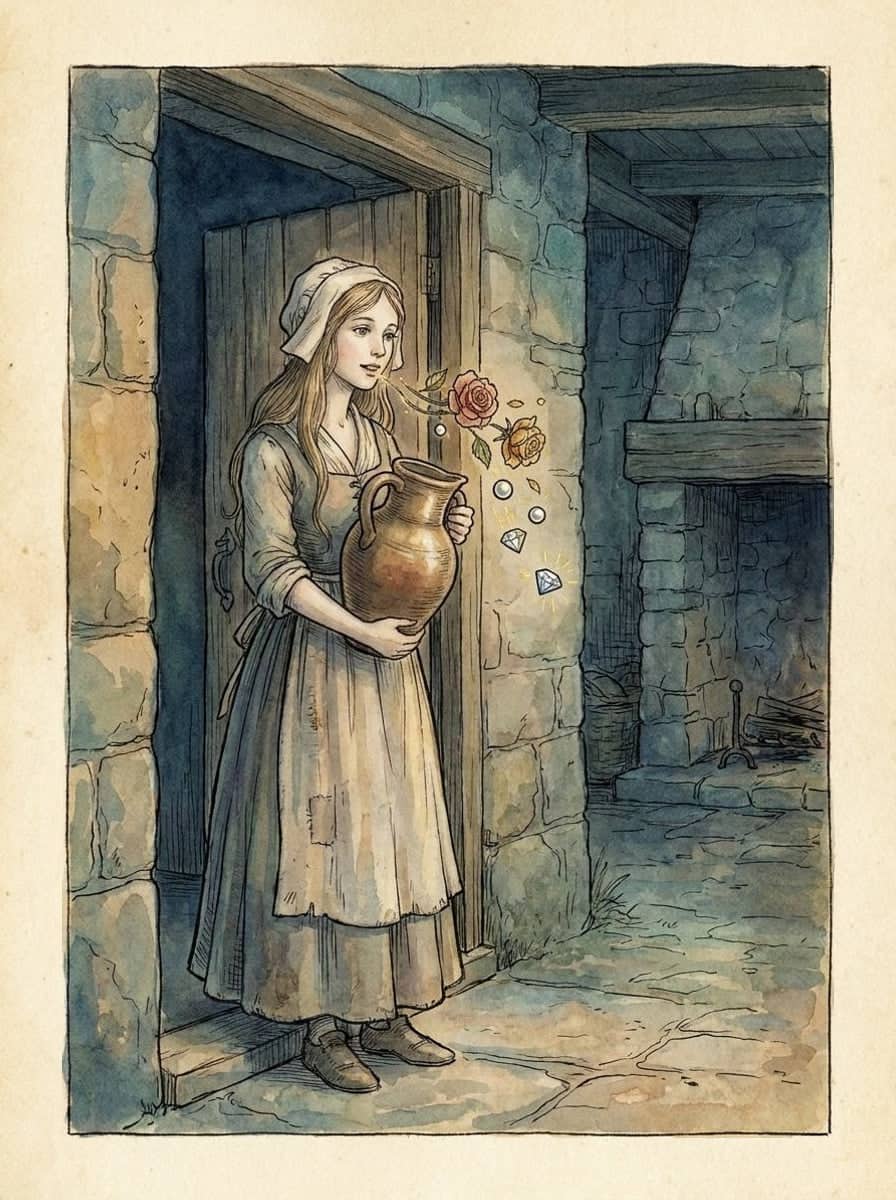

A widow dotes on her proud elder daughter, Fanny, and works the gentle younger one from morning till night. At the fountain the younger girl gives a poor woman a drink, and from then on a flower or a jewel falls from her lips with every word. Now the mother wants the same gift for Fanny.
Once upon a time there was a widow who had two daughters. The elder, Fanny, was so like her mother in face and in temper that whoever looked at the daughter saw the mother. Both of them were so proud and so disagreeable that nobody could live with them.
The younger daughter was the very image of her late father, gentle and kind, and she was one of the most beautiful girls anyone had ever seen. People naturally love those who are like themselves, so the mother doted on her elder daughter and could not bear the younger one. She made her eat in the kitchen and work from morning till night.
Among her other chores, the girl had to walk twice a day to a fountain more than a mile and a half from the house and carry home a full pitcher of water. One day, while she was at the fountain, a poor woman came up and asked her for a drink.
“Why, of course, ma’am,” said the girl. She rinsed out the pitcher at once, filled it from the clearest part of the fountain, and held it up the whole time so that the woman could drink more easily.

When she had finished drinking, the woman said, “You are so pretty, so good, and so polite that I cannot help giving you a gift.” She was really a fairy who had taken the shape of a poor country woman to see how far the girl’s kindness would go. “This is my gift,” the fairy went on. “With every word you speak, a flower or a jewel shall fall from your mouth.”
When the girl got home, her mother scolded her for staying so long at the fountain.
“I’m sorry I took so long, Mother,” said the girl.
And as she spoke, two roses, two pearls, and two diamonds fell from her lips.
“What’s this I see?” cried her mother in astonishment. “Pearls and diamonds, coming out of the girl’s mouth! How did this happen, my daughter?”
It was the first time she had ever called her “my daughter.”
The girl told her everything, quite simply, and all the while diamonds tumbled from her mouth.
“Then I must send my other daughter there,” said the mother. “Fanny, come here! Look what comes out of your sister’s mouth when she talks. Wouldn’t you like to have the same gift? All you have to do is go and draw water at the fountain, and when a poor woman asks you for a drink, give it to her very politely.”
“A fine sight that would be,” said Fanny. “Me, going off to fetch water!”
“You’ll go,” said her mother, “and you’ll go this minute!”
So off Fanny went, grumbling all the way, and she took with her the finest silver tankard in the house.
No sooner had she reached the fountain than she saw a magnificently dressed lady come out of the woods. The lady walked up to her and asked for a drink. It was the very same fairy who had met her sister, but this time she was dressed like a princess and carried herself like one, to see how far this girl’s rudeness would go.
“Did I come all this way to give you water?” said the proud girl. “I suppose I brought the silver tankard just to serve madam, did I? Well, drink from it yourself, if you like.”
“You are not very polite,” said the fairy, without the least anger. “Very well. Since you are so rude and so unkind, this is my gift: with every word you speak, a snake or a toad shall fall from your mouth.”
As soon as her mother saw Fanny coming, she called out, “Well, daughter?”
“Well, Mother?” answered Fanny, and out of her mouth came two vipers and two toads.

“Oh, mercy!” cried the mother. “What do I see? It’s her wretched sister who did this, and she’ll pay for it!” And the mother ran at once to beat the younger girl.
The poor girl fled from her and hid in the forest nearby.
The king’s son was riding home from the hunt when he came upon her there. Seeing how pretty she was, he asked what she was doing all alone and why she was crying.
“Oh, sir,” she said, “my mother has turned me out of the house.”
The king’s son saw five or six pearls and as many diamonds fall from her mouth, and he asked her how such a thing could be. So she told him the whole story. He fell in love with her, and because he thought such a gift was worth more than any dowry, he took her to his father’s palace, and there he married her.

As for her sister, Fanny made herself so hated that her own mother drove her out of the house. The unhappy girl wandered for a long time, and nobody would take her in, until at last she lay down at the edge of a wood and died there alone.
Retold by Talerie from The Blue Fairy Book (opens in a new window) Public domain Copy this text, adapt it, use it however you like. A link back to Talerie is appreciated but never required. CC0 1.0 (opens in a new window)