 Original
On the night before his coronation, the young king lies by the fire thinking of his robe of woven gold. Only months ago he was a bare-legged boy herding goats in the forest. At midnight he falls asleep and dreams of a damp attic where hungry weavers bend over their looms.
It was the night before the day set for his coronation, and the young king was sitting alone in his beautiful room. His courtiers had all taken their leave of him, bowing their heads to the ground as the ceremonious custom of the day required, and had gone off to the Great Hall of the palace for a few last lessons from the Professor of Etiquette. Some of them still had quite natural manners, and in a courtier, I need hardly say, that is a very serious offense.
The boy, for he was only a boy, just sixteen years old, was not sorry to see them go. With a deep sigh of relief he had thrown himself back on the soft cushions of his embroidered couch, and he lay there wild-eyed and open-mouthed, like a brown woodland faun, or some young animal of the forest newly caught by hunters.
And it really had been hunters who found him. They had come upon him almost by chance, a bare-legged boy with a pipe in his hand, following the flock of the poor goatherd who had brought him up and whom he had always believed to be his father.
He was the child of the old king’s only daughter, born of a secret marriage with a man far beneath her in rank. Some said the man was a stranger who had won the young princess’s love by the wonderful magic of his lute playing. Others spoke of an artist from Rimini, to whom the princess had shown much honor, perhaps too much, and who had suddenly vanished from the city, leaving his work in the cathedral unfinished.
When the baby was only a week old, he had been stolen from his mother’s side as she slept and handed over to a common peasant and his wife. They had no children of their own and lived in a remote part of the forest, more than a day’s ride from the town.
Within an hour of waking, the pale young mother was dead. It was grief, some said, or the plague, as the court physician declared, or, as others whispered, a swift Italian poison given to her in a cup of spiced wine.
At the very hour when the trusted messenger, carrying the child across his saddle, leaned down from his tired horse and knocked at the rough door of the goatherd’s hut, the princess’s body was being lowered into an open grave in an abandoned churchyard beyond the city gates. In that grave, it was said, another body already lay: a young man of marvelous, foreign beauty, whose hands were tied behind him with a knotted cord and whose chest was stabbed with many red wounds.
Such, at least, was the story people whispered to one another. What was certain was that the old king, on his deathbed, had sent for the boy and, in front of the Council, had acknowledged him as his heir. Perhaps he was moved by remorse for his great sin, or perhaps he simply did not want the kingdom to pass out of his family.
From the very first moment he was recognized, it seems, the boy showed signs of that strange passion for beauty that was to shape so much of his life. Those who led him to the rooms set aside for him often spoke of the cry of pleasure that burst from him when he saw the delicate clothes and rich jewels prepared for him, and of the almost fierce joy with which he flung off his rough leather tunic and coarse sheepskin cloak.
At times, it is true, he missed the fine freedom of his life in the forest, and he was always inclined to fret at the tedious court ceremonies that took up so much of every day. But the wonderful palace, which they called Joyeuse, and of which he now found himself master, seemed to him a new world made fresh for his delight.
As soon as he could slip away from the council table or the audience chamber, he would run down the great staircase with its lions of gilded bronze and its steps of bright porphyry, and wander from room to room and from corridor to corridor, as though he were seeking in beauty a cure for pain, a kind of healing after sickness.
He called these wanderings his journeys of discovery, and to him they truly were voyages through a marvelous land. Sometimes the slim, fair-haired court pages went with him, with their floating cloaks and bright fluttering ribbons. More often he went alone, for some quick instinct, almost a gift of foresight, told him that the secrets of art are best learned in secret, and that Beauty, like Wisdom, loves the worshipper who comes alone.
Many curious stories were told about him in those days. It was said that a stout burgomaster, who had come to deliver a flowery speech on behalf of the townspeople, had caught sight of him kneeling in true adoration before a great painting just brought from Venice, a painting that seemed to herald the worship of some new gods.
Another time he had been missing for several hours, and after a long search he was found in a little room in one of the palace’s northern turrets, gazing as if in a trance at a Greek gem carved with the figure of Adonis.
He had been seen, so the story went, pressing his warm lips to the marble brow of an ancient statue that had been found in the riverbed when the stone bridge was built, and that bore the name of Hadrian’s slave from Bithynia. He was said to have spent a whole night watching the moonlight fall on a silver image of Endymion.
All rare and costly materials certainly fascinated him. In his eagerness to have them he had sent out many merchants: some to trade for amber with the rough fisherfolk of the northern seas, some to Egypt to look for that curious green turquoise found only in the tombs of kings and said to have magical powers, some to Persia for silk carpets and painted pottery, and others to India to buy gauze and stained ivory, moonstones and jade bracelets, sandalwood, blue enamel, and shawls of fine wool.
But what had filled his thoughts most of all was the robe he was to wear at his coronation, the robe of woven gold, and the crown studded with rubies, and the scepter with its rows and rings of pearls. It was of these that he was thinking tonight, as he lay back on his luxurious couch, watching the great pine log burning itself out on the open hearth.
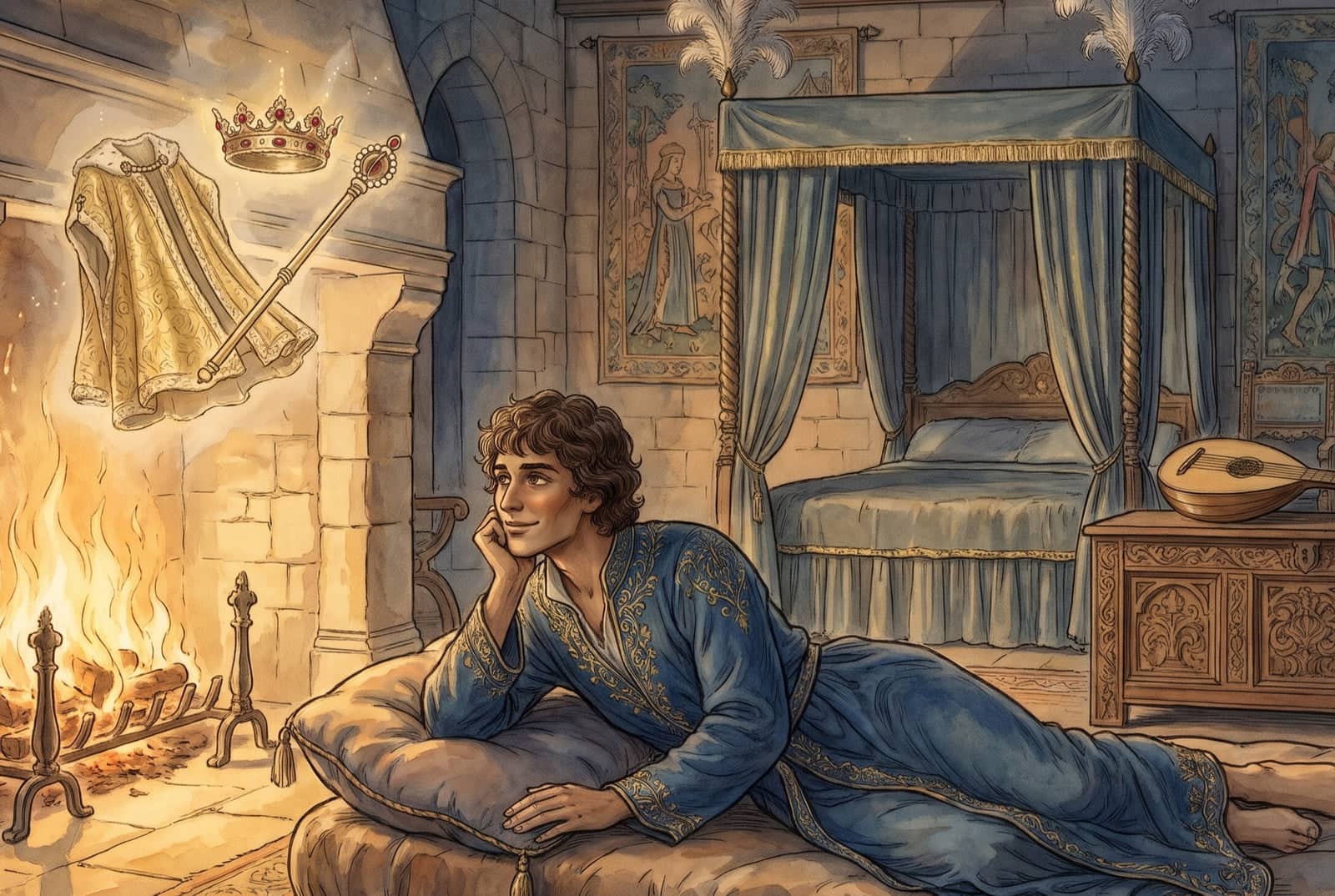
The designs, the work of the most famous artists of the day, had been shown to him many months before. He had ordered the craftsmen to work night and day to carry them out, and the whole world to be searched for jewels worthy of their work. In his mind he saw himself standing at the high altar of the cathedral in the splendid robes of a king, and a smile played and lingered on his boyish lips and lit his dark woodland eyes with a bright gleam.
After a while he rose from his seat and, leaning against the carved hood of the fireplace, looked around the dimly lit room. The walls were hung with rich tapestries showing the Triumph of Beauty. A large cupboard inlaid with agate and lapis lazuli filled one corner, and facing the window stood a finely made cabinet with lacquer panels of powdered and inlaid gold. On it stood some delicate goblets of Venetian glass and a cup of dark-veined onyx.
Pale poppies were embroidered on the silk bedspread, as though they had fallen from the tired hands of sleep. Tall reeds of fluted ivory held up the velvet canopy, and from it great tufts of ostrich plumes sprang like white foam toward the pale silver of the carved ceiling. A laughing Narcissus in green bronze held a polished mirror above his head. On the table stood a shallow bowl of amethyst.
Outside he could see the huge dome of the cathedral rising like a bubble over the shadowy houses, and the weary sentries pacing up and down the misty terrace by the river. Far away in an orchard a nightingale was singing. A faint scent of jasmine came through the open window.
He brushed his brown curls back from his forehead, picked up a lute, and let his fingers wander over the strings. His heavy eyelids drooped, and a strange drowsiness came over him. Never before had he felt so keenly, or with such exquisite joy, the magic and the mystery of beautiful things.
When midnight struck from the clock tower, he rang a bell, and his pages came in and undressed him with great ceremony, pouring rose water over his hands and scattering flowers on his pillow. A few moments after they had left the room, he fell asleep.
As he slept, he dreamed, and this was his dream.
He thought he was standing in a long, low attic, among the whir and clatter of many looms. A thin gray daylight peered in through the barred windows and showed him the gaunt figures of the weavers bent over their frames. Pale, sickly children crouched on the huge crossbeams. As the shuttles shot through the warp, the children lifted the heavy battens, and when the shuttles stopped, they let the battens fall and pressed the threads together.
Their faces were pinched with hunger, and their thin hands shook. A few haggard women sat at a table, sewing. A horrible smell filled the place. The air was foul and heavy, and the walls dripped and streamed with damp.
The young king went over to one of the weavers, stood beside him, and watched him.
The weaver looked at him angrily. “Why are you watching me?” he said. “Are you a spy our master has set on us?”
“Who is your master?” asked the young king.
“Our master!” the weaver cried bitterly. “He is a man like me. The only difference between us is that he wears fine clothes while I go in rags, and that while I am weak with hunger, he suffers more than a little from eating too much.”
“The land is free,” said the young king, “and you are no man’s slave.”
“In war,” answered the weaver, “the strong make slaves of the weak, and in peace the rich make slaves of the poor. We must work to live, and they pay us so little that we die. We toil for them all day long, and they heap up gold in their chests, and our children wither before their time, and the faces of those we love grow hard and cruel. We tread the grapes, and someone else drinks the wine. We sow the grain, and our own table is bare. We wear chains, though no eye sees them, and we are slaves, though men call us free.”
“Is it like this for everyone?” he asked.
“It is like this for everyone,” answered the weaver, “for the young and for the old, for the women and for the men, for the little children and for those bent with age. The merchants grind us down, and we have to do as they say. The priest rides by telling his beads, and no one cares what becomes of us. Through our sunless lanes creeps Poverty with her hungry eyes, and Sin with his bloated face follows close behind her. Misery wakes us in the morning, and Shame sits with us at night. But what are these things to you? You are not one of us. Your face is too happy.”
The weaver turned away, scowling, and threw the shuttle across the loom, and the young king saw that it was threaded with a thread of gold.
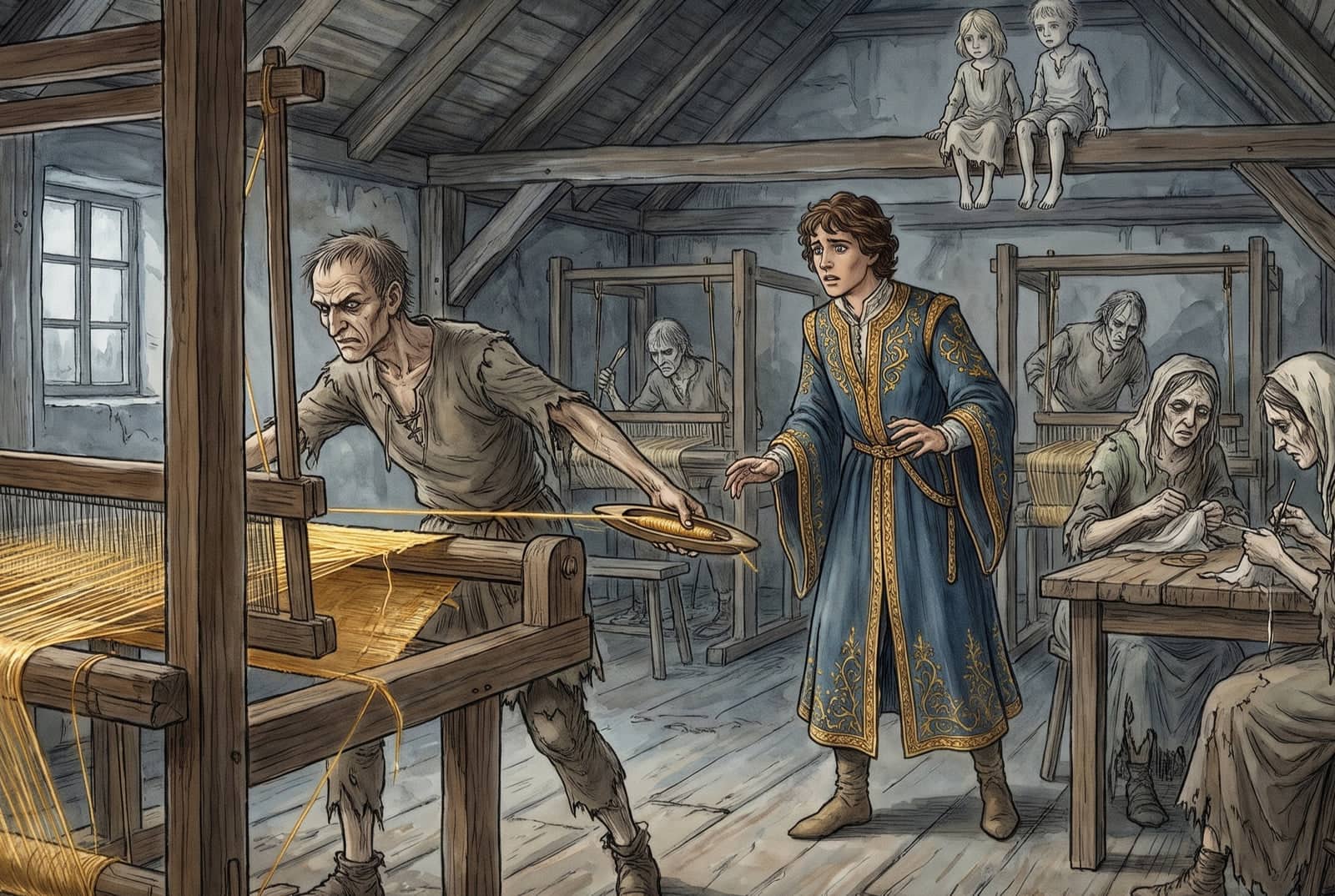
A great terror seized him, and he said to the weaver, “What robe is this that you are weaving?”
“It is the robe for the coronation of the young king,” the weaver answered. “What is that to you?”
The young king gave a great cry and woke, and there he was in his own room. Through the window he saw the great honey-colored moon hanging in the dusky air.
He fell asleep again and dreamed, and this was his dream.
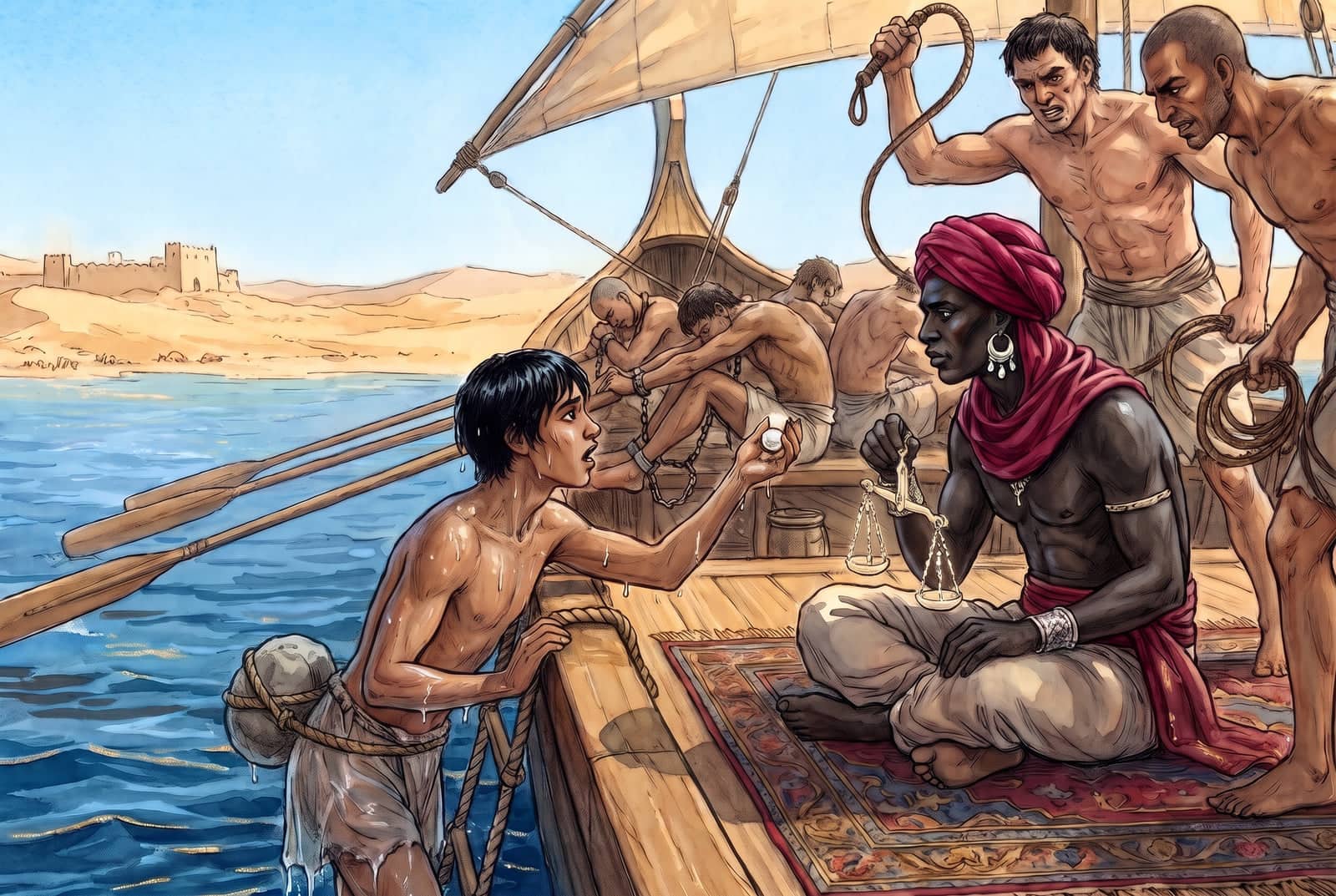
He thought he was lying on the deck of a huge galley rowed by a hundred slaves. On a carpet beside him sat the master of the galley. His skin was as dark as ebony, and his turban was of crimson silk. Great silver earrings dragged down the thick lobes of his ears, and in his hands he held a pair of ivory scales.
The slaves wore nothing but ragged loincloths, and each man was chained to the next. The hot sun beat down on them, and the overseers ran up and down the gangway and lashed them with whips of hide. The slaves stretched out their lean arms and pulled the heavy oars through the water. Salt spray flew from the blades.
At last they reached a little bay and began to take soundings. A light wind blew from the shore and covered the deck and the great triangular sail with fine red dust. Three Arabs on wild donkeys came riding out and threw spears at the ship. The master of the galley took up a painted bow and shot one of them in the throat. The man fell heavily into the surf, and his companions galloped away. A woman wrapped in a yellow veil followed slowly on a camel, looking back now and then at the dead body.
As soon as they had dropped anchor and hauled down the sail, the overseers went into the hold and brought up a long rope ladder, heavily weighted with lead. The master of the galley threw it over the side and made the ends fast to two iron posts. Then the overseers seized the youngest of the slaves, knocked off his shackles, filled his nostrils and ears with wax, and tied a big stone around his waist.
He crept wearily down the ladder and disappeared into the sea. A few bubbles rose where he sank. Some of the other slaves peered curiously over the side. In the bow of the galley sat a shark charmer, beating steadily on a drum.
After some time the diver rose out of the water and clung, panting, to the ladder, with a pearl in his right hand. The overseers snatched it from him and pushed him back down. The slaves fell asleep over their oars.
Again and again he came up, and each time he brought a beautiful pearl with him. The master of the galley weighed them and put them into a little bag of green leather.
The young king tried to speak, but his tongue seemed stuck to the roof of his mouth, and his lips would not move. The overseers chattered among themselves and began to quarrel over a string of bright beads. Two cranes flew around and around the ship.
Then the diver came up for the last time, and the pearl he brought was fairer than all the pearls of Ormuz, for it was shaped like the full moon and whiter than the morning star. But his face was strangely pale, and as he fell onto the deck, blood gushed from his ears and nostrils. He quivered for a little while, and then he lay still. The overseers shrugged their shoulders and threw the body overboard.
The master of the galley laughed. He reached out and took the pearl, and when he saw it, he pressed it to his forehead and bowed. “It shall be,” he said, “for the scepter of the young king.” And he made a sign to the overseers to raise the anchor.
When the young king heard this, he gave a great cry and woke, and through the window he saw the long gray fingers of the dawn clutching at the fading stars.
He fell asleep again and dreamed, and this was his dream.
He thought he was wandering through a dim forest hung with strange fruits and beautiful poisonous flowers. Adders hissed at him as he went by, and bright parrots flew screaming from branch to branch. Huge tortoises lay asleep on the hot mud. The trees were full of apes and peacocks.
On and on he went, until he reached the edge of the forest, and there he saw an immense crowd of men toiling in the bed of a dried-up river. They swarmed up the cliffs like ants. They dug deep pits in the ground and went down into them. Some split the rocks with great axes; others scrabbled in the sand. They tore up the cactus by its roots and trampled the scarlet blossoms. They hurried about, calling to one another, and no man was idle.
From the darkness of a cave, Death and Avarice watched them, and Death said, “I am weary. Give me a third of them, and let me go.”
But Avarice shook her head. “They are my servants,” she answered.
Death said to her, “What do you have in your hand?”
“I have three grains of wheat,” she answered. “What is that to you?”
“Give me one of them,” cried Death, “to plant in my garden. Only one of them, and I will go away.”
“I will not give you anything,” said Avarice, and she hid her hand in the folds of her robe.
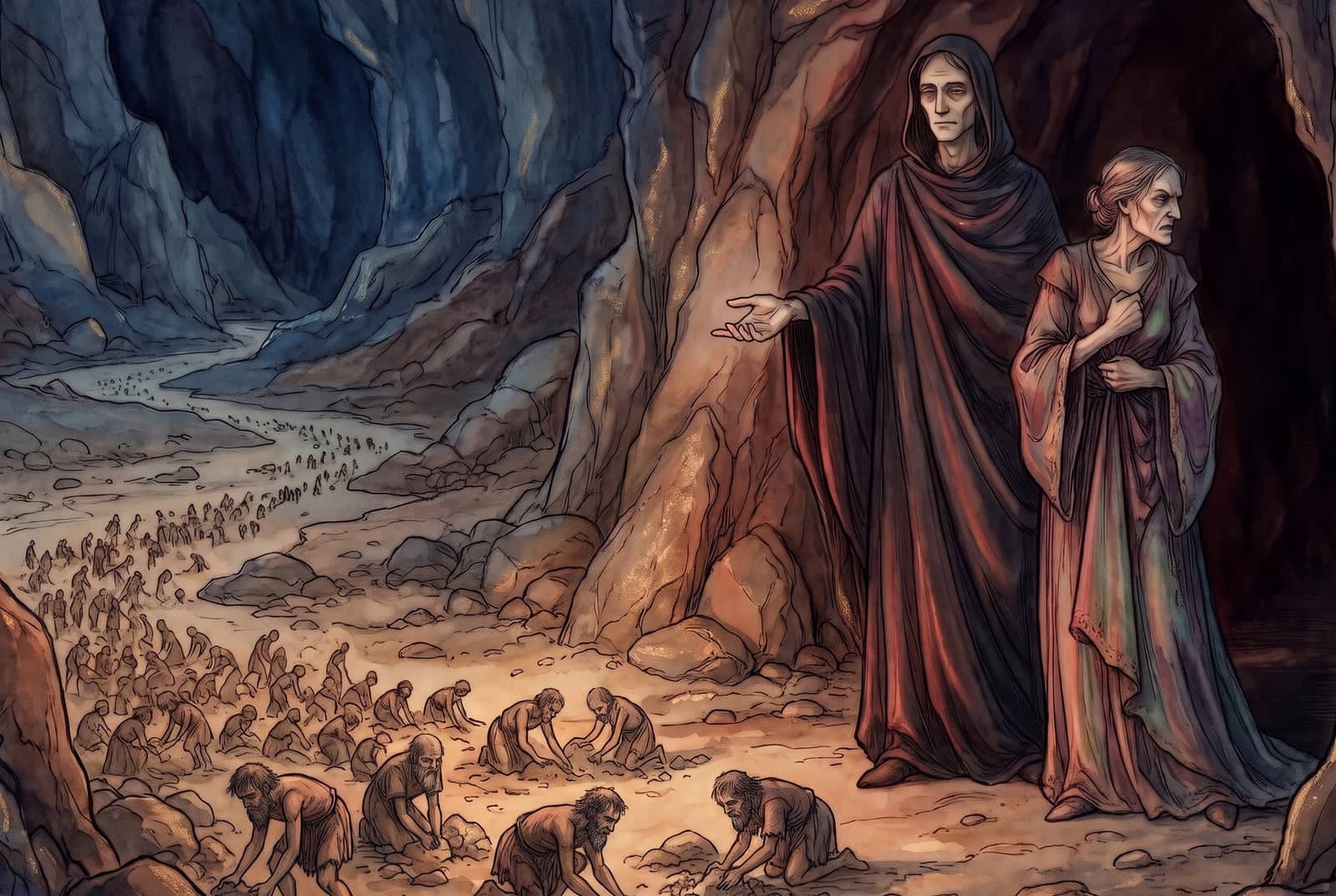
Death laughed, and took a cup, and dipped it into a pool of water, and out of the cup rose Ague. She passed through the great crowd, and a third of them lay dead. A cold mist followed her, and water snakes ran at her side.
When Avarice saw that a third of the crowd was dead, she beat her breast and wept. She beat her barren bosom and cried aloud, “You have killed a third of my servants. Go away! There is war in the mountains of Tartary, and the kings on both sides are calling for you. The Afghans have killed the black ox and are marching to battle. They have beaten their shields with their spears and put on their helmets of iron. What is my valley to you, that you should linger in it? Go away, and come here no more.”
“No,” answered Death. “Until you give me a grain of wheat, I will not go.”
But Avarice shut her hand tight and clenched her teeth. “I will not give you anything,” she muttered.
Death laughed, and picked up a black stone, and threw it into the forest, and out of a thicket of wild hemlock came Fever in a robe of flame. She passed through the crowd and touched them, and every man she touched died. The grass withered under her feet as she walked.
Avarice shuddered and put ashes on her head. “You are cruel,” she cried. “You are cruel. There is famine in the walled cities of India, and the wells of Samarkand have run dry. There is famine in the walled cities of Egypt, and the locusts have come up from the desert. The Nile has not overflowed its banks, and the priests have cursed Isis and Osiris. Go to those who need you, and leave me my servants.”
“No,” answered Death. “Until you give me a grain of wheat, I will not go.”
“I will not give you anything,” said Avarice.
Death laughed again, and whistled through his fingers, and a woman came flying through the air. Plague was written on her forehead, and a crowd of lean vultures wheeled around her. She covered the valley with her wings, and no man was left alive.
Avarice fled shrieking through the forest, and Death leaped onto his red horse and galloped away, and his galloping was faster than the wind.
Out of the slime at the bottom of the valley crept dragons and horrible scaly things, and jackals came trotting along the sand, sniffing the air.
Weeping, the young king asked, “Who were these men, and what were they looking for?”
“Rubies for a king’s crown,” answered someone standing behind him.
He started and turned around, and he saw a man dressed as a pilgrim, holding a silver mirror in his hand.
The young king grew pale and said, “For what king?”
The pilgrim answered, “Look in this mirror, and you will see him.”
When the young king looked into the mirror and saw his own face, he gave a great cry and woke. Bright sunlight was streaming into the room, and in the trees of the garden and the pleasure grounds the birds were singing.

The Chamberlain and the high officers of State came in and bowed low before him, and the pages brought him the robe of woven gold and set the crown and the scepter before him.
The young king looked at them, and they were beautiful, more beautiful than anything he had ever seen. But he remembered his dreams, and he said to his lords, “Take these things away, for I will not wear them.”
The courtiers were amazed, and some of them laughed, for they thought he was joking.
But he spoke sternly to them again and said, “Take these things away, and hide them from me. Though it is the day of my coronation, I will not wear them. For this robe of mine was woven on the loom of Sorrow, by the white hands of Pain. There is Blood in the heart of the ruby, and Death in the heart of the pearl.” And he told them his three dreams.
When the courtiers heard them, they looked at one another and whispered, “Surely he is mad. For what is a dream but a dream, and a vision but a vision? They are not real, and no one need heed them. And what do the lives of those who toil for us have to do with us? Should a man not eat bread until he has seen the sower, nor drink wine until he has talked with the man who tends the vines?”
Then the Chamberlain spoke to the young king. “Your Majesty,” he said, “I beg you, put aside these dark thoughts, and put on this fair robe, and set this crown on your head. For how will the people know that you are a king, if you do not wear a king’s robes?”
The young king looked at him. “Is that really so?” he asked. “Will they not know me for a king if I do not wear a king’s robes?”
“They will not know you, Your Majesty,” cried the Chamberlain.
“I had thought there were men who were kinglike,” the young king answered, “but it may be as you say. And yet I will not wear this robe, nor will I be crowned with this crown. As I came to the palace, so will I go out of it.”
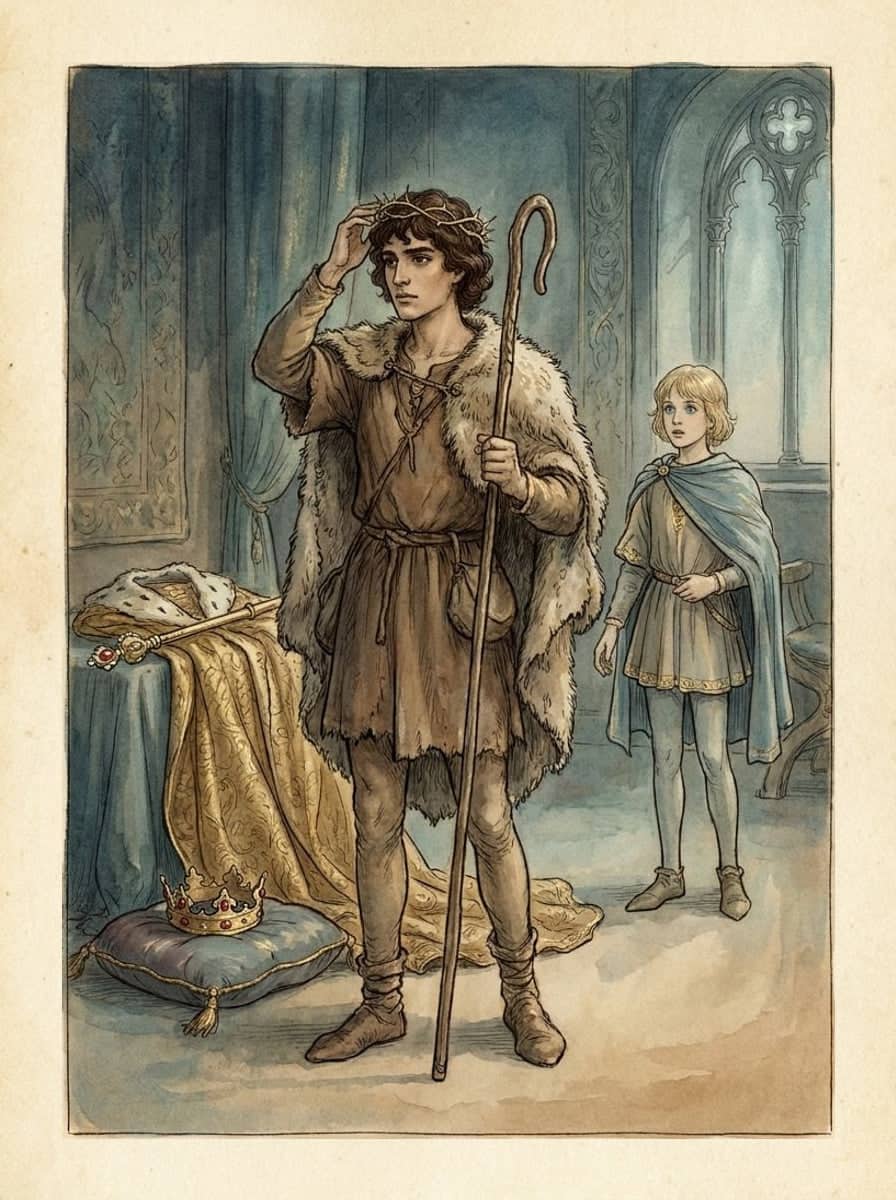
He told them all to leave him, except for one page, a boy a year younger than himself, whom he kept as his companion. When he had bathed in clear water, he opened a great painted chest and took out the leather tunic and rough sheepskin cloak he had worn when he watched the goatherd’s shaggy goats on the hillside. He put them on, and in his hand he took his old shepherd’s staff.
The little page opened his big blue eyes in wonder and said to him, smiling, “My lord, I see your robe and your scepter, but where is your crown?”
The young king picked a spray of wild briar that was climbing over the balcony, bent it into a circlet, and set it on his own head.
“This shall be my crown,” he answered.
Dressed like this, he went out of his room into the Great Hall, where the nobles were waiting for him.
The nobles made merry, and some of them called out to him, “Your Majesty, the people are waiting for their king, and you show them a beggar.” Others were angry and said, “He brings shame on our state, and is unworthy to be our master.”
The young king did not say a word to them. He walked on, down the bright porphyry staircase and out through the gates of bronze, mounted his horse, and rode toward the cathedral, with the little page running beside him.
The people laughed and said, “It’s the king’s fool riding by,” and they mocked him.
He reined in his horse and said, “No, I am the king.” And he told them his three dreams.
A man stepped out of the crowd and spoke to him bitterly. “Sir,” he said, “don’t you know that the life of the poor comes out of the luxury of the rich? Your pomp feeds us, and your vices give us bread. To toil for a hard master is bitter, but to have no master to toil for is more bitter still. Do you think the ravens will feed us? And what cure do you have for these things?
“Will you say to the buyer, ‘You shall buy for so much,’ and to the seller, ‘You shall sell at this price’? I think not. So go back to your palace and put on your purple and fine linen. What do you have to do with us, and with what we suffer?”

“Are the rich and the poor not brothers?” asked the young king.
“Yes,” answered the man, “and the name of the rich brother is Cain.”
The young king’s eyes filled with tears, and he rode on through the murmuring of the people. And the little page grew afraid and left him.
When the young king reached the great doorway of the cathedral, the soldiers thrust out their halberds and said, “What do you want here? No one enters by this door but the king.”
His face flushed with anger, and he said to them, “I am the king.” And he waved their halberds aside and went in.
When the old Bishop saw him coming in his goatherd’s clothes, he rose from his throne in wonder, went to meet him, and said, “My son, is this the dress of a king? And with what crown shall I crown you, and what scepter shall I place in your hand? Surely this should be a day of joy for you, and not a day of humiliation.”
“Shall Joy wear what Grief has made?” said the young king. And he told the Bishop his three dreams.
When the Bishop had heard them, he frowned and said, “My son, I am an old man, in the winter of my days, and I know that many evil things are done in the wide world. Fierce robbers come down from the mountains, carry off little children, and sell them to the Moors. Lions lie in wait for the caravans and leap upon the camels. The wild boar roots up the grain in the valley, and the foxes gnaw the vines on the hill.
“Pirates lay waste the coast, burn the fishermen’s boats, and take their nets from them. In the salt marshes live the lepers, in houses of woven reeds, and no one may come near them. Beggars wander through the cities and eat their food with the dogs. Can you make these things cease to be? Will you take the leper to share your bed, and seat the beggar at your table? Will the lion do as you say, and the wild boar obey you? Is He who made misery not wiser than you are?
“So I do not praise you for what you have done. Ride back to the palace, I tell you, and make your face glad, and put on the robes a king should wear, and I will crown you with the crown of gold and place the scepter of pearl in your hand. As for your dreams, think no more of them. The burden of this world is too great for one man to bear, and the world’s sorrow too heavy for one heart to suffer.”
“Do you say that in this house?” said the young king. And he strode past the Bishop, climbed the steps of the altar, and stood before the image of Christ.
He stood before the image of Christ, and on his right hand and on his left were the marvelous vessels of gold, the chalice with the yellow wine and the vial of holy oil. He knelt before the image of Christ, and the great candles burned brightly beside the jeweled shrine, and the smoke of the incense curled in thin blue wreaths up into the dome. He bowed his head in prayer, and the priests in their stiff copes crept away from the altar.
All at once a wild uproar came from the street outside, and in rushed the nobles with drawn swords and nodding plumes and shields of polished steel. “Where is this dreamer of dreams?” they cried. “Where is this king dressed like a beggar, this boy who brings shame on our state? We will kill him, for he is unworthy to rule over us.”
The young king bowed his head again and prayed, and when he had finished his prayer, he rose, turned around, and looked at them sadly.
And then, through the painted windows, the sunlight came streaming down on him, and the sunbeams wove around him a robe of gold that was fairer than the robe that had been made for his pleasure. The dead staff blossomed and bore lilies whiter than pearls. The dry thorn blossomed and bore roses redder than rubies. Whiter than fine pearls were the lilies, and their stems were of bright silver. Redder than the finest rubies were the roses, and their leaves were of beaten gold.
He stood there in the robes of a king, and the doors of the jeweled shrine flew open, and from the crystal of the many-rayed monstrance shone a marvelous and mystical light. He stood there in a king’s robes, and the Glory of God filled the place, and the saints in their carved niches seemed to move. In the fair robes of a king he stood before them, and the organ pealed out its music, and the trumpeters blew their trumpets, and the choirboys sang.
The people fell to their knees in awe, and the nobles sheathed their swords and paid him homage, and the Bishop’s face grew pale and his hands trembled. “A greater than I has crowned you,” he cried, and he knelt before him.

Then the young king came down from the high altar and walked home through the midst of the people. But no one dared to look upon his face, for it was like the face of an angel.
Retold by Talerie from A House of Pomegranates (opens in a new window) Public domain Copy this text, adapt it, use it however you like. A link back to Talerie is appreciated but never required. CC0 1.0 (opens in a new window)