A small boy finds a half-drowned mongoose and wants to hold a funeral for him. His mother dries him by the fire instead, and Rikki-tikki-tavi wakes up sneezing. But the garden belongs to Nag the black cobra and his wife, Nagaina, and Rikki-tikki has never met a live cobra.
This is the story of the great war that Rikki-tikki-tavi fought all by himself, through the bathrooms of a big bungalow in India. Darzee the tailorbird helped him, and Chuchundra the muskrat gave him advice, but Rikki-tikki did the real fighting.
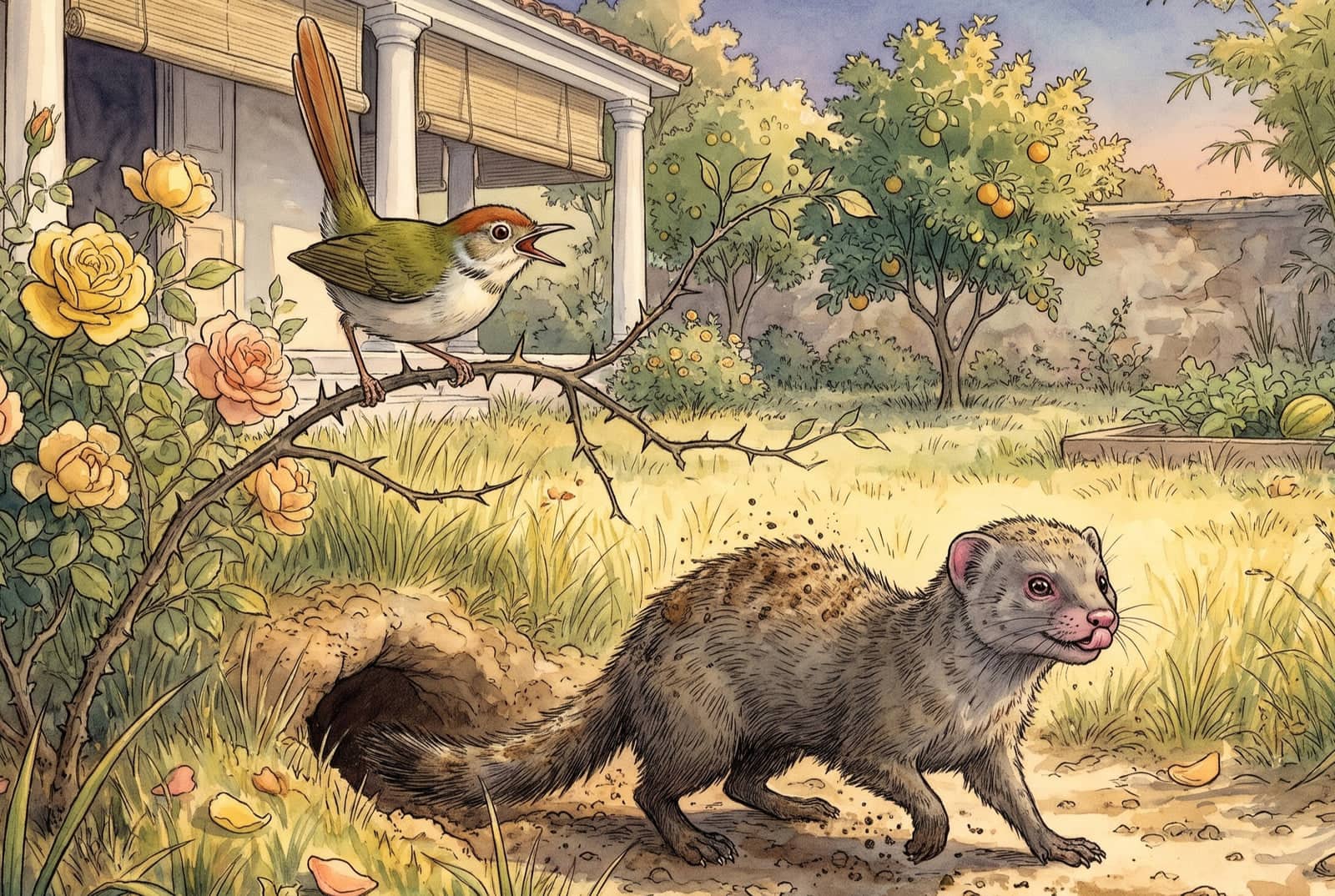
He was a mongoose, rather like a little cat in his fur and his tail, but very like a weasel in his head and his habits. His eyes and the tip of his restless nose were pink, and his war cry as he scuttled through the long grass was “Rikk-tikk-tikki-tikki-tchk!”
One day a summer flood washed him out of his burrow and swept him down a roadside ditch. When he came to, he was lying in the hot sun on a garden path, and a small boy was saying, “Here’s a dead mongoose. Let’s have a funeral.”
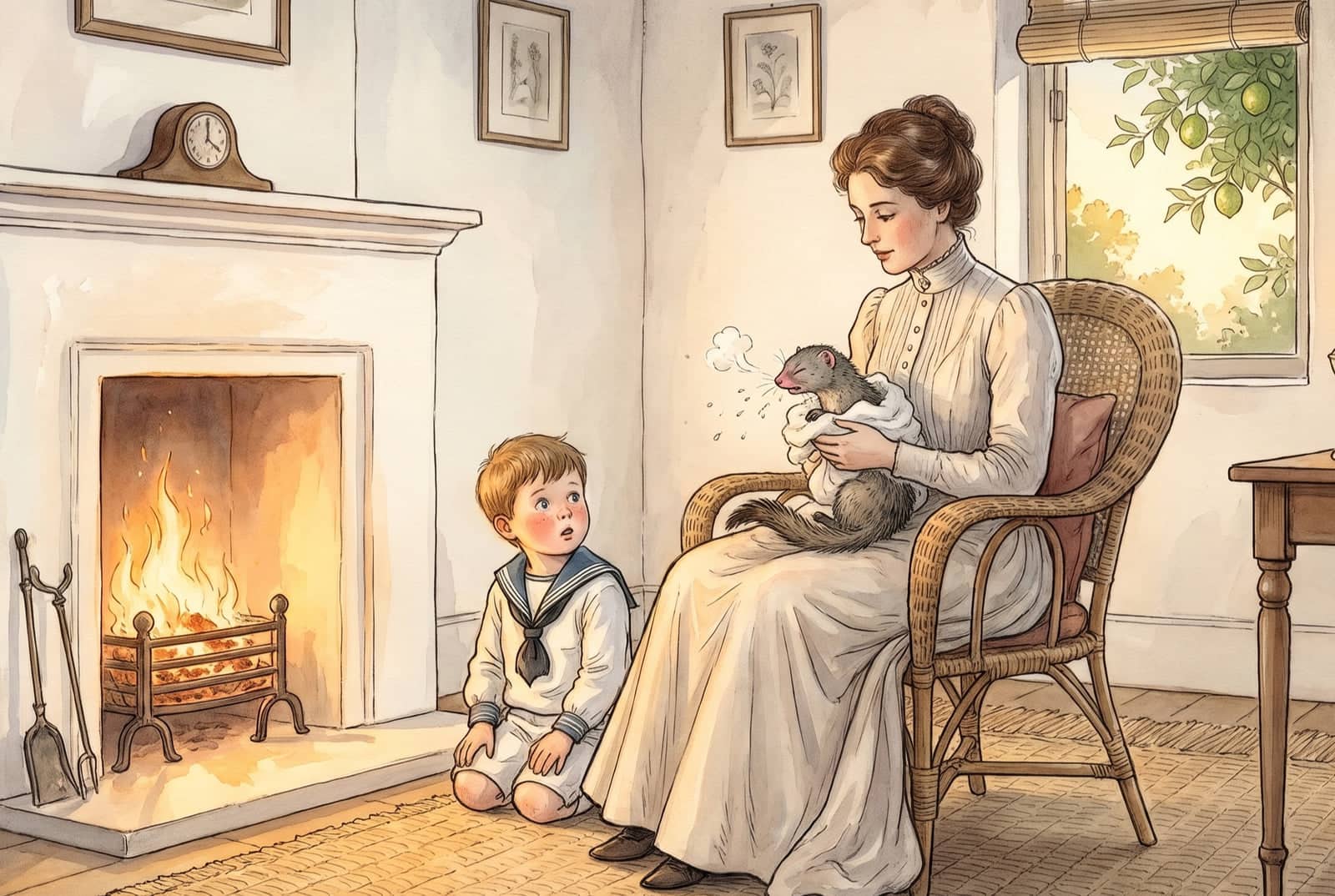
“No,” said the boy’s mother, “let’s take him in and dry him. Perhaps he isn’t really dead.”
So they wrapped him in cotton and warmed him by the fire, and he opened his eyes and sneezed. Nothing frightens a mongoose for long, because he is eaten up with curiosity. The motto of the whole mongoose family is “Run and find out,” and Rikki-tikki was a true mongoose. He ran all around the table and jumped onto the boy’s shoulder.
“Don’t be frightened, Teddy,” said the boy’s father, a big Englishman who had just moved into the bungalow. “That’s his way of making friends.”
Rikki-tikki spent the day exploring. He nearly drowned in a bathtub and burned his nose on the big man’s cigar, and that night he climbed into Teddy’s bed. When Teddy’s parents came in to look at their boy, they found the mongoose wide awake on the pillow.
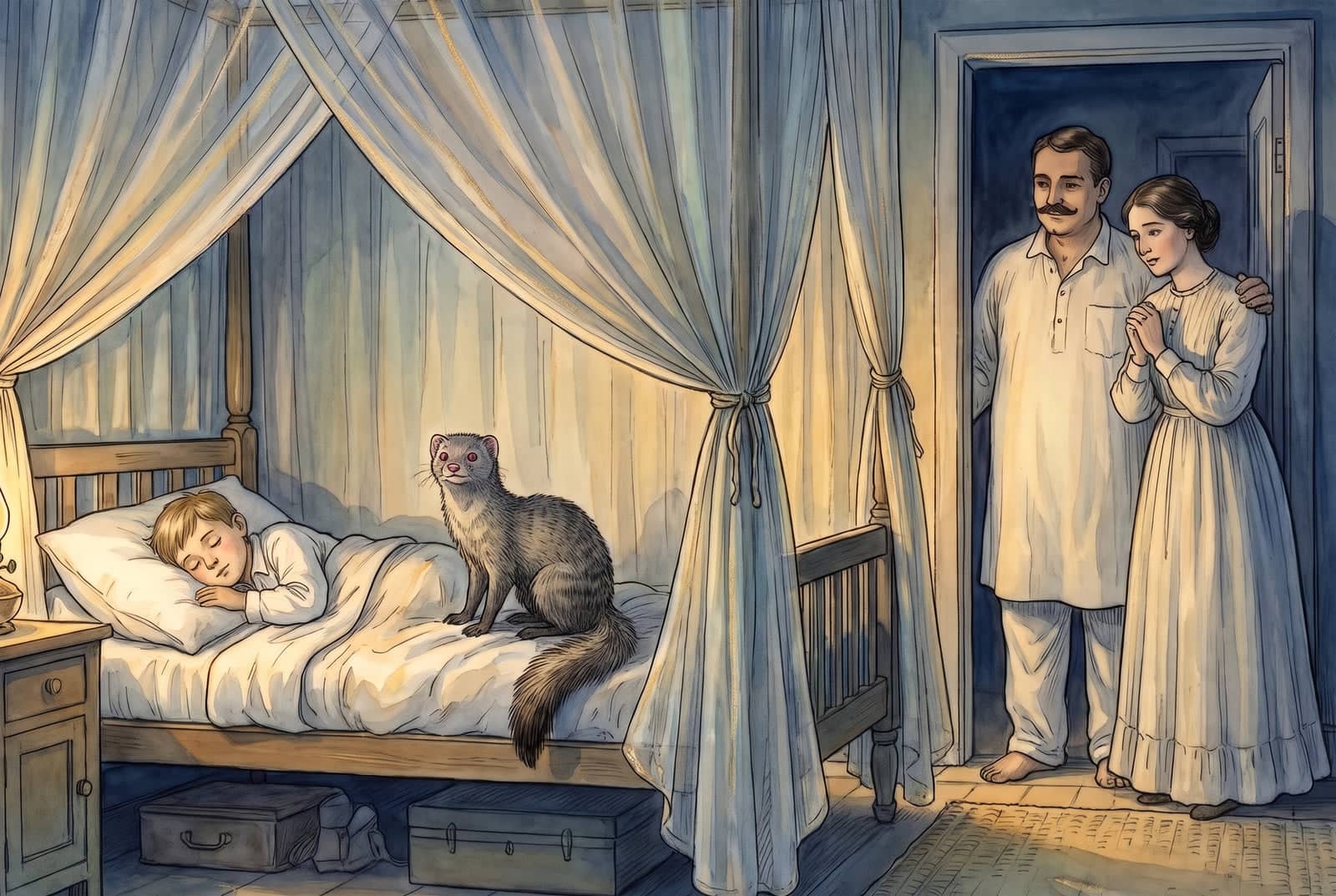
“I don’t like that,” said Teddy’s mother. “He may bite the child.”
“He’ll do no such thing,” said the father. “Teddy’s safer with that little beast than if he had a bloodhound to watch him. If a snake came into the nursery now…”
But Teddy’s mother didn’t want to think of anything so awful.
The next morning Rikki-tikki went out to look at the garden. It was large and half wild. “What a splendid hunting ground,” he said, licking his lips.
Soon he heard sad voices in a thornbush. It was Darzee the tailorbird and his wife, crying on the rim of their nest, which they had stitched together out of two big leaves.
“What’s the matter?” asked Rikki-tikki.
“One of our babies fell out of the nest yesterday,” said Darzee, “and Nag ate him.”
“That’s very sad,” said Rikki-tikki. “But I’m a stranger here. Who is Nag?”
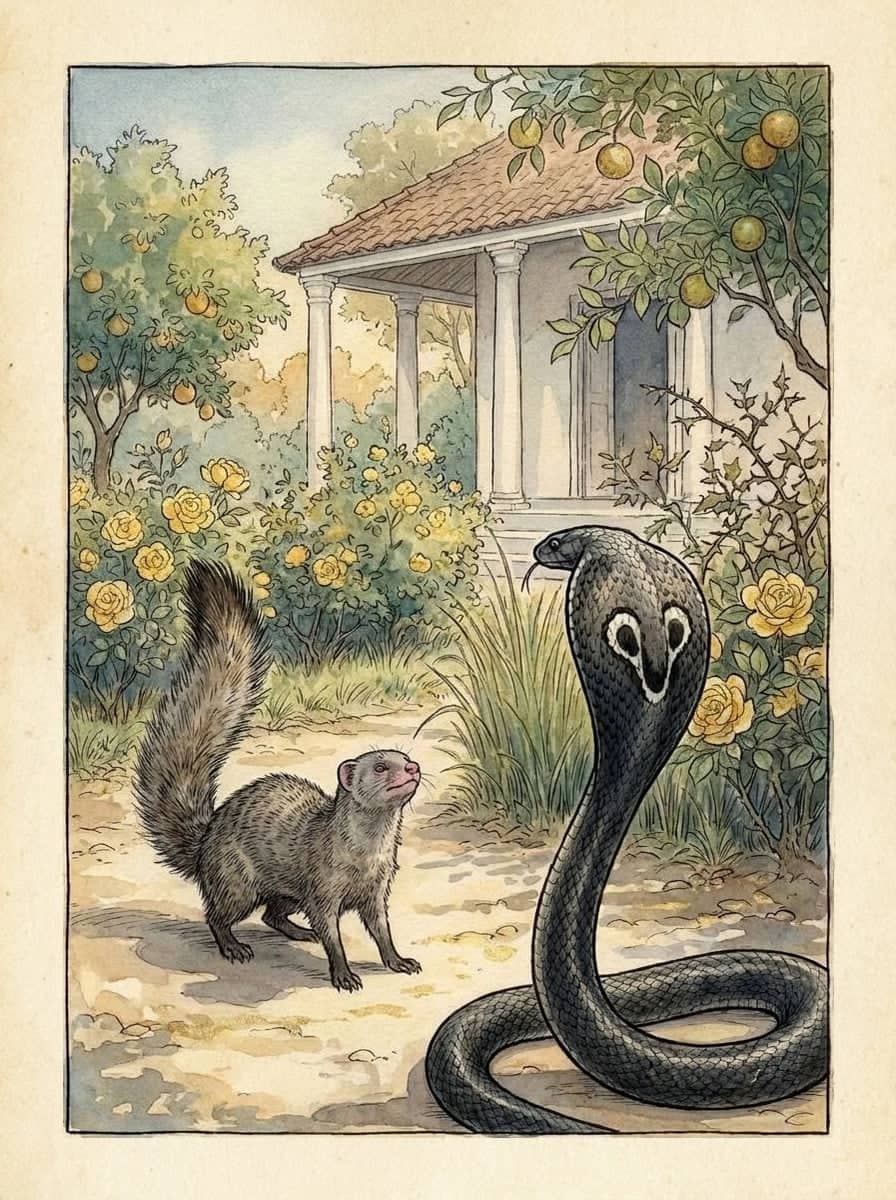
The birds only crouched down in the nest, for from the grass below came a low, cold hiss. Inch by inch, the head and spread hood of Nag, the big black cobra, rose out of the grass. He was five feet long, and he swayed like a dandelion puff in the wind.
“Who is Nag?” he said. “I am Nag. Look, and be afraid!”
For a moment Rikki-tikki was afraid. He had never met a live cobra, but he knew that a grown mongoose’s business in life was to fight snakes. Nag knew it too, and deep in his cold heart he was afraid.
“Well,” said Rikki-tikki, and his tail fluffed up, “do you think it’s right to eat baby birds out of a nest?”
“Let us talk,” said Nag, watching the grass behind the mongoose. “You eat eggs. Why shouldn’t I eat birds?”
“Behind you! Look behind you!” sang Darzee.
Rikki-tikki leaped high, and right under him whizzed the head of Nagaina, Nag’s wicked wife, who had crept up behind him. He came down on her back and bit, but he was young and afraid of her lashing tail, so he let go too soon and jumped clear. Nagaina was hurt, and furious.
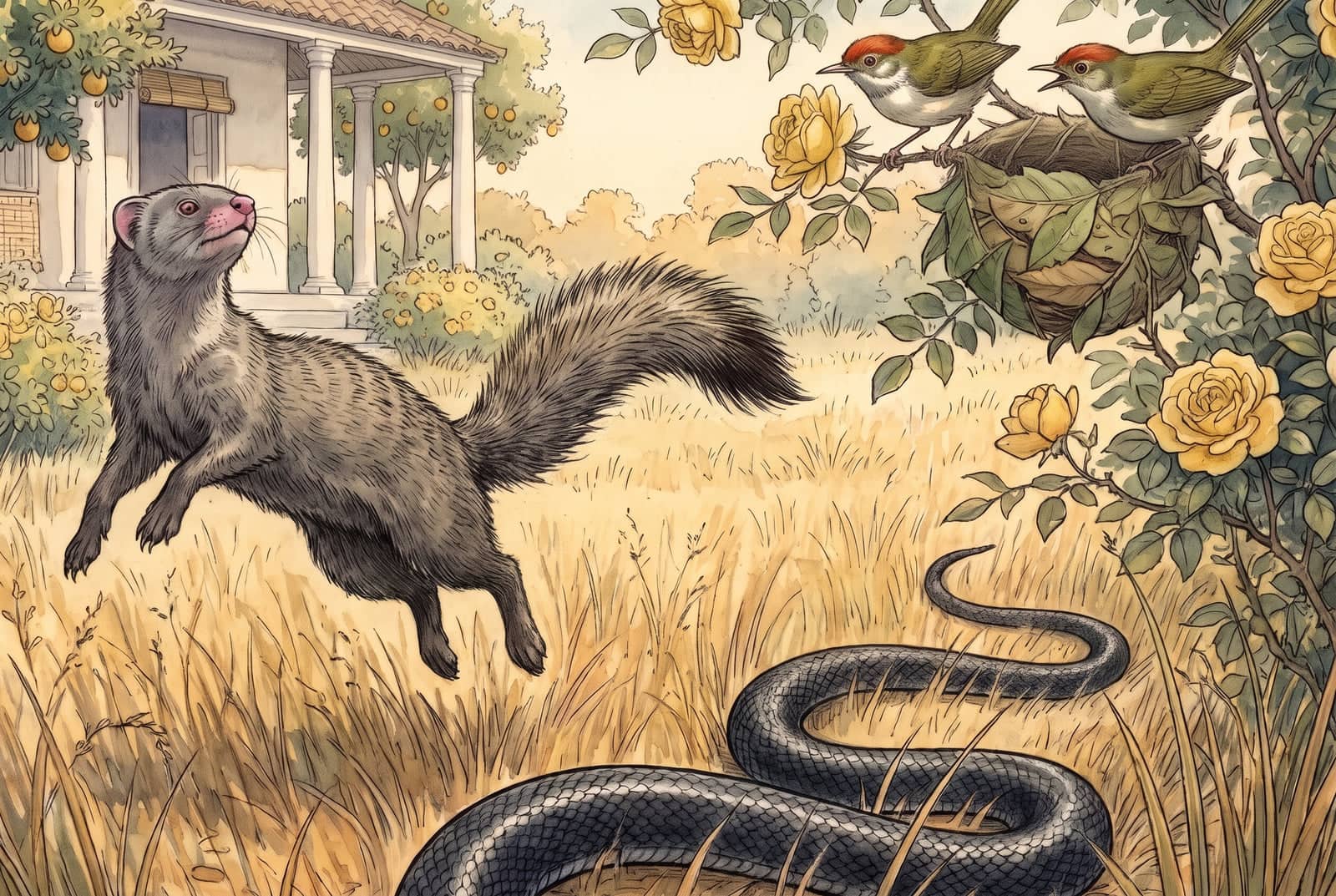
“Wicked, wicked Darzee!” said Nag, striking up toward the nest, but it hung out of reach. Then both snakes vanished into the grass.
Rikki-tikki’s eyes grew red, which is how you know a mongoose is angry, but he was not sure he could fight two snakes at once, so he did not follow. Still, he was pleased with himself, and when Teddy came running down the path, he was ready to be petted.
But just as Teddy bent down, something wriggled in the dust, and a tiny voice said, “Be careful. I am Death!” It was Karait, a small dusty-brown snake whose bite is as deadly as a cobra’s.
Rikki-tikki danced up to him with the rocking, swaying step of his family. Karait struck, and the mongoose leaped aside with the little gray head snapping at his heels.
“Oh, look!” Teddy shouted. “Our mongoose is killing a snake!”
Teddy’s mother screamed, and his father ran out with a stick. But by then Karait had lunged once too far, and Rikki-tikki had sprung onto the snake’s back and bitten him just behind the head. That was the end of Karait.
Rikki-tikki was about to eat him when he remembered that a full meal makes a slow mongoose, so he went off for a dust bath instead. Teddy’s mother picked him up and hugged him, crying that he had saved Teddy from death.
All through dinner he kept thinking of Nag and Nagaina, and every now and then his eyes turned red and he broke into his long war cry, “Rikk-tikk-tikki-tikki-tchk!”
That night, as soon as Teddy was asleep, Rikki-tikki went for a walk around the house, and in the dark he ran into Chuchundra the muskrat, creeping along by the wall.
“Don’t kill me,” said Chuchundra, almost weeping. “Rikki-tikki, don’t kill me!”
“Do you think a snake killer kills muskrats?” said Rikki-tikki.
“Those who kill snakes get killed by snakes,” said Chuchundra, and he began to cry. “Nag is everywhere. I mustn’t tell you anything. Can’t you hear, Rikki-tikki?”
Rikki-tikki listened. The house was still, but he could just make out the faintest scratch-scratch, like a wasp walking on a windowpane. It was the dry scratch of a snake’s scales on brick.
“That’s Nag or Nagaina,” he said to himself, “crawling in through the bathroom drain.”
Rikki-tikki crept into Teddy’s mother’s bathroom. Through the hole at the bottom of the wall where the bath water ran out, he heard Nag and Nagaina whispering in the moonlight.
“When the house is empty of people,” said Nagaina, “the mongoose will go away, and the garden will be ours again. Go in quietly, and remember that the big man who killed Karait is the first one to bite.”
“But are you sure there is anything to be gained by killing the people?” said Nag.
“Everything. Our eggs in the melon bed may hatch tomorrow, and our children will need room and quiet.”
“I hadn’t thought of that,” said Nag. “I will kill the big man and his wife, and the child if I can. Then Rikki-tikki will go.”
Rikki-tikki tingled with rage. Then Nag’s head came through the drain hole, with five feet of cold body after it. Angry as he was, the little mongoose was very frightened when he saw how big the cobra was.
Nag drank from the big water jar beside the bath. “When the big man comes in to bathe in the morning,” he said, “he will not have a stick. I will wait here till he comes.” And he coiled himself around the bottom of the jar.
Rikki-tikki stayed as still as death. After an hour he crept forward, muscle by muscle. Nag was asleep. “It must be the head,” Rikki-tikki said to himself, “the head above the hood. And once I’m there, I must not let go.”
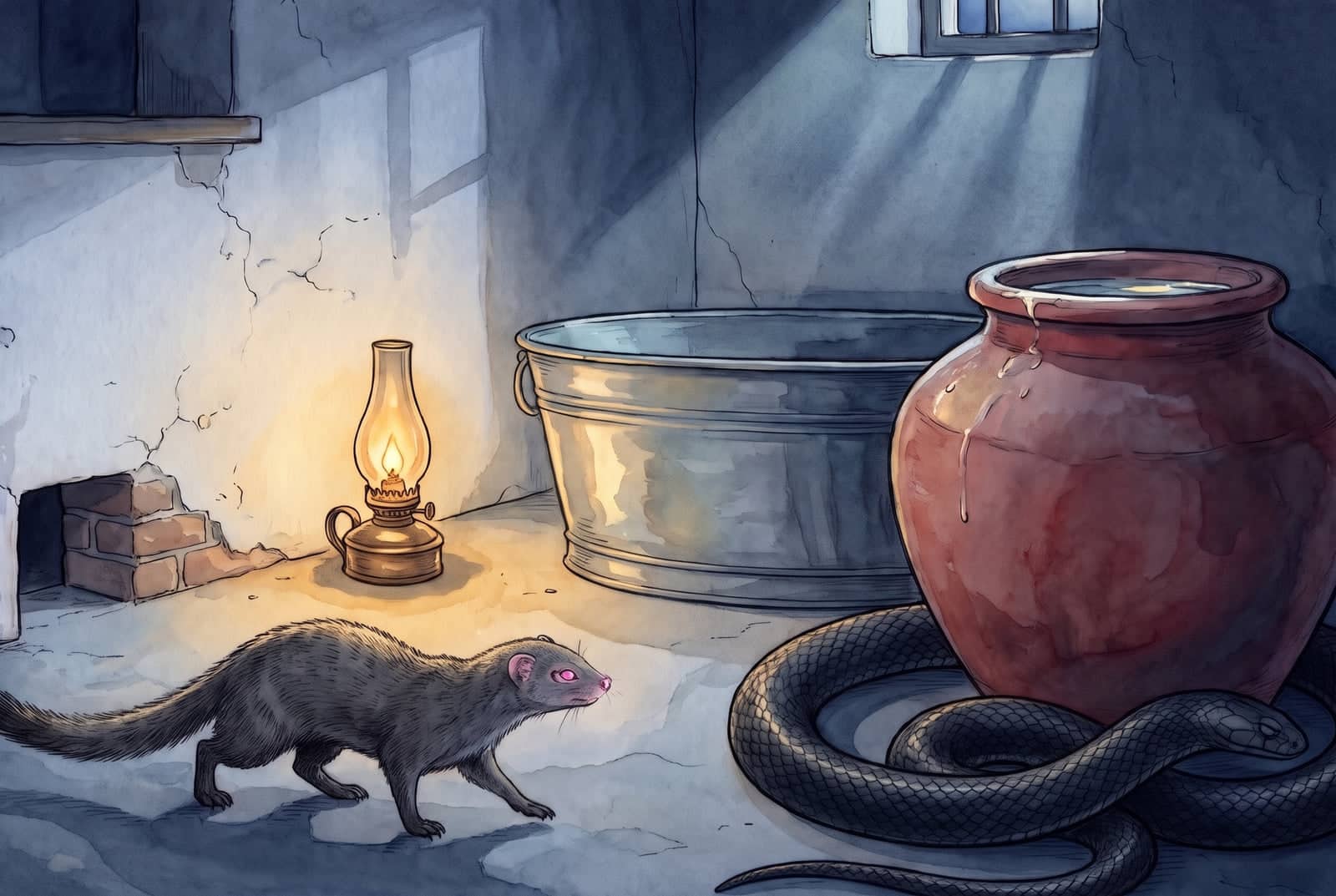
Then he jumped. His teeth met in the cobra’s head, and the next moment he was flung back and forth like a rat shaken by a dog, banging against the floor and the side of the bath. But his eyes were red, and he held on. He was sure he would be battered to death, and for the honor of his family he wanted to be found with his teeth locked.
All at once something went off like a thunderclap behind him and singed his fur. The big man had been woken by the noise and had fired both barrels of his shotgun into Nag, and that was the end of Nag.
Teddy’s father picked the mongoose up and said, “It’s the mongoose again, Alice. The little chap has saved our lives now.”
Teddy’s mother came in, very white, and saw the dead cobra. Rikki-tikki dragged himself off to bed, feeling as if he had been broken into forty pieces.
In the morning he said, “Now I have Nagaina to settle with, and she’ll be worse than five Nags. And there’s no knowing when those eggs will hatch.”
The sweeper had already carried Nag out on a stick and thrown him on the trash heap, and in the thornbush Darzee was singing a song of triumph at the top of his voice.
“Oh, you stupid tuft of feathers!” said Rikki-tikki. “Is this the time to sing? Where is Nagaina?”
“On the trash heap by the stables, mourning for Nag,” said Darzee. “What is it, O Killer of the terrible Nag?”
“Where does she keep her eggs?”
“In the melon bed, at the end nearest the wall. Rikki-tikki, you’re not going to eat her eggs, are you?”
“Not eat them, exactly. Darzee, if you have a grain of sense, you’ll fly to the stables and pretend your wing is broken, and let Nagaina chase you. If I went to the melon bed now, she’d see me.”
Darzee was a feather-brained little fellow, and since Nagaina’s babies came from eggs just like his own, it did not seem fair to him to kill them. But his wife was a sensible bird. She knew that cobra eggs meant young cobras later on, so she flew off herself.
She fluttered in front of Nagaina by the trash heap and cried, “Oh, my wing is broken! The boy in the house threw a stone at me.”
Nagaina raised her head and hissed, “You warned Rikki-tikki when I would have killed him. My husband lies on the trash heap this morning, but before night the boy in the house will lie very still.” And she glided after the bird, who fluttered on along the ground, always just out of reach.
Rikki-tikki raced to the melon bed. Hidden in the warm straw he found twenty-five eggs with soft, whitish skins, and inside them he could see the baby cobras curled up, ready to hatch.
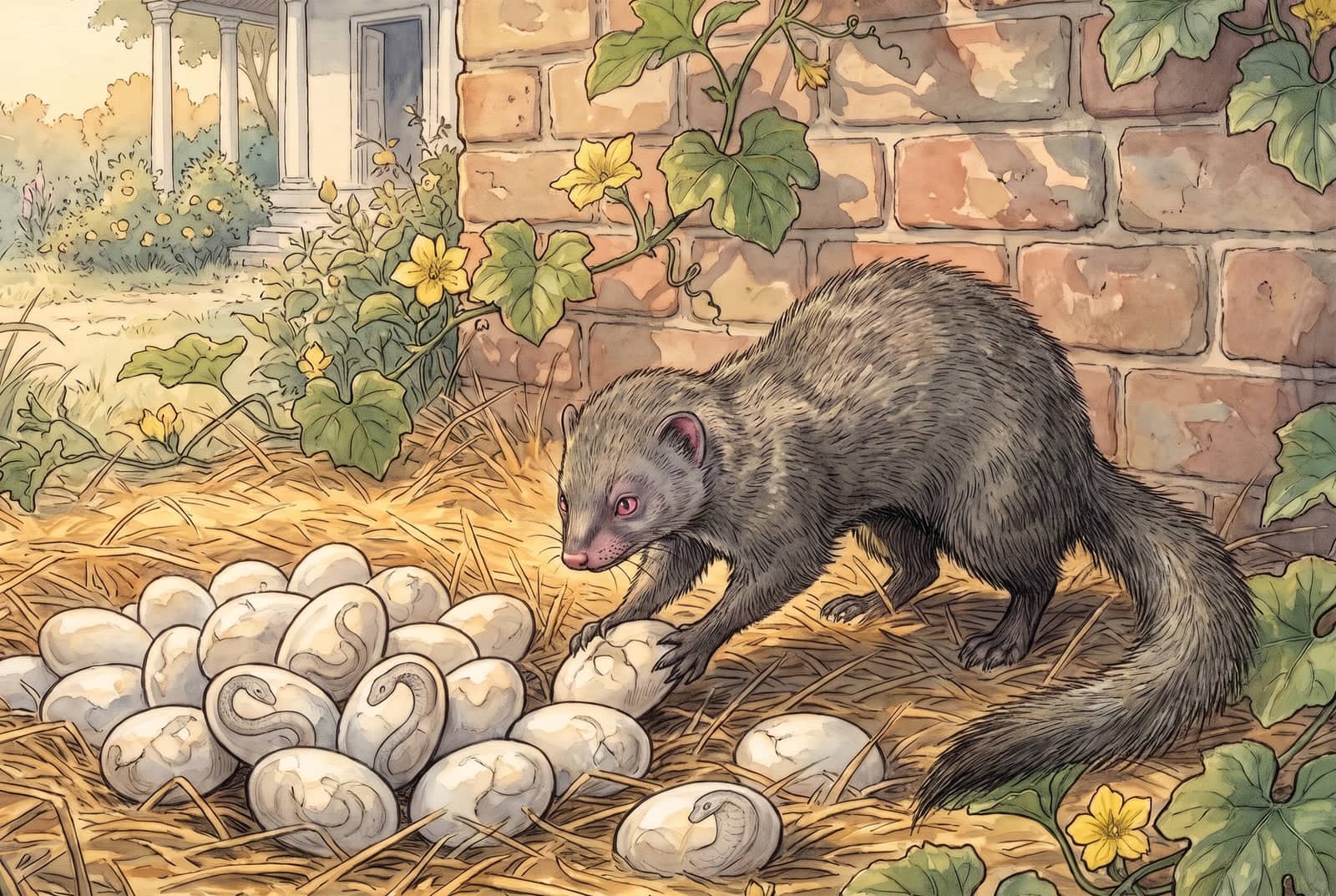
“I wasn’t a day too soon,” he said. He bit the eggs open one after another as fast as he could, and the young cobras inside them died. Only three eggs were left when he heard Darzee’s wife screaming.
“Rikki-tikki, I led Nagaina toward the house, and she has gone onto the veranda! Oh, come quickly! She means to kill!”
Rikki-tikki smashed two of the eggs, grabbed the third in his mouth, and ran.
Teddy and his parents were sitting on the veranda at breakfast, stone-still, their faces white. Nagaina was coiled on the mat beside Teddy’s chair, within easy reach of his bare leg, swaying back and forth.
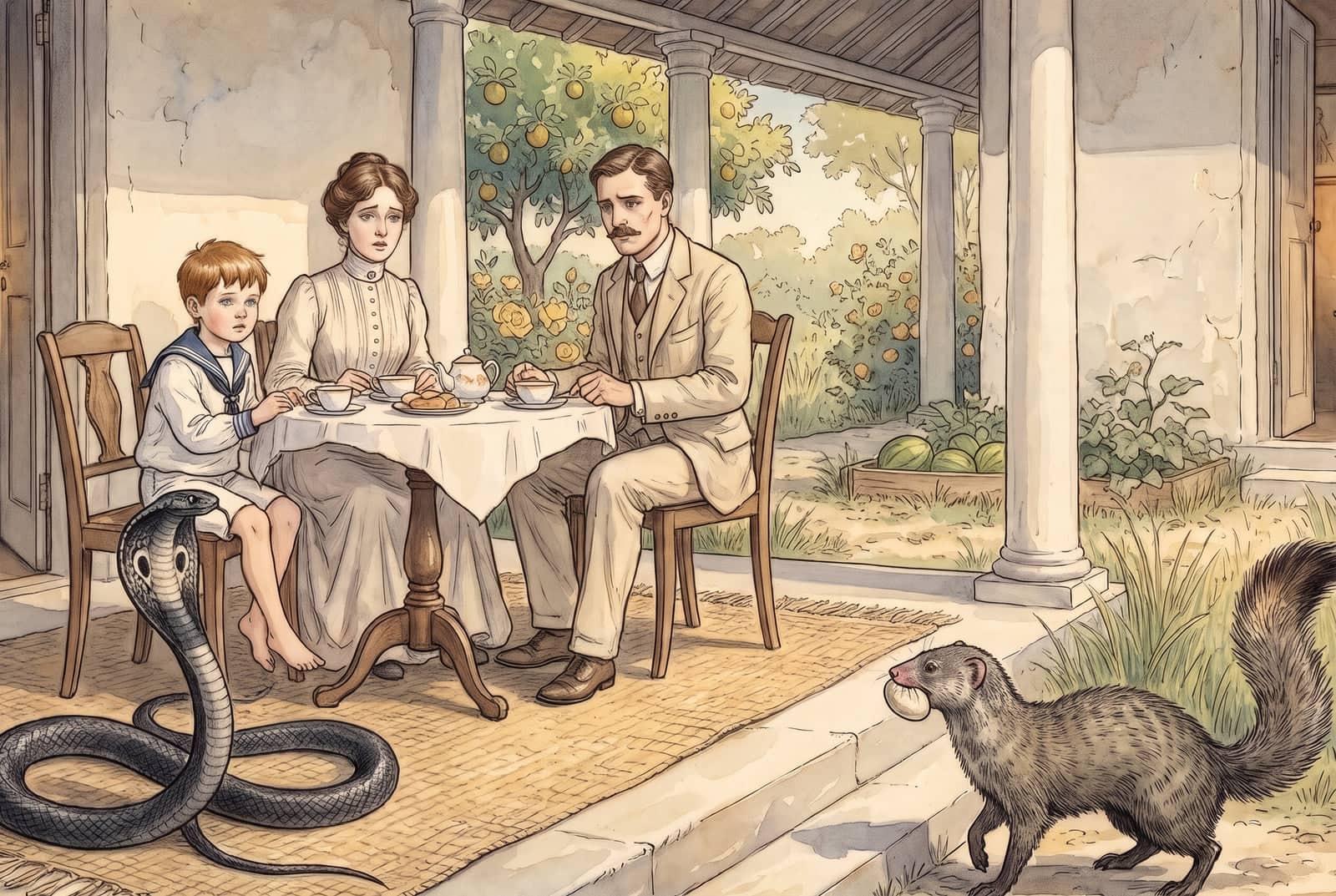
“Son of the big man that killed Nag,” she hissed, “stay still. Keep very still, all three of you! If you move I strike, and if you do not move I strike. Oh, foolish people, who killed my Nag!”
Teddy’s eyes were fixed on his father, and all his father could do was whisper, “Sit still, Teddy. You mustn’t move.”
Then Rikki-tikki came up and cried, “Turn around, Nagaina. Turn and fight!”
“All in good time,” she said, without moving her eyes. “If you come a step nearer, I strike.”
“Look at your eggs,” said Rikki-tikki, “in the melon bed near the wall. Go and look, Nagaina!”
The big snake turned halfway around and saw the egg lying on the veranda. “Ah-h! Give it to me,” she said.
Rikki-tikki put a paw on each side of the egg. “What will you give me for the last egg, the very last of the brood? The ants are eating all the others down by the melon bed.”
Nagaina spun all the way around, forgetting everything for that one egg, and Teddy’s father shot out a big hand, caught Teddy by the shoulder, and dragged him across the table, safe and out of reach.
“Tricked! Tricked! Tricked! Rikk-tck-tck!” chuckled Rikki-tikki. “The boy is safe, and it was I who caught Nag by the head last night. Come and fight, Nagaina. You won’t be a widow long.”
“Give me the last of my eggs,” said Nagaina, lowering her hood, “and I will go away and never come back.”
“Yes, you will go away, and you will never come back, for you will go to the trash heap with Nag. Fight, widow!”
Rikki-tikki bounded all around her, his little eyes like hot coals. Again and again and again she struck at him, and each time her head came down with a whack on the mat, and each time he jumped clear.
But he had forgotten the egg. While he was catching his breath, Nagaina snatched it up in her mouth and shot down the path like an arrow, with the mongoose racing after her. He knew he must catch her, or all the trouble would begin again.
As they ran past the thornbush, Darzee was still singing his foolish song. But his wife flew down and flapped her wings around Nagaina’s head, and that moment’s delay let Rikki-tikki catch up.
Nagaina plunged into the hole where she and Nag used to live, and Rikki-tikki went down with her, his teeth clamped on her tail. It was dark down there, and at any moment the tunnel might widen and give her room to turn and strike.
Then the grass at the mouth of the hole stopped waving, and Darzee said, “It is all over with Rikki-tikki! We must sing his death song.”
So Darzee began a very sad song. But just as he reached the saddest part, the grass quivered, and Rikki-tikki dragged himself out of the hole, covered with dirt and licking his whiskers.
“It is all over,” he said. “The widow will never come out again.”
Then he curled up in the grass and slept until late in the afternoon. When he woke, he said, “Tell the Coppersmith, Darzee, and he will tell the garden.”
The Coppersmith is a bird whose call sounds just like a little hammer tapping on a copper pot, and he is the town crier of every Indian garden. As Rikki-tikki went up the path to the house, he heard the Coppersmith ringing out, “Ding-dong-tock! Nag is dead—dong! Nagaina is dead! Ding-dong-tock!” And all the birds in the garden began to sing.
Teddy and his parents came out and almost cried over Rikki-tikki. At bedtime he curled up on Teddy’s shoulder, and late in the evening Teddy’s mother looked in on them.
“He saved our lives and Teddy’s life,” she said to her husband. “Just think, he saved all our lives.”
Rikki-tikki woke with a jump, for mongooses are light sleepers. “Oh, it’s you,” he said. “What are you fussing about? All the cobras are dead. And if they weren’t, I’m here.”
He had a right to be proud of himself, but he did not grow too proud. He kept that garden as a mongoose should keep it, with tooth and jump and spring and bite, until no cobra ever dared to show its head inside the walls.
Retold by Talerie from The Jungle Book (opens in a new window) Public domain Copy this text, adapt it, use it however you like. A link back to Talerie is appreciated but never required. CC0 1.0 (opens in a new window)