 Original
Rikki-Tikki-Tavi
32 min read ages 6 and up talerie.com/en/tales/rikki-tikki-tavi-original
A flood washes the young mongoose Rikki-tikki-tavi into the garden of an English bungalow in India. The family takes him in, and he sleeps in little Teddy’s bed. Out in the tall grass live Nag, a five-foot black cobra, and his wife Nagaina, who want the bungalow empty of people.
This is the story of the great war that Rikki-tikki-tavi fought single-handed, through the bathrooms of the big bungalow at the army post in Segowlee. Darzee, the tailorbird, helped him, and Chuchundra, the muskrat, gave him advice (Chuchundra never comes out into the middle of the floor but always creeps along by the wall). But Rikki-tikki did the real fighting.
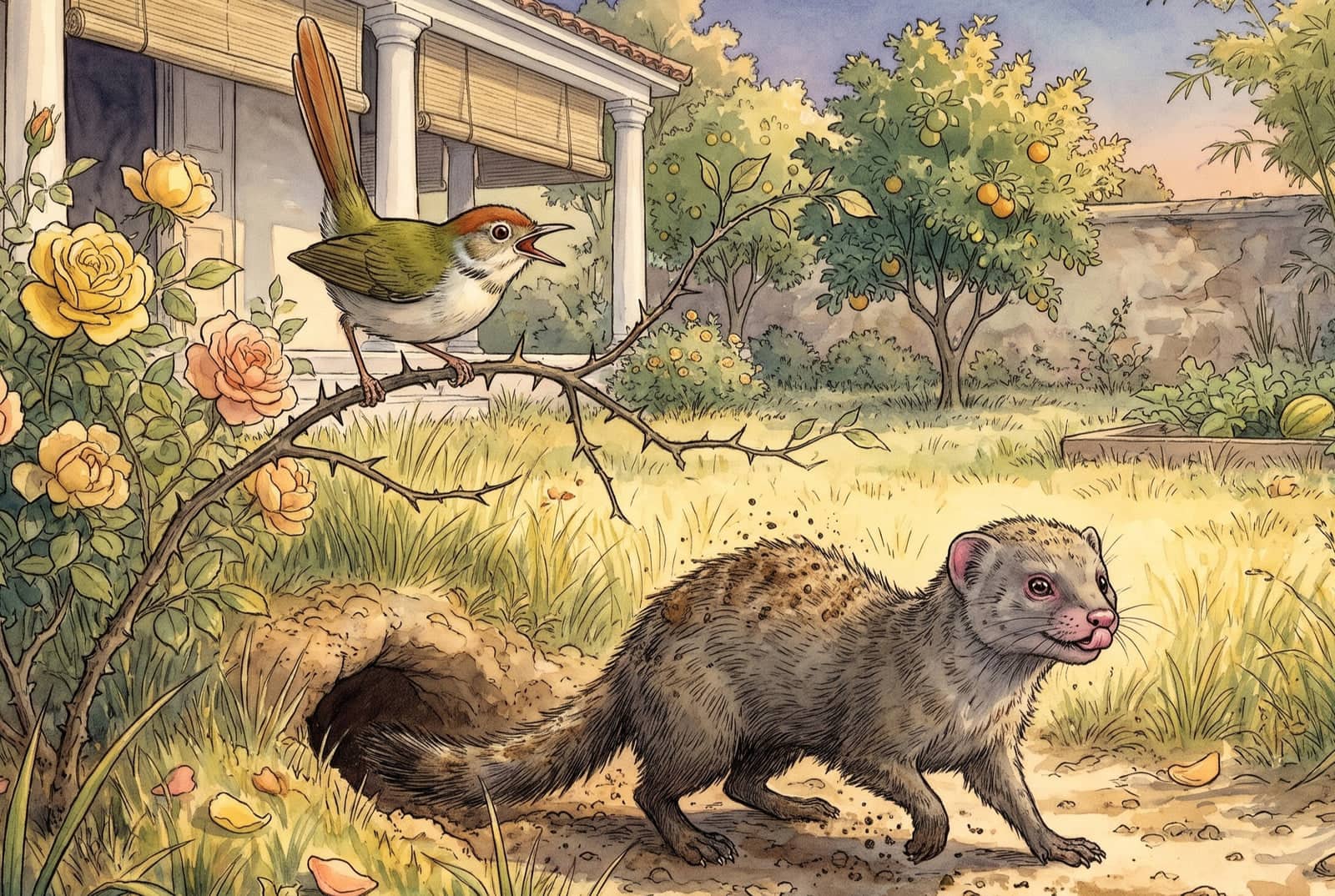
He was a mongoose. In his fur and his tail he was rather like a little cat, but in his head and his habits he was very like a weasel. His eyes and the tip of his restless nose were pink. He could scratch himself anywhere he liked, with any leg he chose, front or back. He could fluff up his tail until it looked like a bottle brush, and his war cry, as he scuttled through the long grass, was “Rikk-tikk-tikki-tikki-tchk!”
One day in high summer a flood washed him out of the burrow where he lived with his father and mother and carried him, kicking and clucking, down a ditch by the road. He found a little wisp of grass floating there and clung to it until he lost his senses. When he came to, he was lying in the hot sun in the middle of a garden path, very bedraggled indeed, and a small boy was saying, “Here’s a dead mongoose. Let’s have a funeral.”
“No,” said the boy’s mother, “let’s take him in and dry him. Maybe he isn’t really dead.”
They carried him into the house, and a big man picked him up between his finger and thumb and said he wasn’t dead, only half-drowned. So they wrapped him in cotton and warmed him over a little fire, and he opened his eyes and sneezed.
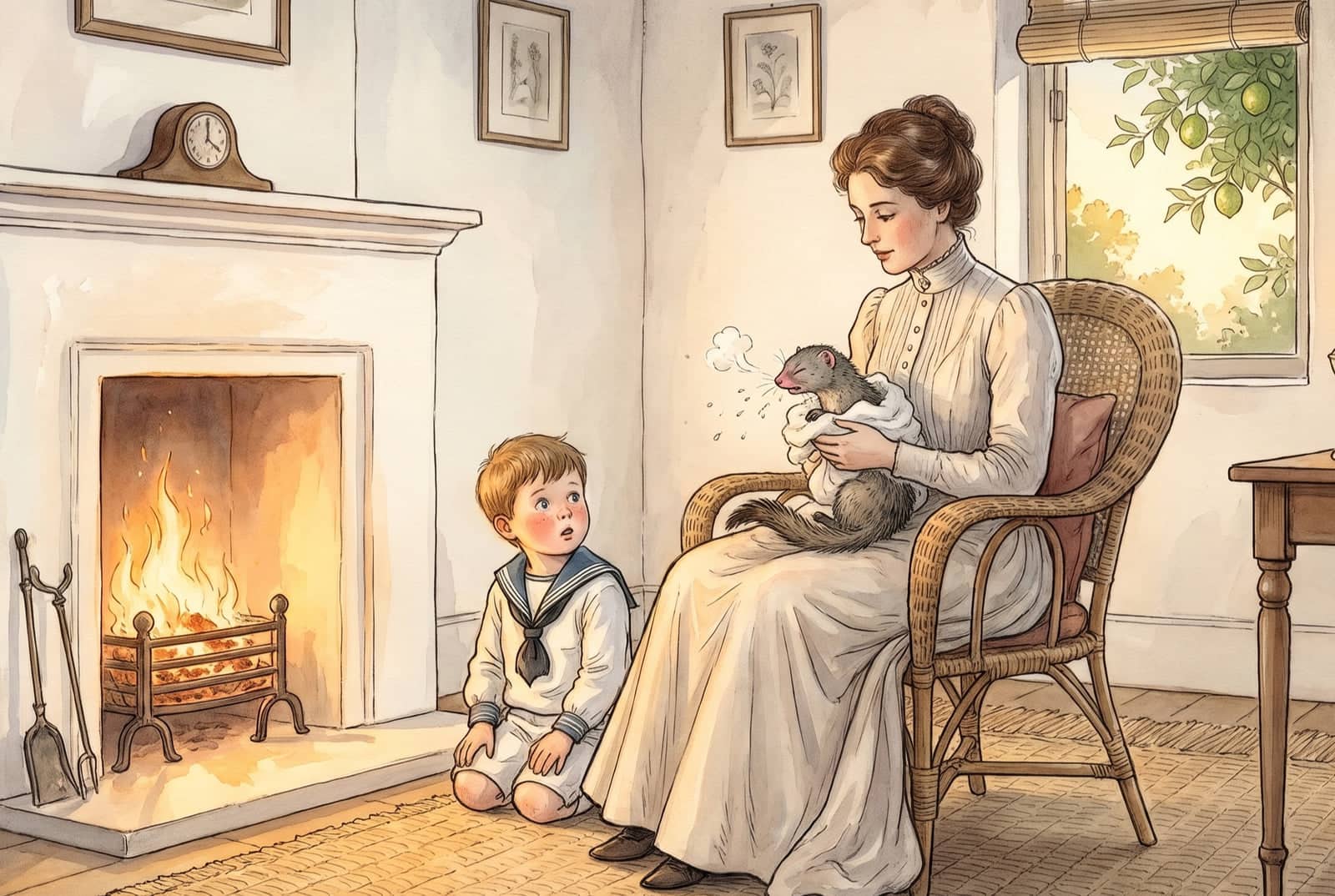
“Now,” said the big man (he was an Englishman who had just moved into the bungalow), “don’t frighten him, and we’ll see what he does.”
It is the hardest thing in the world to frighten a mongoose, because he is eaten up with curiosity from nose to tail. The motto of the whole mongoose family is “Run and find out,” and Rikki-tikki was a true mongoose. He looked at the cotton, decided it was no good to eat, ran all the way around the table, sat up and put his fur in order, scratched himself, and jumped onto the small boy’s shoulder.
“Don’t be frightened, Teddy,” said his father. “That’s his way of making friends.”
“Ouch! He’s tickling me under my chin,” said Teddy.
Rikki-tikki peered down between the boy’s collar and his neck, sniffed at his ear, and climbed down to the floor, where he sat rubbing his nose.
“Good gracious,” said Teddy’s mother, “and that’s a wild animal! I suppose he’s so tame because we’ve been kind to him.”
“All mongooses are like that,” said her husband. “If Teddy doesn’t pick him up by the tail or try to put him in a cage, he’ll run in and out of the house all day long. Let’s give him something to eat.”
They gave him a little piece of raw meat. Rikki-tikki liked it enormously, and when it was gone he went out onto the veranda, sat in the sunshine, and fluffed up his fur to dry it to the roots. After that he felt better.
“There are more things to find out about in this house,” he said to himself, “than all my family could find out in all their lives. I’ll certainly stay and find out.”
He spent the whole day exploring the house. He nearly drowned himself in the bathtubs, put his nose into the ink on a writing desk, and burned it on the end of the big man’s cigar, because he had climbed into the big man’s lap to see how writing was done. At nightfall he ran into Teddy’s nursery to watch the kerosene lamps being lit, and when Teddy went to bed, Rikki-tikki climbed in too.
But he was a restless bedfellow, because all night long he had to get up, look into every noise, and find out what made it. Late that night Teddy’s mother and father came in to look at their boy, and there was Rikki-tikki, wide awake on the pillow.
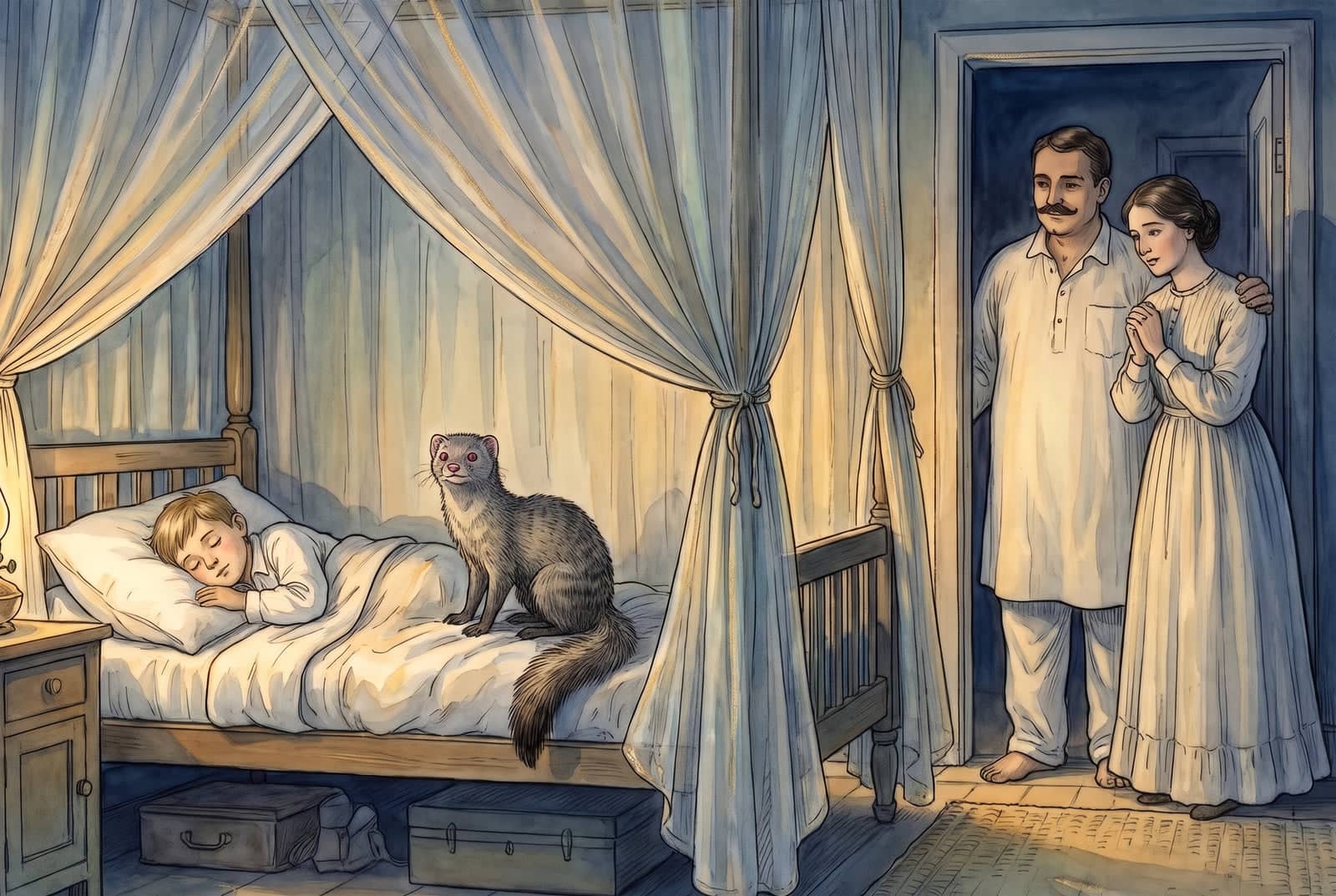
“I don’t like that,” said Teddy’s mother. “He may bite the child.”
“He’ll do no such thing,” said the father. “Teddy’s safer with that little beast than if he had a bloodhound to watch over him. If a snake came into the nursery now…”
But Teddy’s mother wouldn’t think of anything so dreadful.
Early in the morning Rikki-tikki rode on Teddy’s shoulder to breakfast on the veranda, and they gave him banana and some boiled egg. He sat in everyone’s lap, one after another, because every well-brought-up mongoose hopes to be a house mongoose one day and have rooms to run about in. Besides, Rikki-tikki’s mother (she had once lived in the general’s house at Segowlee) had carefully told him what to do if he ever came to live with English people.
Then Rikki-tikki went out into the garden to see what there was to see. It was a large garden, only half tended, with rosebushes as big as summerhouses, lime and orange trees, clumps of bamboo, and thickets of tall grass. Rikki-tikki licked his lips.
“This is a splendid hunting ground,” he said, and at the very thought of it his tail puffed out like a bottle brush. He scuttled up and down the garden, sniffing here and there, until he heard very sorrowful voices in a thornbush.
It was Darzee, the tailorbird, and his wife. They had made a beautiful nest by pulling two big leaves together and stitching up their edges with fibers, and they had lined the hollow with cotton and soft down. The nest swayed back and forth as they sat on the rim and cried.
“What’s the matter?” asked Rikki-tikki.
“We are very unhappy,” said Darzee. “One of our babies fell out of the nest yesterday, and Nag ate him.”
“Hmm!” said Rikki-tikki. “That is very sad. But I’m a stranger here. Who is Nag?”
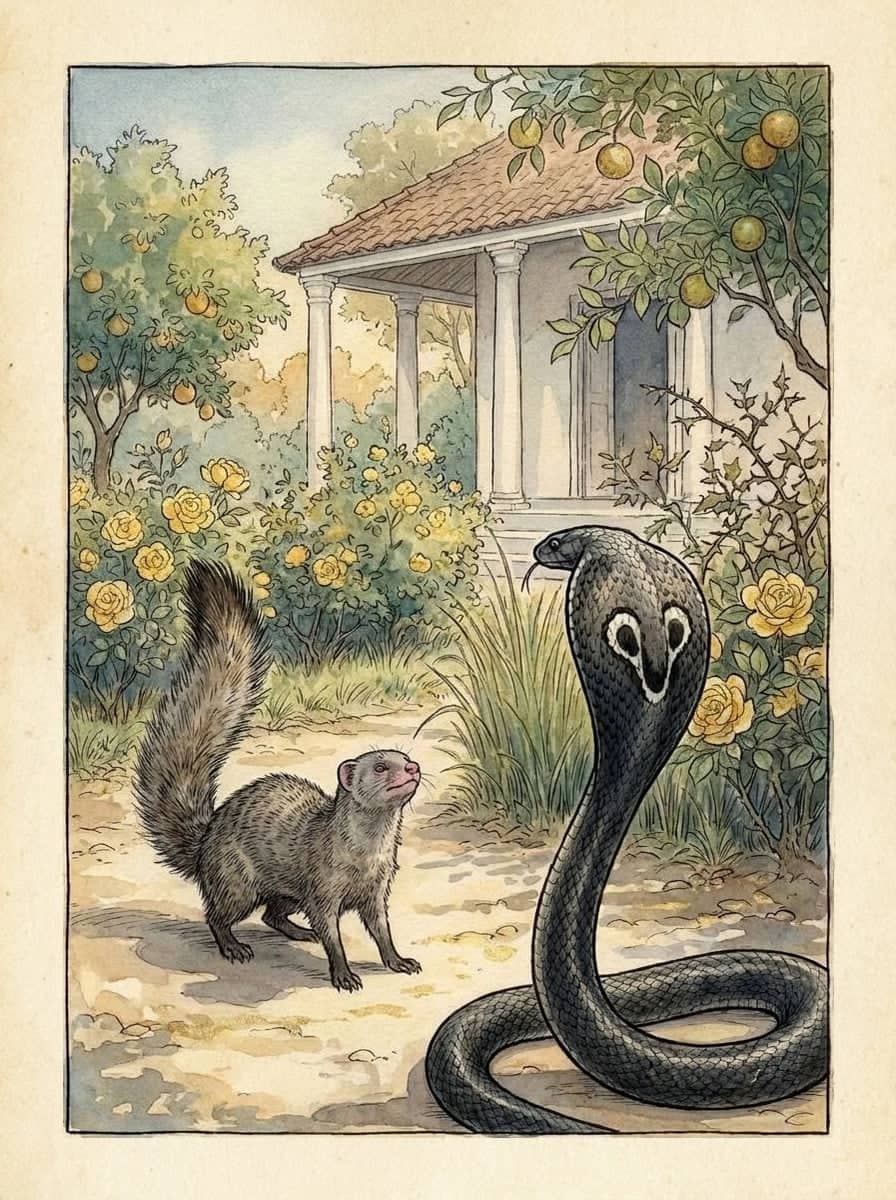
Darzee and his wife only crouched down in the nest without answering, for from the thick grass at the foot of the bush came a low hiss, a horrid, cold sound that made Rikki-tikki jump back a good two feet. Then, inch by inch, the head and spread hood of Nag rose up out of the grass. He was the big black cobra, and he was five feet long from tongue to tail.
When he had lifted a third of himself clear of the ground, he stayed there, swaying back and forth exactly as a dandelion puff sways in the wind. And he looked at Rikki-tikki with the wicked eyes of a snake, which never change their expression, whatever the snake may be thinking.
“Who is Nag?” he said. “I am Nag. The great god Brahm put his mark on all our people when the first cobra spread his hood to keep the sun off Brahm as he slept. Look, and be afraid!”
Nag spread his hood wider than ever, and Rikki-tikki saw the spectacle mark on the back of it, which looks exactly like the eye of a hook-and-eye fastening. For a minute he was afraid. But a mongoose cannot stay frightened for long, and although Rikki-tikki had never met a live cobra before, his mother had fed him on dead ones, and he knew that the whole business of a grown mongoose’s life was to fight snakes and eat them. Nag knew that too, and deep down in his cold heart he was afraid.
“Well,” said Rikki-tikki, and his tail began to fluff up again, “mark or no mark, do you think it’s right for you to eat baby birds out of a nest?”
Nag was thinking to himself and watching for the smallest movement in the grass behind Rikki-tikki. He knew that a mongoose in the garden meant death, sooner or later, for him and his family, but he wanted to catch Rikki-tikki off guard. So he lowered his head a little and tilted it to one side.
“Let us talk,” he said. “You eat eggs. Why shouldn’t I eat birds?”
“Behind you! Look behind you!” sang Darzee.
Rikki-tikki knew better than to waste time staring. He leaped into the air as high as he could go, and just beneath him the head of Nagaina, Nag’s wicked wife, whizzed past. She had crept up behind him while he was talking, to finish him off. He heard her savage hiss as the strike missed.
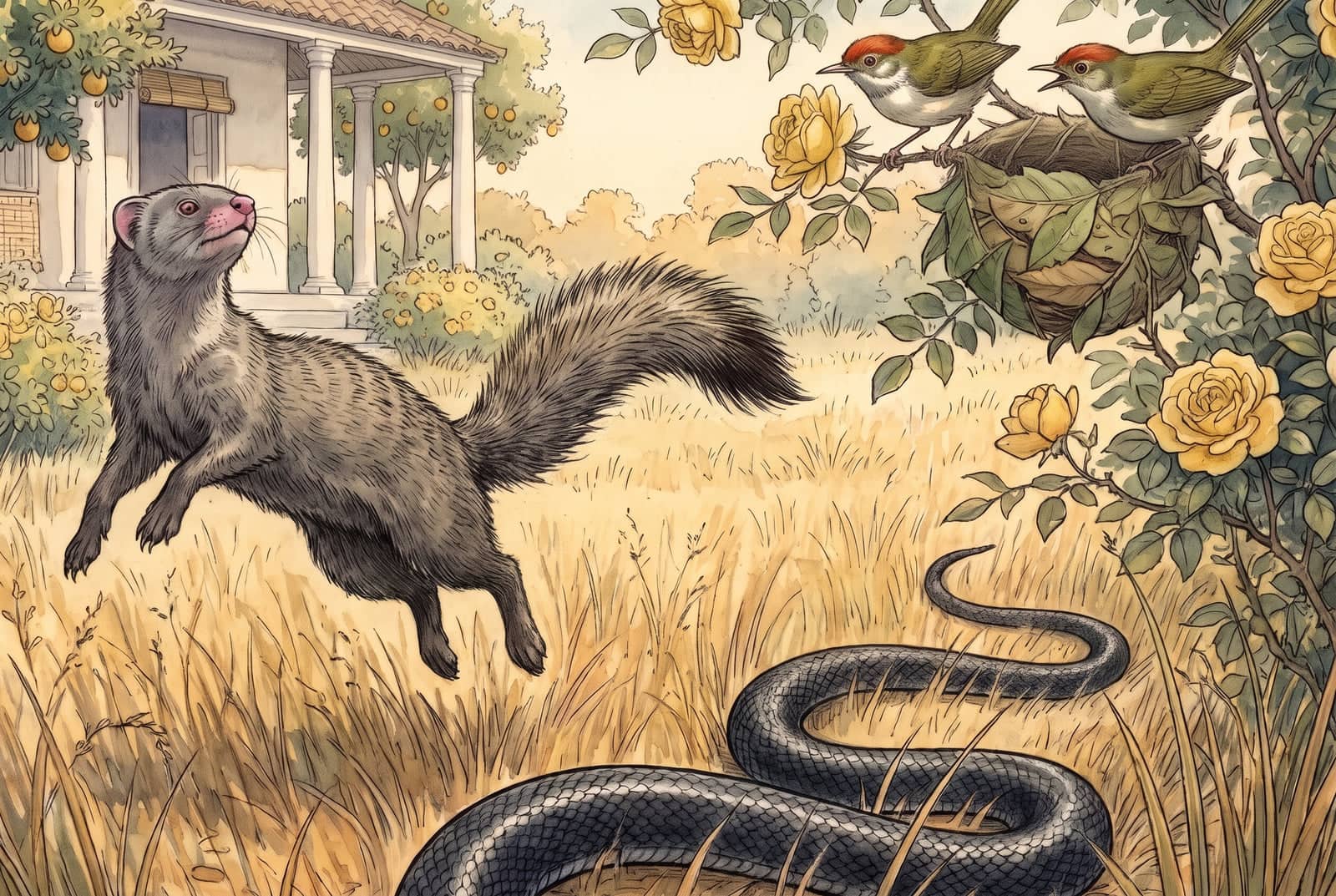
He came down almost across her back. If he had been an old mongoose, he would have known that this was the moment to break her back with one bite, but he was afraid of the terrible lashing return stroke of the cobra. He did bite, but not long enough, and he sprang clear of the whipping tail, leaving Nagaina torn and furious.
“Wicked, wicked Darzee!” said Nag, lashing up as high as he could reach toward the nest in the thornbush. But Darzee had built it out of the reach of snakes, and it only swayed back and forth.
Rikki-tikki felt his eyes growing red and hot (when a mongoose’s eyes turn red, he is angry). He sat back on his tail and hind legs like a little kangaroo, looked all around him, and chattered with rage. But Nag and Nagaina had vanished into the grass. When a snake misses its strike, it never says anything or gives any sign of what it means to do next.
Rikki-tikki didn’t care to follow them, because he didn’t feel sure that he could manage two snakes at once. So he trotted off to the gravel path near the house and sat down to think. This was a serious matter for him.
If you read the old natural history books, you will find that they say a mongoose who gets bitten in a fight with a snake runs off and eats some herb that cures him. That isn’t true. Victory is only a matter of a quick eye and quick feet, the snake’s strike against the mongoose’s jump. No eye can follow a snake’s head when it strikes, and that makes the whole thing far more wonderful than any magic herb.
Rikki-tikki knew that he was a young mongoose, and that made him all the more pleased to think he had dodged a strike from behind. It gave him confidence in himself, and when Teddy came running down the path, Rikki-tikki was ready to be petted.
But just as Teddy bent down, something wriggled a little in the dust, and a tiny voice said, “Be careful. I am Death!” It was Karait, the little dusty-brown snake that likes best to lie in the dust, and his bite is as deadly as the cobra’s. But he is so small that nobody thinks about him, and so he does people all the more harm.
Rikki-tikki’s eyes turned red again, and he danced up to Karait with the odd rocking, swaying step he had inherited from his family. It looks very funny, but it is such a perfectly balanced gait that you can spring off from it at any angle you like, and when you are dealing with snakes, that is an advantage.
If Rikki-tikki had only known it, he was doing something far more dangerous than fighting Nag. Karait is so small and can turn so quickly that unless Rikki bit him close to the back of the head, the snake would strike back into his eye or his lip. But Rikki didn’t know. His eyes were all red, and he rocked back and forth, looking for a good place to take hold.
Karait struck. Rikki jumped sideways and tried to dart in, but the wicked little dusty gray head lashed past within a hair of his shoulder, and he had to jump over the snake’s body, with the head following close at his heels.
Teddy shouted toward the house, “Oh, look here! Our mongoose is killing a snake!” And Rikki-tikki heard Teddy’s mother scream. Teddy’s father ran out with a stick, but by the time he got there, Karait had lunged out once too far. Rikki-tikki had sprung onto the snake’s back, tucked his head far down between his forelegs, bitten as high up the back as he could reach, and rolled away.
That bite paralyzed Karait, and Rikki-tikki was just about to eat him up, starting at the tail as his family did at dinner, when he remembered that a full meal makes a slow mongoose. If he wanted all his strength and speed ready, he had to keep himself thin.
He went off to take a dust bath under the castor-oil plants while Teddy’s father beat the dead Karait.
“What’s the use of that?” thought Rikki-tikki. “I’ve settled it all.”
Then Teddy’s mother picked Rikki-tikki up out of the dust and hugged him, crying that he had saved Teddy from death, and Teddy’s father said he was a godsend, and Teddy looked on with big, frightened eyes. Rikki-tikki was rather amused by all the fuss, which of course he didn’t understand. Teddy’s mother might just as well have petted Teddy for playing in the dust. Rikki was thoroughly enjoying himself.
That night at dinner he walked back and forth among the wineglasses on the table, and he could have stuffed himself three times over with good things. But he remembered Nag and Nagaina. Although it was very pleasant to be patted and petted by Teddy’s mother and to sit on Teddy’s shoulder, every now and then his eyes would turn red, and he would break into his long war cry, “Rikk-tikk-tikki-tikki-tchk!”
Teddy carried him off to bed and insisted that Rikki-tikki sleep under his chin. Rikki-tikki was too well brought up to bite or scratch, but as soon as Teddy was asleep, he set off on his nightly walk around the house. In the dark he ran into Chuchundra, the muskrat, creeping along by the wall.
Chuchundra is a heartbroken little creature. He whimpers and squeaks all night long, trying to make up his mind to run into the middle of the room. But he never gets there.
“Don’t kill me,” said Chuchundra, almost in tears. “Rikki-tikki, don’t kill me!”
“Do you think a snake killer kills muskrats?” said Rikki-tikki scornfully.
“Those who kill snakes get killed by snakes,” said Chuchundra, more sorrowfully than ever. “And how can I be sure Nag won’t mistake me for you some dark night?”
“There’s not the slightest danger,” said Rikki-tikki. “Anyway, Nag is in the garden, and I know you don’t go there.”
“My cousin Chua, the rat, told me…” said Chuchundra, and then he stopped.
“Told you what?”
“Hush! Nag is everywhere, Rikki-tikki. You should have talked to Chua in the garden.”
“Well, I didn’t, so you’ll have to tell me. Quick, Chuchundra, or I’ll bite you!”
Chuchundra sat down and cried until the tears rolled off his whiskers. “I’m such a feeble little thing,” he sobbed. “I never had the courage to run out into the middle of the room. Hush! I mustn’t tell you anything. Can’t you hear it, Rikki-tikki?”
Rikki-tikki listened. The house was as still as could be, but he thought he could just make out the faintest scratch-scratch in the world, a noise as small as a wasp walking on a windowpane. It was the dry scratch of a snake’s scales on brickwork.
“That’s Nag or Nagaina,” he said to himself, “and one of them is crawling in through the bathroom drain. You’re right, Chuchundra. I should have talked to Chua.”
He crept off to Teddy’s bathroom, but there was nothing there, and then to Teddy’s mother’s bathroom. At the bottom of the smooth plaster wall a brick had been taken out to make a drain for the bath water. As Rikki-tikki slipped in past the low brick curb where the bathtub stood, he heard Nag and Nagaina whispering together outside in the moonlight.
“When the house is empty of people,” Nagaina said to her husband, “the mongoose will have to go away, and then the garden will be ours again. Go in quietly, and remember that the big man who killed Karait is the first one to bite. Then come out and tell me, and we will hunt Rikki-tikki together.”
“But are you sure we gain anything by killing the people?” said Nag.
“Everything. When there were no people in the bungalow, did we have a mongoose in the garden? As long as the bungalow is empty, we are king and queen of the garden. And remember: as soon as our eggs in the melon bed hatch (and that may be tomorrow), our children will need room and quiet.”
“I hadn’t thought of that,” said Nag. “I will go, but there’s no need for us to hunt Rikki-tikki afterward. I will kill the big man and his wife, and the child if I can, and come away quietly. Then the bungalow will be empty, and Rikki-tikki will leave.”
At this Rikki-tikki tingled all over with rage and hatred. Then Nag’s head came through the drain, and his five feet of cold body followed it. Angry as he was, Rikki-tikki was very frightened when he saw the size of the big cobra. Nag coiled himself up, raised his head, and peered into the dark bathroom, and Rikki could see his eyes glitter.
“Now, if I kill him here, Nagaina will know, and if I fight him on the open floor, the odds are on his side. What am I to do?” said Rikki-tikki-tavi.
Nag swayed back and forth, and then Rikki-tikki heard him drinking from the biggest water jar, the one they used to fill the bath.
“That’s good,” said the snake. “Now, when Karait was killed, the big man had a stick. He may still have that stick, but when he comes in to bathe in the morning, he won’t have a stick with him. I’ll wait here until he comes. Nagaina, do you hear me? I’ll wait here in the cool until daylight.”
There was no answer from outside, so Rikki-tikki knew that Nagaina had gone away. Nag settled down, coil by coil, around the bulge at the bottom of the water jar, and Rikki-tikki stayed as still as death.
After an hour he began to move, muscle by muscle, toward the jar. Nag was asleep, and Rikki-tikki studied his big back, wondering where the best place for a good hold would be.
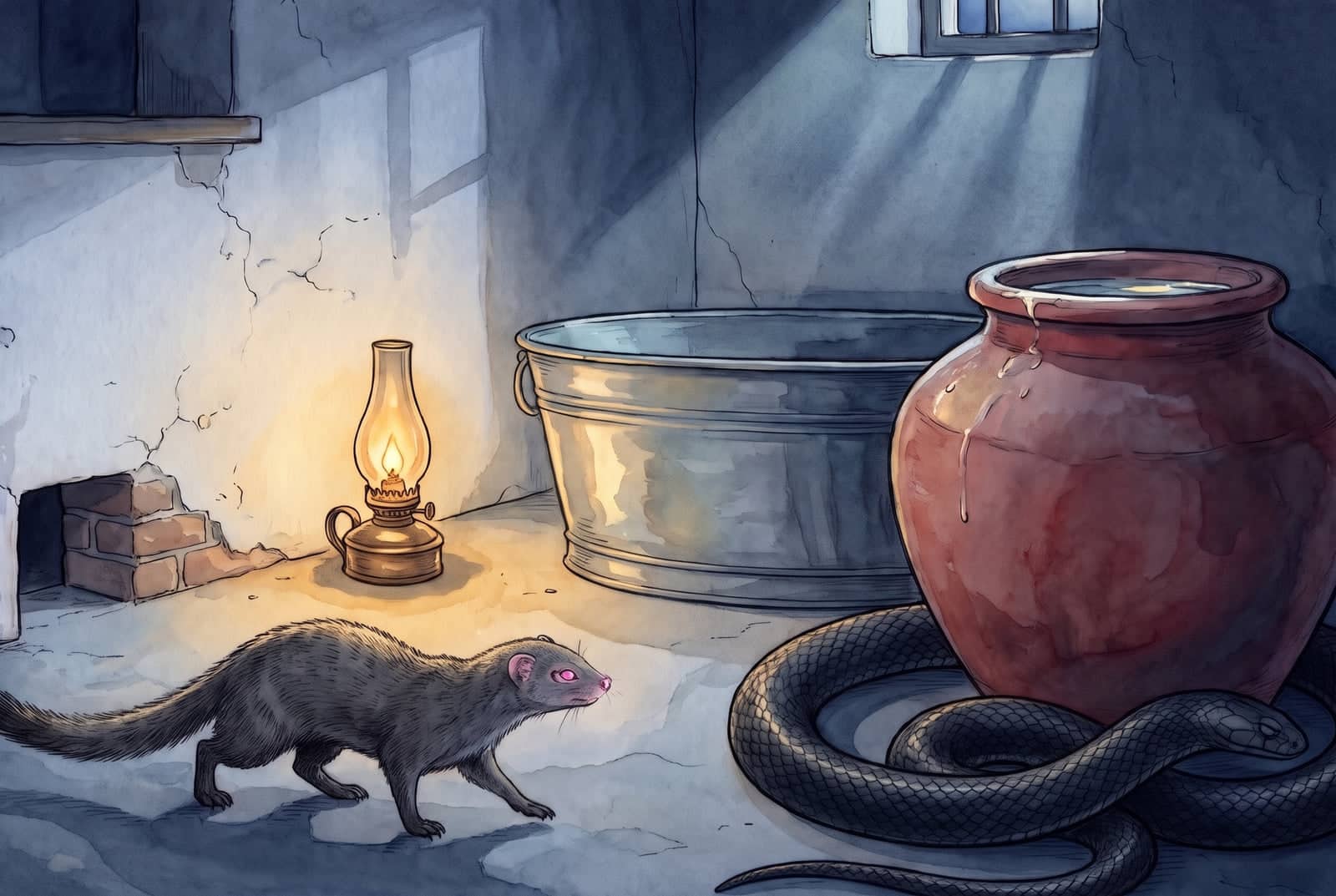
“If I don’t break his back with the first jump,” said Rikki, “he can still fight. And if he fights… oh, Rikki!” He looked at the thickness of the neck below the hood, but that was too much for him, and a bite near the tail would only make Nag savage.
“It must be the head,” he said at last, “the head above the hood. And once I’m there, I mustn’t let go.”
Then he jumped. The head was lying a little way out from the water jar, under its curve, and as his teeth met, Rikki braced his back against the bulge of red clay to hold the head down. That gave him a footing for just one second, and he made the most of it.
The next moment he was flung back and forth the way a dog shakes a rat: back and forth across the floor, up and down, and around in great circles. But his eyes were red, and he held on while the body cracked like a whip across the floor, knocking over the tin dipper, the soap dish, and the scrub brush, and banging against the tin side of the bath.
As he held on, he clamped his jaws tighter and tighter, because he was sure he would be battered to death, and for the honor of his family he would rather be found with his teeth locked. He was dizzy and aching and felt shaken to pieces when something went off like a thunderclap just behind him. A hot blast knocked him senseless, and red fire singed his fur. The big man had been woken by the noise and had fired both barrels of a shotgun into Nag, just behind the hood.
Rikki-tikki held on with his eyes shut, because now he was quite sure he was dead. But the head didn’t move, and the big man picked him up and said, “It’s the mongoose again, Alice. The little fellow has saved our lives now.”
Then Teddy’s mother came in with a very white face and saw what was left of Nag. Rikki-tikki dragged himself to Teddy’s bedroom and spent half the rest of the night shaking himself gently to find out whether he really was broken into forty pieces, as he imagined.
When morning came, he was very stiff but well pleased with what he had done. “Now I have Nagaina to settle with, and she’ll be worse than five Nags, and there’s no telling when those eggs she talked about will hatch. Goodness! I must go and see Darzee,” he said.
Without waiting for breakfast, Rikki-tikki ran to the thornbush, where Darzee was singing a song of triumph at the top of his voice. The news of Nag’s death was all over the garden, because the sweeper had thrown the body on the trash heap.
“Oh, you stupid tuft of feathers!” said Rikki-tikki angrily. “Is this a time to sing?”
“Nag is dead, is dead, is dead!” sang Darzee. “The valiant Rikki-tikki caught him by the head and held on fast. The big man brought the bang-stick, and Nag fell in two pieces! He will never eat my babies again.”
“That’s all true enough. But where’s Nagaina?” said Rikki-tikki, looking carefully around him.
“Nagaina came to the bathroom drain and called for Nag,” Darzee went on, “and Nag came out on the end of a stick. The sweeper picked him up on the end of a stick and threw him on the trash heap. Let us sing about the great, the red-eyed Rikki-tikki!” And Darzee filled his throat and sang.
“If I could get up to your nest, I’d roll your babies out!” said Rikki-tikki. “You don’t know the right thing to do at the right time. You’re safe enough up there in your nest, but down here it’s war for me. Stop singing for a minute, Darzee.”
“For the sake of the great, the beautiful Rikki-tikki, I will stop,” said Darzee. “What is it, O Killer of the terrible Nag?”
“Where is Nagaina, for the third time?”
“On the trash heap by the stables, mourning for Nag. Great is Rikki-tikki with the white teeth.”
“Bother my white teeth! Have you ever heard where she keeps her eggs?”
“In the melon bed, at the end nearest the wall, where the sun shines nearly all day. She hid them there weeks ago.”
“And you never thought it was worth telling me? The end nearest the wall, you said?”
“Rikki-tikki, you’re not going to eat her eggs?”
“Not eat them exactly, no. Darzee, if you have a grain of sense, you’ll fly off to the stables and pretend your wing is broken, and let Nagaina chase you to this bush. I have to get to the melon bed, and if I went there now, she’d see me.”
Darzee was a featherbrained little fellow who could never hold more than one idea in his head at a time. And just because he knew that Nagaina’s children hatched from eggs like his own, he didn’t think at first that it was fair to kill them. But his wife was a sensible bird, and she knew that cobra eggs meant young cobras later on. So she flew off the nest and left Darzee to keep the babies warm and go on with his song about the death of Nag. In some ways Darzee was very like a man.
She fluttered in front of Nagaina by the trash heap and cried, “Oh, my wing is broken! The boy in the house threw a stone at me and broke it.” Then she fluttered more desperately than ever.
Nagaina raised her head and hissed, “You warned Rikki-tikki when I would have killed him. Truly, you’ve picked a bad place to be lame.” And she moved toward Darzee’s wife, gliding over the dust.
“The boy broke it with a stone!” shrieked Darzee’s wife.
“Well! It may be some comfort to you when you’re dead to know that I shall settle accounts with the boy. My husband lies on the trash heap this morning, but before night the boy in the house will lie very still. What’s the use of running away? I’m sure to catch you. Little fool, look at me!”
Darzee’s wife knew better than to do that, because a bird who looks into a snake’s eyes gets so frightened that she can’t move. She fluttered on, piping sorrowfully and never leaving the ground, and Nagaina went faster.
Rikki-tikki heard them going up the path from the stables, and he raced for the end of the melon bed near the wall. There, in the warm straw and leaves above the melons, very cleverly hidden, he found twenty-five eggs, about the size of a bantam hen’s eggs, but with whitish skin instead of shell.
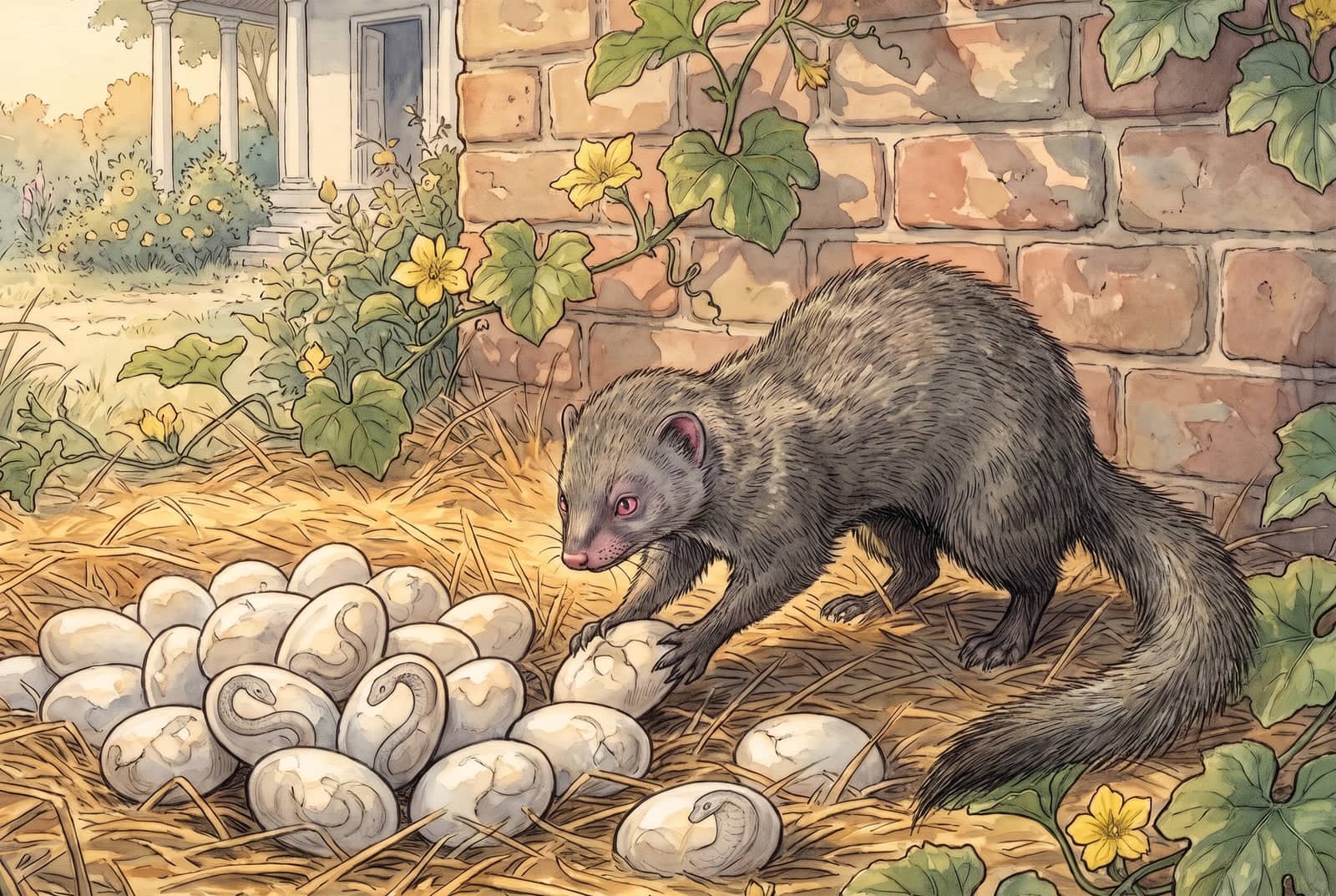
“I wasn’t a day too soon,” he said, for he could see the baby cobras curled up inside the skin, and he knew that the minute they hatched, each one of them could kill a man or a mongoose.
He bit the tops off the eggs as fast as he could, taking care to crush the young cobras, and every so often he turned over the straw to see whether he had missed any. At last there were only three eggs left, and Rikki-tikki was beginning to chuckle to himself when he heard Darzee’s wife screaming.
“Rikki-tikki, I led Nagaina toward the house, and she has gone onto the veranda, and… oh, come quickly… she means to kill!”
Rikki-tikki smashed two eggs and tumbled backward down the melon bed with the third egg in his mouth, then scuttled to the veranda as fast as his feet would carry him. Teddy and his mother and father were there at early breakfast, but Rikki-tikki saw that they weren’t eating anything. They sat stone-still, and their faces were white.
Nagaina was coiled up on the matting beside Teddy’s chair, within easy striking distance of Teddy’s bare leg, and she was swaying back and forth, singing a song of triumph.
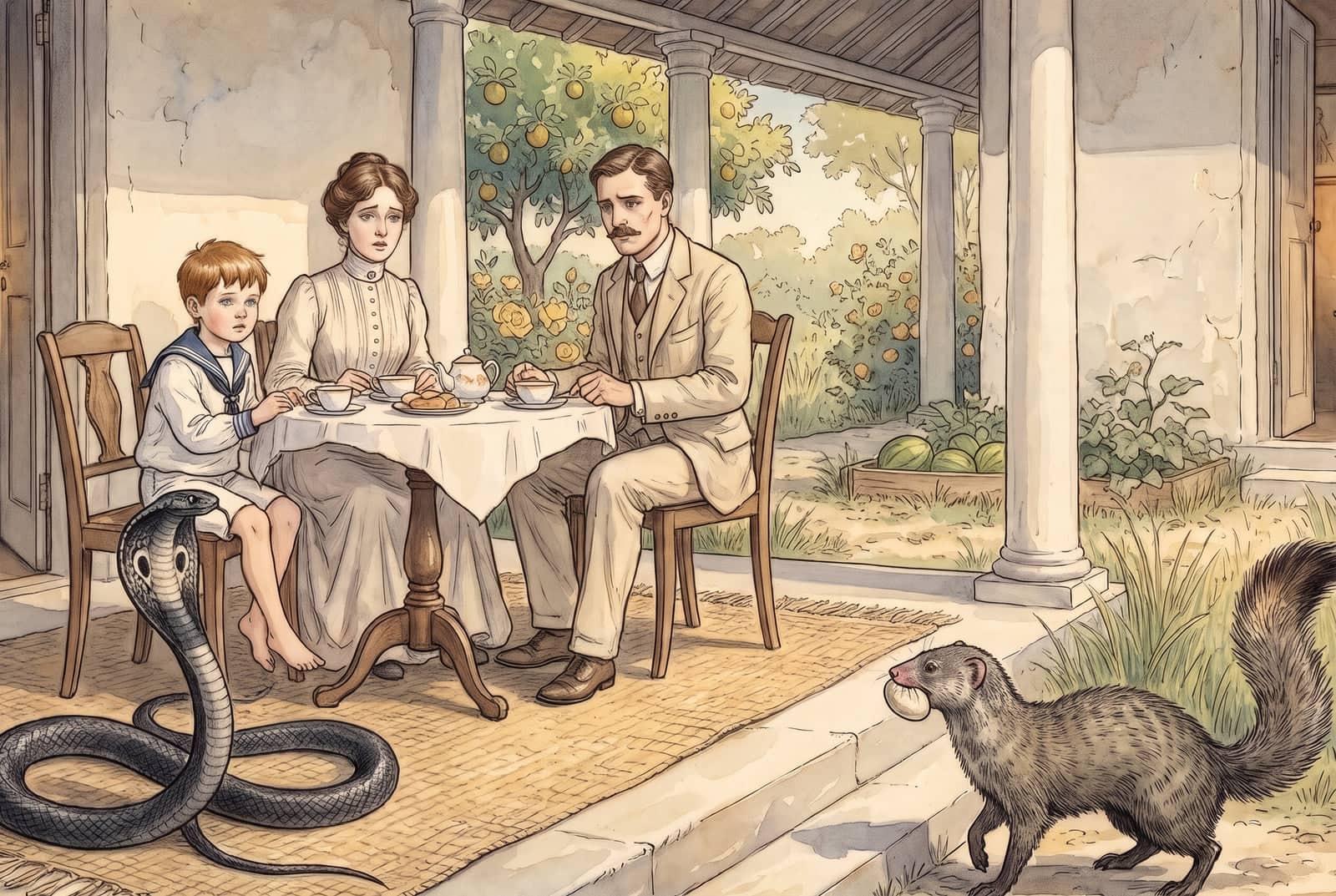
“Son of the big man that killed Nag,” she hissed, “stay still. I am not ready yet. Wait a little. Keep very still, all three of you! If you move I strike, and if you do not move I strike. Oh, foolish people, who killed my Nag!”
Teddy’s eyes were fixed on his father, and all his father could do was whisper, “Sit still, Teddy. You mustn’t move. Teddy, keep still.”
Then Rikki-tikki came up and cried, “Turn around, Nagaina. Turn and fight!”
“All in good time,” she said, without moving her eyes. “I will settle my account with you soon enough. Look at your friends, Rikki-tikki. They are still and white. They are afraid. They dare not move, and if you come one step nearer, I strike.”
“Look at your eggs,” said Rikki-tikki, “in the melon bed near the wall. Go and look, Nagaina!”
The big snake turned halfway around and saw the egg on the veranda. “Ah-h! Give it to me,” she said.
Rikki-tikki put his paws on either side of the egg, and his eyes were blood-red. “What price for a snake’s egg? For a young cobra? For a young king cobra? For the last, the very last of the brood? The ants are eating all the others down by the melon bed.”
Nagaina spun clear around, forgetting everything for the sake of the one egg. Rikki-tikki saw Teddy’s father shoot out a big hand, catch Teddy by the shoulder, and drag him across the little table with the teacups, safe and out of Nagaina’s reach.
Rikki-tikki chuckled. “Tricked! Tricked! Tricked! Rikk-tck-tck! The boy is safe, and it was I… I… I who caught Nag by the hood last night in the bathroom.” Then he began to jump up and down, all four feet together, his head close to the floor. “He threw me back and forth, but he couldn’t shake me off. He was dead before the big man blew him in two. I did it! Rikki-tikki-tck-tck! Come on, then, Nagaina. Come and fight with me. You won’t be a widow for long.”
Nagaina saw that she had lost her chance to kill Teddy, and the egg lay between Rikki-tikki’s paws. “Give me the egg, Rikki-tikki. Give me the last of my eggs, and I will go away and never come back,” she said, lowering her hood.
“Yes, you’ll go away, and you’ll never come back, because you’ll go to the trash heap with Nag. Fight, widow! The big man has gone for his gun! Fight!”
Rikki-tikki was bounding all around Nagaina, keeping just out of reach of her strike, his little eyes like hot coals. Nagaina gathered herself together and lunged at him. Rikki-tikki jumped up and backward. Again and again and again she struck, and each time her head came down with a whack on the veranda matting, and she gathered herself together like a watch spring.
Then Rikki-tikki danced in a circle to get behind her, and Nagaina spun around to keep her head facing his, so that the rustle of her tail on the matting sounded like dry leaves blown along by the wind.
He had forgotten the egg. It still lay on the veranda, and Nagaina came nearer and nearer to it, until at last, while Rikki-tikki was catching his breath, she snatched it up in her mouth, turned to the veranda steps, and flew like an arrow down the path, with Rikki-tikki behind her. When a cobra runs for her life, she goes like a whiplash flicked across a horse’s neck.
Rikki-tikki knew that he had to catch her, or all the trouble would begin again. She headed straight for the tall grass by the thornbush, and as he ran, he heard Darzee still singing his foolish little song of triumph. But Darzee’s wife was wiser. She flew off her nest as Nagaina came along and flapped her wings around Nagaina’s head. If Darzee had helped, they might have turned her back, but Nagaina only lowered her hood and kept going.
Still, that moment’s delay brought Rikki-tikki up to her. As she plunged into the rat hole where she and Nag used to live, his little white teeth were clenched on her tail, and he went down with her. Very few mongooses, however wise and old they may be, care to follow a cobra into its hole.
It was dark in the hole, and Rikki-tikki never knew when it might open out and give Nagaina room to turn and strike at him. He held on savagely and stuck out his feet as brakes on the dark slope of hot, damp earth.
Then the grass by the mouth of the hole stopped waving, and Darzee said, “It’s all over with Rikki-tikki! We must sing his death song. Valiant Rikki-tikki is dead! Nagaina will surely kill him underground.”
So Darzee sang a very mournful song that he made up on the spot, and just as he got to the most touching part, the grass quivered again. Rikki-tikki, covered with dirt, dragged himself out of the hole leg by leg, licking his whiskers, and Darzee broke off with a little shout. Rikki-tikki shook some of the dust out of his fur and sneezed.
“It’s all over,” he said. “The widow will never come out again.” And the red ants that live among the grass stems heard him and began to march down one after another to see if he had told the truth.
Then he curled up in the grass and slept right where he was. He slept and slept until late in the afternoon, because he had done a hard day’s work.
“Now,” he said when he woke, “I’ll go back to the house. Tell the Coppersmith, Darzee, and he’ll tell the garden that Nagaina is dead.”
The Coppersmith is a bird who makes a sound exactly like a little hammer beating on a copper pot, and the reason he is always making it is that he is the town crier of every Indian garden and tells all the news to anyone who cares to listen. As Rikki-tikki went up the path, he heard the Coppersmith’s “attention” notes, like a tiny dinner gong, and then the steady “Ding-dong-tock! Nag is dead—dong! Nagaina is dead! Ding-dong-tock!”
That set all the birds in the garden singing and the frogs croaking, because Nag and Nagaina used to eat frogs as well as little birds.
When Rikki got to the house, Teddy, his mother (she still looked very white, because she had fainted), and his father came out and almost cried over him. That night he ate everything they gave him until he could eat no more, and he went to bed on Teddy’s shoulder, where Teddy’s mother saw him when she looked in late that night.
“He saved our lives and Teddy’s life,” she said to her husband. “Just think, he saved all our lives.”
Rikki-tikki woke up with a jump, because mongooses are light sleepers.
“Oh, it’s you,” he said. “What are you worried about? All the cobras are dead. And if they weren’t, I’m here.”
Rikki-tikki had a right to be proud of himself. But he didn’t grow too proud, and he kept that garden as a mongoose should keep it, with tooth and jump and spring and bite, until no cobra ever dared show its head inside the walls.
Retold by Talerie from The Jungle Book (opens in a new window) Public domain Copy this text, adapt it, use it however you like. A link back to Talerie is appreciated but never required. CC0 1.0 (opens in a new window)