 Original
Hannah has no children, and every year at Shiloh her rival Peninnah mocks her until she weeps. At the temple she vows that if God gives her a son, she will give him back to God for all the days of his life. Eli the priest watches her lips move without a sound and thinks she is drunk.
In the hill country of Ephraim, in the town of Ramah, there lived a man named Elkanah. His family went back through Jeroham, Elihu, Tohu, and Zuph. He had two wives. One was named Hannah and the other Peninnah. Peninnah had children, but Hannah had none.
Every year Elkanah left his town and went up to Shiloh to worship God and offer a sacrifice. Two of the priests at Shiloh were Hophni and Phinehas, the sons of the old priest Eli.
When the day came for Elkanah to make his offering, he gave portions of the meat to Peninnah and to all her sons and daughters. To Hannah he gave a double portion, because he loved her, even though God had not given her any children.
Peninnah, her rival, taunted her cruelly to make her miserable, because God had kept Hannah from having children. It happened year after year. Each time Hannah went up to the house of God, Peninnah mocked her, until Hannah wept and would not eat.
“Hannah, why are you crying?” her husband asked her. “Why won’t you eat? Why are you so sad? Don’t I mean more to you than ten sons?”
One year, after they had eaten and drunk at Shiloh, Hannah got up and went to pray. Eli the priest was sitting on a chair by the doorpost of God’s temple. Hannah was bitterly unhappy, and she prayed to God and wept and wept.
Then she made a vow. “God of heaven’s armies,” she said, “if you will only look at how unhappy your servant is, and remember me, and not forget me, and give me a son, then I will give him back to you for all the days of his life. No razor shall ever touch his head.”
She went on praying for a long time, and Eli watched her mouth. Hannah was praying in her heart. Her lips moved, but no sound came out, so Eli thought she was drunk.

“How long are you going to stay drunk?” Eli said to her. “Put away your wine.”
“No, my lord,” Hannah answered. “I’m a woman with a heavy heart. I haven’t been drinking wine or beer. I’ve been pouring out my soul to God. Don’t take me for a wicked woman. All this time I’ve been speaking out of my great sorrow and grief.”
“Go in peace,” Eli answered, “and may the God of Israel give you what you have asked of him.”
“May you always think kindly of your servant,” she said. Then she went on her way and ate something, and her face was no longer sad.
Early the next morning they got up and worshiped God, and then they went back home to Ramah. Elkanah and his wife Hannah came together as husband and wife, and God remembered her.
In time Hannah became pregnant and had a son. She named him Samuel, saying, “Because I asked God for him.”
The next year Elkanah went up with all his household to offer the yearly sacrifice to God and to keep his vow. But Hannah stayed behind.
“I won’t go until the child is weaned,” she told her husband. “Then I’ll take him, so that he can appear before God and stay there for good.”
“Do whatever you think best,” Elkanah said. “Stay here until you’ve weaned him. And may God do what he has said.” So Hannah stayed at home and nursed her son until he was weaned.
When she had weaned him, she took him up to Shiloh with her, along with three bulls, a large sack of flour, and a skin of wine, and brought him to the house of God. The boy was still very young. They slaughtered one of the bulls, and then they brought the child to Eli.

“Oh, my lord,” Hannah said, “as sure as you live, my lord, I am the woman who stood here beside you, praying to God. I prayed for this child, and God has given me what I asked of him. So now I am lending him to God. For as long as he lives, he is lent to God.” And the boy worshiped God there.
Then Hannah prayed, and this is the song she sang:
My heart is glad in God, my head is lifted high. I can laugh at those who mocked me, for your rescue makes me glad. No one is holy like God, there is no one besides you, there is no rock like our God.
Stop all your proud talk, let no boasting leave your mouth, for God knows everything, and he weighs what people do. The bows of the mighty are broken, and those who stumbled stand strong.
Those who were full now work for bread, and the hungry are hungry no more. The woman who had no children has borne seven, and the mother of many is worn and weak. God brings death and God gives life, he brings down to the grave and raises up. God makes poor and God makes rich, he brings low and he lifts up.
He raises the poor from the dust, he lifts the beggar from the ash heap, to seat them among princes and give them a throne of honor. The pillars of the earth belong to God, and on them he has set the world.
He guards the steps of those who are faithful, but the wicked fall silent in the dark, for no one wins by strength alone. Those who fight against God will be shattered, he will thunder at them from heaven. God will judge the ends of the earth, he will give strength to his king and lift high the head of his chosen one.
After that, Elkanah went home to Ramah, but the boy stayed and served God under Eli the priest.
Eli’s sons were wicked men who had no regard for God. This was how the priests dealt with the people: whenever anyone offered a sacrifice, the priests’ servant would come while the meat was boiling, holding a three-pronged meat fork. He would plunge it into the pan or kettle or cauldron or pot, and whatever the fork brought up, the priest took for himself. That was how they treated all the Israelites who came to Shiloh.
Worse still, even before the fat had been burned on the altar, the servant would come and say to the man making the sacrifice, “Give the priest some meat to roast. He won’t take boiled meat from you, only raw.”
If the man said, “Let them burn the fat first, and then take as much as you like,” the servant would answer, “No, give it to me now. If you don’t, I’ll take it by force.”
So the sin of these young men was very great in God’s eyes, because they made people despise the offerings brought to God.
But the boy Samuel served God, dressed in a linen ephod, which is a priest’s linen apron. Every year his mother made him a little coat and brought it to him when she came up with her husband to offer the yearly sacrifice.
Each time, Eli blessed Elkanah and his wife. “May God give you children by this woman,” he would say to Elkanah, “in place of the one she lent to God.” Then they would go home.
And God was kind to Hannah. She had three more sons and two daughters. Meanwhile the boy Samuel grew up in the presence of God.
Eli was very old by now. He heard about everything his sons were doing to the people of Israel, and how they lay with the women who served at the entrance to the tent of meeting.
“Why are you doing such things?” he said to them. “I hear about your wicked ways from everyone. No, my sons, what I hear people saying is not good. You are leading God’s people into sin. If one man wrongs another, a judge can settle it between them. But if a man sins against God, who will plead for him?”
His sons would not listen to their father, for God had decided to put them to death.
And the boy Samuel kept growing, and both God and people thought well of him.
One day a man of God came to Eli. “This is what God says,” he told him. “Didn’t I show myself to your father’s family when they were in Egypt, under Pharaoh? Out of all the tribes of Israel I chose your ancestor to be my priest, to go up to my altar, to burn incense, and to wear the ephod before me. I gave your family every offering the Israelites burn to me.”
He went on, “So why do you trample on the sacrifices and offerings I commanded for my house? Why do you honor your sons more than me, fattening yourselves on the best part of every offering my people Israel bring? This is what the God of Israel says: I did promise that your family and your father’s family would serve before me forever. But now that promise is ended. I will honor those who honor me, and those who despise me will be thought of as nothing.”
“The time is coming,” the man of God said, “when I will cut off your strength and the strength of your father’s family, so that no one in your family will live to be old. You will see trouble in my house, even while Israel is blessed, and never again will there be an old man in your family. The one I leave at my altar will live only to wear out your eyes with weeping and break your heart, and all your descendants will die in the prime of life.”
He finished, “And this will be your sign: your two sons, Hophni and Phinehas, will both die on the same day. Then I will raise up a faithful priest for myself, who will do what is in my heart and mind. I will give him a family that lasts, and he will serve before my chosen king forever. Everyone left in your family will come and bow down to him, begging for a coin and a crust of bread, and will say, ‘Please give me some work among the priests, so that I can have a bit of bread to eat.’”
The boy Samuel went on serving God under Eli. In those days God seldom spoke to anyone, and visions were rare.
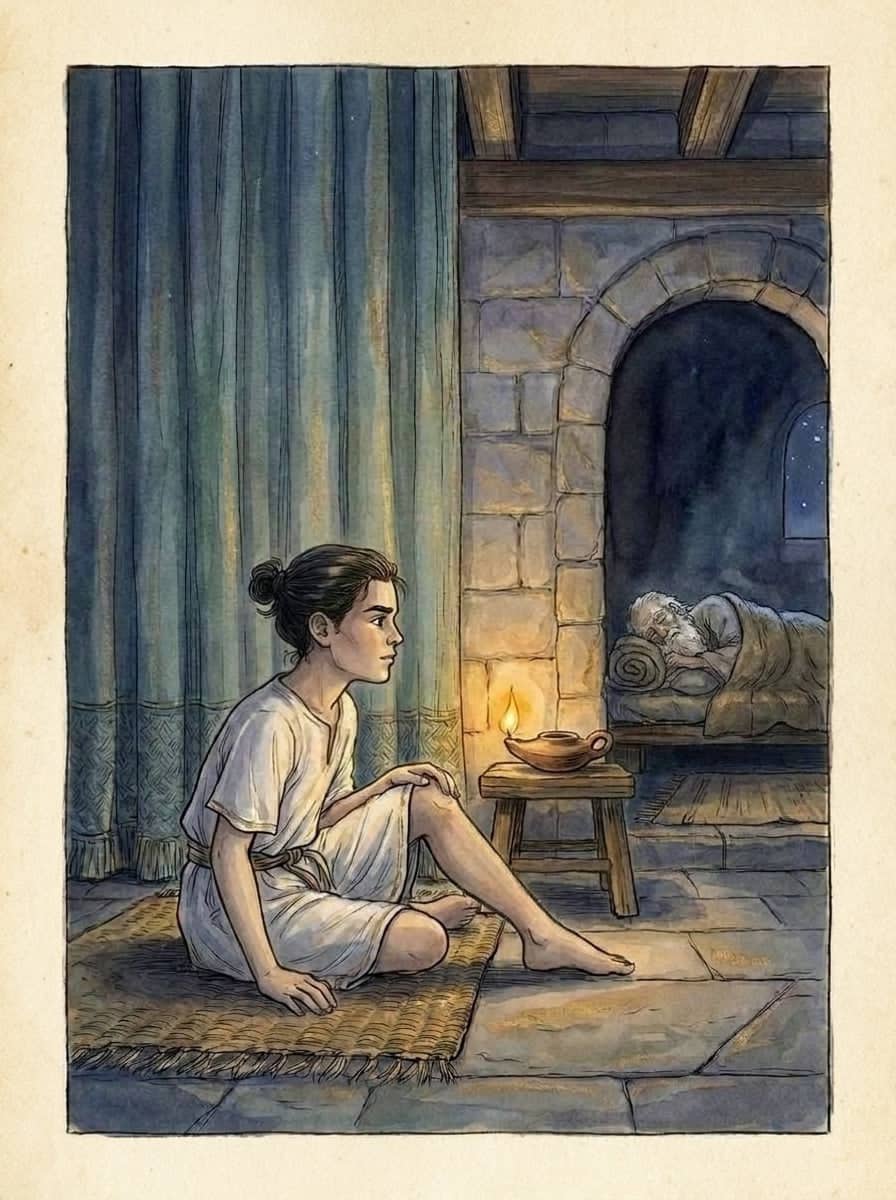
By now Eli’s eyes had grown so weak that he could hardly see. One night he was lying down in his usual place. The lamp of God had not yet gone out, and Samuel was lying down to sleep in the temple, near the ark of God that stood in the dark behind the curtain.
Then God called Samuel.
“Here I am,” Samuel answered. He ran to Eli and said, “Here I am. You called me.”
“I didn’t call you,” Eli said. “Go back and lie down.” So the boy went and lay down.

Again God called, “Samuel!” And Samuel got up, went to Eli, and said, “Here I am. You called me.”
“I didn’t call you, my son,” Eli answered. “Go back and lie down.”
Samuel did not know God yet, because God had never spoken his word to him before.
A third time God called Samuel. Again the boy got up, went to Eli, and said, “Here I am. You called me.”
At last Eli understood that it was God who was calling the boy. “Go and lie down,” he told Samuel, “and if he calls you, say, ‘Speak, for your servant is listening.’” So Samuel went and lay down in his place.
Then God called as he had before, “Samuel! Samuel!”
And Samuel answered, “Speak, for your servant is listening.”
God said to Samuel, “I am about to do something in Israel that will make the ears of everyone who hears about it tingle. On that day I will carry out against Eli everything I have said about his family, from beginning to end. I told him that I would judge his family forever because of the wrong he knew about. His sons brought shame on themselves, and he did not stop them. That is why I have sworn to Eli’s family that their wrong will never be wiped away by any sacrifice or offering, ever.”
Samuel lay there until morning. Then he opened the doors of God’s house. He was afraid to tell Eli what God had told him.
But Eli called him. “Samuel, my son.”
“Here I am,” Samuel answered.
“What did God say to you?” Eli asked. “Don’t hide it from me. May God punish you severely if you hide from me a single thing he told you.”
So Samuel told him everything and kept nothing back.

“It is God,” Eli said. “Let him do whatever seems good to him.”
Samuel grew up, and God was with him and made sure that every word Samuel spoke came true. All Israel, from Dan in the north to Beersheba in the south, knew that Samuel was truly God’s prophet. And God went on making himself known at Shiloh, for it was there that he spoke his word to Samuel.
Retold by Talerie from King James Version (opens in a new window) Public domain Copy this text, adapt it, use it however you like. A link back to Talerie is appreciated but never required. CC0 1.0 (opens in a new window)