The Frog Princess
11 min read ages 5 and up talerie.com/en/tales/the-frog-princess
When Prince Ivan’s arrow lands in a muddy swamp, the tsar tells him to marry the croaking frog who caught it. Each night, while Ivan sleeps, the frog throws off her skin. By morning the bread or the carpet the tsar demanded is ready, finer than anyone could imagine.
Once upon a time, in a certain kingdom, there lived a tsar who had three sons. All three were young and unmarried, and so bold and handsome that no tale could tell it and no pen could write it. The youngest was called Prince Ivan.
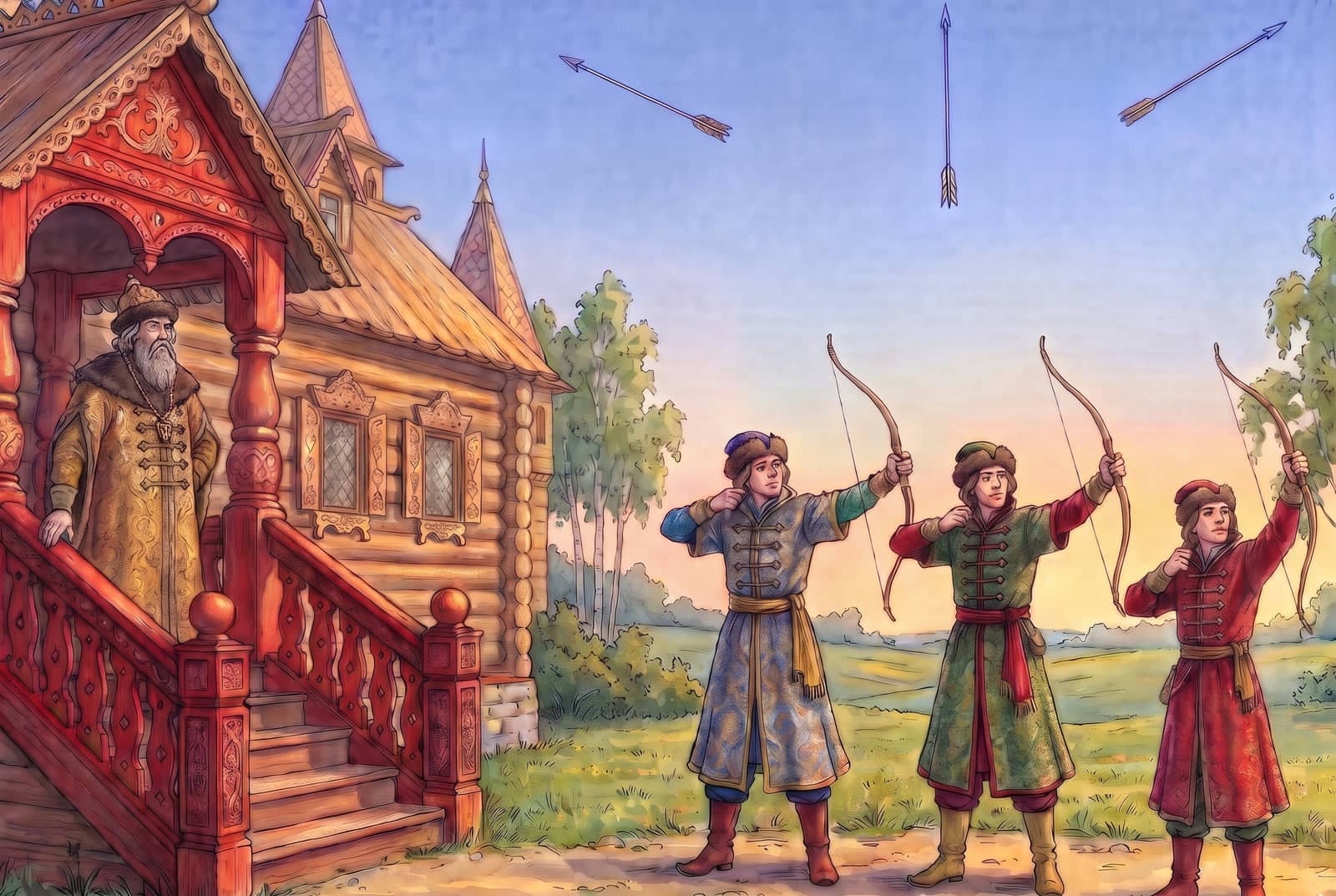
One day the tsar said to them, “My dear children, each of you take an arrow, draw your strong bow, and shoot it in a different direction. Wherever your arrow falls, there you shall find your bride.”
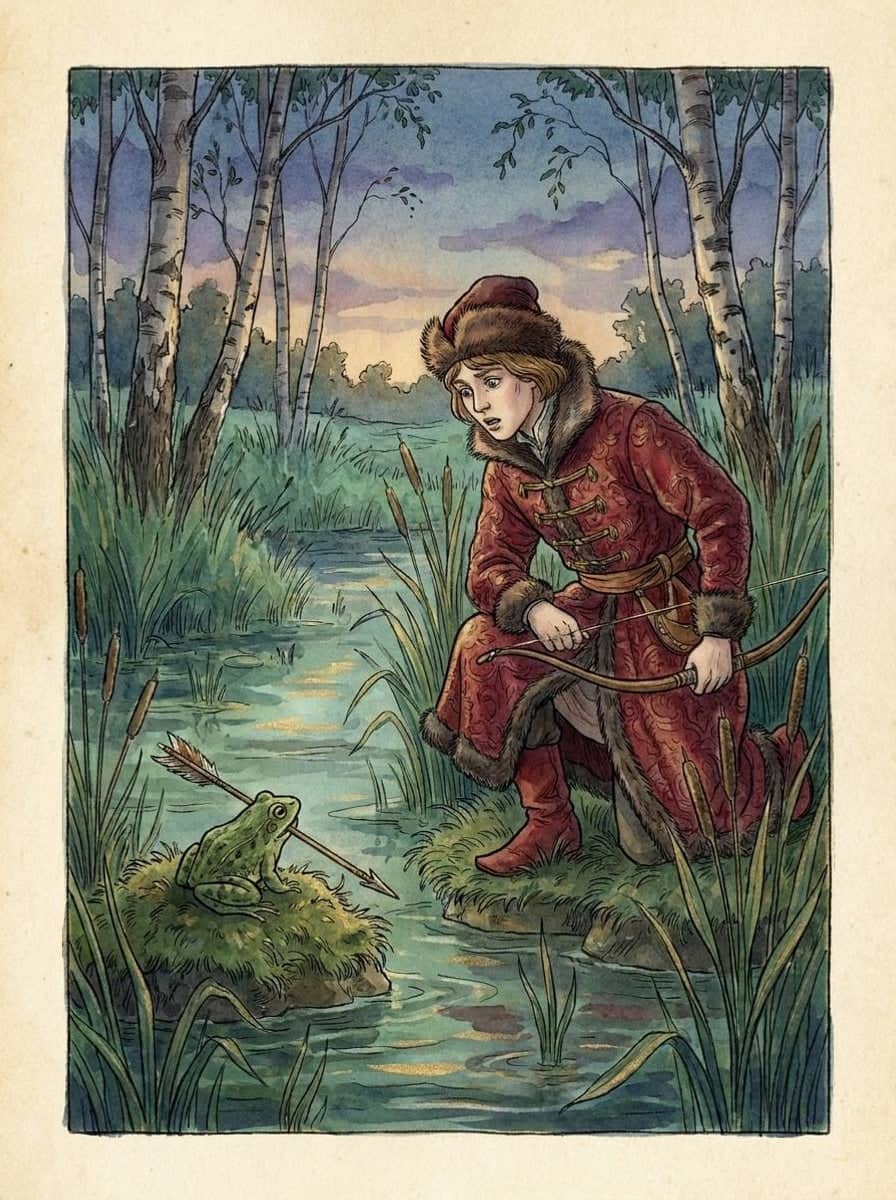
The eldest brother shot his arrow, and it fell in a boyar’s courtyard, right below the window of the boyar’s daughter. The middle brother shot his, and it flew into a merchant’s courtyard and stopped at the front steps, where the merchant’s daughter was standing. Then the youngest shot his, and the arrow fell into a muddy swamp, where a croaking frog caught it.
“How can I marry a frog?” said Prince Ivan. “A frog is no match for me!”
“Take her,” the tsar answered. “That must be your fate.”
So the princes were married: the eldest to the boyar’s daughter, the middle one to the merchant’s daughter, and Prince Ivan to the croaking frog.
Soon the tsar called his sons together and gave them an order. “Tell your wives to bake me a soft white loaf by tomorrow.”
Prince Ivan came home in low spirits, with his head hanging.
“Croak, croak, Prince Ivan! Why so sad?” asked the frog. “Did your father say something unkind?”
“How can I help being sad? My father the tsar has ordered you to bake him a soft white loaf by tomorrow.”
“Don’t grieve, Prince Ivan. Go to sleep. The morning is wiser than the evening.”
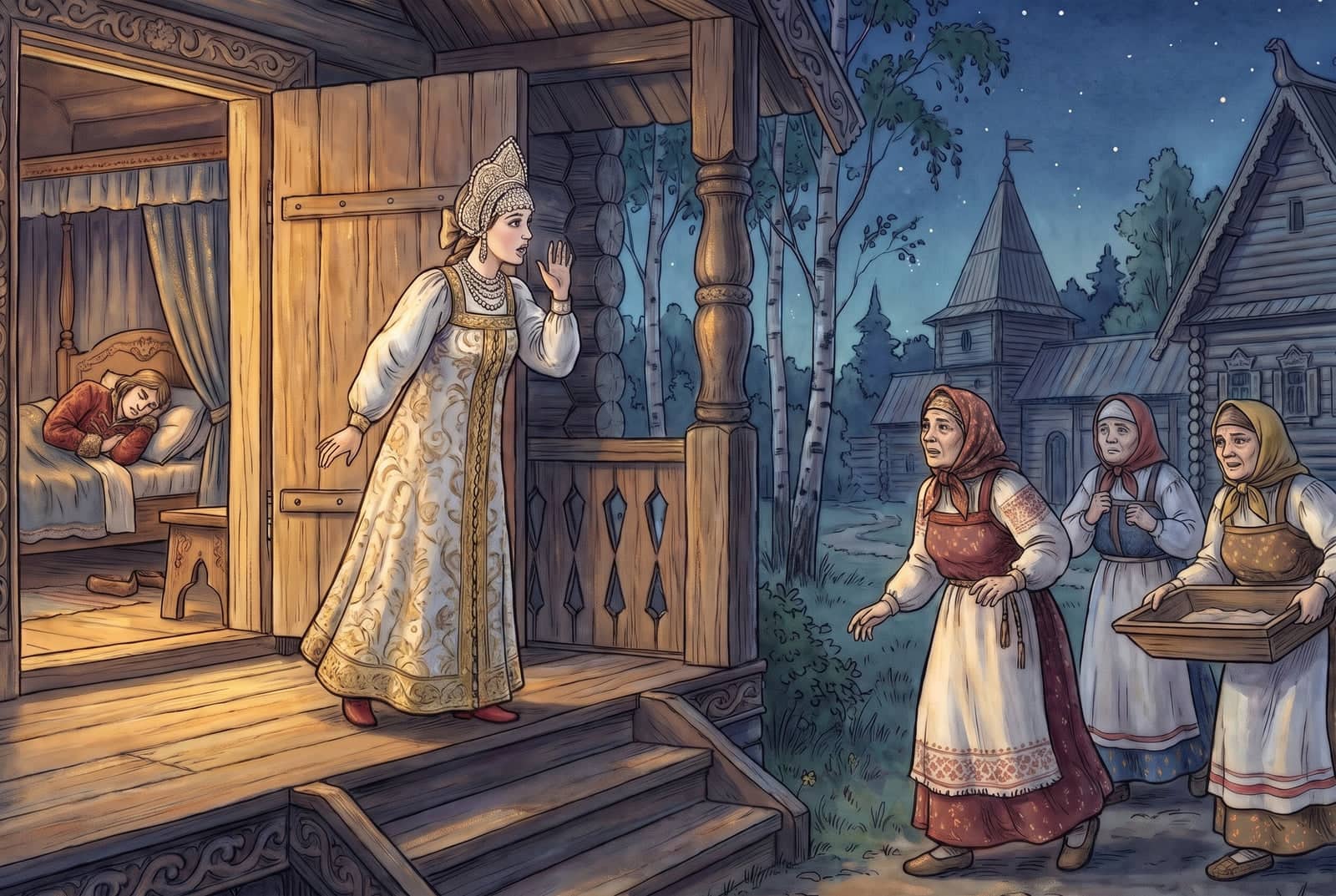
She put him to bed. Then she threw off her frog skin and became a lovely girl, Vasilisa the Wise. She went out onto the front steps and called in a ringing voice, “Nurses and nannies! Gather round and get ready! Bake me a soft white loaf like the bread I used to eat at my own father’s table.”
When Prince Ivan woke in the morning, the frog’s bread was ready and waiting, and it was so splendid that no one could imagine it or guess at it; it could only be told in a tale. It was decorated with all sorts of clever designs, and along its sides stood the tsar’s cities, gates and all.
The tsar thanked Prince Ivan for the bread, and right away he gave his three sons a new order. “Tell your wives to weave me a carpet, each of them, in a single night.”
Prince Ivan came home in low spirits, with his head hanging.
“Croak, croak, Prince Ivan! Why so sad?” asked the frog. “Did your father say something unkind?”
“How can I help being sad? My father the tsar has ordered a silk carpet woven for him in a single night.”
“Don’t grieve, Prince Ivan. Go to sleep. The morning is wiser than the evening.”
She put him to bed, threw off her frog skin, and became Vasilisa the Wise. Out on the front steps she called in a ringing voice, “Nurses and nannies! Gather round and get ready! Weave me a silk carpet like the one I used to sit on in my own father’s house.”
No sooner said than done. When Prince Ivan woke in the morning, the frog’s carpet was ready and waiting, and it was so wonderful that no one could imagine it or guess at it; it could only be told in a tale. It was worked in gold and silver, in the cleverest patterns.
The tsar thanked Prince Ivan for the carpet, and right away he gave a new order: all three princes were to come before him with their wives, so that he could see them.
Once again Prince Ivan came home in low spirits, with his head hanging.
“Croak, croak, Prince Ivan! Why so sad?” asked the frog. “Did your father say something unkind?”
“How can I help being sad? My father the tsar wants me to bring you to court. How can I show you to people?”
“Don’t grieve, Prince Ivan. Go to the tsar alone, and I’ll come after you. When you hear knocking and thunder, say, ‘That’s my little frog coming in her little box.’”
The elder brothers arrived with their wives, who were dressed in their finest and decked out in jewels, and the two brothers laughed at Prince Ivan.
“Why, brother, where’s your wife?” they said. “You could at least have brought her in a handkerchief! And wherever did you find such a beauty? You must have tramped through every swamp in the land.”
All at once there came a great knocking and thunder, and the whole palace shook. The frightened guests jumped up from their seats, not knowing what to do.
“Don’t be afraid, good people,” said Prince Ivan. “That’s my little frog coming in her little box.”
A gilded carriage drawn by six horses swept up to the palace steps, and out stepped Vasilisa the Wise, so beautiful that no one could imagine it or guess at it; it could only be told in a tale. She took Prince Ivan by the hand and led him to the oak tables spread with embroidered cloths.
The guests began to eat and drink and make merry. Vasilisa drank from her cup and poured the last drops into her left sleeve; she ate some roast swan and hid the bones in her right sleeve. The elder brothers’ wives saw what she was doing and began to do the same.
Later, when Vasilisa went out to dance with Prince Ivan, she waved her left hand, and a lake appeared. She waved her right, and white swans swam out across the water. The tsar and his guests were amazed.
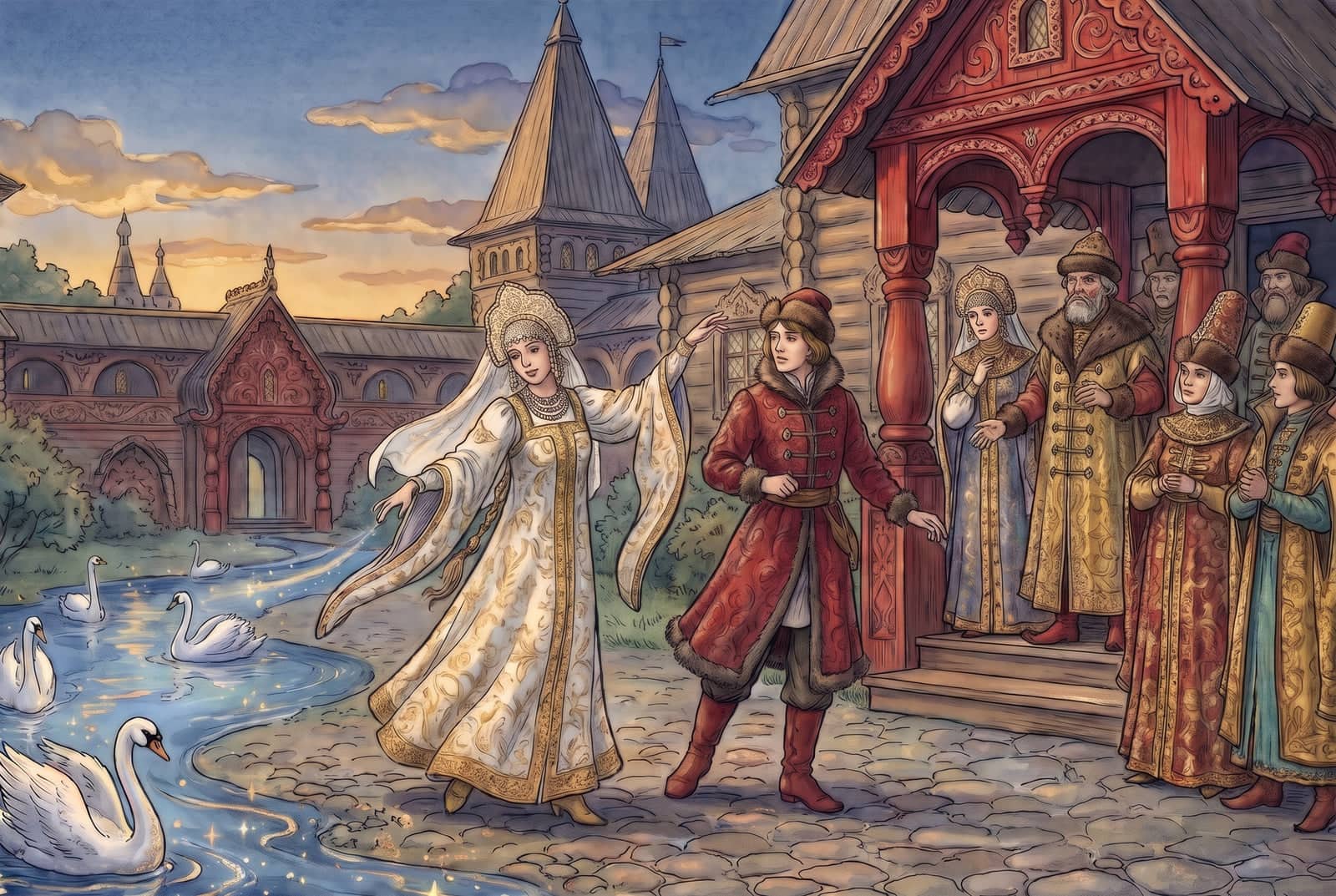
Then the elder brothers’ wives went out to dance. They waved their left hands and splashed the guests; they waved their right hands, and a bone flew straight into the tsar’s eye! The tsar was furious and drove them out in disgrace.
Meanwhile Prince Ivan found a moment to slip away. He ran home, found the frog skin, and burned it in a great fire.
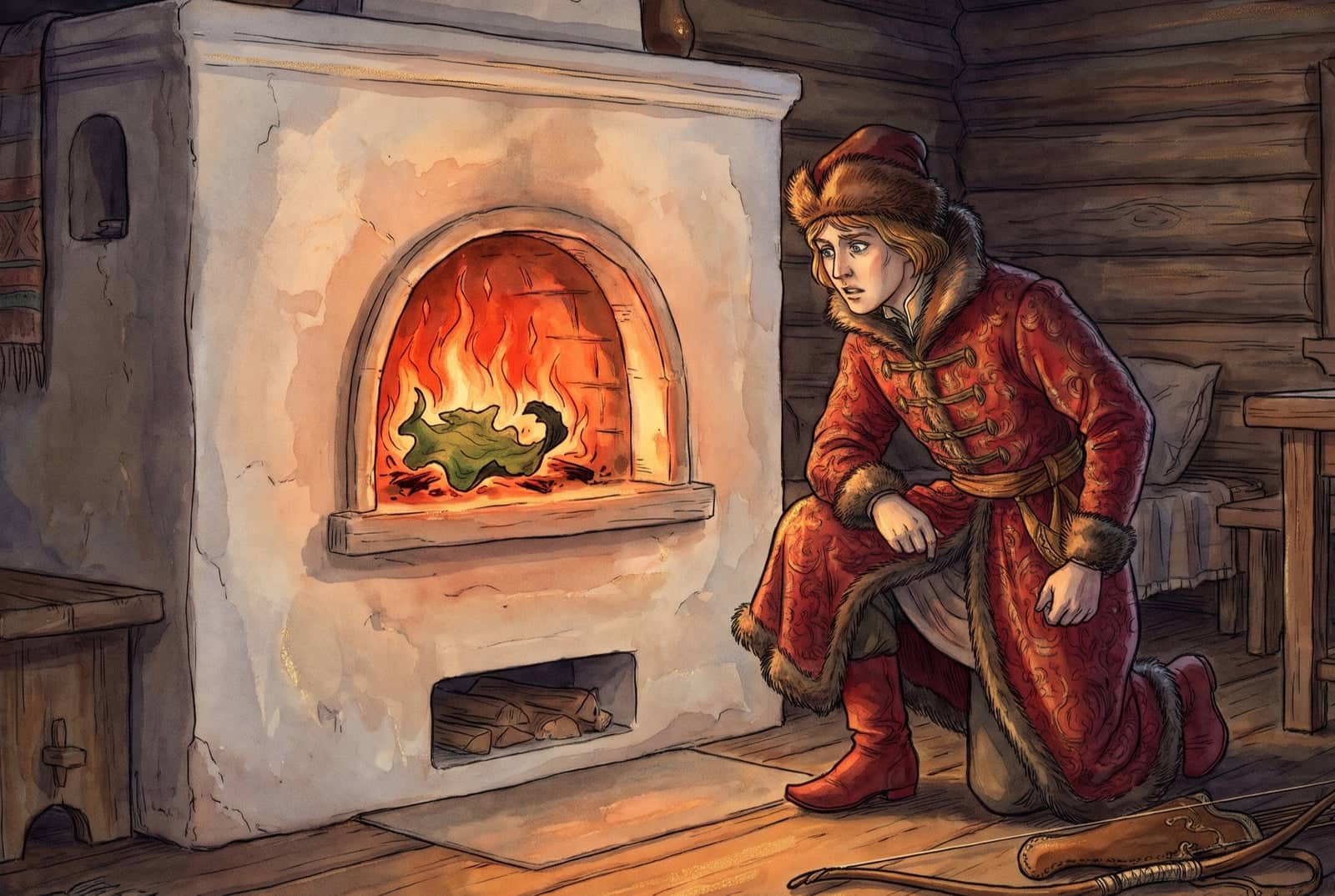
When Vasilisa came home, she looked for her frog skin, and it was gone. Her heart sank, and she said, “Oh, Prince Ivan, what have you done? If you had waited just a little longer, I would have been yours forever. Now farewell! Look for me beyond thrice-nine lands, in the thrice-tenth kingdom, at the house of Koschei the Deathless.” Then she turned into a white swan and flew out of the window.
Prince Ivan wept bitterly. He said a prayer, bowing in all four directions, and set off with no idea where he was going. He walked and walked, and at last he met a very old man.
“Good day, young man,” said the old man. “What are you looking for? Where are you going?”
Prince Ivan told him all about his trouble.
“Ah, Prince Ivan, why did you burn the frog skin? You didn’t put it on, so it wasn’t yours to take off! Vasilisa the Wise was born cleverer and wiser than her father, and that made him so angry that he doomed her to live as a frog for three years. Here is a ball of thread. Wherever it rolls, follow it and don’t be afraid.”
Prince Ivan thanked the old man and followed the ball of thread. Crossing an open field, he came upon a bear. “I’ll kill that beast,” he said.
But the bear spoke to him. “Don’t kill me, Prince Ivan! Someday I’ll be of use to you.”
The prince walked on, and soon he saw a drake flying overhead. He raised his gun and was about to shoot when the bird spoke in a human voice.
“Don’t kill me, Prince Ivan! I’ll be of use to you too.”
Prince Ivan took pity on the drake and walked on. Before long a hare came running by. Again he raised his gun and took aim, but the hare spoke to him in a human voice.
“Don’t kill me, Prince Ivan! I’ll be of use to you too.”
Once more the prince took pity and walked on until he came to the blue sea. There on the sand lay a pike, gasping its last.
“Oh, Prince Ivan,” said the pike, “have mercy on me and put me back in the sea!”
He threw the pike into the sea and walked on along the shore. At last the ball of thread rolled up to a little hut. It stood on hen’s legs and kept turning round and round.
“Little hut, little hut, stand as your mother set you: your back to the sea, your front to me,” said Prince Ivan.
The hut turned its back to the sea and its front to him. Prince Ivan went inside, and there on the stove lay Baba Yaga, bone leg, sharpening her teeth.
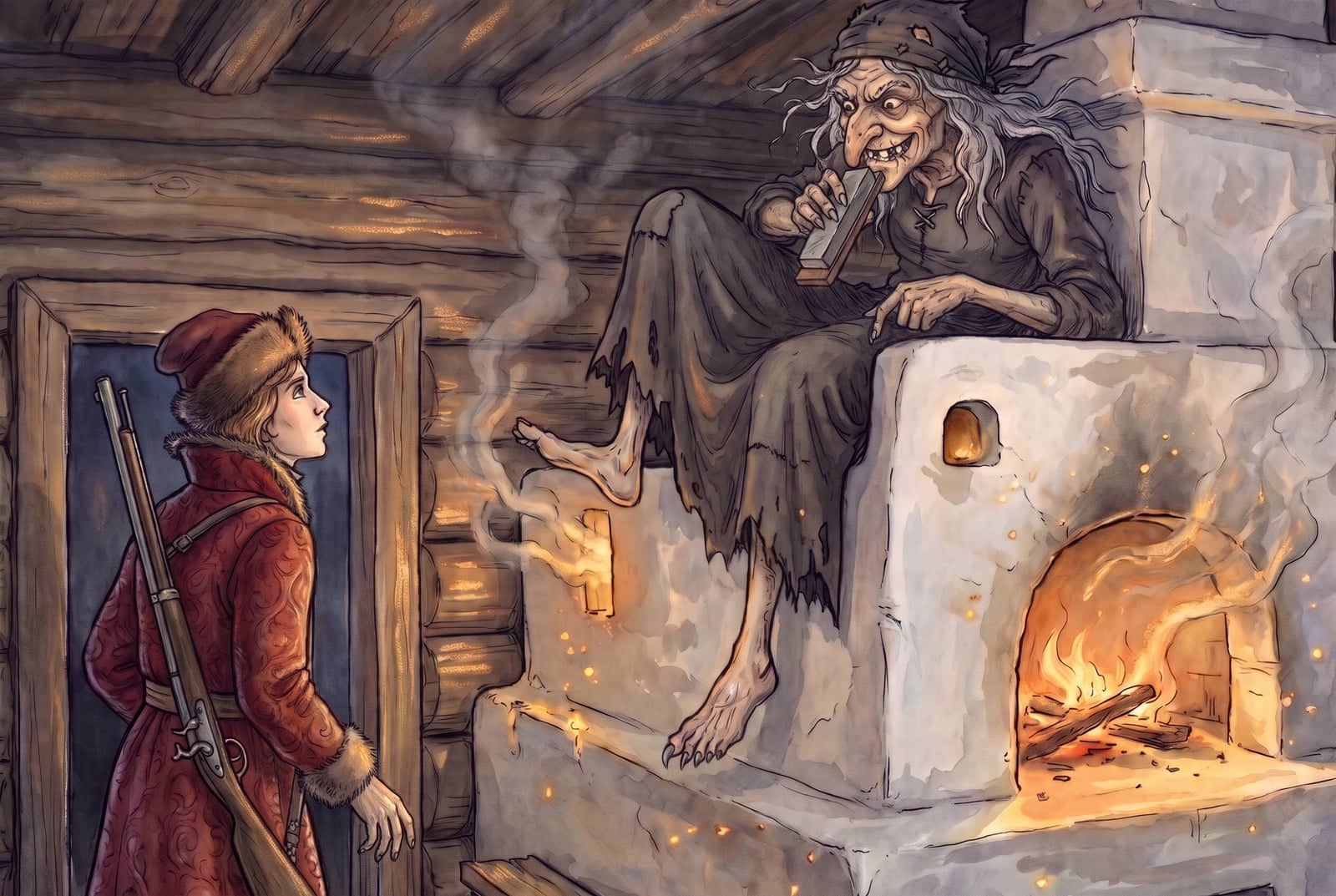
“Well, young man, what brings you here?” she asked.
“You old crone!” said Prince Ivan. “First give me food and drink and a hot bath, and then ask your questions.”
Baba Yaga fed him, gave him a drink, and steamed him in her bathhouse. Then the prince told her that he was looking for his wife, Vasilisa the Wise.
“Ah, I know!” said Baba Yaga. “She is at the house of Koschei the Deathless now. It will be hard to get her back, for Koschei is not easily beaten. His death is at the tip of a needle. The needle is in an egg, the egg is in a duck, the duck is in a hare, the hare is in a chest, and the chest sits at the top of a tall oak. Koschei guards that tree more closely than anything in the world.”
She told him where the oak grew. Prince Ivan went there, but he didn’t know what to do. How could he ever reach the chest?
All of a sudden the bear came running out of nowhere and pulled the tree up by its roots. The chest fell and smashed to pieces. A hare leaped out and raced away as fast as it could, but another hare was already at its heels; it caught the first one and tore it apart. Out of the hare flew a duck, high into the sky, but the drake flew after it and struck it, and the duck let the egg fall. Down went the egg into the sea.
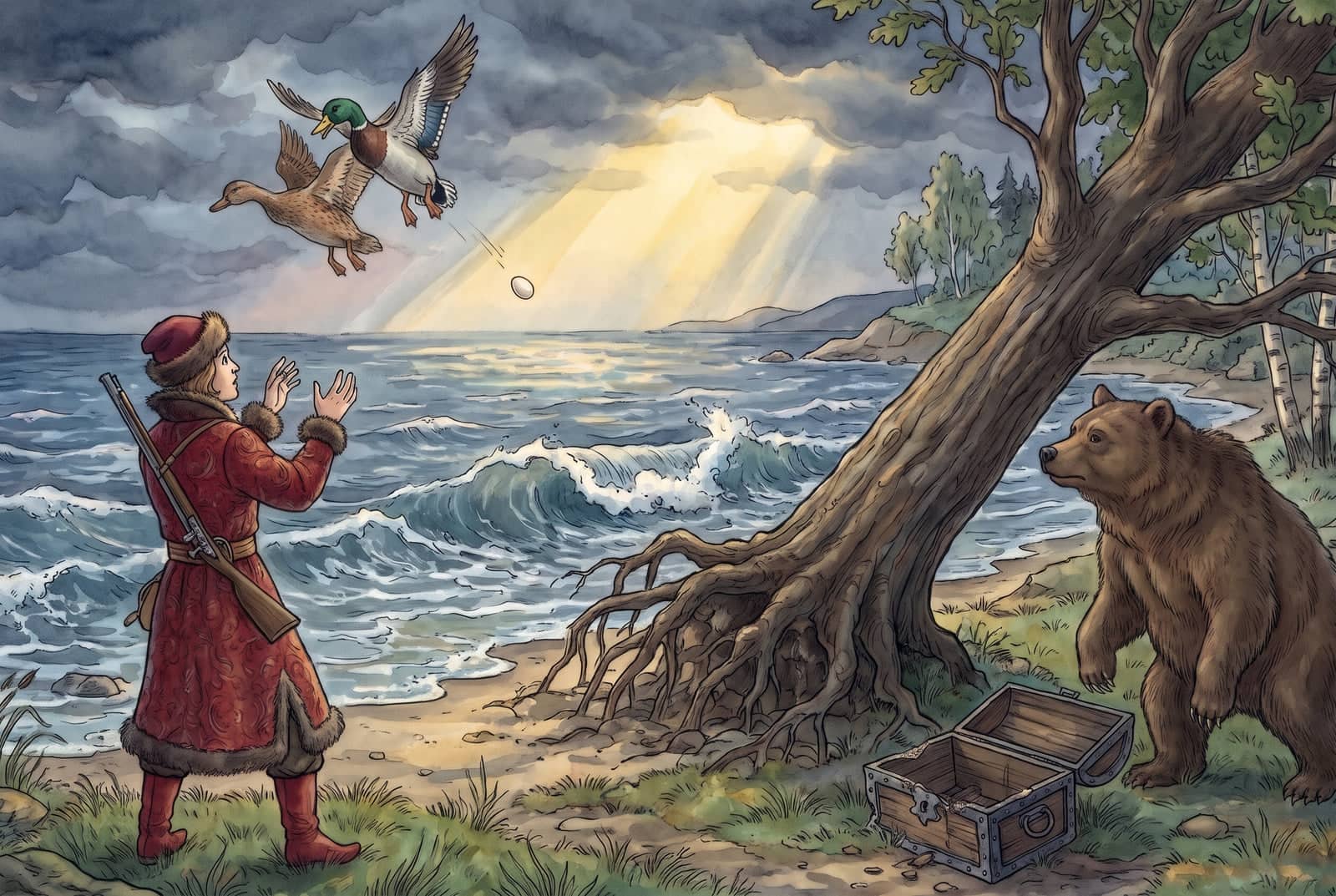
Seeing that all was lost, Prince Ivan burst into tears. Just then the pike swam up to the shore with the egg in its teeth.
He took the egg, broke it open, pulled out the needle, and snapped off its tip. Koschei thrashed and struggled with all his might, but it was no use, and Koschei the Deathless died.
Prince Ivan went into Koschei’s house, took Vasilisa the Wise, and brought her home. And from that day on they lived together, long and happily.
Retold by Talerie from Народныя русскія сказки (opens in a new window) Public domain Copy this text, adapt it, use it however you like. A link back to Talerie is appreciated but never required. CC0 1.0 (opens in a new window)