 Original
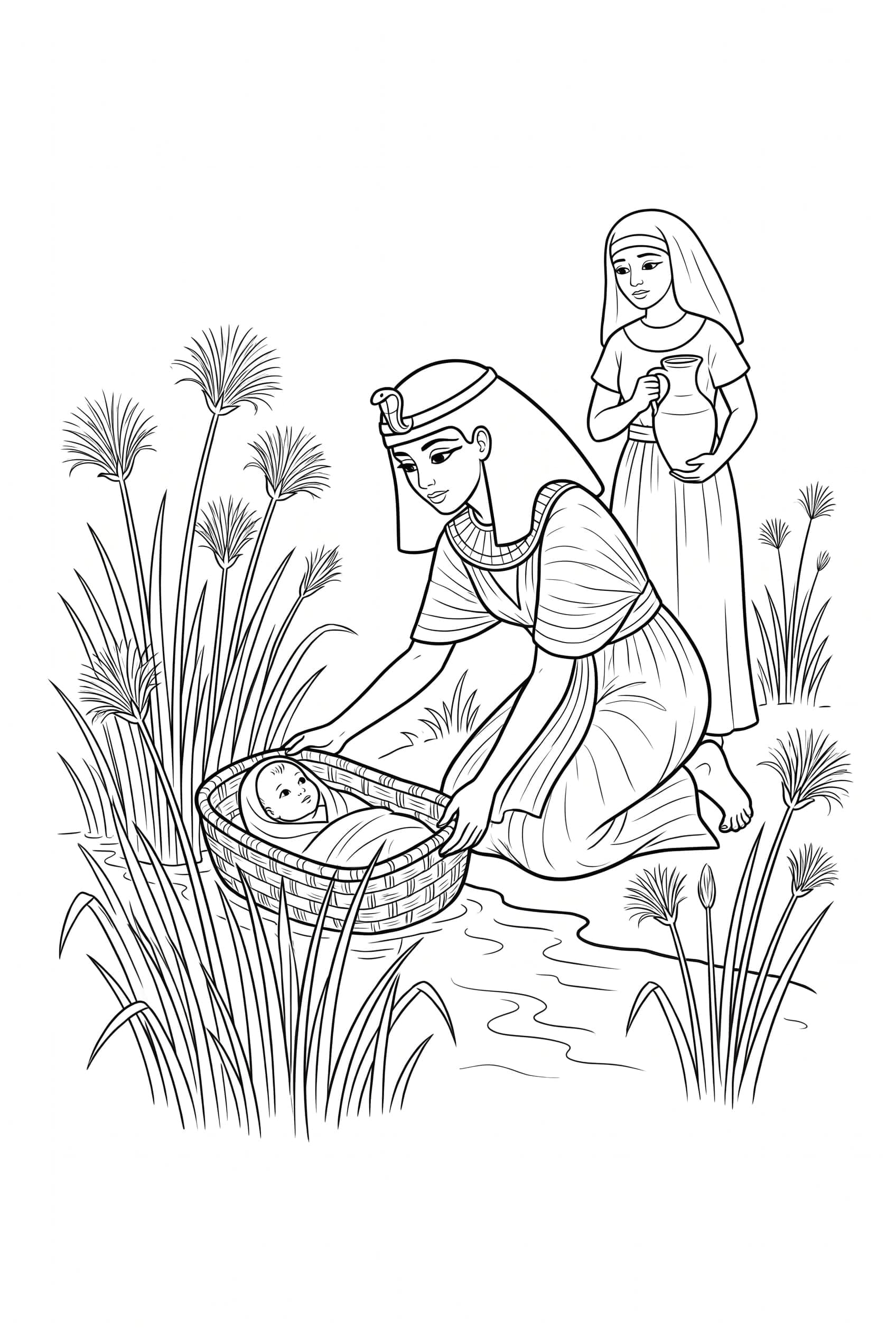
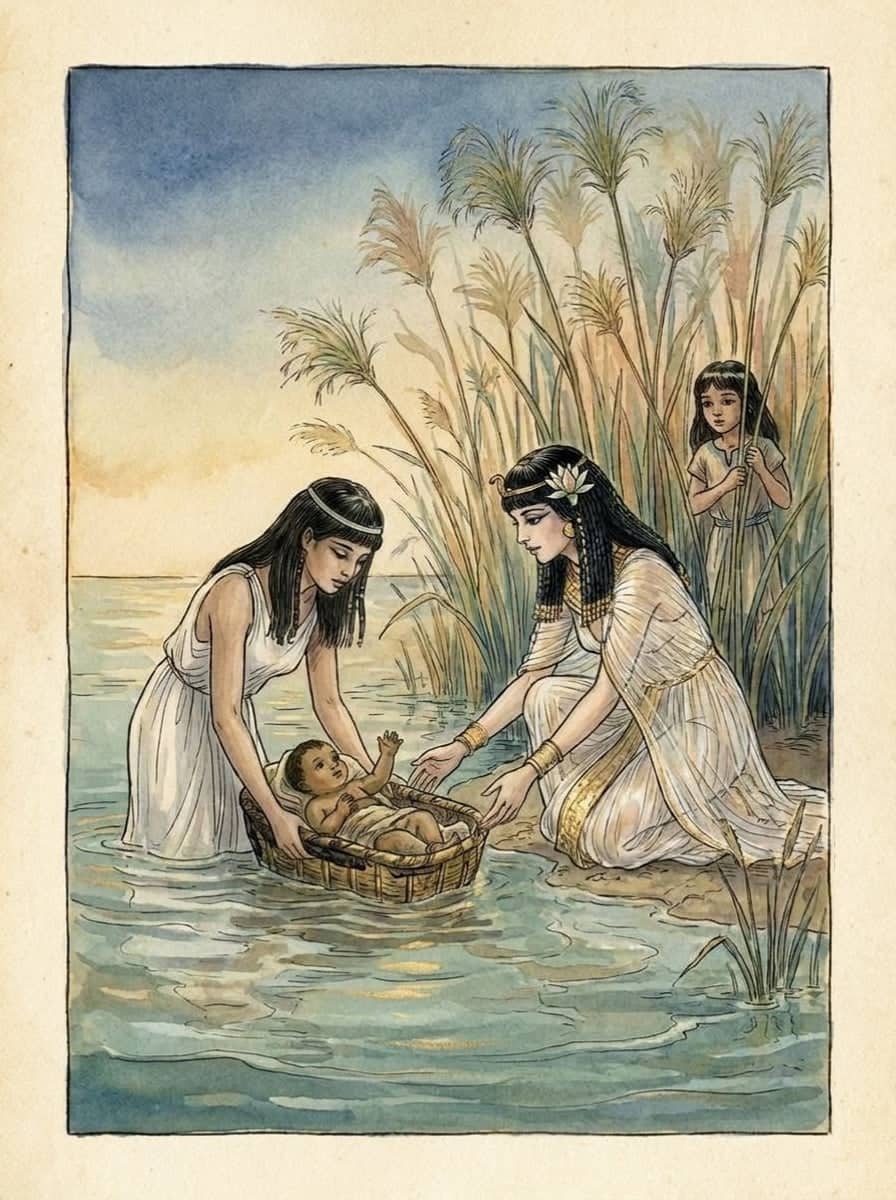
Pharaoh orders every Hebrew boy who is born to be thrown into the Nile, so one mother hides her son. When she can hide him no longer, she coats a papyrus basket with tar and pitch and sets him among the reeds. His sister stands a little way off to see what will happen.
Long ago, Jacob came down into Egypt with his sons, and every one of them brought his whole household along. These were the sons: Reuben, Simeon, Levi, and Judah; Issachar, Zebulun, and Benjamin; Dan and Naphtali, Gad and Asher. Counting everyone who was descended from Jacob, there were seventy of them in all, for Joseph was already in Egypt.
In time Joseph died, and all his brothers died, and the whole of that generation passed away. But their children had children of their own, and those children had children, and the family grew and grew. The Israelites became so many and so strong that the land was full of them.
Then a new king came to the throne of Egypt, a king who knew nothing about Joseph. He said to his people, “Look, these Israelites have become more numerous and stronger than we are. Come, we must deal shrewdly with them, or they will go on multiplying. If a war ever breaks out, they may join our enemies, fight against us, and leave the country.”
So the Egyptians put slave drivers over the Israelites to wear them down with heavy loads, and the Israelites built Pithom and Rameses for Pharaoh, two cities for storing his supplies. Yet the harder the Egyptians worked them, the more the Israelites multiplied and spread, until the Egyptians came to dread the very sight of them.
The Egyptians worked the Israelites without mercy. They made their lives bitter with hard labor, with mortar and brick, and with every kind of work in the fields. Whatever the task, they drove them at it without pity.

Then the king of Egypt sent for the two Hebrew midwives, whose names were Shiphrah and Puah. “When you help the Hebrew women give birth,” he told them, “watch as the baby comes. If it is a boy, kill him. If it is a girl, let her live.”
But the midwives feared God. They did not do what the king of Egypt had commanded, and they let the boys live.
So the king of Egypt called for the midwives again. “Why have you done this?” he asked. “Why have you let the boys live?”
“Pharaoh,” the midwives said, “the Hebrew women are not like Egyptian women. They are strong and quick, and their babies are born before the midwife can get to them.”
God was good to the midwives, and the people went on multiplying and grew very strong. And because the midwives feared God, he gave them families of their own.
Then Pharaoh gave an order to all his people. “Every Hebrew boy who is born,” he said, “must be thrown into the Nile. Every girl may live.”
At that time a man from the tribe of Levi married a woman who was also a Levite. She became pregnant and gave birth to a son, and when she saw what a fine baby he was, she hid him for three months.
When she could not hide him any longer, she took a basket made of papyrus reeds and coated it with tar and pitch. She laid the baby inside it and set the basket among the reeds at the edge of the Nile.

His sister stood a little way off to see what would happen to him.
Before long Pharaoh’s daughter came down to the Nile to bathe, while her maids walked along the riverbank. She caught sight of the basket among the reeds and sent one of her maids to fetch it.
When she opened it, she saw the baby. He was crying, and her heart went out to him. “This is one of the Hebrew babies,” she said.
Then his sister came up to Pharaoh’s daughter. “Your Highness,” she said, “shall I go and find one of the Hebrew women to nurse the baby for you?”
“Go,” said Pharaoh’s daughter.
So the girl ran off and came back with the baby’s own mother.
Pharaoh’s daughter said to her, “Take this baby away and nurse him for me, and I will pay you for it.”
So the woman took the child and nursed him.
The child grew, and when he was older, his mother brought him to Pharaoh’s daughter, and he became her son. She named him Moses, “because,” she said, “I drew him out of the water.”
Years went by, and Moses grew up. One day he went out to where his own people were working, and he saw how heavy their burdens were. Then he noticed an Egyptian beating a Hebrew, one of his own people.
Moses looked this way and that, and when he saw that no one was there, he killed the Egyptian and hid the body in the sand.
The next day he went out again, and there were two Hebrew men fighting. Moses said to the one who was in the wrong, “Why are you hitting your neighbor?”
“Who made you a prince and a judge over us?” the man answered. “Do you mean to kill me the way you killed the Egyptian?”
Then Moses was afraid. “So people know what I did,” he thought.
When Pharaoh heard about it, he tried to have Moses killed. But Moses fled from Pharaoh and went to live in the land of Midian. There he sat down beside a well.
Now the priest of Midian had seven daughters. They came to the well to draw water and fill the troughs for their father’s flock, but some shepherds came along and drove them away. Then Moses stood up, came to the girls’ rescue, and watered their flock himself.
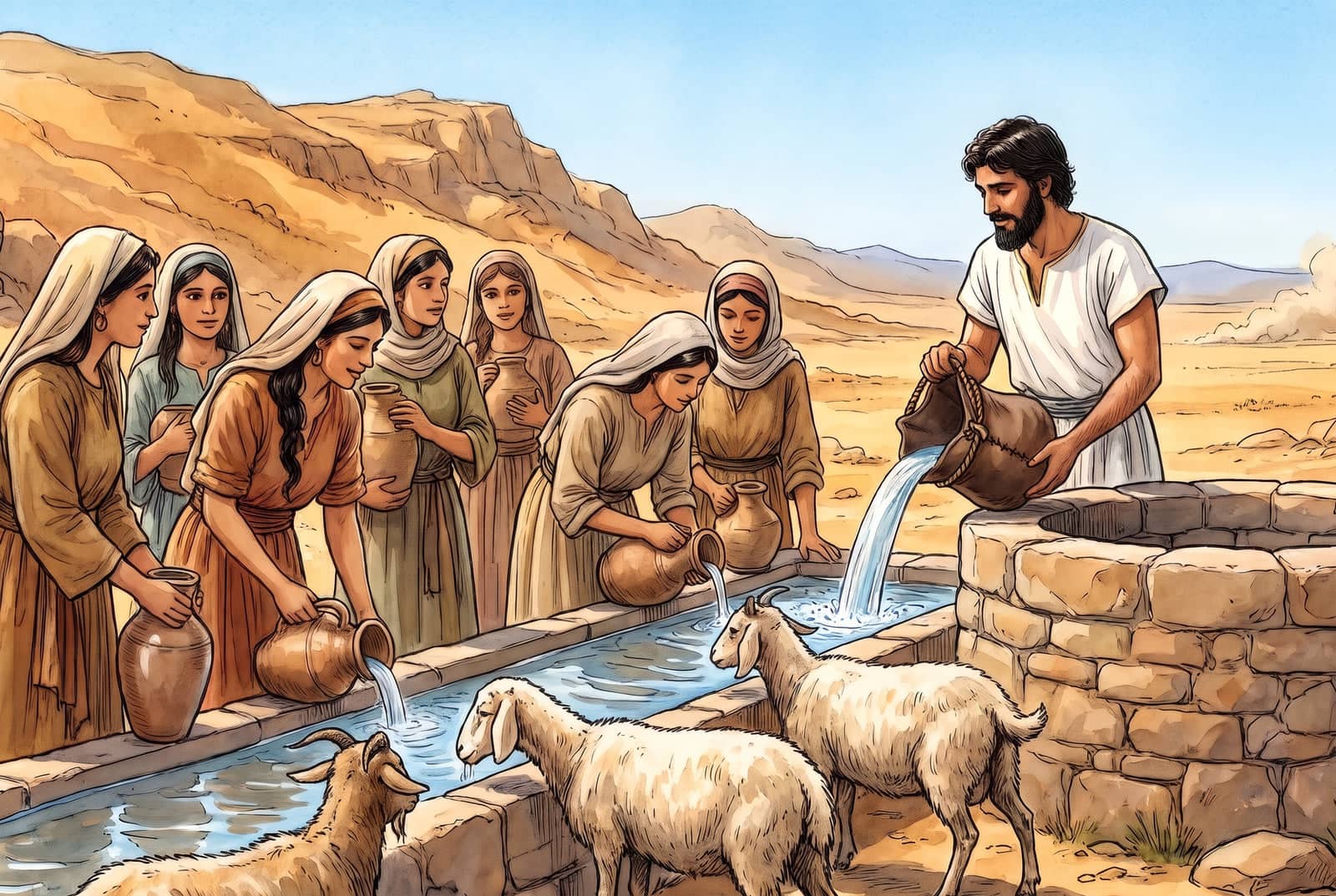
When the girls got home to their father, Jethro, he asked them, “Why are you back so early today?”
“An Egyptian rescued us from the shepherds,” they said. “He even drew water for us and watered the flock.”
“Then where is he?” Jethro asked his daughters. “Why did you leave the man out there? Go and ask him to come and eat with us.”
Moses was glad to stay with Jethro, and Jethro gave him his daughter Zipporah to be his wife. She had a son, and Moses named him Gershom. “For,” he said, “I have become a stranger in a strange land.”
A long time passed, and the king of Egypt died. But the Israelites still groaned under their slavery. They cried out, and their cry for help rose up to God.
God heard their groaning, and he remembered the promise he had made to Abraham, to Isaac, and to Jacob. God looked on the Israelites, and he cared about what was happening to them.
Moses was looking after the flock of his father-in-law, Jethro, the priest of Midian. One day he led the sheep and goats far out into the wilderness and came to Horeb, the mountain of God.
There a flame of fire was blazing out of the middle of a bush. Moses looked, and he saw that the bush was on fire, yet it did not burn up.
“I will go over and look at this strange sight,” Moses said. “Why doesn’t the bush burn up?”
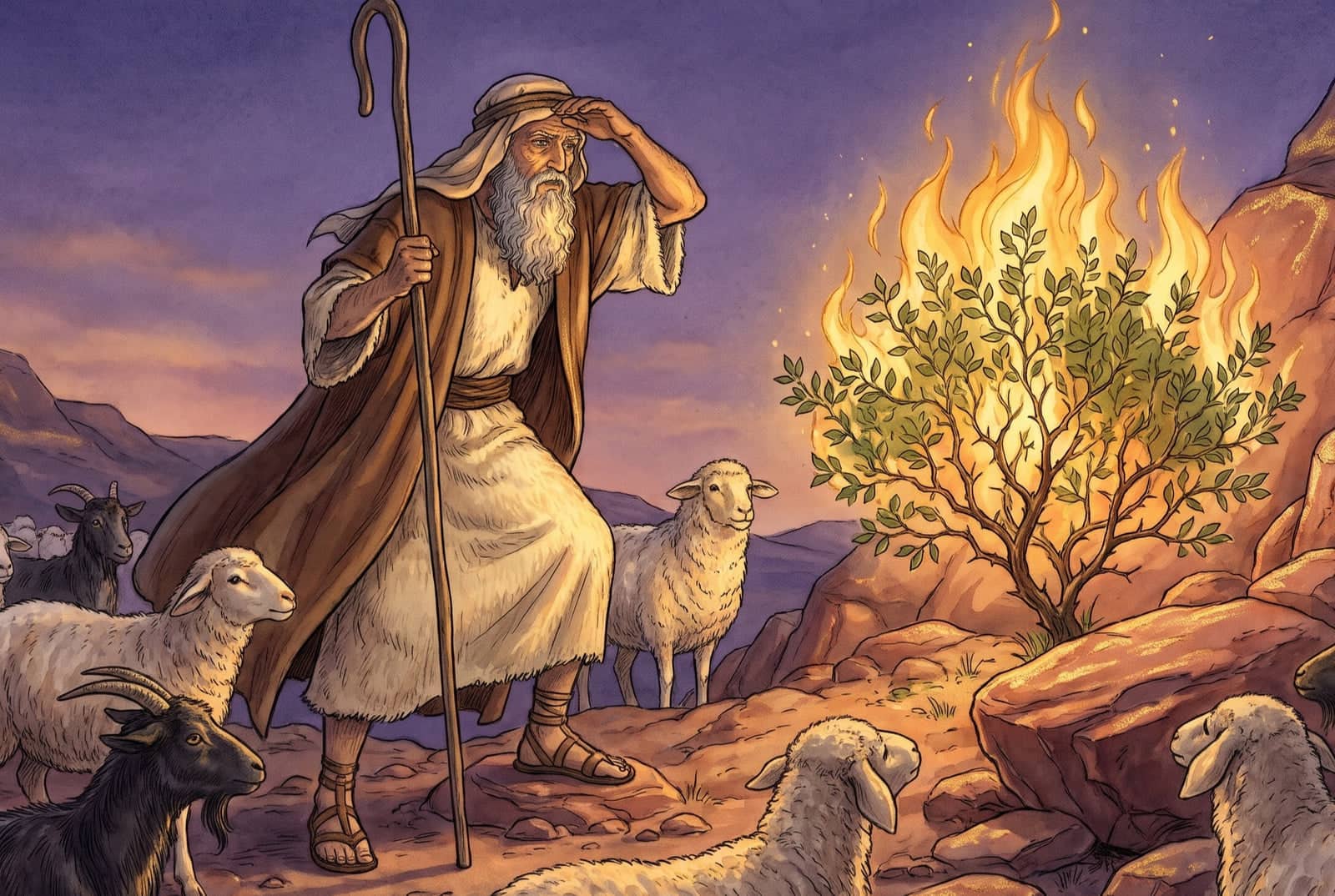
When God saw that Moses had turned aside to look, he called to him from the middle of the bush, “Moses! Moses!”
“Here I am,” said Moses.
“Don’t come any closer,” God said. “Take off your sandals, for the place where you are standing is holy ground.” Then he said, “I am the God of your father, the God of Abraham, the God of Isaac, and the God of Jacob.”
Moses hid his face, because he was afraid to look at God.
God said, “I have seen how my people in Egypt are suffering. I have heard them crying out because of their slave drivers, and I know their pain. I have come down to rescue them from the Egyptians and to bring them up out of that land into a good and spacious land, a land flowing with milk and honey, the home of the Canaanites, the Hittites, the Amorites, the Perizzites, the Hivites, and the Jebusites.”
“The cry of the Israelites has reached me,” God went on, “and I have seen how cruelly the Egyptians treat them. So come now. I am sending you to Pharaoh, to bring my people, the Israelites, out of Egypt.”
But Moses said to God, “Who am I, that I should go to Pharaoh and bring the Israelites out of Egypt?”
“I will be with you,” God said. “And this will be the sign that I have sent you: when you have brought the people out of Egypt, you will all worship God on this very mountain.”
Moses said to God, “Suppose I go to the Israelites and tell them, ‘The God of your fathers has sent me to you,’ and they ask me, ‘What is his name?’ What shall I tell them?”
God said to Moses, “I am who I am. This is what you are to say to the Israelites: ‘I Am has sent me to you.’”
God also said to Moses, “Tell the Israelites, ‘The God of your fathers, the God of Abraham, the God of Isaac, and the God of Jacob, has sent me to you.’ That is my name forever, the name by which I am to be remembered from generation to generation.”
“Go and gather the elders of Israel,” God said, “and tell them, ‘The God of your fathers, the God of Abraham, of Isaac, and of Jacob, appeared to me and said, “I have watched over you, and I have seen what has been done to you in Egypt. I have promised to bring you up out of your misery in Egypt into the land of the Canaanites, the Hittites, the Amorites, the Perizzites, the Hivites, and the Jebusites, a land flowing with milk and honey.”’”
“The elders will listen to you,” God went on. “Then you and the elders are to go to the king of Egypt and say to him, ‘The God of the Hebrews has met with us. Now please let us go on a three-day journey into the wilderness, so that we can offer sacrifices to our God.’”
“But I know,” God said, “that the king of Egypt will not let you go unless a mighty hand forces him. So I will stretch out my hand and strike Egypt with all the wonders I will do among them, and after that he will let you go.”
“I will make the Egyptians look kindly on this people,” God said, “so that when you leave, you will not go empty-handed. Every woman is to ask her neighbor, and any woman living in her house, for jewelry of silver and gold and for clothing. You will put them on your sons and daughters, and so you will carry off the riches of Egypt.”
Moses answered, “But what if they don’t believe me or listen to me? What if they say, ‘God never appeared to you’?”
Then God said to him, “What is that in your hand?”
“A staff,” Moses said.
“Throw it on the ground,” said God.
Moses threw it on the ground, and it turned into a snake, and he ran away from it.
Then God said to Moses, “Reach out your hand and take it by the tail.”
So Moses reached out and caught hold of it, and it turned back into a staff in his hand.
“Do this,” God said, “so that they will believe that the God of their fathers, the God of Abraham, the God of Isaac, and the God of Jacob, has appeared to you.” Then he said, “Now put your hand inside your cloak.”
Moses put his hand inside his cloak, and when he took it out, the skin was covered with a disease and had turned as white as snow.
“Put your hand back inside your cloak,” God said.
Moses put his hand back inside his cloak, and when he took it out again, it was healthy, like the rest of his body.
“If they do not believe you or pay attention to the first sign,” God said, “they may believe the second. And if they do not believe even these two signs or listen to you, take some water from the Nile and pour it on the dry ground. The water you take from the Nile will become blood on the ground.”
But Moses said to God, “Please, God, I have never been good with words, not in the past and not since you began speaking to me. I speak slowly, and I stumble over what I say.”
God said to him, “Who gave people their mouths? Who makes them unable to speak or unable to hear? Who gives them sight, or makes them blind? I do, for I am God. Now go. I will help you speak, and I will teach you what to say.”
But Moses said, “Please, God, send someone else.”
Then God grew angry with Moses. “What about your brother Aaron, the Levite?” he said. “I know that he speaks well. He is already on his way to meet you, and his heart will be glad when he sees you. You will speak to him and put the words in his mouth.”
“I will help both of you speak,” God said, “and I will teach you what to do. Aaron will speak to the people for you. He will be your mouth, and you will be like God to him. And take this staff in your hand, because with it you will do the signs.”
Then Moses went back to Jethro, his father-in-law. “Please let me go back to my own people in Egypt,” he said, “and see whether they are still alive.”
“Go in peace,” Jethro said.
While Moses was still in Midian, God said to him, “Go back to Egypt, for all the men who wanted to kill you are dead.”
So Moses took his wife and his son, put them on a donkey, and set out for the land of Egypt. In his hand he carried the staff of God.
God said to Moses, “When you get back to Egypt, make sure you show Pharaoh all the wonders I have given you the power to do. But I will harden his heart, and he will not let the people go.”
“Then say to Pharaoh,” God went on, “‘This is what God says: Israel is my son, my firstborn. I tell you, let my son go, so that he may worship me. If you refuse to let him go, I will kill your son, your firstborn.’”
On the way, at a place where they stopped for the night, God met Moses and was about to kill him. Then Zipporah took a sharp stone, cut off her son’s foreskin, and threw it at Moses’s feet. “Surely you are a husband of blood to me,” she said.
So God let him alone. It was because of the circumcision that she had said, “A husband of blood.”
Meanwhile God said to Aaron, “Go into the wilderness to meet Moses.” So Aaron went, and he met Moses at the mountain of God and kissed him.
Moses told Aaron everything God had sent him to say, and all the signs God had commanded him to do.
Then Moses and Aaron went and gathered all the elders of the Israelites together. Aaron told them everything God had said to Moses, and he did the signs in front of the people. And the people believed. When they heard that God had come to help the Israelites and had seen their misery, they bowed their heads and worshiped.
After that Moses and Aaron went to Pharaoh. By now Egypt had a new Pharaoh. “Pharaoh,” they said, “this is what the God of Israel says: ‘Let my people go, so that they may hold a festival for me in the wilderness.’”
Pharaoh said, “Who is this God, that I should obey him and let Israel go? I do not know your God, and I will not let Israel go.”
“The God of the Hebrews has met with us,” they said. “Please let us take a three-day journey into the wilderness and offer sacrifices to our God, or he may strike us with sickness or with the sword.”
But the king of Egypt said, “Moses and Aaron, why are you taking the people away from their work? Get back to your own labor!” And Pharaoh said, “Look, the people of the land are many now, and you are stopping them from working.”
That same day Pharaoh gave orders to the slave drivers and to the foremen over the people. “You will no longer give the people straw for making bricks,” he said. “Let them go and gather their own straw. But make them produce the same number of bricks as before. Do not lower it by a single brick.”
“They are lazy,” Pharaoh said. “That is why they are crying out, ‘Let us go and offer sacrifices to our God.’ Make the work harder for these men, so that they are kept busy and pay no attention to lies.”
So the slave drivers and the foremen went out and said to the people, “This is what Pharaoh says: ‘I will not give you any more straw. Go and get your own straw wherever you can find it, but your work will not be reduced at all.’”
So the people scattered all over Egypt to gather stubble to use for straw. The slave drivers kept driving them on. “Finish your work,” they said, “the same amount each day as when you had straw.”
Pharaoh’s slave drivers beat the Israelite foremen they had put in charge of the people. “Why didn’t you make your full number of bricks yesterday or today, the way you did before?” they demanded.
Then the Israelite foremen went to Pharaoh and cried out to him, “Pharaoh, why are you treating your servants this way? Your servants are given no straw, yet we are told, ‘Make bricks!’ Your servants are being beaten, but the fault is with your own people.”
“You are lazy!” said Pharaoh. “Lazy! That is why you keep saying, ‘Let us go and offer sacrifices to God.’ Now get to work. You will be given no straw, and you must still deliver the full number of bricks.”
The Israelite foremen knew they were in trouble when they were told, “You must not make a single brick fewer each day.” As they came away from Pharaoh, they found Moses and Aaron waiting to meet them.
“May God look at what you have done and judge you!” the foremen said. “You have made Pharaoh and his officials loathe the very smell of us. You have put a sword in their hands to kill us.”
Moses went back to God and said, “God, why have you brought this trouble on your people? Is this why you sent me? Ever since I went to Pharaoh to speak in your name, he has treated this people cruelly, and you have not rescued your people at all.”
Then God said to Moses, “Now you will see what I will do to Pharaoh. Because of my mighty hand he will let them go. Because of my mighty hand he will drive them out of his land.”
God also said to Moses, “I am God. I showed myself to Abraham, to Isaac, and to Jacob as God Almighty, but I did not make my own name known to them. I also made my promise to them, to give them the land of Canaan, where they lived as foreigners. And now I have heard the groaning of the Israelites, whom the Egyptians are keeping as slaves, and I have remembered my promise.”
“So tell the Israelites,” God said, “‘I am God. I will bring you out from under the burdens of the Egyptians. I will free you from slavery, and I will rescue you with an outstretched arm and with mighty acts of judgment. I will take you as my own people, and I will be your God.’”
“Tell them also,” God went on, “‘Then you will know that I am your God, who brought you out from under the burdens of Egypt. And I will bring you to the land I swore to give to Abraham, to Isaac, and to Jacob. I will give it to you to be your own. I am God.’”
Moses told this to the Israelites, but they would not listen to him, because their spirits were crushed and their slavery was so cruel.
Then God said to Moses, “Go and tell Pharaoh, king of Egypt, to let the Israelites go out of his land.”
But Moses said to God, “If the Israelites will not listen to me, why would Pharaoh listen to me, when I speak so poorly?”
So God spoke to Moses and Aaron and gave them their orders about the Israelites and about Pharaoh, king of Egypt: they were to bring the Israelites out of the land of Egypt.
The heads of the families of Israel were written down, family by family: the sons of Reuben, Jacob’s firstborn, then the sons of Simeon, then the sons of Levi, from whose line came Moses and Aaron. These were the same Moses and Aaron to whom God said, “Bring the Israelites out of Egypt, company by company.” They were the ones who spoke to Pharaoh, king of Egypt, about bringing the Israelites out of Egypt.
On the day God spoke to Moses in Egypt, he said to him, “I am God. Tell Pharaoh, king of Egypt, everything I tell you.”
But Moses said to God, “I speak so poorly. Why would Pharaoh listen to me?”
God said to Moses, “See, I have made you like God to Pharaoh, and your brother Aaron will be your prophet. You are to say everything I command you, and your brother Aaron will tell Pharaoh to let the Israelites go out of his land.”
“But I will harden Pharaoh’s heart,” God said, “and though I do sign after sign and wonder after wonder in Egypt, he will not listen to you. Then I will lay my hand on Egypt, and with mighty acts of judgment I will bring my people, the Israelites, out of Egypt, company by company. And the Egyptians will know that I am God when I stretch out my hand against Egypt and bring the Israelites out from among them.”
Moses and Aaron did just as God commanded them. Moses was eighty years old and Aaron was eighty-three when they spoke to Pharaoh.
God said to Moses and Aaron, “When Pharaoh says to you, ‘Show me a wonder,’ then say to Aaron, ‘Take your staff and throw it down in front of Pharaoh,’ and it will become a snake.”
So Moses and Aaron went to Pharaoh and did just as God had commanded. Aaron threw his staff down in front of Pharaoh and his officials, and it became a snake.
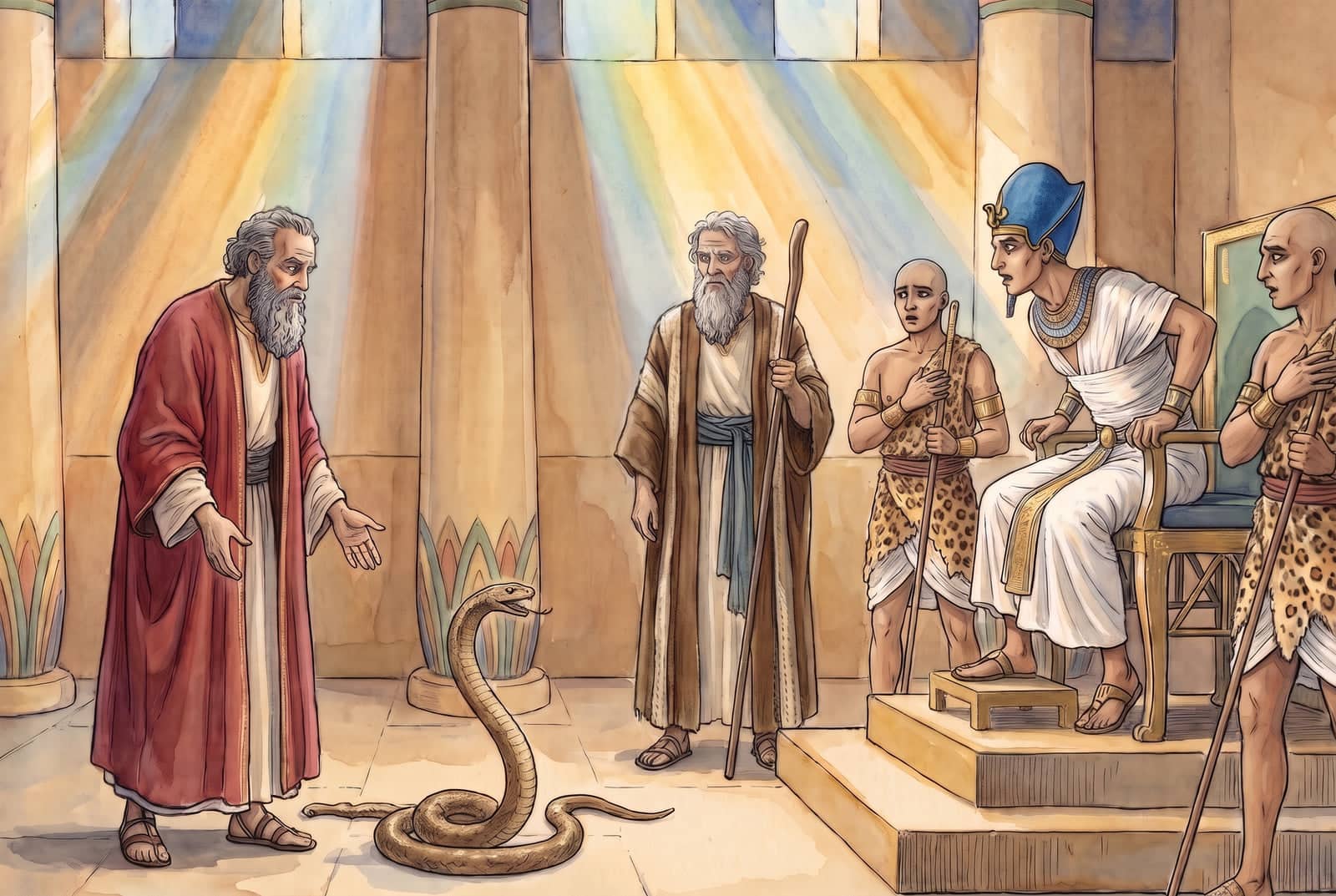
Then Pharaoh called for his wise men and sorcerers, and the magicians of Egypt did the same thing with their secret arts. Each of them threw down his staff, and each staff became a snake. But Aaron’s staff swallowed up their staffs.
Yet Pharaoh’s heart was hardened, and he would not listen to Moses and Aaron, just as God had said.
Then God said to Moses, “Pharaoh’s heart is hard. He refuses to let the people go. In the morning, when Pharaoh goes down to the water, go and wait for him on the bank of the Nile. Take in your hand the staff that turned into a snake.”
“Say to him,” God went on, “‘The God of the Hebrews has sent me to tell you: Let my people go, so that they may worship me in the wilderness. Until now you have not listened.’”
“Then tell him,” God said, “‘This is what God says: By this you will know that I am God. With the staff in my hand I will strike the water of the Nile, and it will turn to blood. The fish in the Nile will die, the river will stink, and the Egyptians will not be able to drink its water.’”
God said to Moses, “Tell Aaron, ‘Take your staff and stretch out your hand over the waters of Egypt, over its streams and its canals, over its ponds and all its pools, and they will turn to blood.’ There will be blood all over Egypt, even in the wooden buckets and the stone jars.”
Moses and Aaron did just as God had commanded. Aaron raised the staff in front of Pharaoh and his officials and struck the water of the Nile, and all the water in the river turned to blood.
The fish in the Nile died, and the river stank so badly that the Egyptians could not drink its water. There was blood everywhere in the land of Egypt.
But the magicians of Egypt did the same thing with their secret arts, and Pharaoh’s heart was hardened. He would not listen to Moses and Aaron, just as God had said. He turned and went back into his palace, and he did not take even this to heart.
All the Egyptians dug along the banks of the Nile for water to drink, because they could not drink the water of the river. Seven days passed after God struck the Nile.
Then God said to Moses, “Go to Pharaoh and tell him, ‘This is what God says: Let my people go, so that they may worship me. If you refuse to let them go, I will send frogs over your whole country.’”
“Tell him,” God went on, “‘The Nile will swarm with frogs. They will come up into your palace and your bedroom and onto your bed, into the houses of your officials and onto your people, into your ovens and your kneading bowls. The frogs will climb on you, on your people, and on all your officials.’”
God said to Moses, “Tell Aaron, ‘Stretch out your hand with your staff over the streams, the canals, and the ponds, and make frogs come up over the land of Egypt.’”
So Aaron stretched out his hand over the waters of Egypt, and the frogs came up and covered the land.
But the magicians did the same thing with their secret arts. They too made frogs come up over the land of Egypt.
Then Pharaoh sent for Moses and Aaron. “Pray to your God to take the frogs away from me and my people,” he said, “and I will let the people go to offer sacrifices to God.”
Moses said to Pharaoh, “I leave it to you to name the time. When shall I pray for you and your officials and your people, so that the frogs will leave you and your houses and stay only in the Nile?”
“Tomorrow,” said Pharaoh.
“It will be as you say,” Moses answered, “so that you may know that there is no one like our God. The frogs will leave you and your houses, your officials and your people. They will stay only in the Nile.”
Then Moses and Aaron left Pharaoh, and Moses cried out to God about the frogs God had brought on Pharaoh.
God did what Moses asked. The frogs died in the houses, in the villages, and in the fields. The people piled them into heaps, and the whole land stank.
But when Pharaoh saw that the trouble was over, he hardened his heart and would not listen to Moses and Aaron, just as God had said.
Then God said to Moses, “Tell Aaron, ‘Stretch out your staff and strike the dust of the ground,’ and all over Egypt the dust will turn into gnats.”
Moses and Aaron did so. Aaron stretched out his hand with the staff and struck the dust of the ground, and gnats came on people and on animals. All the dust in the land of Egypt turned into gnats.
The magicians tried to make gnats with their secret arts, but they could not. And the gnats stayed on people and on animals.
“Pharaoh,” the magicians said, “this is the finger of God.”
But Pharaoh’s heart was hard, and he would not listen to Moses and Aaron, just as God had said.
Then God said to Moses, “Get up early in the morning and stand in front of Pharaoh as he goes down to the water. Say to him, ‘This is what God says: Let my people go, so that they may worship me. If you do not let my people go, I will send swarms of flies on you and your officials, on your people and into your houses. The houses of the Egyptians will be full of flies, and so will the ground they stand on.’”
“Tell him also,” God said, “‘On that day I will set apart the land of Goshen, where my people live. No swarms of flies will be there, so that you will know that I, God, am here in this land. I will make a difference between my people and your people. This sign will happen tomorrow.’”
And God did it. Thick swarms of flies poured into Pharaoh’s palace and into the houses of his officials, and all over Egypt the land was ruined by the flies.
Then Pharaoh sent for Moses and Aaron. “Go,” he said, “offer sacrifices to your God here in this land.”
“That would not be right,” said Moses. “The sacrifices we offer to our God are hateful to the Egyptians. If we offer sacrifices the Egyptians hate, right before their eyes, won’t they stone us? We must take a three-day journey into the wilderness and offer sacrifices to our God, as he commands us.”
“I will let you go to offer sacrifices to your God in the wilderness,” said Pharaoh, “only you must not go very far. Now pray for me.”
“As soon as I leave you,” Moses answered, “I will pray to God, and tomorrow the flies will leave Pharaoh and his officials and his people. Only Pharaoh must not trick us again by refusing to let the people go to offer sacrifices to God.”
Then Moses left Pharaoh and prayed to God, and God did what Moses asked. The flies left Pharaoh and his officials and his people; not one fly remained.
But this time too Pharaoh hardened his heart, and he would not let the people go.
Then God said to Moses, “Go to Pharaoh and tell him, ‘This is what the God of the Hebrews says: Let my people go, so that they may worship me. If you refuse to let them go and keep holding them back, the hand of God will bring a terrible sickness on your livestock in the fields, on your horses, donkeys, and camels, on your cattle, and on your sheep and goats.’”
“Tell him also,” God said, “‘God will make a difference between the livestock of Israel and the livestock of Egypt, and not one animal that belongs to the Israelites will die.’”
God set a time. “Tomorrow,” he said, “I will do this in the land.”
The next day God did it. All the livestock of the Egyptians died, but not one animal of the Israelites died.
Pharaoh sent men to find out, and they found that not a single animal belonging to the Israelites had died. Yet Pharaoh’s heart was hard, and he would not let the people go.
Then God said to Moses and Aaron, “Take handfuls of soot from a furnace, and let Moses toss it into the air in front of Pharaoh. It will become fine dust over the whole land of Egypt, and festering boils will break out on people and animals all over the land.”
So they took soot from a furnace and stood in front of Pharaoh. Moses tossed it into the air, and festering boils broke out on people and on animals.
The magicians could not even stand in front of Moses because of the boils, for the boils were on the magicians just as they were on all the Egyptians.
But God hardened Pharaoh’s heart, and he would not listen to Moses and Aaron, just as God had told Moses.
Then God said to Moses, “Get up early in the morning, stand in front of Pharaoh, and say to him, ‘This is what the God of the Hebrews says: Let my people go, so that they may worship me. This time I will send the full force of my plagues against you, against your officials, and against your people, so that you may know that there is no one like me in all the earth.’”
“Tell him,” God went on, “‘I could stretch out my hand right now and strike you and your people with a plague that would wipe you off the earth. But I have let you live for this very reason: to show you my power, and so that my name will be spoken of all over the earth. Yet you still set yourself against my people and will not let them go.’”
“And warn him,” God said, “‘At this time tomorrow I will send the worst hailstorm that has ever fallen on Egypt, from the day it was founded until now. Send word at once, and bring your livestock and everything you have in the fields under shelter. Every person and every animal still out in the fields and not brought in will die when the hail comes down on them.’”
Those of Pharaoh’s officials who feared the word of God hurried their slaves and their livestock indoors. But those who paid no attention to the word of God left their slaves and their livestock out in the fields.
Then God said to Moses, “Stretch out your hand toward the sky, so that hail will fall all over Egypt, on people and on animals and on everything growing in the fields of Egypt.”
When Moses stretched out his staff toward the sky, God sent thunder and hail, and fire ran along the ground. God rained hail down on the land of Egypt.
The hail fell, and lightning flashed back and forth through it. It was the worst storm the land of Egypt had seen since it had become a nation.
All over Egypt the hail struck down everything in the fields, both people and animals. It beat down every plant in the fields and broke every tree. Only in the land of Goshen, where the Israelites lived, did no hail fall.
Then Pharaoh sent for Moses and Aaron. “This time I have sinned,” he said. “God is in the right, and I and my people are in the wrong. Pray to God, for we have had enough of this thunder and hail. I will let you go. You don’t have to stay any longer.”
Moses answered him, “As soon as I have gone out of the city, I will spread out my hands to God in prayer. The thunder will stop, and there will be no more hail, so that you may know that the earth belongs to God. But I know that you and your officials still do not fear God.”
The flax and the barley were ruined, because the barley had already formed its heads and the flax was in bloom. But the wheat and the spelt were not ruined, because they come up later.
Moses left Pharaoh and went out of the city. He spread out his hands to God, and the thunder and the hail stopped, and the rain no longer poured down on the land.
But when Pharaoh saw that the rain and the hail and the thunder had stopped, he sinned again. He and his officials hardened their hearts. So Pharaoh’s heart stayed hard, and he would not let the Israelites go, just as God had said through Moses.
Then God said to Moses, “Go to Pharaoh, for I have hardened his heart and the hearts of his officials, so that I can show these signs of mine among them, and so that you can tell your children and your grandchildren how I dealt with the Egyptians and what signs I did among them. Then you will all know that I am God.”
So Moses and Aaron went to Pharaoh and said to him, “This is what the God of the Hebrews says: ‘How long will you refuse to humble yourself before me? Let my people go, so that they may worship me. If you refuse to let them go, tomorrow I will bring locusts into your country. They will cover the ground so thickly that no one can see the earth. They will eat whatever little the hail has left you, and they will eat every tree growing in your fields.’”
The locusts would fill Pharaoh’s houses, Moses said, and the houses of all his officials and of all the Egyptians. Neither his fathers nor his grandfathers had ever seen anything like it, from the day they first lived on the earth until now. Then Moses turned and left Pharaoh.
Pharaoh’s officials said to him, “How long will this man be a trap for us? Let the people go, so that they can worship their God. Don’t you see yet that Egypt is ruined?”
So Moses and Aaron were brought back to Pharaoh. “Go, worship your God,” he said. “But tell me, who exactly will be going?”
“We will go with our young and our old,” said Moses, “with our sons and our daughters, and with our flocks and our herds, because we are to hold a festival to God.”
Pharaoh said, “Your God had better be with you if I ever let you go with your little ones! Look, you are plainly up to no good. No! Let only the men go and worship God, since that is what you have been asking for.”
And Moses and Aaron were driven out of Pharaoh’s presence.
Then God said to Moses, “Stretch out your hand over Egypt so that the locusts will come up over the land and eat every plant in the fields, everything the hail has left.”
So Moses stretched out his staff over Egypt, and God made an east wind blow across the land all that day and all that night. By morning the east wind had brought the locusts.
They swarmed over all of Egypt and settled in every corner of the country in great numbers. There had never been such a plague of locusts before, and there never will be again.
They covered the ground until it was dark with them. They ate everything growing in the fields and all the fruit on the trees that the hail had left. Nothing green remained on tree or plant in all the land of Egypt.
Pharaoh quickly sent for Moses and Aaron. “I have sinned against your God and against you,” he said. “Now forgive my sin just this once, and pray to your God to take this deadly plague away from me.”
Moses left Pharaoh and prayed to God. And God changed the wind to a very strong west wind, which caught up the locusts and swept them into the Red Sea. Not a single locust was left anywhere in Egypt.
But God hardened Pharaoh’s heart, and he would not let the Israelites go.
Then God said to Moses, “Stretch out your hand toward the sky, so that darkness spreads over Egypt, a darkness so thick that it can be felt.”
So Moses stretched out his hand toward the sky, and a deep darkness covered all of Egypt for three days. No one could see anyone else, and for three days no one left the place where he was. Yet all the Israelites had light in the places where they lived.
Then Pharaoh sent for Moses. “Go, worship God,” he said. “Even your little ones may go with you. Only leave your flocks and herds behind.”
But Moses said, “You must also let us have animals for the sacrifices and burnt offerings we are to offer to our God. Our livestock must go with us too. Not a hoof is to be left behind. We have to take some of them to worship our God, and until we get there, we will not know which ones we need.”
Once again God hardened Pharaoh’s heart, and he would not let them go.
“Get out of my sight!” Pharaoh said to Moses. “Make sure you never see my face again! The day you see my face, you will die.”
“Just as you say,” Moses answered. “I will never see your face again.”
Now God had already said to Moses, “I will bring one more plague on Pharaoh and on Egypt. After that he will let you go from here, and when he does, he will drive you out completely. Tell the people that every man and every woman is to ask their neighbors for jewelry of silver and gold.”
God made the Egyptians look kindly on the people. And Moses himself was greatly respected in the land of Egypt, both by Pharaoh’s officials and by the people.
So Moses said, “This is what God says: ‘About midnight I will go out through Egypt. Every firstborn in Egypt will die, from the firstborn son of Pharaoh, who sits on the throne, to the firstborn son of the slave girl who grinds grain at the mill, and all the firstborn of the animals too. There will be loud wailing all over Egypt, worse than there has ever been or ever will be again.’”
“But among the Israelites,” Moses went on, “not even a dog will bark at a person or an animal. Then you will know that God makes a difference between Egypt and Israel. All these officials of yours will come down to me and bow before me, saying, ‘Go, you and all the people who follow you!’ After that I will leave.” Then, burning with anger, Moses left Pharaoh.
God had told Moses, “Pharaoh will refuse to listen to you, so that my wonders may be multiplied in the land of Egypt.” Moses and Aaron had done all these wonders before Pharaoh, but God had hardened Pharaoh’s heart, and he would not let the Israelites go out of his land.
God said to Moses and Aaron in Egypt, “This month is to be the first month of the year for you. Tell the whole community of Israel that on the tenth day of this month each man is to take a lamb for his family, one lamb for each household.”
“If a household is too small for a whole lamb,” God said, “they are to share one with their nearest neighbor, counting how many people there are and how much each one will eat. The animal you choose must be a year-old male without any defect, and you may take it from the sheep or from the goats.”
“Keep it until the fourteenth day of the month,” God went on, “and then the whole community of Israel is to kill the lambs at twilight. Take some of the blood and put it on the two doorposts and on the top of the doorframe of the houses where you eat the lambs.”
“That same night,” God said, “eat the meat roasted over the fire, with bread made without yeast and with bitter herbs. Do not eat it raw or boiled in water, but roast it over the fire, head, legs, and insides. Do not leave any of it until morning; if any is left until morning, burn it.”
“And this is how you are to eat it,” God said, “with your belt fastened, your sandals on your feet, and your staff in your hand. Eat it in haste. It is God’s Passover.”
“On that night,” God went on, “I will pass through the land of Egypt and strike down every firstborn, both people and animals, and I will bring judgment on all the gods of Egypt. I am God. The blood will be a sign for you on the houses where you are. When I see the blood, I will pass over you. No plague will touch you or destroy you when I strike Egypt.”
“This day is one you are to remember,” God said. “For all generations to come you will celebrate it as a festival to God, a law that lasts forever. For seven days you are to eat bread made without yeast. On the first day remove the yeast from your houses, for anyone who eats bread with yeast in it from the first day to the seventh must be cut off from Israel.”
“On the first day and on the seventh hold a sacred gathering,” God went on. “Do no work at all on those days, except to prepare food for everyone to eat. Celebrate the Festival of Unleavened Bread, because on this very day I brought your people out of Egypt, company by company. Keep this day as a law for all generations to come.”
“In the first month,” God said, “you are to eat bread made without yeast from the evening of the fourteenth day until the evening of the twenty-first. For seven days no yeast is to be found in your houses. Anyone, foreigner or native-born, who eats anything with yeast in it must be cut off from the community of Israel. Eat nothing made with yeast. Wherever you live, you are to eat bread without yeast.”
Then Moses called all the elders of Israel together. “Go at once,” he said, “choose lambs for your families, and kill the Passover lamb. Take a bunch of hyssop, dip it into the blood in the basin, and put some of the blood on the top and on both sides of the doorframe. Not one of you is to go out of the door of his house until morning.”
“When God goes through the land to strike down the Egyptians,” Moses said, “he will see the blood on the top and sides of the doorframe, and he will pass over that doorway. He will not let death come into your houses to strike you down. Keep these instructions as a law for you and your children forever.”
“When you come to the land God will give you, as he promised,” Moses said, “keep this ceremony. And when your children ask you, ‘What does this ceremony mean?’ tell them, ‘It is the Passover sacrifice to God, who passed over the houses of the Israelites in Egypt when he struck down the Egyptians and spared our homes.’”
Then the people bowed down and worshiped. The Israelites went and did just what God had commanded Moses and Aaron.
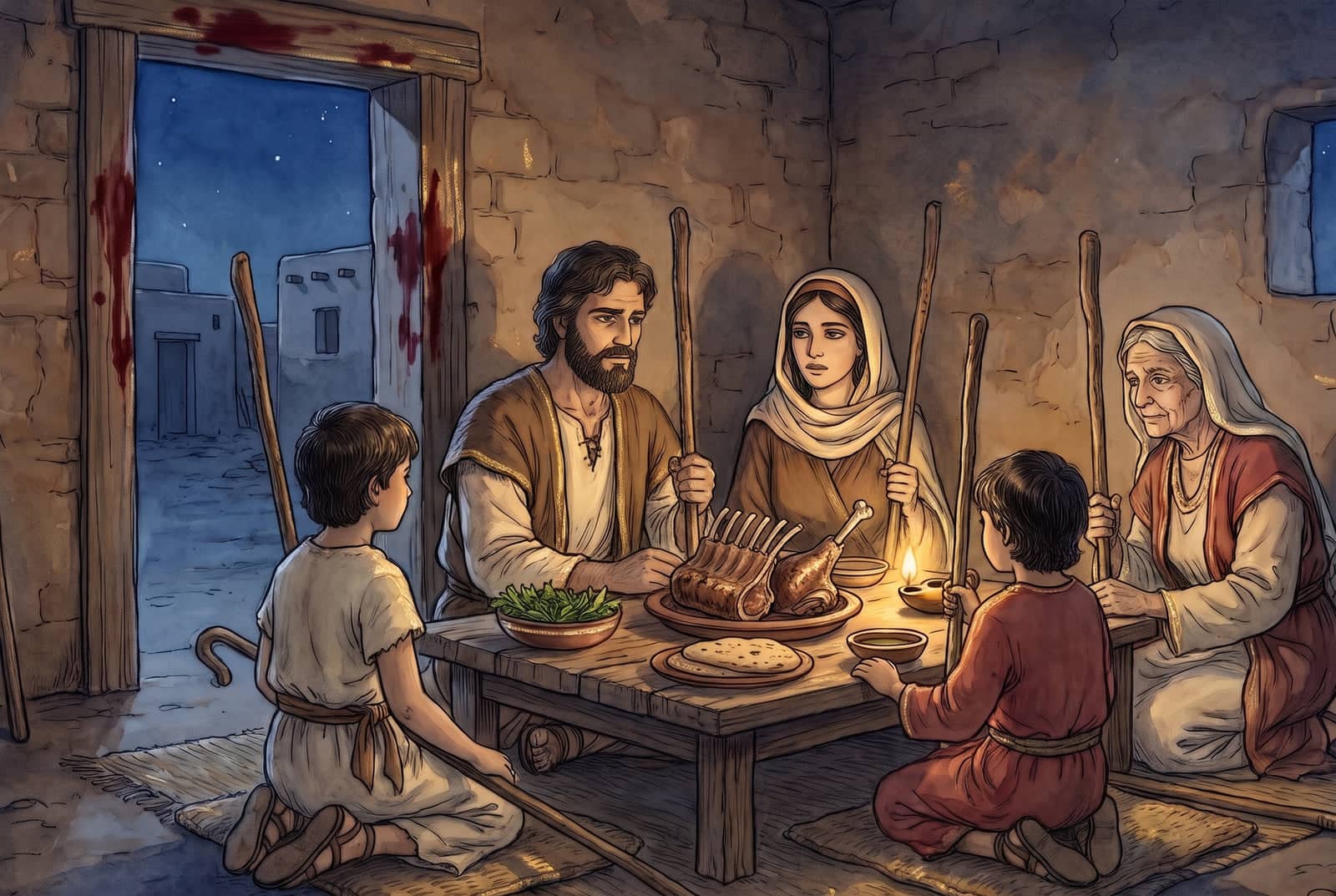
At midnight God struck down every firstborn in the land of Egypt, from the firstborn of Pharaoh, who sat on the throne, to the firstborn of the prisoner in the dungeon, and the firstborn of all the livestock as well.
Pharaoh got up in the night, he and all his officials and all the Egyptians, and there was loud wailing in Egypt, because there was not a single house without someone dead.
That same night Pharaoh sent for Moses and Aaron. “Get up!” he said. “Leave my people, you and the Israelites! Go and worship God, as you have asked. Take your flocks and herds, as you said, and go. And bless me too.”
The Egyptians urged the people to hurry and leave the country. “If you don’t,” they said, “we will all be dead!”
So the people took their dough before it had risen. They wrapped their kneading bowls in their cloaks and carried them on their shoulders.
The Israelites did as Moses had told them. They asked the Egyptians for jewelry of silver and gold and for clothing, and God made the Egyptians look kindly on the people, so they gave them whatever they asked for. In this way the Israelites carried off the riches of Egypt.
The Israelites set out from Rameses toward Succoth. There were about six hundred thousand men on foot, not counting the children. A great crowd of other people went with them too, and huge numbers of livestock, both flocks and herds.
With the dough they had brought out of Egypt they baked flat loaves without yeast. The dough had not risen, because they had been driven out of Egypt and could not wait, and they had not prepared any food for the journey.
The Israelites had lived in Egypt for four hundred and thirty years. At the end of the four hundred and thirty years, to the very day, all of God’s people left Egypt, company by company. Because God kept watch that night to bring them out of Egypt, all the Israelites are to keep watch on this night in honor of God, for all generations to come.
God said to Moses and Aaron, “These are the rules for the Passover. No foreigner may eat it. A slave you have bought may eat it once you have circumcised him, but a stranger staying with you or a hired worker may not. It must be eaten inside one house. Do not take any of the meat outside, and do not break any of its bones.”
“The whole community of Israel must celebrate it,” God said. “A foreigner living among you who wants to celebrate God’s Passover must have all the males in his household circumcised, and then he may take part like one born in the land. No uncircumcised man may eat it. The same law applies to the native-born and to the foreigner living among you.”
All the Israelites did just what God had commanded Moses and Aaron. And on that very day God brought the Israelites out of Egypt, company by company.
God said to Moses, “Set apart for me every firstborn among the Israelites, the first child born to every mother, and the first young of every animal. Each one belongs to me.”
Then Moses said to the people, “Remember this day, the day you came out of Egypt, out of the land where you were slaves, because God brought you out of it with a mighty hand. Eat nothing made with yeast. Today, in the month of Abib, you are leaving.”
“When God brings you into the land of the Canaanites, the Hittites, the Amorites, the Hivites, and the Jebusites,” Moses said, “the land he swore to your fathers to give you, a land flowing with milk and honey, you are to keep this ceremony in this month. For seven days eat bread made without yeast, and on the seventh day hold a festival to God.”
“Eat bread without yeast for those seven days,” Moses went on. “Nothing with yeast in it is to be seen among you, and no yeast anywhere within your borders. On that day tell your son, ‘I do this because of what God did for me when I came out of Egypt.’”
“It will be like a sign on your hand and a reminder on your forehead,” Moses said, “so that God’s law will always be on your lips, for God brought you out of Egypt with his mighty hand. Keep this law at its proper time, year after year.”
“When God brings you into the land of the Canaanites and gives it to you,” Moses said, “as he swore to you and to your fathers, you are to give over to God the first male born of every mother and the first male born of your animals. They belong to God. Buy back every firstborn donkey with a lamb, but if you do not buy it back, break its neck. Buy back every firstborn son among your children.”
“In days to come, when your son asks you, ‘What does this mean?’ tell him, ‘With a mighty hand God brought us out of Egypt, out of the land where we were slaves. When Pharaoh stubbornly refused to let us go, God killed every firstborn in Egypt, people and animals alike. That is why I sacrifice to God the first male born of every mother among the animals, and why I buy back every firstborn son of mine.’”
“It will be like a sign on your hand and a band on your forehead,” Moses said, “that with a mighty hand God brought us out of Egypt.”
When Pharaoh let the people go, God did not lead them along the road through the land of the Philistines, though that way was shorter. For God said, “If they have to face war, they may change their minds and go back to Egypt.”
So God led the people the long way around, by the wilderness road toward the Red Sea. And the Israelites went up out of Egypt ready for battle.
Moses took the bones of Joseph with him, because Joseph had made the Israelites swear an oath. “God will surely come to help you,” he had said, “and then you must carry my bones up with you from this place.”
After leaving Succoth they camped at Etham, on the edge of the wilderness. By day God went ahead of them in a pillar of cloud to show them the way, and by night in a pillar of fire to give them light, so that they could travel by day or by night.
The pillar of cloud by day and the pillar of fire by night never left their place in front of the people.
Then God said to Moses, “Tell the Israelites to turn back and camp near Pi Hahiroth, between Migdol and the sea. Camp by the sea, right across from Baal Zephon. Pharaoh will think, ‘The Israelites are lost and wandering in the land. The wilderness has shut them in.’”
“And I will harden Pharaoh’s heart,” God said, “and he will chase after them. But I will win glory for myself through Pharaoh and all his army, and the Egyptians will know that I am God.”
So the Israelites did as they were told.
When the king of Egypt was told that the people had fled, Pharaoh and his officials changed their minds about them. “What have we done?” they said. “We have let the Israelites go, and now they will not work for us anymore!”
So Pharaoh had his chariot made ready and took his army with him. He took six hundred of the best chariots, along with all the other chariots of Egypt, with officers over every one of them.
God hardened the heart of Pharaoh, king of Egypt, and he chased after the Israelites, who were marching out boldly.
The Egyptians, all Pharaoh’s horses and chariots, his horsemen and his soldiers, went after the Israelites and caught up with them as they were camped by the sea near Pi Hahiroth, across from Baal Zephon.
As Pharaoh came near, the Israelites looked up, and there were the Egyptians, marching after them. They were terrified, and they cried out to God.
“Were there no graves in Egypt,” they said to Moses, “that you brought us out here to die in the wilderness? What have you done to us, bringing us out of Egypt? Didn’t we tell you in Egypt, ‘Leave us alone, and let us serve the Egyptians’? It would have been better for us to serve the Egyptians than to die out here in the wilderness!”
Moses answered the people, “Don’t be afraid. Stand still, and see how God will save you today. The Egyptians you see today you will never see again. God will fight for you, and you only need to keep still.”
Then God said to Moses, “Why are you crying out to me? Tell the Israelites to move on. Raise your staff and stretch out your hand over the sea to divide the water, so that the Israelites can go through the middle of the sea on dry ground.”
“I will harden the hearts of the Egyptians,” God said, “so that they will go in after them, and I will win glory through Pharaoh and all his army, through his chariots and his horsemen. The Egyptians will know that I am God when I win glory through Pharaoh, his chariots, and his horsemen.”
Then the pillar of cloud moved from in front of the Israelites and went to stand behind them. It came between the army of Egypt and the camp of Israel. All night long the cloud was darkness to the one side and gave light to the other, so that neither came near the other the whole night through.
Then Moses stretched out his hand over the sea, and all that night God drove the sea back with a strong east wind and turned it into dry land. The waters were divided.
The Israelites went through the middle of the sea on dry ground, with the water standing like a wall on their right and on their left.

After them came the Egyptians, all Pharaoh’s horses and chariots and horsemen, following them into the middle of the sea.
Just before dawn God looked down on the Egyptian army from the pillar of fire and cloud and threw it into confusion. He made the wheels of their chariots come off, so that they could hardly drive.
“Let’s get away from the Israelites!” the Egyptians cried. “God is fighting for them against Egypt!”
Then God said to Moses, “Stretch out your hand over the sea, so that the waters may flow back over the Egyptians, over their chariots and their horsemen.”
Moses stretched out his hand over the sea, and as morning came, the sea went back to its place. The Egyptians tried to flee from it, but God swept them into the middle of the sea.
The water flowed back and covered the chariots and the horsemen, the whole army of Pharaoh that had followed the Israelites into the sea. Not one of them was left.
But the Israelites had walked through the sea on dry ground, with the water standing like a wall on their right and on their left.
That day God saved Israel from the Egyptians, and Israel saw the Egyptians lying dead on the shore. When the Israelites saw the mighty power God had shown against the Egyptians, the people feared God, and they believed in God and in his servant Moses.
Retold by Talerie from King James Version (opens in a new window) Public domain Copy this text, adapt it, use it however you like. A link back to Talerie is appreciated but never required. CC0 1.0 (opens in a new window)