 Original
The Youth Who Went Forth to Learn What Fear Was
21 min read ages 8 and up talerie.com/en/tales/the-youth-who-went-forth-to-learn-what-fear-was-original
A boy whom even his own brother takes for a dunce has only one wish: he wants to learn how to shudder. His father sends him away with fifty thalers, and the road leads past a gallows to an inn. The innkeeper tells him of an enchanted castle that many have entered and none has left.
Once upon a time a father had two sons. The elder was clever and sensible and knew how to handle anything, but the younger was stupid and could neither understand nor learn a thing. When people saw him, they said, “That one will give his father plenty of trouble!”
Whenever there was a job to be done, it was always the elder son who had to do it. But if his father sent him to fetch something late in the evening, or even at night, and the way led through the churchyard or some other gloomy place, he would answer, “Oh no, Father, I won’t go there. It makes me shudder!” For he was afraid.
And in the evenings, when people sat by the fire telling stories that made your skin crawl, the listeners would sometimes say, “Oh, it makes me shudder!” The younger son sat in his corner and listened, and he could not understand what they meant. “They keep saying, ‘It makes me shudder! It makes me shudder!’ It never makes me shudder,” he thought. “That must be one more skill I know nothing about.”
One day his father said to him, “Listen, you there in the corner. You’re growing big and strong, and it’s time you learned a trade to earn your bread. Look how hard your brother works. With you, it’s all wasted effort.”
“Well, Father,” he answered, “I’d gladly learn something. In fact, if it could be done, I’d like to learn how to shudder. I don’t understand that at all yet.”
His elder brother laughed when he heard this and thought, “Good heavens, what a dunce my brother is! He’ll never amount to anything as long as he lives. As the twig is bent, so grows the tree.”
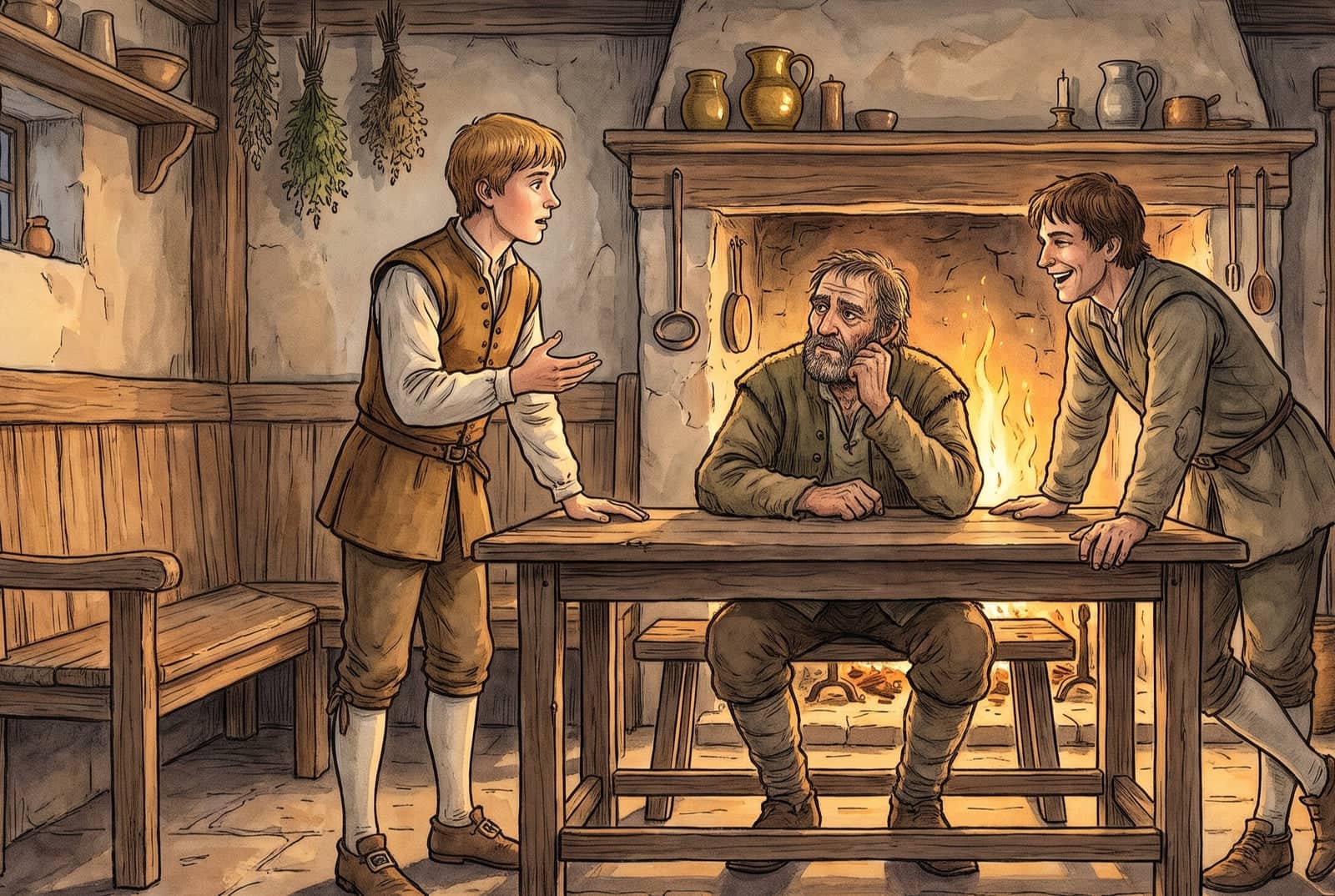
The father sighed and answered, “You’ll learn to shudder soon enough, but you won’t earn your bread by it.”
Soon afterward the sexton came to the house for a visit, and the father poured out his troubles to him. He told him how hopeless his younger son was at everything; the boy knew nothing and learned nothing. “Just think, when I asked him how he meant to earn his bread, he said he wanted to learn how to shudder!”
“If that’s all it is,” said the sexton, “he can learn that from me. Just send him over, and I’ll knock the rough edges off him.”
The father was glad of it, because he thought, “At least the boy will be licked into shape a little.” So the sexton took him into his house, and the boy’s job was to ring the church bell.
After a few days the sexton woke him at midnight and told him to get up, climb the church tower, and ring the bell. “You’ll soon learn what shuddering is,” the sexton thought, and he slipped up the tower ahead of the boy. When the boy reached the top and turned to take hold of the bell rope, he saw a white figure standing on the stairs across from the belfry window.
“Who’s there?” he called, but the figure gave no answer and did not stir.
“Answer me,” cried the boy, “or get out of here. You have no business here at night.”
But the sexton stood perfectly still, so that the boy would think he was a ghost.
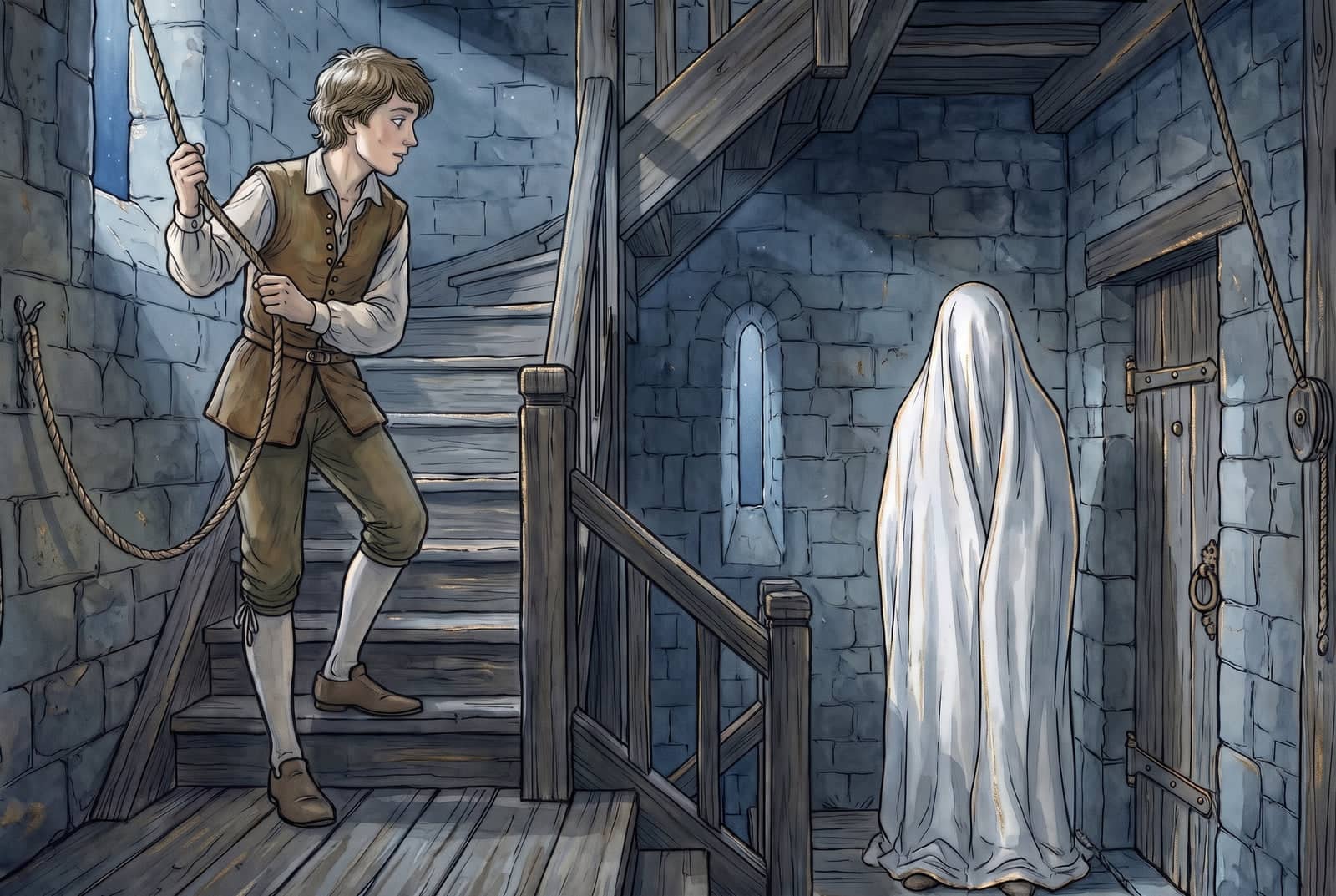
The boy called out a second time, “What do you want here? Speak, if you’re an honest fellow, or I’ll throw you down the stairs.”
The sexton thought, “He can’t really mean it.” He made no sound and stood there as if he were made of stone. Then the boy called to him a third time, and when that was no use either, he took a run at the ghost and pushed it down the stairs. It fell ten steps and lay still in a corner.
Then the boy rang the bell, went home, got into bed without a word, and fell asleep again.
The sexton’s wife waited a long time for her husband, but he did not come back. At last she grew frightened. She woke the boy and asked, “Don’t you know where my husband is? He went up the tower before you.”
“No, ma’am,” answered the boy. “But someone was standing on the stairs across from the belfry window, and because he wouldn’t answer and wouldn’t go away, I took him for a scoundrel and pushed him down. Go and look, and you’ll see whether it was him. I’d be sorry if it was.”
The woman ran off and found her husband lying in the corner, moaning, with a broken leg. She carried him down and then rushed, wailing loudly, to the boy’s father.
“Your boy,” she cried, “has done a terrible thing. He threw my husband down the stairs and broke his leg. Get that good-for-nothing out of our house!”
The father was horrified. He came running and scolded the boy. “What kind of wicked trick is this? The devil himself must have put it into your head.”
“Father,” he answered, “just listen to me. I’m completely innocent. He stood there in the night like someone up to no good. I didn’t know who it was, and I warned him three times to speak or go away.”
“Oh,” said the father, “you bring me nothing but trouble. Get out of my sight. I don’t want to look at you anymore.”
“Yes, Father, gladly. Just wait until it’s light. Then I’ll go out and learn to shudder, and at least I’ll know a skill that can feed me.”
“Learn whatever you like,” said the father. “It’s all the same to me. Here are fifty thalers. Take them and go out into the wide world, and don’t tell a soul where you come from or who your father is, because I’m ashamed of you.”
“Yes, Father, just as you wish. If that’s all you ask, it’s easy enough to remember.”
When day broke, the boy put his fifty thalers in his pocket, set off along the main road, and kept saying to himself, “If only I could shudder! If only I could shudder!”
A man came along and heard the boy talking to himself. When they had walked a little farther and could see the gallows, the man said, “Look, there’s the gallows tree where seven men were wed to the hangman’s rope, and now they’re learning how to fly. Sit down under it and wait until night comes, and you’ll learn to shudder soon enough.”
“If that’s all it takes,” answered the boy, “that’s easily done. But if I learn to shudder as quickly as that, you can have my fifty thalers. Just come back to me early tomorrow morning.”
So the boy went to the gallows, sat down beneath it, and waited for evening. Because he was cold, he made himself a fire, but at midnight the wind blew so cold that he could not get warm in spite of it. And when the wind knocked the hanged men against one another so that they swung back and forth, he thought, “If I’m freezing down here by the fire, how those poor fellows up there must be freezing and shivering!”
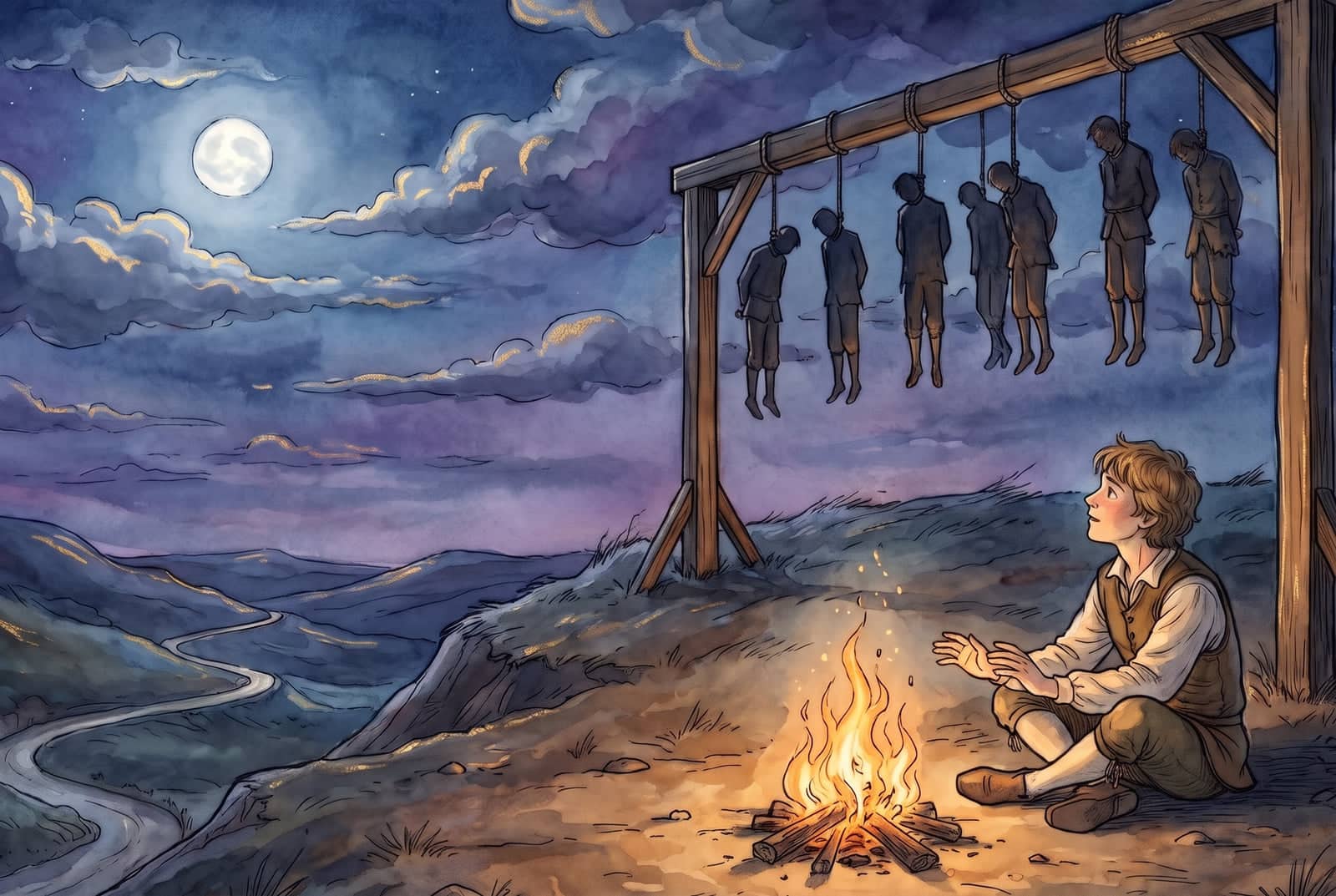
Because he had a kind heart, he set up the ladder, climbed up, untied them one after another, and brought all seven down. Then he stirred up the fire, blew on it, and sat them all around it to warm themselves. But they sat there without moving, and the fire caught their clothes.
“Watch out,” he said, “or I’ll hang you right back up.”
But the dead men did not hear. They said nothing and let their rags go on burning. Then he grew angry and said, “If you won’t be careful, I can’t help you. I’m not going to burn up with you.” And he hung them up again, one by one.
Then he sat down by his fire and fell asleep. The next morning the man came to him, wanting the fifty thalers, and said, “Well, do you know what shuddering is?”
“No,” he answered. “How could I? Those fellows up there never opened their mouths, and they were so stupid that they let the few old rags on their backs catch fire.”
Then the man saw that he would not be carrying off the fifty thalers that day, and he went away, saying, “I’ve never come across anyone like him.”
The boy went on his way too and began talking to himself again. “If only I could shudder! If only I could shudder!”
A wagoner walking behind him heard this and asked, “Who are you?”
“I don’t know,” answered the boy.
The wagoner asked again, “Where do you come from?”
“I don’t know.”
“Who is your father?”
“I mustn’t say.”
“What’s that you keep muttering to yourself?”
“Well, sir,” answered the boy, “if only I could shudder! But nobody can teach me.”
“Stop that silly chatter,” said the wagoner. “Come along with me, and I’ll see about finding you a place.”
The boy went with the wagoner, and in the evening they came to an inn where they meant to spend the night. As he stepped into the room, the boy said again, quite loudly, “If only I could shudder! If only I could shudder!”
The innkeeper heard it and laughed. “If that’s what you’re after, you should have a fine chance of it here.”
“Oh, hush,” said the innkeeper’s wife. “Plenty of daredevils have lost their lives already. It would be a sin and a shame if those bright eyes never saw the daylight again.”
But the boy said, “However hard it is, I mean to learn it. That’s why I set out.”
He gave the innkeeper no peace until at last the man told him that not far away stood an enchanted castle, where anyone could surely learn what shuddering was, if he would only keep watch in it for three nights.
The king had promised his daughter in marriage to whoever dared it, and she was the most beautiful girl the sun had ever shone on. Great treasures lay hidden in the castle as well, guarded by evil spirits. Once the castle was freed, the treasures would be free too, and there was enough to make a poor man rich. Many had gone in, but not one had ever come out again.
The next morning the boy went before the king and said, “If I may, Your Majesty, I would like to keep watch for three nights in the enchanted castle.”
The king looked at him, and because he liked the boy, he said, “You may ask for three things to take into the castle with you, but they must be things without life.”
The boy answered, “Then I ask for a fire, a lathe, and a carving bench with its knife.”
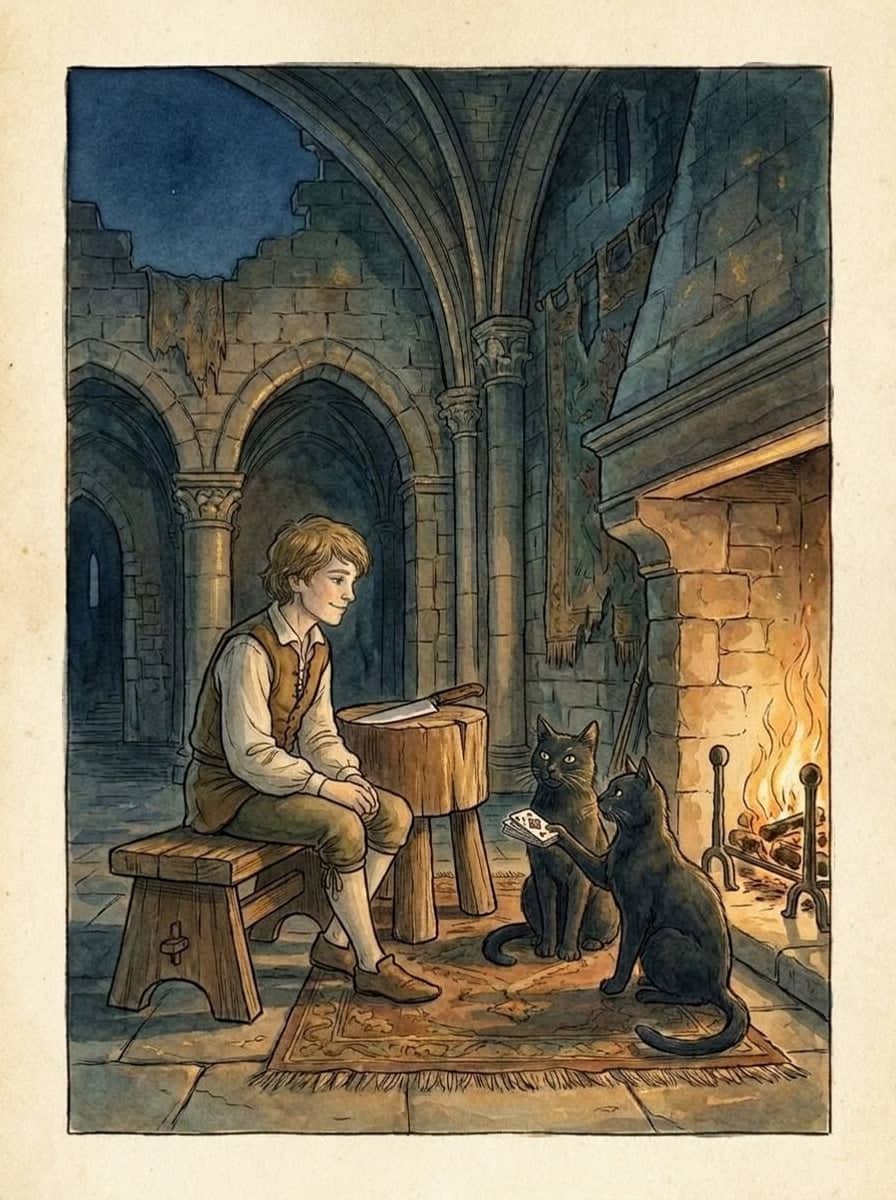
The king had all of it carried into the castle by day. As night was falling, the boy went up, made himself a bright fire in one of the rooms, set the carving bench with the knife beside it, and sat down on the lathe. “If only I could shudder!” he said. “But I won’t learn it here either.”
Toward midnight he decided to stir up his fire. As he was blowing on it, something suddenly cried out from a corner, “Ow, meow! How cold we are!”
“You fools,” he called, “what are you yowling for? If you’re cold, come and sit by the fire and warm yourselves.”
No sooner had he said it than two big black cats came over in one tremendous leap. They sat down on either side of him and glared at him wildly with their fiery eyes. After a little while, when they had warmed themselves, they said, “Friend, shall we play a hand of cards?”
“Why not?” he answered. “But first let me see your paws.”
The cats stretched out their claws.
“My,” he said, “what long nails you have! Wait, I’ll have to trim them for you first.” With that he seized them by the scruff of the neck, lifted them onto the carving bench, and screwed their paws down tight. “I’ve had a good look at your fingers,” he said, “and I’ve lost my taste for cards.” Then he struck them dead and threw them out into the water.
But when he had finished with those two and was about to sit down by his fire again, black cats and black dogs on red-hot chains came out of every nook and cranny, more and more of them, until there was nowhere left for him to go. They howled horribly, trampled on his fire, and pulled it apart, trying to put it out.
For a while he watched it all calmly, but when it got too bad, he seized his carving knife, cried, “Away with you, you rabble!” and laid into them. Some ran off; the rest he struck dead and threw out into the pond. When he came back, he blew the embers into a fresh fire and warmed himself.
As he sat there, his eyes would no longer stay open, and he felt like sleeping. He looked around and saw a big bed in the corner. “That suits me fine,” he said, and lay down in it. But just as he was about to close his eyes, the bed began to move by itself and rolled off through the whole castle.
“That’s right,” he said, “but faster!”
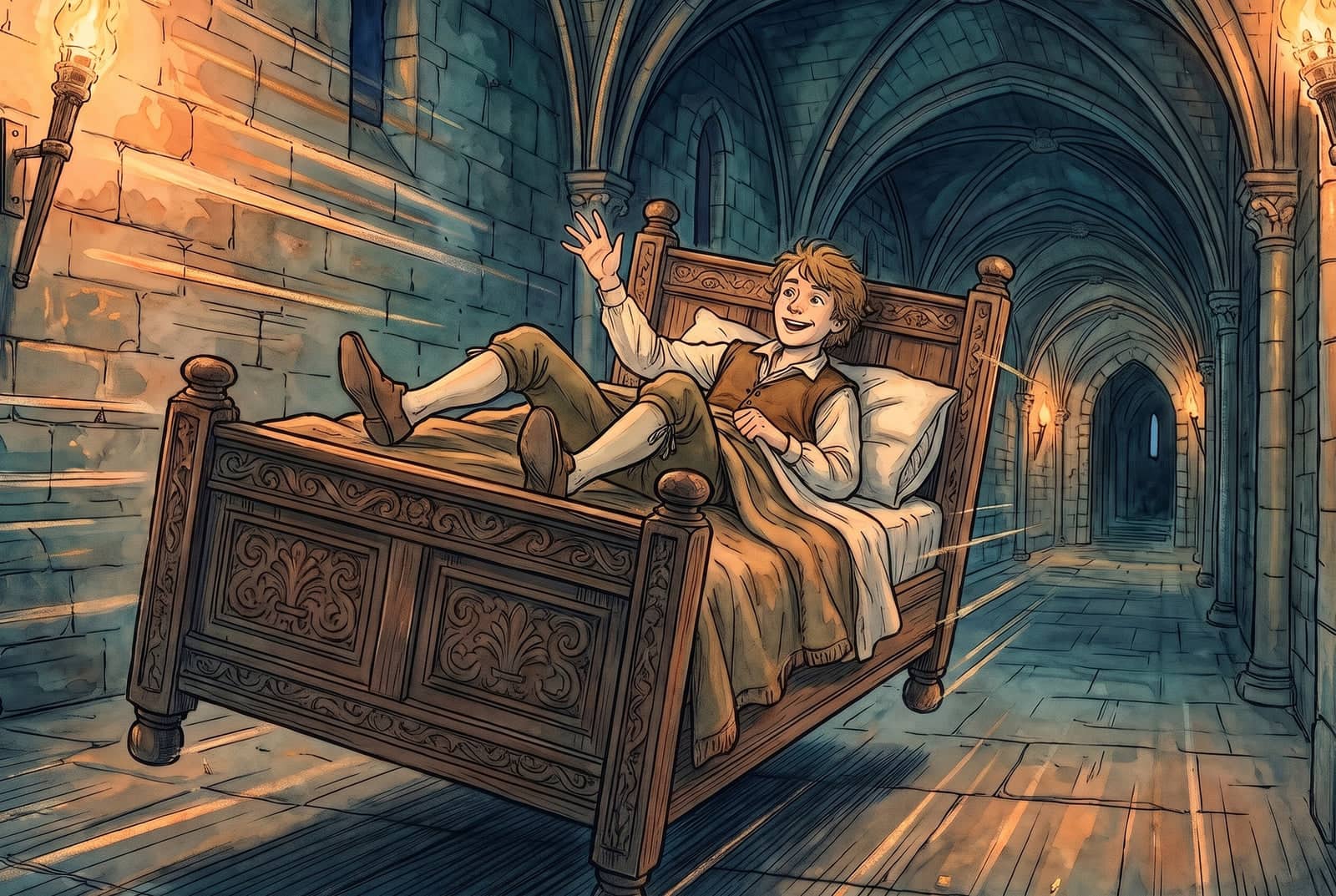
Then the bed raced on as if six horses were harnessed to it, over thresholds and up and down stairs, until all at once, bump, bump, it tipped over, landed upside down, and lay on top of him like a mountain. But he flung the blankets and pillows into the air, climbed out, and said, “Now anyone who likes can go for a ride.” He lay down by his fire and slept until it was day.
In the morning the king came, and when he saw the boy lying on the floor, he thought the ghosts had killed him. “What a pity,” he said, “such a handsome young man.”
The boy heard this, sat up, and said, “It hasn’t come to that yet!”
The king was amazed, but glad, and asked how it had gone.
“Very well,” said the boy. “One night is over, and the other two will pass as well.”
When he went back to the inn, the innkeeper stared at him wide-eyed. “I never thought I’d see you alive again,” he said. “Have you learned what shuddering is now?”
“No,” said the boy. “It’s no use. If only someone could tell me!”
On the second night he went up to the old castle again, sat down by the fire, and started his old song once more: “If only I could shudder!” As midnight drew near, there came a noise and a clatter, softly at first, then louder and louder. Then it was quiet for a little while, and at last, with a loud scream, half a man came tumbling down the chimney and fell in front of him.
“Hey there!” cried the boy. “There’s another half that belongs with you. This isn’t enough.”
Then the noise started up again, with raging and howling, and the other half fell down too.
“Wait,” said the boy, “first I’ll stir up the fire a bit for you.”
When he had done this and looked around again, the two pieces had joined together, and a hideous man was sitting in his place.
“That wasn’t our bargain,” said the boy. “The bench is mine.”
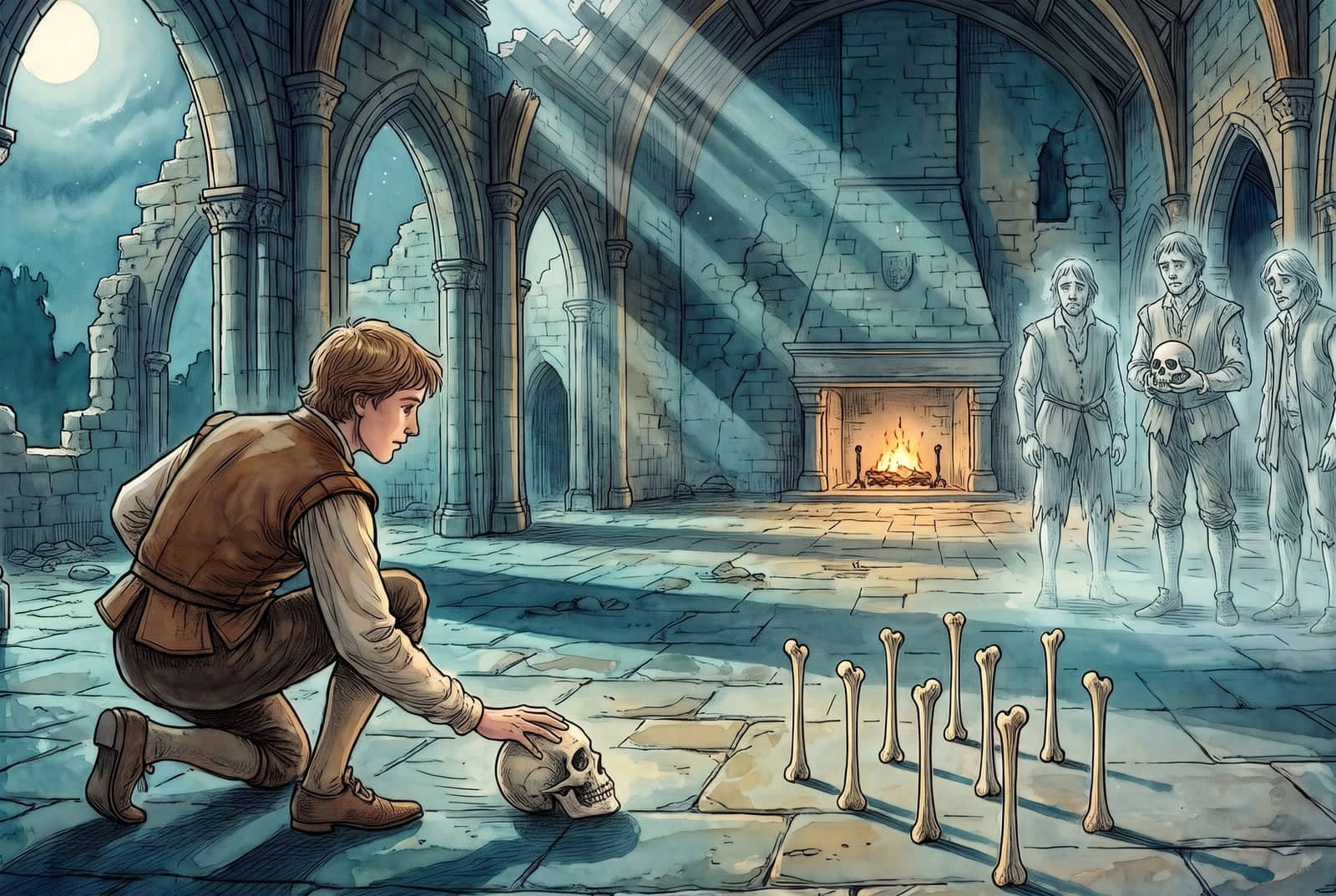
The man tried to push him away, but the boy would not stand for it. He shoved the man off by force and sat back down in his place. Then more men fell down the chimney, one after another. They brought nine dead men’s bones and two skulls, set them up, and played ninepins.
The boy wanted to play too, and asked, “Listen, can I join in?”
“Yes, if you have money.”
“Plenty of money,” he answered, “but those heads of yours aren’t properly round.”
Then he took the skulls, put them in the lathe, and turned them until they were round. “There, now they’ll roll better,” he said. “Hurrah! Now we’ll have some fun!” He played with them and lost some of his money, but when the clock struck twelve, everything vanished before his eyes. He lay down and fell peacefully asleep.
The next morning the king came to find out how things stood. “How did it go this time?” he asked.
“I’ve been playing ninepins,” answered the boy, “and lost a few pennies.”
“Didn’t you shudder, then?”
“Not a bit,” he said. “I had a fine time. If only I knew what shuddering is!”
On the third night he sat down on his bench again and said, quite gloomily, “If only I could shudder!”
Late in the night six tall men came in, carrying a coffin. “Ha ha!” said the boy. “That must be my cousin, who died only a few days ago.” He beckoned with his finger and called, “Come, cousin, come!”
They set the coffin on the floor, and he went up to it and took off the lid. A dead man lay inside. The boy felt his face, but it was as cold as ice.
“Wait,” he said, “I’ll warm you up a little.” He went to the fire, warmed his hand, and laid it on the dead man’s face, but the dead man stayed cold. Then he lifted him out, sat down by the fire, laid him across his lap, and rubbed his arms to get the blood moving again. When that did no good either, he remembered that when two people lie in bed together, they keep each other warm. So he carried him to the bed, covered him up, and lay down beside him.
After a little while the dead man grew warm too and began to stir. Then the boy said, “You see, cousin? Where would you be if I hadn’t warmed you?”
But the dead man rose up and cried, “Now I’m going to strangle you!”
“What?” said the boy. “Is that my thanks? Back into your coffin with you this minute!” He lifted him up, threw him in, and shut the lid. Then the six men came and carried the coffin away again.
“I just can’t shudder,” he said. “I’ll never learn it here as long as I live.”
Then a man came in who was taller than all the others and terrible to look at. He was old, and he had a long white beard.
“You little wretch,” he cried, “now you’ll soon learn what shuddering is, for you are going to die.”
“Not so fast,” answered the boy. “If I’m going to die, I’ll have a say in it.”
“I’ll get my hands on you yet,” the old man growled.
“Easy, easy, don’t puff yourself up. I’m as strong as you are, and maybe stronger.”
“We’ll see about that,” he said. “If you’re stronger than I am, I’ll let you go. Come, let’s put it to the test.”
He led the boy through dark passages to a blacksmith’s forge, took an ax, and with one blow drove one of the anvils into the ground.
“I can do better than that,” said the boy, and went over to the other anvil. The old man stood beside it to watch, and his white beard hung down. Then the boy seized the ax, split the anvil with one blow, and caught the old man’s beard in the crack.
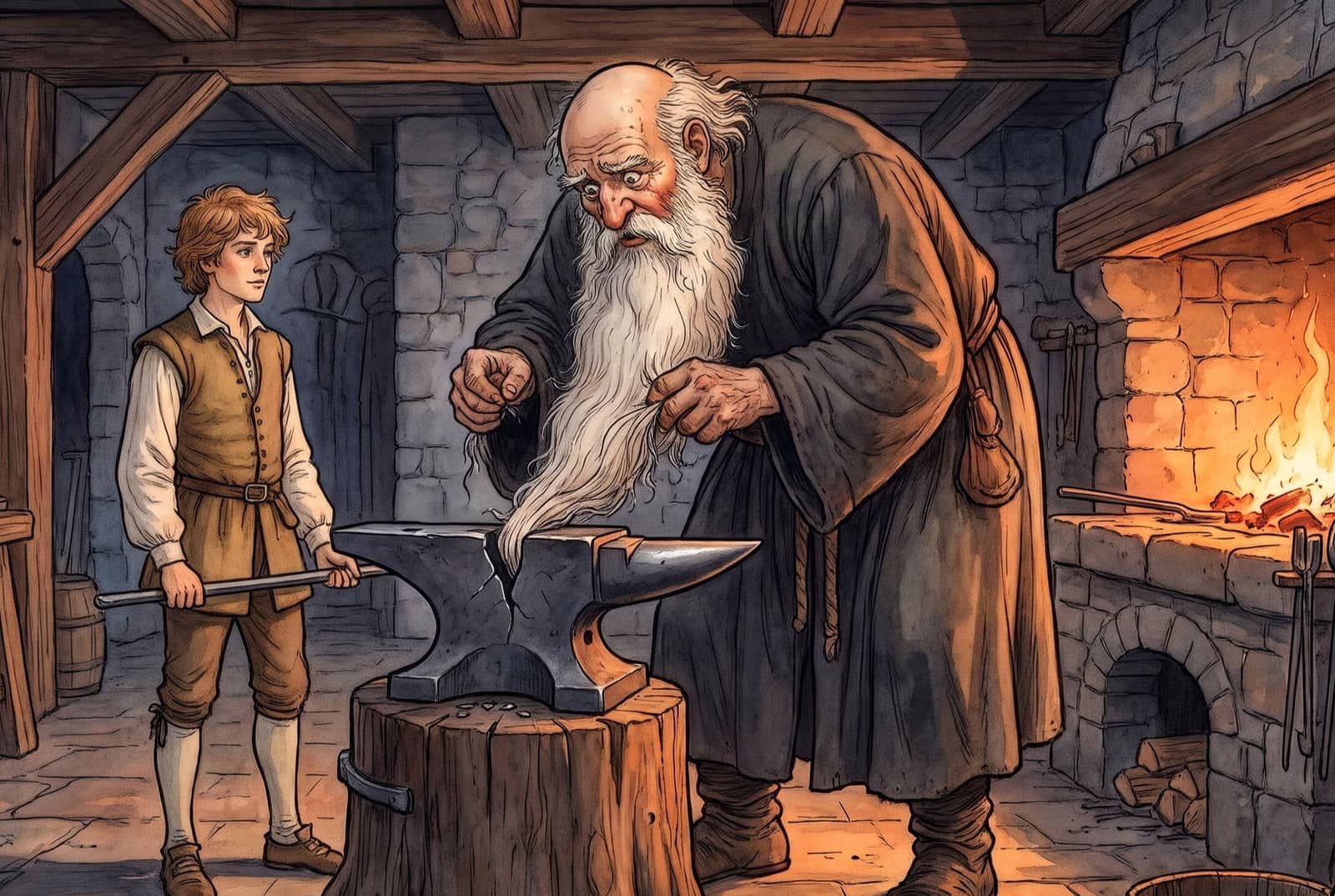
“Now I’ve got you,” said the boy. “Now it’s your turn to die.” He grabbed an iron bar and beat the old man until he whimpered and begged him to stop, promising him great riches. The boy pulled out the ax and let him go.
The old man led him back into the castle and showed him three chests full of gold in a cellar. “One share of this,” he said, “belongs to the poor, the second to the king, and the third is yours.” Just then the clock struck twelve and the spirit vanished, leaving the boy standing in the dark.
“I’ll find my way out somehow,” he said. He groped around, found the way to his room, and fell asleep there by his fire.
The next morning the king came and said, “Well, surely you’ve learned what shuddering is by now?”
“No,” he answered. “What is it, anyway? My dead cousin was here, and a bearded man came and showed me a lot of money down below, but nobody told me what shuddering is.”
Then the king said, “You have set the castle free, and you shall marry my daughter.”
“That’s all very well,” answered the boy, “but I still don’t know what shuddering is.”
So the gold was brought up and the wedding was celebrated. But dearly as the young king loved his wife, and happy as he was, he still kept saying, “If only I could shudder! If only I could shudder!” At last it began to annoy her.
Her chambermaid said, “I’ll help you, Your Majesty. He’ll learn to shudder, never fear.” She went out to the stream that ran through the garden and had a whole bucketful of little fish brought up from it.
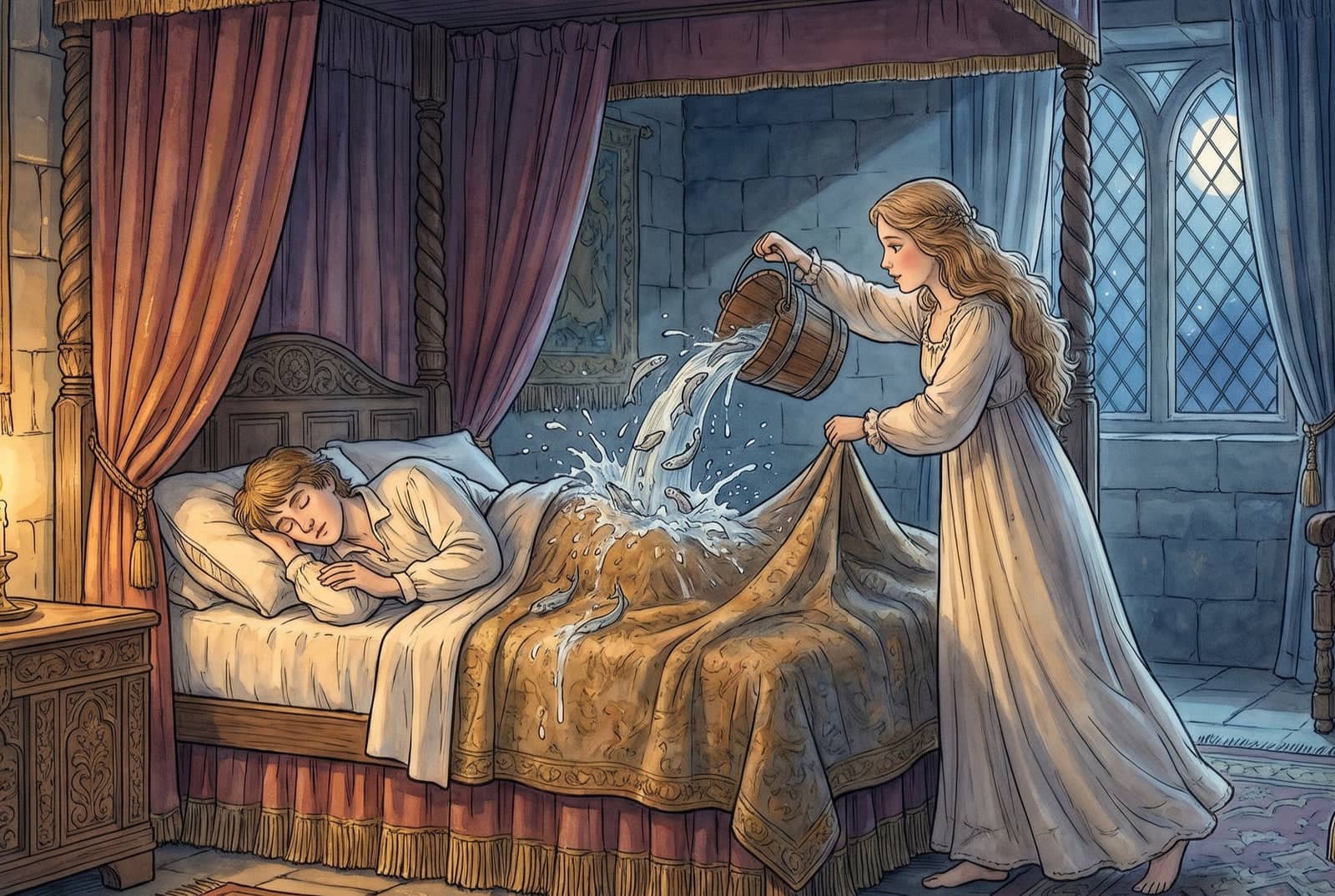
That night, while the young king was asleep, his wife pulled back his blanket and poured the bucket of cold water over him, fish and all, so that they wriggled and flopped all around him. He woke up and cried, “Oh, how I shudder, how I shudder, dear wife! Yes, now I know what shuddering is!”
Retold by Talerie from Kinder- und Hausmärchen (opens in a new window) Public domain Copy this text, adapt it, use it however you like. A link back to Talerie is appreciated but never required. CC0 1.0 (opens in a new window)