 Original
The Story of Saint Nicholas
13 min read ages 8 and up talerie.com/en/tales/the-story-of-saint-nicholas-original
Nicholas, a rich young man of Patara, wants to spend his fortune for God’s glory and never for his own praise. When he hears that a poor neighbor is about to send his three daughters away to a terrible fate, he wraps a lump of gold in a cloth and goes out into the night.
Nicholas was a citizen of the city of Patara, born to parents who were rich and devout. His father was named Epiphanius and his mother Joanna. They had him while they were still young, and after his birth they chose to live chastely for the rest of their lives. On the very day he was born, when the women were bathing him, the baby stood up and held himself upright in the tub. All through his infancy he took his mother’s milk only twice a week, on Wednesdays and Fridays. As a young man he kept away from the rowdy pleasures of his friends and went to church instead, and every passage of Holy Scripture he heard there stayed in his memory.
When his parents died, Nicholas became very rich, and he looked for a way to spend his wealth that would bring glory to God and not praise to himself.
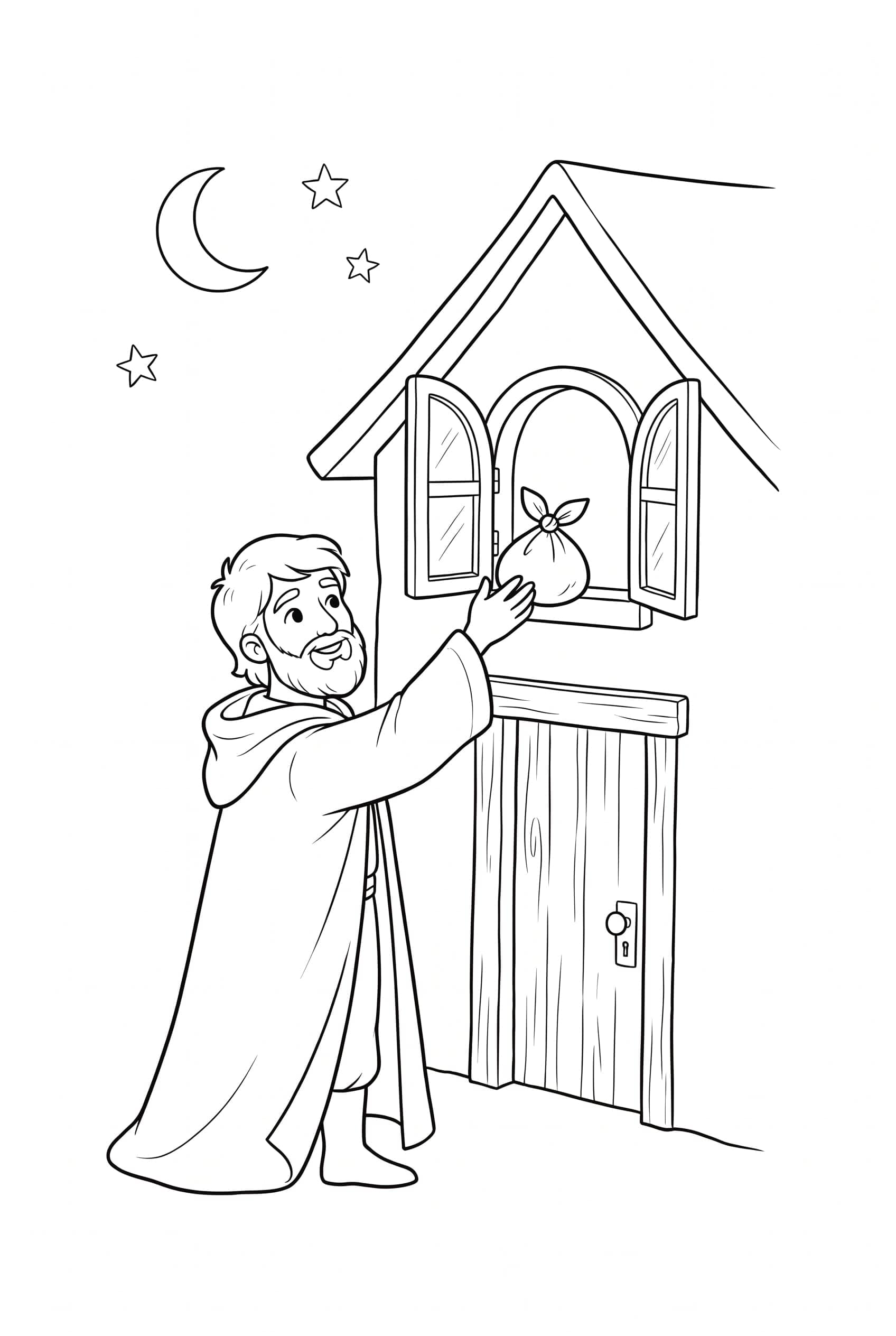
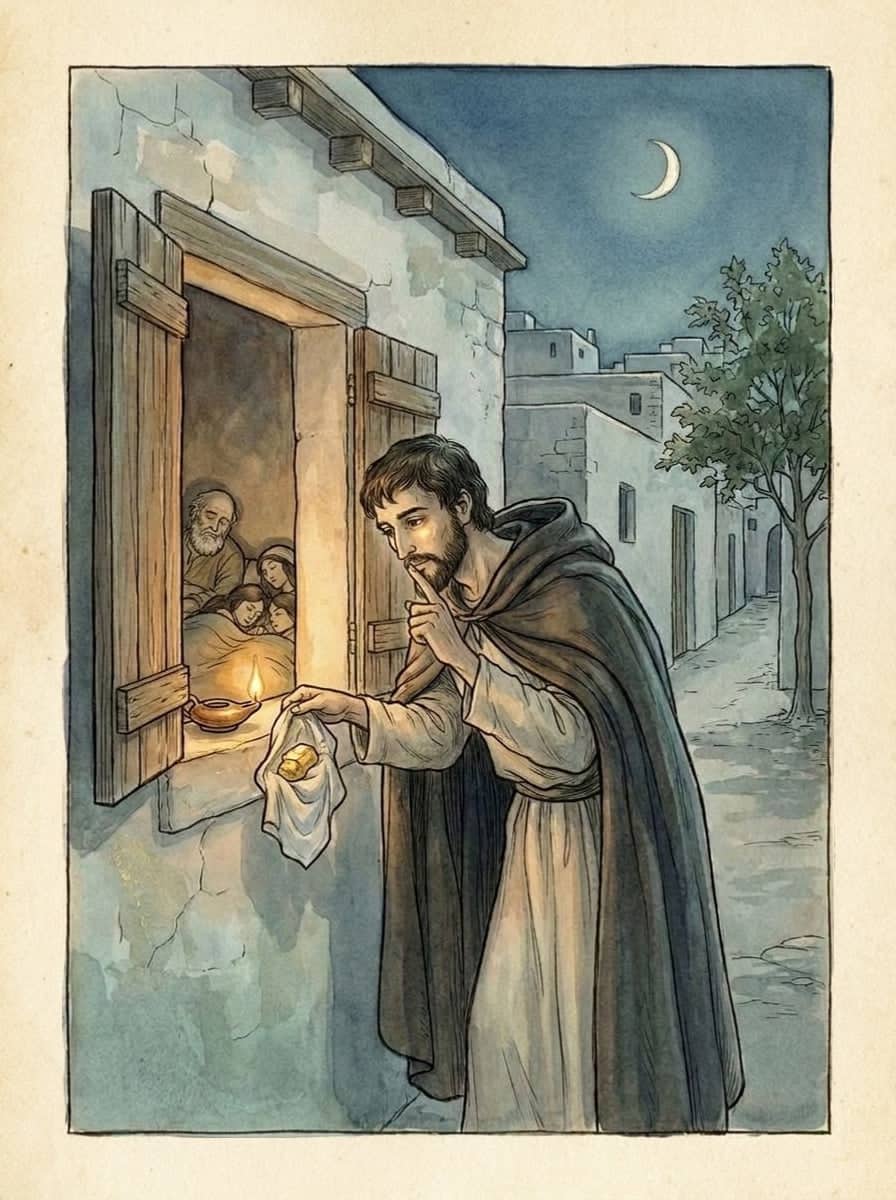
Now one of his neighbors, a man from a good family, had fallen so deep into poverty that he was about to send his three young daughters out to sell themselves to men, so that the family could live on what they earned. When Nicholas heard of it, he was horrified. He wrapped a lump of gold in a cloth, and that night he threw it through the neighbor’s window into the house and ran off before anyone could see him.
The next morning, when the man got up, he found the gold. He thanked God and at once began to prepare the wedding of his eldest daughter.
Some time later, the servant of God gave him a second lump of gold in the same way. When the neighbor found it, he burst into praise of God, and he made up his mind that from then on he would stay awake and find out who was helping him in his need.
A few days later, a lump of gold twice as big as the others came flying into the house, and this time he heard the thud it made as it landed. He ran out after Nicholas, who was already hurrying away, and begged him to stop so that he could see his face. He ran so hard that he caught up with the young man and recognized him.
The neighbor threw himself down on the ground and tried to kiss his feet. But Nicholas would not accept his thanks.
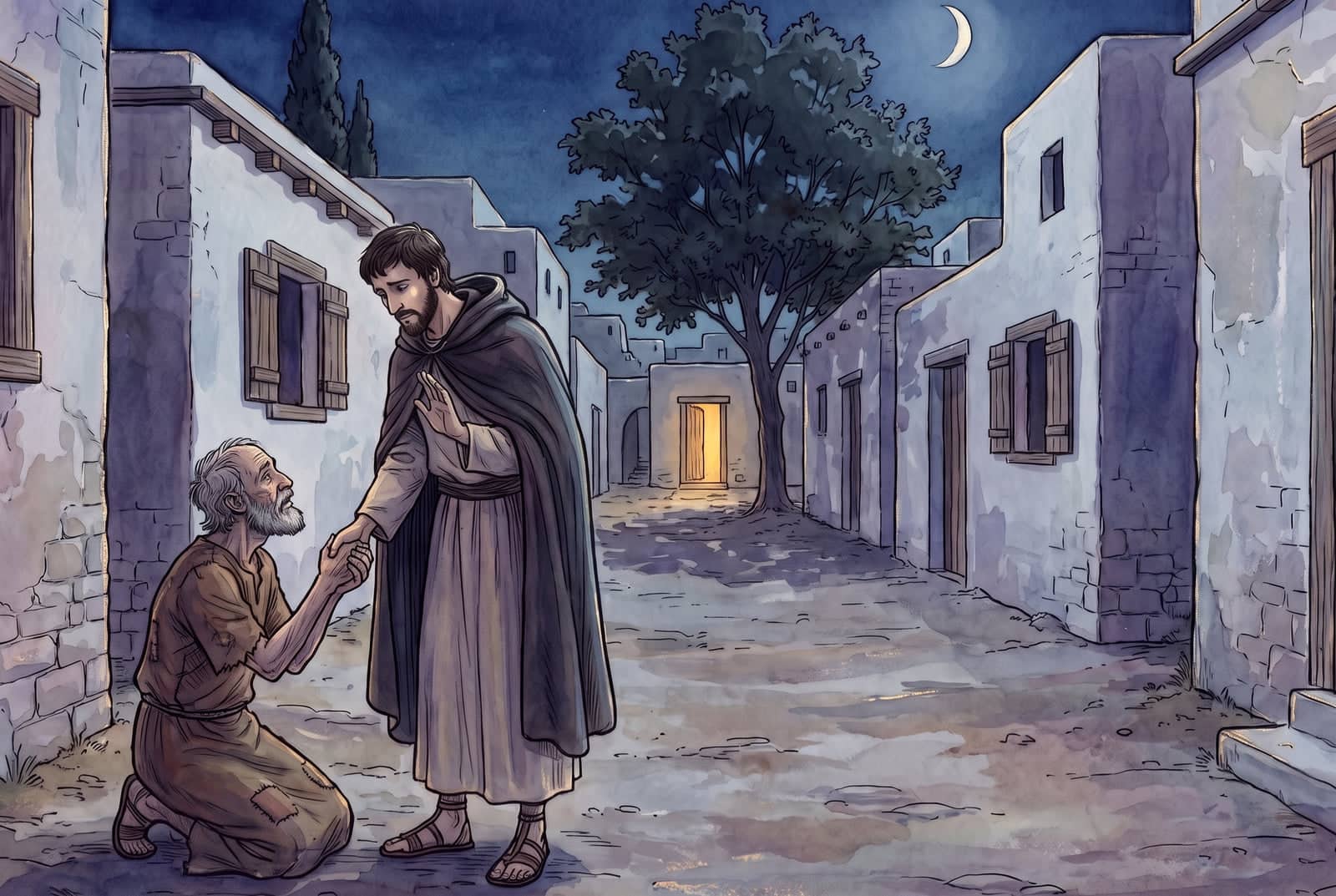
“My friend,” he said, “you must keep this secret for as long as you live.”
After this, the bishop of the city of Myra died, and all the bishops of the region gathered to choose a new one. Among them was one bishop of such great authority that the others always followed his advice. He told them all to fast and pray, and that night he heard a voice. It told him to stand at the door of the church in the morning and to consecrate as bishop the first man he saw come in.
He told the other bishops at once what he had heard, and he went and stood by the church door. And by a miracle, Nicholas, sent by God, walked to the church before dawn and was the first to enter.
The old bishop went up to him and asked, “What is your name?”
Nicholas, who had the simple heart of a dove, bowed his head and answered, “Nicholas, your humble servant.”
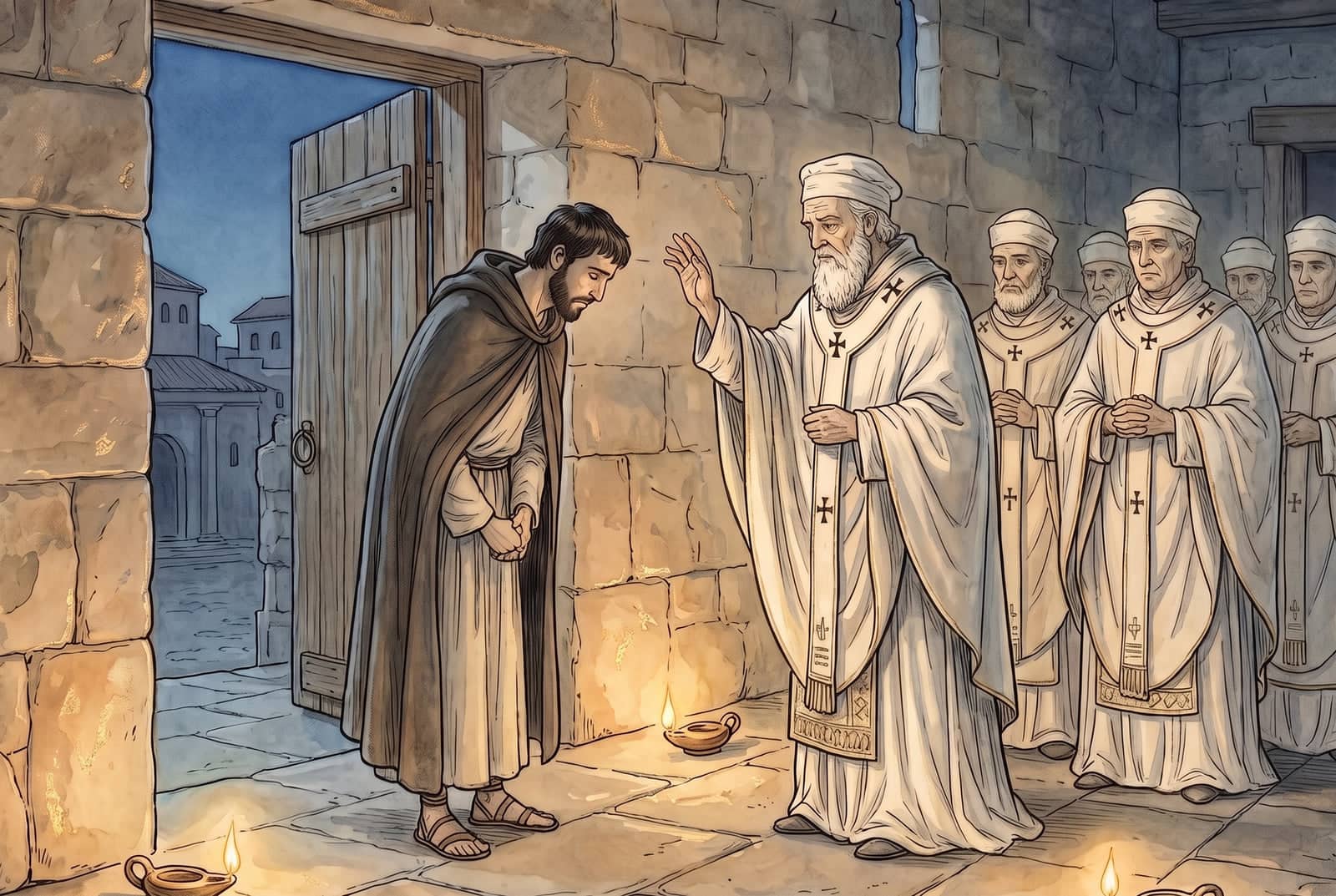
So the bishops dressed him in shining robes and set him on the bishop’s throne. Yet with all these honors he stayed as humble and as serious as he had always been. He spent his nights in prayer, treated his body harshly, and kept away from the company of women. He welcomed people humbly, his preaching did them good, his advice was sound, and his rebukes were stern. One chronicle also says that Saint Nicholas took part in the Council of Nicaea.
One day some sailors were caught in a terrible storm at sea. In tears, they prayed, “Nicholas, servant of God, if what we have been told about you is true, let us see it now!”
At once someone appeared before them who had the saint’s face, and he said, “You called me, and here I am!”
He began to help them with the sails and the ropes and the rest of the ship’s rigging, and that very moment the storm died down.
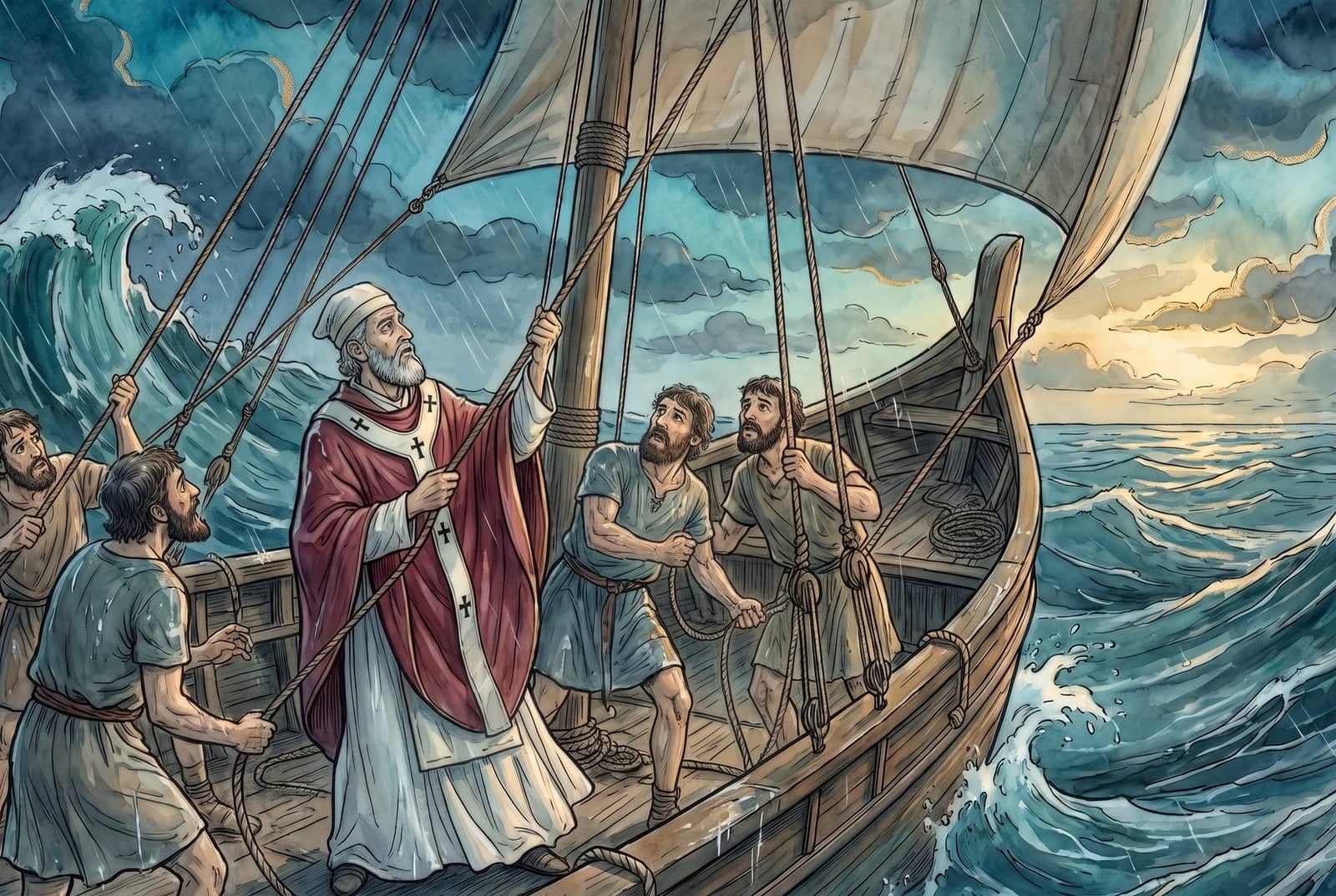
Saved from the sea, the sailors went to the church where Nicholas was, and they knew him at once, even though they had never seen him before. They thanked him for rescuing them. But he told them to thank God instead, for the credit belonged only to God’s mercy and to their own faith.
Once the whole of Nicholas’s diocese was struck by a famine so terrible that nobody had anything left to eat. Then the man of God heard that some ships loaded with grain were lying at anchor in the harbor. He went down there at once and asked the crews to help the starving people with just a hundred measures of grain from each ship.
“Father, we don’t dare,” they said. “Our cargo was weighed at Alexandria, and we must deliver every bit of it to the emperor’s granaries!”
“Do as I ask all the same,” the saint answered, “and I promise you, in the name of God, that the emperor’s officials won’t find your cargo a single grain short!”
The men did as he said. When they reached the end of their voyage, they delivered to the emperor’s granaries exactly the amount that had been weighed at Alexandria. They saw the miracle, told everyone about it, and praised God for what he had done through his servant.
As for the grain they had left behind, Nicholas shared it out according to each person’s need, and it went so miraculously far that it fed the whole region for two years and there was still plenty left to sow the fields.
Long ago, the people of that region had worshiped idols, and even in Nicholas’s time some country folk still kept up certain pagan rites under a tree that was sacred to the goddess Diana. To put an end to this, the saint had the tree cut down.
The demon was furious. It made an unnatural oil that could burn in water and even on stone. Then, taking the shape of a nun, the demon got into a boat and came up beside some pilgrims who were sailing to see Saint Nicholas.
“I’m sorry I can’t come with you to the holy man,” she said to them. “But please, in memory of me, smear this oil on the walls of his church and his house!”
When the demon’s boat had moved off, the pilgrims saw another boat coming toward them, and Nicholas was in it.
“What did that woman tell you,” he asked them, “and what did she give you?”
The pilgrims told him everything that had happened.
“That woman is no nun,” he said. “She is the shameless Diana herself. If you want proof, throw her oil into the sea!”
The moment they threw it in, the oil burst into flames on the water, which showed clearly how unnatural it was. Then the second boat vanished. But later, when the pilgrims came into Nicholas’s church, they recognized him as the man who had been in the second boat.
Once a certain people rose up against the Roman Empire, and the emperor sent three of his generals against them: Nepotian, Ursus, and Apilion. On their way, contrary winds held them back, and they put in at a port in Nicholas’s diocese. The saint invited them to dinner at his house, hoping to keep their soldiers from plundering his people.
While the saint was away, the consul had taken a bribe and sentenced three innocent soldiers to death. As soon as Nicholas heard of it, he asked his guests to come with him and hurried with them to the place of execution. There he found the three soldiers already on their knees with their faces covered, and the executioner already raising his sword above their heads.
Burning with zeal, Nicholas threw himself boldly at the executioner, tore the sword out of his hands, untied the three innocent men, and led them away with him, safe and sound. Then he hurried to the consul’s court and forced open its locked door.
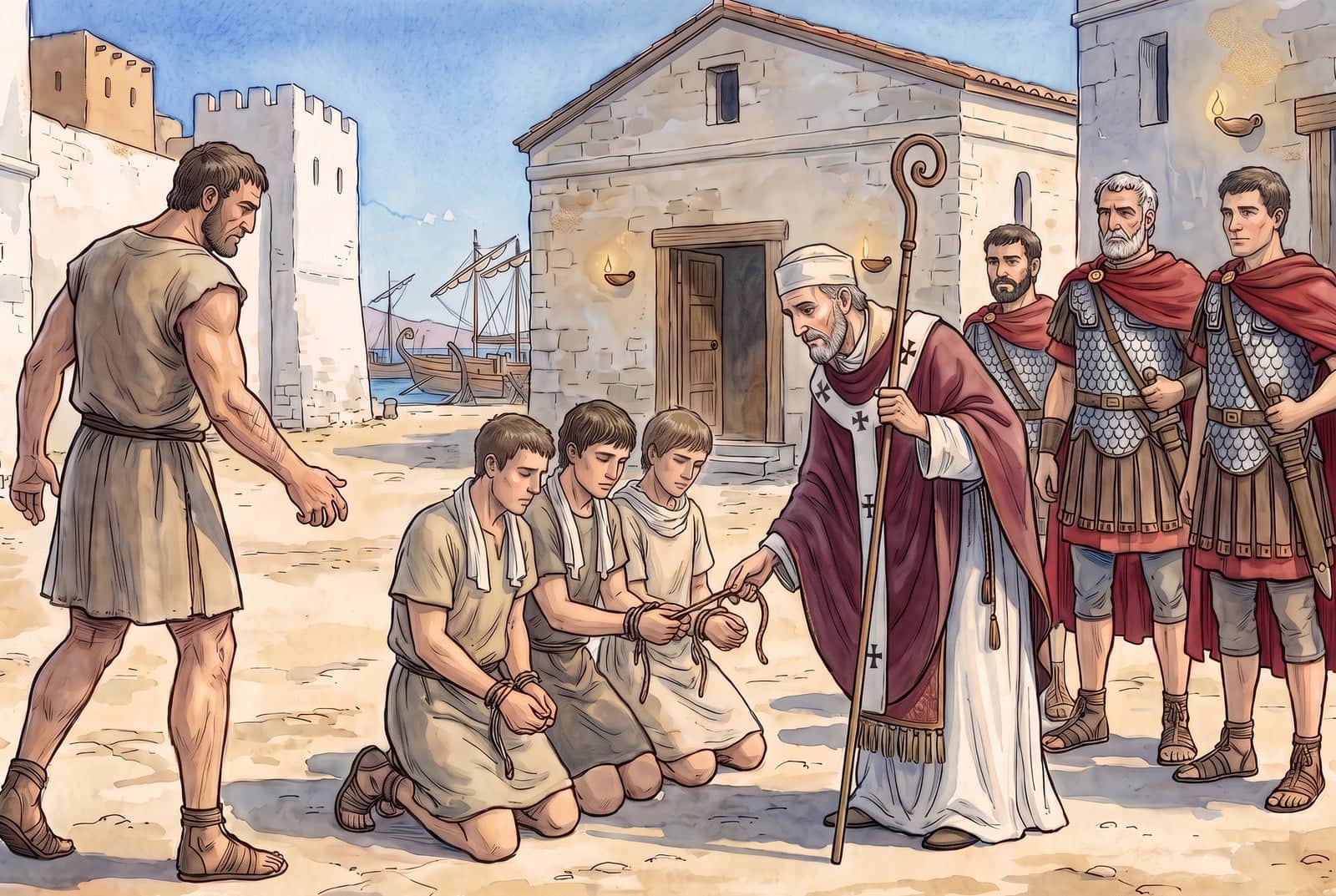
The consul rushed up to greet him with great courtesy. But the saint pushed him away.
“Enemy of God, betrayer of the law,” he said, “how dare you look us in the face with such a terrible crime on your conscience?”
Nicholas went on rebuking him sharply until the generals pleaded for the man. Then, seeing that the consul was truly sorry, he agreed to forgive him.
The three generals then received the saint’s blessing and went on their way. They put down the rebels without shedding a drop of blood and returned to the emperor, who gave them a splendid welcome.
But some of the courtiers grew jealous of the favor the three generals enjoyed and bribed the imperial prefect. Paid by the courtiers, the prefect went to the emperor and accused the three generals of treason. Wild with anger, the emperor had them thrown into prison and ordered them to be killed that night without a trial.
Their jailer told them what was in store for them, and the three generals tore their cloaks and wept bitterly. Then one of them, Nepotian, remembered how Nicholas had once saved three innocent men from death before their very eyes, and he urged his companions to call on him for help.
And indeed, when they prayed to him, Saint Nicholas appeared that night to Emperor Constantine.
“Why have you arrested these generals and sentenced them to death when they are innocent?” he said. “Get up quickly and have them set free at once! If you don’t, I will pray to God to stir up a war against you, in which you will fall, and your body will be thrown to the wild beasts!”
“Who are you,” the emperor asked, “to come into my palace at night and speak to me like this?”
“I am Nicholas, bishop of the city of Myra.”
The saint appeared in the same way to the prefect and terrified him.
“Fool, why did you agree to the death of three innocent men?” he said. “Go quickly and get them released! If you don’t, your body will be eaten by worms and your house will be destroyed at once.”
“Who are you,” the prefect asked, “to threaten me like this?”
“I am Nicholas, bishop of the city of Myra,” he said.
When they woke up, the emperor and the prefect told each other their dreams, and they quickly sent for the three prisoners.
“Are you sorcerers,” the emperor asked them, “who send us visions like these to deceive us?”
They answered that they were not sorcerers and that they were innocent of the crime they had been charged with.
“Do you know a man called Nicholas?” the emperor asked them.
When they heard that name, they raised their hands to heaven and prayed to God to save them from their danger for the sake of Saint Nicholas. The emperor heard from them all about the saint’s life and his miracles.
“Go and thank God,” he told them, “who has saved you because this Nicholas prayed for you! But tell him what I have done, and take him gifts from me. And ask him not to threaten me anymore, but to pray to God for me and for my empire!”
A few days later, the generals came to Nicholas. They threw themselves down before him, calling him the true servant of God, and told him everything that had happened. Nicholas raised his hands to heaven and praised God, and he taught them carefully in the faith before he sent the three of them home.
When the Lord wished to call Saint Nicholas to himself, Nicholas asked him to send his angels. When he saw the angels coming, he bowed his head and recited the psalm that begins, “In you, Lord, I have put my trust.” Then he gave up his soul to the sound of music from heaven. This happened in the year of our Lord 343.
He was buried in a marble tomb, and a spring of oil began to flow from his head and a spring of water from his feet. To this day a holy oil flows from his body, and it brings health to many who are sick.
Once the oil stopped flowing. That happened when Nicholas’s successor, a very good man, was driven out of his see by jealous enemies. But as soon as the bishop was restored to his place, the oil began to flow again.
Long afterward, the Turks destroyed the city of Myra. Forty-seven soldiers from the city of Bari were passing that way, and four monks opened Saint Nicholas’s tomb for them. The soldiers took his bones, which lay bathed in oil, and carried them away to Bari, in the year of our Lord 1087.
Retold by Talerie from La Légende dorée (opens in a new window) Public domain Copy this text, adapt it, use it however you like. A link back to Talerie is appreciated but never required. CC0 1.0 (opens in a new window)